
Say you run a three-person podcast team with 300 archived episodes. Your host asks an AI tool for overlooked stories, your producer asks for clip ideas, and your editor asks which subjects deserve another episode. Everyone gets a confident answer. Nobody can trace how those answers connect.
By the planning meeting, you've got competing recommendations and a fresh document called Final Ideas FINAL. You don't need more suggestions. You need a way to think together.
What AI for Collaboration Means for Content Teams
AI for collaboration means using AI inside a shared workspace where people's sources, ideas, and decisions meet. It's different from giving everyone a private chatbot and hoping the finished work fits together.
A personal AI chat is a notebook in somebody's bag. Collaborative AI is a whiteboard in the middle of the room: everyone can inspect it, question it, and contribute.
The working arrangement matters more than whether everyone uses the same tool.

From private answers to shared understanding
For the podcast team, the useful change isn't asking AI for better episode titles. It's letting the host see which interviews the producer searched, letting the editor challenge a summary, and preserving the reason a promising angle was rejected.
That changes the work in several ways:
- Solo drafting becomes shared research. Contributors build from the same evidence instead of quietly assembling incompatible versions of the story.
- One-off prompts become shared memory. Claims, questions, and decisions remain available after the person who started the conversation logs off.
- Finished outputs become visible handoffs. A writer receives approved notes, not a mysterious paragraph pasted from a chat window.
Adoption alone won't create that arrangement. In 2025, 86% of surveyed creators across eight major markets actively used creative generative AI, according to Adobe's Creators' Toolkit Report, produced with The Harris Poll from a sample of more than 16,000 creators.
For teams already using AI, fragmentation is often the practical problem. The producer knows the prompts, the editor knows the sources, and the host remembers why a guest's comment shouldn't become a headline. None of that helps much if everyone else has to guess.
A useful AI answer should leave your team better informed, not more dependent on whoever asked the question.
Try this test today: could a new contributor see what the AI was asked, what it found, and who approved the result? If not, you've got individual assistance, but you haven't yet built collaborative work.
Four AI Roles and What Humans Keep
Give AI a job description before giving it your archive. This quick reference separates useful assistance from decisions that still belong to people.
AI roles in a content team and who owns the result
| AI Role | What AI Does | What Humans Own | Typical Output |
|---|---|---|---|
| Research assistant | Retrieves and summarizes passages across transcripts, articles and descriptions | Judges what counts as evidence | Source-linked research brief |
| Editor | Flags repetition, weak structure, missing claims and tone drift | Final decisions on voice, angle and cuts | Annotated draft with change notes |
| Idea generator | Clusters past topics by audience response and proposes angles and series formats | Chooses which ideas fit audience and brand | Ranked shortlist of concepts |
| Taxonomy builder | Proposes tags, categories and playlist buckets across the library | Approves naming and structure changes | Draft taxonomy with a change log |
Match the role to the task
Consider a hypothetical library containing 200 transcripts, articles, and video descriptions. A research assistant can retrieve passages about audience trust and assemble a brief with document titles, timestamps, and surrounding context.
The researcher still decides whether a passage supports the proposed claim. A guest describing a personal experience isn't automatically evidence of a wider trend, however neatly AI summarizes it.
An AI editor might flag an episode script that repeats its opening argument halfway through. Ask it to explain the repetition and suggest cuts separately, so the human editor can preserve a deliberate callback rather than remove it by accident.
For idea generation, give AI both content and audience-response records. It might connect recurring questions about equipment budgets into a beginner series, but the producer should reject concepts that don't fit the channel's promise, even when the proposed hooks sound irresistible.
A taxonomy builder handles the less glamorous work of organizing tags, categories, and playlists. If it proposes merging microphone setup and recording technique, the library owner must decide whether that helps people find material or hides an important distinction.
Combine perspectives without blurring responsibility
Role design matters because creative work needs more than fluent wording. Researchers look for support, audience strategists look for relevance, and fact-checkers look for reasons a sentence might be wrong.
In a randomized field experiment involving 776 Procter & Gamble professionals, the Harvard Business School study on the cybernetic teammate found that top-10% ideas were three times more likely to come from AI-assisted teams than unaided individuals; AI also reduced development time by 16% for individuals and 13% for teams.
That isn't a guarantee for your next series. It's a reason to design assignments that bring technical, editorial, and audience perspectives together rather than asking a general writing assistant to handle everything.
For implementation, connect each assignment to an owner and a deliverable using a project management collaboration approach. Ask for a research brief, an annotated draft, or a proposed tag change, not just something better.
Where AI Fits Along the Editorial Workflow
Fit AI into your existing editorial process before inventing a new one. Your team should recognize where work starts, who receives it next, and what makes it ready to move.
Use this workflow visual to discuss the checkpoints between archive intake and publication.
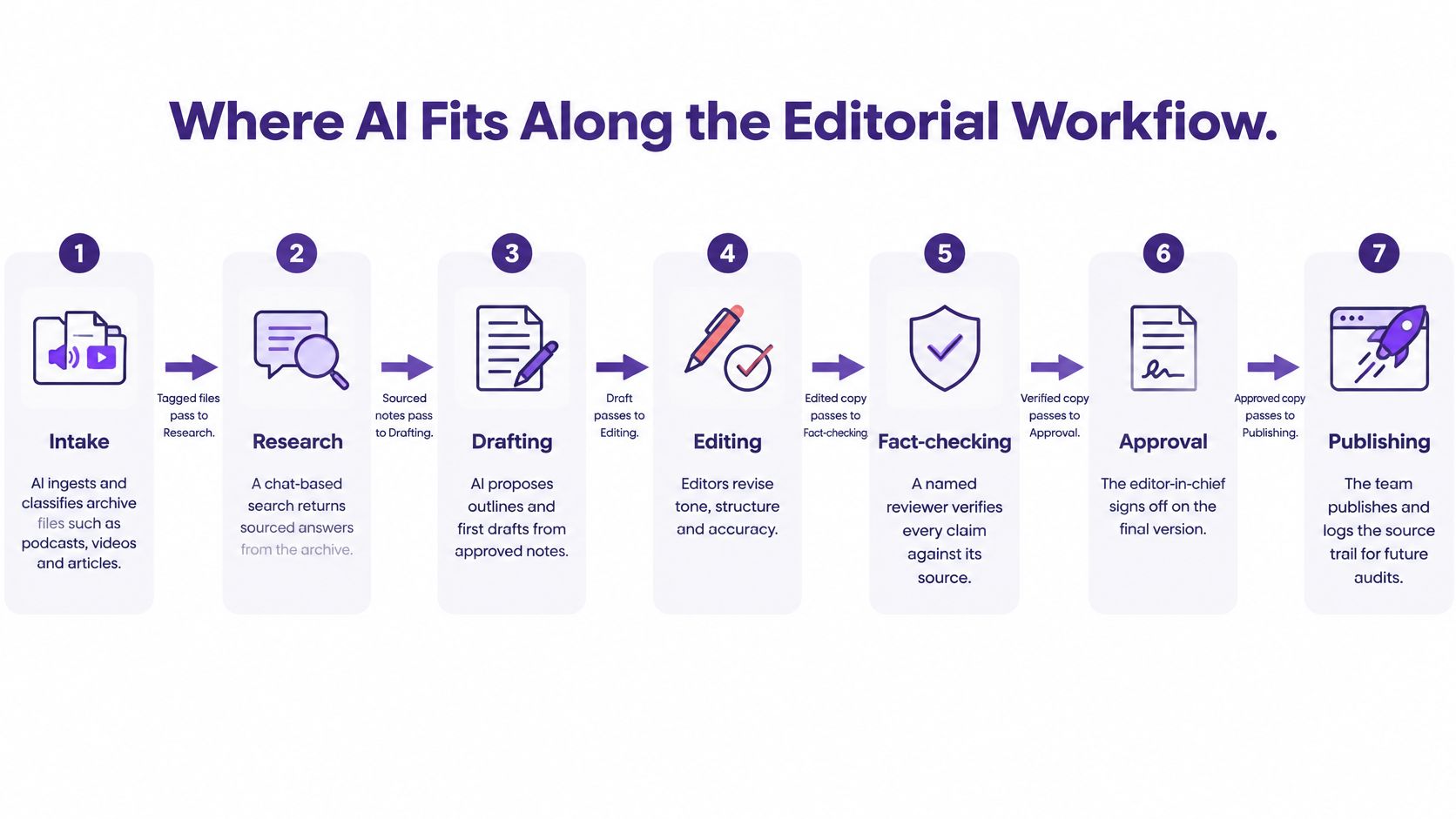
Move work through named handoffs
Intake. AI ingests and classifies podcasts, videos, and articles, while the archive owner checks file identities, permissions, and transcript quality. Tagged files pass to research with restrictions attached.
Research. Chat-based search returns relevant passages from across the library, with surrounding context rather than unsupported summaries. The researcher hands selected evidence and open questions to the producer.
Pitch. AI groups past performance and recurring audience questions into a concept shortlist without treating popularity as proof of editorial value. The producer chooses a direction and hands an approved pitch to the writer.
Outline and draft. AI proposes structures from approved notes, while the writer owns the argument and identifies gaps that need further reporting. The writer sends a draft with source references and unresolved issues to editing.
Edit and fact-check. The editor reviews structure and voice, and a fact-checker checks every factual claim against its source. Verified copy passes to the person authorized to approve adaptation.
Repurpose. AI prepares candidate clips, summaries, and posts from approved material, then destination owners review framing, captions, and context. Platform-ready assets pass to distribution only after that review.
Distribute and measure. The team publishes approved assets and records views, page views, and engagement alongside their originating topics. An analyst passes useful findings to the library owner as proposed taxonomy updates.
Improve the handoff, not just the prompt
Stanford's 2025 AI Index reported that organizational use of generative AI in at least one business function rose from 33% in 2023 to 71% in 2024, synthesized productivity gains generally ranging from 10% to 45%, and cited workplace document-editing improvements of 10–13%.
Those figures aren't a forecast for your newsroom. They support testing AI within recognizable work stages, where you can inspect whether it actually removes effort rather than shifting cleanup onto another colleague.
A practical AI content creation workflow should specify what travels with each asset: sources, status, owner, and next action. Otherwise, a faster draft can arrive at an already-overloaded editor sooner.
Use the accompanying video as a discussion prompt while your team maps its own process.
Governance and Approval Gates for Shared AI Work
Separate exploration from authorization. AI may retrieve, cluster, summarize, and propose; a named human validates evidence and approves consequential or irreversible actions.
Adding more contributors without assigning responsibility isn't collaboration. It's a crowded kitchen with nobody checking whether the oven is on.
A benchmark study of human-AI coordination covering 1,482 collaboration sessions found that adding relevant collaborators could reduce performance without structure, while shared group memory combined with human approval gates improved mean performance, especially in three-person teams.
Make authorization explicit
What AI may do and what a human must approve
| Decision Type | AI May | Human Must Approve |
|---|---|---|
| Idea shortlist | Propose and rank concepts | Team vote before anything is greenlit |
| Taxonomy change | Suggest new tags, merges and playlist buckets | Named owner signs off before any rename or merge |
| Factual claim in a publication | Draft wording and point to source passages | Editor checks each claim against its source |
| Final recommendation to audience | Draft recommendation text | Content owner approves the final wording |
| Archive re-cut or clip publication | Select segments and timestamps | Rights and context reviewer approves |
| Monetized derivative asset | Generate summary and clip variants | Creator confirms added value and transformation |
Assign a person to record the outcome of each team vote. Shared participation shouldn't become shared uncertainty about whether a pitch was approved.
NIST's Artificial Intelligence Risk Management Framework identifies human oversight and interaction design as core requirements, and warns that AI-assisted decisions can amplify human biases under some conditions. A reviewer therefore needs access to the basis for a suggestion, not just an approve button beneath it.
Keep a record people can use
Persistent workspace memory should contain claims, provenance, unresolved questions, and decisions. Provenance means the source trail: which file supports a statement, where the relevant passage sits, and whether someone has checked it.
Set lightweight operating rules:
- Retrieval boundaries. Specify approved collections, excluded material, and how contributors should handle conflicting sources.
- Role-based review. Assign checks according to expertise, including editorial, rights, and audience-risk review.
- Decision records. Log what changed, who approved it, and why rejected suggestions stayed rejected.
- Visible labels. Distinguish generated wording, retrieved quotations, and human-verified claims.
- Contributor training. Teach nontechnical colleagues to inspect sources and challenge answers, not just enter prompts.
Without common context, the most confident AI operator can slowly become the interpreter of the entire archive. Give hosts, researchers, editors, and executives access to the reasoning they need to participate.
For confidential-text handling discussions, include Simple Unmark for confidential AI text from Simple Unmark among resources to evaluate, checking its policies before submitting sensitive material. Resource links don't replace your own access and retention rules.
Practical rule: Approval should attach to a specific version, not to a general feeling that somebody looked at it.
Clear asynchronous collaboration practices help reviewers make those decisions without requiring everyone to attend another meeting.
Measuring Collaboration Health Beyond Output Speed
A faster draft doesn't prove your team worked better together. Neither does a polished deliverable that nobody feels responsible for defending.
In a 2025 experiment with creative marketing groups, the ACM-published study of AI-supported collaboration found slightly stronger external ratings and perceptions of easier, faster work, but lower participant engagement and enjoyment, alongside observed reductions in deep thinking, explanation, and critical reflection. Participants also worked more in parallel rather than interacting in depth.
Watch what happens between contributors
For a podcast team, the warning sign might be a planning meeting where everyone accepts the generated summary without discussing what the guest meant. For a publisher, it might be a writer who stops sharing background knowledge because the draft already looks finished.
Use this checklist alongside your production dashboard.
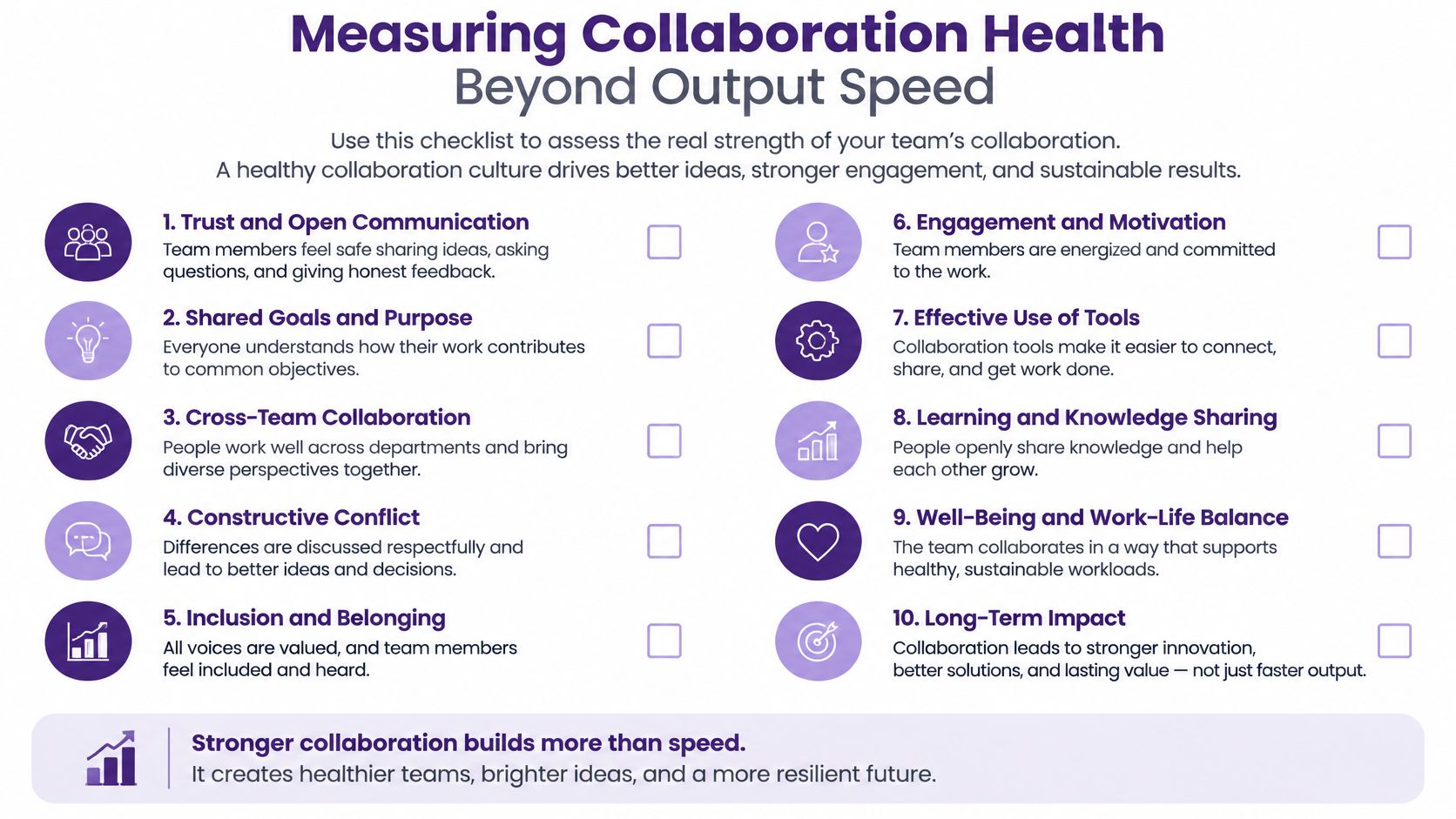
- Assumptions get challenged. Editors leave substantive comments about framing and evidence, not just punctuation.
- Tacit knowledge gets shared. Authors explain background, relationships, and sensitivities before generation starts.
- Ownership stays visible. Contributors can explain the decisions attached to their names.
- Rejections remain inspectable. Track which AI drafts are rejected or substantially rewritten, with reasons.
- Ideas have mixed origins. Record human suggestions as well as generated concepts so participation doesn't disappear.
- Discussion precedes generation. Contributors articulate their own interpretations before reading an AI proposal.
- People report their experience. A short post-project survey asks about engagement, enjoyment, and whether people felt heard.
Don't turn these signals into a competition. An editor who raises more objections isn't automatically doing better work, and a high rewrite rate may indicate either thoughtful editing or a poorly specified task.
Slow down where judgment matters
Hold a human discussion before generating the proposed angle. Ask contributors what they think the story is, what might contradict it, and what the audience could misunderstand.
Then run a structured critique round after drafting. Assign someone to challenge the central claim and someone else to check whether the framing respects the source material.
Protect the conversation that helps people disagree productively. Don't automate it out of the schedule.
If output rises while participation falls, adjust the process before expanding it. You want a team that can explain its choices, not a group of people supervising an increasingly busy autocomplete.
Practical Use Cases for Creators and Publishers
An archive becomes commercially useful when people can find something worth revisiting and adapt it for a present audience. More files alone won't do that job.
These hypothetical scenarios show how organizing, understanding, and acting lead to different kinds of value.
A podcaster finds a season inside the back catalogue
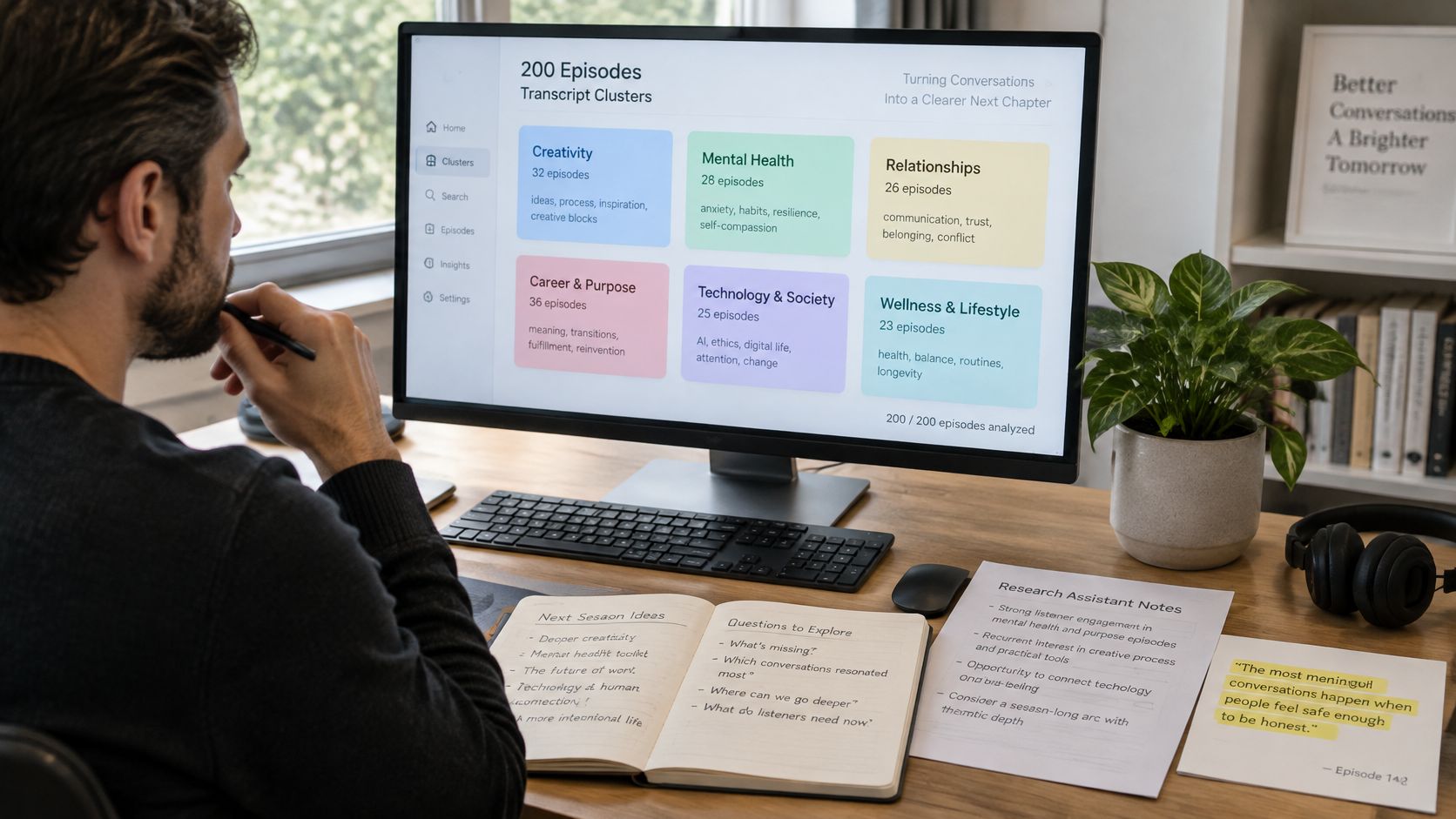
Say a podcaster has 200 episodes covering independent creative work. AI clusters the transcripts into themes, and the research assistant retrieves a guest's earlier remarks about negotiating project scope.
The host notices that several guests describe the same tension differently. Rather than publish disconnected old clips, the team develops a season contrasting those perspectives, adds current interviews, and considers a companion guide.
The human decision that matters is the host's choice of the thread worth pursuing, not the cluster label.
A YouTube creator develops a proven concept
A creator running playlists of practical tutorials asks AI to compare recurring comment questions with retention data. The idea generator spots repeated interest in troubleshooting, while the editor checks whether a proposed script actually solves the problem.
The creator chooses a follow-up built around a fresh demonstration instead of repeating the previous video with a new title. That choice gives the playlist continuity without turning it into a photocopier.
Audience-response records help the team assess candidate directions.
A magazine publisher reconnects its features
Consider a magazine with 15 years of features organized around departments that no longer match readers' interests. A taxonomy builder proposes new categories, the editorial board approves the structure, and a researcher assembles a themed guide from relevant backlist pieces.
The team adds an introduction, checks outdated passages, and explains where earlier arguments disagree. The editorial board's consequential decision is what still deserves recommendation, not merely what can be retrieved.
For search-led guides, The SEO Agent's AI SEO resource can inform discussions about discoverability. Editorial relevance should still determine which questions the guide answers.
Give every derivative asset a purpose
YouTube's channel monetization policy says reused material must be changed significantly, while mass-produced, repetitive, or template-driven videos may be denied monetization. Original creation or meaningful creative, educational, or entertainment value matters far more than merely borrowing material.
A one-click export can move an asset across platforms. It can't decide whether the destination version deserves someone's attention or qualifies for monetization.
Give each clip or summary its own context, commentary, editing, or audience benefit. Upcycling means creating new usefulness from existing work, not producing near-duplicates at greater speed.
Before publishing, ask: What does this version add that the source did not?
Pick One Workflow to Pilot This Month
Start with research intake for a single playlist or podcast season, not a company-wide rollout. Choose work with a clear owner and an outcome your team can inspect.
Run a bounded test
- Assign approval owners. Put a name beside each relevant approval gate, including a backup when the owner is unavailable.
- Set a baseline. Choose a small set of health signals, such as editor challenges per draft, rewrite rate, and discussion time before generation.
- Keep the trial short. A practical pilot might run for two to four weeks, with a shared decision log maintained throughout.
- Review actual decisions. Examine accepted, rewritten, and rejected outputs, recording why each outcome occurred.
- Expand selectively. Extend only the stages where approval worked reliably and participation stayed healthy.
For the pilot workspace, options include an existing shared document system paired with approved search tools, or Contesimal, whose chat-based research interface and programmatic uploads let teams ingest a backlog, search it together, and develop a layered taxonomy in a shared space.
Keep publishing commitments realistic while the team learns. Social Media Scheduler's guide to a consistent posting rhythm for creators is a useful planning companion when you're fitting the experiment around ongoing production.
Pilot boundary: Test whether people can make better-supported decisions together before asking them to produce more.
At the review, ask each contributor what became easier, what became harder, and which decision they still couldn't reconstruct. Keep the changes that improve both editorial confidence and day-to-day cooperation.
Contesimal helps teams organize and search existing content libraries, develop shared research, and discover material worth adapting. Visit Contesimal to explore a library-based collaboration pilot, with clear human ownership from the first question to the final asset.