
You're scrolling through episode folders, opening transcripts, and trying to remember where a guest explained carbon pricing so clearly. You know you recorded it. But the filename says “final revised,” the notes live somewhere else, and re-recording starts to feel easier than searching.
That's not a memory problem. It's an organization problem. A content management taxonomy gives you and your collaborators a shared way to describe what you already own, so your archive becomes a working library rather than a pile of files with excellent intentions.
What a Content Management Taxonomy Actually Does
A content management taxonomy is a controlled vocabulary and a map of relationships that your team uses to classify content. Articles, podcasts, videos, transcripts, and research notes can all follow the same descriptive rules, even when different people create them.
Think of folders inside folders as the starting analogy. A folder labeled “Business” contains “Marketing,” which contains “Content marketing.” That arrangement communicates a relationship, but it doesn't explain how to handle alternative names, overlapping subjects, or material that belongs in several places.
A taxonomy adds those explicit rules. Metadata describes an individual asset, while the taxonomy supplies the agreed terms and relationships used in its classification. Digital-asset-management research on taxonomy and metadata describes this distinction and explains how structured classification supports browsing and retrieval beyond keyword search alone.
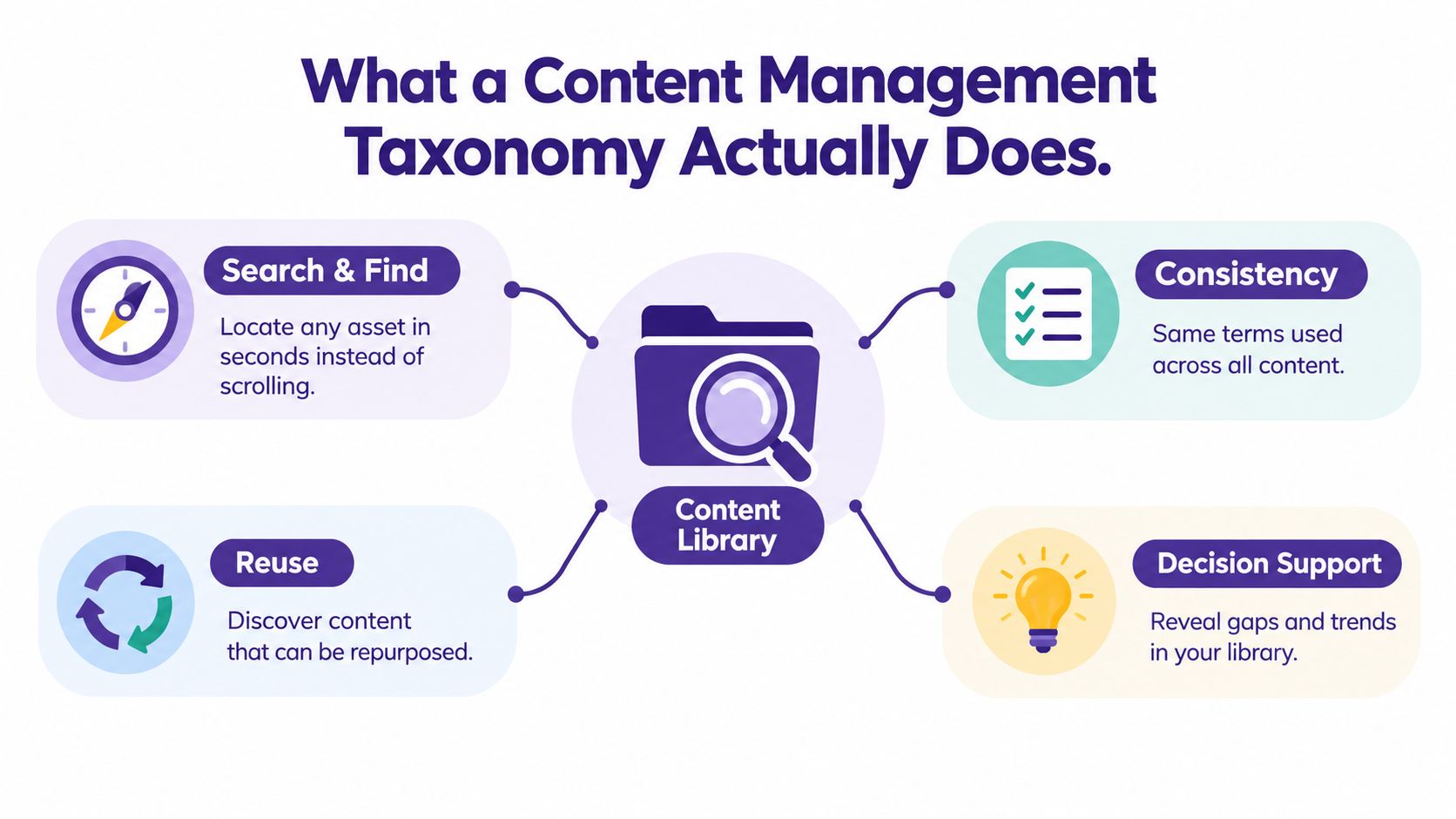
The practical benefits are connected, but each solves a different everyday frustration.
Shared language beats personal shorthand
Casual tagging lets contributors type whatever feels right. One editor chooses “creator economy,” another chooses “online creators,” and a producer uses “influencers.” Without agreed definitions, you can't tell whether they mean the same subject or different ones.
- Discovery: Consistent descriptions give searchers a dependable route to relevant material.
- Repurposing: Editors can identify related source assets instead of starting every assignment from scratch.
- Collaboration: New contributors don't need to learn the private filing habits of the founder.
- Analytics: Teams can compare content groups without first untangling incompatible labels.
Practical rule: A useful taxonomy explains what contributors should select, not merely what they're allowed to type.
You don't need a full-blown ontology to begin. An ontology can model richer entity types and formal relationships, such as a person working for an organization that sponsors a program. Your first taxonomy can stay focused on classification and retrieval.
Keep audience language nearby, too. SemDash content planning insights can serve as a companion resource when you're considering the language people use to seek content. Treat those phrases as candidates to evaluate, not instructions to turn every search query into a permanent category.
A Layered Example from a Real Content Library
Consider an illustrative asset you might find in a working podcast library: a 45-minute interview about carbon pricing. This isn't a reported customer case. It's a practical example of how to describe a recording so an editor can retrieve it for different purposes.
The producer saves the audio master. A writer prepares the transcript, and a video editor creates a short clip. If each file receives only the tag “climate,” the team still has to open everything to determine what it contains and whether it's usable.
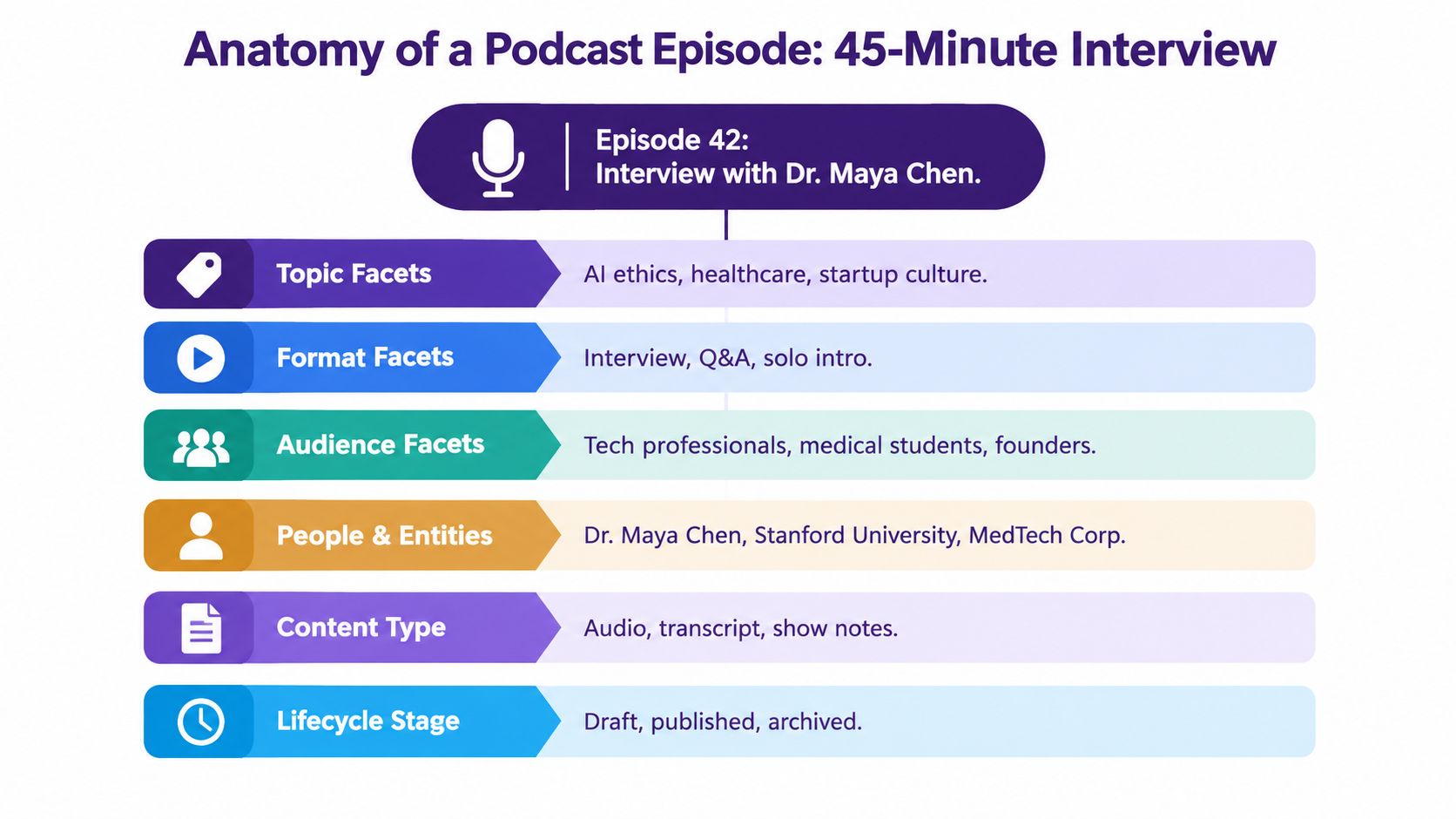
The diagram shows how a hypothetical interview can carry several independent descriptions.
Describe the asset from different directions
A facet answers a particular kind of question. Topic tells you what an asset discusses; format tells you what you can work with. Neither should have to sit inside the other.
| Metadata layer | Illustrative values | Retrieval question |
|---|---|---|
| Topic | Climate policy > carbon pricing | What subject does it cover? |
| Format and content type | Interview, audio episode, transcript, short clip | What kind of material do I need? |
| Audience | Policy beginners, business owners | Who could use this explanation? |
| People and entities | Guest, host, organization discussed | Who appears or is mentioned? |
| Lifecycle status | Draft, approved, published, archived | Where is it in production? |
| Rights | Permission documented, review required | What reuse has been authorized? |
These values come from different places. Topics belong in a controlled subject vocabulary, contributor names belong in an entity registry, and production states come from your workflow. Rights information must come from actual permission records, not an editor's guess.
Research on faceted browsing models explains how independent dimensions support exploratory filtering and how the underlying classification model affects interaction with results.
For a small library, I'd start with topic, format, and status, then add dimensions when a real retrieval task requires them. Keep necessary rights records from the outset, even if you haven't built a rights filter yet.
- Avoid duplication: Link the transcript and clip to their source episode rather than treating them as unrelated creations.
- Allow useful multiplicity: An interview can discuss several themes, while its current approval state should be unambiguous.
You're not building a museum catalog for its own sake. You're making the next editing assignment less dependent on someone remembering everything.
Design Principles That Make a Taxonomy Survive Contact With Reality
The first design decision is simple: give each concept a preferred label. If “Artificial intelligence” is your preferred term, “AI” should lead to that concept rather than become a competing category.
This principle has a long history. Work on the Library of Congress Subject Headings began in 1898, and its first edition appeared in parts between 1909 and 1914, according to this history of the Library of Congress controlled vocabulary. Its use of authorized terms and cross-references offers a useful model for bringing different descriptions together under consistent retrieval labels.
Give every relationship a purpose
Preferred labels shouldn't require contributors to search unnaturally. Add synonyms and aliases so familiar wording resolves to the intended concept, while classification remains consistent.
Not every connection is a synonym, though. Use relationships that explain how concepts differ:
- Broader than: Climate policy is broader than carbon pricing.
- Narrower than: Carbon pricing is narrower than climate policy.
- Related to: Carbon pricing relates to emissions reporting, but neither necessarily contains the other.
- Equivalent to: “AI” can be an alternate label for “Artificial intelligence” when your vocabulary defines them as the same concept.
A scope note draws boundaries where a label alone leaves room for interpretation. For example, define “Podcast series” as the continuing program, “Episode” as an individual installment, and “Clip” as an excerpt prepared as a separate asset. That prevents a producer from classifying every audio file as “podcast.”
Don't create a new term merely because someone used a new phrase. First decide whether the meaning is actually new.
Preserve identity when language changes
Give each concept a stable identifier separate from its display label. If editors rename a category, its assets should remain attached to the same underlying concept. Store a version history so collaborators can see what changed and why.
Deprecate instead of deleting. A retired term should point to its replacement where appropriate, and affected assets should remain traceable. Deletion without a migration plan can leave older content disconnected from current search filters.
For multilingual libraries, separate concept identity from language-specific labels. Translating a term, transliterating a name, and choosing a regional synonym are different editorial tasks. Have someone familiar with the relevant language review equivalence rather than assuming every local concept fits an English category.
The skeptical editor's test is useful: can you explain why a term exists, where its boundary lies, and what happens when it changes? If not, keep it provisional.
Governing AI-Generated Tags Before They Quietly Take Over
An AI-applied tag is a proposed decision, not a harmless decoration. When people use classifications to control discovery, recommendations, moderation, or reuse, an incorrect label can affect more than search convenience.
A 2025 review of AI-governance concerns identifies issues including bias, transparency, and economic influence. My operational conclusion is that creators should attach evidence and accountability to automated classification before depending on it commercially.
An AI-assisted tagging interface should make those controls visible alongside the suggested labels.

Match approval rules to consequences
Set a minimum confidence threshold for automatic application, but calibrate it against reviewed examples from your own library. A confidence score isn't proof of correctness, and a suitable threshold for broad subject tags may be unsuitable for sensitive classifications.
Use a decision table instead of an “accept everything” switch.
| Proposed classification | Suggested handling |
|---|---|
| General business topic | Permit automation after validation against reviewed examples |
| Sensitive topic or potentially stigmatizing label | Require human review |
| Usage rights or commercial permission | Require documentary evidence and authorized approval |
| Unrecognized term | Route to a vocabulary proposal queue |
Record provenance with each AI-applied tag: the tagging system and version, the source passage or timestamp, the taxonomy version, the confidence information available, and any reviewer action. Keep suggested labels distinguishable from approved labels.
For teams exploring the extraction stage, this guide to AI content analysis is a useful companion to designing the approval workflow. Extraction and authorization should remain separate activities.
This video offers an additional viewing resource alongside that workflow.
Audit disagreement and drift
Taxonomy drift occurs when classification practice gradually diverges from the vocabulary you approved. For example, a tagging system might begin assigning both “Founder stories” and “Startup journeys” without recognizing their overlap.
Review samples across formats, languages, and subject areas. Look for unsupported labels, inconsistent mappings, and recurring reviewer corrections. Give contributors a way to challenge a classification and retain the resolution in an audit log.
Reviewer responsibility should rise with the stakes. A label used to suggest a listening recommendation deserves scrutiny; the same label used to support a sponsorship pitch needs a clearly accountable approver.
Choosing the Right Structure for Your Library
A publisher organizing researched articles has a different navigation problem from a filmmaker managing scripts, footage, interviews, and promotional clips. Choose a structure around the questions people need to answer, not the appearance of an orderly category tree.
A flat taxonomy is a controlled list without parent-child levels. I'd use it where the subject range is modest and contributors can select relevant labels without needing a navigation path. Its simplicity is useful, but a growing list can become hard to scan.
Choosing a Taxonomy Structure
| Structure | Best For | Strength | Main Limit |
|---|---|---|---|
| Flat | Focused, single-format libraries | Straightforward selection and maintenance | Limited support for topical depth |
| Hierarchical | Libraries with recognizable subjects and subsubjects | Predictable browsing from broad to specific | Awkward handling of independent attributes |
| Faceted | Mixed-format libraries serving different retrieval needs | Combining filters across separate dimensions | Requires clear field definitions and validation |
A hierarchical taxonomy works well when readers naturally move from a broad subject to a narrower one. A magazine publisher might organize material under Science > Environment > Climate policy. The path communicates increasing specificity without mixing in production details.
A faceted taxonomy suits a request such as “published video interviews about climate policy for beginners.” The searcher is combining topic, format, status, and audience rather than following a single subject branch.
For additional structural examples, consult this overview of types of taxonomies.
Test the awkward retrieval request
The wrong instinct is to put every attribute into the tree. If you create Climate policy > Video > Published, where should the transcript go? If you begin with Video > Climate policy, how does an editor browse the subject across all formats?
Decision test: Choose the structure that answers your team's actual retrieval questions with the fewest unnatural choices.
You can also combine approaches. Keep a subject hierarchy inside the topic facet while using flat controlled lists for format and workflow state. That gives editors topical depth without forcing every asset property into a nested path.
Before committing, ask a writer, producer, and editor to locate material for a real assignment. Their hesitations will tell you more than a polished diagram.
Governance and Workflows That Keep the System Honest
An editor proposes “Creator burnout” after noticing that several interviews discuss exhaustion, publishing pressure, and audience expectations. The term sounds useful, but someone still needs to decide whether it represents a distinct subject, an alias, or a narrower concept.
That decision belongs in a visible workflow. Contributors propose terms; a named vocabulary owner approves their meaning; an operations owner manages implementation. In a small team, the same person may hold several roles, but the responsibilities should remain explicit.
Make proposals easy to evaluate
Ask the proposer for the candidate label, its definition, an example asset, and the retrieval problem it would solve. The approver should compare it with existing concepts before adding another category.
- Promote a draft term: Approve its scope, relationships, and preferred label before making it selectable.
- Merge overlapping concepts: Choose the surviving identifier, migrate affected classifications, and preserve the retired label as an alias where appropriate.
- Retire an unused term: Record the reason and decide what should happen to existing assignments.
The historical scale makes maintenance tangible: the 2012 edition of LCSH contained approximately 329,000 headings and references, including about 8,000 new headings, according to the Library of Congress introduction to LCSH. A creator library needs far less ceremony, but it still needs someone responsible for vocabulary changes.
Keep maintenance close to daily work
Reserve a short weekly or biweekly review for pending proposals, difficult classifications, and planned retirements. Treat this as a suggested operating habit, not a requirement to create another committee.
Maintain a change log, retirement list, and synonym map. For a companion resource when documenting approvals and implementation steps, consider best practices from TheContentMap.
Expose those outputs where contributors search and tag content. A retired label should display its replacement; a newly approved category should include its scope note. Don't expect busy editors to check a separate document before every upload.
Apply the same visibility to required fields, missing values, and ownership. This guide to metadata management best practices can support the wider maintenance process. When the rules appear at the point of work, contributors have a better chance of applying them consistently.
Putting It Into Practice and Measuring What Improves
Start with a bounded pilot rather than your entire archive. As a practical exercise, define topic, format, and status, then apply them to your last 30 assets. That's a suggested working sample, not a research-backed minimum.
Choose material that includes different formats and a few difficult cases. Have collaborators retrieve source material for an actual assignment, then note where they hesitate, disagree, or abandon a search.
Measure usefulness rather than tag volume
Faceted-classification research and evaluation guidance supports examining retrieval quality and classification consistency. A small team can keep a spreadsheet of test queries, expected assets, retrieved results, and tagging disagreements.
- Precision: Of the results returned for a representative query, how many are relevant? Review the results together rather than assuming a populated page means success.
- Zero-result rate: Which searches return nothing? Separate genuine content gaps from missing synonyms or incomplete metadata.
- Facet-selection frequency: Which filters do people use? Investigate neglected facets before deleting them, since poor placement or confusing wording may be the problem.
- Inter-annotator agreement: Do collaborators classify the same assets consistently? Discuss disagreements and revise ambiguous definitions.
Keep a baseline before making changes, then repeat the same tasks afterward. Don't claim improvement because the library contains more tags.
Turn retrieval into a production decision
The commercial opportunity comes after you find usable source material. In Adobe Express's 2024 survey of 517 small-business owners, 70% had repurposed content, and 54% identified time savings as a benefit. Those self-reported findings aren't a revenue guarantee, but they provide context for treating reuse as a deliberate workflow.
When you next search for the carbon-pricing interview, the useful outcome is finding the episode together with its transcript, related clip, and supporting notes. You can then choose what deserves an update, what suits another audience, and what requires permission before reuse.
Organize. Understand. Take action. A library earns its keep when people use historical material to make something relevant again, not when they admire its tidy categories.
Contesimal offers AI-assisted classification, searchable content libraries, and a shared space for humans and AI to research existing assets. Visit Contesimal to explore how you can organize your archive, investigate reusable material, and turn it into your next content project.