
Data ingestion is the process of collecting data from source systems and moving it into a destination where it can be stored, processed, searched, or analyzed.
But if a transcript arrives successfully, can your team prove which recording it came from and whether anyone revised it? That's the gap between moving files and building a trustworthy content library.
Data Ingestion Explained Through a Loading Dock
A loading dock receives deliveries from different suppliers. Workers check the manifest, unpack the goods, send them to the right aisles, and record what arrived.
Data ingestion does a similar job for information. Your suppliers might be applications, databases, websites, sensors, podcast hosts, or video repositories. Instead of crates, you receive audio, text, images, metadata, and activity records.
The conveyor-belt analogy makes the movement easy to see.

An upload isn't the whole job
Say a creator has 500 episodes, with transcripts, clips, and thumbnails scattered across five different places. An editor looking for a guest's earlier comments has to search folders, hosting accounts, and old project files separately.
An ingestion pipeline, meaning a connected sequence of automated tasks, brings those assets into a searchable home. It should also preserve their relationships, so a promising quotation leads back to the correct episode rather than an orphaned text file.
Most readers first encounter these inputs:
- Exported files: Documents, media files, spreadsheets, or metadata downloaded from another tool.
- Application events: Notices that something happened, such as an episode being published or a record being updated.
What successful ingestion delivers
The practical answer to “What is data ingestion process?” goes beyond uploading. A useful process delivers complete capture, usable output, and an inspectable record of what happened to each item.
That foundation matters when you upcycle older content. Editors can find material for a new article, producers can assemble related clips, and researchers can verify the original context before anyone publishes.
The Five Stages of the Ingestion Lifecycle
Follow a podcast episode from its hosting platform into a research library. The stages below describe its operational journey, although real systems often run checks throughout rather than waiting until the end.
Follow an episode through the pipeline
Collection
The hosting platform hands over the audio file, show notes, and speaker names. Capture its source ID immediately, along with the original timestamp, so later tasks don't have to guess where it came from.Transport
The episode travels through a secure file transfer, an API pull, or a message queue. An API lets software request information from another system; a queue holds work until a receiving program can handle it. Log transfer start and end times, and confirm receipt before treating the delivery as successful.Transformation
A processing service makes a standardized audio derivative, generates a transcript, detects language, and puts dates into a consistent format. Keep the transformation rules identifiable. Otherwise, an editor won't know why a regenerated transcript differs from an earlier copy.Storage
The original recording lands in raw storage, while the transcript and descriptive fields go into a searchable index. An index is an organized representation designed for retrieval. Don't confuse having the audio in storage with having its spoken content available in search.Validation
The system checks file integrity, confirms required fields, and marks the episode complete or sends it for review. A checksum, a value calculated from file contents, helps establish whether the transferred file matches the source.
Ingestion lifecycle stages with a podcast example
| Stage | What Happens | Podcast Episode Example | Checkpoint |
|---|---|---|---|
| Collection | Source data is identified and pulled or received | Audio file, show notes, and speaker names from the hosting platform | Source ID and original timestamp recorded |
| Transport | Data moves to the destination | Files sent by SFTP or API, or events placed on a queue | Transfer start and end times logged |
| Transformation | Data is converted into usable forms | Audio normalized, transcript generated, dates standardized | Schema version and processing status stored |
| Storage | Raw and derived copies are kept | Original file in raw storage, transcript in a search index | Immutable raw copy retained |
| Validation | Integrity and completeness are checked | Checksum matched, required fields present | Record marked complete or sent to review |
Plan validation first, even though final acceptance appears last. Define what complete means before building the transfer, then reject unreadable files early and verify the final output before publishing it to search.
The diagram groups the same responsibilities around validation, loading, and ongoing monitoring.

Keep the clocks separate
The Apache Kafka Streams documentation distinguishes event time, ingestion time, and processing time. For your episode, those mean when it was recorded or published, when the pipeline accepted it, and when processing occurred.
Record publication and recording times separately when both matter. Also retain upload time and processing start and completion times, so an older recording uploaded today doesn't masquerade as newly created material.
For documents that need text recognition or field extraction, intelligent document processing adds another transformation layer. Every stage should leave a trace your team can inspect.
Batch, Streaming and Hybrid Ingestion Patterns
Batch ingestion transfers accumulated data on a schedule. Streaming ingestion transfers events continuously or with very low delay.
LinkedIn developed Apache Kafka internally in 2010 because point-to-point integrations couldn't reliably move its growing event data, according to LinkedIn Engineering. By July 2011, its production system processed approximately 1 billion messages per day; by September 2015, LinkedIn reported more than 1 trillion published messages per day.
At that scale, teams need durable queues that retain pending records, partitions that divide work, and replay that lets them process retained records again. Your archive probably doesn't need LinkedIn's infrastructure, but it does need a sensible arrival pattern.
Ingestion patterns compared
| Pattern | Latency | Typical Trigger | Best Fit |
|---|---|---|---|
| Batch | Hours to daily | Fixed schedule such as nightly | Migrating and backfilling a full archive |
| Micro-batch | Seconds to minutes | Frequent small loads | Keeping a search index close to current |
| Streaming | Milliseconds to seconds | Each event as it occurs | Alerts on new uploads and live engagement signals |
| Hybrid | Backfill in batch, live feed in streaming | Both schedule and events | Historical libraries that keep receiving new output |
These latency descriptions are planning categories, not performance promises. Transcription or indexing can still delay when content becomes searchable.
Choose freshness, not fashion
Say you load an eight-year archive over a weekend, then accept new episode notices as they publish. That's a hybrid approach: historical backfill plus an ongoing feed.
A library that publishes once a week and supports next-day research may gain nothing from second-level arrival. A nightly batch can be enough.
For implementation trade-offs, Scrappey's guide helps readers compare streaming pipelines with batch processing.
Match latency to the question users actually ask: must a new episode appear in search within minutes, or is the next morning acceptable?
Ingestion Compared With ETL and ELT
Ingestion describes getting data into a destination. ETL and ELT describe where transformation happens relative to loading, although teams often use ingestion as an umbrella term for the surrounding workflow.
ETL means extract, transform, load. ELT means extract, load, transform.
Where the work happens
| Approach | Order of operations | Content-library example |
|---|---|---|
| ETL | Prepare the data before loading the intended destination | Standardize video exports before sending their derived content to an index |
| ELT | Land raw data, then transform it using destination-side processing | Pull a podcast feed nightly, retain the files, then derive clean titles and dates |
| Streaming with transformation | Clean incoming events while they travel | Normalize live engagement events before they reach a dashboard |
ETL suits destinations that require a fixed schema, meaning an agreed structure of fields and types. For example, a transcript index may require consistent language codes and publication dates before accepting records.
ELT makes sense when your storage and processing environment can retain source material and generate different representations later. It's especially helpful when editors change classification rules or researchers need a different extraction method.
Protect the source from changing rules
Keep the original episode file and any supplied transcript untouched, then derive normalized fields separately. A schema change shouldn't force contributors to upload the archive again.
Before choosing an approach, ask:
- Raw-copy location: Where will the source material live, and who controls access?
- Output consumer: Does an editor, search index, warehouse, or dashboard need the transformed version?
- Expected change: How often will field definitions, classification rules, or processing methods change?
The practical choice isn't a contest between acronyms. It's a decision about where your team can safely perform and repeat the work.
Tools and Protocols That Move Data In
Choose tools by responsibility, not by how often their names appear in architecture diagrams. A scheduler, a transfer protocol, and a streaming platform solve different problems.
Match the tool to its job
Apache Kafka and Amazon Kinesis suit high-volume event feeds that need retained records and replay. They're usually unnecessary when contributors deliver occasional folders.
Apache NiFi helps teams visually route files, apply conditions, and manage retries. Apache Airflow coordinates scheduled jobs and dependencies, such as waiting for a transfer to finish before starting transcription. Airflow isn't a substitute for an event transport system, and either tool can be excessive for a single uncomplicated task.
Managed connectors such as Airbyte and Fivetran reduce custom work when pulling supported software-service or database sources into a warehouse. Check connector coverage carefully: syncing episode metadata doesn't necessarily mean transferring the media itself.
AWS Glue and Azure Data Factory support cloud-based batch integration and transformation. They fit stored-data workflows, but a small editorial team may not need that infrastructure just to receive audio files.
Ingestion tools and protocols by role
| Option | Examples | Best For |
|---|---|---|
| Streaming platforms | Apache Kafka, Amazon Kinesis | High-volume event feeds that need replay |
| Flow-based routing | Apache NiFi | Visual routing, retries, and file handling with little code |
| Orchestration | Apache Airflow | Scheduling and dependency control for batch jobs |
| Managed connectors (ELT) | Airbyte, Fivetran | Pulling SaaS and database sources into a warehouse |
| Cloud batch ETL | AWS Glue, Azure Data Factory | Serverless transforms on large stored files |
| HTTPS and REST APIs | Platform APIs, webhooks | Metadata, incremental pulls, and event notices |
| SFTP | Standard secure file transfer | Bulk file drops from contributors or agencies |
| Object storage API | Amazon S3, Cloudflare R2, MinIO | Large media uploads with multipart transfer |
| JDBC and ODBC | Database drivers | Reading structured tables from production databases |
Pick the right transfer method
HTTPS provides an encrypted connection; REST APIs commonly expose metadata and let your pipeline request changes since its previous run. Webhooks send event notices, but your receiving system still needs to acknowledge, retain, and process them reliably.
SFTP is useful for contributors or agencies delivering bulk files. Object storage APIs suit large media because multipart uploads divide a transfer into pieces that can be retried independently. JDBC and ODBC are database interfaces for reading structured tables, not general-purpose media-transfer tools.
Use these questions to narrow the choice:
- Volume: How much data arrives, including the largest media files?
- Freshness: How soon must users be able to find it?
- Source: Are you receiving files, database rows, or events?
- Preparation: Do you need simple field cleanup or substantial media processing?
- Ownership: Who will maintain credentials, failures, upgrades, and alerts?
Overbuild warning: For a hypothetical library of 2,000 files that changes weekly, a folder watcher with a checksum script may be easier to operate than a streaming platform.
Test the smallest workable setup first. Add infrastructure when a measured bottleneck or recovery requirement justifies it.
Failure, Duplicates and Timing Challenges
Duplicates can cause more silent damage than an obvious failed upload. An editor may mistake repeated quotations for independent evidence, while a search system returns several copies of the same passage.
A useful monitoring view should distinguish arrivals, retries, failures, and completed records.

Make retries safe
Reliable ingestion is a failure-management and idempotency problem. Idempotency means repeating an operation doesn't create an additional unintended result.
Build a stable version identity from the source system, canonical path, version, and content hash. Keep a separate persistent identity for the underlying episode, so a legitimate revision remains connected to its predecessor rather than being mistaken for an unrelated asset.
Kafka tracks each consumer's position with an offset, allowing processing to resume after failure. Its exactly-once guarantees require cooperating transactional boundaries; writes to object storage, search indexes, and external APIs still need their own safeguards.
Use deterministic destination IDs, a deduplication table, or an outbox pattern that records pending external actions alongside the state change. Test recovery by interrupting processing after a write but before acknowledgment.
For batching, the Apache Kafka design documentation gives examples of 64 KB batches or a 10 ms latency bound. Those are examples, not recommended settings for every archive: tune against upload volume, freshness needs, memory, and downstream API limits.
Watch failures that users can't see
- Consumer lag: Track how much queued work remains unprocessed.
- Retry rate: Investigate repeated attempts rather than counting eventual success alone.
- Duplicate rate: Measure repeated deliveries and unintended repeated outputs separately.
- Dead-letter volume: Review records set aside after processing failures.
- End-to-end latency: Measure arrival through actual availability in search.
Use exponential backoff for temporary failures, meaning progressively longer waits between attempts. Send persistent failures to a review queue with the source ID and error details rather than skipping them.
Keep these recovery questions in mind when reviewing a pipeline walkthrough.
Preserve history when updates arrive
A 2025 data-architecture survey reported by Onehouse identified real-time integration with historical data as the leading challenge, reported by 47.5% of respondents, compared with 27.4% for managing data file formats and 26.6% for managing table formats such as Iceberg, Hudi, and Delta Lake.
For a content archive, the practical issue is revision handling. Store a correction as a new version, retain its effective and arrival times, and let users distinguish the latest account from what was known previously.
Ask explicitly: when someone corrects or re-uploads a source, how will ingestion preserve what was known at the time?
Capturing Provenance and Metadata for Archives
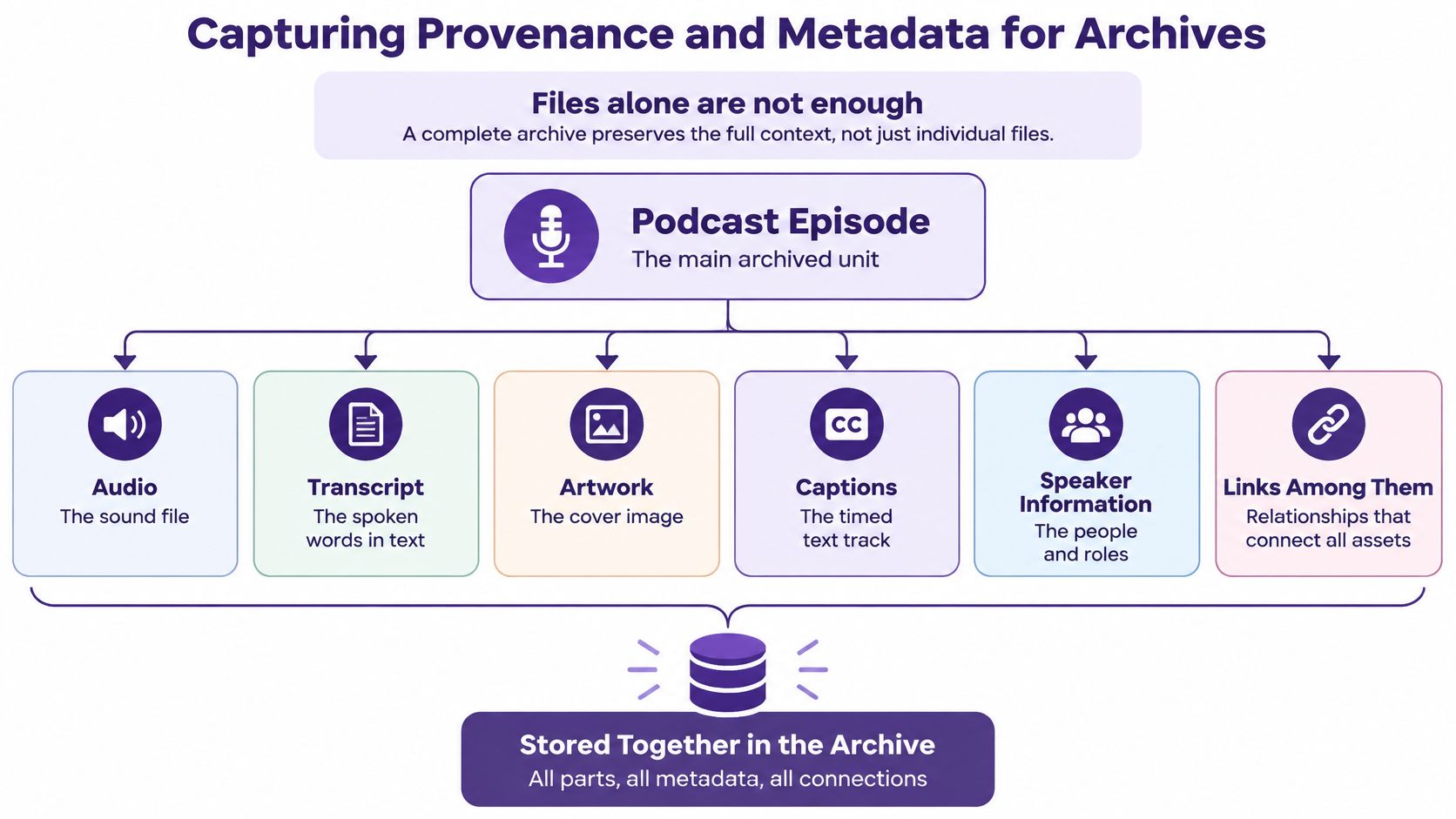
Files alone aren't enough. A podcast episode should remain connected to its audio, transcript, artwork, captions, publication details, and speaker information.
Without those connections, a team might preserve every file yet lose the ability to establish which caption track belongs to which edit. That's a serious obstacle when producing a new clip or checking a quotation.
Preserve the package and its relationships
The Library of Congress format evaluation guidance describes WAVE and TIFF as wrapper formats and identifies METS, BagIt, and MPEG-21 as formats or frameworks for packaged content and structural relationships. A wrapper contains digital components and associated information; a package can organize multiple related files.
These approaches aren't interchangeable. Choose the packaging method that fits your archive, but make the relationships explicit rather than relying on similar filenames.
The episode should be the organizing unit, with its assets connected beneath it.
The Library of Congress summary of archival sustainability describes representation, reference, context, fixity, and provenance information. Use those categories as a field checklist rather than collecting descriptive tags alone.
Metadata categories to capture during ingestion
| Metadata Category | Example Fields | Why It Matters for Repurposing |
|---|---|---|
| Representation | MIME type, codec, schema version | Lets future tools render and read the file |
| Reference | Title, unique ID, publication date | Makes each item discoverable and citable |
| Context | Series, campaign, speakers, purpose | Explains why the item exists and how to reuse it |
| Fixity | Checksum per file, BagIt manifest | Detects corruption or alteration after transfer |
| Provenance | Source system, edit history, processing log | Shows where each item came from and what changed |
Make evidence usable by the next editor
Representation information tells a future tool how to interpret the recording. Reference information identifies the episode, while context explains its place in a series or campaign.
Fixity establishes whether the stored bits changed. Provenance records custody and processing history, which is a different question: an unchanged file can still contain an inaccurate transcript.
The Library of Congress digital preservation resources describe BagIt packaging with an inventory and a checksum for each file. A receiving system can compare the manifest against delivered assets and recalculate checksums before indexing them.
For long-term reuse, retain format versions, field definitions, and relevant technical specifications. The Library of Congress Recommended Formats Statement favors documented, interoperable formats and supporting metadata, dictionaries, and schemas.
An AI-generated transcript also needs the transcription tool or model version, processing settings, and review status recorded. If someone later corrects a speaker's name, preserve the connection between the machine output and the reviewed edition.
An intact file isn't automatically an accurate account. Preserve both integrity evidence and the history of editorial changes.
Use metadata management best practices to assign field ownership and consistent definitions. Record permissions and reuse restrictions too, so finding an asset doesn't become accidental permission to publish it.
Audit One Archive Before You Scale Ingestion
Audit a small sample end to end before investing in a larger system. A successful transfer test alone won't reveal broken relationships, misleading dates, or revisions that overwrite earlier evidence.
Run a practical sample audit
- Select a mixed sample. For example, choose about 50 items from different years, formats, and sources, including an edited or re-uploaded file.
- Trace the journey. Follow collection, transport, transformation, storage, and validation. Note where records are created, altered, or lost.
- Inspect identity and timing. Check stable IDs, content hashes, and event, ingestion, and processing timestamps.
- Test relationships. Open a transcript's parent episode and a clip's original recording from their stored references.
- Rank the repairs. Count duplicates, missing fields, and unreadable formats, then prioritize problems that prevent reliable search and reuse.
Apply data migration best practices when planning the full transfer, including acceptance checks and a recovery route. The audit should establish whether you need a batch backfill, a streaming feed, or a hybrid, and which tools your team can maintain.
Contesimal is an option for library work, with programmatic uploads, fast file ingestion, and classification of large sets of documents, podcasts, videos, and articles.
Contesimal helps teams organize and search existing content libraries, then collaborate with human and AI contributors to develop new ideas from them. Visit Contesimal to explore how a better-organized archive can support research, repurposing, and new value from content you already own.