
A credible source is your secret ingredient. It's the trustworthy, accurate, and reliable information—like a peer-reviewed study or a report from a major institution—that proves you’ve done your homework.
For us creators, think of it as the bedrock for everything we build. It's what gives our work integrity and shows our audience we respect their trust.
Building Your Content on a Foundation of Trust
We're all swimming in an ocean of content, from quick-hit tutorials to sprawling podcasts. In this world, your credibility is everything. It's the invisible thread that turns a first-time viewer into a loyal subscriber and a casual reader into a die-hard fan.
So what transforms a random piece of info into something you can confidently build your content on?
At its heart, a credible source is one that's rooted in evidence, expertise, and transparency. It’s not just about getting the facts right; it's about showing a real commitment to accuracy and being accountable for what you publish. This is the line that separates professional creators who build lasting brands from hobbyists chasing quick trends.
The Anatomy of a Credible Source
A credible source is like a well-built house. It has a few key pillars holding it up, making it stable and reliable. For creators, knowing these pillars is essential for protecting your reputation and delivering real value to your audience.
In fields where accuracy is king, a credible source is often defined as one “that is likely to offer high-quality information and employ processes to reduce conflict of interest and promote transparency and accountability.” This gets to the heart of it: credibility isn't just about the facts themselves, but the entire process behind how they're gathered, checked, and presented. You can explore the research on source credibility to see this framework in action.
Basically, you’re looking for four key things:
- Expertise: Who is behind the information? You want to see a recognized expert or organization with credentials, experience, and a track record of respected work.
- Evidence: Are the claims backed by solid proof? A credible source shows its work with verifiable data, research, or citations, letting you trace its conclusions back to the origin.
- Objectivity: Is the information presented fairly? Every source has a point of view, but a credible one aims for balance and is upfront about any potential conflicts of interest.
- Currency: Is the information still relevant? This is huge for fast-moving topics like tech or marketing, where an outdated stat can be just as misleading as a false one.
To make this super practical, here’s a quick-reference table summarizing these core pillars. Keep these in mind every time you’re evaluating a potential source for your next project.
The Four Pillars of a Credible Source
| Pillar | What It Means | Why It Matters for Your Content |
|---|---|---|
| Expertise | The author or organization is a recognized authority in their field. | Lends your content authority and shows your audience you’re learning from the best. |
| Evidence | Claims are supported by verifiable facts, data, and citations. | Gives your arguments weight and allows your audience to verify your claims for themselves. |
| Objectivity | The information is presented with minimal bias and discloses conflicts. | Builds trust by showing you’re committed to a fair and balanced perspective. |
| Currency | The information is recent and relevant to the current conversation. | Ensures your content is timely and accurate, preventing you from sharing outdated ideas. |
By checking for these four pillars, you're not just finding a source; you're vetting a partner in your content creation process.
Why Credibility Is Your Secret Weapon
Every time you hit publish on a video, post a blog, or drop a podcast episode, you're making a promise. You're telling your audience that what you're sharing is worth their time and attention. Using credible sources is how you deliver on that promise.
For creators moving from hobbyist to professional, mastering source evaluation is a non-negotiable skill. It’s the difference between creating content that simply exists and creating content that influences, educates, and endures.
Building your work on a foundation of credible sources does way more than just prevent you from spreading bad info. It establishes your authority, builds unshakeable trust with your audience, and gives you a powerful edge. It proves you’re not just another voice in the noise—you’re a trusted guide.
Evaluating Source Credibility Like a Pro
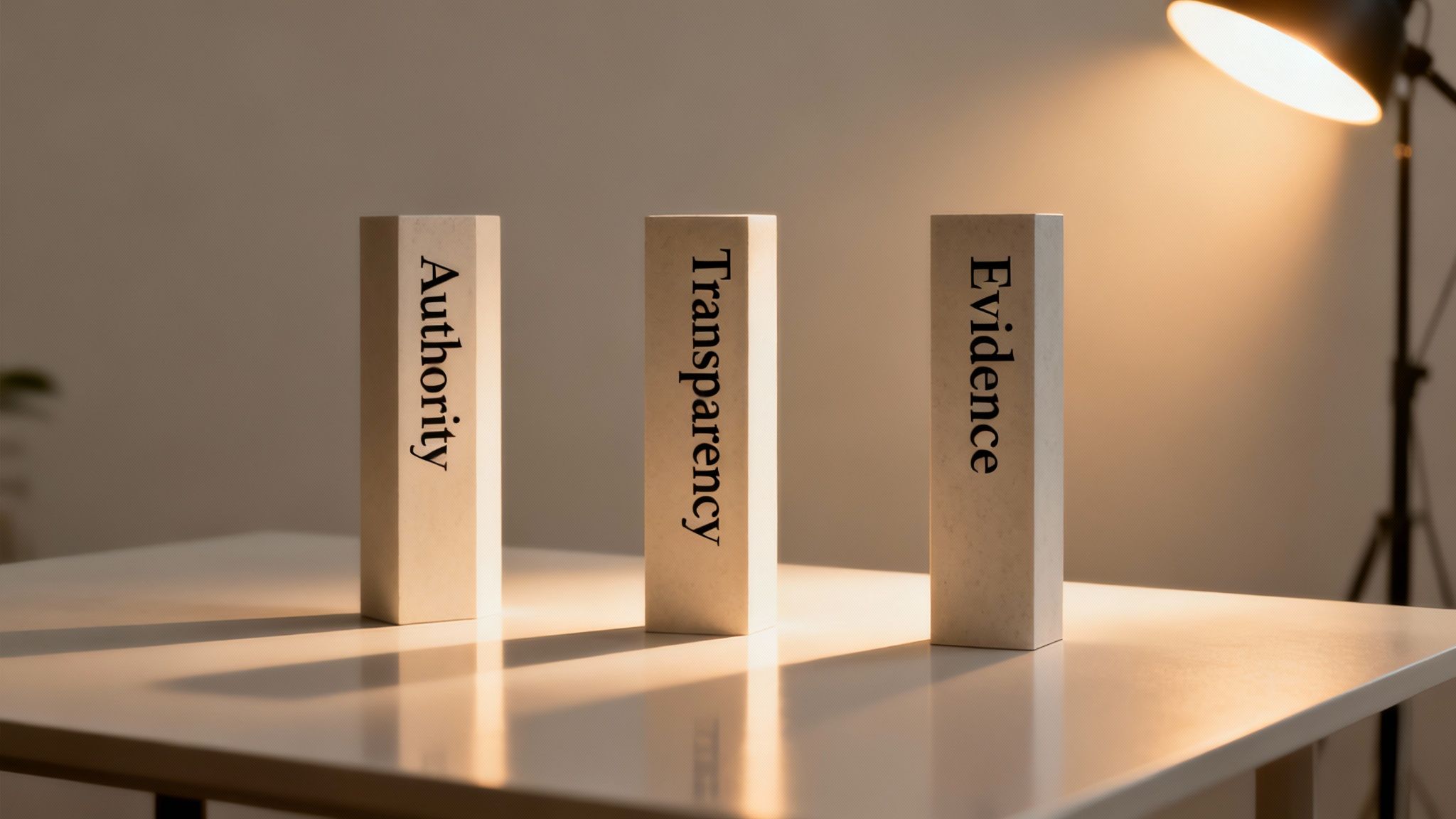
Knowing the definition of a credible source gets you halfway there. The real challenge is learning how to dissect a new piece of information on the fly, especially when you’re deep in the research zone for a new video or article. To move from guessing to knowing, you need a simple framework that becomes second nature.
For busy creators, we recommend the ATE model. It’s a quick mental checklist that zeroes in on three core pillars: Authority, Transparency, and Evidence. This isn’t just theory; it’s a repeatable process that turns source evaluation into a habit, protecting your own credibility with every piece you create.
Dissecting Authority
Authority boils down to one simple question: "Who is behind this information, and why should I trust them?" This goes way beyond a name or a fancy bio. You're hunting for genuine, provable expertise on the subject at hand.
An author or creator with authority has a real track record in their field. Their expertise is recognized by others, and they have the credentials or lived experience to back up what they say.
To get a feel for an author’s authority, dig into these areas:
- Credentials and Affiliations: Are they tied to a respected university, research institution, or industry organization? Do they hold relevant degrees or certifications that matter in their field?
- Publication History: Have they published other work on this topic in reputable outlets? A history of well-researched content adds some serious weight to their claims.
- Industry Recognition: Do other experts cite their work? Do they speak at conferences or contribute to major industry publications?
Uncovering Transparency
Transparency is the next crucial pillar. This is where you ask, "What biases or outside influences might be shaping this content?" Let's be real—no source is 100% neutral. But a credible one is upfront about its perspective and motivations.
A transparent source will disclose its funding, affiliations, and any potential conflicts of interest. This honesty allows you, and by extension your audience, to put the information in the right context. For instance, a glowing study on a new supplement is a lot less convincing if you find out it was funded entirely by the company that sells it.
A lack of transparency is a massive red flag. If you can't figure out who's funding the work or what the author's agenda might be, you should be extremely skeptical.
Look for clear disclosures, "About Us" pages that explain the organization's mission, and a willingness to publicly correct errors. That kind of openness is the hallmark of a source that cares more about accuracy than pushing an agenda. Properly evaluating transparency is a key part of building long-term audience trust.
Demanding Solid Evidence
Finally, we get to the most critical test: the evidence. Here, the question is simple: "Are the claims supported by verifiable facts?" A credible source doesn’t just make assertions; it backs them up with solid data, citations, and sound reasoning.
In the academic world, this is everything. Reputable institutions anchor their credibility in objective, evidence-based facts. They use rigorous peer-review processes, where other experts in the field pick apart a study's methods and conclusions before it ever sees the light of day. It’s why peer-reviewed journals are often seen as the gold standard for evidence.
When you’re evaluating the evidence in any source, watch out for these weak spots:
- Unsupported Claims: Bold statements presented as fact with zero data or citations to back them up.
- Vague References: Weasel words like "studies show" or "experts say" without actually linking to the studies or naming the experts.
- Emotional Language: Overly sensational or emotionally charged phrasing that’s clearly designed to persuade you, not just inform you.
A truly credible source makes it easy for you to check its work. It provides clear links to primary sources, cites specific data points, and builds its arguments on a foundation of verifiable facts, not just strong opinions.
Spotting the Red Flags of Misinformation
Knowing how to find a credible source is a game-changer for any creator. But just as vital is knowing how to spot the bad ones before they poison your content and wreck your reputation. Misinformation often dresses up to look like the real deal, using sneaky tricks to earn your trust so you’ll hit "share."
Developing a sharp eye for these red flags is your best defense. It ensures you don't accidentally amplify false narratives—the fastest way to lose the trust you've worked so hard to build. This skill elevates you from a simple content maker into a trusted curator.
Emotional Manipulation and Sensational Headlines
One of the biggest red flags is language designed to provoke a strong emotional reaction. Misinformation thrives on anger, fear, and outrage because these feelings short-circuit our critical thinking. If a headline makes you furious or terrified before you’ve even read the first sentence, pump the brakes.
Credible sources prioritize factual reporting over emotional bait. They aim to inform, not incite.
Here are a few common emotional tactics to watch for:
- Loaded Words: Using words with heavy emotional weight (like "disgusting," "horrifying," or "miracle") to frame an issue before you even get to the facts.
- Catastrophic Language: Making extreme, all-or-nothing claims that predict either total doom or a perfect utopia.
- Personal Attacks: Shifting focus from the facts of an issue to attacking a person or a group.
This stuff is engineered for clicks and shares, not accuracy. It preys on our natural human responses to get us to react without thinking.
The Absence of Evidence and Vague Sourcing
Another dead giveaway of a weak source is a complete lack of verifiable evidence. A credible source will always show its work, providing links, citations, and references so you can check the facts for yourself. Unreliable sources, on the other hand, make bold claims and just expect you to take them at face value.
Be wary of vague phrases like "experts say" or "studies show" without naming the experts or linking to the actual studies. This is a classic trick to create an illusion of authority without providing any real proof.
If a source isn't willing to show you where its information came from, it’s a clear signal that it might not have a credible origin to begin with. Transparency and accountability are non-negotiable for a trustworthy source.
Take a look at Snopes, a well-known fact-checking website that dedicates itself to verifying claims and debunking myths. They show their work.
Websites like Snopes demonstrate the importance of evidence by methodically breaking down claims and tracing them back to their origins to determine if they hold up.
Distinguishing Source Types
Finally, a key skill is understanding that not all sources are created equal. A post on a public forum, a personal blog, or a sponsored article all serve different purposes, and none should be treated as a primary factual authority on its own.
- Forum Posts & Social Media: These are great for gauging public opinion or finding personal anecdotes, but they are not reliable for factual claims. They represent individual experiences, not verified data.
- Personal Blogs: While blogs from recognized experts can be incredible, many are purely opinion-based. Without rigorous editorial oversight or peer review, they should be used with caution and always cross-referenced.
- Sponsored Content: This is content paid for by an advertiser but designed to look like a neutral article. Always check for disclosures like "Sponsored Post" or "Advertisement." The information is inherently biased toward promoting a product or service.
Mastering the ability to spot these red flags is fundamental. It empowers you to navigate the information jungle with confidence, ensuring every piece of content you create is built on a foundation of truth.
Your Toolkit for Verifying Information
Think of this as your digital detective kit. Having the right verification tools on hand isn't just a "nice-to-have" anymore—it's a core skill for any creator who wants to be taken seriously. Mastering these resources turns you from someone who just makes content into a trusted curator of knowledge.
The point isn't to slow you down. It's to build a reflex for quick, effective verification. With a bit of practice, confirming a sketchy claim becomes second nature, ensuring everything you publish is built on a rock-solid foundation of truth. This is how you protect your brand and earn your audience's trust.
Essential Fact-Checking Websites
Before you even think about citing a viral statistic or a surprising claim you saw on social media, your first stop should always be a dedicated fact-checking site. These organizations have teams of journalists and researchers who dig into common claims, debunk myths, and provide detailed, evidence-based ratings.
Bookmark these sites. Make them a habit.
- Snopes: One of the oldest and most respected players in the game. It's the perfect place for shutting down urban legends, internet rumors, and those "too good to be true" news stories.
- PolitiFact: This Pulitzer Prize-winning site zeroes in on political claims. Its famous "Truth-O-Meter" rates statements from "True" all the way down to "Pants on Fire."
- FactCheck.org: A nonpartisan project from the Annenberg Public Policy Center, it meticulously vets claims across politics, science, and healthcare.
Advanced Verification Techniques
Going beyond the basics, a few powerful techniques can help you dig deeper into a source's origins. These methods are surprisingly easy to use and can uncover critical context that isn't obvious at first glance.
Reverse Image Search
Ever see a stunning photo and wonder where it really came from? A reverse image search is your best friend. Just upload an image or paste its URL into a tool like Google Images or TinEye, and you can see where else it has appeared online. This is priceless for:
- Identifying the original photographer or publication.
- Spotting when an old photo is being reused in a new, misleading context.
- Finding a higher-resolution version of an image for your content.
The Wayback Machine
The Internet Archive's Wayback Machine is basically a time machine for the web. It takes snapshots of websites over the years, letting you see what a specific page looked like months or even years ago. It’s incredibly useful for checking if an article has been quietly edited or deleted, or for digging up information from a site that no longer exists.
Verifying information isn't just about avoiding mistakes; it's about building a library of trusted, pre-vetted sources you can return to again and again. This methodical approach is what separates reliable creators from the rest.
Powerful Tools for Deeper Research
When you need to get past the surface-level articles and find the primary research that credible sources are built on, your toolkit needs to expand. This is where you find the raw data and original studies. For a detailed breakdown of how to integrate these into your workflow, you can check out our guide on the best AI tools for content creators.
For now, here are two absolute must-haves:
- Google Scholar: This is a search engine designed specifically for academic literature. It helps you find peer-reviewed papers, theses, and reports from universities and research institutions worldwide, giving you direct access to the original evidence.
- Data Portals: Government agencies (like the U.S. Census Bureau) and international bodies (like The World Bank) maintain public data portals. These are absolute goldmines of raw, verifiable data you can use to back up your claims with hard numbers.
Fact-Checking and Verification Tool Comparison
Choosing the right tool depends on what you're trying to verify. A reverse image search won't help you debunk a political claim, and a fact-checking site won't give you raw economic data. This table breaks down some of the top tools and where they shine.
| Tool Name | Best For Verifying | Key Feature | Pro Tip for Creators |
|---|---|---|---|
| Snopes | Viral rumors, urban legends, and email chains. | Comprehensive, deep-dive articles that explain the origins of a claim. | Perfect for quickly checking if that "shocking" story in your feed is actually a decade-old hoax. |
| PolitiFact | Statements made by politicians and public figures. | The "Truth-O-Meter" provides a simple, color-coded rating for quick assessment. | Use their detailed reports to pull direct quotes and evidence for your analysis. |
| TinEye | The origin and usage history of a specific image. | Shows when and where an image first appeared online, tracking modifications over time. | Better than Google for finding the original source of a photo, not just other places it was used. |
| The Wayback Machine | How a webpage has changed over time or finding deleted content. | Archives billions of web pages, allowing you to view historical versions of a site. | Invaluable for seeing if an organization has scrubbed inconvenient information from its site. |
| Google Scholar | Academic claims, scientific findings, and expert research. | Filters search results to include only scholarly literature, like peer-reviewed studies. | Look for papers with high citation counts—it's a good signal that the research is influential. |
Ultimately, these tools are about building a process. By making verification a standard part of your research workflow, you not only create better, more reliable content but also build a reputation as a source your audience can count on.
Building a Credibility-Focused Research Workflow
Knowing what a credible source looks like is one thing. Being able to spot one and use it consistently when you're on a deadline is something else entirely. If you want to scale up your content without letting your quality slip, you have to turn those best practices into a reliable system.
This is about building credibility checks right into your content process, making it a habit instead of a chore. A solid research workflow saves you from reinventing the wheel on every project. It ensures that every video, podcast, or article you publish rests on a foundation of trustworthy information. That's how you protect your brand and honor your audience's trust.
A Step-By-Step Research System
Try to think of your research process in clear phases, with a credibility checkpoint built into each one. This methodical approach is your best defense against bad information creeping into a final script or draft.
-
Initial Discovery and Vetting: As you gather potential sources, give each one a quick "ATE" scan (Authority, Transparency, Evidence). Before you even start taking notes, ask: Who wrote this? Why? And where's the proof? If anything feels off, just toss it.
-
Organized Note-Taking: Don't just copy and paste facts. Get in the habit of noting the source right alongside every key insight or statistic. A simple note like, "Stat on X from [Author, Publication, Year]" keeps your evidence trail clean and makes citation painless later on.
-
Cross-Verification: This one is huge. For any claim that’s central to your content, find at least one other independent, credible source that confirms it. This single step is one of the most powerful ways to protect yourself from accidentally spreading bad info.
This simple diagram breaks down the core verification process.
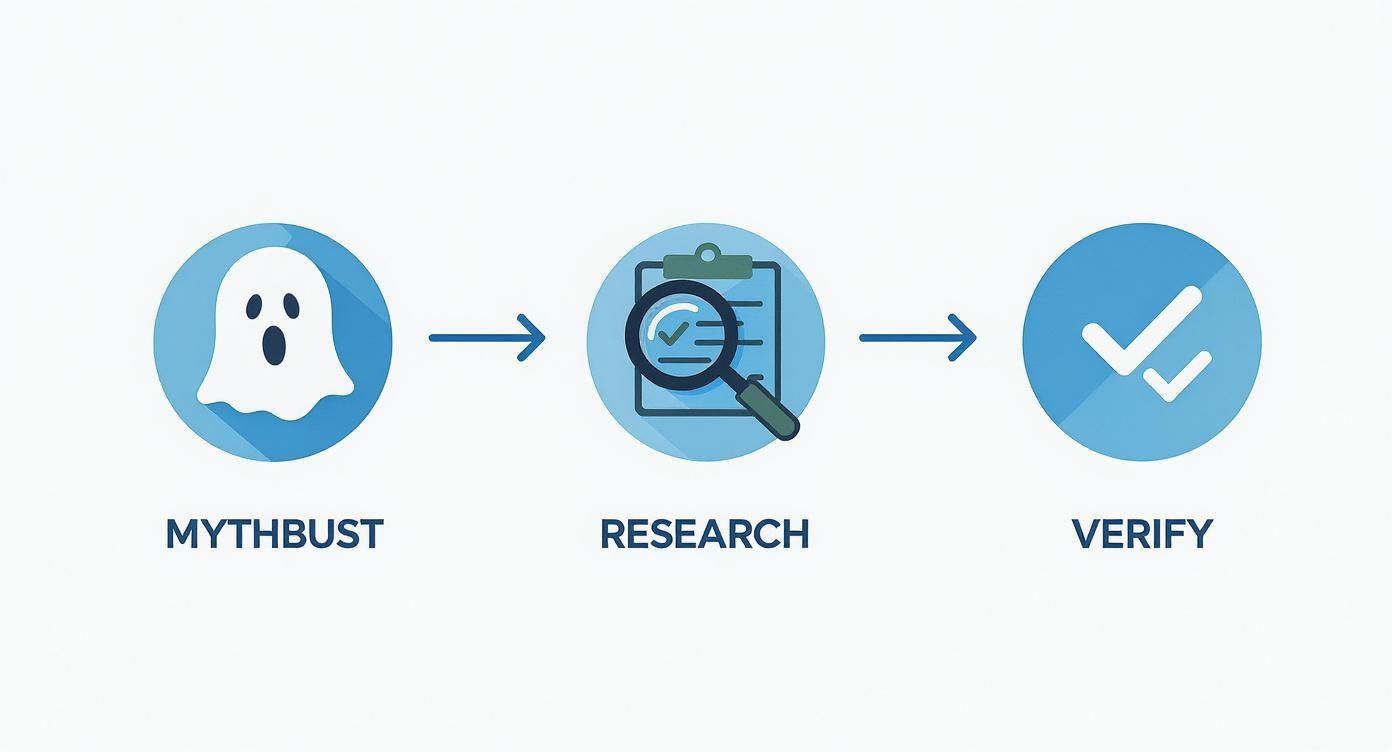
This flow—from questioning a claim to digging into its origins and verifying it with multiple sources—is the backbone of a strong credibility workflow.
Creating a Centralized Knowledge Base
As you create more content, you'll start noticing you return to the same trusted experts, publications, and datasets again and again. Instead of finding and re-vetting them every single time, build your own private library of pre-approved, credible sources. Think of it as your personal goldmine of reliable information.
A centralized knowledge base becomes a single source of truth for you and your team. You can start with a simple spreadsheet or use a dedicated platform to organize your go-to resources by topic. It makes future research so much faster and more efficient.
By building a repository of trusted sources, you're not just organizing links; you're creating a strategic asset. This library accelerates content creation and ensures a consistent level of quality and credibility across everything you produce.
For creators moving from hobbyist to revenue-generating pro, this kind of organization is crucial. Tools that help you organize your content library, like Contesimal, allow you to create new value from your existing assets by making past research easily accessible for future projects. This is how you collaborate more effectively and reignite your entire content library.
Leveraging Your Content Library for Future Projects
All that old content you've made—videos, blog posts, podcast episodes—is a treasure trove of research you've already completed. A smart workflow doesn't just look forward; it also looks back.
Platforms are now emerging that can help you organize and make sense of your own past work, turning your archive into a searchable, credible resource. This allows you to quickly pull vetted facts, statistics, and sources from your own library to use in new content. For creators looking to repurpose and reignite their archives, exploring the capabilities of content intelligence platforms can be a total game-changer.
By building a system that draws from both external credible sources and your own pre-vetted work, you create a powerful engine for scaling high-quality, trustworthy content that your audience will love.
Got Questions About Credible Sources?
Even with the best game plan, you're going to run into weird situations and gray areas. It just happens. This section is all about tackling those common questions that pop up when you're in the middle of a project.
Think of it as your field guide for making the right call when things get tricky.
Is Wikipedia a Credible Source for My Videos?
Here’s the deal with Wikipedia: it's a fantastic place to start, but a terrible place to finish. Its real power for creators isn't in the articles themselves, but way down at the bottom in the "References" section. That's the goldmine.
Use a Wikipedia article to get the lay of the land on a topic. Then, click through those reference links to find the actual studies, government reports, or original news articles. Citing those sources directly is what separates the pros from the amateurs. It shows you did the real work.
How Do I Evaluate an Expert for My Podcast?
Vetting a person is a totally different game than vetting a publication. First, look at their credentials and where they work. Are they attached to a respected university, a known research group, or a major player in their industry? That's a good first signal.
Next, check out their track record. Have they published peer-reviewed research? Written books with actual publishers? Authored reports that other people in their field take seriously? Finally, see if there's a consensus. Do other experts cite their work or treat them like an authority? A quick search can also uncover any major biases or controversies you need to know about before you hit record. Doing this homework protects you, and it protects your audience.
Choosing the right expert is a credibility multiplier. Their authority becomes your authority, instantly boosting your content's trustworthiness and value in the eyes of your audience.
How Old Is Too Old for a Source?
This completely depends on what you're talking about. If your content is about technology, marketing, or breaking medical news, anything older than 2-3 years is probably ancient history. For fast-moving fields, you have to prioritize the freshest data you can find.
But if you're exploring history, philosophy, or a foundational scientific concept, the "old" sources are often the most important ones. Think of landmark studies or seminal texts. The real question to ask yourself is, "Has anything new come out that completely changes what this source is saying?" Context is everything.
Can a Biased Source Still Be Credible?
Absolutely, but you have to handle it with care. A source can have a clear point of view and still be credible, as long as it's honest about its perspective and uses real evidence to back up its claims. A report from an environmental group, for instance, can be perfectly credible if its data is solid and its methods are transparent.
Your job as the creator is to flag that bias for your audience. Don't just present the information—frame it. You could say something like, "According to a report from Organization X, which advocates for…" This gives your audience the context they need to weigh the information properly. The best move? Always pull from multiple sources with different viewpoints to give your audience the full, balanced picture.
Stop letting great, pre-vetted research die in old project folders. Contesimal helps you find and reuse the credible insights buried in your content library, making your past work a searchable asset for everything you create next. Turn your content archive into a goldmine at https://contesimal.ai.