For a small business, a podcast isn't just another marketing channel. It's a way to build a deep, personal connection with your customers and carve out a spot as a trusted voice in your industry. It’s your chance to reach an engaged audience during their screen-free moments, creating an intimacy that other marketing often misses.
Why Your Small Business Needs a Podcast Now
Think about your ideal customer’s day. They’re commuting, at the gym, walking the dog, or just doing chores around the house. Their eyes are busy, but their ears are wide open. Podcasting gives your business a voice that can join them during these moments, building a unique relationship that feels genuinely personal.
Unlike a social media post that vanishes in seconds, a podcast episode gives you the space for real storytelling. You can share your origin story, bring on an industry expert for a chat, or offer practical advice that solves a real problem for your listeners. Delivering that kind of value, week after week, is how you stop being just another business and become their go-to resource.
Build Authority and Trust with Your Audience
Every single episode you release cements your expertise. A local bakery can share the history behind its family recipes. A financial advisor can break down confusing investment topics. A marketing agency can interview clients who’ve seen incredible results. This isn’t just content; it’s a live demonstration of your knowledge and passion.
That consistency builds a foundation of trust that you just can't buy with traditional ads. When a potential customer has spent hours listening to you share your insights, they feel like they know you. And that familiarity makes them far more likely to choose you when they’re ready to make a decision.
"Starting a podcast immediately made me feel like a more professional business. It's a platform to show my expertise, so that businesses know what they’ll get when we work with them."
– Hannah Isted, HI Communications
Reach a Highly Engaged and Valuable Audience
The podcasting world isn't just growing—it's filled with exactly the kind of people you want to reach. The global audience is set to hit 584.1 million listeners worldwide in 2025.
But it gets better. This audience is often affluent and educated. A staggering 45% of listeners report household incomes over $250,000, making them a prime demographic for all sorts of products and services. If you want to dive deeper, you can explore more podcast marketing statistics to see just how valuable this audience is.
Create a Powerful Content Repurposing Engine
Here’s one of the best-kept secrets of smart podcasting: it’s a content goldmine. A single 30-minute episode can fuel your entire marketing strategy for a week, maybe even longer. Podcasting is a powerful way to upcycle your content and create new value from your expertise.
Think about all the things you can pull from just one recording session:
- Blog Posts: Get it transcribed, clean it up, and you’ve got a fantastic, SEO-friendly blog post.
- Social Media Clips: Snip out the best 30-60 second soundbites, turn them into audiograms or video clips, and share them across Instagram, LinkedIn, and TikTok.
- Email Newsletters: Pull the key takeaways and a killer quote to create an engaging newsletter for your subscribers. They get value, and you get to point them back to the full episode.
- Quote Graphics: Take the most powerful lines and turn them into sharp-looking, shareable images.
This isn't about creating more work; it's about working smarter. You organize your content library and multiply the value of a single recording, saving a ton of time while getting your message out everywhere.
Building Your Podcast Blueprint
A great podcast rarely happens by accident. It's built on a strategic foundation long before you ever hit "record." This blueprint is what separates a business podcast that drives real results from one that just fades out after a few episodes. It’s all about creating a show with a clear purpose, designed from the ground up to attract and serve your ideal customer.
The very first move is to define your niche and tie it directly to your business goals. Don't just start a podcast about "marketing." Instead, get specific. If you serve independent coffee shops, create a podcast about "marketing for indie coffee shop owners." This sharp focus makes it instantly clear who your show is for and gives them a compelling reason to listen.
Defining Your Ideal Listener
Once you've carved out your niche, you need to get crystal clear on who, exactly, you're talking to. A vague idea of your audience just won't cut it. The goal is to build a detailed listener persona—a semi-fictional character who represents your ideal customer perfectly.
Give this person a name, a job, and a list of specific problems they're facing. For example, let's meet "Creative Clara." She's a freelance graphic designer who's amazing at her craft but struggles to find high-paying clients. She listens to podcasts on her morning walks to find business advice that's actionable and doesn't sound like a dry corporate lecture.
Now, every single episode idea you have should be filtered through one simple question: "Would Clara find this genuinely useful?"
This one exercise transforms your content brainstorming from random guesswork into a targeted problem-solving session for the exact people you want to bring into your business.
Choosing the Right Show Format
Your podcast's format dictates its entire flow, the production effort required, and how your audience experiences your content. There’s no single "best" option here. The right choice really depends on your personality, your resources, and the kind of value you want to provide.
A simple way to visualize this is to see how the core parts of podcasting—connecting with people, repurposing content, and growing your business—all feed into each other in a continuous loop.
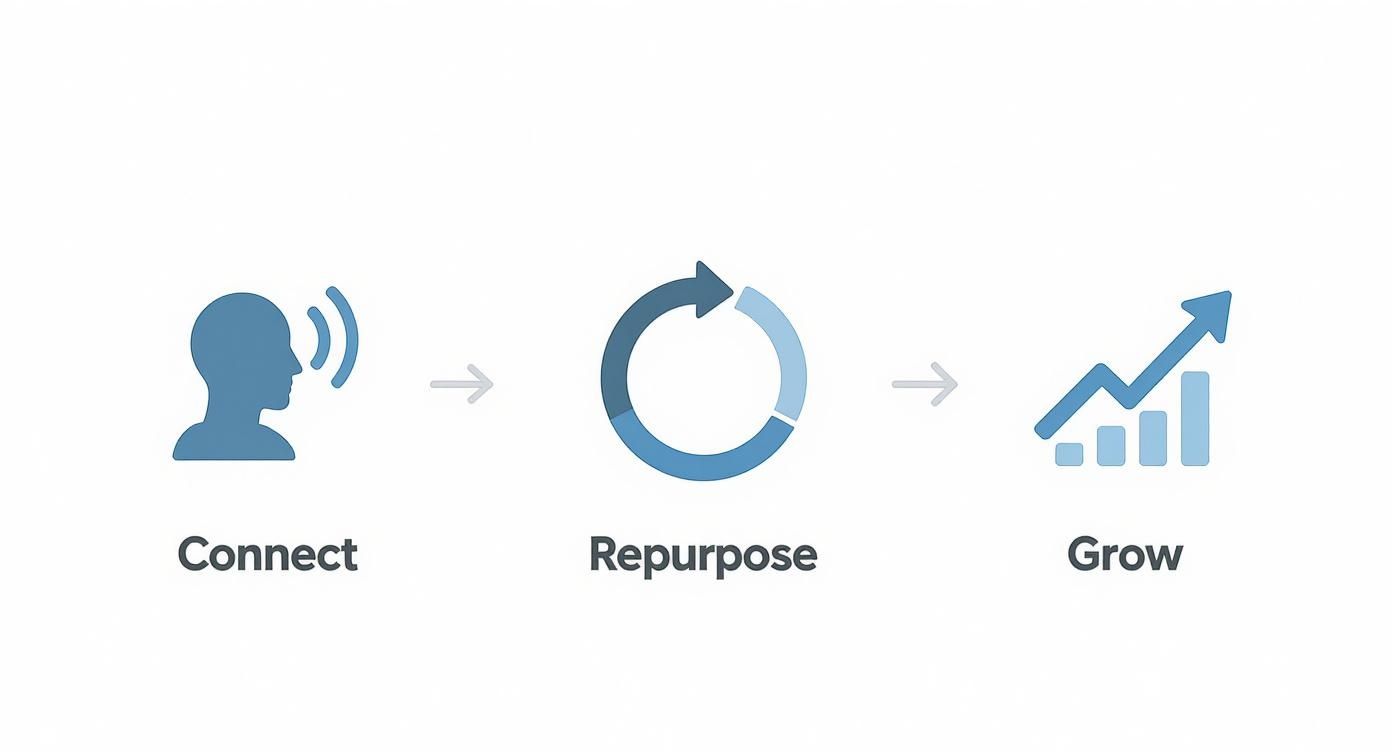
This cycle shows that each stage fuels the next, creating a self-sustaining growth engine powered by your content.
Most small business podcasts fall into one of a few common formats. Let's break them down so you can see what might work for you.
Podcast Format Comparison for Small Businesses
Choosing a format is a foundational decision. This table breaks down the most popular options to help you find the perfect fit for your goals and personality.
| Format Type | Best For | Pros | Cons |
|---|---|---|---|
| Solo Host | Establishing thought leadership and sharing deep expertise on a specific topic. | Simple production, full creative control, builds a direct connection with the listener. | Requires being consistently engaging on your own, can be demanding to script. |
| Interview Style | Networking, building relationships, and bringing diverse perspectives to your audience. | Fresh content each episode, leverages guest's audience, great for building connections. | Guest sourcing and scheduling can be time-consuming, requires strong hosting skills. |
| Co-hosted Show | Creating a dynamic, conversational show with natural back-and-forth banter. | Engaging and entertaining, shared workload for content and promotion, less pressure on one person. | Success depends heavily on host chemistry, requires scheduling coordination. |
Ultimately, the best format is the one you can stick with. Think about what you'll genuinely enjoy creating week after week.
A common mistake is choosing a format that drains your energy. If you thrive on conversation, a solo show might feel like a chore. Pick a format that plays to your strengths and that you can see yourself producing long-term.
Mapping Out Your Content and Brand
With your niche, listener, and format locked in, it's time to plan your content and wrap it all up in a memorable brand.
Start by brainstorming 10-12 episode ideas that directly solve a problem for your listener persona. This becomes your first "season," giving you a clear runway for your launch and taking the pressure off.
Organize these ideas in a simple content calendar. Just note the episode title, a quick summary, and any potential guests you might want to invite. This plan eliminates that weekly panic of, "What am I going to record this week?"
Finally, give your podcast a strong identity. The name should be clear, catchy, and ideally include keywords your audience is searching for. "The Small Business Marketing Show" is okay, but "Marketing for Makers" is even better because it speaks directly to a specific community.
Then, write a compelling show description that hooks potential listeners in the first two sentences. Tell them exactly who the show is for and what's in it for them. This is your podcast's elevator pitch in crowded apps like Apple Podcasts and Spotify, so make it count.
Your Smart Guide to Podcast Gear and Software
Diving into the world of podcasting gear can feel like falling down a rabbit hole of specs and price tags. But here's the truth: you don't need a Hollywood budget to sound amazing. It’s about making a few smart choices upfront, focusing on the gear that actually makes a difference to your listeners.
Let’s get one thing straight: audio quality is a big deal. But "quality" doesn't mean "expensive." It just means your voice is clear, crisp, and doesn't have a bunch of distracting background noise. The good news is you can nail that with a surprisingly simple setup, letting you put your energy back where it belongs—creating a killer show for your business.
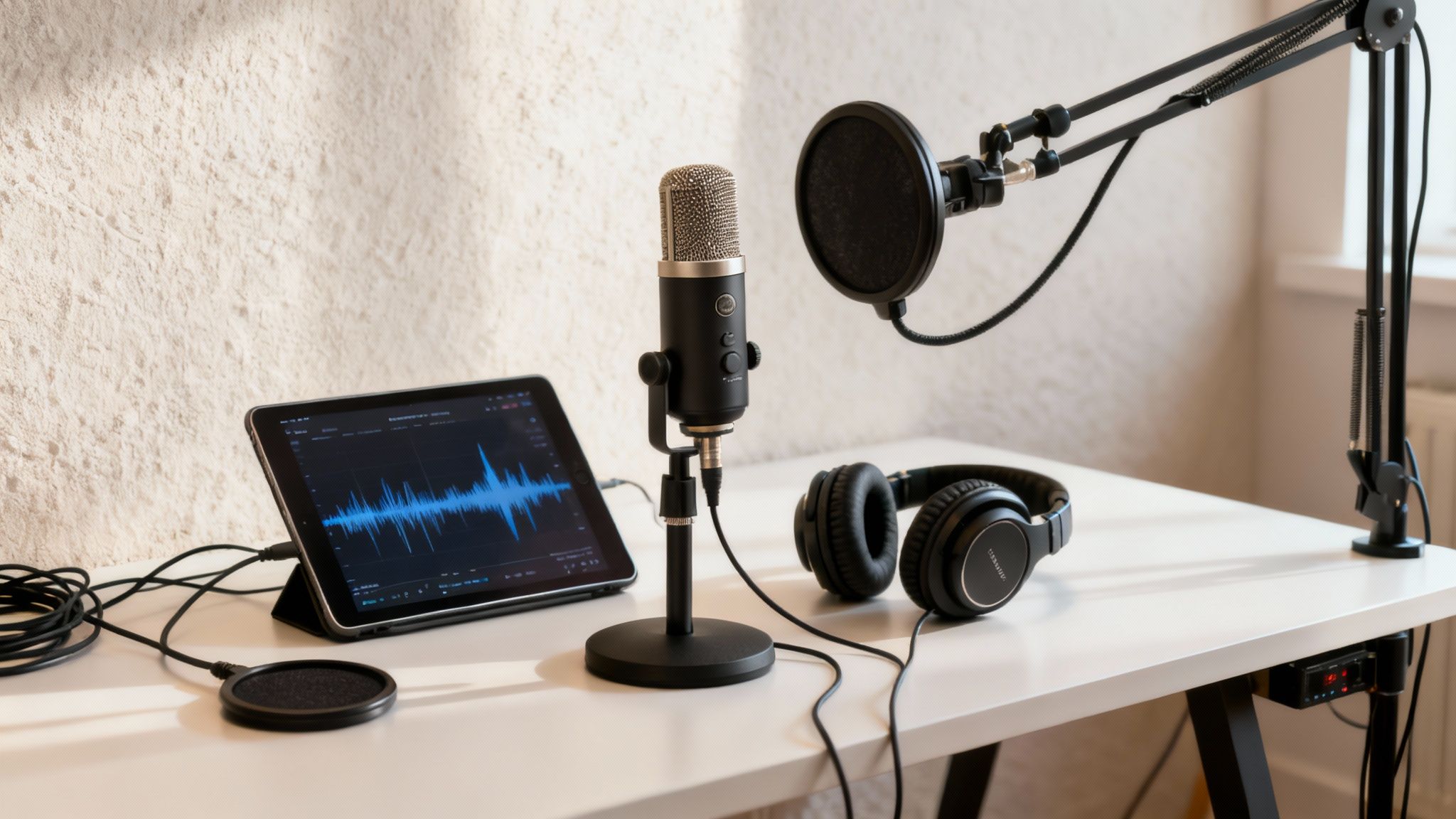
I'm going to walk you through two different setups I’ve seen work time and time again. One is for when you're just getting started on a shoestring budget, and the other is for when you're ready to level up your sound.
The Lean Starter Kit
This is for the scrappy entrepreneur. You want a great-sounding podcast, but you're not ready to drop a ton of cash. The philosophy here is all about simplicity and impact.
- USB Microphone: This is the heart of your starter kit. A good USB mic plugs right into your computer—no other hardware needed—and can deliver fantastic audio. A go-to recommendation is the Rode NT-USB+, which you can usually find for around $170.
- Pop Filter: Seriously, don't skip this. A pop filter is a cheap little screen that clamps onto your mic and softens those harsh "p" and "b" sounds that can make your audio pop unpleasantly. You can grab one for under $20.
- Free Editing Software: No need to pay for software right away. Audacity is a powerful, free, open-source audio editor that can handle everything you need, from chopping out mistakes to adding your intro music. It has a bit of a learning curve, but there are endless tutorials on YouTube to get you going.
This minimal setup is proof that starting a podcast for your business is way more about initiative than it is about budget.
The Business Growth Setup
Okay, so your show has some legs, you're getting traction, and now you're ready to invest in better sound and a smoother workflow. It's time for an upgrade. This setup gives you more professional control and an even richer sound.
- XLR Microphone: Unlike their USB cousins, XLR mics are the industry standard for professional audio. They connect to your gear with a chunky three-pin cable. A fantastic next step would be something like the Rode Procaster or the Shure MV7X. Both give you that classic broadcast-quality sound.
- Audio Interface: This little box is what connects your fancy new XLR mic to your computer. It takes the analog signal from the mic and turns it into a digital one your computer can use. The Focusrite Scarlett Solo is a super popular and reliable choice for solo podcasters, known for its clean preamps that make your voice sound full and clear.
- Streamlined Software: As you grow, your time is your most valuable asset. A tool like Descript can be a total game-changer. It transcribes your audio as you record, so you can literally edit your podcast by editing a text document. It cuts post-production time down dramatically. Many of the best AI tools for content creators can help you organize these workflows and get more mileage out of every episode you produce.
My personal tip? If you have to choose where to put your money first, always, always invest in the microphone. Great content with decent audio will beat mediocre content with studio-perfect sound every single day. The goal is to start smart, not start expensive.
Ultimately, the best gear is the gear that actually gets you to hit "record." Whether you start with a simple USB mic or jump to an XLR setup, the real key is just being consistent. By choosing reliable tools that fit where you are right now, you get all the technical hurdles out of the way and free yourself up to focus on what really matters—making valuable content that grows your business.
Creating Episodes That Hook Your Listeners
This is where the magic happens—where all your planning and gear come together to create something your audience will actually want to listen to. The key isn't just having a good idea; it's building a repeatable workflow. This turns the chaos of creation into an efficient system that pumps out high-quality content, week after week.
Your goal isn't just to talk into a mic. You're creating an entire audio experience designed to keep people hooked from start to finish. Every little detail, from the way you speak to how you structure your episode's story, makes a massive difference in how professional your show sounds.
Nail Your Recording and Editing Workflow
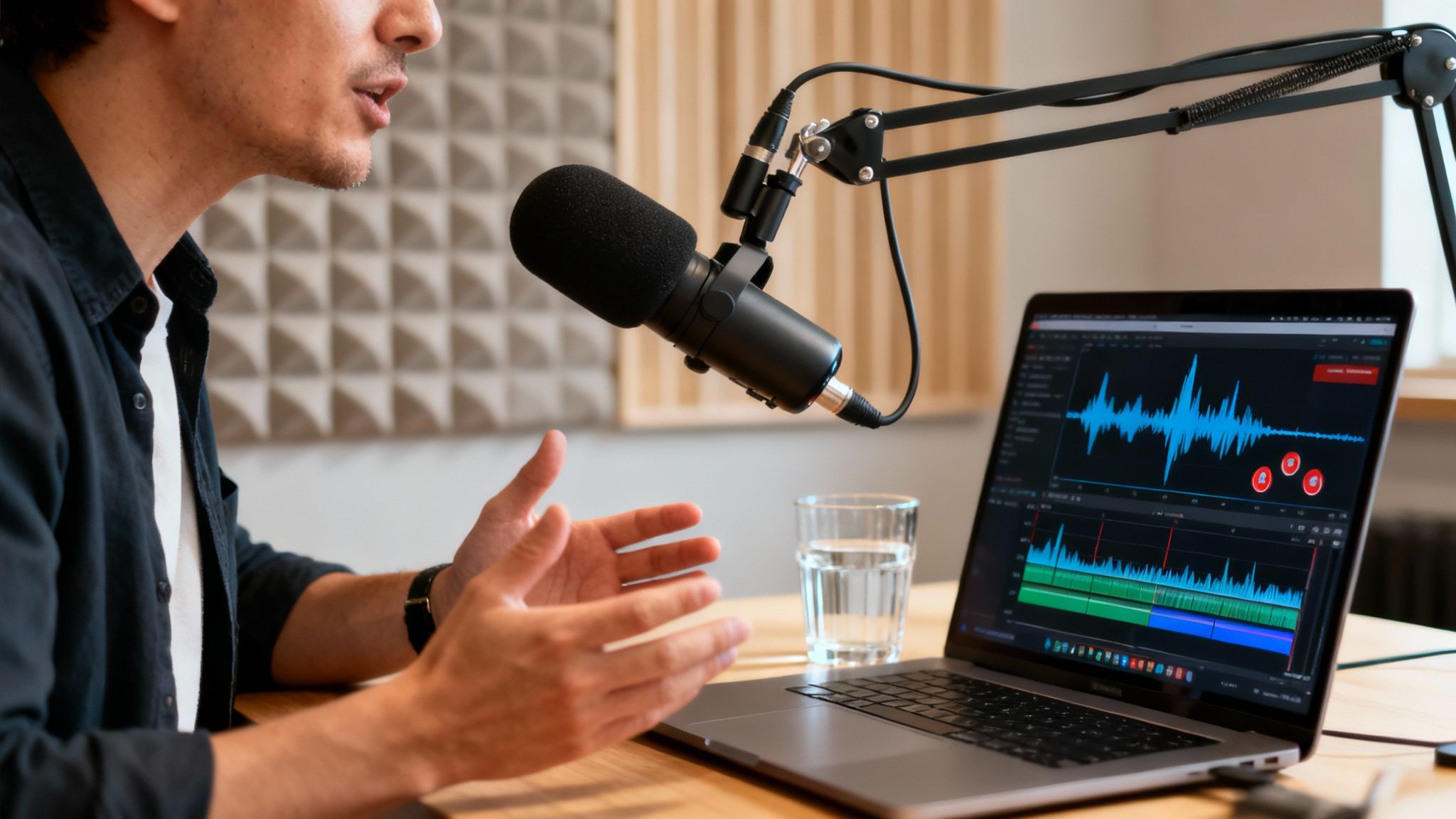
You don't need a million-dollar studio, but you do need to control your recording environment. A small, quiet room with soft surfaces—think carpets, curtains, or even a closet full of clothes—is perfect for absorbing echo and background noise. And the simple stuff, like silencing your phone and shutting the door, is non-negotiable.
Once you hit record, mic technique is everything. A good rule of thumb is to position the microphone about 4-6 inches from your mouth, just slightly off to the side. This simple trick captures the full, rich sound of your voice while dodging those harsh "p" and "b" sounds that can make listeners cringe.
Editing is where you add that final layer of polish. The main job here is to clean things up: cut out the "ums" and "ahs," trim long pauses, and remove any distracting noises. This is also where you'll add your intro and outro music to give the show a consistent, branded feel.
If you're a busy small business owner, batch recording will be your best friend. Instead of scrambling to record an episode every week, block off one afternoon and record a whole month's worth of content. This shift saves an insane amount of setup and teardown time and keeps you way ahead of schedule.
Structuring Episodes for Maximum Impact
An episode's structure is what keeps people from tuning out. Your listeners are busy, and you need to give them a clear reason to stick around. A logical flow helps them follow along and ensures they walk away with something valuable.
Whether it’s a solo show or an interview, a simple framework is your best bet. Here’s a tried-and-true template for a 20-30 minute episode that just works:
- The Hook (0-1 min): Kick things off with a bold question, a surprising stat, or a quick story that teases the episode's core benefit. Tell them exactly what they're about to learn.
- The Intro (1-2 min): Cue the theme music. Formally introduce yourself, your show, and the day's topic.
- The Core Content (15-20 min): This is the main event. Break your topic down into 2-3 main points or, if you have a guest, dive into your prepared questions to pull out their best insights.
- The Summary (2-3 min): Quickly run through the key takeaways. Hammer home the one big lesson you want your audience to remember.
- The Call to Action (1 min): This is absolutely critical for a business podcast. Tell your listeners exactly what to do next—visit your website, check out a product, or subscribe to the show. Keep your ask clear and singular.
Extracting Wisdom from Your Guests
If you’re running an interview show, your number one job is to make your guest look like a rockstar. The spotlight should be on them, not you. And the secret to doing that well? Preparation.
Before you ever hit record, do your homework. Dig into your guest's background, listen to their other interviews, and craft thoughtful questions that go deeper than the surface level. Ditch the generic stuff like, "So, tell me about yourself."
Instead, try asking something like, "What's one common belief in your industry that you completely disagree with, and why?"
This level of prep doesn't just make for a killer episode; it shows massive respect for your guest's time and expertise. A great interview experience can easily turn a one-off guest into a long-term collaborator, opening doors to new audiences and opportunities you never saw coming.
Launching and Growing Your Podcast Audience
Nailing a fantastic episode is a huge win, but that’s really only half the job. The other half is making sure it actually reaches the ears of your ideal customers. Your launch and ongoing promotion strategy is what separates a business podcast that grows from one that quietly fades away.
The good news? This process isn't about throwing a ton of money at ads or spending all day glued to social media. It's about building a smart, sustainable system that works for you. That system starts with a crucial one-time setup: getting your show listed on all the major podcast directories.
Getting Your Podcast on Every Platform
Before anyone can listen, your show has to be discoverable. This means submitting your podcast's RSS feed—a unique link your hosting service gives you—to all the key platforms where people find and listen to podcasts. Think of it as putting your business on the map.
You only have to do this once. After your show gets the green light, every new episode you upload to your host automatically populates across these platforms.
- Apple Podcasts: This is the big one. Being listed here is non-negotiable, as many other podcast apps pull their directories from Apple.
- Spotify: A massive and still-growing platform for all things audio, making it another absolutely essential directory for discovery.
- Google Podcasts: This ensures your show is easily found by Android users and can even show up in Google search results.
- Amazon Music/Audible: Another major player that gives you access to a huge, built-in audience.
Submitting to these core directories makes sure your podcast is available wherever your potential customers are looking for content.
A Sustainable Promotion Strategy for Every Episode
Once you're listed everywhere, it’s time to build a repeatable promotion checklist for every new episode. This isn't about reinventing the wheel each week; it's about creating an efficient engine that drives consistent listenership.
A core piece of this is turning your audio into compelling visual assets for social media. One of the best ways to do this is by creating audiograms. These are just short video clips that pair a snippet of your audio with a static image and animated soundwaves. They're perfect for grabbing attention on platforms like Instagram and LinkedIn.
Another powerful tactic is to treat your show notes as more than just a quick summary. When you write detailed, SEO-optimized show notes, you’re basically creating a blog post for every single episode. This approach not only serves your current listeners but also attracts new ones through search engines. When you focus on optimizing content for search engines, you create a long-term asset that can bring in traffic for months, even years.
"A common mistake is treating promotion as an afterthought. Your marketing plan for each episode should be as well-planned as the content itself. Building a simple, repeatable checklist removes the friction and ensures you're consistently getting the word out."
Expanding Your Reach Through Collaboration
One of the single most effective ways to grow your audience is by tapping into existing ones. This is where collaboration becomes your secret weapon.
- Guest on Other Podcasts: Find other shows in your niche that serve a similar audience but aren't direct competitors. Showing up as a guest is a powerful endorsement and a direct invitation for their listeners to come check you out.
- Invite Guests with Engaged Audiences: When you feature a guest on your podcast, they are almost certain to share the episode with their own followers. This introduces your show to a brand new, relevant audience with very little extra effort on your part.
- Lean on Your Email List: Your email list is one of your most valuable marketing assets, period. Send a dedicated email to your subscribers for every new episode, highlighting the key takeaways and giving them a direct link to listen.
This multi-channel approach is all about working smarter, not harder. By systematically repurposing your core podcast content, you fuel your entire marketing engine. You can even use insights from your library to discover what really resonates, helping you create new value from existing content and pull in listeners from every corner of your industry.
From Listeners to Loyal Customers
So, your podcast is live and finding its audience. That’s a huge win. But how do we turn those ears into actual business growth? For a small business, success isn't just about topping the download charts. The real magic happens when you connect your content directly to your bottom line by converting engaged listeners into paying customers.
This means we need to stop obsessing over vanity metrics and start focusing on what truly impacts the business. Instead of just celebrating another thousand downloads, dig into your host’s analytics. What's the listener retention rate? Are people bailing after the first five minutes, or are they sticking around for the whole ride? More importantly, are they clicking the links in your show notes? Using custom UTM links is a non-negotiable for tracking how many listeners take that next step.
Smart Monetization (Hint: It’s Not About Sponsorships)
For most small businesses, chasing traditional ad sponsorships is a massive distraction. It’s a ton of work, and it pulls focus from your actual goal: growing your business, not someone else’s. A much smarter play is to use your podcast as the ultimate lead-generation machine.
Honestly, the most authentic and powerful way to monetize your show is by promoting your own products and services. Think about it—you’ve already spent hours building trust and proving you know your stuff. When you mention a relevant service or product you offer, it doesn’t feel like an ad. It feels like a genuine recommendation from a source they’ve come to trust.
Don’t fall into the trap of thinking monetization has to mean outside ads. Hannah Isted of HI Communications has never run a single ad or sponsorship on her show, The Best Marketing Podcast Ever. Instead, she drives revenue when listeners sign up for her programs, often telling her the podcast was the final nudge they needed to buy.
Guiding Listeners Down the Funnel
Your podcast is the perfect top-of-funnel asset. It’s an incredible tool for attracting new people, cementing your authority, and building a genuine relationship over time. The trick is to create a clear, gentle path that guides someone from being a passive listener to an active lead in your world.
Here’s a snapshot of what that journey looks like:
- Awareness: Someone’s searching for a solution to a problem you solve. Boom, they find your show.
- Nurturing: They listen to a few episodes. They start to trust your voice and your advice. You're becoming their go-to expert.
- Action: You offer a killer call to action—maybe a free checklist or a webinar that dives deeper into the episode's topic. To get it, they pop over to your site and drop their email.
- Conversion: Now they’re on your email list. You can keep delivering value directly to their inbox and, when the time is right, introduce them to your paid offerings.
This approach builds a rock-solid foundation of trust and proves the incredible ROI of creating a loyal audio community.
While selling your own stuff is the main event, it’s worth understanding the broader podcasting economy. This isn’t some niche hobby; it’s a booming market. Worldwide podcast ad spending is projected to smash $4.46 billion in 2025. And for businesses, the efficiency is just staggering—podcast advertising generates revenue at an approximate cost of only 6 cents per hour of content consumed. You can dive deeper into the growing podcast economy on Backlinko.com. By using your podcast to sell your own offerings, you're capturing all of that value for yourself.
Answering Your Small Business Podcast Questions
Jumping into podcasting always brings up a ton of questions. Let's tackle some of the most common hurdles I see business owners face, so you can move forward with a clear head.
How Much Time Does Podcasting Really Take?
For a standard 30-minute weekly episode, you should realistically budget 4 to 6 hours. That might sound like a lot, but it breaks down into manageable chunks you'll get faster at over time.
Here's how that usually plays out:
- 1 hour for planning and outlining your content. Don't skip this.
- 1 hour for the actual recording session.
- 2-3 hours for editing, mixing in your intro/outro music, and all that post-production polish.
- 1 hour for writing show notes and whipping up some promotional assets for social media.
The real pro-tip here is batching. If you can record a few episodes in one go, you dramatically slash your weekly time commitment. It's a game-changer.
Can I Reuse My Podcast Content?
Not only can you, but you absolutely must. Repurposing is the secret to getting the most mileage out of every single recording. Think of your podcast as the sun in your content solar system, not some lonely planet. The goal is to reignite your content library and bring it to life.
A single episode is a content goldmine. Transcribe it for a blog post, pull key quotes for social media graphics, and create short video clips to share on LinkedIn or Instagram. This multiplies your reach without multiplying your effort.
When Will I See a Return on Investment?
Let's be real: podcasting is a marathon, not a sprint. It's a long-term strategy for building trust and authority, so don't expect it to be an overnight sales machine.
I tell my clients to expect it to take 6 to 12 months of consistent publishing before you build a loyal community and start seeing a clear ROI.
At first, you'll be looking at leading indicators like audience growth and listener feedback. But as you grow, you need a solid way to connect the dots. Understanding how to analyze content performance is what separates a hobby from a real business asset, helping you tie your podcast's growth to actual leads and sales.
Ready to turn your entire content library into a growth engine? Contesimal helps you organize, understand, and create new value from your existing podcasts, videos, and articles. Collaborate with AI to discover fresh ideas and take action on insights that drive your business forward. Explore what's possible at https://contesimal.ai.