
In the world of content creation, authenticity is king. Whether you're a YouTuber crafting a historical deep-dive, a podcaster uncovering a true-crime story, or a content marketer building a brand narrative, the depth of your work hinges on the quality of your sources. Secondary sources like articles and documentaries are useful, but the real magic lies in using primary sources. These are the raw materials of history, the firsthand accounts, and the original artifacts that connect you and your audience directly to the moment.
So, what are the different types of primary sources of information, and how can you leverage them to make your content stand out? For creators moving from hobbyist to professional, mastering these sources is a critical step in building authority and developing content that resonates. More importantly, it's the first step in building a rich content library that you can organize, understand, and repurpose to create new value.
This listicle will walk you through 10 essential categories of primary sources. We'll provide tips for podcasters, filmmakers, and publishers on how to find, analyze, and ethically incorporate these materials. The goal is to equip you to build stories with unmatched credibility, transforming your research into a treasure trove of unique insights. Forget surface-level retelling; it's time to dig into the evidence. This approach not only enriches your work but also provides a powerful foundation for organizing your content library and bringing it back to life.
1. Original Documents
Original documents are the bedrock of historical research and a foundational type of primary source. These are materials, whether handwritten or printed, created during the specific time period under investigation. They provide a direct, unfiltered window into the thoughts, transactions, and official records of the past, capturing the exact language and intent of individuals or institutions without later interpretation.
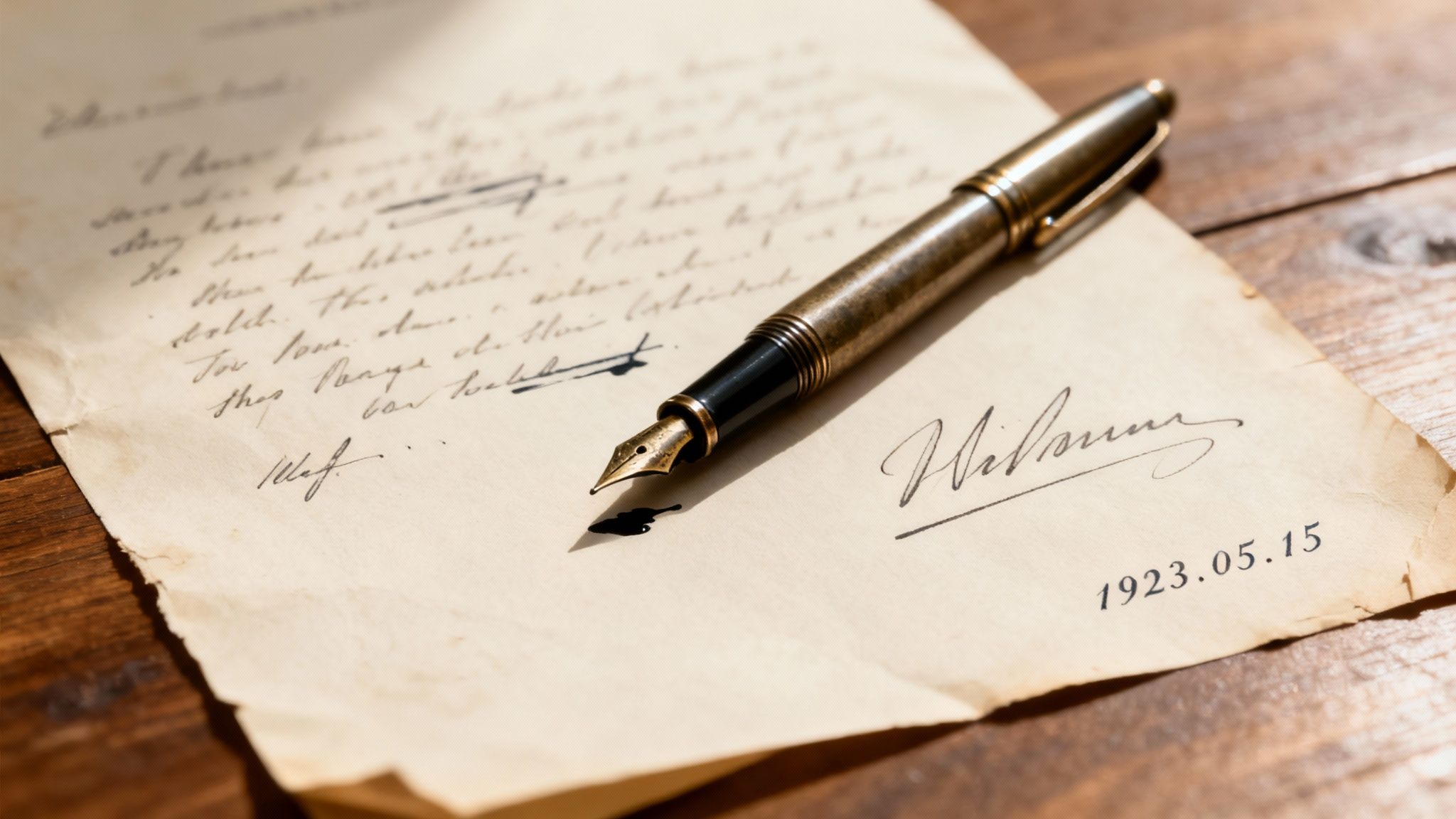
From legal contracts and personal letters to government proclamations and scientific patents, these documents offer raw data. For a screenwriter, a medieval charter can provide authentic dialogue. For a podcaster creating a true-crime series, examining original case files lends unparalleled authenticity. Every document you analyze adds a unique, high-value asset to your content library, ready to be repurposed.
How to Use Original Documents Effectively
To leverage these invaluable sources, creators must approach them with a critical and methodical eye. Authenticity is paramount, so always work with reputable archives like the National Archives or university special collections.
- Context is Key: Always consider the author's purpose, their intended audience, and the societal context in which the document was created. Thomas Jefferson’s private letters reveal different insights than his public declarations.
- Document Every Detail: Note the date, location, any edits, and the physical condition of the document. The material it's written on can be as telling as the words themselves.
- Cross-Reference: Never rely on a single document. Corroborate details with other primary sources to build a more complete and accurate picture. This practice is essential for establishing the credibility of your content. To delve deeper into this, explore what makes for a credible source of information.
- Verify Provenance: Understanding a document's history of ownership (its provenance) helps confirm its legitimacy and can uncover fascinating stories about its journey through time.
2. Interviews and Oral Histories
Interviews and oral histories capture the human element of the past, preserving memories, emotions, and personal perspectives that official documents often miss. These firsthand accounts, gathered through recorded conversations with individuals who witnessed or participated in historical events, are a powerful type of primary source that gives a voice to those whose stories might otherwise go unheard.

From the extensive archives of Holocaust survivor testimonies to the intimate reflections gathered by StoryCorps, these sources breathe life into history. For a YouTuber producing a series on a social movement, interviewing activists offers unparalleled narrative depth. Each interview becomes a rich asset in your content library, filled with quotes, anecdotes, and emotional beats you can reuse across platforms.
How to Use Interviews and Oral Histories Effectively
To harness the power of these personal narratives, creators must conduct and utilize them with care, ethical consideration, and rigor. The goal is to preserve a memory accurately while respecting the storyteller.
- Prepare and Be Flexible: Develop a structured questionnaire to guide the conversation but remain open to following unexpected and valuable tangents. The best insights often emerge from a natural, conversational flow.
- Prioritize Quality: Record in high-quality audio or video format using reliable equipment in a quiet, comfortable environment. This ensures the final product is clear and professional, preserving the nuances of the speaker's voice.
- Handle with Respect: Always obtain written consent and release forms before recording. Train interviewers in active listening and sensitivity, creating a safe space for subjects to share their stories. For a deeper look, you can explore the nuances of why an interview is a primary source.
- Document and Verify: Create detailed transcripts, ideally with timestamps, to make the content searchable and accessible. Whenever possible, cross-reference key facts, dates, and events mentioned in the interview with other primary sources to ensure accuracy.
3. Photographs and Visual Records
Photographs and other visual records are powerful primary sources that freeze a moment in time, offering an immediate and visceral connection to the past. These still images document events, people, places, and cultural conditions, providing visual evidence that can reveal details often absent from written accounts. They capture expressions, attire, and environmental context with a clarity that words alone cannot always convey.
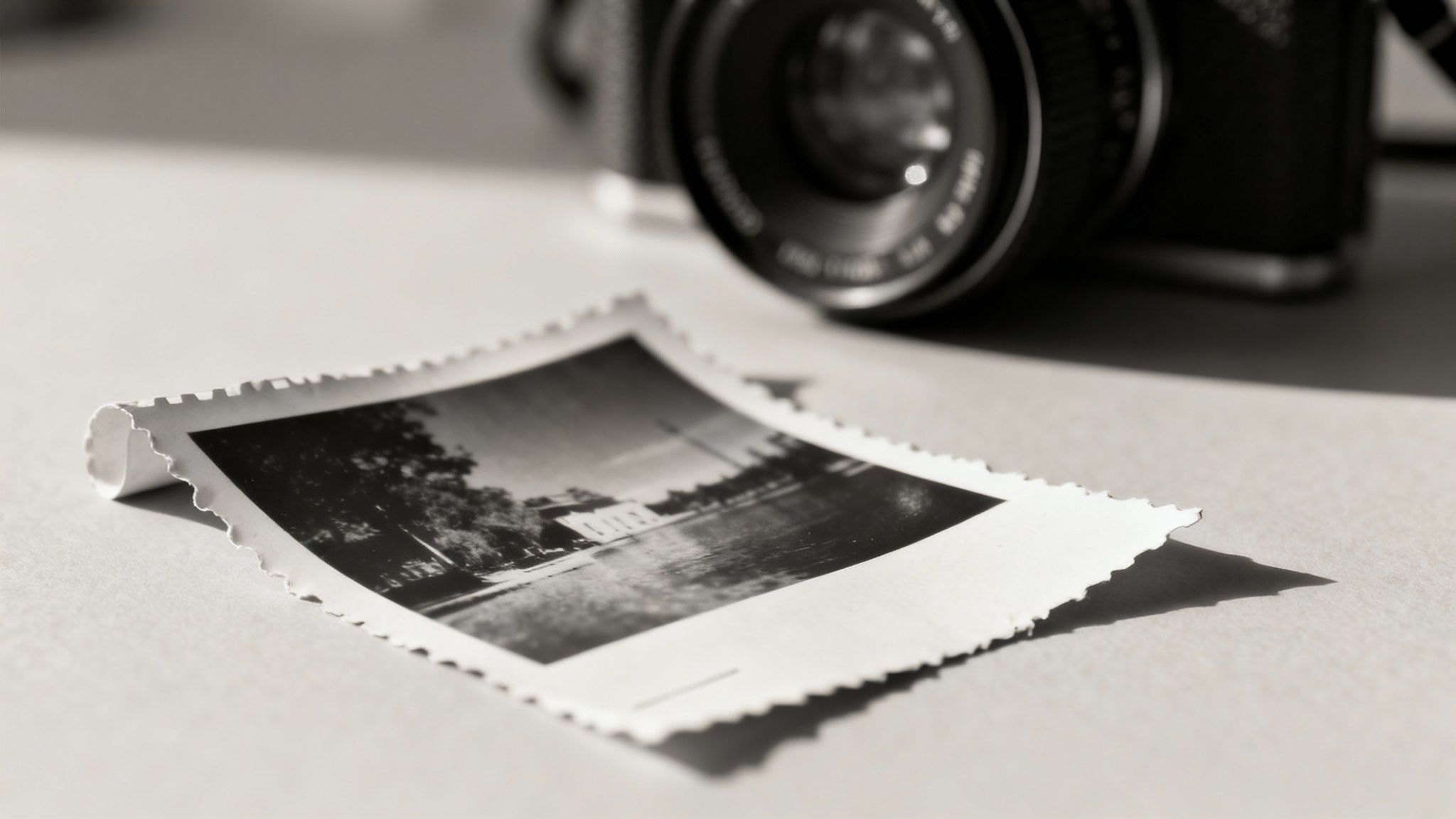
From Dorothea Lange’s stirring portraits of the Great Depression to Mathew Brady’s groundbreaking Civil War documentation, photographs offer raw, unfiltered glimpses into history. For a documentary filmmaker, NASA's Apollo mission photos provide iconic and authentic visuals. For a content marketer creating a historical blog post, Jacob Riis’s photos of tenement life in New York City offer compelling evidence that powerfully illustrates their narrative.
How to Use Photographs and Visual Records Effectively
To properly utilize these types of primary sources of information, creators must treat them as constructed narratives, not just objective snapshots of reality. Analyzing a photograph requires a blend of visual literacy and historical investigation.
- Analyze the Composition: Consider what is included in the frame and, just as importantly, what might be left out. The photographer's choices of angle, focus, and subject matter all shape the story the image tells.
- Investigate the Creator: Research the photographer’s background, purpose, and potential biases. Lewis Hine’s photographs of child labor were created with the specific social reform goal of exposing exploitation.
- Verify Provenance and Context: Confirm the date, location, and subject of the photograph whenever possible through captions, archives, or corroborating documents. Use tools like reverse image searches to trace an image’s online history and check for alterations.
- Examine the Physical Object: If possible, look at the original print or negative. The photographic process used (daguerreotype, tintype, etc.) and the physical condition can provide clues about its age and authenticity.
4. Artifacts and Physical Objects
Artifacts and physical objects are the tangible remnants of the past, offering direct material evidence of how people lived, worked, and interacted with their world. These items, from ancient pottery shards to industrial-era machinery, are primary sources that you can touch and see. They provide a physical connection to a historical period that written documents alone cannot replicate.
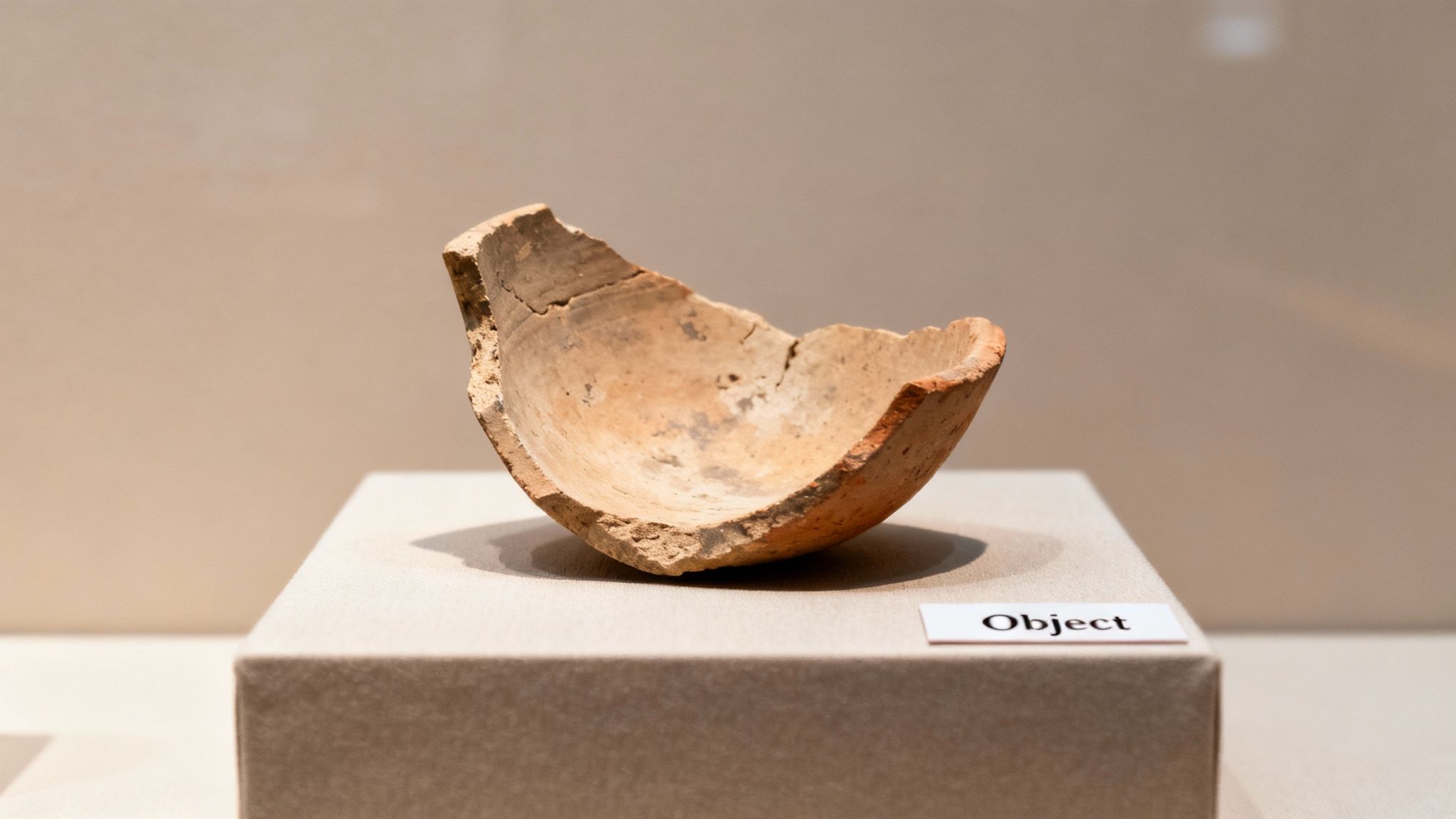
For a vlogger producing a documentary about the Vikings, examining burial artifacts like the Oseberg ship offers insights into their craftsmanship and beliefs. A historical novelist could study a soldier's uniform to describe details with sensory accuracy, bringing the narrative to life. These objects tell stories through their design and wear, providing unique details that can be the hook for your next viral video or podcast episode.
How to Use Artifacts and Physical Objects Effectively
Analyzing physical objects requires a hands-on, observational approach combined with rigorous documentation. Working with museums like the Metropolitan Museum of Art or consulting with archaeologists is crucial for proper interpretation.
- Document Context and Provenance: The value of an artifact is deeply tied to its original location (its context) and history of ownership (its provenance). Note precisely where it was found and who has owned it. This information is vital for authenticity and understanding its significance.
- Analyze Material and Construction: Examine what the object is made of and how it was created. This can reveal the technological capabilities, available resources, and artistic skills of the society that produced it.
- Use Non-Destructive Methods: Whenever possible, use analysis techniques like 3D scanning or X-ray fluorescence that do not damage the object. Preservation is paramount. Once identified, preserving these visual records is crucial for future research; learning how to preserve old photographs and other delicate items follows similar principles of care.
- Record with Scale: When photographing or sketching an object, always include a reference for scale. This helps viewers understand its actual size and proportions, which is essential for accurate representation in your content.
5. Government Records and Statistics
Government records and statistics are official documents and data sets produced by governmental bodies at local, state, and national levels. These sources provide systematic information about populations, policies, and official state actions, offering a large-scale, quantitative perspective that is often unavailable elsewhere. They are a cornerstone for understanding societal structures and historical trends.
From U.S. Census data mapping demographic shifts to military service records, these documents offer immense value. A blogger creating a data journalism piece on immigration could analyze Ellis Island records for patterns. A YouTuber could use legislative records and vital statistics to build a compelling visual narrative about policy changes over a century. These datasets are perfect for repurposing into infographics, charts, and short-form videos.
How to Use Government Records and Statistics Effectively
To use these powerful primary sources correctly, creators must understand their context, limitations, and the methodologies behind their creation. Official data is rarely neutral, so a critical approach is essential.
- Understand the Purpose: Always consider why the data was collected. Tax records were created for revenue, not social history, which influences the information included. This purpose shapes the entire dataset.
- Track Changes Over Time: Definitions and categories change. The definition of a "household" in the 1900 census is different from today. Be aware of these shifts to avoid making inaccurate comparisons across different eras.
- Acknowledge Gaps and Biases: Recognize that government data can be incomplete or biased. For example, early census records notoriously undercounted certain populations. Acknowledging these limitations strengthens your content's credibility.
- Corroborate with Other Sources: Use multiple government sources or cross-reference with other types of primary sources of information to verify details. Comparing census data with personal diaries or local newspapers can provide a richer, more nuanced understanding.
6. Newspapers and Contemporary Accounts
Newspapers and other contemporary accounts act as a time capsule, capturing the immediate reactions, public discourse, and prevailing attitudes of a specific era. As a type of primary source of information, they provide a snapshot of what society deemed newsworthy, offering a day-by-day record of events as they unfolded. These publications present information intended for a broad audience, reflecting the political, social, and cultural currents of their time.
For a content creator producing a documentary about the Gilded Age, analyzing advertisements and editorials from the era reveals invaluable details about consumer culture and public opinion. A podcaster investigating a historical event can trace how the initial reports in publications like the New York Times or the London Times evolved, offering a narrative arc for their episodes. Digital archives like the Library of Congress's Chronicling America project make these resources more accessible than ever.
How to Use Newspapers Effectively
To extract accurate and meaningful information, you must approach newspapers with a critical understanding of their context and inherent biases. They are products of their time, complete with the perspectives and limitations of their creators.
- Identify Bias and Perspective: Understand the newspaper's political affiliation, owner, and target audience. A story about a labor strike will be framed very differently in a pro-business paper versus a socialist publication.
- Corroborate Across Sources: Compare coverage of the same event in multiple newspapers, including those from different cities or political leanings. This helps verify facts and reveals how different communities interpreted the same events.
- Analyze Beyond the Headlines: Don't just read the main articles. Editorials, letters to the editor, and even classified ads provide a richer understanding of public sentiment, daily life, and economic conditions.
- Look for What Isn't There: Consider what events or perspectives are underreported or completely absent. The silence of the press on certain issues can be just as telling as what is printed, revealing societal biases and priorities.
7. Maps and Charts
Maps and charts are visual primary sources that offer unique insights into how people understood and organized their world. These cartographic materials represent geography, political boundaries, or demographic patterns, providing a spatial or quantitative snapshot of a specific time. They are not merely illustrations; they are arguments and narratives presented in visual form, showing relationships that text alone cannot convey.
These visual documents are invaluable for creators. A documentary filmmaker can use John Snow's 1854 cholera map to visually narrate the birth of modern epidemiology, while a historical fiction author can consult Civil War battle maps from the Library of Congress to plot troop movements with authentic detail. For a blogger explaining historical trade, a map of the Silk Road offers a far more immediate and compelling narrative tool than a lengthy description.
How to Use Maps and Charts Effectively
To extract accurate stories from these sources, creators must analyze them with a critical and informed perspective. Collections like the David Rumsey Historical Map Collection or the National Archives offer access to authenticated cartographic materials.
- Scrutinize the Creator and Purpose: Understand who made the map and why. Was it for military strategy, political propaganda, or scientific exploration? Mercator's world maps were designed for navigation, which intentionally distorts the size of landmasses near the poles.
- Decode the Visual Language: Pay close attention to the legend, symbols, scale, and compass rose. These elements are the key to interpreting the mapmaker's intended message and understanding the level of detail provided.
- Identify Distortions and Omissions: Every map is a simplification of reality. Consider what the cartographer chose to include, exclude, or emphasize. Political maps often contain biases that reflect the creator's worldview or nationalistic agenda.
- Contextualize with Other Sources: Use maps alongside written documents like journals, government records, or letters. A traveler's diary can provide rich narrative context for the route shown on a topographic exploration map, creating a more comprehensive story.
8. Audio and Video Recordings
Audio and video recordings are powerful types of primary sources of information that capture events, interviews, and performances with an immediacy that text cannot replicate. These sources preserve not just the words spoken, but also the tone, emotion, and visual context of a moment, offering a direct sensory connection to the past. They are invaluable for understanding the nuances of communication and the atmosphere of historical events.
For content creators, these recordings are a goldmine. A podcaster covering the Cold War can use clips from the Kennedy-Nixon debates to let listeners hear the candidates' differing styles firsthand. A YouTuber can use newsreels from the March on Washington to transport viewers directly into the crowd. These assets are endlessly reusable, providing audio clips for podcasts, video for documentaries, and transcripts for blog posts.
How to Use Audio and Video Recordings Effectively
To leverage these dynamic sources, creators must handle them with both technical care and critical analysis. The institutions that popularize these sources, like the BBC Archives and the Library of Congress, provide excellent models for preservation and documentation.
- Prioritize Preservation: Analog media like magnetic tape degrades over time. Work with reputable services to create high-quality digital copies and store them in multiple formats to prevent loss due to technological obsolescence.
- Document Meticulously: Create detailed metadata for each recording. Note the date, location, individuals involved, and any known edits or modifications. This context is crucial for accurate interpretation.
- Transcribe for Analysis: Working with audio and video can be time-consuming. Creating a written transcript allows for easier searching, citation, and detailed analysis of the content. For content found online, learning how to transcribe YouTube video to text can be an incredibly useful skill for researchers and creators alike.
- Question Everything: Consider the purpose behind the recording. Was it propaganda, news reporting, or a private home movie? Understanding the creator's intent and the technological limitations of the era will prevent misinterpretation. For a closer look at using transcripts in content creation, see how you can create a podcast transcript on Contesimal.ai.
9. Raw Research Datasets and Field Notes
Raw research datasets and field notes are the unprocessed, foundational evidence collected directly during scientific, social, or environmental inquiry. This type of primary source includes everything from a climate scientist’s raw weather station data to an anthropologist’s handwritten observations of a remote culture. These materials offer a transparent look at the building blocks of research before any analysis, interpretation, or formal publication.
These datasets are the bedrock upon which scientific conclusions are built, allowing for verification, reanalysis, and new discoveries. For a video creator producing a documentary on climate change, accessing raw data from NOAA or NASA provides the direct evidence needed to create compelling data visualizations. A historical author writing about Charles Darwin can consult his original field notes to understand his thought process as he formed his theories, adding immense depth to the narrative.
How to Use Raw Research Datasets and Field Notes Effectively
Working with raw data requires a meticulous and organized approach to ensure accuracy and respect for the scientific process. The rise of the Open Science movement has made many datasets accessible through repositories like Zenodo and Figshare.
- Understand the Methodology: Before using any data, you must understand how it was collected. Read the accompanying documentation, codebooks, or README files to grasp the methods, instruments used, and any potential limitations.
- Prioritize Metadata: A dataset without its metadata (data about the data) is almost useless. Look for data dictionaries that explain what each variable and value represents. This context is crucial for accurate interpretation.
- Respect Privacy and Ethics: When working with data involving human subjects, such as survey responses or clinical trial records, ensure all sensitive personal information has been properly redacted or anonymized to protect participant privacy.
- Cite Your Sources: Just like any other primary source, datasets must be cited properly. Repositories often provide a specific citation format, giving credit to the original researchers and ensuring your audience can trace your work back to its source.
10. Personal Papers, Diaries, and Letters
Personal papers, diaries, and letters offer some of the most intimate and humanizing types of primary sources of information. These private records were created for personal reflection or close correspondence, not for public consumption. They provide an unfiltered look into the private thoughts, daily routines, emotions, and personal biases of individuals, revealing a perspective often hidden in more formal documents.
From the poignant entries in The Diary of a Young Girl by Anne Frank to the detailed societal observations in Samuel Pepys' diary, these sources bring history to life on a personal level. For a filmmaker, a collection of Civil War soldier letters can provide the emotional core of the narrative. A blogger can use the private journals of someone like Virginia Woolf to offer fresh insights into her creative process, creating content that can be repurposed into social media quotes, podcast segments, or video essays.
How to Use Personal Papers, Diaries, and Letters Effectively
To responsibly use these deeply personal sources, creators must balance historical inquiry with ethical sensitivity. Accessing these materials often requires visiting special collections at institutions like The Huntington Library or university archives.
- Understand Context and Personality: Read extensively to grasp the author's voice, personality, and the specific circumstances of their life. An entry written in a moment of crisis will have a different tone than one written during a time of peace.
- Note the Details: Pay close attention to dates, locations, and any mentions of contemporary events. These details help place the personal account within a broader historical framework.
- Consider the Audience: Even private diaries can have an intended audience, sometimes the future self or a trusted confidant. Considering this helps interpret the author’s level of honesty and what they might have omitted.
- Cross-Reference for a Fuller Picture: Compare one person's diary entries with letters from their contemporaries or other primary sources to validate events and understand different perspectives on the same situation.
10 Primary Source Types Compared
| Source | Implementation complexity | Resource requirements | Expected outcomes | Ideal use cases | Key advantages |
|---|---|---|---|---|---|
| Original Documents | Moderate–High (authentication, paleography) | Archive access, conservation, specialist skills | Authenticated contemporary evidence | Provenance, legal evidence, language analysis | Unmediated original testimony; high authenticity |
| Interviews and Oral Histories | Moderate (planning, ethics, interviewing skill) | Recording equipment, trained interviewer, consent forms | Firsthand memories, emotions, personal narratives | Social history, marginalized voices, memory studies | Rich personal perspective and nuance |
| Photographs and Visual Records | Low–Moderate (provenance, restoration) | Digitization, metadata, proper storage | Visual snapshots of people, places, events | Visual analysis, identification, comparative studies | Immediate visual detail; spatial/context cues |
| Artifacts and Physical Objects | High (excavation, conservation) | Conservation labs, climate-controlled storage, scientific testing | Material culture insights; technological evidence | Archaeology, technology history, everyday life studies | Tangible evidence of use, materials, craftsmanship |
| Government Records and Statistics | Moderate (access, interpretation) | Databases, statistical tools, archival retrieval | Systematic demographic and administrative data | Demographic, economic, policy and longitudinal analysis | Large-scale, comparable empirical datasets |
| Newspapers and Contemporary Accounts | Low–Moderate (bias assessment, verification) | Newspaper archives, digitized collections | Contemporaneous reporting and public opinion | Media studies, event chronology, public sentiment | Immediate public perspective; trace story development |
| Maps and Charts | Moderate (projections, cartographic interpretation) | Map archives, GIS tools, cartographic expertise | Spatial relationships and temporal change visuals | Historical geography, territorial/boundary analysis | Clear spatial visualization of data and change |
| Audio and Video Recordings | Moderate–High (format obsolescence, authentication) | Playback/digitization equipment, large storage, metadata | Aural/visual context, speeches, performances | Speech analysis, broadcast events, cultural studies | Preserves tone, movement, and real-time context |
| Raw Research Datasets and Field Notes | High (curation, metadata, standardization) | Data management, repositories, domain expertise | Reproducible data and detailed methodology | Replication studies, meta-analysis, methods review | Transparency, ability to reanalyze and verify results |
| Personal Papers, Diaries, and Letters | Moderate (contextualization, privacy issues) | Archive access, transcription, contextual research | Intimate perspectives, daily-life details, networks | Microhistory, biography, social and emotional studies | Private, candid insight into motives and daily life |
Turn Your Research Into Revenue: Organize, Understand, and Take Action
You have now journeyed through the vast and varied landscape of primary source materials. From the tactile authority of original documents to the vivid immediacy of audio recordings, you've seen how these raw ingredients form the bedrock of compelling, authentic content. We've explored ten distinct types of primary sources of information, each offering a unique portal into the past and a powerful tool for storytelling.
But the journey doesn't end with discovery. For professional creators, YouTubers, authors, and marketers, the real work begins after you've gathered your materials. The challenge is no longer just finding a source; it's about managing an ever-growing library of them. Every interview transcript, government statistic, and archival photograph you collect becomes part of a valuable, yet complex, content asset.
From Collection to Creation: The Professional Leap
Transitioning from a hobbyist to a revenue-generating professional is marked by how you manage and leverage your research. A scattered collection of files on a hard drive is a passive archive. An organized, searchable, and interconnected knowledge base, however, is an active engine for creation. This is where you upcycle your old content and create new value.
Consider the immense potential locked within your existing library:
- An oral history transcript might contain the perfect soundbite for a podcast intro and a dozen quotes for social media.
- A raw dataset from a government report could be visualized into a compelling infographic for your blog.
- A detail from an old map could become the central plot point for your next screenplay or YouTube series.
Without a system to organize, understand, and act upon this information, these opportunities remain buried. The key is to build a process where you and your team can instantly find connections, rediscover forgotten insights, and collaborate to bring new ideas to life.
Activating Your Archive for Infinite Value
The true power of mastering the different types of primary sources of information lies in your ability to synthesize and repurpose them. This means creating a single source of truth where your research isn't just stored, it's understood. Imagine being able to ask your content library, "Show me every mention of 'Project Bluebird' across all my interview transcripts and declassified documents," and getting an answer in seconds.
This level of organization transforms your workflow and unlocks new revenue streams. Instead of starting every new project from scratch, you can dip back into your curated well of information to:
- Repurpose with Precision: Quickly find related materials to turn a successful YouTube video into a detailed blog post series or a podcast season.
- Discover New Angles: Identify thematic links between seemingly unrelated sources to spark your next viral concept or book chapter.
- Collaborate Seamlessly: Give your team access to a centralized library, ensuring everyone is working from the same high-quality source material.
By systematically organizing your primary sources, you aren't just tidying up your digital workspace. You are reigniting your content library, turning a static collection of files into a dynamic asset that generates infinite value. The goal is clear: Organize your research, Understand the deep connections within it, and Take Action to create groundbreaking content that captivates your audience and makes money.
Ready to transform your scattered research into a powerful, revenue-generating content engine? Contesimal is the platform designed for creators who want to organize, understand, and monetize their content libraries. Stop losing valuable insights in disorganized folders and start collaborating with your own intelligent archive by visiting Contesimal to see how it works.