
Think of a video content management system as less of a storage locker and more of a mission control for your entire video library. It’s a powerful system designed to help you organize, find, analyze, and—most importantly—repurpose every single clip you've ever created. It’s the brain behind the brawn of your video assets, helping you upcycle your old content and create infinite new value.
Your Video Library Is an Untapped Goldmine
Does your video archive feel like a messy attic packed with forgotten treasures? You know there’s value in there—that killer clip from an old interview, amazing B-roll from a project two years back, or a full-length webinar just brimming with potential. But finding and using it feels like an impossible task. If that sounds familiar, you’re not alone.
This feeling of digital clutter is a sure sign you've outgrown basic cloud storage. As you move from hobbyist into a revenue-generating professional creator, or as your company’s marketing gets more serious, that collection of files becomes a legitimate business asset. The challenge is no longer just about storing content; it’s about strategically managing it to reignite your library and bring it back to life.
From Storage Problem to Strategic Asset
Every hour of footage you own represents a serious investment of time, money, and creative energy. Letting it gather digital dust in a folder is like burying gold in your backyard. A video content management system (VCMS) is the map and shovel you need to unearth all that hidden value. It completely reframes your archive—it’s not a storage problem anymore, but a goldmine of potential just waiting to be tapped so you can make money with it.
A VCMS allows you to Organize, Understand, and Take Action on your content. It’s the first step to reviving your old videos, creating new value, and turning historical assets into your next money-maker.
Putting a dedicated system in place creates a structured environment where every single piece of content is discoverable and ready for action. This is a game-changer for anyone who wants to make their content work harder. Instead of constantly starting from scratch, you can build on the great work you’ve already done. For a deeper dive, check out our guide on maximizing ROI by transforming your content library for lasting value.
This structured approach is crucial for:
- YouTubers and Podcasters: Instantly finding old clips to slice into Shorts, Reels, or "best of" compilations to generate more audience across platforms.
- Content Marketers: Turning one longform piece of content into dozens of social media posts, blog snippets, and email campaigns across platforms in one click.
- Publishers and Editors: Giving teams a central, searchable archive so they can collaborate on video projects instead of hunting for files, helping them move beyond working alone.
Ultimately, a VCMS lets you stop searching and start creating. It turns your content library from a passive backlog into an active, money-making engine that fuels your growth and keeps your audience engaged.
Understanding Your Video Content Management System
So, what exactly is a video content management system? Let’s cut through the jargon. Think of it as a super-smart librarian for your entire video collection, but one that does way more than just put things on a shelf.
It’s a common mistake to lump a VCMS in with simple cloud storage like Dropbox or Google Drive. Those are great for holding files, sure. A VCMS, on the other hand, actively works with your content to unlock its hidden potential. This digital librarian doesn't just shelve your videos; it watches every single one. It automatically transcribes the dialogue, pinpoints key moments, and applies smart tags, making every second of your footage instantly searchable and ready for action.
This system gives you a solid framework for the entire video lifecycle. It handles everything from the initial upload and organization to long-term management, repurposing, and monetization. For creators looking to scale from a hobby into a real business, it’s the foundational tool that makes it all possible.
From Disorganized Archive to Actionable Asset
Without a proper system, your growing library quickly becomes a digital junk drawer. You know valuable clips are in there somewhere, but finding them when you need them is a nightmare. A VCMS transforms this chaos into a highly organized, strategic asset.
The flowchart below shows how a VCMS is the key to unlocking the value trapped in your video archive.
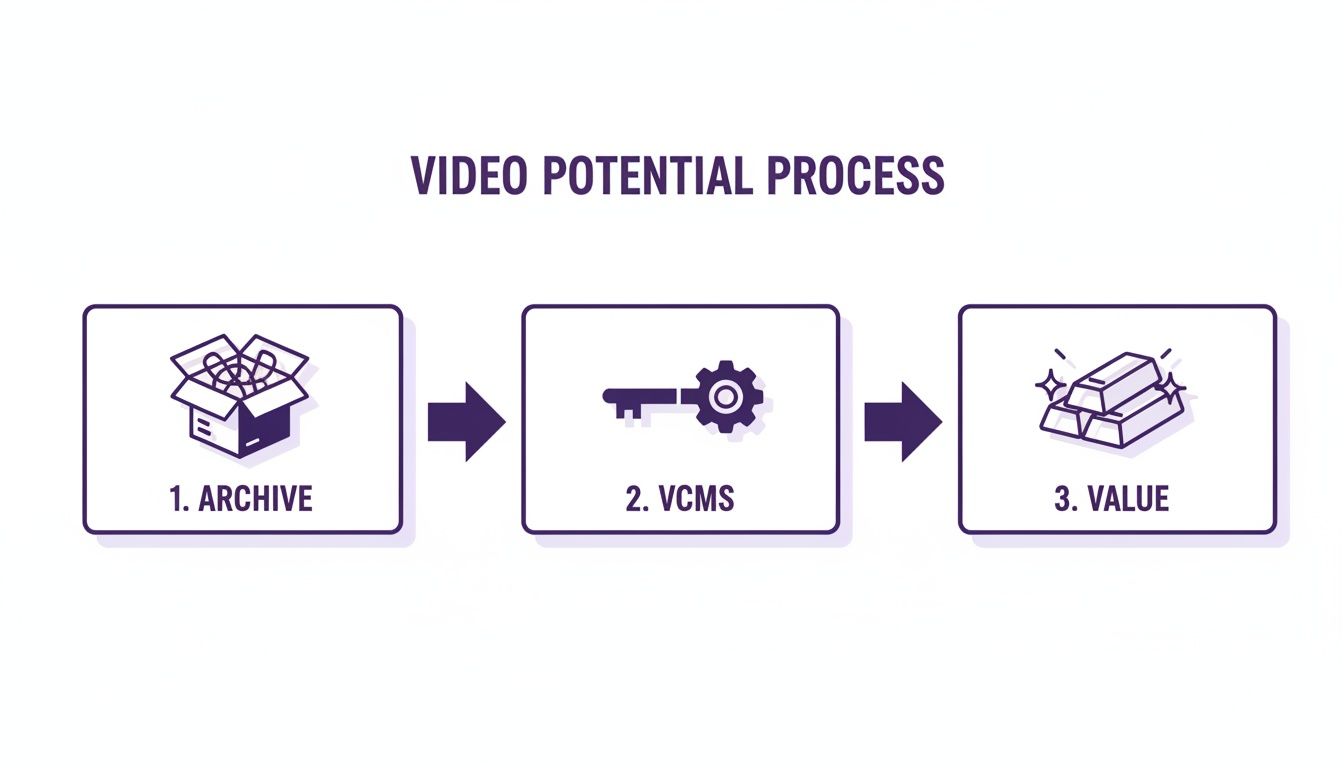
This simple flow nails the core purpose of a VCMS: to systematically turn disorganized historical content into a tangible, valuable resource for your brand.
The demand for these systems is surging for a reason. The global video content management system market was valued at USD 23.57 billion in 2025 and is projected to skyrocket to USD 113 billion by 2032. That’s a blistering 25% compound annual growth rate. This explosion shows how creators and businesses worldwide are scrambling to manage the massive influx of video. The shift really kicked into high gear after 2020, when a 300% jump in live stream viewership forced companies to get serious about their systems for communication and marketing.
The Foundational Pillars of a VCMS
A true video content management system is built on several key pillars that set it far apart from basic storage. These aren't just features; they're solutions to the real-world problems that growing creators and content teams face every single day.
- Intelligent Ingestion: It seamlessly handles just about any video format you throw at it, automatically preparing files for management and distribution without you having to mess with manual conversions.
- Deep Searchability: Instead of just searching file names, you can search the actual spoken words inside your videos. Finding a specific quote or topic now takes seconds, not hours.
- Rich Metadata and Taxonomy: The system automatically creates a rich layer of data—like tags, categories, and even sentiment—that helps you understand your content on a much deeper level.
- Collaboration and Workflow: It provides a central hub where team members can work on projects, share feedback, and manage versions without getting lost in endless email chains. This is essential for creators who are starting to bring more people in to grow.
- Monetization and Distribution: A VCMS simplifies getting your content onto multiple platforms and can integrate with monetization tools to help you turn your old longform content into a money-maker.
These elements work together to create a powerful engine for your content operations. For a comprehensive overview, from strategic planning to successful implementation, check out this complete guide to video content management systems. By embracing this technology, you’re not just organizing files; you’re building a scalable foundation for future growth.
Core Features That Power a Modern VCMS
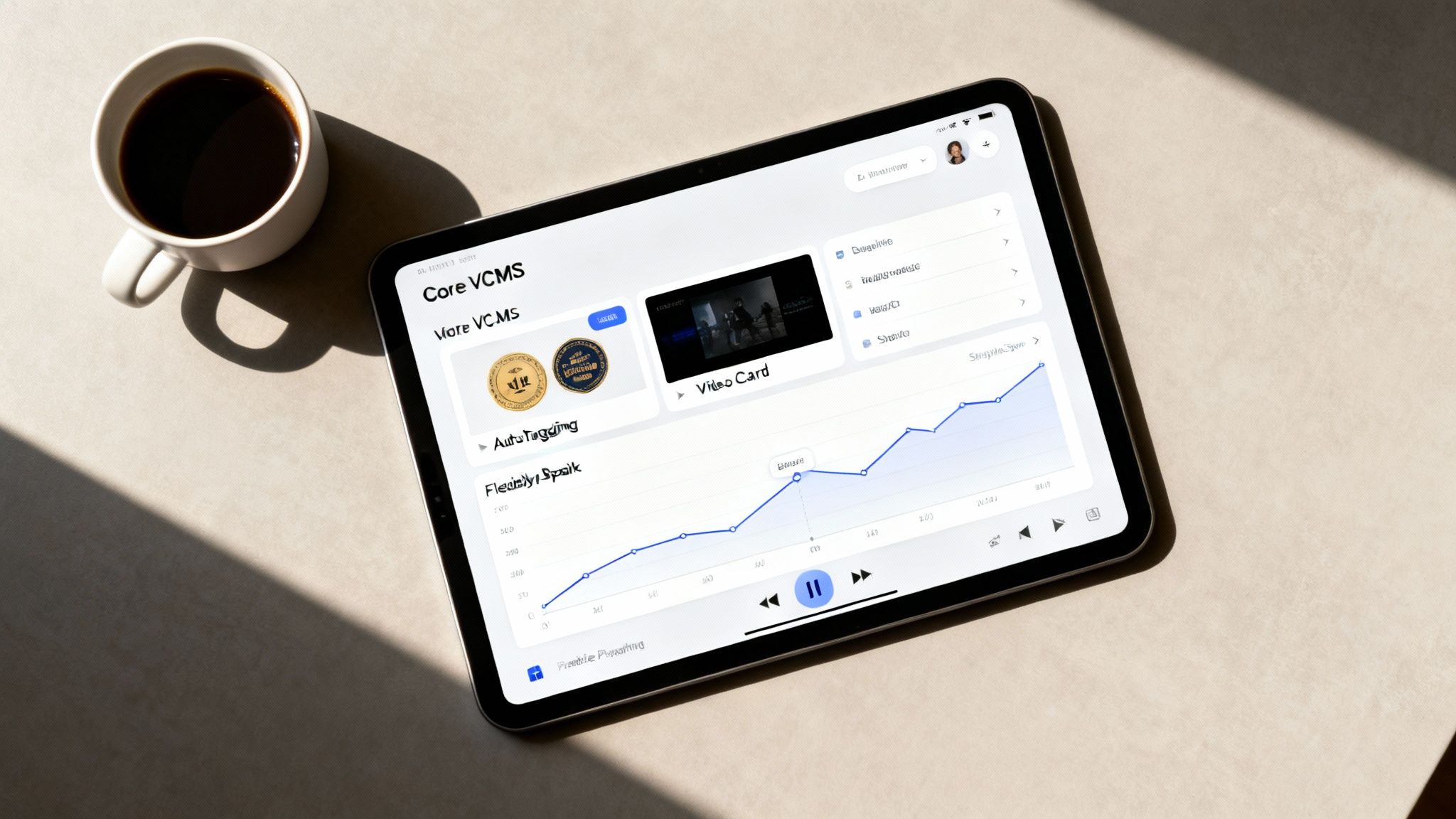
To really get what a video content management system does, you have to look under the hood. It’s the purpose-built tools that turn a pile of video files into a living, breathing content engine. These features are designed to fix the real-world headaches that slow down growing creators and content teams.
Think of it this way: basic cloud storage is like a digital shoebox. You can toss things in, but good luck finding what you need later. A VCMS, on the other hand, is more like a sophisticated workbench, giving you the power to organize, dissect, and reassemble your work into something totally new. Let's break down the essential components every modern VCMS needs.
Seamless Video Ingestion and Transcoding
First things first, a VCMS has to get your content into the system without a fight. A solid ingestion engine will take just about any video format you throw at it—from massive 8K camera files to tiny compressed web clips—and handle the upload automatically.
From there, it kicks off transcoding. This is just a fancy word for converting your video into a bunch of different formats and resolutions. Why does this matter? It ensures your audience gets smooth playback whether they’re on a giant 4K monitor or a smartphone with a shaky connection. This one automated step saves countless hours of mind-numbing manual file conversion.
Intelligent Metadata and Auto-Tagging
This is where a VCMS really starts to flex its muscles. Metadata is just the descriptive info attached to your videos, but it's the secret sauce that makes your content library searchable. A modern system handles most of this for you.
- Automatic Transcription: The system literally "listens" to your videos and spits out a full, time-stamped text transcript. Suddenly, every single word spoken becomes searchable.
- AI-Powered Tagging: The platform can identify objects, people, and even abstract concepts within your footage, applying relevant tags without you lifting a finger.
- Custom Taxonomies: You get to build your own system of categories and keywords, organizing your library around the topics, campaigns, or products that actually matter to your business.
This rich layer of data is what lets you find that one specific clip in seconds. If you're managing more than just video, learning about the best digital asset management software can give you a bigger picture of how to organize all your creative files.
A great VCMS doesn't just store your video; it understands it. By creating a deep, searchable web of metadata, it turns your entire library into an intelligent, interconnected database.
Powerful Search and Discovery
Once all that rich metadata is in place, the search bar becomes your creative superpower. Forget digging through folders and trying to remember vague file names like Final_Video_v3.mp4. A proper VCMS lets you search your content based on what's inside it.
Imagine you’re a podcaster trying to figure out how to create your next new video. You need a clip where you talked about "audience growth strategies." Just type that phrase into the search bar. The system will instantly find every single video where those words were spoken and even show you the exact timestamp. This completely changes how you use your back catalog, turning a passive archive into an active resource for your next great idea.
The VCMS Advantage Over Basic Storage
Trying to compare a dedicated VCMS to standard cloud storage is like comparing a race car to a shopping cart. Sure, they both have wheels, but they’re built for entirely different purposes. One is for passive holding; the other is for active creation and management.
Here's a quick look at the major differences.
Standard Cloud Storage vs. Video Content Management System
| Feature | Standard Cloud Storage | Video Content Management System (VCMS) |
|---|---|---|
| Searchability | Limited to file names and folder structures. | Deep search of spoken words, on-screen text, and AI-generated tags. |
| Organization | Manual sorting into folders. | Automated tagging, custom categories, and intelligent taxonomies. |
| Playback | Basic file preview, often requires downloading. | Optimized, adaptive bitrate streaming with a customizable player. |
| Collaboration | Limited to file sharing and basic comments. | Centralized workflows, version control, and team permissions. |
| Analytics | Tracks file downloads and access only. | Detailed viewer engagement metrics, like watch time and drop-off points. |
As you can see, there's really no contest for serious video work. A VCMS provides a robust foundation for growth, collaboration, and eventually, monetization. These features work together to help you finally reignite your content library and create infinite new value from the assets you already own.
Where AI Fits into Video Management

If a traditional video content management system is a super-organized librarian, then an AI-powered one is a creative collaborator. AI elevates a VCMS from a simple storage tool to an active partner in your content process. It helps humans and AI collaborate in a healthy way, supercharging your ability to understand, find, and reuse your video content at a scale that just wasn't possible before.
This isn't about replacing human creativity; it’s about augmenting it. AI takes on the tedious, repetitive tasks that bog you down, freeing you to focus on strategy and storytelling. It can analyze your entire library in minutes, surfacing connections and opportunities that would take a human team weeks to find.
AI as Your Creative Co-Pilot
Modern AI-driven platforms act as an intelligent layer on top of your video archive, making your entire library interactive. This is where the real magic happens for YouTubers, podcasters, and marketers who need to squeeze more value from their existing assets. These platforms offer features that fundamentally change your workflow.
Here’s what that looks like in practice:
- Automated Transcription & Translation: AI accurately turns spoken words into text, making every second of your video library searchable. It can also translate this text, instantly opening your work up to a global audience.
- Intelligent Chaptering: For long-form content like webinars or podcasts, AI can identify distinct topics and automatically create chapters. This makes your content way easier for viewers to navigate and for you to repurpose.
- Instant Highlight Generation: AI can analyze content and engagement patterns to pinpoint the most compelling, shareable moments in your videos. This turns the hours-long task of creating social clips into a one-click process.
Talking to Your Content Library
Perhaps the biggest shift is how AI lets you build rich, layered taxonomies. This allows you to essentially "talk" to your content library. Instead of just searching for keywords, you can ask your video content management system more complex questions to find inspiration or specific clips. You're no longer just managing files; you're interacting with a body of knowledge.
The growth here is undeniable. The video management systems market is expected to be worth USD 20.60 billion in 2025 and is projected to hit USD 108.77 billion by 2034. A major driver of this 20.31% annual growth rate is the integration of AI for tasks like transcoding and analytics. This evolution helps creators and marketers turn dusty archives into powerful engagement boosters and new revenue streams.
With AI, your VCMS becomes less like a filing cabinet and more like a research assistant. It actively helps you discover patterns, connect ideas, and generate new content from your historical work.
For a deeper dive into specific functions, understanding the difference between AI video notes versus AI video summaries can really help optimize your workflows.
Let's imagine a real-world scenario. A podcaster wants to create a highlight reel of every time they mentioned "brand building" across 200 episodes. Manually, this is a nightmare—a task that could take days of scrubbing through footage.
With an AI-powered VCMS, they simply type in the phrase. The system instantly pulls every relevant clip, complete with transcripts and timestamps, ready to be edited into a new compilation video. The task is done in minutes.
This is the power AI brings to video management. It's a critical component for platforms like Contesimal, which are built to help you organize, understand, and act on your content library. Exploring the capabilities of content intelligence platforms can further illuminate how these tools work. AI turns your archive into a dynamic, responsive asset, ready to fuel your next big idea.
Practical Ways to Use Your VCMS
Theory is fine, but a video content management system (VCMS) really shows its muscle when you see it in action. This isn't just about tidying up your files; it’s about unlocking new opportunities and bulldozing the frustrating, time-sucking problems that every creator runs into. Let's walk through a few real-world situations where a VCMS becomes the most valuable player on your team.
For most creators, the biggest headache is figuring out how to make more content without completely burning out. A VCMS tackles this head-on by turning your existing library into an active partner. Instead of seeing old videos as dusty relics, you start seeing them as a treasure chest of reusable clips, quotes, and ideas for your next big project.
This isn't just a niche idea—it's a massive shift. The cloud-based video content management market is projected to hit USD 35.67 billion in 2025 and rocket to USD 93.13 billion by 2035. That growth is being driven by smarter AI and the relentless demand for video. As this full analysis of the video content management market points out, creators are turning their archives into collaborative hubs where human creativity and AI get things done faster.
For YouTubers and Podcasters
Okay, imagine you’re a YouTuber with a backlog of 150 long-form videos. You know you need to be on TikTok and Reels, but the thought of scrubbing through hundreds of hours of your own footage to find a few good clips makes you want to take a nap.
- The Problem: Finding that perfect 30-second soundbite or a killer visual moment feels like digging for a needle in a haystack. It’s a slow, manual grind that completely drains your creative energy.
- The VCMS Solution: With an AI-powered system, you just type in a phrase like "the biggest mistake new creators make." Boom. The system instantly serves up every single time you’ve said that, complete with timestamps. You can crank out a dozen social-ready clips in minutes, not days. You might even spot a recurring theme you can turn into your next full-length video by running buckets or playlists to build on a successful concept.
For Content Marketers and Publishers
Now, let's say you're a content marketer at a company that’s growing fast. You just wrapped up a killer hour-long webinar and need to squeeze every drop of value out of it. The whole team needs to be on the same page, and you need to know what’s actually working.
- The Problem: Your webinar recording is on one person’s laptop, the transcript is in a Google Doc somewhere, and the slides are in another folder. It's chaos. There's no single source of truth, so tracking performance is basically a guessing game.
- The VCMS Solution: The webinar gets uploaded once to the central VCMS. From that single file, the whole team can get to work.
- The social media manager uses AI-suggested highlights to create ten short clips for LinkedIn and X.
- The blog writer grabs direct quotes from the auto-generated transcript to flesh out a summary article.
- The email marketer yanks a powerful statistic you mentioned to use as a hook in the next newsletter.
A VCMS becomes the central nervous system for your content engine. It helps align content across many platforms, ensuring everyone is pulling from the same approved material and giving you the analytics to see which clips are actually getting engagement so you can make smarter content next time.
For Researchers and Screenwriters
Finally, think about a documentary filmmaker sifting through hundreds of hours of interviews and old footage. They need to find specific moments to piece together a story that’s both compelling and factually accurate.
- The Problem: Manually logging all that footage is a soul-crushing task that’s begging for human error. Trying to find one specific quote from an interview you shot six months ago could burn an entire day.
- The VCMS Solution: Every video is ingested and automatically transcribed. The creator can now search their entire archive for names, places, or keywords like "uncovered evidence." The system acts like their personal research assistant, letting them pull all the relevant clips together instantly. What used to take weeks of painstaking work can now get done in an afternoon.
VCMS Questions We Hear All The Time
Even after you get the big picture, the practical, day-to-day questions start popping up. We get it. Let’s tackle some of the most common ones we hear from creators and marketers, with straightforward answers to show you exactly how a VCMS can fit into your world.
How Is This Different from Just Using YouTube or Vimeo?
Great question. Think of YouTube and Vimeo as your public-facing digital storefronts. They are fantastic distribution platforms built to get your finished videos in front of as many people as possible.
A VCMS, on the other hand, is your private production studio and intelligent library. It’s the behind-the-scenes powerhouse where all the messy, heavy lifting happens before you ever hit publish. We’re talking deep-diving search, metadata management, team collaboration, and slicing and dicing content for new purposes. It’s where you organize your raw footage and finished assets to create new value in ways public platforms just aren't built for.
Is a VCMS Only for Giant Media Companies?
Not anymore. That used to be the case, but the game has changed. While massive enterprises have relied on these systems for years, modern cloud-based platforms have made a VCMS accessible and affordable for individual creators, small teams, and growing businesses.
If you have a video library that’s starting to feel unwieldy and you want to scale up, repurpose clips efficiently, or even monetize your archive, a VCMS is a smart move. It's especially true when you're making that jump from a hobby to a real, revenue-generating business.
For solo creators and small teams, a VCMS isn't an expense; it's a force multiplier. It automates the organizational work that would otherwise require hiring another person, letting you focus on creating.
What's the First Step to Getting Started with a VCMS?
Start by finding your single biggest headache. Seriously, don’t try to boil the ocean and solve every problem at once. Just pinpoint your most frustrating operational pain point.
- Is it the soul-crushing time it takes to find old clips?
- Is it turning that one-hour podcast into 15 social media shorts?
- Is it the back-and-forth chaos of working with an editor or VA?
Once you’ve nailed down your top priority, you can find a VCMS that really shines in that one area. Most modern systems make getting started a breeze with simple drag-and-drop uploads. Just grab a small batch of your most valuable content, learn the ropes with that, and you’ll see an immediate, tangible impact on how you work.
Ready to stop searching and start creating? Contesimal is an AI-powered platform designed to help you unlock the hidden value in your video library. Organize your content, collaborate seamlessly, and turn your historical assets into your next big idea. Learn how Contesimal can reignite your content library today.