
So, you've got a mountain of videos, podcasts, and articles you've created over the years. Feels good, right? But let's be honest, finding that one specific clip or that killer quote from two years ago is probably a nightmare. This is where most creators, YouTubers, and podcasters hit a wall. You're sitting on a goldmine of your own work but have no map to find the treasure.
This is exactly why we need to talk about Knowledge Management Systems (KMS). Forget the stuffy corporate jargon you might be thinking of. For a content creator, a KMS is less like a filing cabinet and more like a second brain—one that remembers every single brilliant idea you've ever had and can pull it up in an instant. It's the tool that helps you organize your library, understand your content, and take action to create new value.
Your Content Library: From Digital Attic to Idea Engine
If you’re a professional creator, you're not just making content; you're building a massive knowledge asset. The problem is, without a system, that asset feels more like a cluttered digital attic than a strategic library. Your work is probably scattered across a dozen folders and drives, making it almost impossible to connect the dots between projects or collaborate with your team.
A KMS completely flips that script. It’s a tool that transforms your messy archive into a smart, searchable hub. Think of it as a dynamic engine for your creativity, not just a static place to dump old files. A KMS is designed to reignite your content library and bring it to life, allowing humans and AI to collaborate seamlessly.
Here’s how it changes the game:
- It brings everything together. All your videos, audio files, and articles finally live in one unified place. No more frantic searching.
- It understands your content. A good KMS doesn't just see file names. It dives into your content, automatically tagging topics, identifying speakers, and linking related ideas.
- It makes discovery instant. You get a powerful search engine for your own work. Need to find every time you mentioned a specific topic? Done in seconds.
A well-organized content library isn’t just about being tidy; it’s about unlocking potential. It turns your past work from a passive archive into an active engine for new ideas, faster creation, and smarter collaboration.
To give you a clearer picture, let's break down the core functions of a KMS and what they actually mean for your day-to-day workflow.
Knowledge Management System At a Glance
This table breaks down core KMS functions and what they mean for your creative workflow.
| Core KMS Function | What It Means for You | Real-World Example |
|---|---|---|
| Data Ingestion | Effortlessly pulls in all your content—videos from YouTube, podcast episodes, blog posts—into one central hub. | Automatically importing your entire podcast backlog into the system without you lifting a finger. |
| Classification | Automatically analyzes and tags your content by topic, theme, and keywords, so you don't have to do it manually. | Tagging all video clips where you discuss "audience growth" or "monetization strategies" without manual review. |
| Taxonomy & Ontology | Creates a structured "map" of your knowledge, showing how different concepts and pieces of content relate to each other. | Seeing that your content on "SEO" is closely related to "keyword research" and "content marketing." |
| Search & Retrieval | Lets you find any specific moment, quote, or piece of information across your entire library in seconds. | Searching for a specific guest's name and instantly finding every clip where they spoke across all your episodes. |
| Collaboration | Allows your team to access, share, and build upon the same pool of knowledge, ensuring everyone is on the same page. | Your video editor quickly finds approved B-roll footage that your producer uploaded last month. |
| Content Repurposing | Makes it easy to find related clips, quotes, and ideas to quickly create new content from your existing work. | Pulling three short, powerful clips from a long-form interview to create a viral Reel for Instagram. |
Ultimately, a KMS stops your best work from fading into obscurity. Instead of starting from scratch every time, you get to build on the solid foundation you've already laid. This is where the real magic happens—rediscovering old gems and turning them into fresh content. You can learn more about the art of mining your content library for fresh ideas to see just how powerful this can be. A KMS is the tool that makes this process not just possible, but easy.
How a Modern Knowledge Management System Works
So, what actually happens when you decide to stop letting your brilliant content collect digital dust? A modern knowledge management system steps in as a kind of hyper-efficient digital librarian, working behind the scenes to turn chaos into clarity. This isn’t about intimidating tech; it’s a logical, step-by-step process designed to make your life as a creator, writer, or publisher a whole lot easier.
Understanding this flow is the key to unlocking its power. The process starts by gathering your raw materials, then intelligently sorting them, and finally, making every single insight instantly discoverable. It’s the engine that transforms a messy folder of files into a living, interconnected library of your own knowledge.
Content Ingestion: The First Step
The journey begins with content ingestion. Think of this as the system’s front door. It hooks into wherever you store your work—YouTube channels, podcast hosts, cloud drives—and pulls everything into one central hub. But this is far more than a simple file transfer; it's where the initial magic kicks in.
As soon as your files arrive, the system gets to work. For a video creator, this means every video is automatically transcribed. For a podcaster, every spoken word in every episode is converted into text. This is a critical first step because it unlocks all the valuable information trapped inside your multimedia files, turning it into text-based data the system can actually read and understand.
Without solid ingestion and transcription, your video and audio content might as well be locked in a vault. This foundational process sets the stage for everything that follows.
This simple flow chart shows how a KMS takes your disorganized files and turns them into a structured, valuable library.
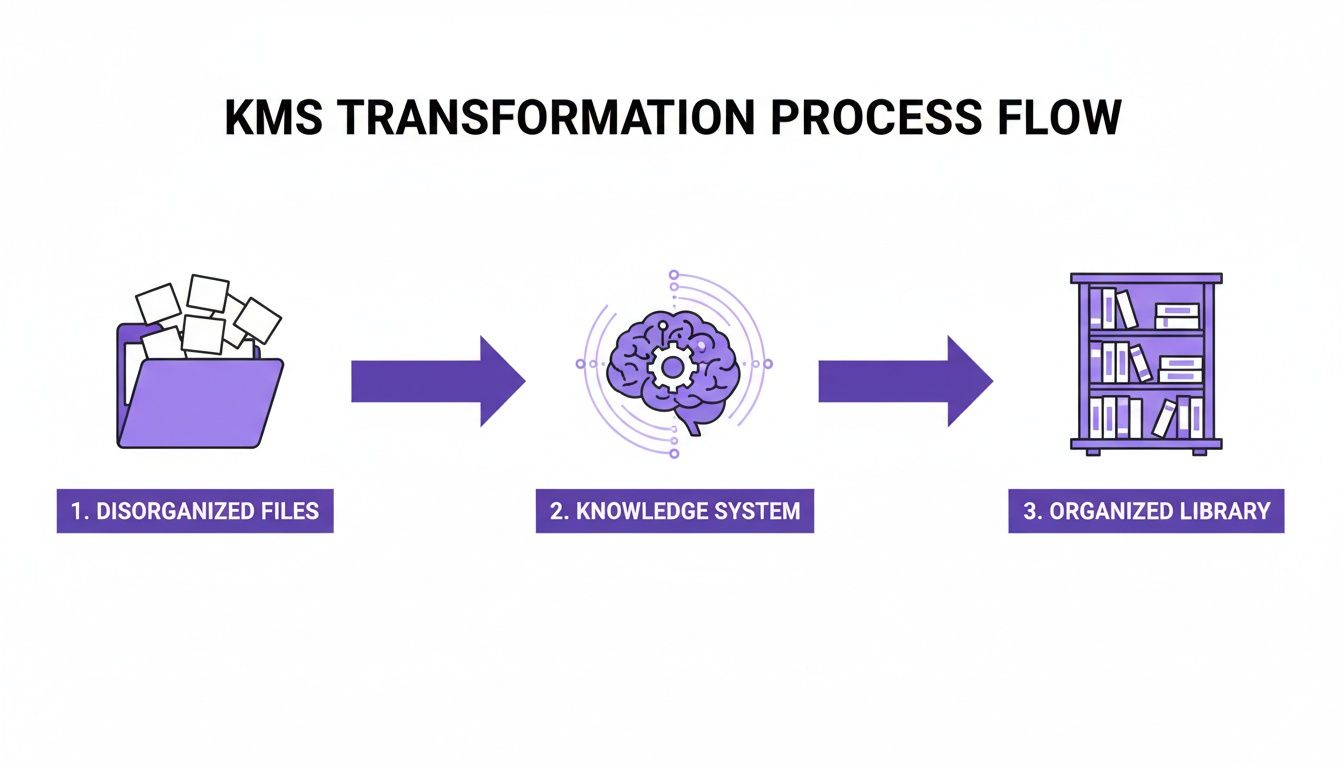
You can see how the system acts as the intelligent "brain" processing raw inputs into an organized, accessible asset.
Building Intelligence with Taxonomy
Once your content is ingested and transcribed, the system builds a taxonomy. That’s just a fancy word for a smart categorization and tagging structure. Forget manually dragging files into folders; this is light-years ahead. An AI-powered KMS reads the transcribed text and automatically figures out the key themes, topics, people, and concepts.
For example, the system will automatically:
- Identify recurring topics: It might notice you talk about "audience engagement" in 15 different videos and two podcast episodes, then tag them all accordingly.
- Recognize entities: The system can pick out the names of guests, companies, or products you’ve mentioned across your entire library.
- Understand context: It connects related ideas, linking your discussions about "SEO strategy" with content about "keyword research."
This automated process creates an intelligent map of your entire content library. Instead of just knowing what a file is, the system understands what the file is about. Getting this right is a huge part of making a system work, and it pays to follow a few top knowledge management best practices.
The Search Engine for Your Own Brain
The final piece of the puzzle is the search and discovery engine. With all your content ingested, transcribed, and intelligently tagged, you now have a private 'Google' for your own work. This is where you really start to see the payoff.
You can ask complex questions and get back precise answers in seconds. No more manually scrubbing through hours of footage. You can just search for "every clip where my guest mentioned 'viral marketing'" and get a list of exact timestamps.
The real power of a knowledge management system isn't just storing your content; it's making the knowledge within that content instantly accessible and actionable at any moment.
This capability is becoming non-negotiable as more of our work moves to the cloud. The Knowledge Management Systems market is on a massive growth trajectory, with some forecasts suggesting it could eclipse $3.5 trillion by 2034. This boom is driven by the need for real-time search across all kinds of content, especially since nearly 50% of all data is expected to live in the cloud by the end of 2025.
So, What's the Real Payoff for Creators?
Look, understanding the theory behind a knowledge management system is one thing. Seeing how it actually helps you create new value and ultimately make money from your content library is something else entirely. This is where the rubber meets the road.
For YouTubers, podcasters, bloggers, and publishers, a KMS isn't just a fancy digital filing cabinet. It's the engine that drives growth, efficiency, and—let's be honest—revenue.
When you centralize all your content, you’re not just organizing it. You're transforming a dead, messy archive into a living, breathing asset. It’s the difference between a garage full of junk and a perfectly organized workshop where every tool is at your fingertips. This simple shift lets you upcycle old content, generate more audience across platforms, and create infinite content value.
Stop Searching, Start Creating
How much of your week is wasted hunting for that one thing? The perfect B-roll clip, a specific quote from a guest interview two years ago, or those research notes you know are buried somewhere on your hard drive? It's a universal frustration for creators, a workflow killer that bleeds time and energy.
A KMS is the antidote to that chaos. It makes your entire library instantly searchable.
Instead of scrubbing through hours of video, you can just type what you’re looking for and get exact timestamps. Think about what that means in practice:
- Find Soundbites Instantly: Need a killer quote for a social media clip? Search a keyword and pull every single time it was mentioned across your entire podcast history.
- Locate B-roll in Seconds: Find relevant footage from past videos to make your new project shine, saving you the headache of searching for hours or reshooting.
- Resurface Old Research: Instantly pull up articles, stats, and notes from previous work to build on for your next piece. You never have to start from square one again.
This isn’t about small improvements; it's about fundamentally changing how you work. You get to spend less time digging and more time doing what you actually love: creating.
Squeeze More Juice From Every Piece of Content
Every podcast, video, or long-form article you publish is packed with smaller content opportunities just waiting to be set free. A KMS is the key that unlocks them. By understanding the themes, topics, and golden moments hidden inside your library, it makes repurposing effortless and way more strategic.
The real value of your content isn't just in the original piece; it's in its potential to be endlessly remixed, reshared, and re-monetized. A KMS turns that potential into a predictable system.
This isn't some brand-new idea. Knowledge management has been boosting productivity for decades. The concept goes back to the 1990s when companies like Xerox gave their field service reps tools to share repair tips, which radically cut down on troubleshooting time.
Today, that same principle is supercharging the creator economy. The global market for this kind of software is projected to hit a staggering USD 74.22 billion by 2034. For creators like us, this growth is all about having tools that let us mine our own archives, turning one asset into ten and boosting productivity by 20-30%. You can dive deeper into these powerful market trends and see what they mean for creators.
Know What Your Audience Really Wants
What topics make your audience light up? Which themes consistently bring in the views, comments, and shares? A KMS helps you finally get clear answers by spotting the patterns in your own work. It can analyze your entire library and show you which recurring topics are your heavy hitters, so you can double down on what works.
This lets you stop guessing and start making data-driven decisions about your content strategy. You get to create more of what your audience actually loves, which is how you build a truly engaged community and generate engagement.
Finally, Scale Your Team Without the Headaches
Going from a solo creator to a professional with a team is a huge leap, and collaboration can get messy fast. A KMS acts as the single source of truth for everyone. Your editor, writer, and social media manager can all tap into the same intelligent library, keeping everything consistent and efficient.
It’s the system that supports your growth. It gets vital knowledge out of one person’s head and turns it into a shared, accessible asset that empowers the whole team to do their best work. This is crucial for creators moving beyond working alone and needing to align content across many platforms.
The AI Superpower Fueling Next-Gen KMS
A traditional knowledge management system is powerful, but let’s be honest—an AI-powered one is a total game-changer. When you inject artificial intelligence into the mix, you’re not just tweaking the system; you're fundamentally upgrading how you interact with your entire content library. It’s what turns a useful digital filing cabinet into an indispensable creative partner.
This isn’t about just doing things a little faster. It’s about making your workflow smarter. AI handles the grunt work that used to eat up your time, like transcribing hours of raw video. But more importantly, it grasps the context behind the words, opening the door to a much deeper, more intuitive way to find what you need. A modern KMS helps humans and AI collaborate in a healthy way that benefits everyone.

From Simple Search to Intelligent Discovery
Think about the difference between a basic keyword search and a conversation with a seasoned research assistant. A standard KMS can find a file if you type in the exact keyword. An AI-powered system, on the other hand, understands relationships, concepts, and intent.
It finds not just what you explicitly asked for, but also related ideas you didn't even know to look for. This is where you graduate from simple organization and enter the realm of true content intelligence. You can dive deeper into this idea in our guide on what makes content intelligence platforms so effective.
Here’s a quick look at how AI really transforms your process:
- Automated Transcription and Tagging: AI can listen to every minute of your audio and video, transcribe it with startling accuracy, and automatically tag key topics, speakers, and themes. This single feature can save you hundreds of hours.
- Contextual Understanding: It moves beyond simple keyword matching. You can search for something like "ideas for growing our audience," and it will pull up clips where you discussed different strategies, even if you never used that exact phrase.
- Pattern Recognition: AI can scan your entire library to spot recurring themes, find out which topics really resonate with your audience, and even point out gaps in your content that signal new opportunities.
An AI-powered KMS acts as a collaborator, helping you discover hidden value in your library. It surfaces connections and suggests new ideas, streamlining your creative process and turning your archive into an active source of inspiration.
This shift isn't just a small trend; it's a massive industry movement. The AI-driven Knowledge Management System market is absolutely exploding, growing from $5.23 billion to $7.66 billion in just one year—a blistering 46.3% growth rate. It shows how profoundly machine learning is supercharging these tools for content pros. With 78% of organizations now using multi-cloud setups to get better insights, creators with AI-powered tools are in the perfect spot to pull ahead. You can read the full research on this explosive market growth to get a sense of the scale here.
The AI Assistant for Your Content Team
For professional creators, this technology is like having another member on your team. It’s the research assistant who never sleeps, constantly organizing, analyzing, and prepping your content for its next big moment. This lets you and your human team get back to what you do best: creating compelling stories.
Ultimately, AI integration is what separates a good what is knowledge management system answer from a great one. It’s the superpower that helps you reignite your content library and generate endless value from the assets you already own.
Choosing the Right KMS for Your Creative Workflow
Let's be honest: not all knowledge management systems are built the same. This is especially true if you’re a content creator, publisher, or podcaster. Most of the generic, one-size-fits-all platforms out there were designed for corporate IT departments. They feel clunky and totally out of sync with the fast-paced, media-heavy world we live in.
Picking the right system is a huge decision. It directly impacts your ability to organize your content library, collaborate with a team, and ultimately, make more money from your work.
The trick is to look past basic file storage and find a platform that was actually built with a creator’s workflow in mind. A system designed for corporate text documents is going to choke when you feed it a podcast interview or a YouTube video. For a KMS to become a real creative partner, it needs to speak your language—the language of multimedia, storytelling, and connecting with an audience.
Core Features Every Creator Should Demand
When you're looking for the right fit, some features are simply non-negotiable. These are the tools that turn a simple digital archive into a powerful content engine.
Your checklist has to include:
- Robust Multimedia Support: The system can't just store your video and audio files; it has to understand them. That means automatic, highly accurate transcription isn't a luxury add-on, it's the absolute baseline.
- Powerful Contextual Search: You need more than a glorified keyword finder. Look for a system that uses AI to grasp context, letting you search for concepts, ideas, and spoken phrases, not just exact file names. This is the difference between finding a file and discovering a game-changing insight.
- Seamless Collaboration Tools: As you grow from a solo creator into a professional team, your KMS needs to be the central hub. It has to include features that let writers, editors, and marketers work on projects together, share what they find, and build on each other’s research without stepping on toes.
A platform that nails these three things is built to support a modern content business. It helps you organize, understand, and finally act on the hidden value just sitting in your library.
Corporate KMS vs. Creator-Focused Platforms
The difference between a generic corporate KMS and a platform built for creators is night and day. Corporate systems are usually built around structured data, complex permission settings, and rigid workflows. They’re all about compliance and controlling information, not sparking creative discovery and moving fast.
For creators, a KMS should feel less like a restrictive corporate library and more like an extension of your own creative brain—intuitive, fast, and full of surprising connections.
Creator-focused platforms, on the other hand, are designed for the messy, unstructured reality of content creation. They prioritize a great user experience, making it dead simple to find inspiration, repurpose clips, and brainstorm new ideas without getting stuck in red tape. They’re built to handle the massive file sizes and unique formats that are just part of the job in video and audio production. For a deeper look, you can explore this detailed enterprise search software comparison to see how different tools really stack up.
A Practical Checklist for Your Decision
Making the right call really just comes down to being honest about your specific needs and goals. Before you sign up for anything, run through this quick evaluation to make sure the platform aligns with where you're headed.
- Your Content Library: How big is it? Is it mostly video, audio, text, or a mix of everything? A platform like Contesimal is made for multimedia, which is perfect for YouTubers and podcasters with huge backlogs.
- Your Team Structure: Are you flying solo, or are you building a team? If collaboration is in your future, you need a system that makes it easy to share access and work on projects together.
- Your Primary Goal: What’s the biggest problem you’re trying to solve right now?
- Repurposing: You need a tool that’s amazing at finding and clipping specific moments from your long-form content.
- Research & Ideation: You need powerful AI-driven search to uncover themes and help plan what you’ll create next.
- Audience Analysis: The system should help you pinpoint which topics and ideas get the biggest reaction from your audience.
Answering these questions will give you the clarity you need to pick a knowledge management system that doesn’t just store your content, but actively helps you create new value from it every single day.
Getting Started: An Actionable Plan
Alright, let's stop talking theory and start doing. A great idea is just an idea until you put it into action, and building a powerful content engine with a knowledge management system isn't as intimidating as it sounds.
The trick is to start small. Don't try to boil the ocean. Aim for a quick win that delivers immediate value and builds momentum. It all begins with pulling your existing assets together for one simple, focused project.
This is how you turn a dusty digital archive into an active creative partner. Once you start thinking with a 'KMS-first' mindset, every new piece of content you make will compound in value, making your future work smarter, faster, and more impactful.
Your Quick-Start Implementation Plan
Getting your system humming can be broken down into just a few manageable steps. Remember, we’re aiming for progress, not perfection on day one.
- Gather Your Assets: First things first, figure out where all your content lives. Is it on a YouTube channel? A podcast host? Scattered across a dozen Dropbox folders? Get all your sources lined up so the KMS can connect and start pulling everything in.
- Let the AI Do the Heavy Lifting: Once connected, a modern KMS gets to work automatically. It will ingest your entire library, transcribe audio and video, and analyze everything. This is the magic step where raw files become structured, searchable data—no manual data entry required.
- Start with Simple Tags: The AI will handle the bulk of the classification, but you should create a few high-level tags unique to your workflow. Think simple categories like “Top Performing,” “Repurpose Candidate,” or “Series A.” Keep it basic for now; you can always get more granular later.
A Mini Case Study: Planning the Next Video
Let's watch this play out for a YouTuber who needs to plan their next three videos. Instead of staring at a blank screen and waiting for inspiration to strike, they open up their new KMS.
Their goal is simple: find themes from their most successful videos to create new content that has a high probability of performing well.
- Step 1 The Query: They kick things off with a simple search for clips and transcripts from their top 10 most-viewed videos.
- Step 2 The Discovery: The KMS instantly flags a pattern. The phrase "audience burnout" pops up in seven of those ten videos, and it’s consistently tied to spikes in comments and engagement. That’s a massive signal from their audience.
- Step 3 The Action Plan: Armed with this one insight, the creator maps out their next three videos in minutes:
- Video 1: A deep-dive on the "Three Hidden Signs of Creator Burnout."
- Video 2: An interview with a fellow creator about their personal battle with burnout.
- Video 3: A practical guide on "Five Ways to Structure Your Week to Avoid Burnout."
By analyzing their existing library, the creator went from pure guesswork to a data-backed strategy. This is the real power of a knowledge management system—it helps you build on what already works.
This is a simple, repeatable workflow that you can use over and over again. You can see how these same principles apply in other areas by looking into building a robust knowledge base helpdesk for customer support.
By starting small and focusing on one actionable insight at a time, you immediately start squeezing new value out of the content you’ve already worked so hard to create.
Frequently Asked Questions
Even with a clear game plan, jumping into a new system can kick up a few questions. Here are some of the most common ones we hear from creators, along with practical answers to help you see exactly how a knowledge management system fits into your workflow.
Is a KMS Just a Fancier Version of Google Drive?
Not even close. While tools like Google Drive and Dropbox are great for stashing files, a knowledge management system is built to understand what’s inside those files. It doesn't just store your content; it actively analyzes it, turning a passive archive into an intelligent, searchable library.
Think of it this way: Google Drive knows your video is named "Podcast_Interview_Episode_42.mp4." A KMS knows that inside that video, you discussed "creator burnout" for three minutes, mentioned a specific software tool, and dropped a powerful quote about audience growth. You can’t ask a standard cloud drive to find concepts—with a KMS, that’s the entire point.
Do I Need a Huge Content Library to Use a KMS?
You don't need a massive archive to get value. In fact, the best time to bring in a KMS is right as you're shifting from hobbyist to a professional creator with a library that's starting to grow. Even with just 20-30 pieces of long-form content, like videos or podcast episodes, a system can start to reveal valuable patterns.
Starting early builds a solid foundation for growth. It makes sure that as your library gets bigger, its value compounds instead of turning into a digital junk drawer. It’s a proactive move that turns your content archive into a strategic asset from day one.
Are Knowledge Management Systems Hard to Set Up?
The old, corporate-style systems were often clunky and needed a whole IT team to get running. But modern platforms built for creators are designed to be simple and fast. The setup is usually straightforward and built for people who aren't tech wizards.
A modern KMS should feel intuitive, not intimidating. The goal is to get you to the insights faster, without a steep learning curve or a week of configuration headaches.
For most creator-focused systems, getting started is pretty simple:
- Connect your existing content sources (like a YouTube channel or cloud drive).
- Let the software automatically pull in, transcribe, and analyze your files.
- Start your first real search within hours, not weeks.
The AI does all the heavy lifting, like tagging topics and organizing information. That way, you can spend your time discovering ideas and making content, not messing with software.
Ready to turn your scattered content library into your most powerful creative asset? With Contesimal, you can organize your videos, podcasts, and articles into an intelligent, searchable hub. Discover hidden insights, accelerate your content creation, and collaborate seamlessly with your team. Stop searching and start creating today. Learn more about Contesimal and see how it works.