
Your content library is a goldmine. Every podcast episode, YouTube video, blog post, and customer interview is filled with audience insights, hidden themes, and untapped ideas for your next big hit. But manually sifting through hours of transcripts, open-ended survey responses, and user feedback is a monumental, often impossible, task. This is where the right qualitative data analysis tools transform unstructured data from chaotic noise into a clear signal.
For content creators transitioning from hobbyist to professional, publishers aiming to maximize their archive's value, and marketers needing to align content across platforms, these tools are game-changers. They provide the structure needed to organize, understand, and act on your data. This allows you to reignite your content library, systematically discover what truly resonates with your audience, build on successful concepts, and strategically plan your next viral piece of content. Qualitative data analysis tools are particularly adept at handling unstructured data sources like User-Generated Content (UGC), transforming raw feedback into actionable insights.
This guide moves beyond generic feature lists. We break down the 12 best qualitative data analysis tools designed to help you bring your content library to life and turn your existing assets into powerful, revenue-generating opportunities. We’ll dive into specific use cases, practical limitations, and pricing to help you find the perfect fit for your workflow. Each option includes screenshots and direct links, so you can see the platforms in action and make an informed decision to upgrade your content analysis process today.
1. Contesimal
Contesimal emerges as a powerful, AI-first platform uniquely positioned for creators, publishers, and research teams sitting on extensive archives of multimedia content. It moves beyond traditional qualitative data analysis tools by focusing on activating historical assets, transforming dormant libraries of podcasts, videos, and articles into searchable, actionable knowledge bases. Its core strength lies in its ability to help humans and AI collaborate to ingest, classify, and build rich, layered taxonomies from diverse content formats, making vast amounts of unstructured data instantly discoverable.
The platform integrates a sophisticated, chat-based research interface with robust, structured search capabilities. This blended approach allows teams to not only find specific information but also to uncover thematic patterns, audience preferences, and monetization opportunities that were previously buried. For content marketers, podcasters, and publishers, this means an accelerated workflow for everything from generating new ideas to repurposing existing content for different platforms. With Contesimal, users can curate information to create a set of knowledge, gather around that knowledge to create meaning, and collaborate to generate new value from it.
Key Strengths and Use Cases
Contesimal excels where content volume and collaborative research intersect. Its operational-ready toolkit is designed for teams aiming to streamline their entire content lifecycle.
- For Podcasters & YouTubers: Quickly analyze entire episode backlogs to identify recurring themes, popular guest talking points, or audience-favorite segments. Use the AI chat to generate new episode ideas, social media clips, and blog post outlines based on proven high-engagement topics from your archive, helping you figure out what to create next.
- For Publishers & Content Marketers: Transform your content library into an internal insights engine. A marketing team can ask, "What are the top five pain points our customers mentioned in webinars last year?" and receive a synthesized answer with direct source links, enabling faster, data-driven content creation across many platforms. You can explore a deeper dive into the different forms of research Contesimal facilitates to enhance your strategic approach.
- For Authors & Screenwriters: Organize and cross-reference extensive literature, interview transcripts, and field notes. The platform’s ability to build taxonomies helps structure complex research projects, while the AI assistant can help synthesize findings and identify gaps in existing arguments.
Access and Onboarding
Contesimal encourages hands-on evaluation with a "launch your first Contesimal session for free" offer, allowing teams to test its capabilities with their own data before committing. Detailed pricing for its tiered plans is not publicly listed; prospective users will need to contact the Contesimal team for a tailored quote and onboarding information, which suggests a focus on customized solutions for professional teams.
- Website: https://contesimal.ai
2. Lumivero (NVivo)
Lumivero serves as the official publisher and commercial hub for NVivo, one of the most established and powerful qualitative data analysis tools in the world. Rather than just a software page, the site is a comprehensive portal for acquiring and expanding the NVivo ecosystem. Researchers, academic institutions, and content teams can purchase everything from individual perpetual licenses to flexible team subscriptions for the latest version, NVivo 15.

The platform’s key strength is its modular, add-on-based structure, allowing users to build a tailored analysis suite. You can augment the core NVivo software with specialized tools like the AI Assistant for thematic analysis, automated Transcription services, and the Collaboration Cloud for team-based projects. This approach ensures you only pay for the capabilities you need, although navigating the various bundles and add-on pricing can initially seem complex.
For large organizations, the site provides clear pathways for enterprise and academic volume licensing. Choosing the right NVivo package is a crucial step in defining your project's framework, directly impacting how you structure your research approach. You can explore different analysis frameworks by reviewing samples of methodology in a research paper to see how tools like NVivo are applied.
Key Features & Offerings
- Flexible Licensing: Purchase both subscriptions and perpetual (one-time cost) licenses.
- Modular Add-Ons: Enhance core functionality with AI Assistant, Transcription, and Collaboration Cloud.
- Institutional Sales: Dedicated options for enterprise, government, and academic volume licensing.
- Transparent Access: Offers free trials directly from the product pages for evaluation.
Our Take: Lumivero is the definitive source for NVivo, providing a secure and official channel for one of the industry's most robust analysis platforms. Its US-based vendor status and deep academic footprint make it a trusted choice for serious research projects.
- Website: https://lumivero.com/products/nvivo/
3. ATLAS.ti (official)
The official ATLAS.ti website is the central hub for acquiring one of the most versatile qualitative data analysis tools available. It provides direct access to purchase or trial a unified license that covers Windows, Mac, and a fully-featured Web version. This platform is particularly strong for teams and individuals who work across different operating systems, as it emphasizes feature parity, ensuring a consistent user experience regardless of the device.
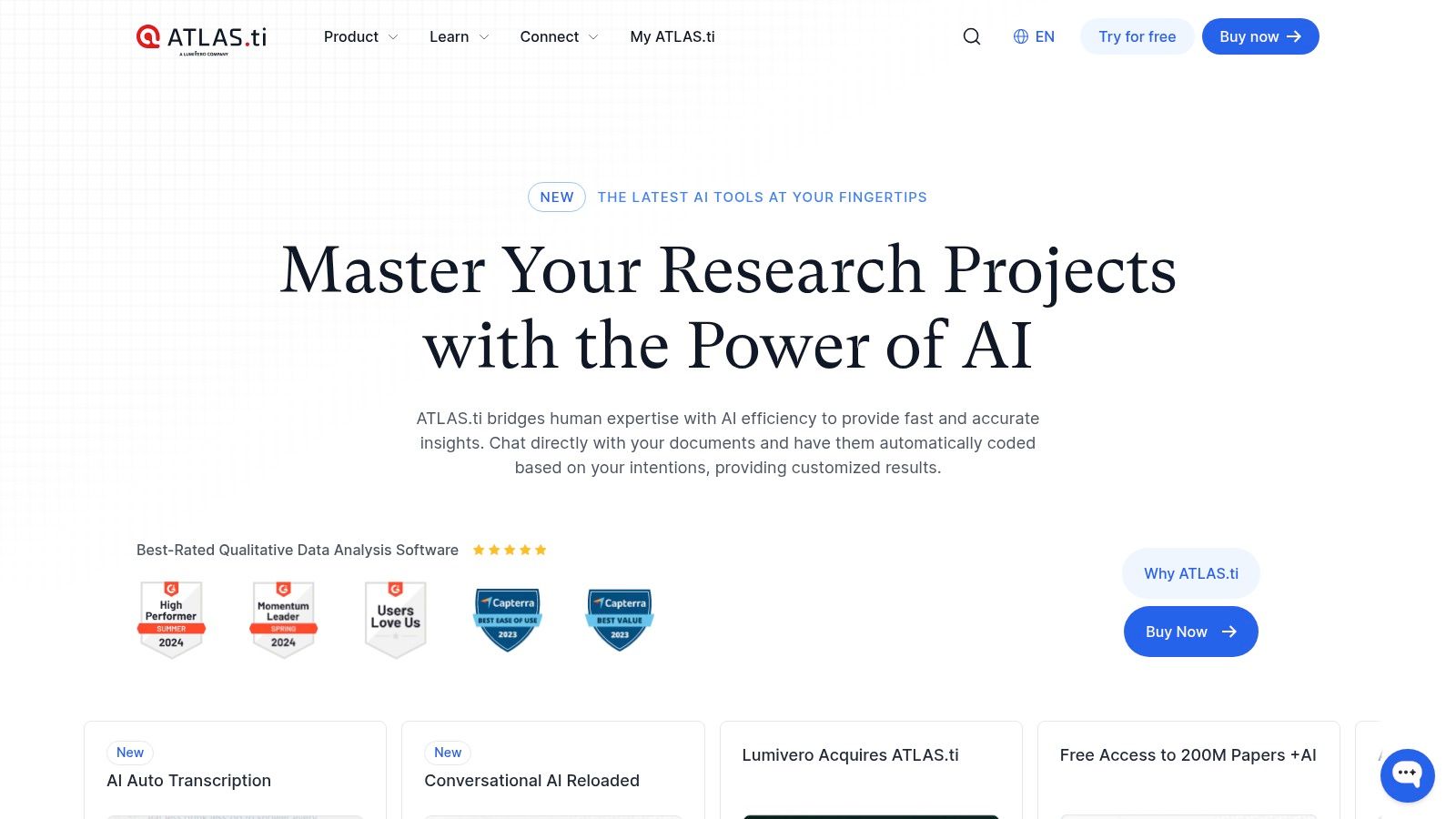
A key differentiator is the ATLAS.ti Web platform, which enables real-time collaboration, allowing multiple researchers to code and analyze the same project simultaneously. The site also highlights its integrated OpenAI-powered tools, designed to accelerate the coding process and surface insights more efficiently. For users evaluating the software, the free trial is straightforward, offering full functionality for five active days within a 20-day window. This is ideal for content teams looking to test its capabilities on live projects.
The platform’s powerful analytical features can help creators and publishers dig deep into audience feedback or source material, a core component of strategic content planning. By understanding these qualitative data points, you can learn more about how to analyze content performance and refine your creative direction. While the site provides robust documentation and 24/5 live support, users may need to enter the purchasing flow to see specific pricing details for all license types.
Key Features & Offerings
- Unified Licensing: A single license grants access to Windows, Mac, and Web versions.
- Real-Time Collaboration: The Web version allows for seamless, simultaneous teamwork on projects.
- AI-Powered Tools: Integrated OpenAI features assist with automated and conceptual coding.
- Accessible Free Trial: A full-featured trial is available directly from the website without commitment.
Our Take: ATLAS.ti is a top-tier choice for cross-platform research teams and individuals who value flexibility and modern collaborative features. Its unified license and strong web version make it a powerful, forward-thinking alternative in the qualitative analysis space.
- Website: https://atlasti.com/
4. MAXQDA (VERBI Software)
VERBI Software’s official website for MAXQDA is the primary destination for acquiring this leading software for qualitative and mixed-methods research. The site clearly segments its offerings for different users, including dedicated purchasing paths for business, academia, non-profits, and students. This customer-centric approach simplifies the process of finding the right license, whether you need a subscription, a perpetual license, or a multi-year plan.
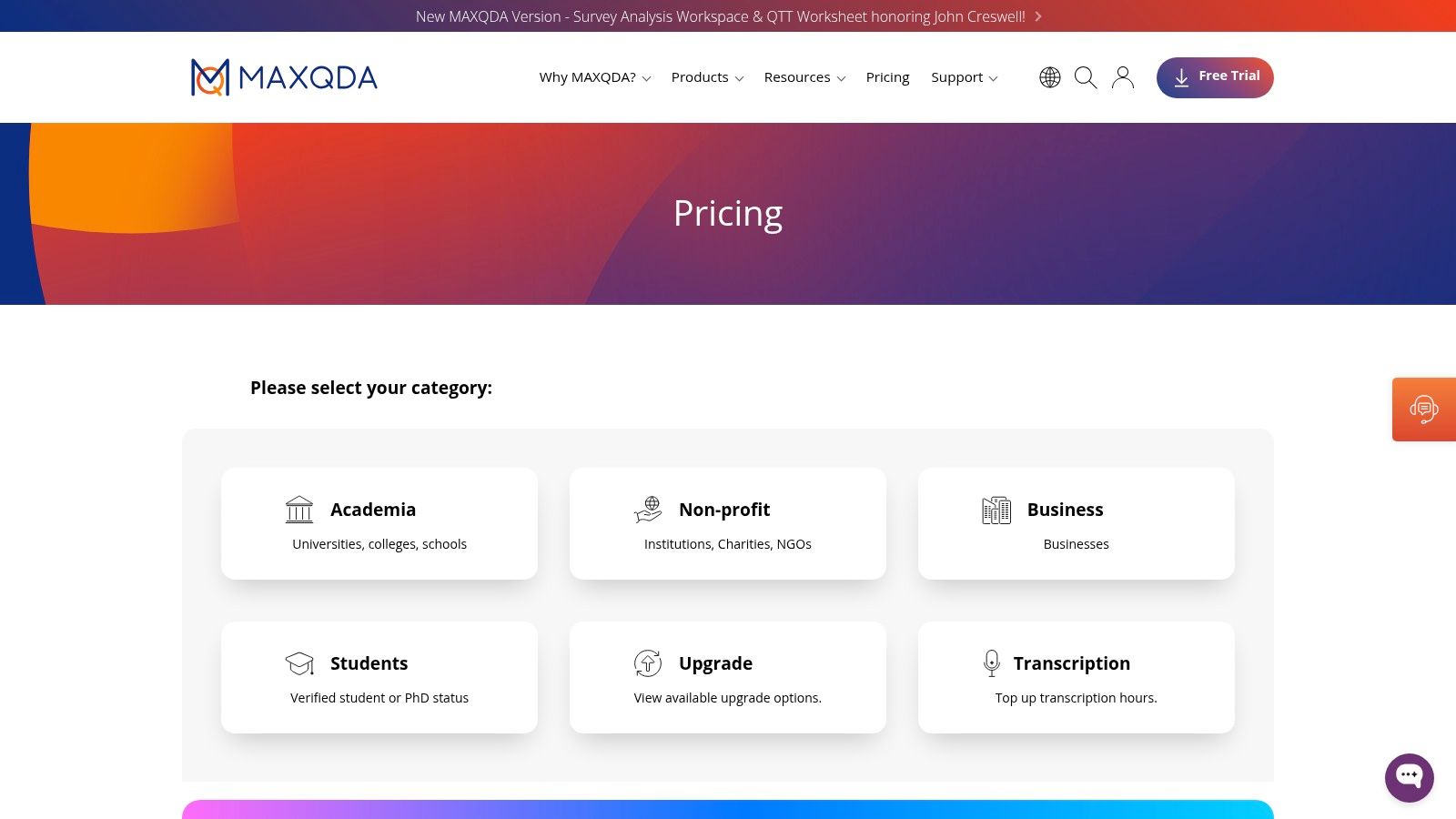
Similar to other major qualitative data analysis tools, MAXQDA has adopted a modular ecosystem. From the main site, you can enhance the core software with powerful add-ons like the AI Assist for automated summary and coding, the TeamCloud for secure project sharing, and integrated transcription services. While this à la carte model provides flexibility, it's important to factor in the additional costs for these features when budgeting for your complete analysis toolkit.
The platform is also backed by a mature training ecosystem, with extensive documentation and tutorials available directly on the site, making it accessible for new and experienced researchers alike. This strong support system is a key differentiator, helping teams get up to speed quickly. Note that final pricing can vary by region and is confirmed at checkout, so it’s wise to proceed through the cart to see the final cost.
Key Features & Offerings
- Segmented Editions: Tailored product pages and pricing for Business, Academia, Non-profit, and Student users.
- Modular Add-Ons: Optional AI Assist, TeamCloud for collaboration, and built-in auto-transcription services.
- Flexible Licensing: Offers subscriptions, perpetual, and multi-year licenses to suit various needs.
- Strong Support: Provides a comprehensive library of free learning materials, tutorials, and user guides.
Our Take: The MAXQDA website makes it exceptionally easy to find the right package for your specific role. Its clear segmentation and strong training resources make it one of the most user-friendly platforms for acquiring a top-tier analysis tool.
- Website: https://www.maxqda.com/pricing
5. Dedoose
Dedoose is a cloud-based, cross-platform app designed for collaborative mixed-methods and qualitative data analysis tools. Its standout feature is an exceptionally flexible pricing model, particularly for individual researchers and small teams. Instead of locking users into long-term subscriptions, Dedoose offers "active-month" billing, meaning you only pay for the months you actually log in and use the service, making it ideal for episodic or grant-funded projects with intermittent activity.
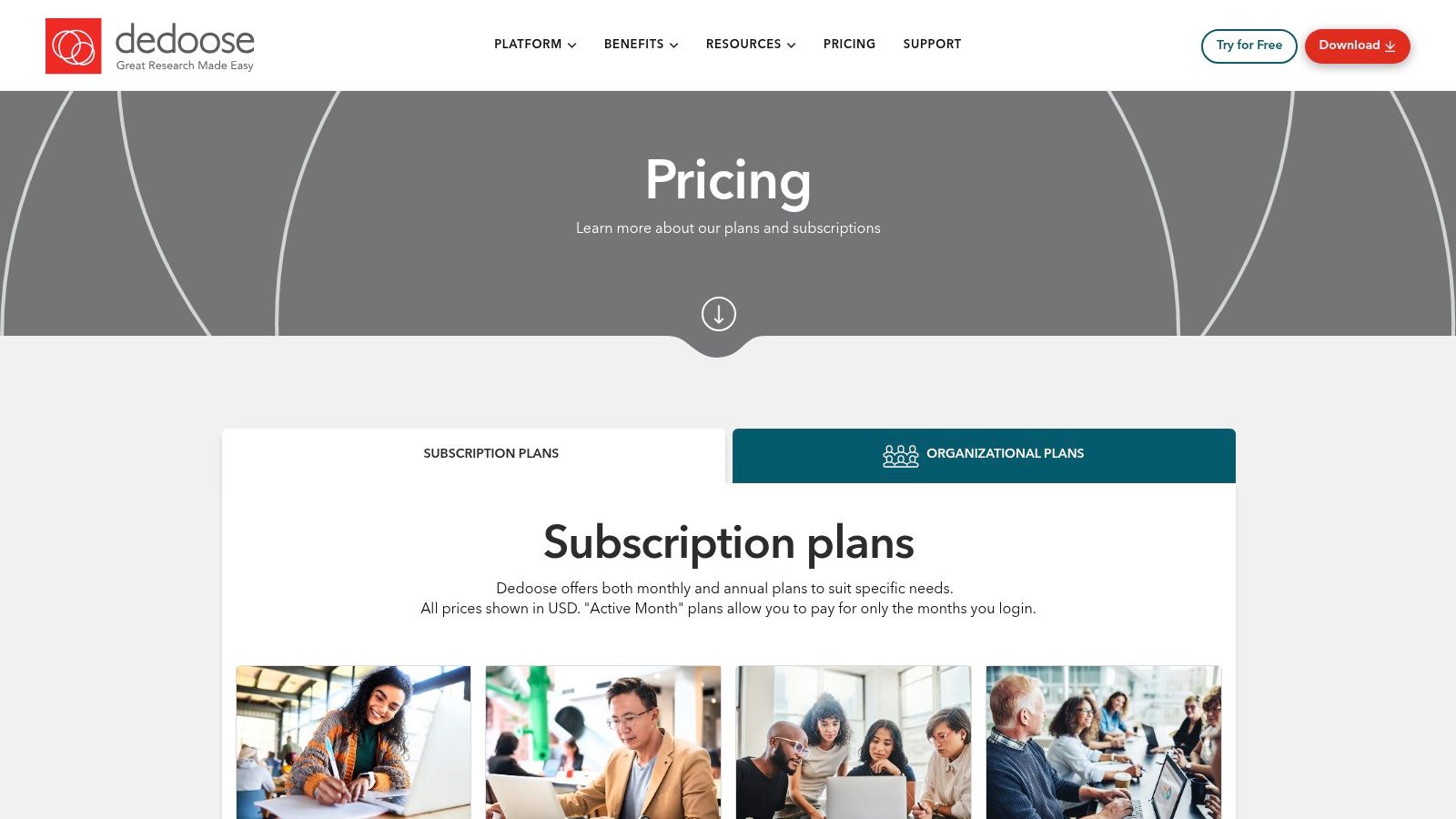
The platform is built from the ground up for real-time collaboration. Teams can work together seamlessly, with role-based permissions ensuring data integrity and project-level encryption securing sensitive information. This collaborative focus makes it a strong choice for academic groups, content teams, and publishers who need to analyze audience feedback or user interviews together. For larger organizations, Dedoose provides Premier and Enterprise plans that include dedicated training and SSO integration.
While the pricing is budget-friendly for fluctuating use, it's important to note potential extra costs. The active-month model applies mainly to individual and small group plans; larger group plans are billed monthly regardless of usage. Additionally, hosting audio and video files incurs storage fees based on minutes, which can add up for media-heavy projects like podcast or video analysis.
Key Features & Offerings
- Active-Month Billing: Pay-as-you-go model where individual users are only charged in months they use the service.
- Real-Time Collaboration: Work simultaneously with team members with secure, role-based access controls.
- Mixed-Methods Support: Integrates both qualitative and quantitative data analysis capabilities.
- Student & Group Discounts: Offers a simple, transparent pricing grid with reduced rates for students.
Our Take: Dedoose excels with its cost-effective and flexible pricing, making it a powerful yet accessible tool for researchers and content creators with variable project timelines. Its cloud-native, collaborative environment is perfect for teams who need to work together from anywhere.
6. Quirkos
Quirkos positions itself as one of the most accessible and affordable qualitative data analysis tools, specifically targeting students, non-profits, and small research teams. The website clearly presents its dual-access model, allowing users to choose between low-cost cloud subscriptions or perpetual lifetime licenses for offline desktop use. This flexibility is a significant draw for those who don't require the extensive, and often expensive, feature sets of platforms like NVivo or ATLAS.ti.
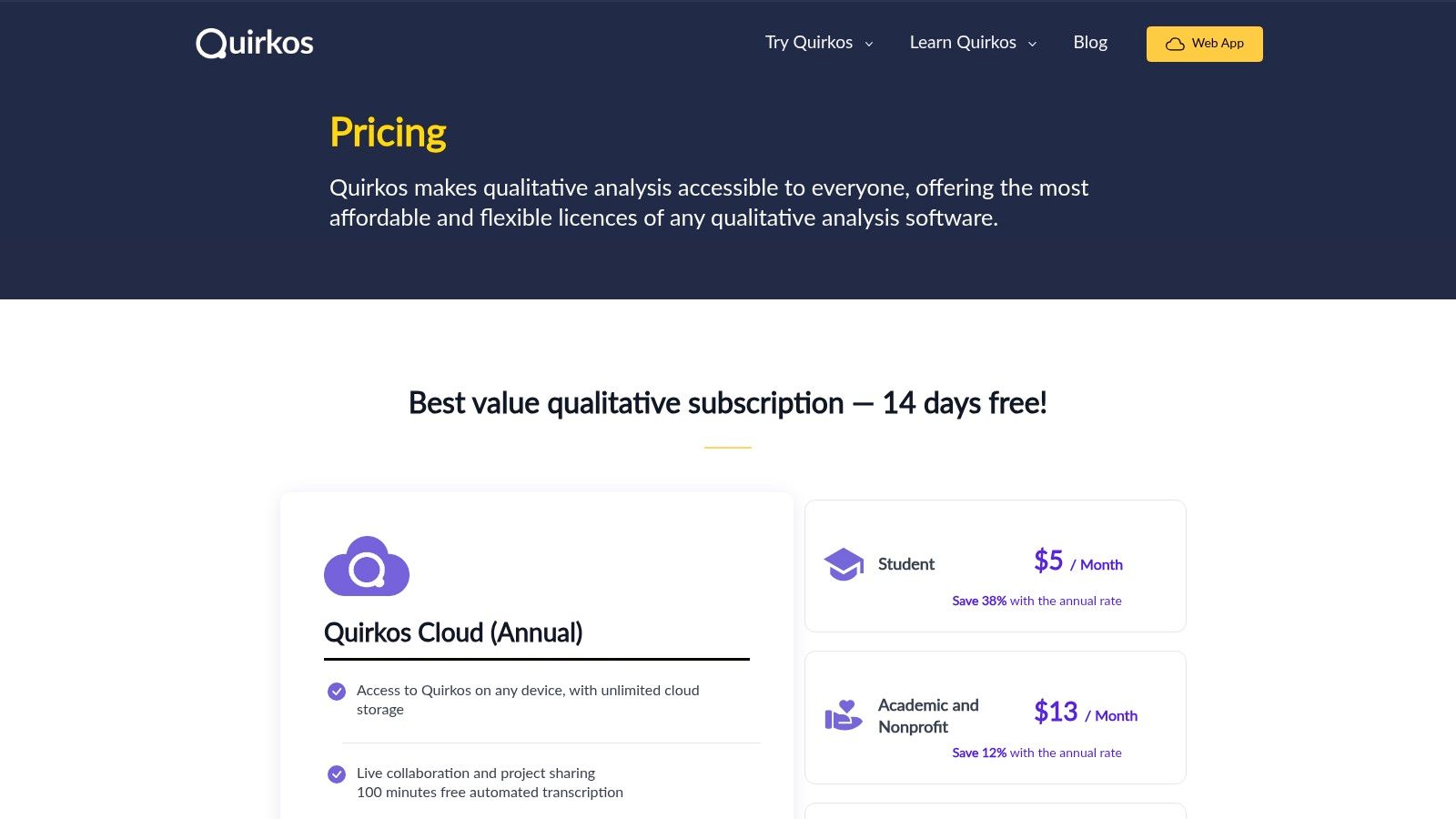
The platform is designed with a quick learning curve in mind, featuring a simple, visual interface that helps users get started on coding and analysis without a steep technical barrier. The Cloud plan is particularly compelling for small teams, offering unlimited storage, live collaboration, and a small number of free transcription minutes per month. The site’s transparent, tiered pricing for students, academics, public sector, and commercial users makes it easy to find the right package for your budget and project scope.
While it excels in usability and cost-effectiveness, its feature set is intentionally lighter. Researchers working on highly complex projects with extensive multimedia analysis or advanced statistical integrations might find it limiting. However, for content creators, bloggers, and students conducting foundational thematic analysis, Quirkos offers a powerful yet straightforward solution to organize and understand their qualitative data.
Key Features & Offerings
- Flexible Licensing: Offers both cloud-based subscriptions and one-time purchase lifetime licenses.
- Tiered Pricing: Dedicated pricing plans for students, academic/nonprofit, public, and commercial sectors.
- Live Collaboration: The Cloud plan includes real-time project collaboration and unlimited storage.
- Built-in Transcription: Provides a small number of free transcription minutes with cloud subscriptions.
Our Take: Quirkos is an excellent entry point into qualitative data analysis. Its affordability and user-friendly design make it a standout choice for students, independent researchers, and content teams who need effective tools without a prohibitive cost or complex interface.
7. Transana
Transana is a specialized desktop application focused entirely on the in-depth analysis of audio and video data. Its website serves as the direct-to-consumer portal for purchasing the software, offering a streamlined path for researchers, particularly in academia, to acquire perpetual licenses. Unlike cloud-based platforms, Transana’s strength lies in its powerful, offline capabilities for handling rich multimedia files, making it a standout among qualitative data analysis tools for video-centric projects.
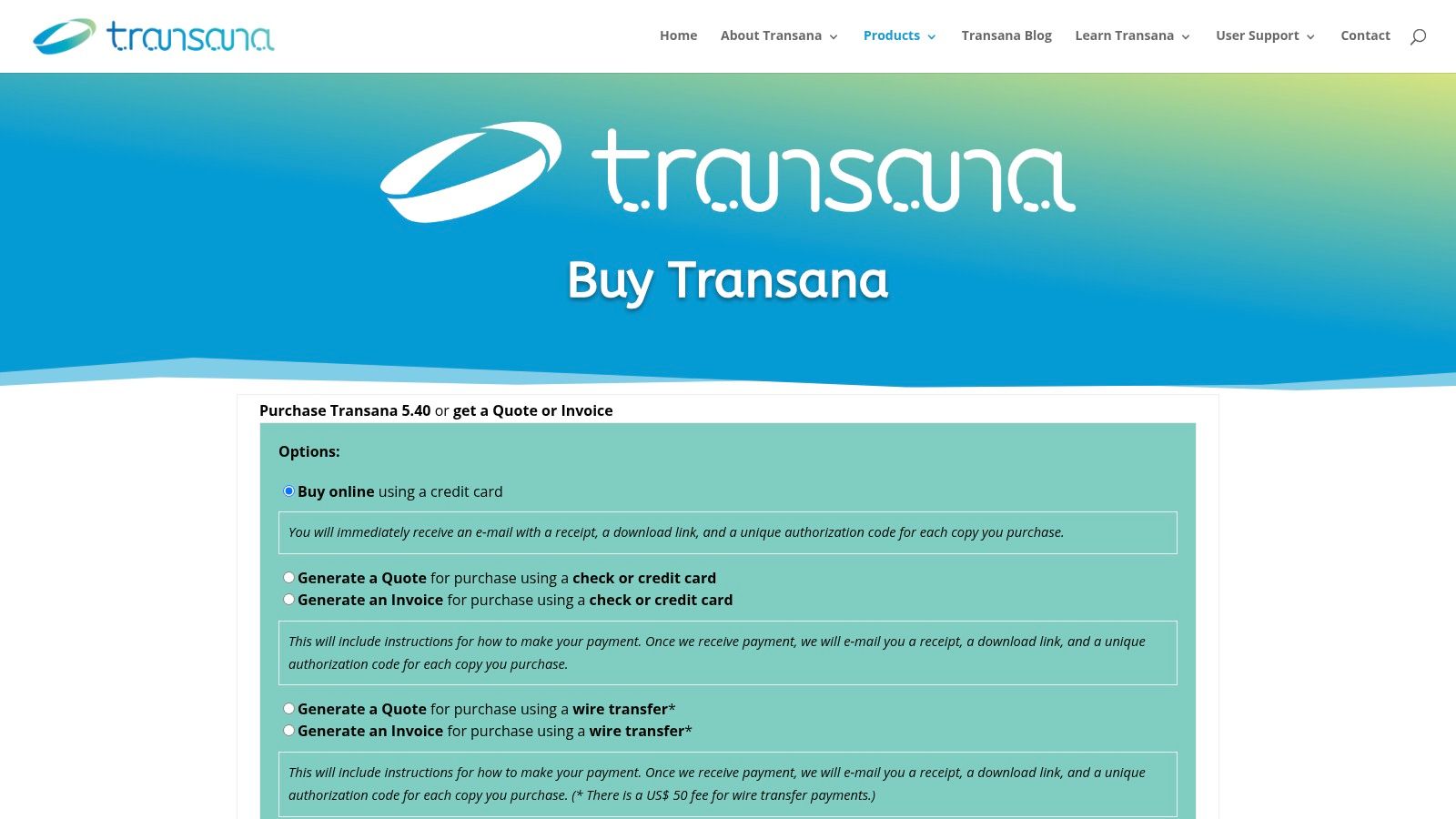
The platform is designed for granular, time-based analysis. Its key differentiator is the ability to synchronize and analyze up to four video or audio streams simultaneously, a crucial feature for studying group interactions, focus groups, or multi-camera recordings. The website clearly lays out its license tiers (Basic, Professional, Multiuser) with transparent pricing, including significant discounts for educational use. While its interface is more traditional compared to modern web apps, its focused toolset is highly effective for its intended purpose.
Purchasing from the site is straightforward, with options for individual researchers or entire lab environments. The Multiuser version allows for server-based collaboration, bridging the gap between desktop power and team-based analysis needs. This makes it a practical choice for academic departments or content production teams who need to meticulously code and transcribe large volumes of video and audio content without relying on a constant internet connection.
Key Features & Offerings
- Multimedia Focus: Specialized tools for transcribing and time-coding audio and video data.
- Multi-Angle Sync: Analyze up to four synchronized media streams at once.
- Perpetual Licenses: One-time purchase model with tiered pricing for different needs.
- Educational Discounts: Significant price reductions are available for academic institutions.
Our Take: Transana is a workhorse for video and audio analysis, offering robust, specialized features at a competitive one-time price. While it lacks the modern UI of cloud platforms, its powerful offline capabilities make it an indispensable tool for researchers and video creators who need to perform deep, frame-by-frame qualitative analysis.
8. HyperRESEARCH (ResearchWare)
ResearchWare is the developer behind HyperRESEARCH, a long-standing and respected name among qualitative data analysis tools. The platform caters to researchers who prefer a one-time purchase over recurring subscriptions, offering a perpetual license model that is increasingly rare in the software landscape. Its website serves as a direct sales and information portal where individuals, academic institutions, and government bodies can acquire the software and its companion transcription tool, HyperTRANSCRIBE.
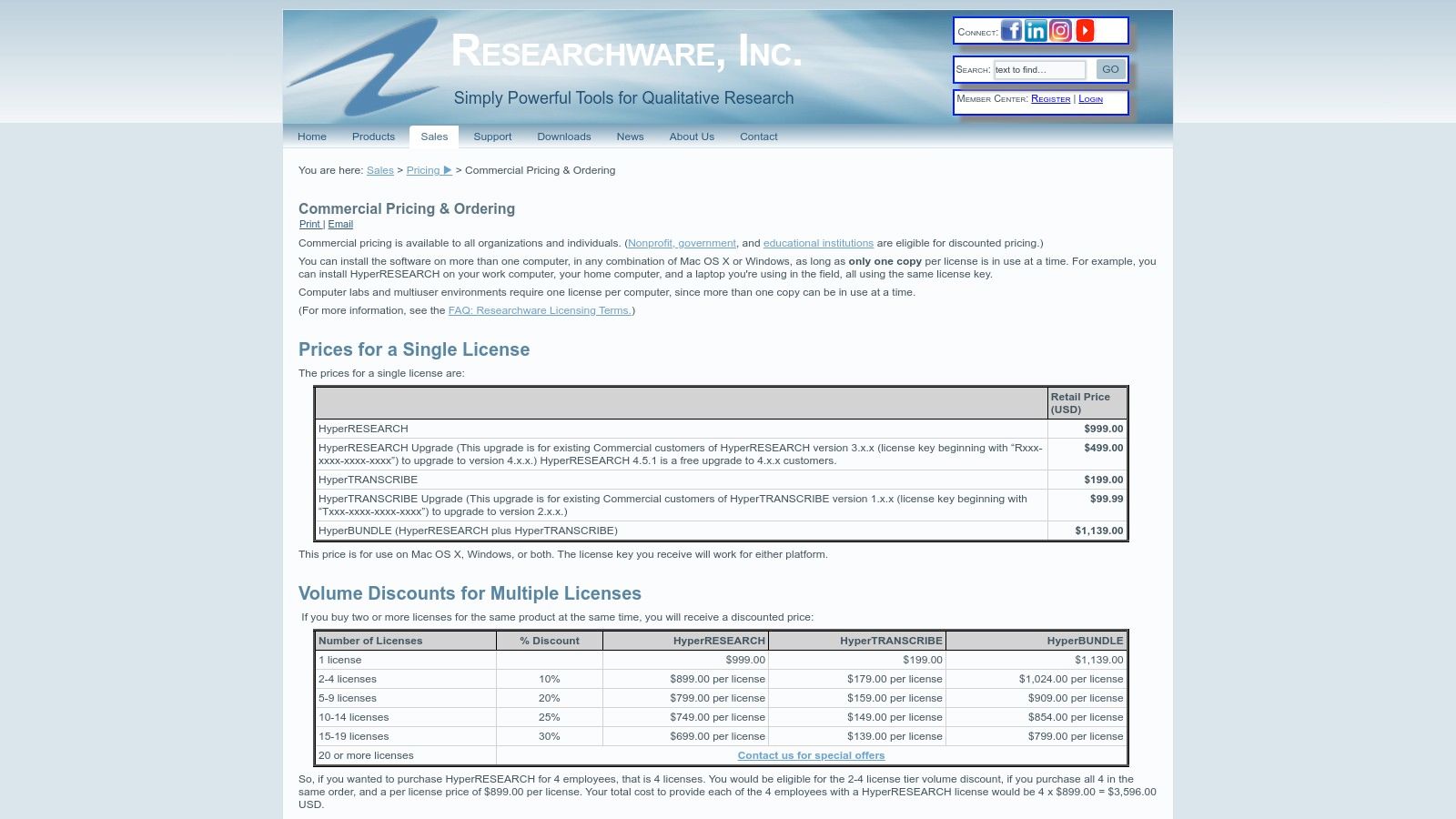
The primary appeal of HyperRESEARCH is its straightforward, cost-effective licensing. A single cross-platform license can be used on multiple personal devices, providing flexibility for researchers who work across different operating systems. The software includes unique analytical features like the "Hypothesis Tester," which allows users to systematically explore relationships between codes and validate emerging theories within their data. This makes it a practical choice for grounded theory and other iterative analysis methods.
The website clearly outlines discounted pricing tiers for students, educational institutions, and government or nonprofit organizations, making it accessible for budget-conscious projects. While its user interface may feel more traditional compared to newer, cloud-based alternatives, its focus on core analytical functions and a stable, self-contained environment remains a significant draw for many researchers who prioritize function over flash.
Key Features & Offerings
- Perpetual Licensing: Buy the software once and own it forever, avoiding subscription fees.
- Cross-Platform Use: A single license works on both Windows and macOS personal devices.
- Hypothesis Tester: A unique tool for formally testing the relationships between codes in your dataset.
- Tiered Discounts: Significant price reductions for academic, student, and government/nonprofit users.
Our Take: HyperRESEARCH offers a refreshingly traditional and cost-effective approach to qualitative analysis. Its perpetual license and Hypothesis Tester tool make it a strong contender for academics and individual researchers who value long-term ownership and robust, theory-testing capabilities.
9. Provalis Research (QDA Miner, WordStat, SimStat)
Provalis Research is the developer and primary distributor for a suite of powerful qualitative data analysis tools, including QDA Miner, WordStat, and SimStat. The website functions as a central hub where researchers and analysts can acquire these specialized programs, known for their strong mixed-methods capabilities. It provides clear pathways to purchase perpetual or annual licenses, download free trials, and access extensive training materials to master the software.

The platform’s standout feature is the seamless integration between QDA Miner for qualitative coding and WordStat for advanced text analytics. This combination creates a robust environment for mixed-methods research, allowing users to quantify qualitative data and explore textual patterns statistically. While the site is straightforward for accessing trials and documentation, the pricing information can be somewhat fragmented, often found within promotional materials or third-party reseller pages.
For content teams and publishers, this toolset offers a unique way to bridge qualitative insights with quantitative evidence, perfect for analyzing audience feedback or large volumes of content. The software is primarily Windows-native, so macOS users will need to use virtualization software like Parallels or a Boot Camp installation.
Key Features & Offerings
- Integrated Suite: Offers QDA Miner (qualitative), WordStat (text mining), and SimStat (statistics) that work together.
- Mixed-Methods Focus: Strong integration allows for sophisticated text analytics within a qualitative framework.
- Flexible Licensing: Provides both perpetual and annual licenses, with bundles available for the full suite.
- Trial Access: Free, fully functional 30-day trials are easily accessible directly from the website.
Our Take: Provalis Research provides a potent, specialized toolkit for researchers engaged in mixed-methods analysis. The powerful combination of QDA Miner and WordStat is a major differentiator for anyone needing to blend deep qualitative coding with statistical text mining.
10. webQDA
webQDA stands out as a fully browser-based platform for qualitative analysis, developed in partnership with the University of Aveiro. It eliminates the need for any desktop software installation, making it an ideal choice for geographically dispersed research teams and individuals who prioritize cloud accessibility. The platform is designed for both synchronous and asynchronous collaboration, allowing team members to work on projects together in real-time or independently.

The platform’s key differentiator is its licensing model, which is entirely time-boxed. Instead of subscriptions or perpetual licenses, users purchase access for specific durations, ranging from 90 to 720 days. This low-commitment approach is perfect for short-term projects, academic semesters, or teams that need flexible, project-based access to qualitative data analysis tools. webQDA supports a comprehensive range of data types, including text, images, video, audio, PDFs, and even direct YouTube imports, providing robust versatility.
While its user community in the US is smaller than giants like NVivo or ATLAS.ti, its straightforward web interface and collaborative features make it a strong contender. Potential US-based buyers should note that the store is priced in Euros, so currency conversion will apply. The platform offers a free 7-day trial, allowing teams to fully evaluate its capabilities before committing.
Key Features & Offerings
- 100% Web Application: No software installation required; access your projects from any browser.
- Built-in Collaboration: Supports both synchronous and asynchronous work for seamless teamwork.
- Diverse Data Support: Analyze a wide variety of sources, including text, multimedia, PDFs, and YouTube videos.
- Time-Boxed Licensing: Purchase access for fixed periods (90, 180, 360, or 720 days) to match project timelines.
Our Take: webQDA is an excellent, hassle-free option for collaborative teams and researchers who need a powerful analysis tool without the commitment of a subscription or the complexity of desktop software. Its simple, time-based access is a significant advantage for project-specific needs.
11. Taguette
Taguette stands out as a free, open-source qualitative data analysis tool designed for simplicity and accessibility. It offers a no-cost entry point for researchers, students, and small teams who need to perform fundamental text-based analysis without the steep learning curve or financial commitment of commercial software. Users can access it instantly via the hosted web application or download cross-platform installers for offline use on their local machines.
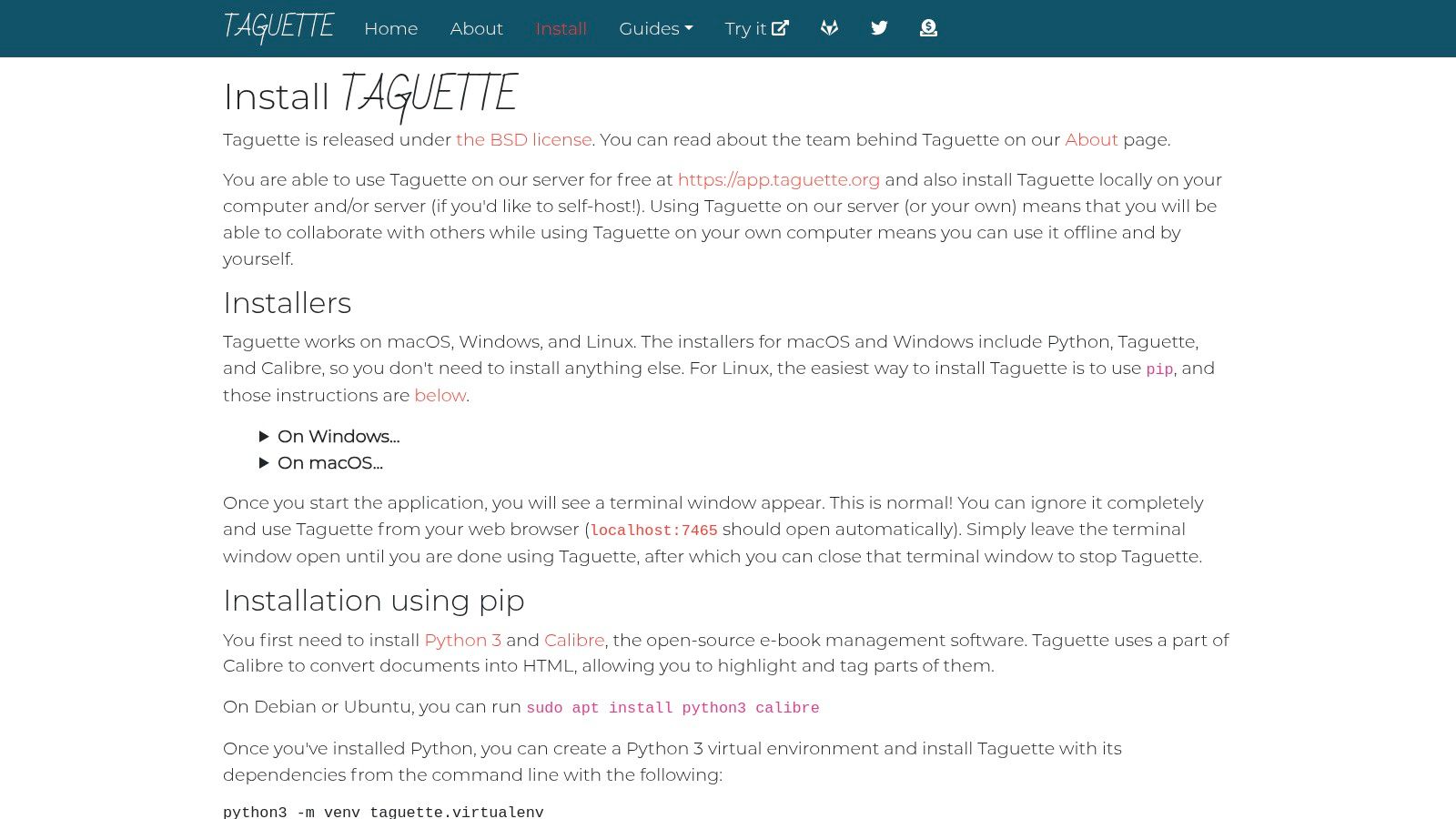
The platform's core strength is its straightforward approach to qualitative coding. You can easily import documents (PDFs, DOCX, TXT, and others), highlight text segments, and apply codes or "tags." The BSD-licensed open-source nature of the project means it has an active community, and technically inclined users can self-host the application for complete data control and private collaboration. This makes it a great choice for projects with sensitive data or those operating on a minimal budget.
While it lacks the advanced multimedia support and AI-driven features of paid platforms, Taguette excels as a starter tool. Its streamlined interface is perfect for teaching qualitative methods or for content teams needing a basic system to thematically organize interview transcripts and user feedback before moving to a more robust platform for deeper analysis.
Key Features & Offerings
- Free & Open-Source: No licensing fees, with the codebase available for modification and self-hosting.
- Flexible Deployment: Use the official hosted server or install it locally on Windows, macOS, or Linux for offline access.
- Core Coding Functionality: Supports highlighting, tagging, and exporting coded data for analysis.
- Basic Collaboration: Multiple users can work on the same project when using the web app or a self-hosted instance.
Our Take: Taguette is an invaluable resource for anyone new to qualitative analysis or for small-scale projects where budget is a primary concern. Its simplicity and option for local data hosting provide a secure, cost-effective way to organize textual data without enterprise-level overhead.
12. CAQDAS Networking Project (University of Surrey)
The CAQDAS Networking Project, hosted by the University of Surrey, isn't a software platform but an indispensable academic resource for anyone evaluating qualitative data analysis tools. It functions as a trusted, vendor-agnostic hub, providing impartial guidance, detailed software reviews, and up-to-date information on the evolving landscape of QDA software. For researchers, content teams, and students, it is one of the primary places to learn about and compare the major players in the market before committing to a purchase.
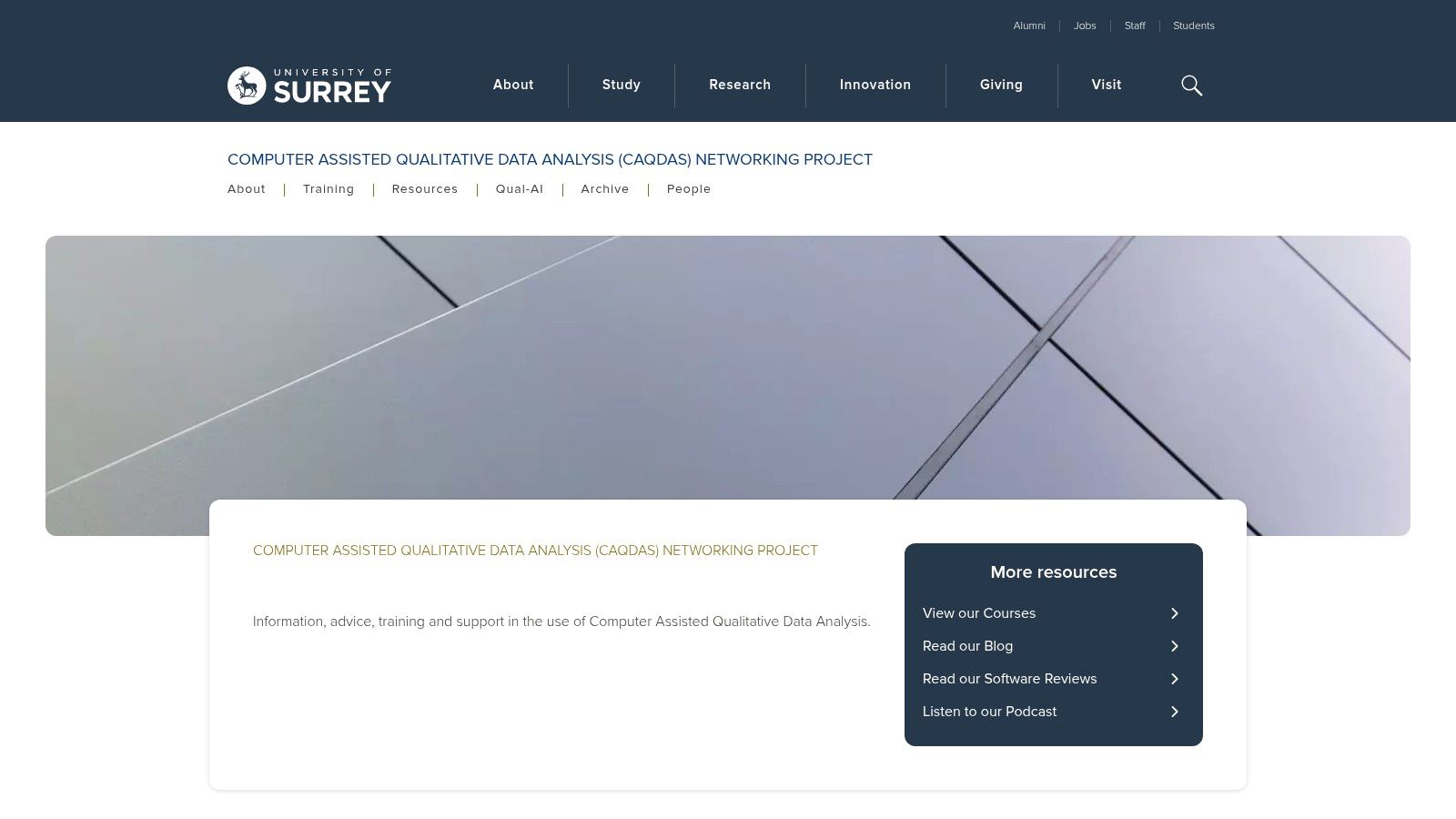
The project’s core strength is its unbiased, in-depth analysis of tools like NVivo, ATLAS.ti, MAXQDA, and others. It cuts through marketing claims to offer realistic assessments of features, platform compatibility, and the integration of new technologies like AI. Through webinars, short courses, and even a podcast, the project equips users with the methodological and practical skills needed to select and effectively use the right CAQDAS package for their specific needs, ensuring a better fit between tool and project.
The resources are provided free of charge, although its in-depth reviews are often lengthy PDF documents that require dedicated time to read. While you cannot purchase software here, the knowledge gained is invaluable for making an informed investment. This educational focus makes it a critical first stop for anyone serious about qualitative analysis.
Key Features & Offerings
- Impartial Software Reviews: In-depth, unbiased guidance on choosing the right CAQDAS package.
- Up-to-Date Information: Covers the latest software versions, platform changes, and emerging AI features.
- Training & Education: Offers regular webinars, short courses, and podcasts on methods and software skills.
- Comprehensive Coverage: Actively tracks all major QDA software, including NVivo, ATLAS.ti, and MAXQDA.
Our Take: The CAQDAS Networking Project is the most authoritative and trustworthy educational resource for comparing qualitative analysis software. It empowers you to make a smart, evidence-based decision rather than one based on marketing, making it an essential bookmark for any serious researcher or content strategist.
Top 12 Qualitative Data Analysis Tools Comparison
| Product | Core features | UX & quality | Value / USP | Target audience | Pricing / licensing |
|---|---|---|---|---|---|
| Contesimal | AI chat research, programmatic ingestion, layered taxonomies, multi-format (text/audio/video) search | Sleek chat UI, real-time data mediation, team collaboration toolkits | Turns archives into actionable ideas; outcome-focused (discoverability, engagement, monetization) | Podcasters, publishers, content marketers, video creators, researchers, writers | Free first session; tiered plans (pricing/contact for quotes) |
| Lumivero (NVivo) | NVivo 15 core, AI Assistant, Transcription, Collaboration Cloud add‑ons | Enterprise polish; clear product pages and documentation | Established QDA with extensible AI/transcription add‑ons | Academics, enterprises, research teams | Subscriptions or perpetual licenses; transparent pricing; add‑ons cost extra |
| ATLAS.ti (official) | Cross‑platform license (Win/Mac/Web), real‑time collaboration, OpenAI integrations | Full‑feature short trial; strong docs and 24/5 support | Feature parity across platforms + integrated AI tooling | Academic researchers, distributed teams | License store flow required to view pricing; trials available |
| MAXQDA (VERBI) | Editions by user type, TeamCloud, AI Assist, auto‑transcription | Clear edition segmentation; mature training ecosystem | Flexible editions for business/academia; strong support resources | Businesses, universities, non‑profits, students | Subscriptions or multi‑year licenses; add‑ons increase cost; regional pricing |
| Dedoose | Cloud QDA, active‑month billing, role‑based permissions, project encryption | Simple, budget‑friendly UI for episodic use | Pay‑only‑when‑active model suits intermittent projects | Small teams, individual researchers, project‑based users | Pay per active month for individuals; enterprise monthly plans; storage fees for media |
| Quirkos | Low‑cost cloud subscriptions, offline lifetime licenses, live collaboration | Very approachable; quick learning curve | One of the most affordable commercial QDA tools | Students, small content teams, beginners | Low‑cost tiers; lifetime offline license option; cloud plans include unlimited storage |
| Transana | Multimedia focus: A/V transcription, time‑coding, multi‑angle sync | Desktop‑centric UI; powerful A/V workflows | Specialized for complex multimedia research and teaching labs | Media researchers, labs, educators | Perpetual license tiers with volume/edu discounts |
| HyperRESEARCH (ResearchWare) | Perpetual cross‑platform license, Hypothesis Tester, HyperTRANSCRIBE optional | Traditional, stable interface; simple purchasing | Cost‑effective perpetual licensing and academic discounts | Academics, government/non‑profit researchers | Perpetual licensing; education/student discounts; higher commercial price |
| Provalis Research | QDA Miner + WordStat (text‑analytics), SimStat for stats | Strong text‑analytics integration; training available | Powerful mixed‑methods and text‑mining workflows | Mixed‑methods teams, text‑analytics users | Perpetual or annual licenses; bundles and trials; Windows‑centric |
| webQDA | 100% web app, supports text/image/video/audio/PDF/YouTube, collaborative | Browser‑only ease for distributed teams; straightforward trials | Time‑boxed licensing for flexible commitments | Distributed teams, short projects, courses | Time‑boxed licenses (90–720 days); Euro pricing |
| Taguette | Free open‑source text coding; hosted or local install | Lightweight, quick to teach; community support | No‑cost, privacy‑friendly option for small/pilot projects | Students, instructors, privacy‑sensitive users, pilots | Free (BSD license); optional self‑hosting |
| CAQDAS Networking Project | Vendor‑agnostic reviews, up‑to‑date notes, webinars and courses | Trusted academic resource; impartial comparisons | Helps choose and learn CAQDAS rather than sell software | Researchers deciding on QDA tools, instructors | Free resource hub; training/webinars may have fees |
Turn Your Content Library Into Your Biggest Asset
Navigating the landscape of qualitative data analysis tools can feel overwhelming, but making an informed choice is the crucial first step toward transforming your content archive from a passive storage unit into an active, value-generating engine. We've explored a wide spectrum of platforms, from the academic powerhouses like NVivo and ATLAS.ti to the nimble, open-source accessibility of Taguette. Each tool offers a unique pathway to understanding the rich, unstructured data that lives within your interviews, transcripts, videos, and audience feedback.
The central takeaway is clear: the most effective tool is not necessarily the one with the most features, but the one that aligns seamlessly with your specific workflow, team size, and creative goals. For a solo researcher, the rigorous coding capabilities of MAXQDA might be ideal. For a small, budget-conscious team, the visual simplicity of Quirkos or the collaborative focus of Dedoose could be a perfect fit. The key is to move beyond the feature list and envision how a platform will integrate into your daily process of creation and analysis.
Choosing Your Path: Key Considerations
Selecting the right qualitative data analysis tool requires a strategic assessment of your needs. Before you commit, consider these critical factors we've highlighted throughout this guide:
- Your Core Use Case: Are you a podcaster seeking to identify recurring themes from hundreds of interview hours? A content marketer analyzing customer feedback to inform your next campaign? A publisher looking to unearth evergreen topics from decades of articles? Your primary objective will dictate whether you need robust multimedia support, advanced text analysis, or simple, collaborative coding features.
- Collaboration Needs: Think about who needs access to the insights. Is it just you, or a team of writers, editors, and producers? Tools like Contesimal are built from the ground up for team collaboration, whereas more traditional software might have steeper learning curves or less intuitive sharing capabilities.
- Technical Skill and Scalability: Be honest about your team's comfort level with complex software. Some platforms require a significant time investment to master. Furthermore, consider your future. Will your library of content grow exponentially? Choose a tool that can scale with your ambitions, not one that will become a bottleneck as your operations expand.
Beyond Analysis: The Shift to Actionable Insights
Ultimately, the goal of using these powerful tools isn't just to generate reports or tag data. It's about turning those findings into your next viral video, your next high-engagement podcast series, or your next market-defining book. This is where the true revolution in content management lies: bridging the gap between deep analysis and immediate creative action.
The most forward-thinking qualitative data analysis tools are those that don't just help you understand your content but also empower you to act on it. This means integrating AI to accelerate discovery, providing a shared workspace for your team to brainstorm, and connecting insights directly to your content creation pipeline. By organizing your library, you’re not just cleaning house; you’re building an interconnected web of knowledge that your entire team can draw from. This structured asset becomes the foundation for everything you create, ensuring every new piece of content is informed by the collective intelligence of your past work. Embrace this new paradigm, and you'll unlock a continuous cycle of value creation from the content you already own.
Ready to move from static analysis to dynamic creation? Contesimal is designed for creators and publishers who need to organize their content library, collaborate with their team, and turn qualitative insights into their next big project. Discover how to build your content engine by visiting Contesimal today.