
Too many podcasters think promotion is something you do after you hit publish. That’s a huge mistake. Effective promotion actually starts way before your first episode drops, with a rock-solid foundation that makes your show easy to find and impossible to ignore.
This is all about crafting a compelling brand identity—from killer cover art to an SEO-friendly description—so that when new listeners stumble upon you, they’re instantly hooked. This guide will help you learn best practices for content repurposing, organize your content library to create new value, and reignite your old content to make it a money-maker today.
Building a Promotion-Ready Podcast Foundation
Before you can even think about "how to promote a podcast," you first have to build something worth promoting. I’ve seen countless creators jump straight to marketing tactics, only to see their efforts completely flop. Why? A weak foundation.
Without the core elements locked in, even the most brilliant promotional strategies will struggle to get off the ground.
Think of it like a storefront. If the sign is blurry, the window display is a mess, and the door is hard to find, people are just going to walk right by. Your podcast is no different.
Know Your Ideal Listener Inside and Out
Every single successful promotional campaign I’ve ever seen started with a crystal-clear picture of who they were trying to reach. Seriously, creating a detailed listener persona isn't just some fluffy marketing exercise; it's absolutely essential.
Who is this person? What keeps them up at night? What are their biggest passions? Where do they hang out online? Answering these questions shapes every decision you make, from the topics you cover to where you spend your marketing dollars.
For instance, if your ideal listener is a busy marketing executive trying to align content across platforms, you'd be smart to focus on LinkedIn articles and guest spots on business podcasts. But if they're a hobbyist YouTuber transitioning to a professional, you should be engaging in YouTube comments and filmmaking forums instead.
Craft a Brand That Demands Attention
In a sea of over four million podcasts, being generic is a death sentence. Your brand is so much more than a logo—it’s the entire vibe you put out there.
- Compelling Cover Art: This is your first impression, period. It has to look professional, be readable as a tiny thumbnail, and instantly communicate what your show is all about.
- A Magnetic Show Description: Think of this as your sales pitch. Weave in your target keywords naturally, but more importantly, tell people exactly what your podcast is about and what they’ll get out of listening. You have to hook them in the first two sentences.
A great podcast description does two jobs: it satisfies the search algorithms and seduces the potential listener. It must be both functional and fascinating, giving people a reason to press play.
Your foundation is the launchpad for all your future growth. Nailing these elements makes every single promotional activity you do later that much more effective. For a deeper dive, check out these actionable podcast marketing strategies. Build a strong base, and your hard work will pay off by turning casual browsers into loyal subscribers.
Getting Your High-Impact Launch Strategy Right
A powerful podcast launch doesn't happen by accident. It's a carefully orchestrated event, meticulously planned to create a huge wave of buzz right out of the gate. The whole point is to generate so much activity on day one that platforms like Apple and Spotify can't help but notice.
When you create that initial surge, you can trip their algorithms, which then puts your show in front of thousands of potential new listeners who would have never found you otherwise.
Your launch strategy has to start weeks—not days—before your first episode ever goes live. This pre-launch phase is all about building anticipation and getting your promotional assets lined up and ready to go. If you skip this groundwork, launch day becomes a frantic scramble instead of the coordinated strike it needs to be.
Building Your Pre-Launch Promotional Kit
To tease your upcoming show effectively, you need a solid collection of shareable, eye-catching content. Think of it as your digital arsenal for social media. Your mission here is simple: make people curious and genuinely eager to hear more before they can even hit the play button.
Start by mining your first few episodes for a variety of assets:
- Audiograms: These are short audio clips, usually 15-60 seconds, layered over a simple graphic or animation. You'll want to pull out a compelling quote, a funny moment, or a shocking statistic to really pique interest.
- Quote Graphics: Design some visually sharp graphics that feature powerful quotes from your guests or even from you. These are incredibly shareable and perform especially well on platforms like Instagram and LinkedIn.
- Behind-the-Scenes Content: Don't underestimate the power of showing the human side of your podcast. Share photos or short videos of your recording setup. It's a simple way to build a personal connection with your audience from the very beginning.
The key here is to build a backlog of this content so you can post consistently in the two to three weeks leading up to your launch. It's this steady drumbeat of promotion that builds an audience that is ready and waiting for episode one. If you're looking for more guidance on the fundamentals, our article on learning about podcasts is a great place to start.
Mastering the Launch Day Blitz
When launch day finally arrives, your mission shifts. Now, it's all about driving as many downloads, ratings, and reviews as possible within the first 24-48 hours. This concentrated burst of activity is exactly what the algorithms love to see.
The success of your launch isn't just measured in downloads; it's measured in momentum. A strong start creates a ripple effect, making future promotion exponentially easier and more effective.
Your launch day needs to be a coordinated effort across every channel you have. Here's what that looks like:
- Email Your List: Your email list is gold. It’s your most valuable asset. The moment your podcast goes live, send a dedicated announcement to your subscribers with direct links to listen on the major platforms.
- Coordinate with Guests: If you're launching with guest interviews, make sure they're prepped and ready to share the episode with their own audiences. Give them everything they need—pre-made graphics, suggested text—to make it a no-brainer for them.
- Lean on Your Personal Network: Don't be shy about this. Personally reach out to friends, family, and colleagues. Ask them to listen, subscribe, and—this is crucial—leave an honest review.
- Go All-In on Social: Dedicate the entire day to social media. Post all those assets you prepared, maybe even go live to talk about the launch, and make sure you're actively engaging in conversations in relevant online communities.
This multi-pronged attack ensures you’re hitting people from every possible angle. With a significant portion of consumers spending at least an hour a week listening to podcasts, coordinating promotion with guests and on social is a statistically proven way to amplify your reach. You can explore the full report on global podcast listenership to dig into these trends. Nailing this launch strategy is what sets the stage for sustained, long-term growth.
Turning Your Back Catalog Into a Growth Engine
Every episode you've ever recorded isn't just a relic of the past; it's a powerful asset just waiting to fuel your future growth. So many creators get caught up in promoting only the newest episode, leaving a mountain of valuable content to gather digital dust. This is a massive missed opportunity to upcycle your old content and create new value.
The art of content repurposing is how you promote a podcast for the long haul. It's what transforms your back catalog from a simple archive into an active, evergreen promotional machine that works for you 24/7. This isn't just about saving time—it’s about systematically multiplying your reach.
Imagine turning one single hour-long conversation into a dozen different marketing assets. This approach ensures your best ideas are constantly resurfacing, reaching new people on new platforms long after the original recording.
From Single Episode to Full Campaign
Stop thinking of a podcast episode as a one-and-done event. Instead, you need to see it as the raw material for a complete, multi-platform marketing campaign. With this mindset, your content library becomes an endless source of fresh promotional material.
A single episode can be deconstructed and rebuilt into a variety of formats, each designed for specific platforms and audiences. This strategy amplifies your core message and places it directly in the path of potential new listeners where they already spend their time.
This diagram breaks down the journey from pre-launch planning to post-launch analysis—a critical loop for turning each episode into a promotional opportunity.
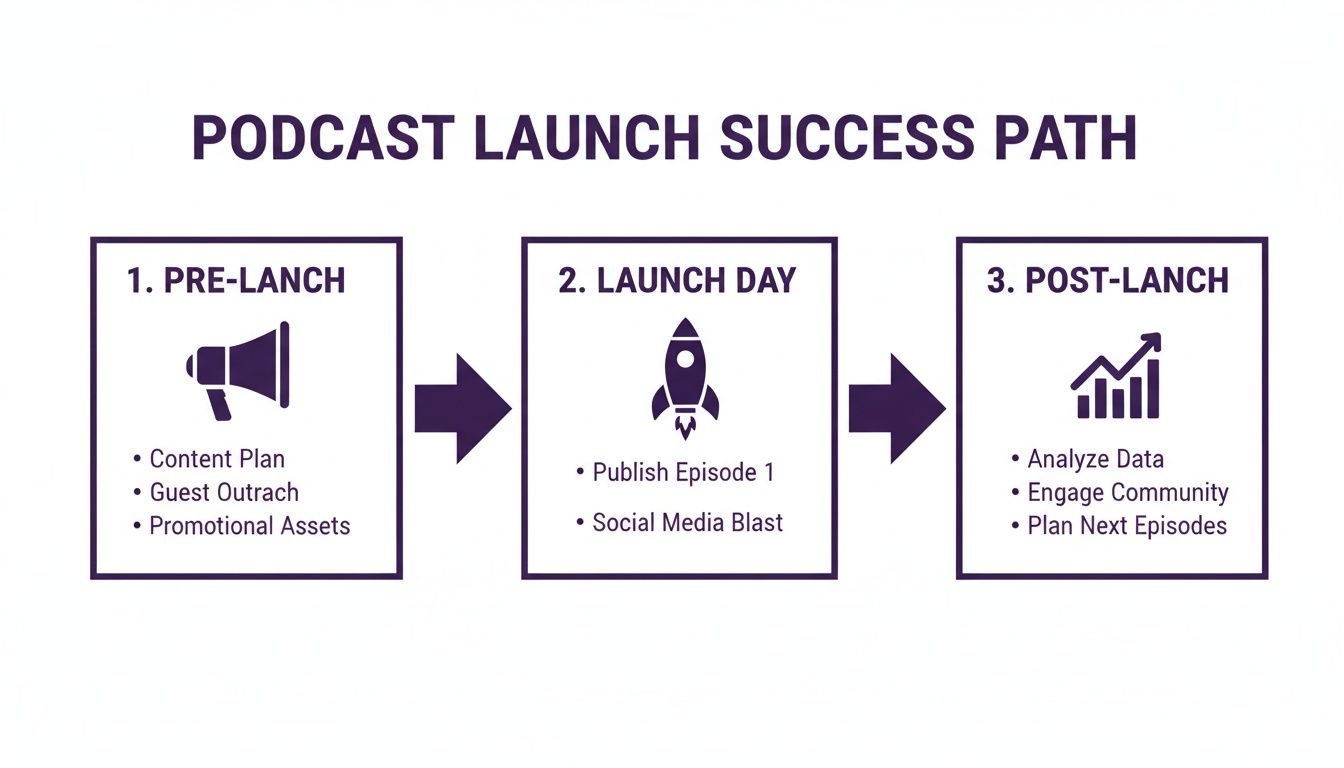
This process shows how ongoing promotion isn't just a final step but an integrated part of a continuous growth cycle, all powered by the content you already have.
Systematically Unlocking Your Library
The real challenge for most creators is the sheer volume of their back catalog. Let's be honest, manually sifting through hundreds of hours of audio to find the best moments just isn't feasible, especially as you move beyond working alone and need to collaborate. This is where modern tools can make all the difference.
Platforms like Contesimal allow you to organize your content library to create new value, helping humans and AI collaborate seamlessly. It can quickly surface the most compelling stories, insightful quotes, and recurring themes that are perfect for repurposing. This lets you organize your library, understand its hidden value, and take immediate action.
By treating your archive as a dynamic asset library, you can consistently generate high-value promotional content without having to record anything new. It reignites your old work and breathes new life into it, creating infinite content value.
This approach is becoming essential as the podcasting space gets more crowded. The industry has exploded to over 4.52 million podcasts worldwide, with 584.1 million listeners—a 6.83% jump from the previous year. Promotion through content repurposing is a game-changer for cutting through the noise.
Practical Repurposing Tactics
So, what does this actually look like day-to-day? Let's break down how one episode can be multiplied into a whole suite of promotional assets. It all starts with a full transcript, which is the foundation for almost all repurposing efforts.
Having an accurate text version of your audio is critical, not just for accessibility but for SEO and content creation. If you need a hand with this, our guide on getting your Spotify podcast transcript is a great place to start.
From that single transcript, you can spin off a whole campaign. Think of it like a content tree with many branches. Here's how you can turn one episode into a full content marketing calendar.
Podcast Repurposing Ideas Across Platforms
This table shows just a few ways you can break down a single episode into multiple pieces of content, each with a specific goal on a different platform.
| Platform | Content Format | Promotion Goal |
|---|---|---|
| Website/Blog | SEO-Optimized Article | Attract organic search traffic, establish authority. |
| TikTok/Reels | Short-Form Video Clip (30-60s) | Drive viral discovery and channel awareness. |
| YouTube Shorts | Vertical Video Highlight | Capture new subscribers in a high-growth format. |
| Thought Leadership Post | Build professional credibility and network. | |
| Instagram/Facebook | Quote Graphic or Carousel | Spark engagement and drive shares. |
| X (Twitter) | Thread of Key Takeaways | Start conversations and link back to the episode. |
| Newsletter Summary | Nurture your core audience and drive downloads. | |
| Infographic | Create a shareable, visual summary of key data. |
By building this repurposing workflow, you create a sustainable system for promotion. You're no longer just a podcaster; you're a multi-platform content creator, squeezing every drop of value from every conversation you record. This is how you turn your back catalog into your single greatest growth engine.
Growing Your Audience Through Smart Collaborations
Let's be honest, growing a podcast is rarely a solo mission. While you can get a lot of mileage out of repurposing your own content, one of the fastest ways to expand your reach is by tapping into someone else's audience. Smart collaborations are like a cheat code for growth, introducing your show to engaged listeners who already love podcasts.
This isn't about just getting your name out there; it's about strategic alignment. When you partner with a creator whose audience is a good match for yours, you’re getting a warm introduction from a trusted source. That’s far more powerful than any ad you could ever buy.
Finding and Pitching the Right Partners
First things first, you need to find collaborators who are a perfect fit. Chasing the biggest names in podcasting right out of the gate is usually a waste of time. Instead, focus on creators who are at a similar stage of growth as you, or maybe just a little bit ahead. They’re way more likely to be open to a partnership that benefits both of you.
Look for shows that cover complementary, non-competing topics. If you host a podcast about screenwriting, a collaboration with a show about independent filmmaking just makes sense. Their audience is your audience.
Once you’ve got a shortlist, it's time to craft your pitch. A solid outreach email usually includes these key ingredients:
- A personal touch: Show you’ve actually listened to their show. Mention a specific episode or a point they made that you really liked.
- A clear value proposition: Don't just ask for a favor. Spell out what’s in it for them. Propose a specific idea—a guest spot, an ad swap—that helps you both win.
- Make it easy to say yes: Keep your first email short and sweet. Link to your show and your media kit so they can quickly get a feel for what you're all about.
The best collaborations feel less like a transaction and more like a genuine creative partnership. Focus on building real relationships within your niche, and the promotional opportunities will follow naturally.
This approach turns a cold outreach into a warm conversation. You’re no longer just another person asking for a feature; you’re a peer offering a win-win that brings real value to both of your communities.
Expanding Beyond Guest Appearances
When people think about podcast collaborations, guesting on other shows is usually the first thing that comes to mind. And while it’s an incredibly effective tactic, it's really just the beginning. There are so many other powerful ways to cross-promote with fellow creators.
Think creatively about how you can pool your resources and audiences. A great collaboration is all about leveraging each other's strengths to reach new people in an authentic way.
Here are a few partnership ideas that go beyond the standard guest spot:
- Newsletter Swaps: If you both have an email list, agree to feature each other's podcasts in an upcoming newsletter. It’s a direct endorsement delivered straight to your most engaged followers.
- Social Media Takeovers: Let another creator "take over" your Instagram Stories for a day, and you do the same on their account. This is a fun, engaging way to introduce your personalities to new audiences.
- Content Collaboration: Co-create a special episode or another piece of content together that you both publish and promote. This could be a debate, a joint interview with an expert, or a deep dive into a topic you both cover.
- Ad Swaps: This one's simple but highly effective. You run a short, pre-recorded ad for their show on your podcast, and they do the same for you. It's a direct and targeted way to drive new listeners.
By exploring these different strategies, you create multiple ways for people to discover you. Each partnership builds on the last, creating a network effect that steadily grows your audience and solidifies your position as a trusted voice in your niche.
Scaling Growth with Paid Ads and Monetization
Once your organic growth strategies are firing on all cylinders, paid promotion is the accelerator you've been waiting for. Think of it as pouring fuel on a fire that’s already burning, taking your podcast from steady growth to exponential reach.
But investing in paid ads isn't about throwing money at a wall to see what sticks. It demands a smart, targeted approach to find your perfect listener without completely draining your budget.
Running Targeted Ad Campaigns
Platforms like Spotify Ad Studio and the ad managers on Meta or X offer some incredible targeting capabilities. You can get seriously granular, aiming your ads at people based on their interests, demographics, and even their listening habits. That precision is everything.
Instead of running a broad, generic campaign, zero in on a specific listener persona. For instance, if your podcast is all about screenwriting for indie filmmakers, you could target users who follow specific filmmaking accounts, list "screenwriter" as a job title, or hang out in filmmaking communities online.
Start with a small, experimental budget. Your goal in the beginning is simply to gather data.
- Test Different Creatives: Run A/B tests with various audiograms, video clips, and static images. See what actually grabs people's attention.
- Refine Your Targeting: Dig into the analytics. Which audience segments are responding best? Double down on what works and cut what doesn't.
- Track Your Cost Per Acquisition (CPA): You need to know how much it costs to gain one new subscriber. This single metric will tell you if your investment is paying off.
This data-driven approach ensures every dollar is spent efficiently. It transforms advertising from a pure gamble into a predictable growth machine—a crucial step when you're looking to promote a podcast at scale.
Turning Listeners Into Revenue
Promotion and monetization are two sides of the same coin. As your audience grows, you unlock opportunities to generate revenue, which you can then reinvest right back into more promotion. This creates a powerful, self-sustaining growth loop.
Moving from a hobbyist to a professional creator means thinking like a business. That starts with having the right tools to show potential partners the value you bring to the table, helping you transition into a revenue-generating entity.
A professional media kit is your podcast's resume. It should instantly communicate your brand, audience demographics, download numbers, and what makes your show a valuable partner for advertisers.
Your media kit needs to be a concise, visually appealing document that includes:
- Your show’s description and slick cover art.
- Key statistics like monthly downloads and listener demographics.
- A little something about your ideal listener persona.
- Your sponsorship packages and pricing.
Armed with this, you can confidently start pitching potential sponsors. But please, don't just send a generic email blast. Research brands that genuinely align with your content and audience. A personalized pitch explaining why a partnership makes sense for them is way more likely to get a positive response.
Leveraging Your Content Library for Monetization
Your back catalog is more than just a promotional tool; it's a powerful asset for proving your value to advertisers. By analyzing your entire content library, you can pinpoint the topics, guests, and episode formats that generate the most engagement. This data is pure gold during negotiations.
Imagine being able to show a potential sponsor, "Our episodes on this specific topic consistently get 25% more downloads and shares." This is how you prove you can deliver an engaged audience they want to reach. With global podcast advertising revenue set to hit $4.46 billion and U.S. spending alone at $2.55 billion, data-informed strategies are critical for securing your piece of that pie.
Beyond sponsorships, a well-organized content library opens doors to other income streams:
- Affiliate Marketing: Recommend products you genuinely use and love, then earn a commission.
- Premium Content: Offer bonus episodes or ad-free versions for your most dedicated, paying subscribers.
- Merchandise: Create some cool merch that your biggest fans will be excited to wear.
Effectively monetizing your podcast provides the resources to scale your promotional efforts, turning your creative passion into a sustainable and profitable venture. For a deeper dive, be sure to check out our guide on making money with a podcast.
Your Podcast Promotion Questions, Answered
Even with the best playbook in hand, you’re going to have questions. The world of podcast promotion is swimming with advice—some good, some not so good, and plenty of it conflicting. Let's cut through the noise.
This is your no-fluff guide to the common hurdles that trip up creators. We'll tackle the big questions about timelines, budgets, and the tools you actually need to grow your show.
How Long Does Podcast Promotion Really Take to Show Results?
This is the big one, isn't it? The honest-to-goodness answer is: it depends, but patience is non-negotiable. A splashy launch can give you an immediate sugar rush of downloads, but building a real, lasting audience is a marathon, not a sprint.
For organic stuff like SEO and repurposing your content, you should give it a solid three to six months before you expect to see significant, steady traction. Think of it like this: every blog post, audiogram, and social clip you create is another fishing line in the water. One line might not catch much, but dozens of them working for you 24/7 start to build powerful, long-term momentum.
Sure, paid ads can get you listeners by tomorrow. But true, sustainable growth comes from showing up consistently with the foundational tactics.
What Are the Best Free Ways to Promote a Podcast?
You absolutely do not need a massive budget to make a dent. In fact, some of the most effective promotional tactics will only cost you your time and a bit of creativity. If you're bootstrapping this thing, make these your priorities.
- Be a Guest on Other Podcasts: This is probably the single most powerful free tactic out there. You're tapping directly into an existing audience that already loves podcasts, and you get a warm introduction from a host they trust. It’s a massive shortcut.
- Repurpose Everything: Your one-hour episode is a content goldmine. Turn it into a dozen or more micro-assets. Pull out the best quotes for graphics, create short video clips of killer moments, and make audiograms for social. Give people a taste, and they’ll come looking for the full meal.
- Hang Out in Online Communities: Find the subreddits, Facebook groups, and forums where your people are already congregating. The key here is not to just drop your link and run. Add real value to conversations, answer questions, and build a reputation first. Then, when it’s natural, share your show.
- Just Ask for Shares and Reviews: Seriously, don't overlook this. A simple, genuine call-to-action at the end of your show asking listeners to share it with one friend or leave a review can move the needle more than you think.
Word-of-mouth is still the king of growth engines, and it costs exactly zero dollars.
Is a Website Really Necessary for My Podcast?
Yes. A thousand times, yes. In a world where you're renting space on platforms like Spotify and Apple Podcasts, your website is the one piece of the internet you actually own. It’s your home base.
A dedicated site does a few critical things you just can't do anywhere else. For starters, it makes your show look legitimate and professional, which matters to potential guests, sponsors, and listeners.
Think of your podcast directory listings as pop-up shops in a crowded mall. Your website is your flagship store. It's where you build a real relationship with your biggest fans, far away from the whims of an algorithm.
Here’s why it’s not optional:
- SEO Gold: Your website is your best shot at getting found on Google. Publishing detailed, keyword-rich show notes and transcripts lets you rank for the topics you discuss, attracting listeners who are actively searching for what you're talking about.
- Your Email List: This is your most valuable asset, period. A website is the perfect place to host an email sign-up. It's a direct line to your audience that you control completely.
- The Central Hub: It gives you one clean link (
yourpodcast.com) to share. That link can house everything: subscribe buttons for all platforms, your entire back catalog, and info about you and the show.
To see just how far a strong, independent brand can take you, it's worth exploring how podcasters are redefining global influence and leveraging their own platforms for massive impact.
Should I Run Paid Ads for a Brand New Podcast?
It’s tempting to just throw money at the problem, I get it. But for a show that’s fresh out of the gate, your best bet is to focus on organic promotion first. Before you spend a dime, you need to prove your concept. You need to know you have a show people actually want to stick around for.
Use your first couple of months to build a small, core audience and get feedback. See which topics pop off and which guests get the best reactions. This organic phase isn't just about saving money; it's about gathering the critical data you'll need to make your ads effective when you do run them.
Once you know your show has legs and you have a crystal-clear picture of your ideal listener, then paid ads can be like pouring gasoline on the fire. Start with a small budget, test different audiences and ad creatives, and only scale up what’s working.
As you've seen, your existing content is the bedrock of your promotion. The key to unlocking its full value is having a system to organize and understand that library. Contesimal is built for creators ready to turn their back catalog into a growth engine. We help you collaborate with AI to find your best moments and spin them into an endless stream of high-impact promotional content. Reignite your content library and build your audience by visiting https://contesimal.ai.