
An effective SEO content strategy is your master plan for pulling in the right audience through search engines. It’s a roadmap for creating, publishing, and managing content that speaks directly to your audience's questions, turning your website into the kind of go-to resource Google loves to show off.
What Is an SEO Content Strategy
Think of an SEO content strategy like the blueprint for a grand library. Without a plan, you might just end up with random piles of videos, podcast episodes, and articles scattered everywhere. But with a plan, you build an organized, interconnected space where every piece of content has a purpose and your audience can easily find exactly what they’re looking for. This blueprint decides not just what you create, but why you create it and how each piece supports the others to reignite your content library and bring it to life.
This is the huge difference between just publishing content and publishing with real purpose. A solid strategy ensures you’re not just chasing random keywords but are methodically building authority around topics that truly matter to your audience—whether they're YouTubers, podcasters, or professional creators. This approach transforms scattered efforts into a unified force that drives steady, long-term organic growth.
Beyond Individual Keywords to Topical Authority
Modern SEO isn’t a game you win by targeting one keyword with one article. Search engines now reward websites that show deep expertise across an entire subject. This is where topical authority comes in. Your strategy needs to focus on covering a topic from every angle, which usually involves a few key parts:
- Pillar Content: These are your massive, foundational guides that cover a broad topic from top to bottom. In our library analogy, this is the main wing dedicated to a huge subject like "Video Production."
- Cluster Content: These are the specific, individual articles that dive deep into the subtopics related to your pillar. Think of them as the books on the shelves, covering things like "Best Lighting for YouTube Videos" or "How to Edit Podcast Audio."
- Internal Links: These are the hallways and signs connecting your pillar and cluster content. They guide both users and search engines through your library, showing them how everything fits together.
A well-executed SEO content strategy is an asset that appreciates over time. Each new piece of content you add strengthens the authority of the whole, creating a powerful flywheel effect that attracts more traffic and builds a loyal audience.
For any creator or publisher, just keeping track of a growing library of assets—videos, blog posts, podcasts—is a monumental task. This is exactly where a platform like Contesimal becomes a game-changer. It allows you to organize your content library to create new value and ultimately make money with it. You can instantly spot existing assets to build out your topic clusters, find hidden gems to upcycle, and build that sought-after authority systematically.
Auditing Your Content and Understanding Your Audience
Before you even think about creating something new, the first move is always to look inward. A killer SEO content strategy doesn't start with a blank page. It starts with a deep, honest look at two things: what you’ve already created and who you’re actually talking to.
This isn’t just about spring cleaning old blog posts or glancing at demographic charts. It’s the foundational work that makes everything else click into place.
Uncovering Your Audience's True Intent
The process has to start with your audience. To really connect with people, you need to get past surface-level stuff like age and location. The real goal is to get a handle on their search intent—what’s the problem they're desperately trying to solve? Are they a YouTuber trying to figure out their next viral video, or a content marketer needing to align content across multiple platforms?
When you understand this, you can create content that meets them right where they are, whether they’re just figuring out they have a problem or they’re ready to pull the trigger on a solution.
Getting to the heart of what your audience wants feels a bit like detective work. Instead of just guessing, you can use a few solid methods to build a crystal-clear picture of what they need and what drives them. This is how you create content that doesn't just rank but actually resonates.
- Analyze Search Queries: Pop open Google Search Console and look at the exact phrases people use to find you. Are they asking questions ("how to start a podcast"), weighing options ("vlog camera vs. mirrorless"), or hunting for a specific tool ("best video editing software")?
- Listen to Your Community: Your YouTube comments, social media mentions, and email replies are a goldmine. The language your audience uses and the questions they ask tell you everything you need to know about their biggest frustrations.
- Map Their Journey: Think about the path your audience takes. A brand-new YouTuber just getting started (Awareness stage) has totally different needs than a pro looking to monetize their back catalog (Decision stage).
A winning SEO content strategy is built on empathy. When you understand your audience’s problems as well as they do, you create content that not only ranks but also builds a loyal following.
Performing a Strategic Content Audit
Once you have a sharp picture of your audience, it’s time to take a hard look at your entire content library. A content audit is a strategic review of every single asset you've ever made—from blog posts and podcast episodes to videos—to figure out what's working, what’s not, and where your biggest opportunities are hiding.
This process is absolutely critical for building topical authority. We're seeing more and more that topical depth is a massive ranking factor, and marketers agree that creating relevant content is their number one SEO tactic. But here's the catch: with over 55% of pages having zero backlinks, just churning out content is a losing game. It has to be strategic, interconnected, and genuinely valuable. A proper audit makes sure every piece in your library has a job to do. Dig into more insights about the shifting sands of SEO strategy over at infiflex.com.
For creators sitting on hundreds or even thousands of assets, a manual audit sounds like a nightmare. This is where AI-powered platforms like Contesimal come in and change the game. It’s designed for creators transitioning from hobbyists to revenue-generating professionals who need to organize, understand, and take action on their content library.
Contesimal helps you and your team collaborate to discover hidden connections and repurposing opportunities you’d never spot on your own. It turns a painful chore into a powerful strategic planning session, letting you quickly see how to create new value from the content you already have.
To make this process more concrete, think about sorting your content into a few key buckets. Each piece will have a different fate based on its performance and relevance.
Content Audit Action Framework
Here's a simple framework to guide your decisions during an audit. It helps you decide what to do with each piece of content and shows how a tool like Contesimal can make the job faster and smarter.
| Content Category | Criteria | Recommended Action | Contesimal Use Case |
|---|---|---|---|
| High Performers | High traffic, strong engagement, relevant keywords. | Keep & Promote: Optimize further and use as a model. | Identify top-performing assets to build topic clusters around. |
| Outdated but Relevant | Good topic, but has old stats or broken links. | Update & Relaunch: Refresh with new info and visuals. | Quickly find all assets on a topic to consolidate and update. |
| Underperforming Assets | Low traffic, thin content, targets irrelevant keywords. | Merge or Remove: Combine with a stronger piece or delete if it offers no value. | Pinpoint weak content and find related videos to embed for more depth. |
| Hidden Gems | Great content but poor SEO or visibility. | Repurpose & Optimize: Turn a video into a blog post or social clips. | Search transcripts to pull key moments for new, targeted content creation. |
By systematically categorizing your assets, you move from a cluttered archive to a strategic library where every piece of content is working for you. This audit isn't just about cleaning house; it's about building a stronger foundation for everything you'll create next.
Building Topic Clusters to Achieve Authority
If you’re still chasing individual keywords one by one, you’re playing a game that ended years ago. Modern SEO is all about proving you're a true authority on a subject, not just a one-hit wonder for a specific search term. The single best way to show search engines you have that deep expertise is by building topic clusters.
Think of your website like an encyclopedia. The topic cluster model organizes your content into logical, interconnected chapters. It’s a powerful framework that sends a clear signal to Google: "Hey, we know this subject inside and out," making your entire site more valuable in its eyes.
The Pillar and Cluster Model Explained
This whole model is built on two parts working together. Imagine a central hub with a bunch of spokes branching out from it.
- Pillar Page: This is the hub. It’s a long-form, comprehensive guide that covers a broad topic from a high-level view. For someone with a YouTube channel, a pillar page might be something like "The Ultimate Guide to Starting a YouTube Channel."
- Cluster Content: These are the spokes. They're shorter, more focused pieces that dive deep into the specific subtopics you touched on in the pillar page. Using our YouTube example, clusters could be "How to Choose a Microphone for Vlogging" or "Best Video Editing Software for Beginners."
The real magic happens when you link them all up. Each cluster article links back to the main pillar page, and the pillar page links out to every cluster piece. This creates a tightly knit web of content that's dead simple for both your audience and search engines to navigate.
This structure isn't just about neat organization. It strategically funnels authority from all your detailed cluster content back to your main pillar page. This boosts its ranking power for those highly competitive, broad keywords. It’s how you build an unshakable foundation.
A content audit is the perfect jumping-off point for spotting potential pillar and cluster content you already own. This diagram breaks down the simple decision-making process for every asset in your library.
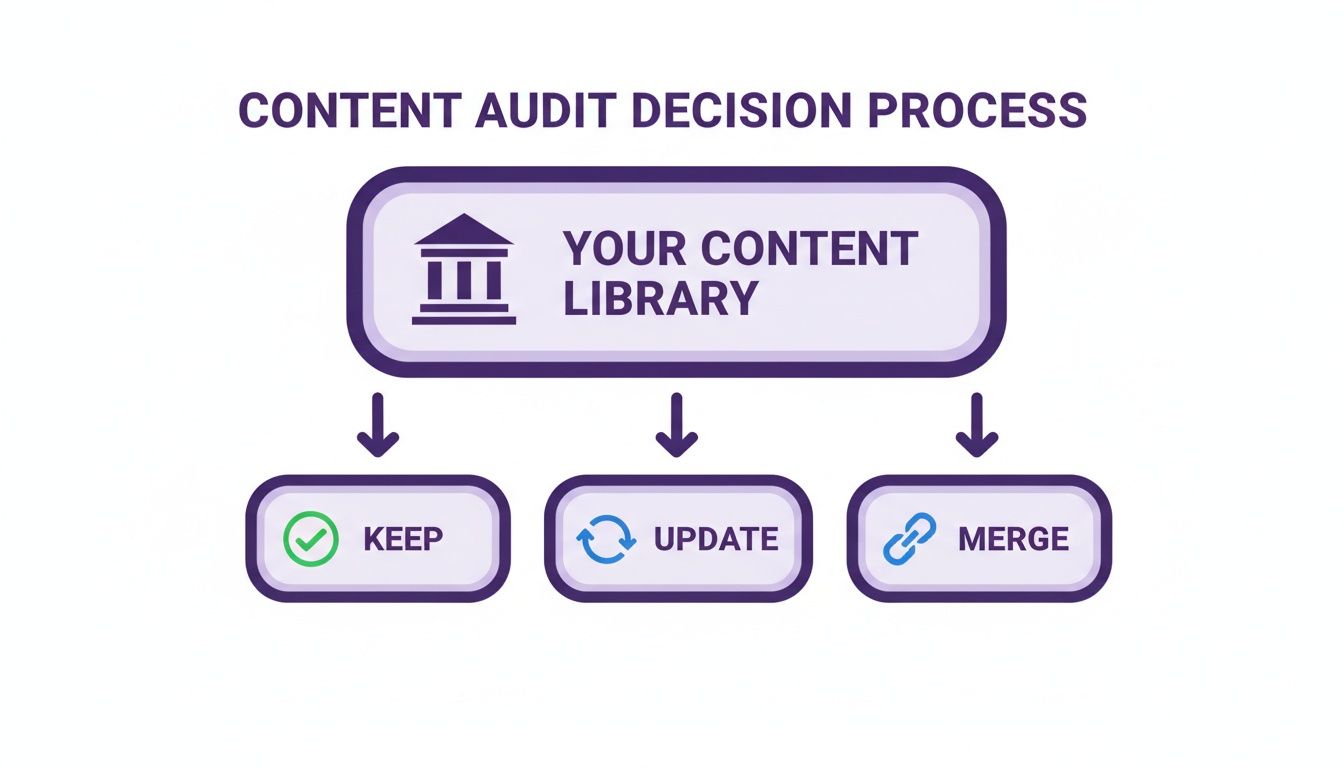
This hierarchy shows you need to evaluate every piece of content to either keep, update, or merge it. That process directly tells you how to build out topic clusters from the assets you already have.
How to Build Your First Topic Cluster
Ready to actually do this? Building your first topic cluster is a straightforward process that gets your content creation efforts aimed at a clear SEO goal.
-
Identify Your Core Pillar Topics: First, brainstorm the big, overarching subjects you want to be known for. These need to be broad enough to spin off at least 15-20 related subtopics and should tie directly to the problems your audience is trying to solve. A podcaster, for example, might choose "Podcast Monetization" as a core pillar.
-
Research Keywords for Cluster Content: With a pillar topic in hand, it's time for keyword research. Find all the specific questions and long-tail phrases your audience is plugging into search. For the "Podcast Monetization" pillar, this could include keywords like "how to get podcast sponsors," "patreon for podcasters," or "selling merchandise for a podcast."
-
Map Your Content: Create a visual map of your pillar and all its cluster topics. This lets you see the whole picture, spot gaps where you need to create new content, and find existing articles in your library that you can update to fit into the cluster.
Accelerating Cluster Creation with AI
If you're a creator with a massive back catalog of videos, articles, or podcast episodes, the idea of manually sifting through it all to find potential cluster content is, frankly, a nightmare. This is exactly where an AI-powered platform like Contesimal becomes your strategic partner.
Instead of getting lost in spreadsheets for weeks, you can scan your entire library almost instantly. Contesimal helps you:
- Discover Existing Cluster Content: Search through all your transcripts and documents to find every single mention of a subtopic. This instantly shows you which videos or posts can serve as ready-made cluster pieces.
- Identify Internal Linking Opportunities: Pinpoint every instance where you’ve mentioned a related topic, making it ridiculously easy to build those crucial internal links that tie your cluster together.
- Pinpoint Content Gaps: By mapping out what you already have, the platform makes it painfully obvious where the holes in your strategy are. It tells you exactly what content you need to create next to achieve true topical authority.
This turns a daunting organizational mess into a clear, actionable plan, letting you build authority much faster and more efficiently.
Putting Your Content and Optimization Workflow into Motion
Alright, you’ve mapped out your topic clusters and you have a solid grasp of what your audience is really looking for. Now it's time to roll up your sleeves and shift from planning to doing. This is the moment your SEO content strategy truly comes alive—where research and ideas transform into high-quality, optimized content that clicks with both actual people and search algorithms.
Think of this workflow less as a rigid checklist and more as a system for consistently churning out assets that build real authority.
During the creation process, you’ll want to weave in all those foundational on-page SEO elements. We're talking about compelling title tags, sharp meta descriptions, and a logical header structure (H1, H2, H3). These are the signposts that help search engines understand what your content is about and why it’s important, making it much easier for them to get it in front of the right eyeballs. If you want a deeper dive, check out our guide on optimizing content for search engines.
Building E-E-A-T Into Every Single Piece
Beyond the technical stuff, the true north for any modern content is E-E-A-T: Experience, Expertise, Authoritativeness, and Trustworthiness. This isn't just some Google buzzword; it's the framework they use to evaluate content quality, and it should be the guiding light for every article, video, or podcast you produce.
Building E-E-A-T is about more than just spitting out facts. You have to prove you know your stuff.
- Experience: Got a story? Tell it. Share firsthand accounts, case studies, or even personal screw-ups. If you're a filmmaker, show the messy behind-the-scenes footage. If you're a podcaster, talk about what you learned from a disastrous interview.
- Expertise: Go deep. Get into the nitty-gritty details, back up your claims with credible sources, and break down complex topics so anyone can understand them.
- Authoritativeness: Show why people in your industry should listen to you. This comes from collaborating with other experts, getting mentioned in respected publications, or even just showcasing glowing testimonials.
- Trustworthiness: Be straight-up with your audience. Clearly label sponsored content, include real author bios, and make it ridiculously easy for people to get in touch.
As you're creating, you'll also need to figure out how many keywords to use for SEO and content strategy—it’s a delicate balance between optimizing for search and sounding like a natural, trustworthy human.
The New Standard: Human-AI Collaboration
Let’s be real: AI in content creation isn't going anywhere. It has quickly become a core part of a modern SEO strategy. In fact, AI-written pages now pop up in 17.31% of top Google search results, a massive leap from just 2.27% not too long ago. That tells us one thing loud and clear: speed and scale are now serious competitive advantages.
But the smartest creators aren't just hitting "generate" and calling it a day. They’re using AI as a powerful sidekick, not a replacement for human ingenuity and expertise. The real magic happens when you blend the raw efficiency of AI with the irreplaceable value of human insight.
AI is a phenomenal tool for jump-starting research, brainstorming ideas, and knocking out initial drafts. But the storytelling, the unique perspectives, and the final polish that builds genuine trust—that still comes from a human.
This is exactly where a platform like Contesimal comes in. It helps humans and AI collaborate in a healthy and seamless way. You can lean on its AI to instantly pull insights from your entire content library, find that perfect quote from a video you shot last year, or dig up a data point buried in an old blog post. Then, your creative team can take that raw material and craft something truly authoritative that oozes E-E-A-T.
This hybrid approach lets you scale up production without sacrificing the quality and authenticity that builds a loyal audience. It’s about working smarter, not just faster, and turning your existing library into a springboard for fresh, high-impact content.
Repurposing Content to Maximize Your Reach
Hitting “publish” on a huge, high-impact piece of content feels like a major win. But if your SEO content strategy stops there, you're leaving most of its value on the table. The sharpest creators know that the initial asset is just the starting point. The real growth comes from turning that one great piece into an entire ecosystem of content.
This is the "create once, publish everywhere" philosophy in action. It’s all about squeezing every drop of value from the hard work you’ve already done. Think of that one, in-depth video you just produced. It’s not just a video; it's a goldmine of clips, quotes, and ideas just waiting to be dug up and upcycled.

From One to Many: The Art of Atomization
The big idea behind repurposing is atomization. You take one large "macro" piece of content and splinter it into dozens of smaller "micro" assets, each perfectly shaped for different platforms and audiences. This isn't just about saving time; it's about amplifying your message and generating more audience across platforms.
Let's say you just dropped a 45-minute podcast episode with an industry expert. Instead of letting it just sit in your podcast feed, you can atomize it and launch a full-blown content campaign.
- Detailed Blog Post: Get the whole thing transcribed and turn it into a deep-dive article. Pop the audio player at the top, and you’ll start catching search traffic from people who’d rather read than listen.
- Short Social Media Clips: Find the 3-5 most powerful moments and chop them into vertical videos for TikTok, Instagram Reels, and YouTube Shorts.
- Quote Graphics: Design some sharp, shareable graphics with the best quotes from your guest. These are perfect for sparking conversations on LinkedIn, X (formerly Twitter), and Facebook.
- Audiograms: Create short audio clips with animated waveforms to promote the full episode on visual-first platforms like Instagram Stories.
Repurposing a single asset isn't just repeating yourself. It’s about meeting different parts of your audience where they are, in the format they love. That’s how you dramatically increase the ROI of your original effort.
This kind of multi-platform presence sends powerful signals back to search engines, reinforcing your authority from every angle.
Reigniting Your Entire Content Library
This strategy isn't just for brand-new content. If you're a creator, publisher, or marketer with years of assets under your belt, your archive is a sleeping giant. Every video, podcast, and article you've ever made is packed with valuable moments and insights that can be brought back to life to create infinite content value.
Of course, the biggest challenge has always been the mind-numbing effort of sifting through it all. Manually scrubbing through hundreds of hours of video or audio to find one perfect clip is a task so overwhelming that most people don't even try.
This is exactly the problem a tool like Contesimal was built to solve. It turns your content library from a dusty, passive archive into an active money maker. By making your video and audio transcripts instantly searchable, you can pinpoint key ideas and quotes in seconds.
Instead of guessing what to post, just type in a topic and see every single time you’ve ever talked about it. This gives you an endless stream of ideas for new content, helps you find the perfect clips for social, and uncovers opportunities to link related assets together. You can explore more specific tactics in our guide on powerful content repurposing strategies.
By making your entire library searchable, every piece of content you've ever created becomes a building block for your future success. This systematic approach to repurposing is the bedrock of a scalable and sustainable SEO content strategy.
Measuring Your Success and Refining Your Strategy
An SEO content strategy isn’t something you create once and then file away. Think of it as a living system, one that needs to breathe and adapt based on what’s actually happening out in the wild. To make smart moves, you have to look past fluffy numbers like page views and lock in on the Key Performance Indicators (KPIs) that signal real business impact.
Honestly, measuring what truly matters is the only way to know if your hard work is paying off. It's about connecting your content directly to growth, authority, and whether or not your audience is actually paying attention. Without this feedback loop, you’re just guessing—burning time and money on things that feel right but don’t move the needle.
Key Metrics for Your SEO Content Strategy
To get a clear picture of how things are going, you don't need a thousand metrics. Just focus on a handful of powerful ones. Each tells a different piece of the story, from how many new people you’re reaching to how well your content is pushing them to act.
Here’s a breakdown of the essential KPIs to track, what they really mean, and the tools you can use to measure them.
Key Metrics for Your SEO Content Strategy
| Metric | What It Measures | Why It Matters | Tools to Use |
|---|---|---|---|
| Organic Traffic Growth | The increase in visitors coming from search engines (like Google) over time. | This is the most direct signal that your SEO efforts are working and you're gaining visibility. | Google Analytics, Ahrefs, Semrush |
| Keyword Ranking Improvements | How your target keywords are moving up or down in search engine results pages (SERPs). | Upward trends show you're building topical authority and becoming a go-to source for your niche. | Ahrefs, Semrush, Google Search Console |
| Conversion Rates | The percentage of visitors who take a desired action (e.g., newsletter signup, download, purchase). | Traffic is great, but conversions are what drive business growth. This links content to revenue. | Google Analytics (with goal tracking) |
| Backlinks Earned | The number of new, high-quality links pointing to your content from other websites. | Backlinks are like votes of confidence from other sites, boosting your domain authority and rankings. | Ahrefs, Moz, Majestic |
Tracking these metrics gives you a solid, data-backed foundation for every decision you make next.
Treat your strategy like a constant process of learning and tweaking. The data you gather isn’t just a report card; it’s a roadmap showing you exactly where to turn next.
Creating a Framework for Regular Analysis
Data is only useful if you do something with it. A simple, repeatable process for analysis ensures you’re consistently sharpening your approach. Set aside time every month or quarter to review your performance, ask the tough questions, and adjust your plan.
For a deeper dive, our guide on how to analyze content performance walks you through it step-by-step.
This regular check-in helps you see which content formats connect, what topics are lighting up your audience, and where your biggest opportunities are hiding. If you have a big library of content, the engagement patterns within your archive offer another goldmine of qualitative data.
Platforms like Contesimal can seriously speed up this process by helping you analyze engagement across your entire library. When you understand which moments in your videos or podcasts get the most replays, you can plan future content with way more confidence. This ensures your SEO content strategy stays perfectly tuned to what your audience actually wants.
Got Questions About SEO Content Strategy?
Even with the best-laid plans, a few questions always pop up. Let's tackle some of the most common head-scratchers people run into when building and running an SEO content strategy.
How Long Does This Stuff Actually Take to Work?
Let's be real: SEO is a long game. While you might see some encouraging signs in the first 3 to 6 months—like a handful of long-tail keywords starting to climb the ranks—the big wins take time.
You're usually looking at 6 to 12 months of consistent work before you see substantial organic traffic growth and start ranking for the keywords that really move the needle. Think of it less like a sprint and more like building an investment portfolio. Every great piece of content you publish and every link you earn is another asset, and their value compounds over time. Consistency is what separates a temporary bump from sustainable growth.
What's the Real Difference Between a Keyword and a Topic?
This is a huge one, and getting it right is fundamental to modern SEO. A topic is the broad neighborhood you want to be the expert in, like "podcast monetization." It's the big idea your audience cares about, the thing you want to own in their minds.
Keywords are the specific street addresses within that neighborhood. They're the actual phrases people are punching into Google, like "how to get podcast sponsors," "best Patreon alternatives," or "selling merchandise for a podcast." A smart SEO strategy doesn't just chase individual keywords; it aims to cover the entire topic comprehensively with a cluster of content, where each piece tackles different keywords to build that deep, undeniable authority.
How Can I Breathe New Life Into Old Content?
Reviving old content isn't just a tactic; it's one of the most efficient SEO plays you can make. Your archives are probably sitting on a goldmine of forgotten potential. The first step is to dig up posts that used to perform well but have started to fade, even though they still target relevant keywords.
Once you’ve found your candidates, it’s time for a makeover.
- Update and Refresh: Swap out old stats, add new information, and make sure everything is factually on point for today.
- Enhance and Expand: Can you add a new section? Embed a few relevant video clips? Make it deeper and more valuable than it was before.
- Strengthen Internal Links: Weave in links to your newer articles, pulling that older piece firmly into your current topic clusters.
This is where a content intelligence platform can be a game-changer. It helps you instantly find related assets—like a specific clip from a podcast or a moment in a video—to embed and add fresh value. This signals to Google that your content is more relevant and comprehensive than ever, which is exactly what the algorithm loves to see.
Ready to turn your entire content archive into a growth engine? Contesimal helps you organize, search, and repurpose your library to create infinite new value. Discover hidden opportunities and accelerate your SEO content strategy today by visiting https://contesimal.ai.