
A paragraph on respect should describe dignity, listening, and boundaries, not demand politeness or obedience. In 2024, only 37% of U.S. employees strongly agreed they were treated with respect at work, a reminder that good intentions don't guarantee respectful behavior. In class, respect means hearing a classmate's idea and giving them credit before adding your own. Online, it means asking before sharing someone's private photo or message. Respect lets people disagree while protecting each person's dignity, privacy, and right to speak without being humiliated.
A Paragraph on Respect Ready to Copy
Use the opening paragraph above as a ready-to-paste example. It defines respect, gives a classroom moment and a privacy boundary, and makes room for disagreement without turning respect into obedience. If your assignment calls for a different length, keep the definition and replace the scene.
Polite wording alone isn't the definition. A sentence can sound courteous while excluding someone; a firm sentence can show respect if it addresses the issue without attacking the person. For help shaping an introduction, see this guide to structure in writing.
Short versions for different uses
School version, 40 words: Respect means listening to others, treating people fairly, and refusing to humiliate anyone, even when you disagree. When a classmate shares an idea, acknowledge it before adding your own. Respect makes discussion safer and helps everyone take part.
Caption, 35 words: Give people your attention, and ask before sharing their photo. Respect means making room for someone's voice while treating their privacy as a real boundary, not an obstacle to a joke or post.
| Use | Length | Must include | Concrete beat |
|---|---|---|---|
| School essay opening | 90 words | Dignity, listening, disagreement without humiliation | Credit a classmate's idea |
| Social or community post | 35 words | One action and one boundary | Ask before sharing a photo |
| Workplace or team note | 40 words | Fairness, credit, and no harassment | Name a contribution in a meeting |
| Video or podcast open | 25–40 words | Spoken definition plus one scene | Host pauses so a guest finishes |
A workplace note might say: “Respect means treating colleagues fairly, crediting their contributions, and addressing problems without harassment. In a meeting, name the person whose idea you're building on before explaining your own.” For a spoken opening, use short words and one action the audience can picture.
Keep the definition steady and swap only the scene. That makes a paragraph easier to adapt without watering down its meaning.
Respect as Dignity Rather Than Obedience
A student politely agrees with a teacher's decision, even though the decision unfairly shuts a classmate out. Another student calmly asks the teacher to explain the rule and gives a reason it may be unfair. The first student sounds more agreeable, but agreeable manners don't automatically make an action respectful. The second student may be showing respect by treating the classmate as someone whose dignity matters and by questioning a decision without insulting the teacher.
The Universal Declaration of Human Rights, adopted by the United Nations General Assembly on 10 December 1948 through Resolution 217 A (III), ties respect to human dignity, equality, freedom, justice, and peace; Article 26 says education should promote respect for human rights and fundamental freedoms, as the Council of Europe's UDHR overview explains.
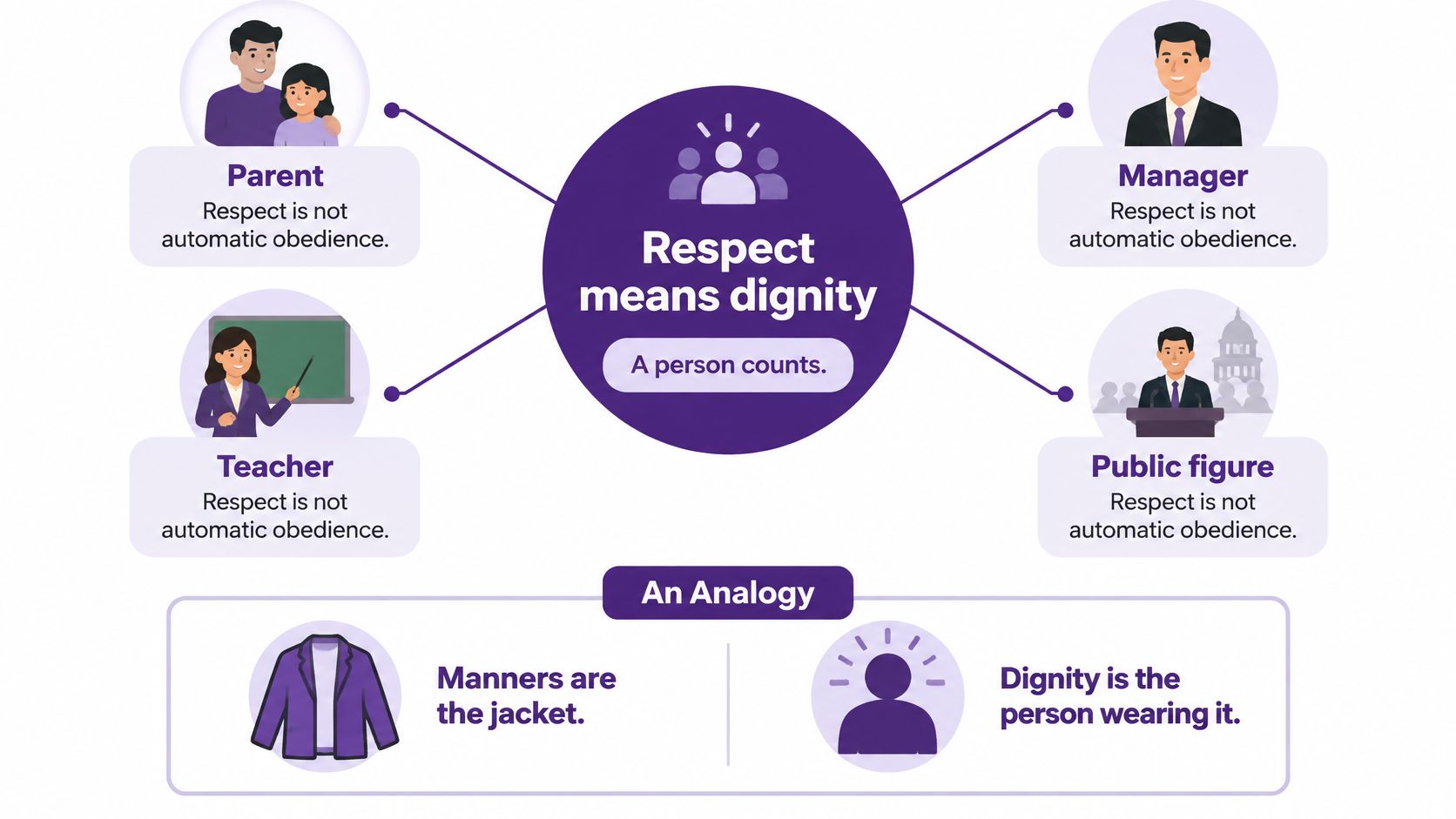
A useful analogy is that manners are the jacket, and dignity is the person wearing it. Manners can help an interaction go smoothly, but they're not the whole measure of respect. A person might use a formal greeting while excluding someone from a conversation. Someone else might disagree directly but still listen, explain their reasoning, and avoid humiliating anyone.
For a school assignment, a concise citation line is: United Nations General Assembly, Resolution 217 A (III), 1948.
A strong paragraph passes three tests: the person is recognized, heard, and not humiliated.
Those tests work whether the person in question is a parent, teacher, manager, public figure, or peer. Respect doesn't require automatic obedience to any of them. It requires recognizing that each person counts, listening to what they have to say, and disagreeing without trying to shame or silence them.
Checks That Show Respect Is Real
An organization can call respect a core value while employees still experience the opposite. In its 2024 U.S. findings, Gallup reported that only 37% of employees strongly agreed they were treated with respect at work, a return to the record low first measured in 2022 (Gallup's workplace findings). That measure captures employees' strong agreement, not every detail of every interaction. Still, it gives writers a concrete reason to describe what respectful treatment looks like rather than declaring that it exists.
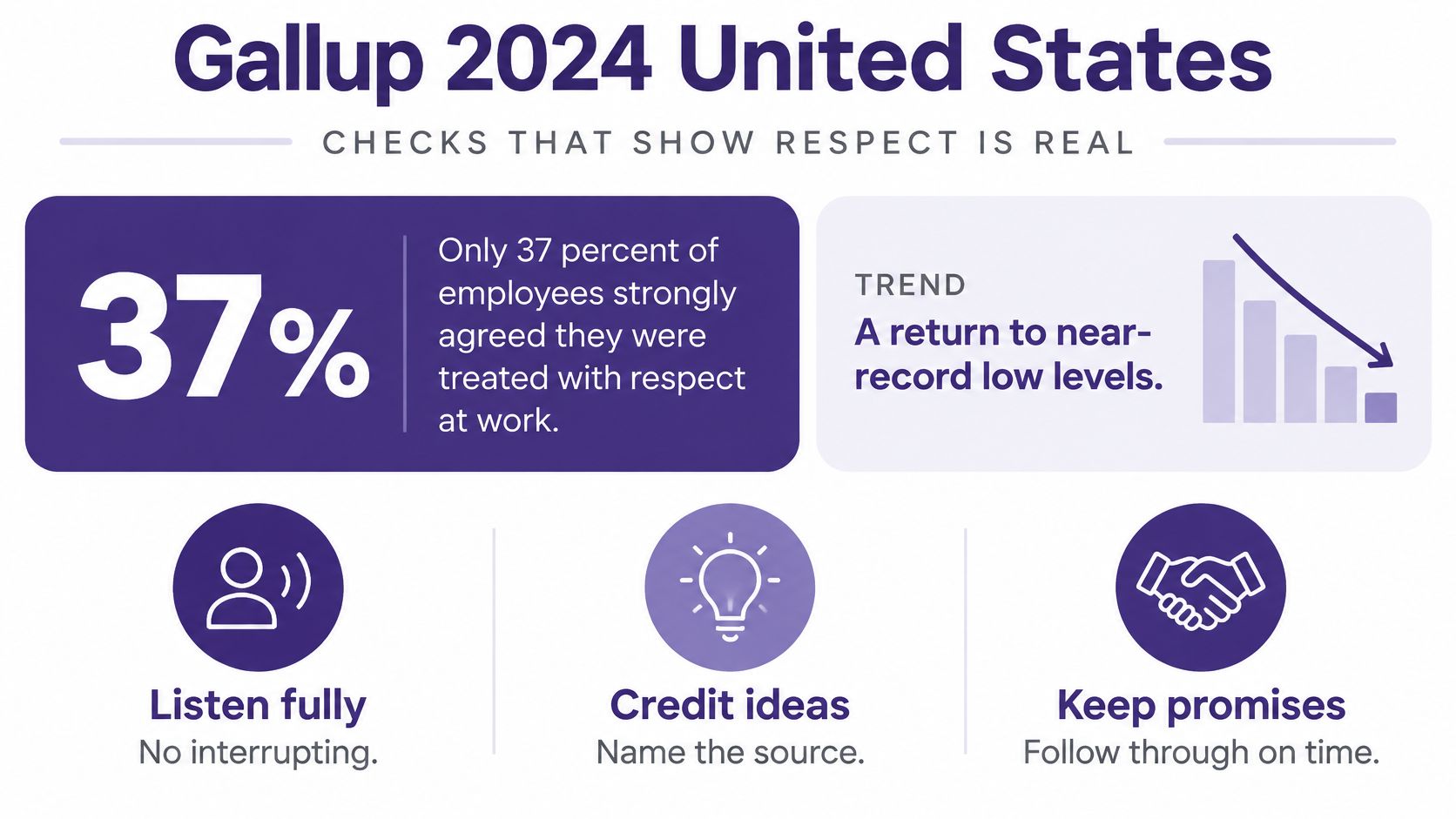
Five observable checks
A useful paragraph can show respect through actions a reader could recognize:
- Fairness in decisions. Apply rules consistently and explain decisions that affect people.
- Listening without interruption. Let someone finish before responding.
- Inclusion in the conversation. Invite quieter participants in instead of treating their silence as agreement.
- Dignity when correcting someone. Point out the error without turning it into a judgment of the person.
- Freedom from harassment. Don't dismiss insults or targeted abuse as ordinary disagreement.
Each check gives you a moment to describe. “We respect everyone” is a broad claim; “the editor credits a writer's idea during the pitch meeting” gives the reader something to picture. Specific recognition also makes clear who did what, rather than using a general statement that could mean almost anything.
A respectful paragraph doesn't have to argue that kind words automatically improve performance. It can stick to the evidence of behavior: who gets heard, whether a correction preserves dignity, and whether people can take part without harassment. A survey result describes reported experience; it doesn't prove that a polite phrase on its own changes workplace outcomes.
Before you keep a sentence, test it against the five checks. If it names a real action, keep it; if it only repeats a slogan, make it more specific.
Everyday Scenes for Essays and Posts
Respect becomes easier to write about when the reader can see one person make one choice. A scene shouldn't carry the whole subject; it should give a larger idea a clear, ordinary shape.
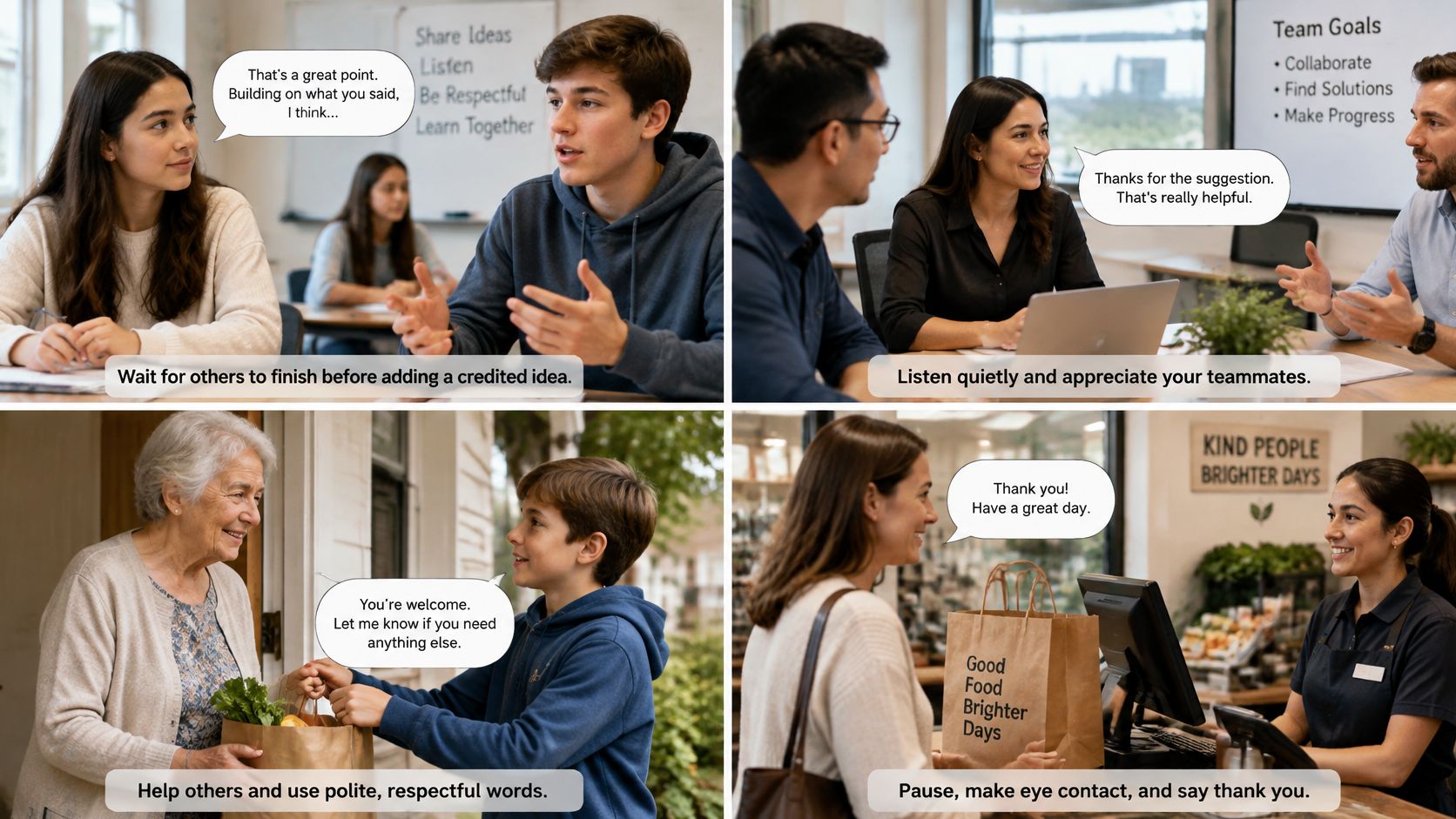
In class: Maya waits until her classmate finishes explaining an idea, then adds to it and says whose point helped her. She contributes without taking credit.
At work: A producer tells an editor, “This cut loses the speaker's main point,” rather than calling the editor careless. The note identifies a problem with the work, not a flaw in the person.
For more examples that suit different audiences and platforms, browse these social media post examples. The useful habit is to borrow the structure of a scene, not to force every example into one tone. In a mixed team, an action that seems friendly to one person may feel too familiar to another; MyCulture.ai's guide to workplace cultural differences offers context for thinking about those differences.
Online: Before reposting a private voice note, Sam asks the sender. When a mocking comment appears, Sam doesn't join the pile-on or pass it along.
In a creative meeting: A team member questions a plan, and the group responds to the concern instead of ridiculing the person who raised it. The American Psychological Association defines psychological safety as a climate where people can speak and take appropriate interpersonal risks without expecting humiliation, dismissal, or blame. In its 2024 Work in America findings, 96% of workers experiencing higher psychological safety said their manager effectively respected their psychological and emotional well-being, compared with 71% of workers experiencing lower psychological safety, a reported association rather than the result of a controlled experiment (the APA's psychological safety findings).
Choose one scene for your paragraph, not all four. One well-chosen moment keeps the writing focused and gives your reader room to understand why the action matters.
Shared Principles and Culture-Specific Signals
Advice like “make eye contact,” “use first names,” or “speak directly” can mistake one local signal for a universal rule. A behavior that seems engaged in one setting may feel challenging, overly familiar, or blunt in another.
Principles to keep fixed: dignity, consent, listening, and freedom from humiliation.
The signals around those principles can change. A study of 24 participants from 20 cultures found differences in acceptable eye contact, touch, interruptions, directness, titles, and responses to ordinary greetings. Respect may also involve honorifics, deference to elders, harmony-preserving behavior, personal space, privacy, or hospitality, as described in this cross-cultural study of communication norms.
| Signal | Often read as respect | Can misfire when | Safer move |
|---|---|---|---|
| Steady eye contact | Attention and honesty in some Western settings | A steady gaze is rude or challenging | Listen and respond to what was said |
| Direct disagreement | Candor and equal standing | Harmony matters more than bluntness | Disagree with the idea, not the person |
| First names | Warmth and equality | Titles or honorifics are expected | Ask how someone prefers to be addressed |
| Silence or indirect speech | Deference and care | Quiet is misread as disengagement | Check meaning before calling someone passive |
| Questioning a teacher or manager | Truth-seeking | The setting expects deference to role | Challenge the decision without insult |
If you're writing for people unfamiliar with a particular setting, examples can add context without pretending that one etiquette rule fits everyone. This introduction to everyday customs in Germany can help readers consider how social expectations shape ordinary interactions.
A polite person can still exclude someone. A firm disagreement can protect truth-seeking and personal autonomy. Adapting to someone's norms also never requires accepting discrimination, coercion, or forced silence.
For mixed classrooms, families, and global audiences, keep the principle fixed and localize the signal. If you're choosing how formal a sample paragraph should sound, this guide to informal versus formal writing can help you match the style to the audience without treating a particular tone as proof of respect.
Choose a Response When Respect Fails
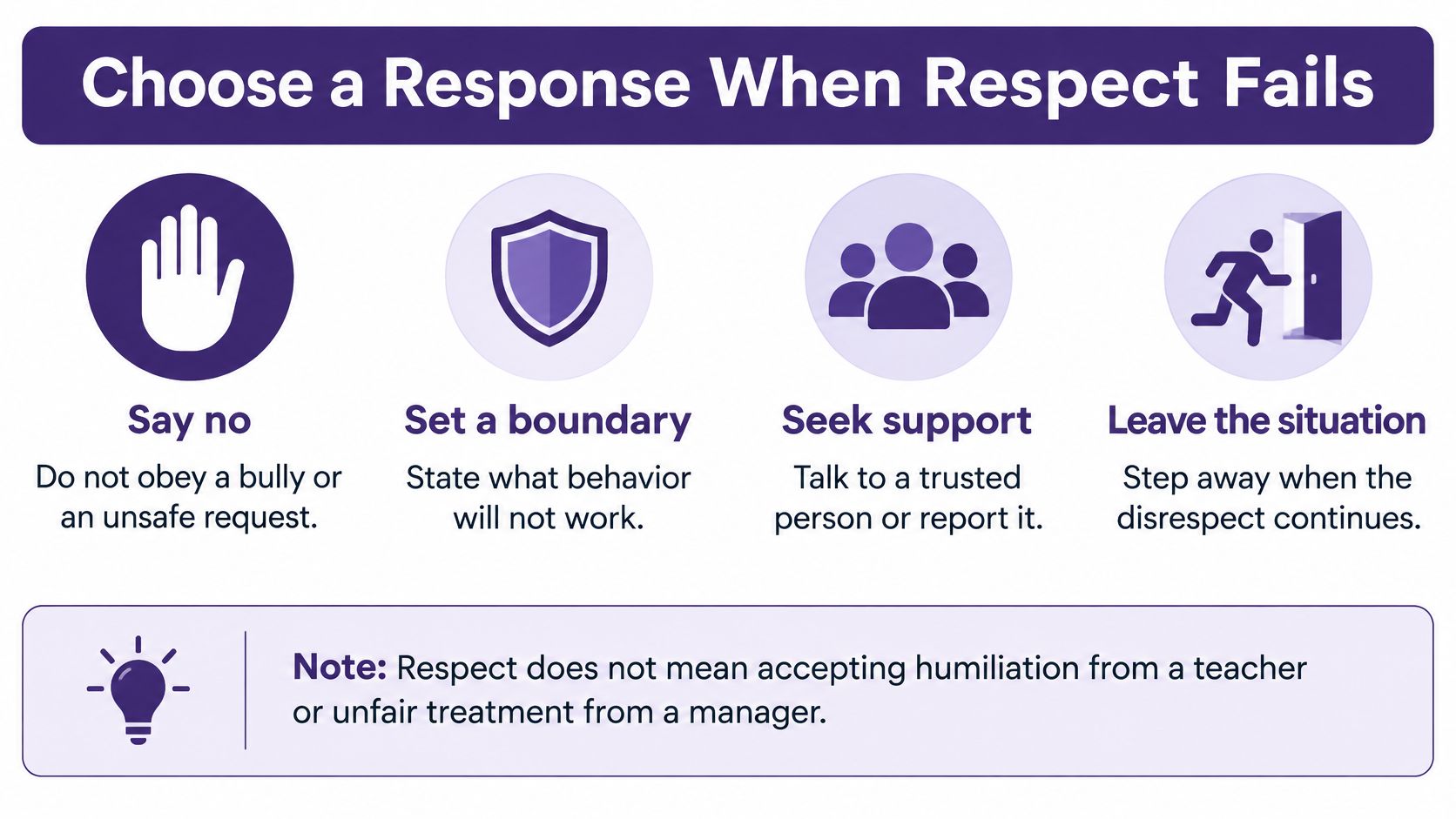
A respectful paragraph should make room for what happens after a boundary is crossed. Respect doesn't mean obeying a bully, accepting humiliation from a teacher, tolerating unfair treatment from a manager, or following an unsafe demand. It includes the right to refuse and the responsibility to seek help when someone's safety or ability to speak is at risk.
UNESCO estimates that school-related violence and bullying affect 246 million children annually, a reason respect has to include action from schools and bystanders, as well as kind intentions (UNESCO's guidance on empowering teachers to end school violence). Use these steps in order when they fit the situation:
- Listen without interrupting when it's safe to do so, so you understand what happened before responding.
- Ask before touching or sharing private information. Don't assume permission, especially with a photo, message, or recording.
- Name the harmful behavior calmly. Say what needs to stop without insulting the person.
- Support the person targeted. Check what help they want instead of leaving them to handle the situation alone.
- Get help when safety or a power gap is involved. Tell a trusted adult, supervisor, or appropriate reporting contact.
“Respectful debate” isn't permission to harass someone. A good-faith disagreement addresses an idea; discriminatory abuse attacks a person or group. When a discussion crosses that line, the priority is to stop the harm and protect the person targeted, not to pretend that every side has made an equally valid argument.
In a youth sports setting, clear expectations can help players, families, and coaches respond to poor conduct; Villarreal Houston Academy's player behavior guidance provides a practical example to consult. The same clarity helps in a classroom, workplace, comment thread, or production team.
Creators and editors who maintain a library of explainers can keep reviewed paragraphs together and search them when a new post, script, or lesson needs the same idea. Contesimal helps teams organize and search existing content so they can find useful material and build on it rather than start each draft from scratch.
If you create essays, episodes, videos, or posts, use Contesimal to organize your content library and find material your team can adapt into new work. Bring your research and existing assets together, then turn a clear idea about respect into useful content for the audience and platform it's meant to serve.