
You finish a strong YouTube script in your usual voice. It's loose, funny, and easy to follow. Then the sponsor brief lands in your inbox, and suddenly that same idea needs to become a pitch deck, a partner email, and a polished campaign summary.
That's where most creators get tripped up.
The problem isn't that one style is right and the other is wrong. The problem is treating informal vs formal writing like a school exercise instead of a business decision. Tone affects whether an audience feels close to you, whether a brand sees you as reliable, and whether a piece of repurposed content still sounds native on the platform where it appears.
A casual podcast riff can become a sharp LinkedIn post. A blog draft can become a sponsor proposal. A webinar transcript can become a structured guide. But only if you know how to change register without flattening your voice. That's the skill that helps creators look consistent across platforms while still speaking appropriately to each reader.
Matching Your Message to the Moment
A creator might say on camera, “Hey, let's get into the messy truth about launching a show.” That line works because it sounds human. It invites attention. It fits a video, podcast intro, or newsletter note.
The trouble starts when that same tone gets pasted into a media kit or a partnership outreach email. In those settings, “messy truth” may feel casual in the wrong way. The message may still be smart, but the packaging signals less control than the moment requires.
One idea, different readers
A single content asset often has to do several jobs:
- Audience growth: A caption, teaser, or community post needs warmth and speed.
- Monetization: A sponsor pitch or client proposal needs structure and confidence.
- Search visibility: A blog post or landing page often needs cleaner phrasing and more explicit organization.
- Internal collaboration: Notes to an editor, producer, or assistant can stay fast and conversational.
That's why experienced editors don't ask, “Should this be formal or informal?” They ask, “Who is reading this version, and what do they need to trust me?”
Practical rule: If the reader is evaluating your credibility, lean more formal. If the reader is deciding whether to keep reading, lean more conversational.
Brand perception gets shaped in these small decisions. A creator who sounds too stiff on social can feel distant. A creator who sounds too casual in a proposal can feel underprepared. The sweet spot is rarely extreme. It's usually controlled variation.
A good working habit is to think in versions, not originals. Your script, email, article, and pitch aren't separate ideas. They're the same idea adjusted for the moment.
Understanding the Two Writing Styles
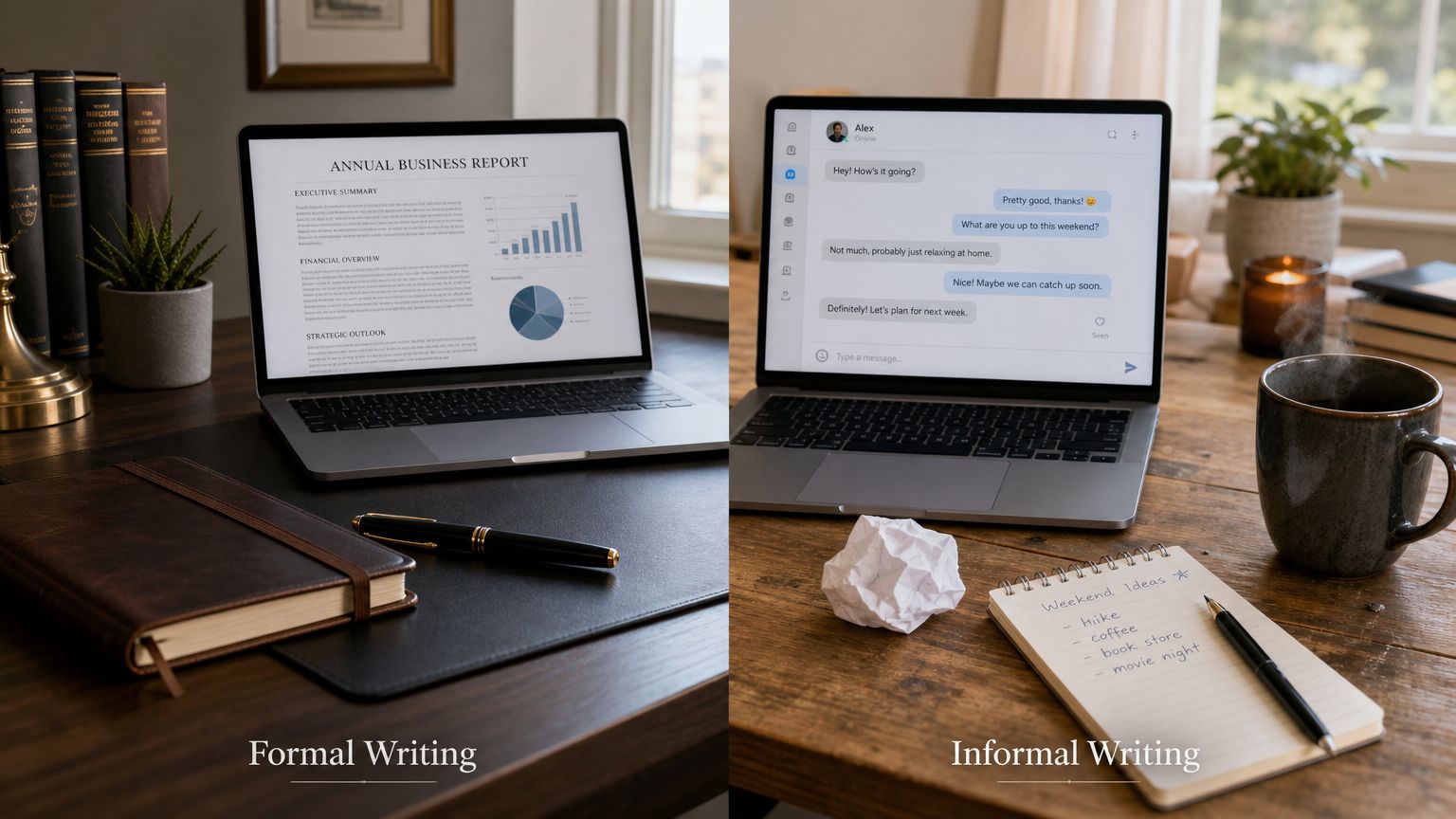
Formal writing and informal writing aren't just different tones. They're different operating modes.
Formal writing is built for precision. Informal writing is built for connection.
What formal writing is really doing
Think of formal writing like a custom-made jacket. It's shaped for a specific setting. It signals care, preparation, and control.
In academic and professional contexts, these expectations are standardized. Purdue Global explains that formal writing is tied to audience and purpose, and that APA-style scholarly writing typically avoids contractions, slang, and first-person phrasing while requiring citations and structured sections such as title page, abstract, methods, results, discussion, and references in its guidance on formal and informal writing.
That matters because many creators eventually cross into those expectation-heavy environments. They write proposals, statements of work, executive summaries, white papers, or research-backed articles. At that point, style isn't just preference. It's part of the format.
If you manage a team or publish across channels, it helps to document those decisions. A practical place to start is establishing a company writing rulebook, especially if contributors keep shifting between casual content and professional communications.
What informal writing is really doing
Informal writing is closer to streetwear. It's flexible, faster, and easier to move in. It often uses shorter sentences, contractions, direct address, and personality.
That doesn't make it sloppy. Good informal writing is usually harder than people think. You still need control. You just hide more of the machinery.
Use informal writing when you want readers to feel that a person is speaking to them, not at them. That's why it works well in:
- Creator newsletters
- Video scripts
- Captions and social posts
- Community updates
- Behind-the-scenes blog entries
Formal writing earns trust through structure. Informal writing earns trust through proximity.
The mistake is assuming formal means better. It doesn't. It means more regulated. Informal writing can outperform it when relatability, momentum, and voice matter more than ceremony.
A Side-by-Side Comparison of Writing Styles
The most useful distinction is simple. Formal writing is optimized for precision, objectivity, and structural discipline, while informal writing is optimized for conversational engagement and relational proximity, as described in this breakdown of formal and informal grammar differences.
That difference shows up on the page fast.
Formal vs. Informal Writing At a Glance
| Characteristic | Formal Writing | Informal Writing |
|---|---|---|
| Tone | Professional, measured, objective | Conversational, personal, direct |
| Vocabulary | Technical, specific, less slang | Everyday words, colloquialisms, familiar phrasing |
| Sentence structure | Longer or more layered sentences | Shorter, quicker sentences |
| Point of view | Often avoids first- and second-person voice | Freely uses I, we, and you |
| Contractions | Usually avoided | Common and natural |
| Structure | Often follows explicit sections and clear logic | Can feel essay-like or spoken |
| Punctuation style | Controlled and restrained | More expressive when appropriate |
| Best use | Proposals, reports, research-backed pieces, official communication | Scripts, social posts, newsletters, community updates |
Before and after examples
A few line edits make the contrast obvious.
Formal: “The campaign will prioritize audience retention through a revised publishing schedule.”
Informal: “We're changing the schedule to keep more people watching.”
Formal: “Please review the attached proposal and provide feedback by Friday.”
Informal: “Take a look and let me know what you think by Friday.”
Formal: “This article examines how creators adapt content across multiple channels.”
Informal: “This piece looks at how creators reshape one idea for different platforms.”
What changes beyond grammar
Writers often focus on surface markers like contractions, but the deeper shift is intent.
Formal writing tells the reader, “This has been organized for evaluation.”
Informal writing tells the reader, “This is easy to enter.”
That's why the same creator may need both in one workday. A morning might involve drafting an upbeat script intro, then revising a brand partnership note into cleaner, more disciplined language. If you publish educational content, you'll see the same split inside a single asset. The opening hook may be casual, while the explanatory body becomes tighter and more exact.
For creators repurposing longform work, structure proves invaluable. A transcript can produce many formats, but each one needs a different register. If you're working from an educational asset, these examples of informative writing are useful for spotting where clarity, explanation, and tone have to balance.
What usually works and what usually fails
What works:
- Formal writing that stays readable
- Informal writing that still sounds intentional
- A stable voice adjusted for context
What fails:
- Formal writing loaded with stiffness
- Informal writing that sounds careless
- Repurposed content copied from one platform to another without tonal editing
The reader doesn't grade your intention. The reader reacts to what the sentence feels like.
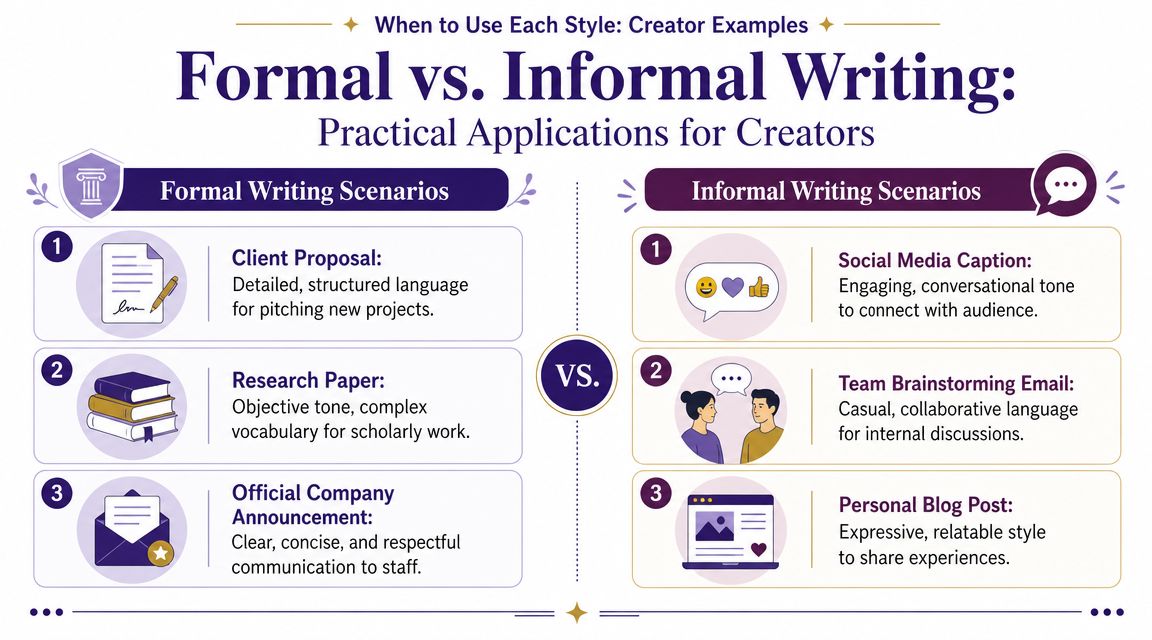
When to Use Each Style Creator Examples
Most creators don't need a definition. They need to know what to send, where, and why.
A YouTube script versus a sponsor email
A YouTube intro can open with energy:
“Today we're fixing the part of content strategy that keeps wasting your time.”
That line is direct, spoken, and audience-first. It earns attention because it sounds like a person talking.
A sponsor outreach email needs a different posture:
“I'm reaching out to explore a potential partnership aligned with our audience's interest in content operations and publishing workflows.”
That sentence is more formal because the reader is evaluating fit, professionalism, and clarity. It doesn't need to charm first. It needs to orient the reader and reduce friction.
A Patreon update versus a website page
A member post can sound close and unpolished in a good way:
- Informal: “Quick update. I'm reworking the next episode because the original version felt bloated, and I'd rather get it right than rush it.”
A services or about page usually needs more control:
- More formal: “The next release has been revised to improve structure and clarity before publication.”
The second version creates distance, but it can also create confidence. If your site is trying to convert visitors, that may help. If your community is paying for access to your process, the first version may be better.
A blog post versus a white paper
A casual educational post can say:
- Informal: “If your old content is sitting in folders, you're probably leaving useful ideas on the table.”
A white paper or executive resource would likely shift to:
- Formal: “Underused archival content often contains reusable material that can support new editorial, marketing, and research outputs.”
Both can be true. They just do different jobs.
Why tone changes reader behavior
Formality isn't only cosmetic. A controlled study found that the language style of an AI agent could shift user writing toward more informal summaries, which shows that register can influence how people respond and write back in research on AI agent language style and writing behavior.
That has a practical implication for creators using AI tools, templates, and collaborative workflows. If your prompt, assistant, or draft model starts casual, your output often drifts casual too. If it starts stiff, your copy may become harder than necessary to read.
For web-facing content, this gets especially important. Your homepage, landing page, and lead magnet don't need the same voice, even when they support the same offer. In this scenario, studying copywriting for a website proves beneficial. Website copy often needs a blended register: clear enough to convert, warm enough to feel human, and disciplined enough to sound credible.
If you want more formal output, don't just edit the final paragraph. Change the tone of the source draft, the prompt, and the examples feeding it.
How to Choose Your Writing Register
Most advice stops at “know your audience.” That's useful, but it's incomplete.
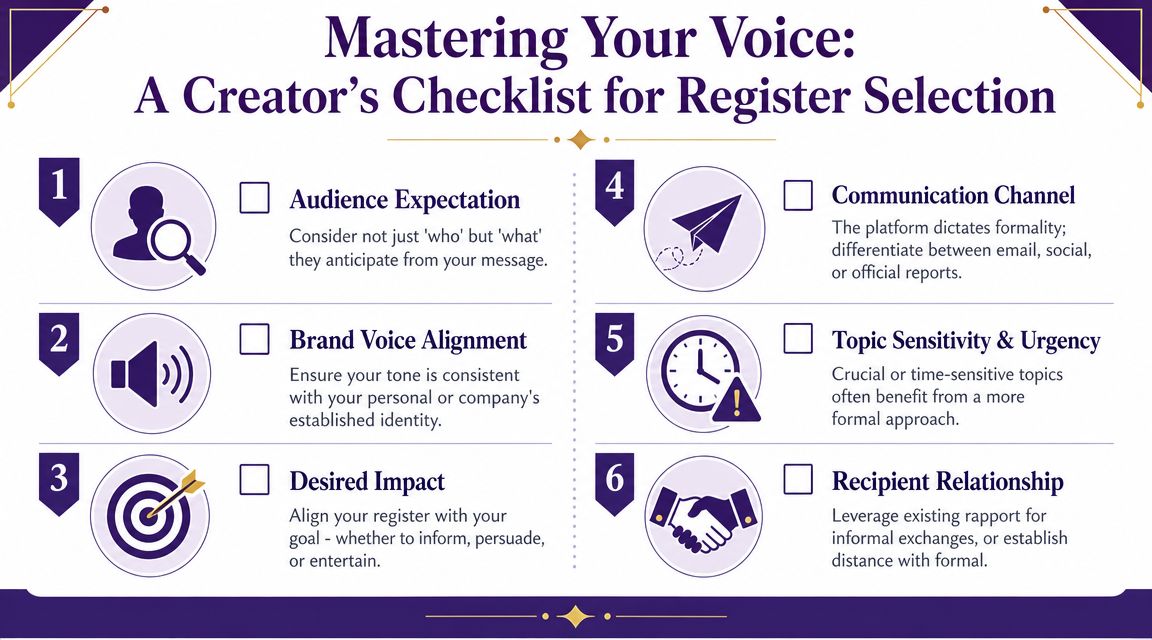
Creators make register decisions under pressure. You're dealing with deadlines, platform norms, client expectations, legal sensitivity, and whatever version of the content already exists. In practice, informal vs formal writing is often a decision about risk management.
Start with risk, not preference
A useful lesson comes from outside publishing. A 2023 mixed-methods study on multilingual healthcare found that physicians and nurses often used informal interpreters because of lack of time and urgent issues, while the broader finding was that real-world communication choices are often constrained by risk, time, and access, not just style preference, as described in the study on interpreter use in healthcare settings.
The writing lesson is clear. Sometimes people choose the faster, less formal route because the moment demands speed. That doesn't automatically make it wise. It means context is doing part of the choosing.
For creators, the checklist looks more like this:
- High risk: Contracts, policies, sponsored deliverables, public statements, investor-facing materials. Lean formal.
- High urgency: Team updates, live event changes, fast community messaging. Lean clear first, then formal if needed.
- High intimacy: Personal newsletters, community posts, founder notes, scripts. Lean conversational.
- High discoverability: Search-oriented pages and evergreen educational content. Use a blended register.
Platform norms matter more than people admit
A brand update on LinkedIn and the same update in Slack should not sound identical.
A creator who uses polished, report-style prose in an Instagram caption often feels off-platform. A creator who writes a sponsorship proposal like a group chat message feels underbaked. Readers don't consciously score “register mismatch,” but they feel it immediately.
Don't confuse formality with professionalism
One of the most common mistakes is over-formalizing. Writers start replacing plain words with heavier ones. They stretch simple sentences. They remove all warmth. The result sounds “professional” in the worst way: vague, inflated, and hard to trust.
Field note: The right tone is the one that preserves credibility without making the reader work harder.
Good professional writing doesn't need ceremonial language. It needs clean decisions. State the point. Respect the reader. Cut whatever makes the sentence slower without making it more accurate.
A practical decision filter
When deciding your register, ask:
- What happens if this is misunderstood?
- Is this being read quickly or carefully?
- Does the reader want information, reassurance, or action?
- Am I building closeness or establishing authority?
- Will this be reused elsewhere in a more formal asset?
That last question matters for repurposing. If a rough note may later become a proposal, article, or policy page, draft with enough discipline that the material can travel.
From Formal to Informal and Back A Practical Toolkit
Register is editable. That's the good news.
You don't need to draft every piece from scratch in the perfect tone. Most working writers shift tone during revision. The essential skill is knowing which levers to pull.
How to formalize a casual draft
Use this when turning a script, note, or blog paragraph into a proposal, report, or partner-facing document.
- Remove casual fillers: Cut phrases like “kind of,” “a bit,” “pretty much,” and “you know.”
- Swap vague words for precise ones: Replace “stuff,” “things,” or “a lot” with a specific noun.
- Reduce direct chatter: Fewer rhetorical questions. Less stage voice.
- Tighten structure: Group ideas into purpose, method, outcome, and next step.
- Check pronouns: Too much “I” or “you” can make a document feel less formal than the setting requires.
- Trim expressive punctuation: One exclamation point can change the whole posture of a sentence.
Example:
- Casual draft: “We're basically trying to figure out what content still has legs and what's probably not worth pushing again.”
- Formal revision: “The goal is to identify which existing content remains reusable and which assets no longer merit additional distribution.”
How to make a stiff draft more conversational
Use this when turning a report section, landing page, or internal memo into something readers can enter more easily.
- Shorten sentences: Break one heavy sentence into two clean ones.
- Use contractions where appropriate: They soften rhythm quickly.
- Bring the reader in: A carefully placed “you” can improve connection.
- Choose common words first: If a simpler term says the same thing, use it.
- Add a human verb: “We tested” often reads better than “testing was conducted.”
- Keep the point near the front: Readers shouldn't dig for the sentence's purpose.
Example:
- Stiff draft: “Audience retention improvements may be achieved through strategic revision of introductory segments.”
- Conversational revision: “You can often improve retention by rewriting the intro.”
A practical way to handle these shifts across a content library is to keep drafts, transcripts, outlines, and polished versions organized by purpose. Tools like Google Docs, Notion, and Airtable can help with simple version control. For larger libraries, Contesimal is one option for classifying and searching historical content so teams can locate source material and adapt it into new formats. The primary advantage isn't automation by itself. It's seeing which raw materials can be rewritten for a different register instead of starting over each time.
For the editing side, strong structure helps more than “sounding formal.” That's why this reminder matters: writing guidance from academic style literature emphasizes that formal writing should still be clear, simple, and direct, not confusing or ornate, as reflected in this explanation of structure in writing.
Your best move is usually not to ask, “How do I make this more formal?” Ask, “How do I make this clearer for this reader?”
If you're sitting on a backlog of videos, podcasts, articles, or research notes, the fastest win is often better reuse, not more production. Contesimal helps teams organize content libraries, search across existing assets, and turn past material into new outputs that fit different channels and tones. For creators moving from hobbyist workflows to professional systems, that kind of visibility makes it easier to repurpose old work without losing the voice that made it useful in the first place.