
Website copywriting isn’t just about filling a page with words. It’s the art of writing persuasive, intentional text that gets visitors to do something. It's not about listing your services; it’s about telling a story that builds trust, shows your value, and leads your audience—whether they're YouTubers, podcasters, or marketers—to a specific goal. Think of it as your hardest-working salesperson, one that’s on the clock 24/7.
Why Most Website Copy Fails to Connect
Let’s be honest—most website copy is completely forgettable. It reads like a digital brochure, crammed with industry jargon, self-congratulatory fluff, and feature lists that mean absolutely nothing to the person reading it. This kind of writing talks at people, not to them.

The biggest mistake I see is businesses focusing on the "what" instead of the "so what." They get completely wrapped up in describing their company history, their internal processes, and the technical specs of their product. All the while, the visitor is frantically scanning the page with one burning question: "What's in it for me?"
If your copy doesn't answer that question in seconds, they're gone. Click.
The Real Job of Your Website Copy
Good copywriting for a website has a much bigger job than just taking up space. It needs to be your brand’s best ambassador, your top salesperson, and a trusted guide, all rolled into one. It’s the bridge between what you offer and what your audience actually needs.
It’s got a few critical roles to play:
- Build Instant Trust: Your words have to create an immediate sense of credibility. Your audience, from content creators to marketing executives, needs to feel like you get them.
- Articulate Clear Value: Your copy must translate complex features into real-world benefits that solve a problem, organize their content library, or make their life better.
- Guide Action: Every sentence should gently nudge the reader toward the next logical step, creating a smooth path from just browsing to taking action.
Getting this right requires a fundamental shift in thinking. You’re not just selling a product; you’re selling a solution, a feeling, an outcome. For a creator with a huge back-catalog of videos, you're not just offering software; you're offering a way to reignite their content library and create infinite new value from it.
The best website copy doesn't sound like a sales pitch. It feels like a helpful conversation with an expert who genuinely understands your challenges and has the perfect solution. It's educational, maybe even a little fun.
From Brochure to Salesperson
Think about the difference between a brochure and a great salesperson. A brochure is static. It just sits there, presenting information and hoping for the best. A great salesperson, on the other hand, listens, empathizes, and connects the customer's pain points directly to the right solution. Your website copy has to do the work of the salesperson.
This is especially true for your headlines. The data doesn't lie: websites with clear, compelling headlines can see a 25% higher conversion rate. When you only have a few seconds to make an impression, that first line of text is everything. You can read the full research about these copywriting findings to dig deeper into the numbers.
When your copy speaks directly to the reader's problems and dreams, it transforms your website from a passive information dump into an active conversion tool, turning curious visitors into loyal customers.
Lay the Groundwork Before You Write a Single Word
Let’s get one thing straight: great website copy isn’t about pulling clever phrases out of thin air. It’s about deep, genuine empathy. The copy that actually converts—the stuff that makes people click, buy, and believe—feels like it was written for one specific person. Because, in a way, it was.
Before you even think about opening a Google Doc, you have to build a solid foundation of customer insight.
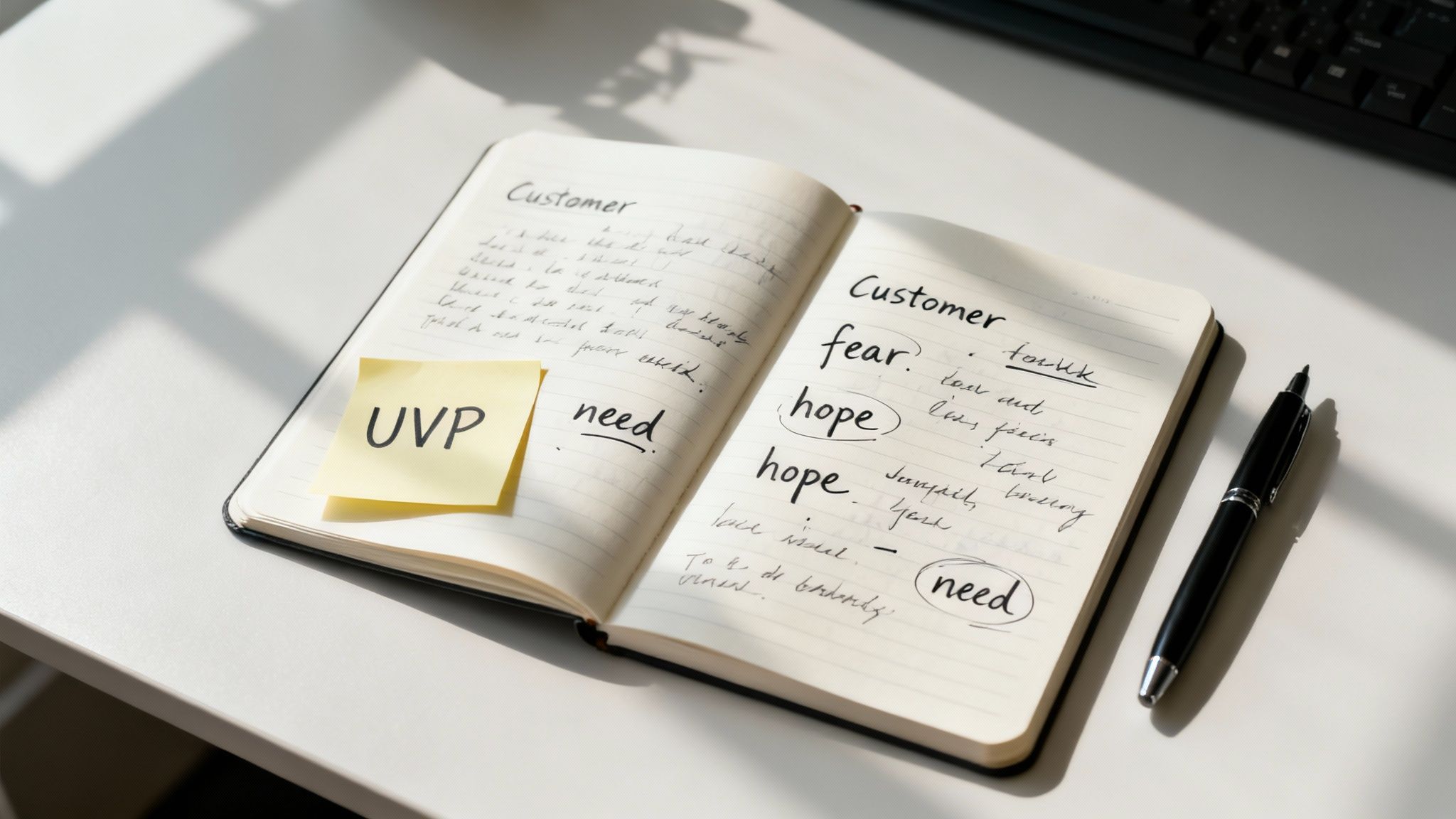
This is the work that separates copy that truly connects from copy that just gets ignored. It's about getting out of your own head and spending time in your audience's world. Whether your audience is a YouTuber trying to grow their audience across platforms or a publisher wanting to increase the value of their content library, your goal is to understand how they think, what they worry about, and what they secretly hope for.
Go Way Beyond Basic Demographics
Forget about those generic personas with stock photos and flimsy descriptions like "Marketing Mary, age 35." That stuff is useless for writing copy that sells. You need to get into the messy, human details—the psychographics that actually drive people to make a choice.
Think of yourself as a detective hunting for motivational clues. Where do you find them?
- Customer Reviews: Don't just skim them. Scour reviews for your products and, just as importantly, your competitors' products. Pay attention to the exact words people use when they describe their problems and what they loved about the solution.
- Online Hangouts: Dive into the Reddit threads, Facebook groups, or niche forums where your people gather. Just listen. What are their biggest frustrations? What questions do they ask over and over? What gets them fired up?
- Sales Call Recordings: If you have a sales team, their call recordings are an absolute goldmine. You'll hear raw, unfiltered objections, pain points, and those "aha!" moments when a solution finally clicks for someone.
This whole process is about collecting your audience's language. When you can describe their problem even better than they can, you build instant trust. For creators sitting on a big library of content, this research is a goldmine—it can show you what topics your audience craves, helping you upcycle old content or hit on the next viral concept.
Nail Down Your Unique Value Proposition
Once you really get your audience's world, you can figure out your place in it. Your Unique Value Proposition (UVP) is just a clear, simple statement explaining how you solve your customer's problem or make their life better. No fluff.
Your UVP absolutely must answer three questions from your visitor's perspective:
- What is this?
- How does it make my life better?
- Why should I get it from you instead of someone else?
A weak UVP is something like, "We provide innovative content solutions." It’s vague, corporate, and all about "we." A strong UVP is specific and all about the customer: "Contesimal helps you organize your content library to create new value and make money from it." See the difference?
Your UVP isn't a tagline you slap on a t-shirt. It's the strategic core of your entire website. It should be the very first thing a visitor understands when they land on your homepage, setting the tone for everything else they're about to read.
Find Your Voice (And Stick to It)
Finally, you have to decide how you want to sound. Your brand voice is the personality your business has on the page. Are you the authoritative expert? The funny, quirky friend? The empathetic and supportive mentor?
Your voice needs to feel authentic to you, but it also has to resonate with the audience you just spent all that time researching. A podcaster transitioning from hobbyist to pro shouldn't sound like a stiff, corporate entity. Likewise, a magazine publisher needs a voice that conveys authority and credibility.
I like to think of it this way: if your brand was a person at a party, how would they talk? What kind of stories would they tell? Nailing this down ensures your website feels consistent, from the main headline all the way down to the tiny text on a contact form button. That consistency builds familiarity, which is the bedrock of trust.
Time-Tested Frameworks for Writing Copy That Sells
Alright, you’ve done the hard work. You know who you’re talking to and you’ve got your brand voice nailed down. Now it's time to actually write something. But that blinking cursor on a blank page can be intimidating.
Good news: you don't have to reinvent the wheel. Great copywriters lean on proven psychological frameworks to structure their arguments. These aren’t rigid, paint-by-numbers templates. Think of them more like the chord progressions in a hit song—they provide a structure that just works, guiding a reader from mild curiosity to decisive action.
Once you get a feel for them, you can start riffing and creating your own variations that sound completely natural for your brand.
The Classic: AIDA
One of the oldest tricks in the book is AIDA, which stands for Attention, Interest, Desire, and Action. It’s a dead-simple, four-step flow that perfectly mirrors how someone decides to buy.
- Attention: You have to hook them instantly. This is your headline and your opening line. It needs to be a magnet, calling out a specific problem or a powerful promise.
- Interest: Now that you’ve got them, you have to keep them. Use fascinating facts, relatable stories, or compelling details to dig into the problem they're facing and why it’s so frustrating.
- Desire: Here’s where you pivot. Stop talking about the problem and start painting a vivid picture of the solution. You’re not just listing features—you’re showing them what their life will look like after they use your product. Build that emotional craving for the outcome.
- Action: Finally, you have to tell them exactly what to do. Your call-to-action (CTA) can't be wishy-washy. Be direct. Use strong, clear verbs like "Get," "Start," or "Join."
Imagine a YouTuber selling a video editing course. Their headline grabs attention by promising to "Edit Videos Twice as Fast." They build interest by describing the soul-crushing hours wasted on clunky software. Desire kicks in when they show off sleek, professional-looking videos from past students. The final action is an unmissable "Enroll Now" button. Simple, effective.
The Gut-Punch: PAS
Another powerhouse framework is PAS: Problem, Agitate, Solve. This one is more direct and cuts right to the chase, making it incredibly effective when you know your audience’s deepest pain points. It works because, psychologically, we're often more motivated to avoid pain than we are to gain pleasure.
Here’s how it unfolds:
- Problem: State their problem clearly and with genuine empathy. Use the same words they would use. Show them you get it.
- Agitate: This is the secret sauce. Don't just mention the problem—poke it. Twist the knife a little. Remind them of the frustration, the wasted money, the missed opportunities. Make the pain feel urgent.
- Solve: Just when they can’t take it anymore, you swoop in with the perfect solution: your product. The sense of relief is almost physical. You position your offer as the obvious, immediate way to make all that pain disappear.
PAS is like finding a splinter in your reader's finger. You don't just point it out. You gently press on the skin around it to remind them how much it hurts before handing them the perfect pair of tweezers. It’s powerful because it creates an immediate need for your solution.
This is exactly the kind of skill modern copywriters are honing. Freelancers now make up 59% of the copywriting workforce, and in 2022, 44% of them invested in SEO training to blend these persuasive frameworks with search visibility. You can dig into more stats about how copywriters are upskilling on Bloggingwizard.com.
Weaving in SEO Without Sounding Like a Robot
You can’t talk about website copy today without talking about SEO. But the goal is not to cram keywords into every sentence until it reads like a machine wrote it. The best SEO copy feels 100% natural to a person but still sends all the right signals to Google.
Start by choosing one primary keyword for the page, plus a handful of related secondary keywords.
Make sure your primary keyword shows up in a few key spots:
- Your main page title (the H1)
- Somewhere in the first 100 words
- At least one subheading (an H2 or H3)
- The page’s URL slug (like yourwebsite.com/primary-keyword)
Then, just sprinkle your secondary keywords throughout the copy where they feel natural. Seriously, don't force it. You're writing for humans first. Today’s search algorithms are smart enough to understand context and synonyms. If your writing is high-quality, relevant, and structured with clear headings, you're already doing 90% of the work.
Another pro-tip? Link out to credible, authoritative sources. It builds trust with your readers and signals to search engines that you’ve done your homework. To learn more about how to do this right, check out our guide on what is a credible source. It’s a simple tactic that adds a ton of weight to your content.
Writing for Your Most Important Website Pages
Copywriting frameworks give you a fantastic starting point, but the real skill comes from applying them to the unique job of each page on your site. Think about it: your homepage has a completely different goal than a service page, and both are worlds away from your 'About Us' page. Great website copy means treating every single page like a specialist tool, perfectly designed for one specific task.
Your website isn't one long monologue; it's a series of focused conversations. Each page needs to guide your visitor deeper into your world, picking up right where the last one left off. Let's break down the blueprints for the pages that do the most important work.
The Homepage: Your First Impression
Your homepage has one critical job: answer three questions in less than five seconds. Who are you? What do you do? And why on earth should I care? If a visitor has to scroll or click just to figure that out, you’ve probably already lost them.
This is a place for clarity, not cleverness. Your main headline needs to slam your Unique Value Proposition home instantly. Subheadings should then expand on that, quickly detailing the core benefits you deliver. The copy here must be tight, benefit-driven, and laser-focused on pushing visitors to the next logical step—whether that’s checking out your services or learning more about your brand.
For a homepage that actually converts, you’ll need:
- A Crystal-Clear UVP: State your big promise right at the top. No exceptions.
- Benefit-Oriented Subheadings: Break down your value into easy-to-scan chunks.
- Social Proof: Get testimonials, client logos, or key stats on there to build instant trust.
- A Dominant Call-to-Action (CTA): Make it painfully obvious what single action you want them to take next.
The Service Page: Your Sales Pitch
Okay, this is where you shift from the broad promise to the nitty-gritty solutions. The single biggest mistake I see on service pages is just listing features. Nobody buys features. People buy the outcomes those features create. Your copy has to translate every feature into a real-world benefit.
So, instead of saying, "Our software has a content organization tool," try this: "Effortlessly find any video or blog post in your library so you can repurpose content in minutes, not hours." See the difference? You’re framing everything around solving a problem or helping the customer win.
Use storytelling to walk them through a transformation. Acknowledge their current pain (the PAS framework is perfect for this), then show them, step-by-step, how your service makes that pain go away and delivers the future they want. This is where you can get detailed with subheadings, bullet points, and even mini-case studies to build an undeniable case for what you’re offering.
The About Us Page: Your Trust Builder
Your 'About Us' page is often the second most-visited page on your site, right after the homepage. And yet, so many businesses treat it like an afterthought. Here’s the secret: this page isn't really about you. It’s about why your story should matter to your customer. It's your big chance to forge a genuine human connection.
A killer 'About Us' page boils down to three things:
- Shared Values: Explain the "why" behind what you do. What do you believe in? This helps you connect with an audience that sees the world the way you do.
- Authentic Storytelling: Share the real origin story, the challenges you’ve overcome, and the mission that keeps you going. This is what makes your brand relatable and trustworthy.
- Human Faces: Show the actual people behind the brand. It’s a simple move that can massively increase trust and make your whole operation feel more approachable.
Ditch the corporate jargon and the self-congratulatory fluff. Instead, tell a story that positions your company as a trusted guide on your customer's journey. It’s the perfect spot to let the passion that fuels your work shine through, which is crucial for creators, authors, and anyone building a personal brand.
To help tie this all together, here’s a quick rundown of the main job for each of your key pages.
Key Website Page Copywriting Focus
| Page Type | Primary Goal | Essential Copy Elements |
|---|---|---|
| Homepage | Grab attention & direct traffic | Clear UVP, benefit-driven subheadings, social proof, primary CTA |
| Service/Product Page | Persuade & sell the solution | Benefit-focused descriptions, problem-solving narrative, detailed features, CTAs |
| About Us Page | Build trust & human connection | Origin story, company mission/values, team photos, authentic tone |
| Contact Page | Facilitate easy communication | Multiple contact options, clear instructions, reassurance/trust signals |
| Blog Post | Educate, engage & attract | Actionable advice, storytelling, SEO keywords, internal links, clear CTA |
Remembering these distinct roles helps ensure every page on your site is working together, not against each other.
While every page has its own mission, foundational copywriting frameworks like AIDA and PAS give you the psychological scaffolding to build your message.
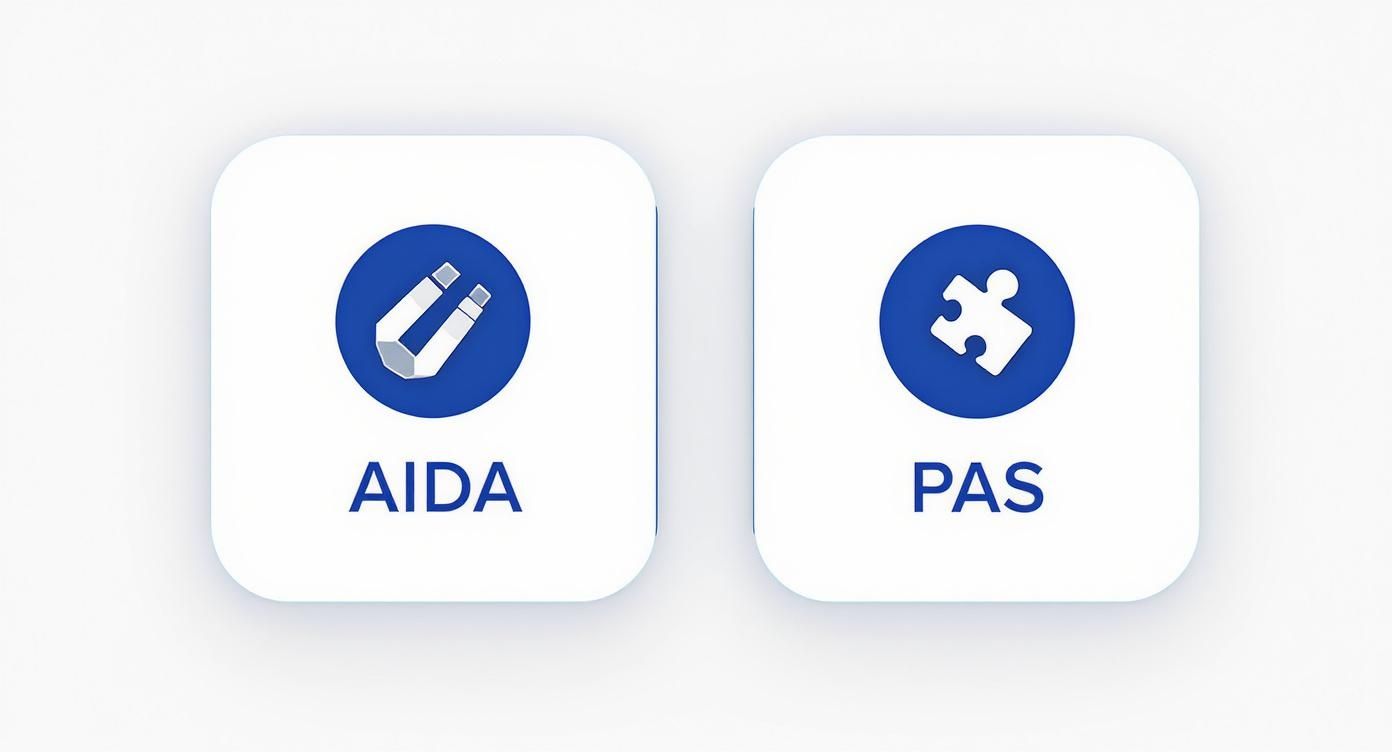
These models are your secret weapon for organizing your thoughts. They ensure your copy logically pulls a reader from just being aware to taking real action, no matter what page they land on. Once you master these page-specific blueprints, you can build a website narrative so cohesive that it guides visitors from one step to the next without them even realizing it, building trust and momentum all the way.
Turn Your Website Copy into Endless Content
Hitting "publish" on your new website copy feels like the finish line, but really, it's just the starting gun. Your website isn't a static brochure that just sits there; it's a living asset, an absolute goldmine of core messaging just waiting to be unleashed. For savvy marketers and content creators, the real work begins after the launch. This is how you take action, upcycle old content, and create new value.
The smartest creators I know treat their website as the central hub of their entire content ecosystem. All that copy on your homepage, service pages, and 'About Us' page? That's not a one-and-done deal. It's the foundational clay you can mold and reshape to fuel your content calendar for weeks, even months.
This is exactly how you start working smarter, not harder. You’ve already done the heavy lifting of figuring out what you stand for and how to say it. Now it's time to reignite your content library and bring it to life across every platform where your audience hangs out.
From Static Page to Content Engine
Just think about a single, well-written service page for a moment. It's probably packed with your unique value proposition, the exact pain points your customers face, your solutions, and all that benefit-driven language you agonized over. That one page is a treasure trove.
Seriously, that one page can become:
- Five short-form videos: Each one can tackle a specific benefit or customer problem you mentioned. Easy.
- A detailed blog post: Go deeper on the "how" behind your service, using the page's copy as a ready-made outline.
- A full week of social media posts: Pull out key phrases, customer testimonials, and powerful stats to create bite-sized, engaging updates.
- A script for a podcast episode: The narrative flow of the page is perfect for guiding a conversation, letting you dive deeper into the stories and examples.
When you approach your website this way, you naturally create brand consistency across all your channels. Your social media, videos, and articles will all echo the core messaging you so carefully crafted for your site. This reinforces your brand identity at every single touchpoint. Understanding how content repurposing adds value to your strategy is the key to scaling your efforts without burning yourself out.
Test and Refine Your Core Message
Your website copy is also the perfect laboratory for figuring out what truly connects with your audience. Don't just set it and forget it. Simple A/B testing can give you invaluable data that sharpens not just your website's performance, but your entire marketing message.
Start with small, manageable tests:
- Headline Variations: Try a benefit-driven headline against one that asks a provocative question.
- Call-to-Action (CTA) Wording: Does "Get Started Today" pull more weight than "Request a Free Demo"? Sometimes, tiny changes deliver huge results.
- Button Color: I know it sounds silly, but a simple design tweak can have a surprising impact on click-through rates.
Each test hands you concrete data about what your audience actually prefers. These insights are pure gold, helping you refine your messaging everywhere—in your ads, emails, and social media campaigns. You stop guessing and start making decisions based on real user behavior.
The Power of a Centralized Content Hub
This is where having an organized content library becomes a total game-changer. When you can easily search, classify, and understand all your existing assets—from website copy to old video scripts—you unlock a whole new level of creative potential. Tools that help humans and AI collaborate seamlessly are making this process faster than ever.
The adoption of AI-assisted content briefing tools is exploding, making it possible to produce copy at scale. In fact, online platforms generated 62.34% of copywriting activities in 2024, and this market is projected to grow by over 10% every year through 2030. These platforms help streamline workflows with AI-powered features like keyword mapping and headline optimization, helping teams work way more efficiently. You can find more insights about the evolving copywriting market on Mordor Intelligence.
By getting your library in order, you can instantly see the connections between a high-performing blog post and a service page, letting you create new, valuable content from concepts you already know work. This is how you organize, understand, and take action—turning a static archive into an active engine for growth.
Common Questions About Website Copywriting
Even after you've nailed down the frameworks and page structures, the real questions start popping up once you get your hands dirty on a project. That's when the practical challenges hit. Here are some clear, no-fluff answers to the questions we see most often from creators and marketers trying to write copy for their websites.
These insights should help you navigate the tricky parts of the process, from figuring out if your words are actually making an impact to understanding where new tech fits into your workflow.
How Do I Know if My Copy Is Actually Working?
This is the most important question you can ask. Good copy isn't about what feels right; it's about what the data proves is right. The metrics that matter most will always tie back to the specific goal of the page you're looking at.
Your key performance indicators (KPIs) will likely include a few of these:
- Conversion Rates: This is the big one. Are people actually filling out your contact form, downloading your guide, or buying your product?
- Time on Page: Are visitors sticking around long enough to read what you've written? Or are they bouncing the second they arrive?
- Bounce Rate: A high bounce rate can be a red flag that your headline and opening lines just aren't grabbing people's attention.
- Click-Through Rate (CTR): This tells you how many people are clicking on your main call-to-action buttons. It’s a direct measure of how persuasive your CTA is.
The only way to get definitive answers is through A/B testing. Pit one headline against another. Test two different versions of your CTA button. This process replaces guesswork with hard evidence about what truly connects with your audience. For a much deeper dive, our guide on how to analyze content performance gives you a great framework to follow.
How Often Should I Refresh My Website Copy?
Think of your website copy as a living document, not something carved in stone. There's no magic number here, but a good rule of thumb is to do a full review of your core pages—like your Homepage, About page, and main Service pages—at least once a year.
That said, you should be ready to update your copy more often if:
- Your business offerings or prices change.
- You’re launching a major marketing campaign.
- You notice that your key performance metrics are starting to drop off.
Making small, continuous tweaks based on performance data will almost always beat doing a massive overhaul every few years. Staying agile means you can adapt to what your audience is telling you through their actions.
What Is the Real Difference Between Copywriting and Content Writing?
This question trips a lot of people up, but the distinction is actually pretty simple. It all comes down to a single word: intent.
Copywriting is all about persuasion. Its only job is to get the reader to take a specific, immediate action—like making a purchase or signing up for a newsletter. It’s direct-response writing.
Content writing is meant to inform, educate, or entertain. Its goal is to build a relationship over time by providing value through blog posts, guides, and articles. It’s about creating trust and authority.
An effective website needs a perfect blend of both. Content writing is what draws people in and nurtures their interest. Then, copywriting steps in to convert that interest into action. They're two sides of the same coin, working together to guide a visitor all the way through their journey with your brand.
Can I Use AI Tools for My Website Copywriting?
Absolutely—but you have to think of AI as a creative assistant, not a replacement for a writer. AI tools are fantastic for smashing through writer's block. They can brainstorm a dozen different headlines in seconds or bang out a rough first draft of a section to get you started.
But here’s the catch: AI can't replicate the deep customer empathy, unique brand personality, and strategic insight that a skilled human writer brings to the table. The best workflow is a collaboration. Use AI for speed and ideation, then have a human writer come in to refine, edit, and inject the strategic nuance and authentic voice needed to truly connect with another person. This kind of healthy and seamless collaboration is what helps everyone benefit from evolving technology.
Ready to turn your entire content archive into a goldmine of new ideas? Contesimal allows creators and publishers to organize their content library, create new value, and ultimately make money with it. It's built for collaboration between humans and AI, revolutionizing research and enabling you to expand value across your existing assets. Stop guessing and start creating. Explore the platform at https://contesimal.ai.