
You've stared at a blank page long enough to know the problem isn't ideas, it's structure. An outline of a research paper APA gives that paper a spine before you write the first full paragraph, so you can stop rearranging sections halfway through the draft and start moving with a clear plan.
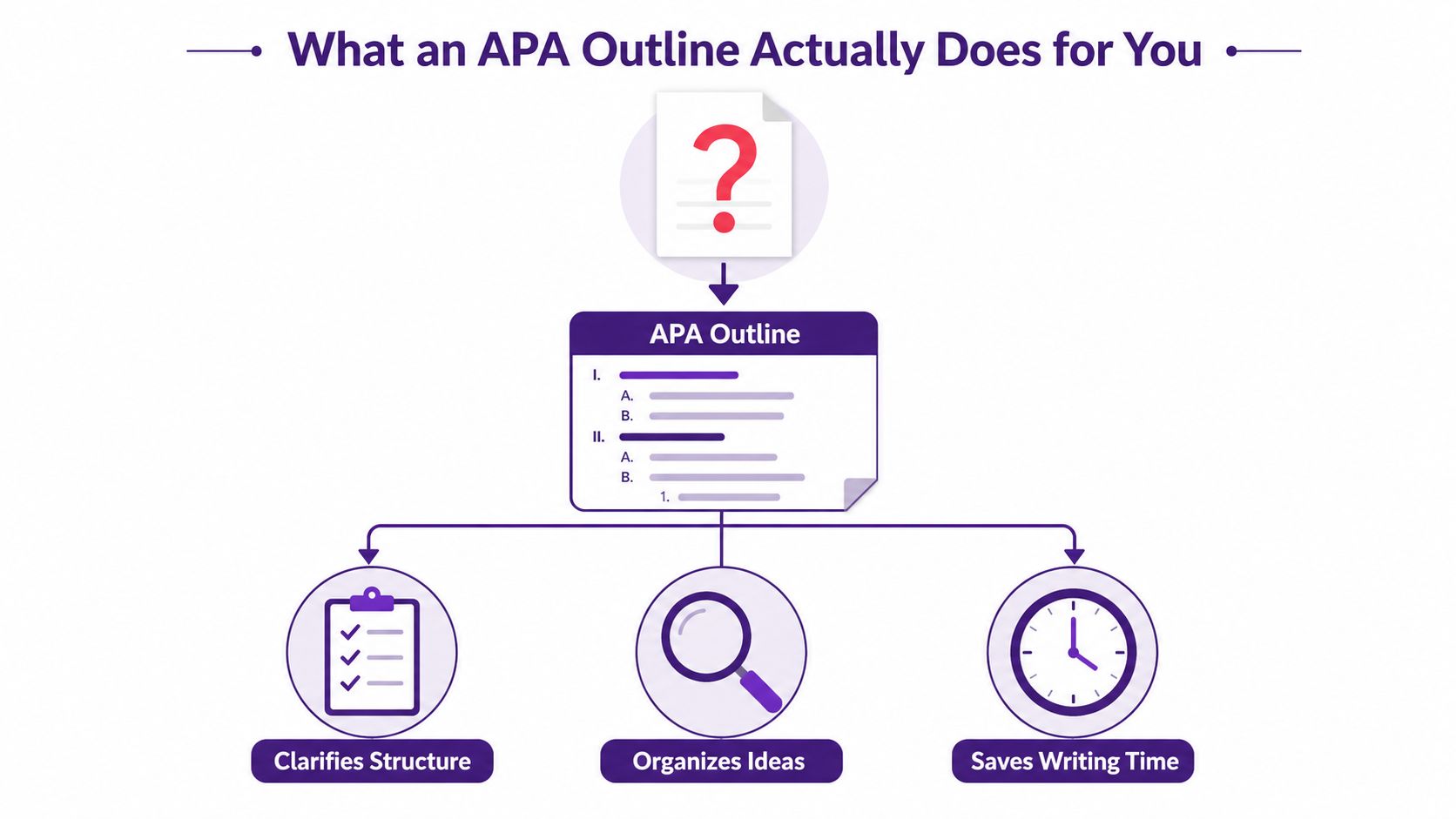
What an APA Outline Actually Does for You
A working APA outline does more than list headings. It gives you a decision map, so you can see what belongs in the paper, what belongs in notes, and what belongs nowhere yet. That matters because the outline is a planning document, while the final paper is the deliverable, and those two get mixed together all the time.
The cleanest way to think about it is simple, title page, abstract, introduction, body, references. APA paper structure also expects the usual formatting rules, including 1-inch margins and double spacing in APA 7th edition, which helps the finished paper stay consistent from the start (Troy University outline guide, Purdue OWL APA format guide). That's why a good outline can save you from rewriting sections that were never in the right place to begin with.
Practical rule: if a heading doesn't tell you what you still need to prove, explain, or cite, it probably belongs in notes, not in the outline.
For a writer who wants to keep sources and ideas under control, master lab notebook writing is a useful companion habit, because the same discipline that keeps a lab notebook readable also keeps an outline usable.
The big payoff is clarity. You can test your thesis earlier, see where the evidence thins out, and choose whether your paper should follow an empirical frame or a review-paper frame before you sink time into prose.
The Five Building Blocks Every APA Outline Shares
A strong APA outline usually starts with a working title and a thesis statement. That title doesn't need to be final, but it should already point toward the paper's focus. The thesis should do the same thing your opening argument will do later, tell the reader what the paper is trying to show, compare, or explain.
Start with the front end
The next block is the abstract plan, even if you won't draft the abstract until the paper is much farther along. Student-facing APA guides commonly keep the abstract concise, and they often place it around 150 to 250 words in practice, which is one reason it helps to sketch it early instead of treating it as a last-minute summary (Troy University outline guide). After that comes the introduction, where your outline should show the move from broad context to the specific research problem.
Build the body around evidence
For empirical work, the body usually holds Methods, Results, and Discussion, and the Methods section is the one students most often underbuild. A useful outline breaks it into participants or sample, materials or instruments, procedure, and analytical approach so each piece has a place before the draft begins (paperdraft.io APA research paper outline). That kind of detail also helps you decide what evidence you still need.
The outline is logic, not decoration. If the reader can't follow the sequence from problem to evidence to meaning, the outline isn't doing its job.
The final block is the references scaffold. Even in outline form, it reminds you that every claim needs a source path, and it helps you avoid the common trap of writing a polished argument and then scrambling to find citations afterward. In other words, the outline doesn't just arrange headings, it arranges thinking.
Heading Levels and Indentation Patterns That Work
APA outlines often use a hierarchy that makes the structure visible at a glance. The common pattern is Roman numerals for main sections, capital letters for subpoints, Arabic numerals for the next level, and lowercase letters for the deepest level (phdprojects.org on APA outline structure). That visual system helps you see whether a section is developed or just sitting there as a label.
A clean empirical example
A typical empirical outline might look like this in shape, not wording:
I. Introduction
A. Background
B. Research Question
C. Thesis
II. Literature Review
A. Major Theme One
B. Major Theme Two
III. Methodology
A. Participants or Sample
- Selection criteria
- Size and source
B. Materials or Instruments
C. Procedure
D. Analytical Approach
IV. Results
V. Discussion
VI. Conclusion
The mistake students make most often is skipping a level. If you create III. Methodology, then jump straight to 1. Procedure without an A. or B. above it, the outline starts looking unstable. The fix is to keep every subpoint answering the same question as its parent, so each layer stays parallel.
Keep the logic even
That parallel structure matters more than fancy formatting. If your top level names sections of the paper, the next level should name parts of those sections, not random details from the research. A subpoint should always fit the level above it, and if it doesn't, the heading probably needs to move up or down.
The best quick test is to read each line aloud and ask whether it belongs with its neighbor. If one point feels like a paragraph and the other feels like a fragment, the outline still needs shaping. When a source seems thin or hard to verify, check a guide on what counts as a credible source before you build it into the outline.
Drafting Your Outline Step by Step
Begin with one clear sentence about what the paper is trying to do. A narrow research question keeps the outline from wandering, and a working thesis gives each later section a purpose. If you cannot state the question in one line, the paper is probably trying to cover too much at once.
A useful way to begin is to treat the outline like a floor plan and the final paper like the finished room. The floor plan decides where each part belongs. The paper decides how those parts are written out. That difference matters, because students often start filling in details before they know whether they are planning an empirical paper or a review paper. If a source looks shaky or hard to verify, pause and check a guide to credible sources before you build it into the outline.
Move from question to sections
Write the research question first, then turn it into a thesis or claim you can support. After that, list the major sections in the order the reader should meet them, because the outline should follow the paper's logic, not your note-taking habits. First drafts often get messy here, because students gather sources before they decide where those sources belong.
Then add subpoints under each section. For Methods, that usually means the sample, the materials, the procedure, and the analysis. For the introduction, it means enough background to make the problem make sense without burying the point. If you are mapping an empirical project and want a model for how methodology sections are commonly framed, a page with samples of methodology in research paper can help you judge how much detail belongs in the planning stage.
Use a logic review before formatting
After the content is in place, check whether every heading earns its spot. Ask whether the outline moves cleanly from question to method to evidence to interpretation, or whether one section is doing work that belongs somewhere else. A careful logic review also catches awkward gaps, such as a results section with no analysis plan or an introduction that never reaches a thesis.
A quick test is to read each line aloud and ask whether it fits with the line above it. If a point sounds like a paragraph and its neighbor sounds like a fragment, the outline still needs shaping. If the outline is for a review paper, the middle changes shape. Instead of Methods and Results, use thematic sections that sort the literature into meaningful clusters, then end with patterns and implications. That structure keeps the outline honest about what the paper can deliver.
Empirical Versus Review Paper Outlines
The fastest way to choose the right outline is to look at the assignment prompt. If you collected data, interviewed people, ran an experiment, or analyzed a dataset, you're usually working with an empirical paper. If you're organizing what other people have already written, you're usually building a literature review.
| Outline Feature | Empirical Paper | Literature Review |
|---|---|---|
| Core middle sections | Method, Results, Discussion | Thematic sections, synthesis, implications |
| Main purpose | Report a study | Compare and interpret existing work |
| Body structure | Driven by what the researcher did and found | Driven by ideas, themes, or debates in the literature |
| Outline priority | Sample, materials, procedure, analysis | Topic clusters, gaps, patterns, meaning |
| Best use case | Original data or experiment-based assignment | Survey of scholarship or source-based assignment |
APA title-page mechanics are easy to overlook when the outline feels preliminary, but they still matter. Standard APA title pages include the page number, paper title, author name, affiliation, course, instructor, and due date, and one common guide notes that the paper title is usually under 12 words (EssayMarket APA outline guide). Those details belong on the final paper, but they're worth keeping in view while you outline so the front matter doesn't get forgotten.
Use this rule: if the assignment asks what you found, use an empirical outline. If it asks what the literature says, use a review outline.
A review-paper outline doesn't need a Methods section unless your instructor asks for one. In that case, your outline should shift toward how you selected sources and how you grouped them, which is why it helps to keep the outline flexible until the assignment language is fully clear. For a quick refresher on what usually appears in a methodology section, the article on methodology in research paper examples can help you separate content you need now from content you'll write later.
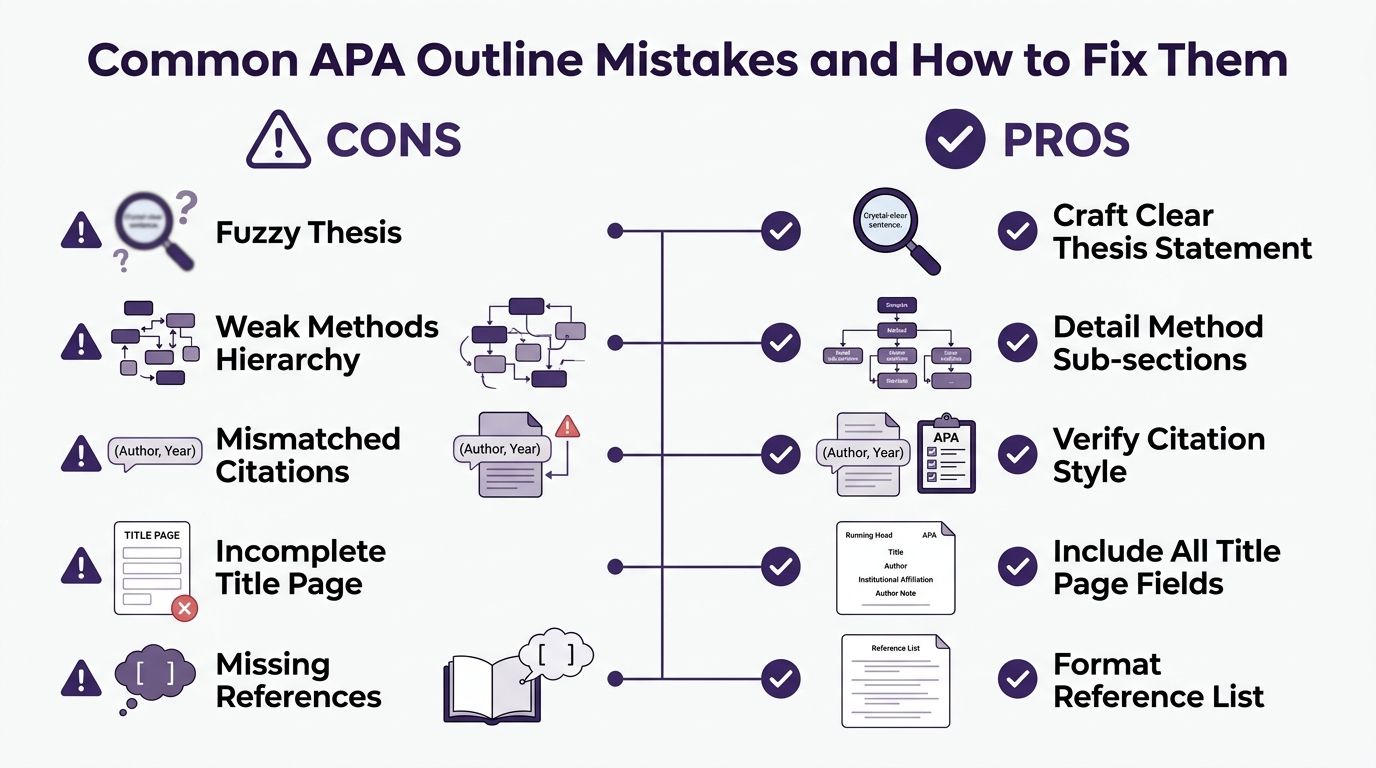
Common APA Outline Mistakes and How to Fix Them
Most weak outlines fail in predictable ways. The first problem is a fuzzy thesis. If the central claim doesn't tell you what the paper is proving or comparing, every section after it starts to wobble.
The five errors to catch early
- Fuzzy Thesis: the outline lists topics, but no clear argument ties them together. Fix: write one sentence that states the paper's central point in plain language.
- Weak Methods Hierarchy: the Methods section exists, but sample, instruments, procedure, and analysis are lumped together. Fix: split the section into those parts before drafting prose.
- Mismatched Citations: the outline relies on one citation style in some places and another style elsewhere. Fix: pick the APA convention and keep the notes consistent from the start.
- Incomplete Title Page: the outline skips fields that belong on the front page. Fix: include the required title-page elements in your planning notes so they don't disappear later.
- Missing References Scaffold: the outline never reserves space for the sources behind the argument. Fix: build a reference list placeholder as soon as the first source enters the paper.
The deeper issue is confusing the outline with the final IMRaD shape. IMRaD, meaning Introduction, Method, Results, Discussion, is the destination for many empirical papers, but it isn't the same thing as a planning draft. When students collapse those two stages, the structure drifts because the outline never had room to reveal gaps.
Run a five-minute self-audit
Read the outline once from top to bottom and once from bottom to top. The second pass helps you catch missing support, because you notice where a section ends without a clear next step.
If the headings feel uneven, fix the hierarchy before you write paragraphs. Small outline problems usually become large revision problems later.
Your Quick-Copy APA Outline Template and Final Checklist
Use this as a starting shape, then replace the placeholders with your own topic:
I. Title Page
II. Abstract
III. Introduction
A. Background
B. Research Question
C. Thesis
IV. Literature Review
A. Theme One
B. Theme Two
V. Method
A. Participants or Sample
B. Materials or Instruments
C. Procedure
D. Analytical Approach
VI. Results
VII. Discussion
VIII. References
IX. Appendix, if needed
Final checklist
- Thesis drafted: the outline points to one central claim.
- Methods subheads specified: the plan names the sample, materials, procedure, and analysis.
- Citations mapped: source notes are attached to the right sections.
- References stubbed: the outline leaves room for the bibliography.
- Title page fields captured: page number, title, author name, affiliation, course, instructor, and due date are accounted for.
- Logic reviewed: each heading supports the one after it.
For citation placement while the outline is still fluid, this guide on how to add citation can help you keep source notes tied to the right claims without losing track of them.
Paste these three prompts into your notes app and answer them before you draft the paper:
What is my research question?
What evidence will I cite?
What is the single most important thing my reader should leave understanding?
An outline works best when it's treated like a working map, not a decorative requirement. If you want a cleaner way to organize sources, search your working bibliography, and keep a research project moving without losing the thread, visit Contesimal and see how it helps turn scattered material into a structure you can write from.