
Your content archive probably started as a competitive advantage. Then the PDFs multiplied, slide decks disappeared into shared folders, scanned contracts became invisible to search, and video transcripts accumulated without useful labels. A content lead can remember where a few important files live. That approach breaks once the library becomes large, mixed-media, multilingual, and constantly updated.
Document classification methods turn that disorder into a navigable system. They assign files to categories such as contract, press release, internal memo, product brief, podcast transcript, or research note, using signals from text, layout, images, metadata, or a combination of them. The aim isn't perfect categorization. It's making every useful document findable quickly enough that your archive becomes a working asset instead of a black hole.
When Your Content Archive Becomes a Black Hole
A media company's content lead opens the search box and types the name of a campaign from several years ago. The archive contains PDFs, slide decks, scanned agreements, interview transcripts, and production notes, but the results mix everything together. The right file may exist, yet the team can't tell which result contains it.
Manual tagging had seemed manageable at first. Editors added labels when they uploaded files, and researchers corrected a few mistakes during retrieval. At roughly 50,000 documents, however, the process stopped scaling. New contributors used different names for the same topic, old files had incomplete metadata, and scanned pages offered no searchable text at all.

What classification actually does
A classifier makes a practical decision about each file. It might identify a document as a sponsorship contract, a show transcript, or a research source, then attach that label to the archive. A more advanced system can assign several labels when one file serves multiple purposes, such as a transcript that belongs to both “audience research” and “episode planning.”
That label can drive search, routing, permissions, review queues, or content repurposing. A publisher could locate every interview transcript about a subject. A video team could find source material for a new episode without opening hundreds of files. A marketing group could separate approved messaging from exploratory research.
Practical rule: Choose classification around the decisions your team needs to make, not around the model that looks most sophisticated on a benchmark.
The difficult part is that archives rarely contain clean text alone. They contain born-digital documents, poor scans, charts, screenshots, captions, handwritten notes, and transcripts with inconsistent formatting. The rest of the method choice depends on how well each approach handles those differences while remaining understandable and maintainable.
The Main Document Classification Methods Explained
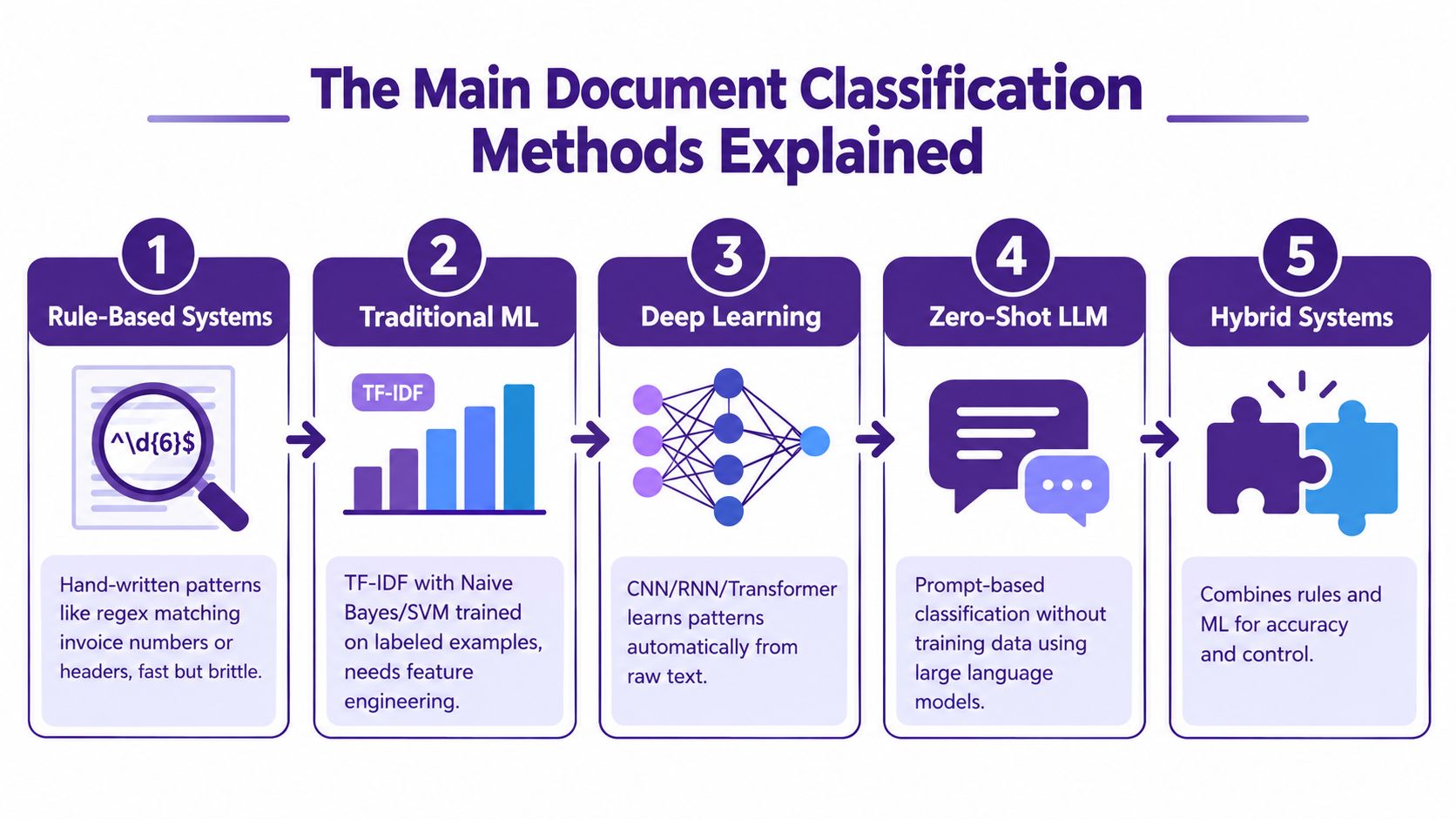
A content library owner may hold contracts, scanned forms, screenshots, charts, and interview transcripts in the same archive. Start with the simplest method that can separate the categories your team uses. A predictable text collection may need only explicit rules, while mixed layouts and incomplete OCR usually require a model that can recognize patterns beyond exact words.
Rule-based systems
A rule-based classifier follows instructions written by a person. It can search for a phrase in a header, match a regular expression for an invoice number, or check whether a page contains a known disclaimer.
Example: If a file contains “press release” in the title and a publication date on the first page, assign the press-release label.
This approach is quick, transparent, and easy to audit. It also becomes brittle when contributors change naming conventions, vendors redesign templates, or documents use unexpected language. Rules suit narrow, stable categories, but ambiguity and frequent exceptions create maintenance work.
Traditional supervised machine learning
A supervised classifier learns from examples that people have already labeled. Logistic regression, support vector machines, decision trees, and related models can use word counts, term weighting, metadata, and extracted layout features.
Example: Provide labeled samples of contracts, briefs, and internal memos. The model learns which terms and patterns tend to distinguish those categories.
Labeling is required, yet the resulting model can generalize beyond exact phrases. It remains relatively explainable as well. A team can inspect influential terms or features and check whether the classifier relies on a sensible signal or on an artifact, such as a repeated filename convention.
Deep learning
Deep learning models learn representations from text, images, or both. Convolutional neural networks can recognize visual structures, while recurrent neural networks process sequences. These models reduce the need to design every feature by hand, but they require suitable data, careful evaluation, and more computing resources.
Example: A visual model can distinguish a magazine cover, a form, and a chart-heavy report even when OCR produces incomplete text.
That capability matters in an archive where the page itself carries meaning. A text-only classifier may see fragments of a scanned form, while a visual model can use its arrangement, borders, and image regions.
Transformer transfer learning
Transformer models such as BERT and RoBERTa start with broad language representations and are then fine-tuned for your categories. Their strength is contextual representation, so the same word can contribute differently according to the surrounding sentence.
Example: “Brief” may identify a legal document, a creative assignment, or a short summary, depending on the language around it.
Document classification traces back to the mid-1960s, when researchers used mathematically derived, empirically based factor analysis to infer thematic content from word distributions. Transformer-based language models marked a major shift in 2017 by improving contextual representation across longer documents. This development belongs to a method history spanning 50+ years, as described in IBM's classification process documentation.
A practical method comparison places rule-based systems around 60-80% accuracy, keyword matching around 80-90%, traditional machine learning around 90-95%, CNN-based approaches around 95-98%, and LLM-based methods around 95-99%. It also describes a speed difference, with rule-based systems running in under 10 milliseconds and LLM-based systems often taking 1-3 seconds per document (document classification overview). These figures are reference points, not a guarantee for a library containing scans, transcripts, and mixed media.
Zero-shot LLM classification can follow instructions without task-specific training examples, but it raises questions about cost, latency, consistency, and privacy. Hybrid systems often provide a workable compromise: deterministic rules handle obvious or high-risk cases, while learned models handle ambiguous files. Choose around the decisions your team must make, not around a model that appears complex on a benchmark.
Accuracy vs Speed Trade-offs Across Methods
A content library owner usually balances four operating needs: dependable accuracy, predictable latency, infrastructure cost, and failure handling the team can maintain. A method that performs well on clean text may slow down when scans need OCR, images need visual processing, or one file contains several document types.
The comparison below summarizes published document-classification comparisons. Treat it as a reference for method selection, not as a forecast for every mixed-media archive.
| Method | Accuracy Range | Throughput | Hardware |
|---|---|---|---|
| Rule-based systems | 60-80% | Under 10 ms per document | Commodity hardware |
| Keyword matching | 80-90% | Generally fast | Commodity hardware |
| Traditional machine learning | 90-95% | Faster than LLM-based methods | CPU often sufficient |
| CNN-based image or document methods | 95-98% | Moderate, dependent on image processing | More compute for visual inputs |
| LLM-based methods | 95-99% | 1-3 seconds per document | Often benefits from GPU or hosted inference |
A rule engine suits a small, stable set of document types. It can route a file immediately and show the condition behind the decision. Its limits appear in an archive full of exceptions. Each exception adds another rule, while overlapping conditions can produce outcomes that are difficult to explain.
Traditional machine learning offers a practical middle ground. It learns vocabulary and patterns while keeping inference relatively efficient. For long, heterogeneous documents, a 2025 benchmark found that XGBoost reached an 86 F1 score on 27,000 academic documents and remained versatile across data regimes. The benchmark also reported that BERT required 2GB+ GPU memory, compared with about 100MB RAM for XGBoost, while transformer training could take more than 4 hours on the full dataset (long-document classification benchmark).
A transformer or LLM earns its cost when context, layout, or semantic ambiguity determines the category. For high-volume triage with straightforward labels, a smaller model may produce the better operational result. Before choosing a center of gravity, content teams can review this guide to semantic search and vector search, then decide whether classification, retrieval, or both belong in the workflow.
Embeddings, Clustering, and Semi-Supervised Approaches
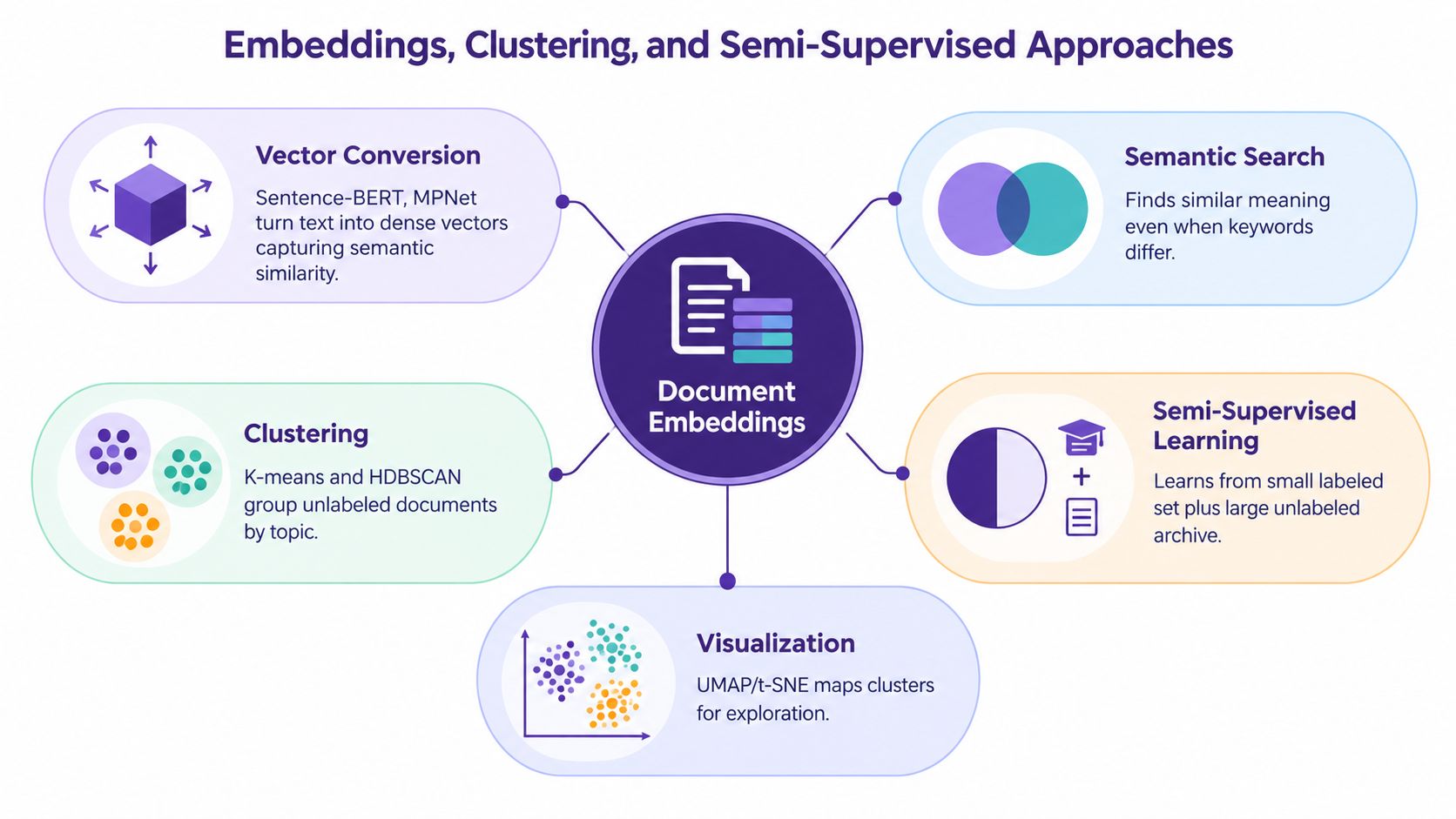
A keyword system treats “vehicle financing” and “car loans” as different strings unless someone adds a connection. Embeddings represent text as dense numerical vectors, allowing a system to compare meaning even when the exact words differ. Sentence-BERT, MPNet, and instruction-focused embedding models can place semantically similar passages near one another in vector space.
That representation helps content teams explore archives before they have a complete taxonomy. A media library might discover that interviews about creator burnout, production routines, and sustainable publishing form related groups even though the files use different vocabulary.
Clustering for discovery
Unsupervised methods such as k-means and HDBSCAN group documents according to similarity without requiring predefined labels. That makes them useful for a cold-start archive, especially when nobody knows which categories already exist.
A publisher could cluster thousands of scanned magazine pages after OCR, inspect the resulting groups, and name them afterward. The model surfaces structure, but a person still decides whether a group represents “product reviews,” “editorials,” or merely a scanning artifact.
Semi-supervised learning for seed sets
Semi-supervised learning becomes more attractive when a small labeled set already exists. Label propagation can spread likely labels to nearby documents, while consistency-based methods encourage stable predictions across related examples.
Consider a legal discovery collection with 200 manually coded contracts. Those examples can seed a larger unlabeled set, giving reviewers a starting point for prioritization instead of requiring them to label every file. The quality still depends on whether the seed set represents the archive's language, jurisdictions, document formats, and edge cases.
Choose clustering when you need to understand what exists. Choose semi-supervised learning when you already know enough to name a few reliable categories.
Embeddings also support research workflows beyond classification. Teams developing practical AI for market research can use semantic representations to connect scattered evidence, compare themes, and identify relevant material that keyword searches might miss. For a deeper look at how AI can inspect individual files and extract meaning, see AI document analysis.
Active Learning for Large Mixed-Media Archives
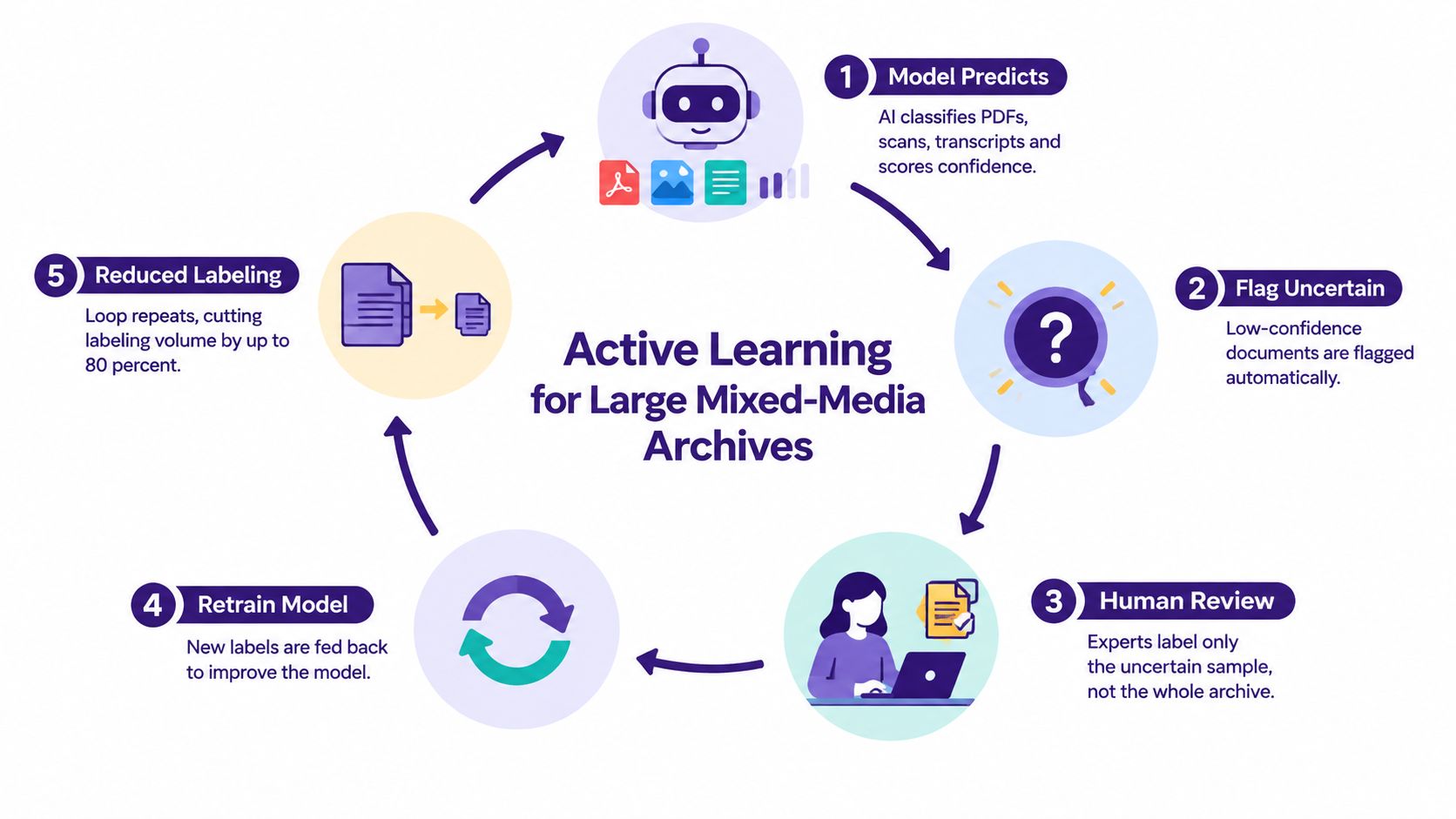
Active learning changes the human role from “label everything” to “review what the model doesn't understand.” The classifier predicts categories, assigns confidence scores, and sends uncertain or strategically selected documents to reviewers. New labels return to training, creating a feedback loop.
A research library with 500,000 documents might use this process to prioritize difficult PDFs, scans, slide decks, and email threads. In one documented scenario, reviewers labeled 2% of items and the system reached 92% accuracy because it learned from difficult examples first, rather than spending review time on obvious cases (active learning benchmark context).
Three ways to choose the next document
Uncertainty sampling selects files where the model's leading predictions are close. A transcript that could be either a product interview or a customer story belongs in this queue because a human label can resolve a genuine ambiguity.
Diversity sampling selects examples that represent different regions of the archive. This prevents the queue from filling with near-duplicates and helps the model encounter varied formats, languages, and sources.
Query-by-committee asks several models to make predictions, then prioritizes documents where they disagree. This approach can expose systematic uncertainty that a single confidence score conceals.
Mixed-media archives usually need a combination. Uncertainty finds confusing documents, diversity protects coverage, and committee disagreement highlights model blind spots.
Production details decide the outcome
The review interface should show the file preview, extracted text, predicted labels, confidence, and a simple correction action. Reviewers need a way to mark “unknown,” “multiple labels,” or “unreadable,” because forcing a bad category pollutes future training data.
Track agreement between reviewers, record why labels change, and establish a retraining cadence that matches archive activity. Active learning isn't a magic shortcut. It works when the organization treats review data as a product input and keeps the feedback loop visible.
Domain Adaptation and Multimodal Classification
A general language model can understand language yet still misunderstand your archive. Legal contracts, medical records, internal memos, production scripts, and academic papers use specialized vocabulary, formatting conventions, and implied meanings. Domain adaptation adjusts the model to those conditions through in-domain training or fine-tuning.
A classifier trained on public prose may treat "release" as a general news term. In a media archive, it might refer to a rights release, a product announcement, or an episode release. The model needs representative examples and carefully designed labels, not only a larger parameter count.
Mixed-media documents add another layer. A slide deck may communicate its category through a title, a chart, a logo, and the position of a table. A scanned agreement may contain weak OCR but a recognizable signature block. A useful classifier combines text, visual appearance, layout, and metadata instead of trusting one signal.
Fusion strategies
| Fusion Strategy | Best Use Case | Limitation |
|---|---|---|
| Early fusion | Combine text, image, and layout features before classification | Requires compatible representations and careful preprocessing |
| Late fusion | Let separate text and vision models vote or combine scores | Can miss relationships between words and visual positions |
| Cross-attention | Model interactions between text tokens and page regions | More complex to train, deploy, and explain |
Layout-aware models such as LayoutLMv3 are practical reference points for documents where word position matters. CLIP-style approaches can help connect visual and textual concepts, but neither removes the need to inspect OCR quality, page segmentation, and domain-specific errors.
A confidence score is only useful when you know which evidence produced it.
If OCR reads a caption incorrectly while the image clearly shows the relevant object, a text-only score can be misleading. If the page layout resembles a contract but the language indicates a press release, a vision-only score can fail in the opposite direction. Store modality-level evidence where possible, then route disagreements to human review rather than hiding them inside one blended number.
Best Practices for Choosing and Evaluating Methods
A reliable classifier begins with a reliable evaluation set. Don't create a random sample that mostly contains easy, frequent document types. Use stratified sampling so rare categories, file formats, sources, languages, and quality levels appear in validation and test data.
Build the evaluation around decisions
Define whether each file receives one label or several. A multi-class taxonomy assigns one category, while a multi-label taxonomy can assign several. The distinction changes the model output, thresholding strategy, review interface, and success criteria.
Use the metric that matches the risk. Micro-F1 aggregates true positives, false positives, and false negatives across labels, so frequent categories influence the global result more heavily. Macro-F1 calculates F1 for each label and averages them, giving rare and common labels equal weight (Micro-F1 and Macro-F1 definitions).
Don't report only one global score. A strong micro result can conceal a classifier that fails on an important minority category. Review per-class precision, recall, confusion patterns, and the examples behind false positives and false negatives.
Tune thresholds instead of inheriting them
A probability of 0.5 isn't a universal rule. In multi-label classification, researchers distinguish between a static threshold, shared across documents, and a dynamic threshold, learned for different documents or conditions (thresholding approaches for multi-label classification).
One metadata-based study found an optimal threshold of 0.25 for its dataset, which demonstrates why teams should tune thresholds empirically rather than assume a default (metadata-based classification study). Use validation precision-recall curves, choose thresholds by class when the business risk differs, and create an explicit “unknown” path.
Monitor the live system
Log confidence distributions, label frequencies, OCR quality, unknown rates, and review corrections. Test a new model in shadow mode against the production baseline before changing routing behavior. Drift often appears first as a change in confidence or reviewer disagreement, not as an obvious catastrophic failure.
Choosing the Right Method for Your Library
Method selection isn't a race toward the newest transformer. A small legal archive with clear vocabulary, limited labels, and strict audit requirements may benefit more from a tuned support vector machine than from a large transformer. A visually structured collection of forms, scans, tables, and signatures needs layout and image signals that a text-only model can't provide.
Use five questions to narrow the field:
- Label volume: Do you have enough trustworthy examples, or should you begin with clustering and active learning?
- Taxonomy depth: Are categories broad and stable, or layered, overlapping, and constantly changing?
- Content modality: Is the archive mostly clean text, or does it include scans, images, tables, audio transcripts, and slides?
- Latency budget: Does the system need immediate routing, or can it process files asynchronously?
- Explainability: Can a reviewer accept a probabilistic prediction, or must the system show the exact rule and evidence?
A small text archive may suit rules or classical machine learning. A mixed-media library may need OCR, layout-aware modeling, embeddings, and human review. A fast-moving content operation can combine a stable taxonomy with clustering to find emerging themes. Regulated content often benefits from conservative thresholds, explicit unknown categories, and traceable evidence.
For a broader example of why automated summaries can fail when context and source structure are mishandled, you can browse Artul.ai insights. The lesson applies here too. A model's apparent fluency doesn't guarantee that it captured the document's purpose.
Teams evaluating software can also compare their requirements with document classification software, especially when they need custom categories across articles, scripts, transcripts, and other library assets. Contesimal supports AI-defined categorization at upload, layered taxonomies, and custom tagging for content collections.
Newer isn't automatically better. The right method is the one your team can label, audit, retrain, explain, and connect to the work that follows. Organize the archive, understand its patterns, and take action on the files you already own.
Contesimal helps content teams classify, organize, and search documents, podcasts, videos, and articles through custom taxonomies and AI-assisted research workflows. If your archive is difficult to manage, visit Contesimal to turn scattered files into a working library for research, collaboration, and content repurposing.