
Think of AI document analysis as your personal content librarian—one with a photographic memory and an uncanny ability to connect dots you never knew existed. For content creators, YouTubers, and podcasters, it’s a game-changer. It’s a system that can instantly scan every podcast transcript, video script, and article you've ever poured your soul into, finding hidden themes and golden nuggets you can spin into your next viral hit. This is how you upcycle your old content and create infinite new value.
What Is AI Document Analysis Anyway?

Picture your entire content library as a giant, messy warehouse. Every video script, podcast transcript, and research doc is just tossed in a random box. Good luck finding that one specific quote from a podcast you recorded two years ago. For any creator moving from hobbyist to professional, that chaos is a growth killer.
AI document analysis is the pro who comes in with a high-tech scanner, organizing and understanding every single item. It doesn't just read words on a page; it actually understands the concepts, topics, and even the sentiment behind them. This is how you turn a chaotic archive into a searchable, monetizable goldmine. Organize. Understand. Take Action.
Beyond Simple Keyword Search
We all know the limits of a basic Ctrl+F search. It’s great if you need to find an exact word, but that’s it. If you search for "growth hacking," you’ll completely miss the moments where you discussed "user acquisition strategies" or "viral loops," even though they're all part of the same conversation.
This is where AI flips the script. It sees the relationships between ideas. You can search for a single concept and instantly pull up every relevant discussion, quote, or data point across your entire content library, no matter what specific words were used. This is the first real step in breathing new life into your old work and reigniting your content library.
At its core, AI document analysis turns your passive content archive into an active, intelligent database. It’s no longer about where a file is stored, but what knowledge is stored within it.
This same power is being used across all sorts of industries. For example, some VC firms now use AI to triage inbound pitch decks, which is a perfect parallel for creators. Your past content pieces are the "pitch decks," and the AI helps you instantly spot the winners to build upon.
From Manual Drudgery to Automated Discovery
The old way of managing a content library was pure, soul-crushing manual labor. It meant hours spent re-watching videos, re-reading articles, and trying to keep up with a meticulous tagging system. For creators trying to grow their audience across platforms, that process is painfully slow, loaded with human error, and simply doesn't scale.
The table below breaks down just how big of a shift this is, moving from tedious chores to an efficient, AI-powered workflow that lets humans and AI collaborate seamlessly.
Manual Content Management vs AI Document Analysis
| Task | The Old Manual Way | The New AI-Powered Way |
|---|---|---|
| Finding a Quote | Manually scrubbing through hours of video or audio transcripts. | Asking the AI, "Find the clip where my guest explained brand storytelling." |
| Topic Research | Keeping messy spreadsheets or notes of past topics covered. | Instantly generating a list of every time a specific theme was discussed. |
| Content Repurposing | Guessing which old clips might work for a new social media post. | Identifying the most impactful, shareable moments automatically. |
| Collaboration | Sharing links to massive files and telling collaborators to "look around the 30-minute mark." | Sharing a precise, AI-generated summary and timestamped link for your team to build on. |
By automating the heavy lifting of organization and discovery, AI document analysis gives you your time back. You get to focus on what you actually love doing: creating. You can instantly find every mention of a specific topic or guest, turning your past work into a powerful resource for your next great idea.
How the Technology Actually Works
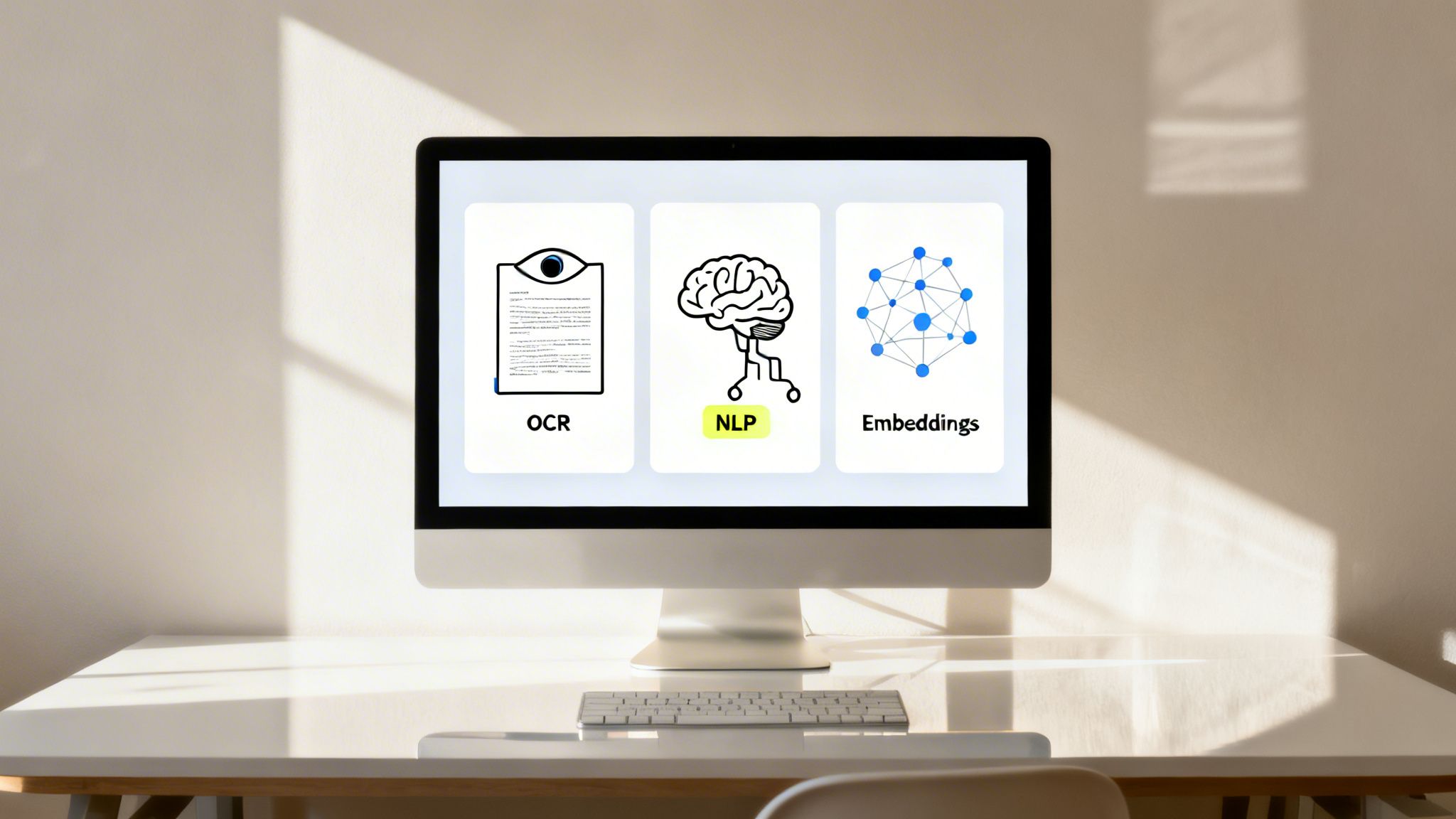
So, how does an AI actually understand your content? It’s not magic, but it’s close. Let's pull back the curtain and look at the core technologies that turn your scattered files into a searchable, intelligent library you can actually make money with.
You don't need to be an engineer to get it. The whole process breaks down into three main jobs, each handled by a specific piece of tech. Together, they create a system that doesn’t just scan your content—it comprehends it.
The Eyes: Optical Character Recognition (OCR)
First things first, the AI has to be able to read. That’s where Optical Character Recognition (OCR) steps in. Think about all the content that isn't plain text: a scanned PDF of an old article, a slide from a presentation, or even the text inside a video thumbnail.
OCR acts like a super-fast digital scanner for words. It looks at any image, finds the characters, and converts them into machine-readable text the AI can work with. Without this step, any content trapped in images or scans would be completely invisible to the system.
The Brain: Natural Language Processing (NLP)
Once the text is free, the real thinking starts. Natural Language Processing (NLP) is the brain of the whole operation. It’s what allows the machine to make sense of human language—the grammar, the slang, the context, and all the messy nuances.
NLP isn’t just looking for keywords. It can spot the names of people, places, and companies (Named Entity Recognition), figure out if a sentence is positive or negative (Sentiment Analysis), and identify the core subjects being discussed (Topic Modeling). It's how the AI knows "Apple" means a tech giant in one podcast and a piece of fruit in another.
The Navigator: Vector Embeddings
This is where things get really interesting for creators. Vector embeddings work like a GPS for your ideas. This tech takes words, sentences, or whole documents and converts them into a string of numbers, called a vector. This vector captures the conceptual meaning of the text.
These numbers are plotted as points in a massive, multi-dimensional space. The closer two points are, the more related their underlying concepts are.
This is why you can search for "brand-building tips" and the AI finds a segment where you talked about "logo design," "audience trust," and "social media voice"—even if the words "brand-building" never came up.
This conceptual map is what turns AI document analysis from a basic search bar into a true creative partner. It reveals connections and related ideas you'd completely forgotten about, bringing your entire content library back to life so you can create new value.
These technologies are catching on fast. The global Document AI market pulled in USD 32.8 billion in 2024 and is expected to soar to USD 185.3 billion by 2034.
It all comes together in a simple workflow:
- Ingestion: OCR digitizes your content from every file type.
- Processing: NLP analyzes the text to understand what it actually means.
- Indexing: Vector embeddings build a searchable map of every concept in your library.
This powerful trio is the engine behind what's called intelligent document processing. You can learn more in our full guide on what is intelligent document processing. It’s this teamwork between technologies that allows a platform like Contesimal to make your content library organized, understandable, and ready for you to create something new.
Building Your Intelligent Content Map

Let’s be honest, your content library is probably a chaotic mix of folders and tags. It’s like a classic library card catalog—it tells you where a book is, but it knows nothing about the ideas inside it or how they connect to the other books on the shelf. For any creator with a library of hundreds of videos, articles, and podcasts, that system just doesn't scale.
This is where AI document analysis steps in to give you a major upgrade. We’re moving from a simple list of files to a dynamic, multi-layered map of your entire content universe. Think of it as a smart, interconnected web. Instead of just pointing to files, it actually charts the relationships between every concept, theme, and idea you've ever recorded.
What you're building is a living, breathing structure for your content. It’s no longer a pile of disconnected files but an intelligent network where every piece of information is linked to related concepts. Your whole library becomes a single, explorable asset—a set of knowledge your team can gather around.
From Static Files to a Dynamic Network
The real magic of this intelligent map is its knack for surfacing connections you never knew existed. An AI doesn’t just see a transcript from "Podcast Episode #52" and an article about "Marketing Trends." It understands that both pieces discuss customer retention, mention the same guest speaker, and reference a specific brand.
Suddenly, two completely separate files are linked on your map. The AI automatically spots and connects these dots across your entire library, including:
- Recurring Themes: Pinpointing which topics you circle back to most often, revealing your most successful concepts and true areas of expertise.
- Guest Appearances: Linking every podcast, video, and article where a specific person was featured.
- Brand Mentions: Tracking every single time a particular company or product came up, for better or worse.
- Conceptual Clusters: Grouping content that talks about similar ideas, even if the wording is totally different.
This automated linking is the foundation for turning a passive archive into an active creative partner. It builds a rich, contextual understanding of your work that no human could ever piece together manually. If you want to go deeper, our guide on what is document indexing explains exactly how this underlying structure gets built.
Your intelligent content map is more than just an organizational tool; it’s a discovery engine. It reveals the DNA of your content, showing you the patterns and relationships that define your unique voice and value.
Finding the Needle in the Haystack—Instantly
Once this interconnected map is in place, how you interact with your content library is completely transformed. That frustrating search for the one perfect clip or quote you vaguely remember? It's over. You can now ask your library complex questions and get immediate, surgically precise answers, helping you figure out how to create your next new video.
Imagine you're outlining a new YouTube video about sustainable business practices. Instead of wracking your brain trying to remember which podcast guest talked about it six months ago, you can just ask.
A content creator could ask:
- "Show me every clip where my guests discussed eco-friendly supply chains."
- "Find the strongest quotes about corporate responsibility from the last two years."
- "What data points have I cited about consumer trust in green brands?"
The AI zips through the map it created, pulling the exact segments, quotes, and data points from dozens of different files in seconds. This isn't just about saving time; it's about elevating the quality of your work. You can effortlessly weave your best moments from the past into new creations, adding a layer of depth and authority that would have been impossible to dig up before. Platforms like Contesimal are built entirely around this idea, revolutionizing research collaboration and enabling you to find your next big idea hiding in plain sight.
Putting AI Document Analysis Into Practice
All the theory behind AI document analysis is great, but let's be honest—what really matters is seeing it work in the real world. This isn't just some abstract tech for data scientists or giant corporations. It’s a practical toolkit for creators like us—Youtubers, podcasters, and bloggers—who are grinding it out daily, trying to find that next great idea or get more mileage out of the content we’ve already poured our hearts into.
So, let's move past the technical jargon and look at how actual content professionals are using this to solve problems, get time back, and find hidden gems in their own libraries. The applications are as different as the creators themselves.
This whole area is exploding, powered by a sector called Intelligent Document Processing (IDP). That market was valued at USD 10.57 billion in 2025 and is set to rocket from USD 14.16 billion in 2026 to an incredible USD 91.02 billion by 2034. That explosive growth tells you everything. This is becoming essential for big industries, and now, creators and publishers are finally getting in on the action. You can see the full breakdown of these numbers and what's fueling the growth in this detailed market analysis.
For the Podcaster Themed Episode Wizard
Picture this: you want to pull together a "best of" episode on a specific theme, like "lessons in failure" or "early-stage startup advice." The old way? Spending days, maybe even weeks, scrubbing through hundreds of hours of audio, trying to remember where those perfect soundbites are hidden. It's a total headache.
With AI document analysis, the whole thing becomes almost instant. You can literally ask your content library, "Find all the moments where guests talked about their biggest career mistakes." The AI zips through your archive and serves up a list of timestamped clips from every relevant episode. You just review, pick the best ones, and stitch together a killer compilation episode in a tiny fraction of the time. You can turn your old longform content into a money maker, today.
For the YouTuber Repurposing Pro
A YouTuber's back catalog is a goldmine, but manually digging for that gold is the hard part. Maybe you're hunting for those perfect moments that could go viral as YouTube Shorts or TikToks. Or maybe you need to align your content across many platforms by finding all your best B-roll descriptions for a new video.
AI turns this chore into a simple search. It scans every single video transcript and helps you:
- Find Viral-Worthy Clips: Search for segments with high emotional energy or moments where a tricky concept was explained perfectly in under 60 seconds.
- Compile Your B-Roll: Instantly locate every time you described a specific shot, like "slow-motion shot of the city" or "drone footage of the coast."
- Spark New Ideas: The AI can analyze your most-watched videos to spot the themes and successful concepts that really connect with your audience, giving you a data-backed starting point for your next hit series.
For any YouTuber transitioning from hobbyist to professional, this is the cheat code. You stop relying on a fuzzy memory and start using a smart, data-driven system to make more of what your audience already loves.
For the Publisher and Blogger Building SEO Authority
If you’re a blogger, publisher, or content marketer, you know that topical authority is the name of the game for winning at SEO. That means creating deep, interconnected webs of content where all your related articles link to each other. It’s how you signal to Google that you’re the expert and grow the value of your content.
This is where AI document analysis really shines. Instead of trying to keep a mental map of every article you've ever published, the AI does it for you. When you write a new post on "email marketing strategies," it can immediately suggest a dozen older articles from your archives that touch on related topics, like "A/B testing subject lines" or "list segmentation."
This lets you:
- Build Powerful Content Hubs: You can systematically interlink related posts to create those resource centers that Google loves, attracting backlinks and climbing the rankings.
- Breathe New Life into Old Content: Quickly spot older articles that could use a refresh with new info or be linked to your latest work.
- Fuel Team Collaboration: On a publishing team, the AI makes sure everyone knows what content already exists. No more accidentally writing the same article twice.
In all of these cases, the AI isn’t replacing your creative spark; it’s amplifying it. It’s like having a brilliant creative partner who has a perfect memory of everything you’ve ever made. With platforms like Contesimal, creators can finally organize their content library, understand the knowledge locked inside, and start turning it into endless new opportunities.
Putting Your First AI Workflow into Action
Ready to dive in? The whole idea of setting up an AI document analysis workflow can sound pretty technical, but you don't need a computer science degree to get it done. Modern tools are built for creators, not coders, making it a surprisingly straightforward process for anyone who wants to get serious about their content operation.
The whole thing really comes down to three main stages. Picture it like a factory for your content's brainpower. You feed in the raw materials (your entire back catalog), the machinery processes and organizes everything, and then you can pull finished insights right off the line whenever you need them.
Stage 1: Ingestion
First things first, you have to get your content into the system. This is the ingestion phase. For us creators, this just means uploading your entire archive—every video, podcast episode, blog draft, and scrap of research you've ever made.
A solid platform handles this for you. It doesn't matter if your files are a mess, scattered across different hard drives or cloud services. You just point the system at your library, and it starts pulling everything into one central, secure hub, getting it ready for the next step.
Stage 2: Indexing
Now for the fun part. This is where the AI really gets to work. Once all your content is inside, the indexing process kicks off. The AI digs into every transcript, document, and media file, using all that cool tech we talked about—like NLP and vector embeddings—to build an intelligent map of your entire content universe.
It automatically starts picking out key topics, guests you've interviewed, brands you've mentioned, and core concepts. It’s not just making a simple file list; it's building a rich, interconnected web of knowledge that represents everything you've ever put out there. This is the most important part of AI document analysis, turning a digital junk drawer into a structured, searchable goldmine.
A big question here is always data privacy. Good platforms like Contesimal are built with serious security, like end-to-end encryption, to make sure your content stays yours. Your library is your secret sauce, and keeping it safe is everything.
This process is what takes your archive from a shoebox full of files to an interactive database. Once indexing is done, your library is primed for the final—and most valuable—stage. To get your library ready for this, it helps to follow a few best practices. For more on that, check out our guide on 10 essential metadata management best practices for content creators.
Stage 3: Interaction
The final stage is interaction. This is where you, the creator, start seeing the payoff. You can now search, collaborate, and pull value from your freshly organized library without breaking a sweat. And this isn't your average keyword search; it’s more like having a conversation with your own body of work.
You can ask it real, complex questions and get precise answers back in seconds. Think about it:
- "Show me every clip where I talked about user-generated content."
- "Pull all the stats I've ever cited about audience retention."
- "Give me a summary of my interview with Jane Doe."
This interactive layer lets you and your team collaborate on research seamlessly. You can find that perfect clip for a social post, pull a powerful quote for a new article, or find the spark for your next video series. This is exactly how creators make the jump from hobbyist to a professional, revenue-generating business—by building a system that can actually scale.
And this isn't some niche trend; it's a global shift. The Asia Pacific region has become the fastest-growing market for Document AI, with emerging economies leading the charge. This growth signals a massive opportunity for content businesses of all sizes—from solo podcasters to major publishers—to get these workflows in place and jump ahead. You can dig into this regional growth in this comprehensive market report. By setting up a clear workflow, you’re not just organizing your past; you’re building an engine that creates your future.
Turn Your Content Library Into Your Next Big Thing
Every creator knows the feeling. You pour your heart and soul into articles, podcasts, and videos, only to see them fade into a disorganized archive. Your best ideas and sharpest insights are just sitting there, collecting digital dust. It's the biggest bottleneck for any growing creator: your most valuable assets are locked away, making it impossible to build on what you’ve already built.
But what if you could change that? Imagine having a partner with a perfect memory of every single thing you've ever published. That's what AI document analysis brings to the table. It turns your passive archive into an active, intelligent collaborator, ready to help you unearth your next big idea.
Unlock Infinite Content Value
Going from a hobbyist to a professional means building systems that can keep up with you. The more you create, the harder it is to manage it all, let alone find smart ways to repurpose it. This is exactly where a platform like Contesimal comes in, helping humans and AI to collaborate in a healthy and seamless way. It helps you get organized, understand the knowledge buried in your work, and actually do something with it.
The real goal here is to create a smooth collaboration between you and the AI. You can find fresh angles for stories, quickly take your longform content across platforms, and even open up new ways to make money. It’s all about giving you the tools to relight the fire in your library and bring it back to life.
Here’s a simple visual of how that AI workflow actually works, broken down into three main stages.
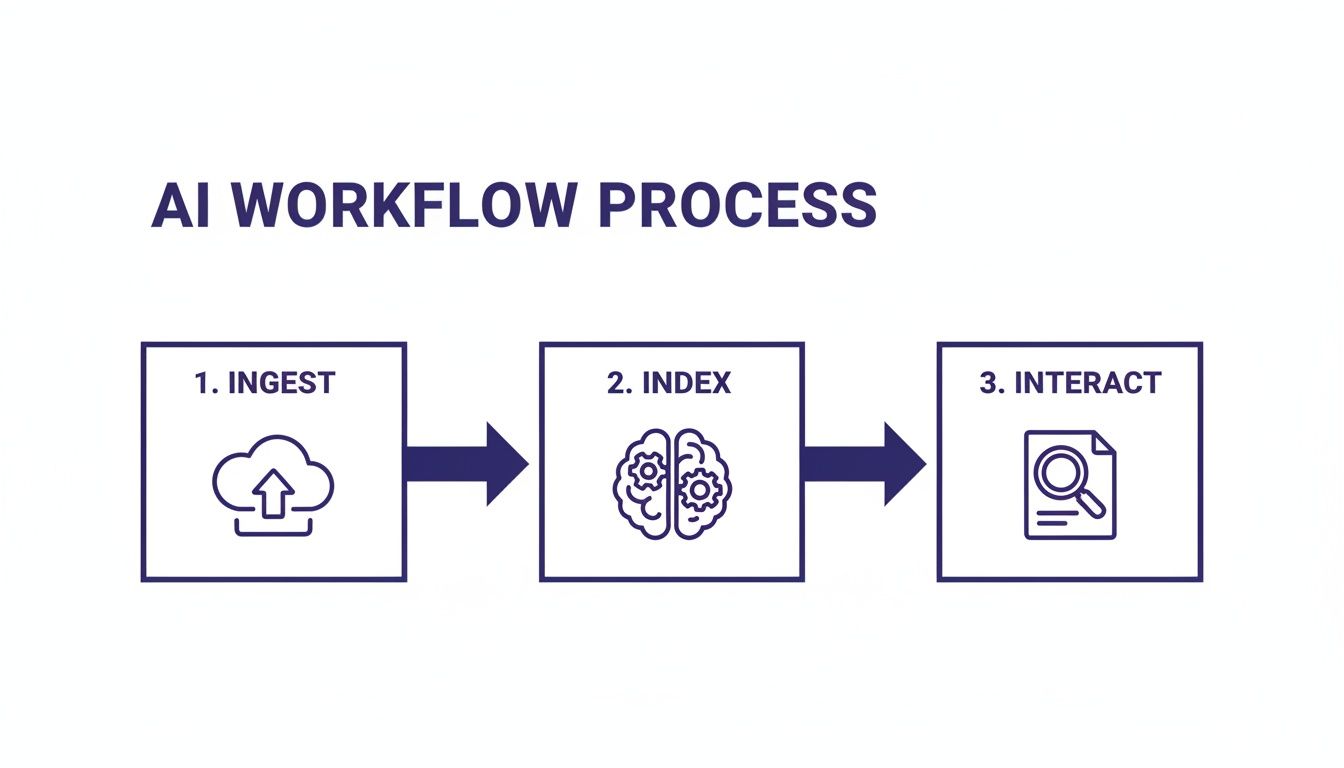
This process shows you exactly how your raw content gets systematically turned into a searchable, interactive knowledge base you can actually use.
It's time to stop letting your content history sit idle. With the right workflow, your archive becomes an engine for discovery, helping you spot successful patterns and find hidden gems for your next project.
Beyond just making your own work better, this use of AI is part of a much bigger shift. When you adopt these tools, you’re turning your library into a strategic business asset. This is a huge trend, explored in discussions about AI's transformative impact on the jobs economy and future of work, which makes it clear that getting a handle on these systems is essential for staying ahead.
Your past work is a treasure trove of potential. By putting an AI document analysis workflow in place, you’re not just getting organized. You’re building a foundation for sustainable growth and creativity that never runs dry. It’s time to take control of your library and start using it to fuel your future.
Frequently Asked Questions
When you're a creator, marketer, or publisher, your time is everything. So, when a new tool like AI document analysis comes along, it’s natural to have a few questions. We get it. Here are some straightforward answers to the things people ask us most.
How Accurate Is AI Analysis for Transcripts?
It's surprisingly good, especially when you feed it clean transcripts from a quality service. But the real magic isn't about the AI catching every single word perfectly—no system is 100% flawless.
The true win is the AI's knack for understanding context. It lets you search for ideas, not just exact keywords. So, you can find every clip where you discussed "early-stage growth," even if your guests called it "seed funding," "initial traction," or "finding product-market fit."
It’s less about word-for-word perfection and more about the AI’s ability to grasp the meaning behind the words. That’s how it connects related ideas across your entire content library.
Is My Content Secure on an AI Platform?
Yes, it has to be. Any serious platform in this space, including Contesimal, treats security as a non-negotiable. This means using things like end-to-end encryption and having strict privacy policies in place to shield your work.
Your content—the transcripts, the videos, the research—is your intellectual property, period. While you should always glance at a platform's specific security docs, the standard is clear: your creative assets are kept confidential and protected.
Can AI Analyze Content in Different Languages?
Absolutely. Most of the powerful AI tools today are multilingual right out of the box. The Natural Language Processing (NLP) models that drive them have been trained on a massive amount of global text, so they can process and make sense of content in many different languages.
This is a game-changer for anyone with an international audience or a library filled with content from around the world. It lets you bring all your assets into one searchable system, knocking down language barriers and making your whole archive useful.
Ready to stop letting your content history sit idle and start using it to fuel your future success? With Contesimal, you can organize, understand, and take action on your content library. Reignite your past work and create infinite value today by visiting https://contesimal.ai.