
So, is an encyclopedia a primary source? Let's get right to it: An encyclopedia is almost never a primary source. The best way to think of it is as a helpful summary—an excellent starting point for your research, but not the raw evidence itself. It's a collection of facts gathered from other places.
Understanding the Hierarchy of Sources
For any creator—whether you're a YouTuber, podcaster, or professional writer—getting a handle on different source types is fundamental to building credibility. It’s what separates content that merely repeats information from work that offers genuinely authoritative insights. Using the right sources is how you build trust and reignite your content library.
Information flows from an original event down to a summary, and this hierarchy helps visualize that path.
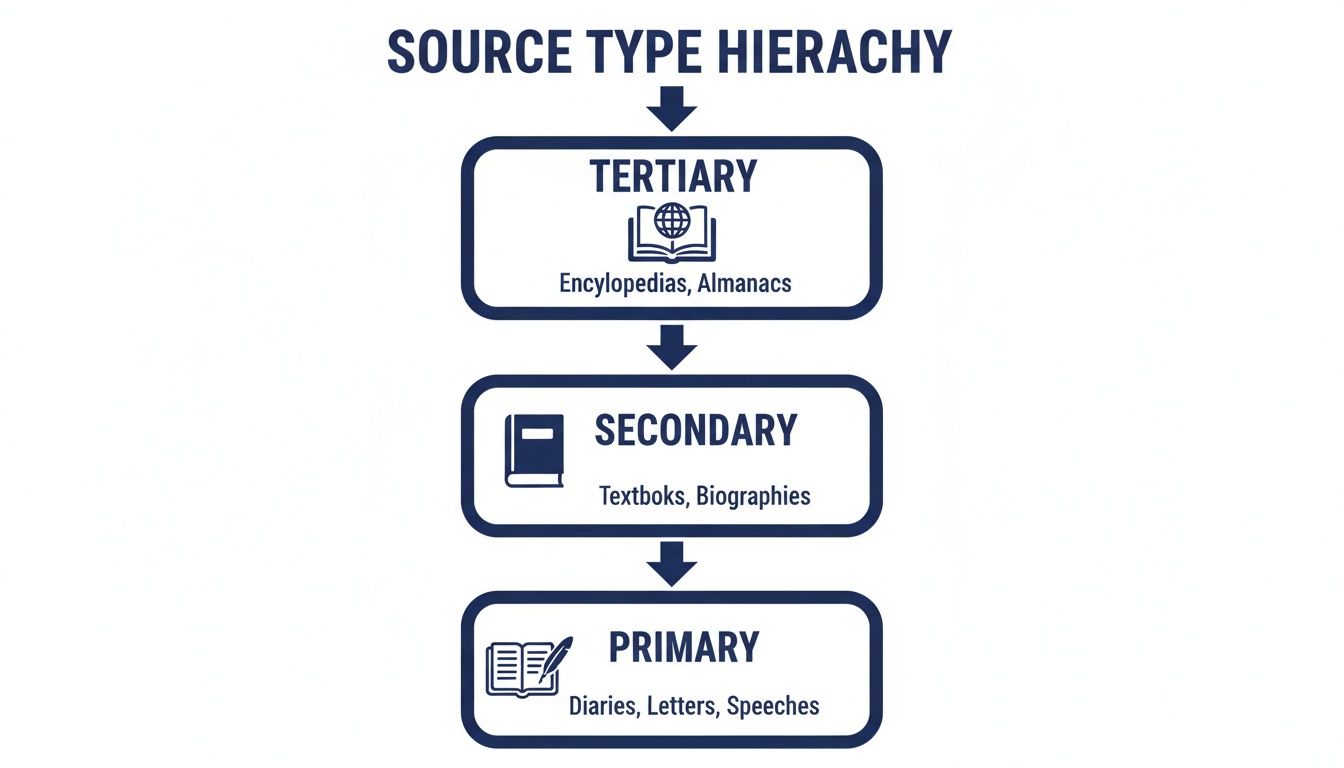
As you can see, sources like encyclopedias are the furthest removed from the original event. They build on the analysis that secondary sources provide, putting them at the top of the information food chain.
Primary vs. Secondary vs. Tertiary Sources at a Glance
To make this crystal clear, it helps to see the three main types of sources side-by-side. Each plays a distinct role in the content creation process.
This table breaks down their definitions and provides a simple historical example to illustrate the difference.
| Source Type | Definition | Example for a History Topic |
|---|---|---|
| Primary | A firsthand account or direct evidence from the time of the event. | A soldier's diary from the Civil War. |
| Secondary | An analysis, interpretation, or summary of primary sources. | A historian's book about Civil War battle strategies. |
| Tertiary | A collection and summary of secondary (and sometimes primary) sources. | An encyclopedia entry on the Battle of Gettysburg. |
As the table shows, a primary source is the raw material, a secondary source is the analysis, and a tertiary source is the general overview.
Encyclopedias are almost universally considered tertiary sources because their job is to compile and summarize information, not to present original, firsthand discoveries. One survey found that 87% of librarians specifically teach students to use encyclopedias as a starting point, not as a final piece of evidence, because of the heavy editorial and summarization involved.
If you're a creator trying to establish authority and generate more engagement, this distinction is everything. An encyclopedia is like a map for your research journey; it's fantastic for getting your bearings. But to create truly compelling content, you need to visit the destinations the map points to—the primary and secondary sources themselves.
Understanding Primary and Secondary Sources
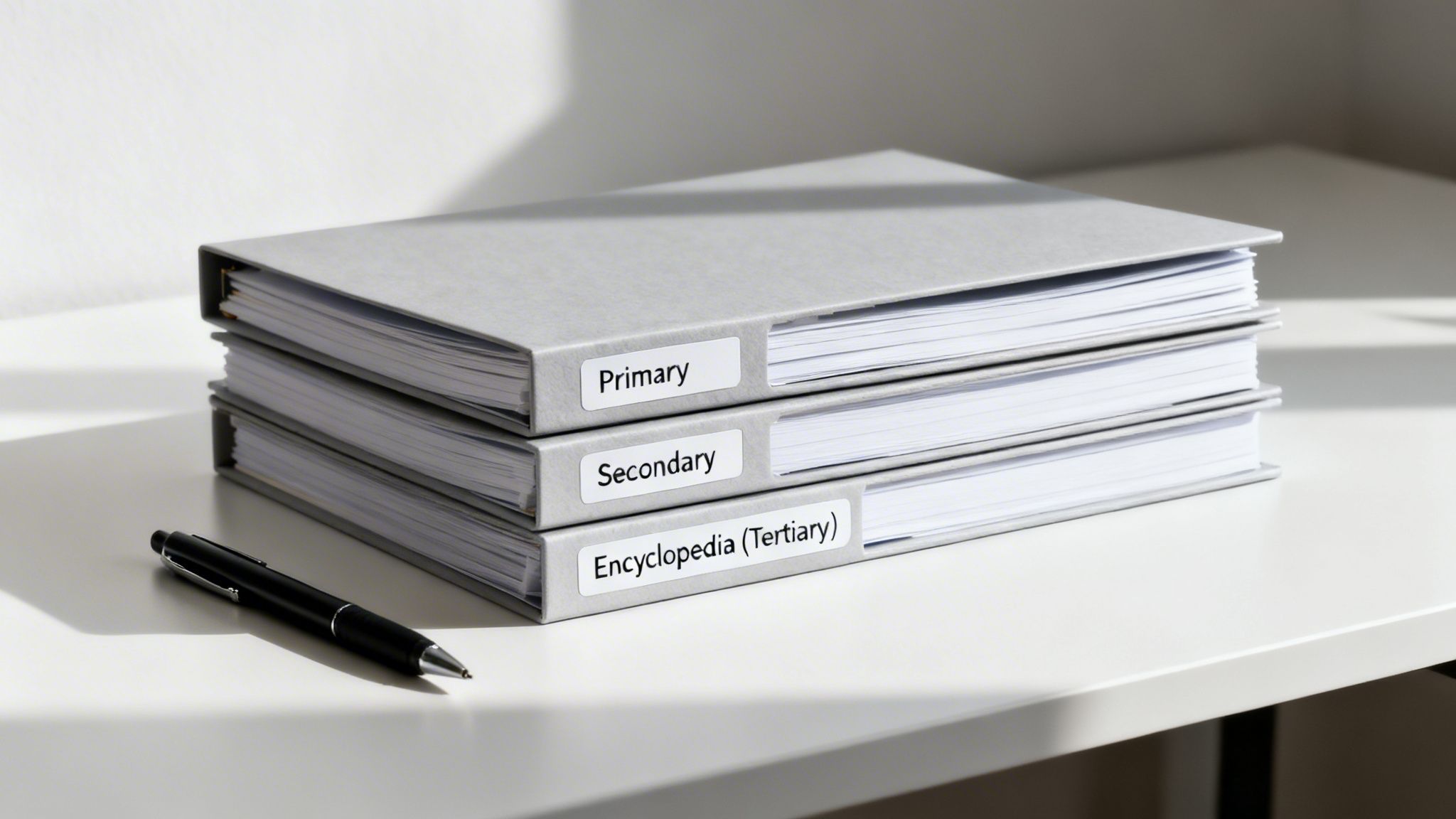
If you want to create content that stands out and earns trust, you have to get a handle on the difference between primary and secondary sources. Forget the dry, academic definitions. Let's break this down in a way that actually matters for creators, podcasters, and publishers transitioning from hobbyist to pro.
Think of a primary source as the raw material. It’s the original stuff, the direct evidence. This could be the unedited footage from your interview, a direct quote from a subject matter expert, or the raw data from a survey you just ran. It's the firsthand account, with no filter.
A secondary source, then, is what you build from that raw material. It’s your analysis, your interpretation, or your commentary that explains what the original material means.
What This Looks Like in Your Workflow
This distinction isn't just theory; it's the foundation of credible content. Here’s how it plays out in the real world for creators trying to grow the value of their content:
Primary Source: You find a fascinating historical speech to use in your next video. That audio clip is the primary source—it's a direct record of the event.
Secondary Source: Your voiceover explaining the political climate at the time and why that speech was so important. That’s your analysis.
Primary Source: A spreadsheet with the raw viewer retention data from your last 10 videos.
Secondary Source: The article you publish titled, “What My Audience Data Taught Me About Storytelling.” You’re interpreting the data to find a new insight.
Getting this right is a big deal. While the simple answer to "is an encyclopedia a primary source?" is almost always "no," understanding why it isn't is what separates amateur content from professional work.
The Bottom Line: Primary sources are your evidence. They show your work. Secondary sources are your analysis. They show your expertise.
For any creator trying to build an authoritative voice, leaning on primary sources is one of the most powerful moves you can make. It shows your audience the evidence directly instead of just asking them to take your word for it. This builds a much deeper layer of trust and proves you've done the research, immediately setting your work apart.
Why Encyclopedias Are Expert Summaries, Not Original Evidence
So, where do encyclopedias fit into the research puzzle? We generally label them as tertiary sources, and it all comes down to their core mission: to summarize.
Think of an encyclopedia as a "greatest hits" album of human knowledge. It’s not the raw, original studio recording (a primary source) or even the full-length album where an artist explores a theme (a secondary source). Instead, it’s a carefully curated collection of highlights, distilled for easy access.
The people writing encyclopedia entries aren't giving their firsthand accounts. They are expert summarizers, sifting through mountains of primary and secondary material to give you a reliable, high-level overview. This massive filtering process is exactly what defines a tertiary source.
The Launchpad for Deeper Content
This bird's-eye view is fantastic for getting your bearings on a topic. When you're brainstorming your next video or blog post, an encyclopedia gives you the essential "who, what, when, and where" to get started. But for any creator trying to build authority, it's only the first step. The real meat of your content—the compelling details and original perspectives—lies deeper.
Consider the encyclopedia your research launchpad, not the final destination. It gives you the map, but the real treasure is found in the primary and secondary sources it points to.
This isn't a new concept. The role of encyclopedias as knowledge aggregators has been consistent for centuries. Denis Diderot's famous Encyclopédie (1751-1772) was a monumental effort, with 72,000 entries and over 25 million words. Yet it was built by summarizing existing knowledge about French law, science, and philosophy, not by conducting new experiments or interviews.
That tradition holds. Modern library reports show that over 91% of institutions classify encyclopedias as tertiary tools meant for initial exploration, not for building a thesis from scratch. If you'd like to dig deeper, you can find more insights on the role of encyclopedias in research.
For YouTubers, bloggers, and storytellers, this means using an encyclopedia to identify the key players, dates, and ideas. Then, you take that information and hunt down the original interviews, scientific studies, or historical documents. That's where you'll find the unique material that makes your content pop and helps you hit on that next viral concept.
When an Encyclopedia Becomes a Primary Source
Alright, so we've established that encyclopedias are usually reference tools, sitting firmly in the secondary or tertiary source camp. But now for the fascinating exception. An encyclopedia can be a primary source, but only when you shift your focus.
This happens when the encyclopedia itself becomes the object of your study. You're no longer using it to get facts about, say, the solar system. Instead, you're analyzing the entry about the solar system to understand what people in a certain time period knew or believed.
Think of it like this: if you read a 1950s Britannica entry on "computers," you're not getting accurate information about modern computing. What you are getting is a direct, unfiltered look at how people understood this new technology back then. The entry itself—with its clunky terminology and wild predictions—becomes your raw data.
Studying the Source Itself
When you do this, you're essentially treating the encyclopedia as a historical artifact. You’re not just a researcher; you're a detective examining a time capsule. This opens up some incredible angles for your content:
- Cultural Shifts: Compare entries on "family" or "work" from a 1960s edition to one from the 2000s. The differences in tone and content offer direct evidence of changing social norms.
- Scientific Evolution: An entry on "genetics" from before the discovery of the double helix is a snapshot of scientific understanding frozen in time.
- Evolving Language: Track how descriptions of race, gender, or mental health have changed. The outdated language isn't just "wrong"—it's proof of a different worldview.
For creators, this is an absolute goldmine. You can build an entire video, podcast episode, or article around a single, outdated encyclopedia entry. It serves as direct, tangible proof of just how much our understanding of the world has changed.
This is the whole secret. You’re not looking at what the encyclopedia says, but how it says it, when it said it, and what that reveals about the moment it was published.
The table below breaks down this distinction.
Using an Encyclopedia as a Primary vs Tertiary Source
| Research Goal | How the Encyclopedia is Used | Source Type |
|---|---|---|
| Find a quick, reliable summary of the French Revolution for a video. | Look up the entry for "French Revolution" to get key dates, figures, and an overview of events. | Tertiary |
| Understand how the perception of Marie Antoinette changed in the 20th century for a podcast series. | Compare the 1920, 1960, and 1990 encyclopedia entries about her to analyze the evolving narrative. | Primary |
| Get background information on the key scientists of the Enlightenment to plan a blog series. | Use it as a starting point to identify names and their major contributions before moving to deeper sources. | Tertiary |
| Analyze how much the general public knew about atomic energy in the 1950s for a documentary. | Study the "Atomic Energy" entry from an encyclopedia published in 1955. | Primary |
Ultimately, context is everything. An encyclopedia can be a simple reference book one moment and a profound historical document the next—it all depends on the questions you're asking.
How to Use Encyclopedias for Smarter Content Creation
Alright, we’ve sorted out the theory. But how does this all translate into better content? For professional creators, podcasters, and publishers, the trick is to see encyclopedias as a launchpad, not a landing strip.
When you’re staring down a completely new topic, an encyclopedia is your best first stop. It gives you a reliable, 30,000-foot view of the landscape before you get lost in the details.
Building Your Content Map
Think of an encyclopedia entry as a trusted map for your content journey. Before you dive deep into unfamiliar territory, it gives you the lay of the land so you can organize, understand, and take action.
Use it to knock out three crucial first steps:
- Get a quick overview: In just a few minutes, you can grasp the general scope of a subject.
- Identify key elements: Pinpoint the names, dates, events, and essential terms you absolutely can't miss.
- Find foundational keywords: Uncover the core phrases people use to talk about the topic—a fantastic starting point for your SEO strategy and figuring out how to generate more audience across platforms.
Once you have this map, you can start hunting for the real treasure. If an entry on a historic battle mentions a key general, your next step is to find their personal letters. If an entry on a scientific breakthrough references a groundbreaking study, your job is to track down that original paper.
The encyclopedia gives you the "what." Your job as a creator is to find the "how" and "why" in the primary and secondary sources it points to. This is how you move from summarizing information to providing real, authoritative insight that captures an audience.
Turning Your Library into an Asset
This is where things get really fun. Many experienced creators have a personal goldmine they're not even using: their own library of past interviews, research notes, video clips, and published articles. The challenge is connecting your new research "map" to the assets you already have to create new value.
You might discover that the perfect primary source for your new project is a quote from an interview you conducted 2 years ago.
This is exactly what a content intelligence tool like Contesimal is for. It lets you organize your entire content archive, making it instantly searchable. Instead of starting from scratch, you can immediately locate that specific interview clip, piece of raw data, or expert quote that will make your new project shine. It helps you upcycle your old content and create infinite value.
By using an encyclopedia to get your bearings and a smart system to search your own archives, you create a seamless process. You can guide your audience from a general understanding to a deep, unique insight built on your own original evidence. That's the kind of content that builds true authority and keeps people coming back for more.
Frequently Asked Questions About Source Types
Even with a clear understanding of source types, some tricky situations always seem to pop up. Let's walk through a few of the most common questions creators and researchers run into.
Are Digital Encyclopedias Like Wikipedia Primary Sources?
Definitely not. In fact, digital encyclopedias like Wikipedia are classic tertiary sources.
Their entire purpose is to collect and summarize information from other places. Wikipedia even has a core policy called "No original research," which means every claim must be backed up by a separate, citable source. The encyclopedia article itself is just the summary.
This makes it a fantastic starting point for your content repurposing efforts, but never the final destination for evidence.
How Should I Cite an Encyclopedia in My Content?
If you're just pulling a simple background fact, it's fine to cite the encyclopedia entry you used. But if you want to build real authority, you need to go one level deeper.
The best move is to treat the encyclopedia as a roadmap. Scroll down to the "References" or "Footnotes" section and find the original study, book, or article the encyclopedia entry is based on. Citing that original source gives your work far more credibility.
Pro Tip: The footnotes section of an encyclopedia entry is a goldmine. It's often the fastest way to discover the high-quality primary and secondary sources that will make your content truly authoritative.
Can an Encyclopedia Entry by an Expert Be a Primary Source?
This is where the nuance really matters. Let’s say a Nobel Prize-winning physicist writes a Wikipedia article about one of her own discoveries. Is that a primary source?
The answer is still no. The format and purpose of an encyclopedia require the expert to summarize existing knowledge for a general audience, not to introduce new findings. In this context, she is acting as a teacher, not a researcher presenting new data.
If she were publishing a groundbreaking new theory, she would do it in a peer-reviewed journal or at a scientific conference. The platform and its purpose—to summarize, not to reveal—are what define the source type.
So, when you ask "is an encyclopedia a primary source?", the answer really depends on what you're trying to achieve. It's an incredible tool for getting your bearings, but the real magic begins when you use it to unearth the original evidence that makes your work shine.
Ready to unlock the hidden value in your content library? Contesimal helps you organize, search, and repurpose your past work to create new, authoritative content with ease. Discover how you can turn your archives into your greatest asset.