
You know the interview exists. Your guest explained creator burnout perfectly, and that answer would make a useful newsletter, a short video, and the opening of a paid workshop. But the recording's buried under an episode title nobody remembers, the transcript lives somewhere else, and searching burnout returns everything except the clip you need.
So you open a blank document. Again. Your next content opportunity isn't necessarily another recording session. It might be a better way to retrieve what you already own.
Why a Library Needs a Taxonomy Content Strategy
A taxonomy content strategy defines the preferred terms, relationships, and tagging rules that let people and machines retrieve an asset for a new purpose. It's not a folder tree named after your teams. Your audience searches for pricing advice, not Marketing Department Final Assets.
Say you're building a video about becoming a professional podcaster. Useful material might sit inside an interview, a blog post, and an unpublished script. Consistent subject labels connect those assets even when their titles and formats don't match.
Classification is discovery infrastructure
Structured data expresses a related discipline publicly: standardized fields describe attributes and entities, including people, books, and companies. In cases documented by Google Search Central, Rotten Tomatoes marked up 100,000 unique pages and reported 25% higher click-through rates for enhanced pages, while Nestlé measured 82% higher click-through rates for rich-result pages compared with non-rich-result pages.
Those are public-search results, not promised improvements for your private archive. The useful connection is the mechanism: search systems need consistent descriptions to interpret content. Inside your library, those descriptions help an editor retrieve the right interview instead of commissioning its accidental replacement.
The relationship between organization and reuse looks like this:
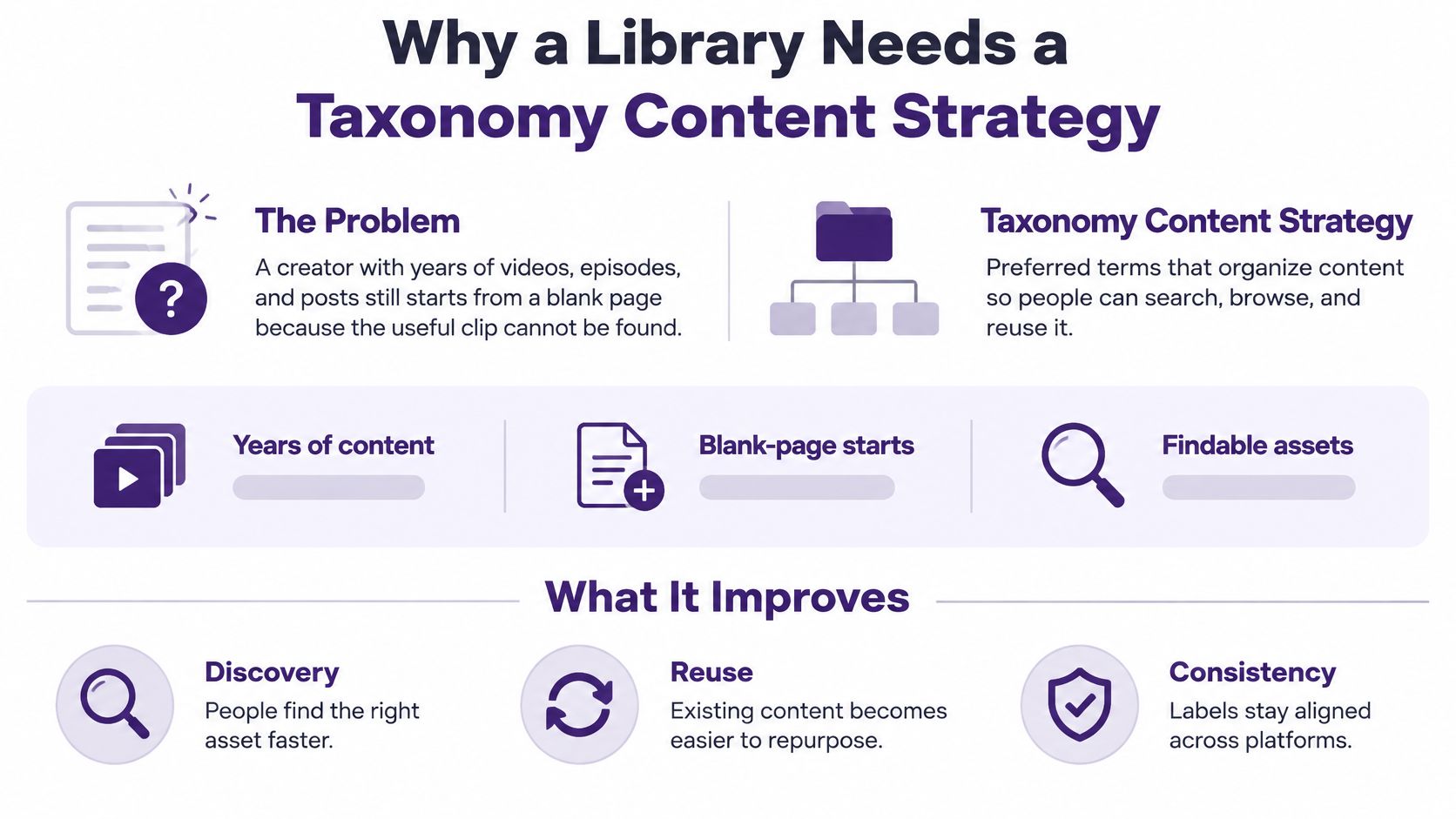
Build for retrieval, not tidiness
For a complementary support-library perspective, consult the knowledge base best practices from AgentStack. Use the same practical lens on your creative archive: can someone who didn't create an asset still find and understand it?
Practical rule: A neatly tagged library isn't finished until someone can retrieve useful material without asking its original creator.
A workable system has clear components:
- Six facets: Subject, format, audience, intent, lifecycle, and rights.
- Six build moves: Define purpose, inventory content, derive concepts, specify terms, separate facets, and assign governance.
- Pass marks: Independent classification and realistic retrieval tasks, not approval by committee.
- An AI label rule: Generated labels remain drafts until their risk and retrieval checks are satisfied.
That's how an archive becomes working editorial infrastructure rather than a very organized attic.
Six Facets Every Asset Should Carry
| Facet | Question it answers | Example labels | Do not merge with |
|---|---|---|---|
| Subject | What is this about? | Sleep science; creator burnout; named series | Format |
| Format | What kind of file is it? | YouTube video; podcast audio; transcript; blog; script | Subject |
| Audience | Who is it for? | New creators; editors; subscribers; researchers | Internal team name |
| Intent | What job does it do? | Teach; entertain; pitch; archive; update | Subject |
| Lifecycle | How current is it? | Evergreen; seasonal; breaking; needs refresh; retired | Rights |
| Rights | What may we do with it? | Owned; licensed; guest; sensitive; do not republish | Audience |
Copy these rows before tagging anything. Six facets for a mixed content library give you separate questions to answer, rather than a single category that tries to describe everything.
Subject captures the idea a fan would search for. Sleep science, creator burnout, and a named editorial series belong here. Avoid turning every passing mention into a subject tag; apply it when the asset meaningfully addresses the concept.
Format describes the container, including podcast audio, transcript, blog, newsletter, or script. A transcript and its recording should remain connected records, not interchangeable files. Treat vlog as an alternate label for YouTube video only when your library uses those terms interchangeably; otherwise, define the distinction.
Keep purpose separate from permission
Audience describes whom the piece serves, such as hobbyists turning professional or magazine editors. It doesn't identify who produced it. An editorial team can create material for researchers without making Editorial the audience.
Intent identifies the job: teach, entertain, pitch, archive, or update. Subject and intent aren't substitutes. Material about sponsorship might teach negotiation, entertain with a cautionary story, or pitch a service.
Lifecycle describes editorial currency. Evergreen doesn't mean permanently accurate, and seasonal doesn't mean unusable outside its original publication window. Use needs refresh when someone must verify or revise the material before reuse.
Rights records reuse constraints. Owned, licensed, guest, sensitive, and do not republish are operational labels, not automatic legal conclusions. Link them to the relevant permission record or review decision, especially when ownership doesn't settle every embedded image, quotation, or guest contribution.
Work one asset across the grid
Say a hypothetical interview recorded in 2024 explores creator burnout. Its subject is creator burnout; its formats are podcast audio and transcript; its audience is hobbyists going professional; its intent is teach; its lifecycle is evergreen after review; and its rights status is owned if the supporting permissions confirm that.
Don't collapse that into Creator Burnout Podcasts for Beginners. Nobody will apply that compound label consistently, and it won't help when you need all burnout material regardless of format.
Try a working exercise with 20 existing assets, filling every facet where you have evidence. Leave an uncertain cell blank rather than inventing another dimension or guessing permission.
For packaging ideas, Genesize's guide to turn existing content into paid products offers a useful companion. Your grid should establish which material is relevant, current, and reusable before you choose the product.
How to Design the Taxonomy Before You Tag
Start with the retrieval job, not a brainstorming session for category names. The purpose-led, iterative approach described in the taxonomy-development methodology published in Business & Information Systems Engineering combines conceptual and empirical work rather than treating the first hierarchy as final.
Make the vocabulary usable
Write the meta-characteristic. This is the organizing principle derived from the user's need and your business objective. For example: help a podcaster find reusable explanations and clips for audience-building posts and a paid compilation. That sentence prevents scope creep into cataloging details nobody needs.
Inventory representative content. Build a working sample across video, audio, posts, and documents, including weak, outdated, and awkward-to-classify pieces. For a practical pilot, use the same 100–200-item sample assigned to classification testing below. Sampling only your hits hides the edge cases that will make bulk tagging expensive to repair.
Derive concepts from both directions. Work deductively from editorial goals, then inductively from titles, comments, search logs, and existing labels. If your strategy says creator sustainability but your audience searches for burnout, record that language rather than correcting your audience into silence.
Define each concept. Give it a preferred term, synonyms, broader and narrower relationships, a scope note, and an application rule. For creator burnout, specify whether ordinary production fatigue qualifies and when a passing mention doesn't. This prevents different editors from attaching different meanings to an identical tag.
Assign every term to a facet. An asset can carry several relevant labels without living in one exclusive branch. Use different types of taxonomies deliberately: a subject hierarchy can support broader and narrower concepts, while facets let an editor combine subject, audience, and lifecycle filters. Don't force those jobs into the same tree.
Name the owner and publish a version. Record deprecated terms with redirects to their replacements, and review frequently proposed concepts. Otherwise, an editor's quick workaround becomes everyone else's permanent cleanup task.
The design cycle is easier to manage when each decision has a clear purpose:
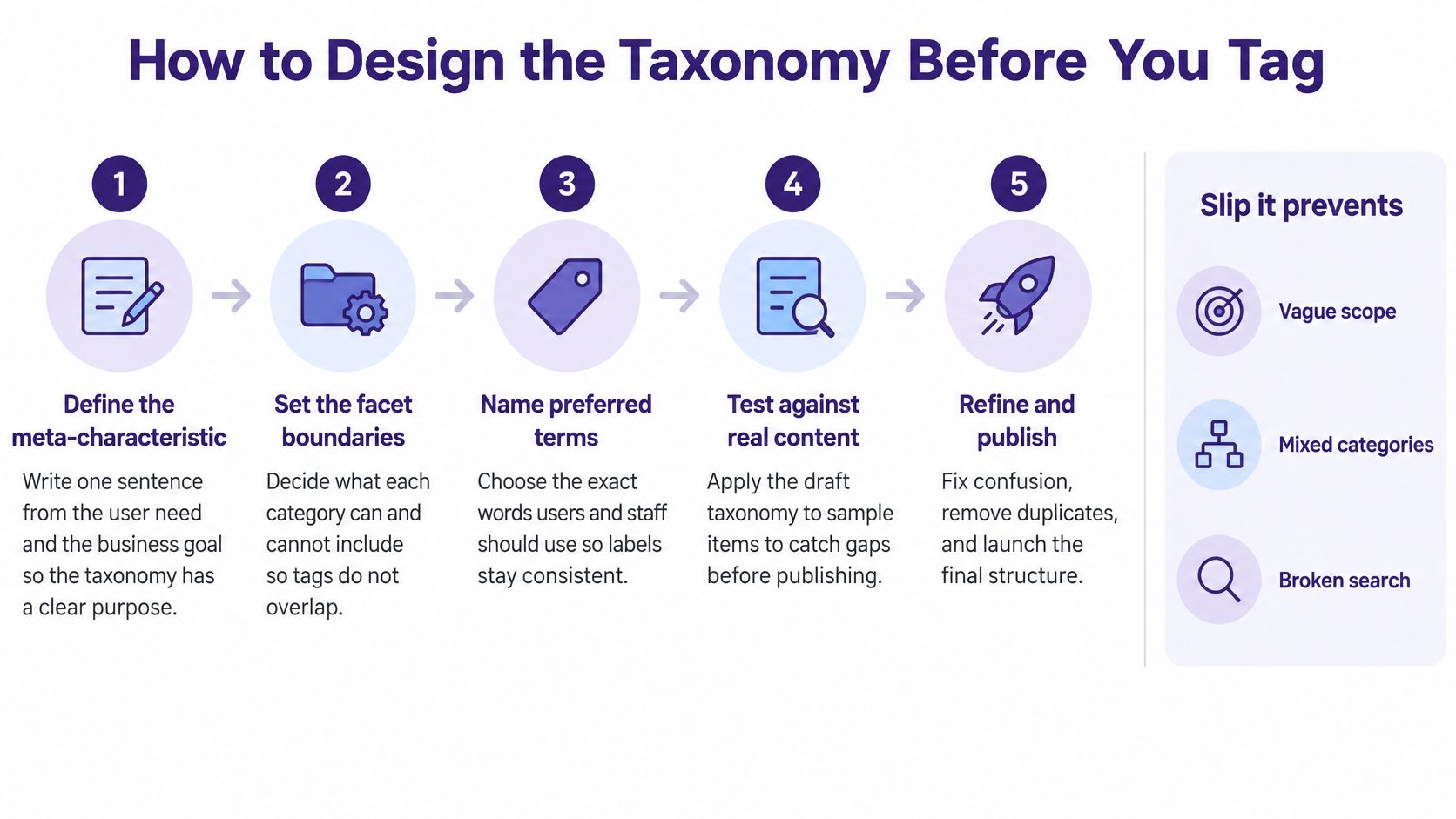
Govern the words, not the org chart
Department names make convenient administrative folders but poor primary discovery categories. A filmmaker looking for interview material about grief shouldn't need to know which production unit commissioned it.
Check candidate terms with the people doing the retrieval. Ask what they'd type, what they'd expect beneath a label, and which neighboring category feels confusing. Keep their language when it's precise enough; add a scope note when it isn't.
Your vocabulary file can start as a shared spreadsheet. Give each concept a stable identifier so renaming its display label doesn't break existing assignments, and keep the change history alongside it.
Finish with a governance card:
- Owner: Name the person who approves vocabulary changes.
- Vocabulary location: Record the shared file or repository everyone must use.
- Review cadence: Set a recurring review for high-volume proposals.
- Decision record: Mark each proposal as a new concept, an existing synonym, or a rejection with a reason.
Tests That Show the Taxonomy Actually Works
Stakeholder consensus isn't a launch signal. People can agree that a menu looks sensible while assigning the same episode to incompatible categories.
Start with independent classification. Give annotators the same mixed-content sample and have them assign the primary subject category without consulting one another. Compare their decisions before discussing disagreements, otherwise you're measuring persuasion rather than clarity.
The Knowledge Management Handbook's organization guidance supplies practical benchmarks of 100–200 items and above 85% primary-category agreement, plus 5–10 users, above 80% task success, and under two minutes per task for scenario testing; it also suggests approximately 20–30 participants for tree testing.
Pass marks before you scale tagging
| Test | Sample | Pass mark | A miss usually means |
|---|---|---|---|
| Independent classification | 100–200 items, more than one annotator | Above 85 percent agreement on the primary category | Ambiguous scope notes or overlapping categories |
| Task-based findability | 5–10 representative users | Above 80 percent success and under two minutes per task | Labels do not match real tasks |
| Tree test | About 20–30 participants | Diagnosis of hierarchy levels, not a single score | Structure is too deep or mixes dimensions |
| Card sort | Run early with real users | No pass mark; discovery only | Reveals mental models and label language, not launch proof |
Treat those as working benchmarks, not universal certification. A small, specialized archive and a broad publisher's library won't have identical retrieval problems.
When annotators split, inspect the actual asset and its scope notes. Perhaps creator income overlaps ambiguously with sponsorship, or someone has placed podcast beside business strategy at the same hierarchy level. Fix the definition, examples, or facet boundary before asking an automated classifier to reproduce the confusion.
Test the task, not the label
Give users a realistic assignment: find a reusable explanation of sponsorship pricing suitable for new podcasters. Record success, elapsed time, wrong paths, and confidence. Don't coach them toward the category you intended.
Test browsing and natural-language search separately. Segment results for podcasters, publishers, researchers, and marketers instead of letting a strong result for one audience conceal failure for another.
Card sorting belongs earlier, when you're learning how users group ideas. Tree testing diagnoses the proposed hierarchy without the distractions of page design.
An editor's confident wrong answer deserves attention. It can lead to unsuitable material being reused without anyone noticing the retrieval failure.
Watch for deep trees, cute internal jargon, and levels that mix topic with format. I would challenge a hierarchy once it stretches beyond three or four levels, rather than making users keep drilling.
Make a concrete decision: pass when classification and retrieval work, revise when failures have identifiable fixes, or stop bulk tagging when the structure still produces inconsistent answers.
How to Check AI Labels Before You Publish
More metadata isn't automatically better discovery. A 2025 experimental study of AI-generated metadata compared Gemini, Gemini Advanced, and ChatGPT-4 across Dublin Core, MODS, MARC, and BIBFRAME and found that completeness varied while accuracy remained low. The researchers concluded that human metadata specialists couldn't yet be removed without harming discovery, although generated output could serve as a draft.
Make review a visible editorial task, not an invisible assumption:

Separate enrichment from consequential judgments
Low-risk enrichment can include proposed topics, entities, and formats. Sample these fields after an initial review period, but escalate ambiguous identities or potentially harmful associations rather than treating every topic as harmless.
High-risk fields include rights, sensitivity, factual claims, audience suitability, and editorial meaning. A model can suggest a value, but a person must sign it off before it controls publication or reuse. Mentioning a guest doesn't establish permission to resell their contribution.
I recommend this starting review policy, not as a research-established threshold but as an operational choice:
- Initial batch: Review every proposed label on the first 200 items.
- Ongoing intake: Review about 10% of new uploads, plus every high-risk field.
- Escalation: Expand review when a format, subject area, or model change introduces recurring errors.
- Confidence gate: Calibrate any automation threshold against reviewed examples, not the model's self-reported certainty.
The right balance among rules, statistical classifiers, and generative tools depends on the material. Compare document classification methods before deciding which fields need generation at all.
For a related video resource, use the player below alongside your review checklist:
Preserve provenance and measure retrieval
Track precision, the share of proposed labels reviewers consider correct, and recall, the share of relevant labels the system successfully identifies against a reviewed reference set. Also track duplicate-label rate and searches that return nothing. High precision with poor recall can leave valuable material effectively missing.
Store the model name, version, generation date, source asset, and approval status with the annotation. When a curator's approved tag conflicts with a model proposal, preserve the human tag while a reviewer resolves the disagreement. Don't overwrite reviewed work because a newer model sounds more certain.
Release gate: A draft label becomes approved through review evidence, not through confident wording.
Publish, syndicate, or feed labels into retrieval only after sampled disagreements are resolved and tests show that relevant queries retrieve appropriate material. Watch whether empty searches for those terms decline, but inspect the returned assets too: replacing an empty result with a confidently irrelevant one isn't progress.
Turn Tags Into Offers Without a Second Vocabulary
Keep one vocabulary with several views. Don't maintain a human navigation system and a separate AI taxonomy that gradually assigns different meanings to the same material.
Give stable concepts durable identifiers. Attach audience, channel, dates, and provenance as layers, so an episode, its cut-down clip, and a newsletter excerpt remain connected to the same subject. Store chunk boundaries and source references for machine retrieval without inventing new subject labels for every extract.
Package the library around a buyer's need
The commercial reason to do this isn't theoretical. In the Reuters Institute's 2025 publisher survey, 77% identified subscription or membership as a major revenue focus, 69% display advertising, and 59% native advertising; most relied on three or four revenue streams, including events at 48%, affiliate revenue at 29%, donations at 19%, and related businesses at 15%, while 44% named new products and services as a growth priority.
Those publisher priorities don't guarantee demand for your archive. They do make a useful case for treating existing assets as ingredients for distinct offers rather than assuming every recording has finished its job.
Consider these packages, without commissioning new reporting:
- Members compilation: Filter evergreen episodes by subject, confirm reuse permissions, and add an introduction that explains the collection's value.
- Sponsor series: Filter by audience and intent to assemble a coherent sequence. Keep sponsorship suitability separate from editorial endorsement.
- Posts and newsletters: Pull excerpts from subject-tagged transcripts, preserving the source connection and enough context to avoid changing the speaker's meaning.
A clear understanding of content monetization helps distinguish a reusable asset from an offer someone has a reason to buy.
Maintain the offer, not just the tags
Add a synonym when fans consistently search a nickname. Update lifecycle when a seasonal asset returns, and block model-generated near-duplicates before they enter a collection.
Measure reuse rate per tagged asset and sell-through per offer, using a consistent denominator for each product. Include editorial review and packaging effort when judging whether reuse pays.
A fully tagged library can still produce an unconvincing offer. The useful question isn't how many labels you generated, but whether your team assembled something relevant that an audience chose to use or purchase.
Start With One Connected Library This Week
Choose 50 items for a manageable week-one exercise: a growing playlist, a podcast season, or a cluster of posts that already earned attention. Apply the facets by hand, then ask a colleague who didn't design the labels to complete a findability task. Repair the failed terms before inviting a model to classify the rest.
Connect the archive to ongoing work
At Contesimal, you connect a YouTube channel, upload podcasts, or import document archives, and we build a thematic map with tags for themes, topics, and audiences. After organization, you can use AI agents to research the library, mix ideas, and turn insights into blogs, social posts, podcasts, and scripts.
You keep ownership of your content. We process it securely to build the searchable taxonomy and power our internal AI agents.
For distribution planning after editorial approval, iHatePosting's social media cross posting is a useful resource to consider separately from classification. Getting an asset onto another channel doesn't remove the need to check its context, permissions, and fit.
The done state is a usable library, not an ambitious tagging backlog.
Close the week with a concrete checklist:
- Labeled: Your chosen 50 items have reviewed facet values.
- Repaired: At least one failed term has a clearer name, synonym, or scope note.
- Connected: Your channel or archive is connected, with the same vocabulary rules ready for tomorrow's upload.
Contesimal helps you organize an existing content library, research it with AI agents, and turn historical material into new formats. Visit Contesimal to connect your channel or archive and start building a searchable taxonomy your team can review, trust, and put to work.