
Content monetization is the process of turning your creative work into sustainable income by packaging your value in different ways for your audience. It isn't one single payment method, and in one study of financial social media accounts, strategic content choices explained 46.20% of the variation in free-content sentiment decisions and 24.50% of paid-content sentiment decisions, which shows how central audience tiers and access design are to monetization.
You probably know the feeling. You publish a strong video, a sharp podcast episode, or a blog post you're proud of. It gets some traction, then the next upload takes over, and the work that took days or weeks slides into your archive.
That's the point where many creators start asking a more serious question. Not “How do I get more views?” but what is content monetization, really, and how do I build something that lasts?
The short answer is that monetization is how you stop treating content as a one-time performance and start treating it as a business asset. Your catalog, your audience trust, your point of view, and your expertise all have value. Monetization is the system that turns that value into income without stripping the creativity out of the work.
From Creative Passion to Sustainable Business
Most creators start by focusing on output. Make the video. Publish the episode. Finish the article. That's normal, and it's necessary. You can't monetize what you haven't made.
But after you've built a body of work, a shift has to happen. You move from value creation to value realization, the idea MIT Sloan uses to describe the moment when something useful or meaningful gets translated into direct revenue or lower costs through a monetization strategy in its explanation of value realization in monetization.
What monetization actually means
A lot of people hear “monetization” and think ads. That's too narrow.
Content monetization means structuring access and packaging value. Sometimes that looks like advertising around free content. Sometimes it means charging for deeper access, bundling your best work into a product, or creating a membership around a body of knowledge. The money follows the packaging.
Think of your content like a kitchen. Creating content is cooking. Monetization is deciding what gets served free as samples, what becomes the signature dish, what goes into the tasting menu, and what belongs in a paid class with the chef.
Practical rule: If people consistently get value from your work, there's a monetization path. The real question is which format fits your audience and your workflow.
Why this matters to creators with a library
If you've been publishing for a while, your backlog isn't dead weight. It's inventory. Your old episodes, articles, interviews, and scripts can become bundles, premium feeds, guides, courses, members-only archives, or licensing assets.
That's why it helps to study proven content monetization models before you chase random tactics. The strongest creators don't just ask how to make the next post perform. They ask how each piece adds to a larger revenue system.
A creator with a business mindset still cares about craft. They just stop relying on craft alone to pay the bills.
The Eight Primary Content Revenue Models
The easiest way to understand monetization is to stop thinking in terms of hacks and start thinking in terms of revenue models. Each model answers the same question in a different way: how does this content create income?
Here's the picture at a glance.
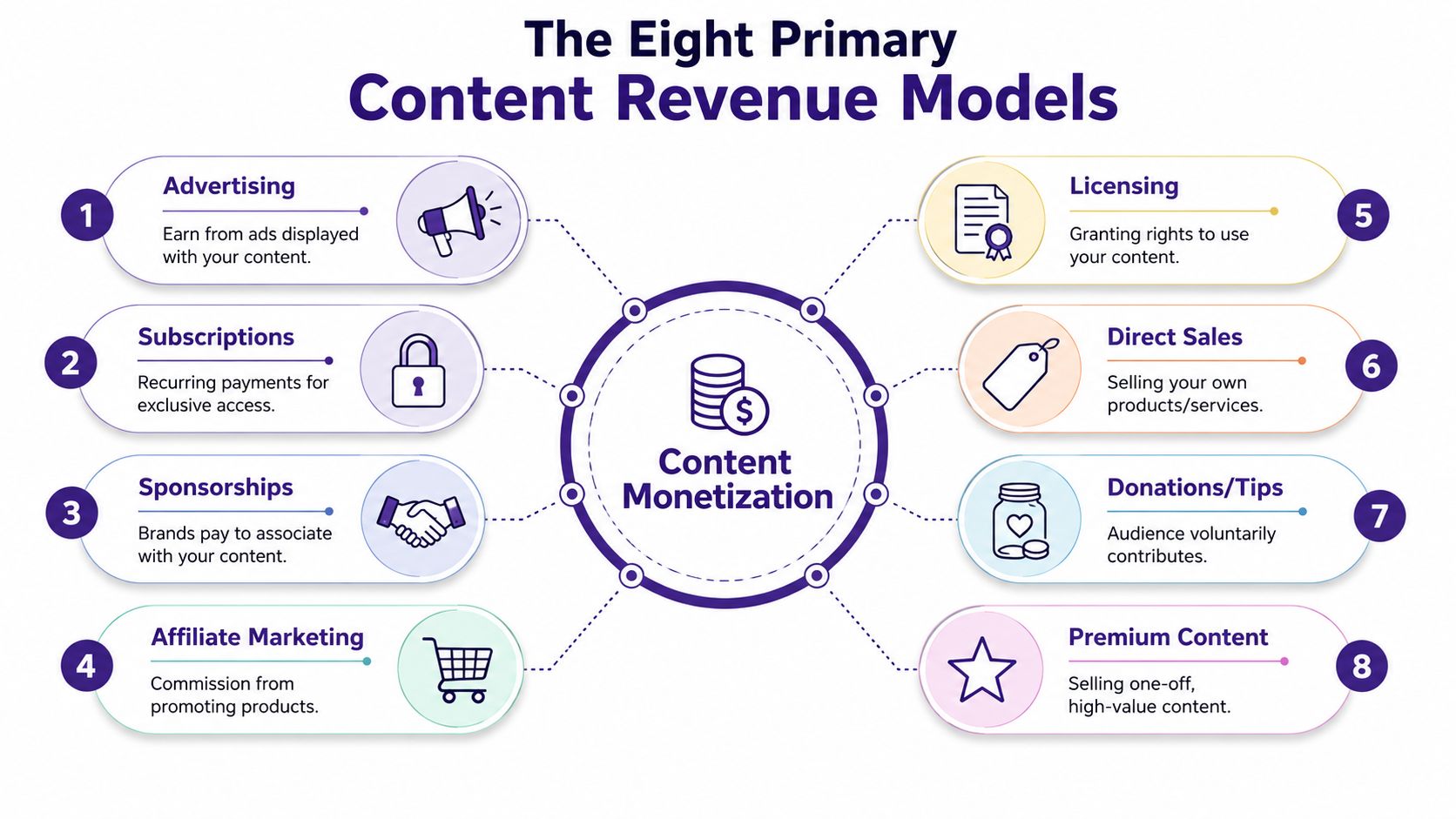
A useful way to simplify the options is to group them by who pays you.
Audience reach models
These models work best when your content attracts attention at scale.
| Model | How it works | Simple example |
|---|---|---|
| Advertising | You earn when ads appear with your content or performance triggers a platform payout. | A video creator earns from ads on long videos and short-form content. |
| Affiliate marketing | You earn a commission when someone buys through your recommendation. | A podcaster links to their microphone or editing tool in show notes. |
| Sponsorships | A brand pays to be associated with your content or audience. | A newsletter includes a paid sponsor segment. |
These models are often easier to start with because your audience doesn't need to pay you directly. The tradeoff is dependency. Ad rates change. Sponsor budgets shift. Affiliate programs get revised.
That's one reason the Yale ISP essay describes creator monetization as a mix of four revenue streams: brand deals, platform payouts, peer-funded income, and direct selling in its analysis of creator monetization structures. Mature creators combine channels instead of betting everything on one.
Fan-funded models
These models rely on trust, identity, and repeat value.
- Subscriptions let people pay on a recurring basis for access, community, bonus content, or a premium version of your work.
- Donations and tips give supporters a lightweight way to contribute without a full membership commitment.
- Micropayments charge small amounts for specific pieces, access moments, or interactions.
These work well when your audience feels connected to you, not just interested in a topic. A casual viewer may watch for free forever. A committed fan wants a closer circle.
When people pay directly, they're not just buying content. They're buying continuity, access, and trust.
Asset and product models
These treat content less like media and more like a product library.
- Licensing means someone pays for the right to use your content, excerpts, research, footage, or IP.
- Direct sales cover things like courses, templates, books, workshops, consulting, merchandise, or paid digital products built from your expertise.
- Premium content refers to one-off paid assets such as a deep guide, special report, archive bundle, or exclusive series.
A podcaster who wants a concrete example can look at this guide on making money with a podcast. The useful lesson isn't that podcasting has one revenue path. It's that one format can support several paths at once.
Why the best stacks are mixed
A creator who only runs ads has one kind of risk. A creator who only sells a membership has a different one. A creator who combines free reach, direct support, and owned products has options.
That's the main point of these eight models. They aren't eight separate identities. They're building blocks.
How to Choose Your Monetization Mix
You publish for months, maybe years. A few posts bring in affiliate sales. A sponsor reaches out. A handful of loyal followers ask whether you offer something paid. At that point, the hard part is rarely finding a monetization option. The hard part is choosing the right combination without turning your business into a pile of disconnected experiments.
That is why creators do better with a mix than with a single tactic. Your monetization setup works like a portfolio. One part brings in broad, lower-friction revenue. Another serves the people who want more depth. A third turns your expertise and archive into assets you own and can sell repeatedly.
The mix matters because monetization is still immature in many organizations. BARC's data monetization survey infographic shows that many teams are still early in building monetized products and services. For creators, that creates room. If you choose deliberately, you are not late. You are building in a field where many people are still improvising.

Start with your assets, not the tactic
Creators often start with the revenue model. Ads, sponsorships, memberships, courses. That sounds logical, but it usually leads to copycat decisions.
Start one layer earlier. Ask what assets you already have.
Your assets might include:
- a growing audience that trusts your recommendations
- a repeatable content format
- a backlog of posts, videos, or episodes on one topic
- a skill people already ask you to explain
- a niche reputation that brands or clients value
That shift changes everything. A monetization model is just a container. Your content library, audience trust, and expertise are the product underneath.
Use a stage-based framework
You do not need to launch four revenue streams at once. You need the next one that fits your current stage.
If you are still building reach
Choose models that are simple to add and easy to test.
- Affiliate offers fit when your content already helps people choose tools, products, or services.
- Platform payouts can add incremental income if your channel already qualifies.
- Lead generation for services works if people regularly ask for direct help.
At this stage, your goal is not maximum revenue. It is signal collection. You are learning what your audience clicks, buys, asks for, and ignores. A good content performance analysis process helps you spot those patterns before you build the wrong offer.
If you have strong trust and repeat engagement
Add models that reward closeness.
- Sponsorships work when your audience is clear enough that a brand can see the match.
- Memberships or subscriptions work when people want ongoing access, community, or extra material.
- Premium one-off products work when a specific problem keeps coming up and your content already answers parts of it.
Many creators often get stuck here. They assume payment follows audience size. In practice, payment often follows clarity. A small audience that knows exactly why it follows you can outperform a large audience with weak intent.
If you have a deep content library
Build around owned assets.
An archive is not old content sitting on a shelf. It is inventory. If you have twenty, fifty, or two hundred pieces on a topic, you already have raw material for bundles, courses, workshops, paid research, consulting packages, or licensing conversations.
| Signal you have | What it suggests |
|---|---|
| Strong archive on one topic | Bundle or premium library |
| Repeatable expertise | Course, workshop, or consulting offer |
| Distinct voice and niche credibility | Sponsorships or licensing conversations |
| Loyal returning audience | Membership or subscriber community |
This is the strategic shift many creators miss. New content builds attention. Your library builds margin.
Four filters that keep your mix practical
Before you add any revenue stream, run it through four filters.
Audience fit
Does your audience already show signs that they want this?Content fit
Does the model match how you naturally publish and teach?Operational fit
Can you maintain it consistently without creating a second full-time job?Brand fit
Will this strengthen trust after the transaction, not just before it?
A sponsorship that pays well but confuses your audience fails the test. A membership no one has time to run fails the test. A small digital product built from content you have already made may pass all four.
A strong monetization mix does more than create revenue. It turns your existing work into a set of assets that can keep producing value in different forms.
Grand View Research has projected strong growth for the broader data monetization market in the years ahead. Creators are not operating in that exact category, but the direction is still useful. Knowledge, access, archives, and specialized insight are becoming more commercially valuable. The creators who treat their libraries like assets, not leftovers, are in a stronger position to build income that lasts.
Measuring What Matters for Monetization
Views feel exciting. Downloads feel validating. Likes feel visible.
But none of those numbers, by themselves, tell you whether your content business is healthy.
The three metrics creators should understand
The most useful metrics for monetization are RPM, ARPU, and LTV. You don't need an MBA to use them. You need a notebook, a spreadsheet, and a willingness to look beyond vanity metrics.
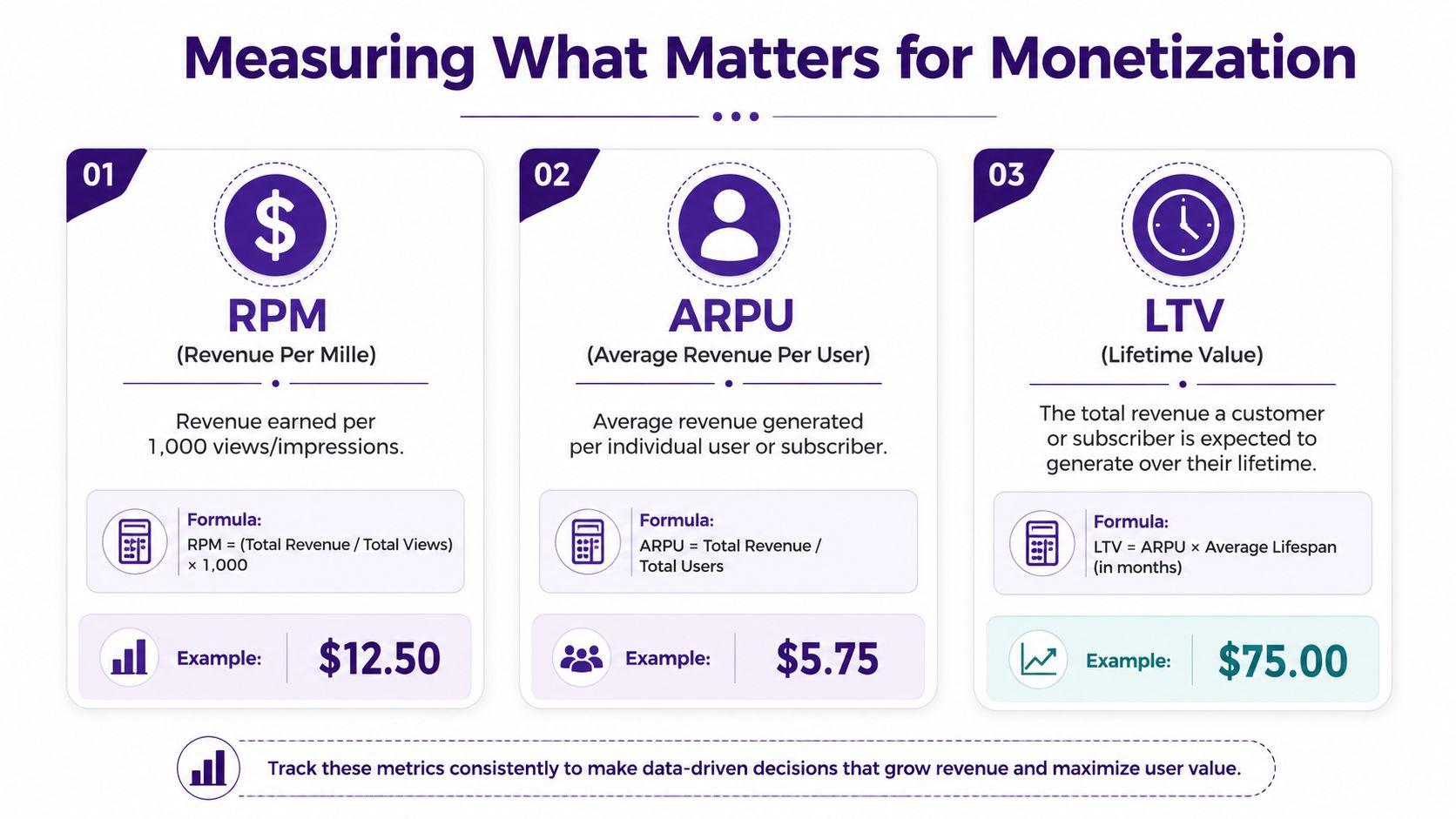
RPM
RPM means revenue per thousand views, listens, or impressions across your monetized activity.
For creators, the practical use is simple. It helps you compare content performance as a business outcome, not just as attention. A video with fewer views but stronger affiliate sales or subscription conversions may be more valuable than a viral clip that earned applause and little else.
ARPU
ARPU means average revenue per user.
This tells you, on average, what one audience member is worth over a period of time. That matters because not all audiences monetize equally. A smaller, focused audience can outperform a larger, less committed one.
LTV
LTV means lifetime value.
This is the total value a person brings over the full time they engage with your business. If someone discovers your free content, joins your membership, buys a workshop, and stays connected, their value is cumulative.
Why these beat vanity metrics
Think of views as foot traffic in a store. Useful, yes. But foot traffic alone doesn't tell you whether people buy, return, or refer others.
These metrics do.
- RPM helps you judge content efficiency
- ARPU helps you judge audience quality
- LTV helps you judge long-term business health
If you want a practical companion to this mindset, this guide on how to analyze content performance is a useful next read because it helps connect editorial decisions to measurable outcomes.
Don't ask only, “Did this piece perform?” Ask, “Did this piece strengthen the business?”
A simple creator dashboard
You don't need advanced software at first. Track these in a sheet:
- Content title and format
- Primary monetization path
- Revenue generated
- Views, listens, or opens
- Conversions to email, membership, or product
- Notes on audience quality
After a few months, patterns emerge. You'll notice which topics attract buyers, which formats drive trust, and which channels look loud but stay financially quiet.
That's when monetization starts feeling less mysterious.
Activating Your Content Library for New Revenue
The most overlooked revenue asset in content isn't the next thing you publish. It's the work you already made.
Creators often treat their archive like a storage closet. They know useful things are in there, but finding them takes too long, so they keep making new work instead. That habit creates the content treadmill. You run faster, but the back catalog sits still.

Taboola points to an important gap in its guide to content monetization and older content: creators need a way to systematically classify, search, and package archives so old content becomes useful for memberships, bundles, and premium access instead of disappearing into the feed.
A simple archive activation story
Take a podcaster with three years of interviews about creative careers. Each episode performed for a week or two, then faded. Individually, they were episodes. Collectively, they were a curriculum.
Once that creator grouped episodes by topic, the library changed shape. Interviews on pricing became one cluster. Episodes about pitching became another. Conversations on burnout, workflow, and client management formed their own tracks.
Suddenly, the archive could support several products:
- A paid private feed for freelancers
- A bundled audio course on creative business basics
- A searchable members archive organized by challenge
- A lead magnet series built from edited transcripts and clips
Nothing new had to be invented from scratch. The value was already there. It just hadn't been packaged.
The three-part method
Organize what you already have
Start with a working inventory. Not perfection. Just enough structure to see the shape of your catalog.
List your assets by format, topic, date, and audience intent. Tag what performs well, what stays evergreen, and what repeatedly answers the same questions.
Find knowledge clusters
A knowledge cluster is a group of pieces that become more useful together than alone.
An old blog post plus a webinar transcript plus a podcast segment might all support the same paid guide. A set of interviews might become a premium resource for one audience segment. When you cluster content, you stop seeing isolated files and start seeing products.
Package the cluster into access
Here's where monetization happens.
| Archive pattern | New monetization format |
|---|---|
| Repeated beginner education | Email course or paid starter guide |
| Deep niche expertise | Subscription library or premium membership |
| Strong interviews and commentary | Curated private feed or bundle |
| Research-heavy articles | Reports, briefings, or premium collections |
One option for teams doing this at scale is Contesimal's workflow for turning content libraries into new revenue and relationships. The practical relevance is straightforward: tools that help classify, search, and connect large archives make it easier to spot patterns that can be monetized.
Originality still matters
Resurfacing old work doesn't mean low-effort reposting. It means recontextualizing, curating, and packaging in a way that serves people now.
That's especially important on platforms that emphasize original or creator-involved content for eligibility. Old material can absolutely earn again. It just needs to be transformed into a product, a system, or a better access experience.
Your archive isn't a graveyard. It's a warehouse. Revenue starts when you label the shelves.
Common Pitfalls and How to Avoid Them
Most monetization mistakes don't happen because creators are lazy. They happen because revenue pressure makes people reactive.
A creator sees sponsorship money and says yes to a poor fit. Another leans too hard on one platform because payouts look good this month. Someone else launches a paid offer before their audience understands the value.
Pitfall one: monetizing too abruptly
If every post suddenly feels like a pitch, trust drops. Audiences can feel when the relationship changes from “I'm helping you” to “I'm extracting from you.”
A better approach is to ladder the ask.
- Start with relevance by tying offers to problems your audience already wants solved.
- Keep free value strong so paid offers feel like extension, not bait.
- Explain the difference between public content and premium access.
People rarely object to monetization itself. They object to misalignment.
Pitfall two: relying on a single platform
Platform income can look steady until the rules change.
Meta's 2024 Content Monetization beta merged in-stream ads, Reels ads, and the performance bonus into one program that pays for Reels, longer videos, photos, and text posts, with onboarding through the Professional dashboard or Meta Business Suite, according to Meta's overview of its streamlined content monetization program. The bigger lesson isn't just about Meta. It's that platforms increasingly reward cross-format engagement signals, and eligibility can change.
So protect yourself:
- Diversify revenue streams so one rule change doesn't wreck your month.
- Build owned channels like email lists, memberships, and direct products.
- Stay current on platform policy before you repurpose, repost, or automate content.
Pitfall three: underpricing or poorly packaging value
Creators often underprice because they compare their paid offer to free content online. That's the wrong comparison.
A paid product isn't just information. It's organized information, delivered in a useful order, with less friction for the buyer. Packaging creates value.
Pitfall four: skipping the boring compliance details
This part isn't glamorous, but it matters.
If you run sponsorships, disclose them clearly. If you license content, understand your rights before signing anything. If you build an email list or community, handle user data responsibly. Revenue grows faster when trust is intact, and trust often rests on details your audience never sees.
The strongest monetization systems are creative on the front end and disciplined on the back end.
Your Action Plan for Building a Content Business
At this point, the question isn't just what is content monetization. It's what you should do next.
The answer is smaller and simpler than often expected. You don't need eight revenue streams next month. You need a working system that turns your existing content into clearer opportunities.
Start with an audit
Go back through your last few months, or your last few years if you have a deep archive.
Look for:
- Your strongest recurring topics that people return to or ask about often
- Formats that build trust such as tutorials, interviews, essays, or breakdowns
- Pieces with product potential because they solve one clear problem well
- Archived content worth regrouping into clusters, bundles, or member resources
Choose one revenue model to test
Pick a model that matches your current stage.
- If you already recommend tools, test affiliate links.
- If your audience wants closer access, test a simple membership or subscriber layer.
- If you've built a strong niche reputation, create a sponsorship page and outreach list.
- If your library has depth, bundle a focused premium product from existing material.
One test is enough. The goal isn't maximum complexity. The goal is proof.
Build a basic operating system
You can do this in a spreadsheet, a project tool, or a content library platform.
Track:
- What you have
- Who it serves
- How it could be repackaged
- Which monetization path fits
- What result each test produced
That process matters because monetization compounds. Each organized asset makes the next decision easier.
Protect the audience relationship
Creators sometimes rush into fan funding or community offers without thinking through the mechanics. If crowdfunding or member support is part of your path, reviewing these common crowdfunding mistakes can help you avoid preventable trust breaks before you launch.
Build the business in a way that makes your audience glad you monetized, not disappointed that you did.
Your first-step checklist
- Audit five strong pieces from your archive
- Group them by one audience problem
- Choose one monetization model that fits that problem
- Create one simple offer from content you already have
- Track revenue and response
- Refine the packaging before adding another model
A sustainable content business usually doesn't start with a huge leap. It starts when a creator stops asking, “What should I post next?” and starts asking, “What value have I already built, and how should I package it?”
If you're sitting on a large archive of podcasts, videos, articles, or research, Contesimal is one option for organizing, classifying, and searching that library so you can spot themes, package knowledge, and turn older content into new revenue opportunities.