
You've got the archive already. The problem isn't a lack of content, it's that the good stuff is buried under old episodes, transcripts, clips, posts, drafts, and half-remembered ideas. Insight generation is the skill that helps you dig through that library, spot what matters, and turn it into the next decision, the next episode, or the next post.
Creators usually feel this pain right after they've crossed from “I make things” into “I have a catalog.” A podcaster has fifty interviews, a video creator has years of uploads, and a publisher has a shelf of articles that still get traffic but haven't been re-used in a meaningful way. The archive feels valuable, but without a repeatable way to read it, it stays mostly invisible.
What Insight Generation Means for Creators
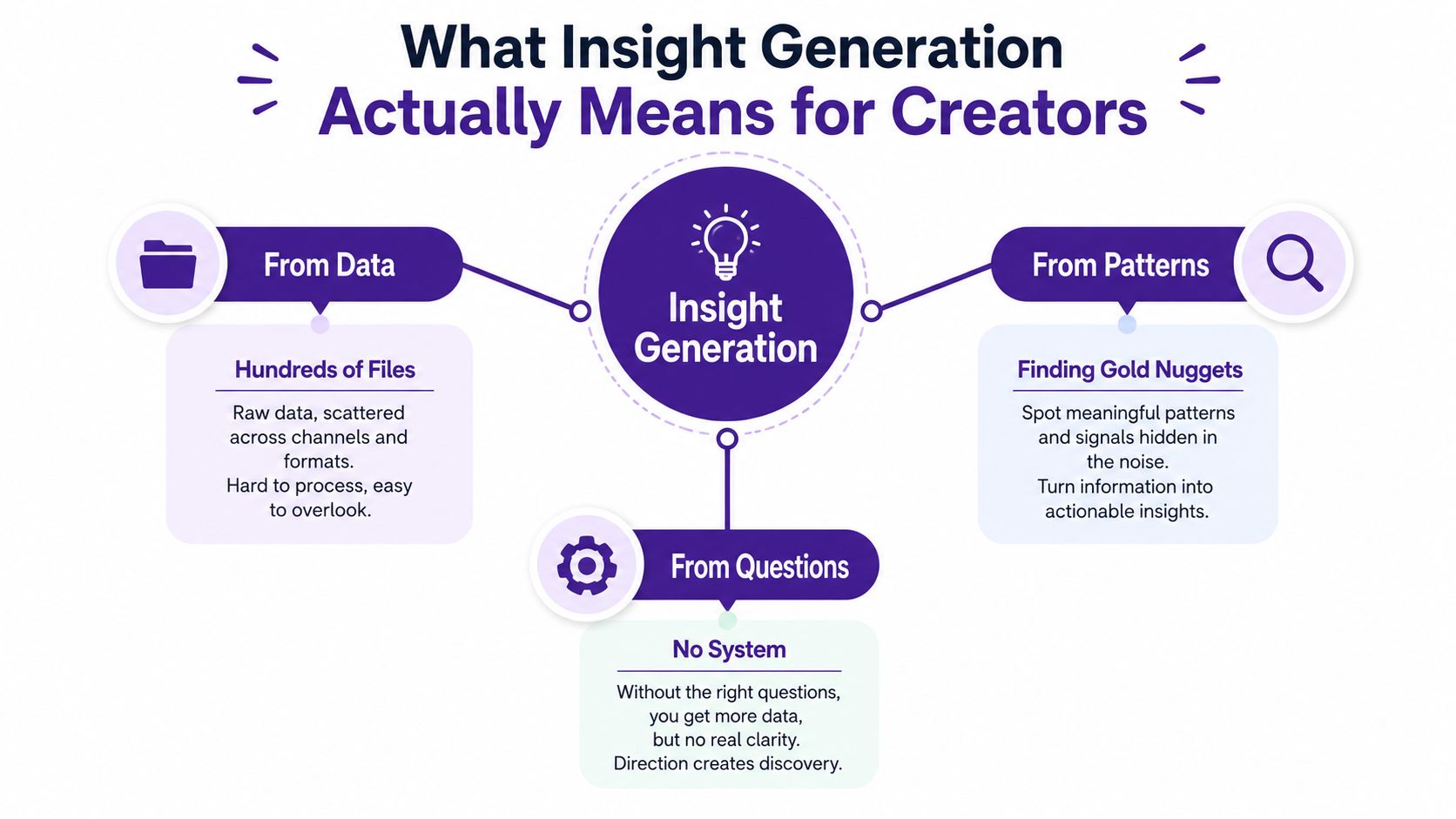
A creator opens the archive, scans a dozen episodes, a stack of clips, and a folder of old posts, then asks a simple question: what here is worth using next? That question is where insight generation begins. It is the process of turning stored material into a decision about topics, packaging, distribution, or format.
The cleanest way to separate it from related work is this. Reporting shows what happened. Analysis explains how the parts connect. Insight generation takes those connections and turns them into a choice that changes what happens next.
A simple podcast example makes the difference clear. A report might show that one episode reached more listeners than usual. Analysis might show that the guest had a specific profession, or that the topic matched a recurring audience question. The insight is the usable conclusion, such as realizing that this kind of guest consistently creates stronger pull and should shape the next booking calendar.
That matters because creators already own the material they need. The archive is not a dead folder of past work, it is a source of patterns waiting to be read. The challenge is that raw clips, transcripts, comments, and posts do not become useful on their own. They have to be sorted, compared, and tested against a real decision.
A helpful reference point is O'Reilly's insight generation process model. Its framing is straightforward, insight work starts with data ingestion, moves through knowledge extraction, and ends when the result is applied against KPIs. A chart can sit in a deck and still do nothing. An insight changes the next action. A diagram illustrating the three key elements of insight generation for creators: data, patterns, and questions.
Practical rule: if the finding does not change a booking, a topic choice, a packaging decision, or a distribution move, it is still an observation, not an insight.
For creators, that definition matters because the archive is already there. What is missing is the workflow that turns files into patterns, and patterns into questions. Once that happens, the library stops feeling like storage and starts working like a decision engine.
Why the Data Scale Has Made This a Necessity
The volume problem is no longer abstract. One industry summary says 463 zettabytes of data were created daily in 2025, and the global big data market was worth $229.4 billion in 2025, with a projection of $549.73 billion by 2028. The same source projects the global number of intelligent tool users will rise by 826.2 million between 2025 and 2031, reaching about 1.2 billion users. Big data statistics summary
For a creator, that scale shows up in a smaller, messier form. A YouTuber posting weekly can end a year with a library that no human can comfortably re-read from top to bottom. A publisher can have years of evergreen articles, but the best themes, the strongest hooks, and the most reusable examples remain trapped inside search results, playlists, or folders.
Why manual review breaks down
The issue isn't just size, it's drift. Audience interests change, formats change, and the signals buried in comments, transcripts, and analytics get harder to notice once the library gets large. That's why the core question isn't “Do we have enough content?” It's “Can we still inspect it fast enough to make decisions from it?”
A useful outside reference on this kind of workflow is using insights to craft content, especially if you're trying to move from content volume to content reuse. The bigger lesson is that insight generation has become infrastructure, not luxury. If the archive keeps growing and the team stays small, the only realistic response is a structured system that can classify, search, and synthesize at the same time.
Bottom line: the library isn't getting simpler. The job is to build a method that gets stronger as the archive grows.
That's why small teams and solo creators need a pipeline, not a pile of saved notes. Once the content surface area gets wide enough, ad hoc scrolling stops being a research method and starts being a time sink.
The Three Methods Every Insight Workflow Needs
The strongest creator workflows don't lean on one way of reading the archive. They use qualitative, quantitative, and AI-driven extraction together, because each method sees a different layer of the same content. Treating one as the whole answer usually creates blind spots.
What each method catches and misses
Qualitative extraction is close reading. It catches phrasing, emotion, repeated objections, memorable guest lines, and the kind of nuance that doesn't fit neatly into a chart. It misses scale, though, because one strong comment thread can feel important even when it's not representative.
Quantitative extraction is pattern counting. It catches shifts in watch time, topic clusters, repeat appearances, retention dips, and recurring spikes in performance. It misses context, because a number can tell you that something changed without telling you why the change mattered to the audience.
AI-driven extraction sits between those two. It can scan a corpus, retrieve relevant passages, cluster related items, and surface latent connections across transcripts, posts, or articles. It misses judgment if you let it run alone, because fast retrieval isn't the same as a valid decision.
| Method | Best for | Typical output |
|---|---|---|
| Qualitative | Reading transcripts, comments, and notes for themes | Repeated audience pain points, quotable moments, topic language |
| Quantitative | Counting patterns across episodes, posts, or clips | Topic trends, retention shifts, frequency tables, topic clusters |
| AI-driven | Searching large archives and grouping related material | Retrieved passages, clusters, candidate insights, supporting evidence |
A podcaster might use qualitative reading to spot that listeners keep asking for behind-the-scenes details, then use quantitative checks to see whether episodes with that angle hold attention better, then use AI retrieval to pull supporting clips from the archive. The same archive can produce completely different answers depending on which lens you use first.
You can also think about the methods in relation to a stronger practical output. Qualitative work gives you voice. Quantitative work gives you scale. AI-driven work gives you speed. If you skip one, the final insight often feels thin or overconfident.
If you want a deeper look at the reading side of that process, the guide on how to analyze qualitative data is a useful companion. The point isn't to choose a favorite method, it's to know what each one contributes before you ask it for a conclusion.
Building a Repeatable Weekly Pipeline
A weekly pipeline turns insight generation from a good intention into a habit. The best versions are short enough to run, but structured enough to keep you from cherry-picking the findings you already wanted. The design target is simple, fast enough to feel interactive, accurate enough to trust, and disciplined enough to reuse.
A recent NAACL paper on LLM-based insight generation describes a pipeline that begins with high-level questions and then decomposes them into simpler subquestions, which matters because decomposition reduces reasoning complexity and broadens coverage across a dataset. A separate arXiv system reports 89.5% overall accuracy and 13.56 seconds P90 latency, a helpful benchmark because tail latency is what makes interactive research feel smooth or frustrating. NAACL insight generation paper, multi-agent data insights benchmark
A six-stage weekly workflow
Curate your source set. Choose the episodes, posts, clips, comments, transcripts, or articles you'll inspect this week. A good default is one focused corpus, not the whole archive.
Define the question. Ask one sharp question, such as which guest type produces the most reusable hooks, or which topic keeps showing up in audience objections. If the question is vague, the output will be vague too.
Retrieve candidate passages. Search the archive for relevant sections, quotes, comments, and performance notes. AI search and semantic retrieval save time here.
Extract relations. Look for recurring themes, contrasts, outliers, and linked ideas. At this stage, you're not deciding yet, you're mapping relationships.
Validate against KPIs. Check the candidate insight against the metric or workflow it should affect, such as topic selection, episode retention, newsletter clicks, or re-use potential.
Turn the insight into next week's plan. Convert the validated finding into a decision, a test, or a content brief.
Working rule: if a question can't be answered with a source set, it's too broad for a weekly pipeline.
For a broader platform view on how teams operationalize this kind of work, content intelligence platforms are worth studying alongside the workflow above. And if you're comparing AI workflow patterns more generally, the Writingmate 2026 AI guide gives a useful view of how humans and systems can split the work without turning the process into guesswork.
The important part is not the exact tool stack. It's the sequence. Curate, question, retrieve, extract, validate, act. That's what makes the process repeatable instead of decorative.
Combining the Methods So They Reinforce Each Other
The three methods work best as a layered filter, not as competitors. A creator who uses them in sequence gets something stronger than any one method can produce alone, because each layer reduces the chance of a false conclusion.
One example, three passes
A podcast team notices that listeners keep mentioning confusion around a recurring topic. The qualitative pass identifies the pain point because the wording repeats across comments and transcripts. The quantitative pass then checks whether that pain point appears across multiple episodes or only in one outlier. The AI-driven pass pulls supporting quotes, related examples, and counterexamples from the archive so the team can see whether the pattern is stable or just loud.
That sequence matters because the methods answer different questions. Qualitative work says, “What are people saying?” Quantitative work says, “How often does it happen?” AI retrieval says, “Where else does this show up, and what connects it?” Used together, they move a creator from gut feeling to defensible action.
| Sequence | What it does | What it produces |
|---|---|---|
| Qualitative first | Spots the theme in real language | A candidate audience pain or recurring opportunity |
| Quantitative second | Checks whether the theme shows up at scale | A pattern worth trusting or rejecting |
| AI-driven third | Finds supporting and opposing evidence across the archive | A richer, more complete insight set |
The order can change when the problem changes. A publisher might start with quantitative drops in a topic cluster, then use qualitative reading to understand the language readers use, then use AI retrieval to surface older articles that already contain relevant angles. The point is to stop asking which method is “best” and start asking which one should come first.
Use human reading to seed the question, AI to widen the search, and judgment to close the loop.
That sequence is especially useful when your archive is large enough to hide the answer in plain sight. The methods reinforce each other because each one catches a failure mode in the others, shallow interpretation, weak scale, or overconfident automation.
How to Tell a Real Insight from a Plausible One
More data doesn't automatically produce better insight. In practice, the limiting factor is usually interpretation, synthesis, and causal connection-making, not raw volume. That's why a plausible observation can feel convincing long before it becomes a decision-worthy insight.
A useful test starts with a clear distinction, a data point tells you what's happening, while an insight explains why it's happening and what decision it enables. If the finding doesn't help you decide, it still isn't ready. Actionable insight framing
A five-minute validation check
Use three filters.
- Source check. Is the source credible enough for the decision you're making? A direct transcript, a platform metric, or a consistent comment pattern is stronger than a vague memory.
- Novelty check. Is this new compared with what your team has already decided? Anchor this against your own archive and prior content choices, not against some external benchmark you can't reproduce.
- Causal check. Does the pattern make sense beyond surface correlation? If not, treat it as a hypothesis, not an insight.
A recent literature review notes that the term insight can mean different things in different research contexts, including reflections, observations, and even data facts. That's useful for creators because it explains why teams talk past one another when they use the same word for different levels of confidence. Insight definition review
For teams that want a content-specific way to pressure-test findings, how to analyze content performance is a practical companion. The warning sign is overfit noise, especially in comment sections where one loud thread can masquerade as a pattern. When a candidate insight passes those three filters, you can stop collecting and start acting.
Two Compact Scenarios and Your Implementation Checklist
A podcaster runs a six-week archive review in a chat-based research workspace. She starts with guest interviews, asks which guest types create the most reusable audience questions, retrieves the strongest passages, and validates the finding against episode performance and booking decisions. By the end, she has a tighter guest strategy and a short list of repeatable prompts for the next production cycle.
A magazine publisher uses the same kind of pipeline on dormant articles. The team identifies old themes that still cluster around reader interest, pulls strong passages from the archive, checks which topics still deserve attention, and turns the result into updates, repackaging, and new cross-links. The archive stops behaving like a warehouse and starts behaving like a shelf of reusable assets.
A simple implementation checklist looks like this.
- Set up the library. Gather the sources you use, transcripts, notes, posts, clips, articles, and analytics.
- Write one recurring question. Pick the decision you need to make each week, not ten questions you'll never finish.
- Define validation rules. Decide what counts as enough evidence before the team acts.
- Create a review cadence. Run the process on the same day each week so the archive gets used instead of admired.
- Capture the decision. Record what changed, so the next round starts with context instead of guesswork.
If you're trying to turn your archive into a working research and content system, Contesimal helps you organize, search, and synthesize content libraries so you can turn old material into new decisions and new output. Visit Contesimal to see how a content library can become a repeatable insight engine for your next episode, article, or campaign.