
You already have the raw material for a stronger content engine. The problem is that most of it is buried, sitting in old podcast transcripts, long interview recordings, half-forgotten blog posts, and repurposing ideas that never got a second pass. AI for content marketing matters here because the primary advantage usually isn't making something from nothing, it's turning the archive you've already paid for into new distribution, new search visibility, and new revenue paths.
That shift is already mainstream. Ahrefs reports that 87% of respondents use AI to help create content, and AI-assisted publishing is associated with 42% more content per month, with a median of 17 articles for teams using AI versus 12 articles for teams not using AI Ahrefs. The same dataset shows AI content is already embedded in the pages search surfaces and answer surfaces are surfacing, including 74.2% of new webpages, 86.5% of top-ranking pages, and 91.4% of pages cited in AI Overviews containing some amount of AI-generated content Ahrefs.
For creators, publishers, and content teams, that means the question is no longer whether AI belongs in the workflow. The question is where it should sit, what it should touch, and how to use it without flattening the voice that makes the library valuable in the first place.
The Library Most Creators Are Sitting On
A creator can finish a strong season of work, then watch the files get buried in folders. There's a drive full of raw video, a podcast back catalog with strong interviews, a folder of blog drafts that never got a second pass, and a stack of research notes no one has opened since launch week. That archive already proved there's an audience, but it still sits there like unused inventory.
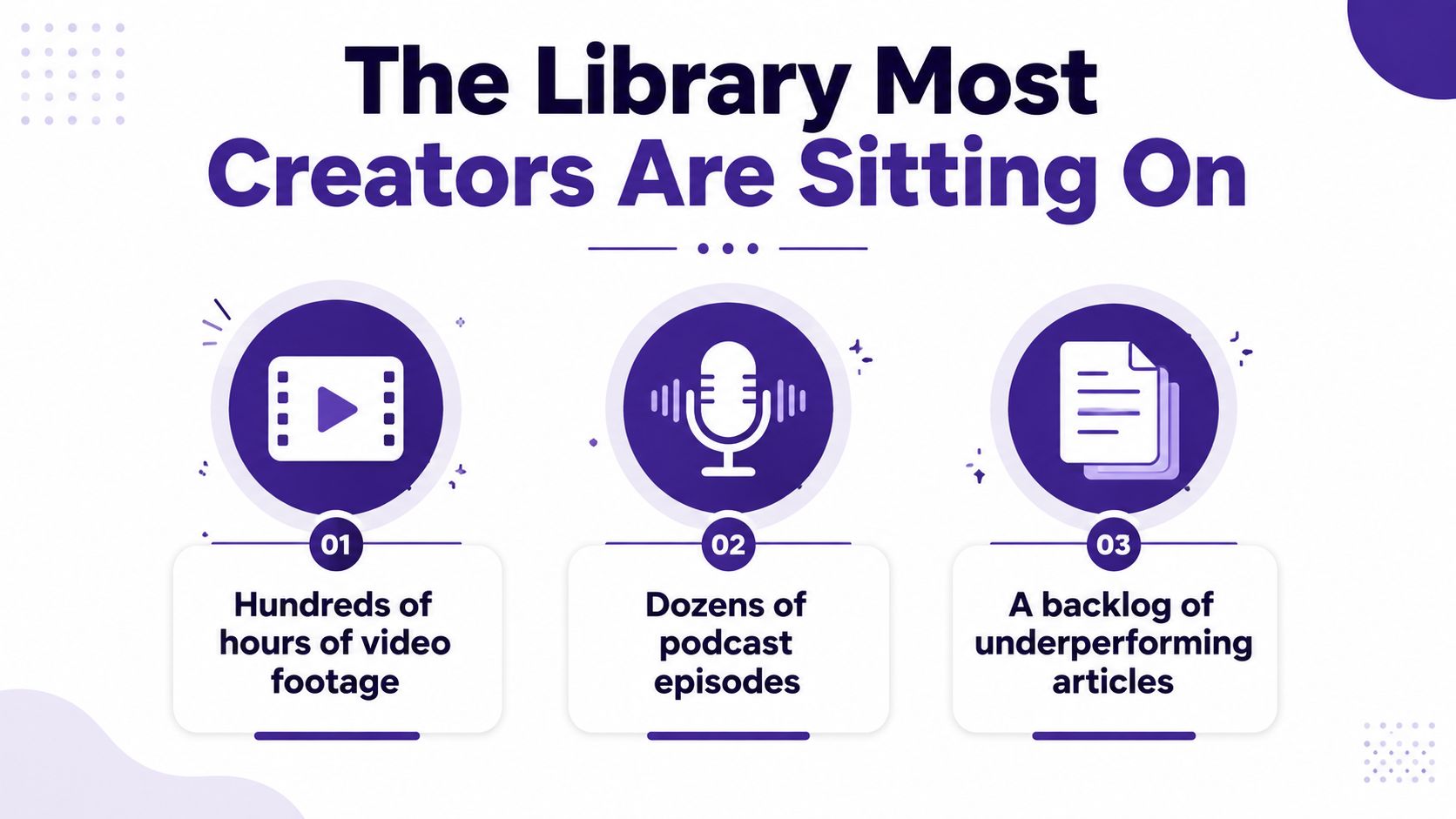
The missed opportunity is practical. When teams keep producing without reusing, they pay for the same research, the same topic framing, and often the same audience education more than once. In SEO-driven markets, that gets expensive fast because publishing velocity and search visibility feed each other, while dormant assets do nothing to compound.
Dormant content still carries value
A strong archive already contains audience signals. Some episodes triggered questions in comments, some posts earned shares, and some videos revealed the language customers use. AI is useful when it helps teams surface those patterns quickly instead of depending on memory or scattered notes.
Practical rule: if a piece of content already earned attention once, treat it like a source file, not a finished object.
The best teams stop thinking in terms of “new versus old” and start thinking in terms of usable content inventory. An interview transcript can become newsletter angles. A webinar can become a blog post, a short clip, and a FAQ. A research-heavy article can be recombined into a sharper point of view, but only if someone can find the useful fragments.
That is why AI for content marketing is less about novelty and more about operating efficiency. It helps a team move from one-off publishing to a system where the library keeps generating new work. For marketers trying to grow audience and revenue at the same time, that matters because it turns work already paid for into more distribution, more search visibility, and more chances to convert.
What AI for Content Marketing Means
A content team often gets more value from AI once it treats the archive as the starting point. The first win is usually not fresh drafting. It is finding what already exists, sorting it fast, and turning buried material into usable output.
At a working level, generative models create drafts, summaries, hooks, and variations. They are useful for first-pass language, especially when the source material already exists in transcripts, articles, or video notes. Predictive analytics helps decide what to make next by looking at engagement signals, past performance, and topic patterns. Workflow automation moves content through distribution, routing, and routine follow-up without forcing a human to push every button.
Harvard's marketing overview notes that AI can process both structured data, like purchase histories and site interactions, and unstructured data, like images, videos, and social posts, to infer preferences and brand perception Harvard Professional and Executive Development. That matters because content libraries are full of both. A transcript, a clip, a webinar recording, and a comment thread all carry different signals, and AI becomes useful when it can read those signals without flattening them into generic copy.
The weekly reality inside a creator team
A podcaster might use AI to draft show notes from a transcript, then use engagement data to decide which recurring segment deserves a standalone clip series. A newsletter operator might ask AI to propose new subject lines from archived interviews, then route the final version through editorial review. A publisher might let AI sort the archive by themes, entities, or audience questions so editors can see where there is still value hiding in plain sight.
Hyper-personalization sits inside this same system. AI can segment audiences in real time and adapt headlines, layouts, or calls to action based on observed behavior rather than static demographic rules Snoika. That is why the category is broader than writing with a bot. It blends creation, prediction, and distribution, and the strongest teams use all three.
The useful mental model is simple. AI for content marketing is the infrastructure that helps a library think, sort, and ship faster. The drafting matters, but it is only one part of the stack.
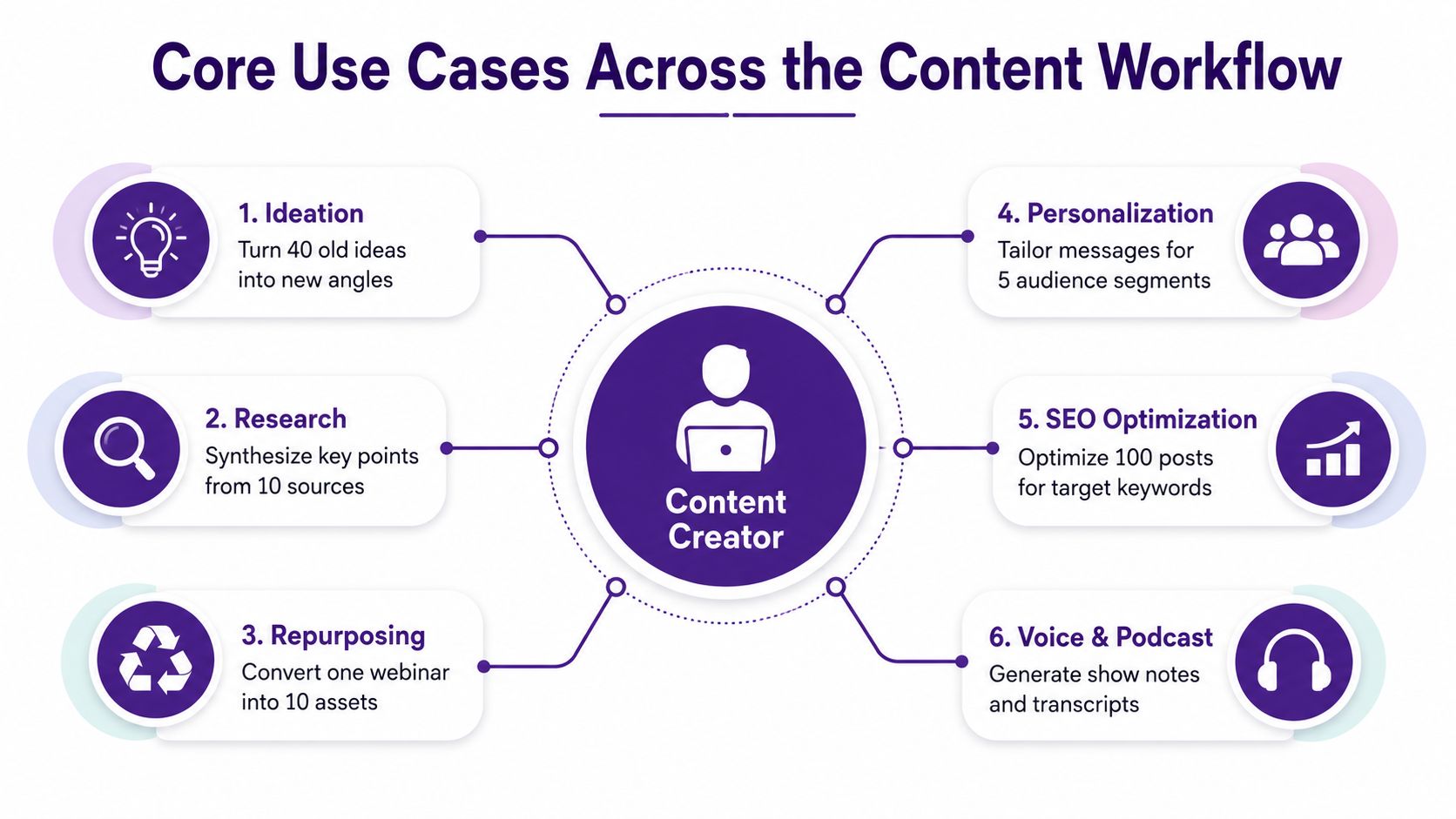
Core Use Cases Across the Content Workflow
A lot of teams start by asking AI to write a blog post. That's the narrowest possible use case. The better move is to assign AI to the bottleneck that slows your pipeline most, then measure whether it reduces time, increases output, or improves reuse.
Ideation and research
The strongest ideation workflows begin with the archive. If you have forty old transcripts, AI can cluster the recurring themes and surface a dozen newsletter angles without forcing your team to reread everything manually. That's also where the right research resource matters, because a practical roundup like best AI content creation tools 2026 is more useful when it's evaluated against a real content system, not a generic benchmark.
For research-heavy teams, AI can synthesize key points from source material and pull together topic clusters faster than a human can skim every file. The trick is to use it for compression, not authority. It's a guide to what matters, not a substitute for checking the original.
Repurposing and voice workflows
Repurposing is where the payoff gets obvious. A 45-minute interview can become nine short clips, a blog, a LinkedIn post, and a newsletter opener if the transcript is clean and the edits are disciplined. Podcasts and video workflows benefit here because AI can generate show notes, chapter markers, summaries, and clip candidates with far less manual labor.
Voice workflows deserve their own lane because transcripts are rich but messy. AI helps turn spoken language into searchable material, which is especially helpful when a team is trying to build a backlog of usable assets instead of a pile of files. If your production team already has transcripts, AI turns them into working material faster than any editor can do alone.
Personalization and SEO
Personalization is where one asset starts behaving like multiple assets. The opening hook can change for cold readers, returning readers, or people coming from a podcast clip. The layout, CTA, or framing can shift based on what the audience has already seen.
SEO optimization has changed enough that AI is now part of the baseline workflow, not a side experiment. Ahrefs found that 86.5% of top-ranking pages contained some amount of AI-generated content Ahrefs. That doesn't mean AI guarantees rankings, it means serious search competition now includes AI-assisted production in the mix. For teams that still treat SEO as a purely manual editorial process, that gap is getting harder to ignore.
Mining Your Existing Library for Net-New Value
The most effective AI workflow starts before generation. It starts by turning your content library into something you can query. Many teams already have enough raw material to create the next wave of output, but they don't have a system that lets them ask the archive useful questions quickly.
A good library-mining process has five steps. First, ingest everything, transcripts, articles, PDFs, video files, show notes, and related research. Second, classify it with a layered taxonomy so the archive can be filtered by format, theme, audience, and asset type. Third, query it conversationally so editors can ask real questions instead of hunting through folders. Fourth, recombine fragments into new formats, such as articles, scripts, snippets, or internal briefs. Fifth, distribute the results where the audience already pays attention.

That's where a platform like Contesimal fits naturally. It combines a chat-based research interface with tools for classifying and searching large sets of documents, podcasts, videos, and articles in real time. It isn't about replacing editorial judgment, it's about making the archive legible enough to work with.
One important shift is separating ingestion from generation. Teams often ask AI to write before they've structured the material it should learn from. That's backwards. The archive gets smarter when the library is organized well enough to answer questions like, “Which interview themes keep showing up?” or “What topics already have strong customer language attached to them?”
The same principle shows up in the broader guidance around content intelligence platforms, where search, classification, and analysis create the conditions for better reuse Contesimal's content intelligence overview. The goal isn't to store content more neatly. The goal is to make past work easy to rediscover, recombine, and ship again.
A content library should behave like a knowledge base, not a storage closet.
The practical payoff is straightforward. When an editor can ask the archive for the strongest examples, the recurring questions, or the most reusable claims, the next asset takes less time to build and usually lands with more relevance. That's how historical content starts creating fresh value instead of sitting there as sunk cost.
The same logic applies to content repurposing playbooks that start from old material and move toward new formats Unlocking new value through content library mining. Once the archive is queryable, the content team stops guessing where the next opportunity lives.
Measuring Performance and Setting Governance Rules
AI output is never the finish line. It is the first draft of an operating system, and the system only works if you measure it and review it with discipline. Teams that skip governance usually end up with more content and less confidence, which is the worst possible trade.
A lightweight scorecard keeps the process honest. Track whether AI is increasing output volume, whether it is saving time, whether the published work is getting better engagement, and whether the output gets cited, shared, or reused. Those are the signals that matter when the goal is not just speed, but durable content value.
| Metric | What It Answers | Sample Signal |
|---|---|---|
| Output volume | Are we shipping more usable assets? | More repurposed posts, clips, or newsletters per month |
| Time saved | Does the workflow remove manual work? | Fewer hours spent on transcripts, summaries, or first drafts |
| Engagement lift | Is the audience responding better? | Better opens, replies, watch time, or scroll depth |
| Citation or share rate | Does the asset travel beyond launch? | More backlinks, citations, reposts, or internal reuse |
The review gate matters just as much as the scorecard. Ahrefs' survey found that 97% of companies edit or review AI content before publishing, while only 4% publish pure AI-generated content Ahrefs. That is the operating norm. AI helps teams move faster, but humans still approve the work before it ships.
Governance that scales
Governance does not have to be heavy. It does need to be explicit. Decide who reviews drafts, what content types require human approval, and when the scorecard gets checked. If your team handles customer-facing claims, keep version history and source notes attached to the asset so editors can see where each line came from.
The other guardrails are straightforward. Disclose when AI materially shaped the draft if your team's policy requires it. Citation-friendly content needs verifiable facts it can stand behind, which is why strong teams start with real questions and real evidence instead of asking AI to invent a point of view FiftyFive and Five. For workflow teams that need a practical template for request handling and handoffs, a document like this request for information template can help standardize the ask before anyone starts drafting.
The big idea is simple. AI should speed up editorial judgment, not replace it. If the team cannot explain why a piece was approved, it probably was not governed well enough.
Where AI Should Stay Out of the Way
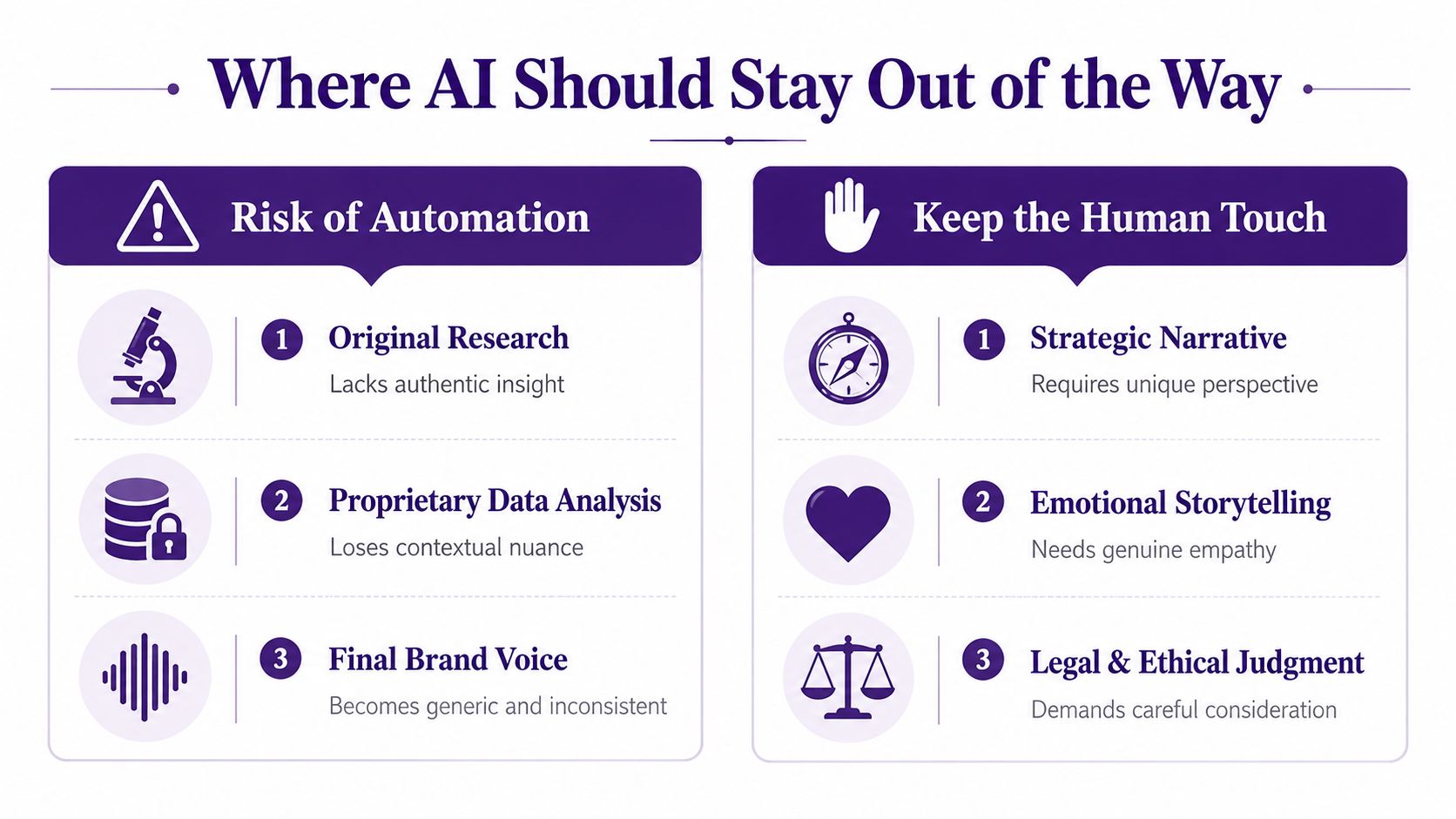
The smartest AI strategy is partial. If a team tries to automate everything, it usually weakens the very material that makes the brand worth following. The point isn't to use AI everywhere. The point is to use it where volume matters and keep humans in the places where credibility matters most.
Keep the human voice on the highest-stakes work
Original research needs real interpretation, not generic synthesis. Executive thought leadership needs the leader's actual perspective, not a polished approximation. Crisis communications demand accountability and judgment in the moment, which AI can't own.
Highly regulated or technically sensitive material carries a different kind of risk. The more a piece can create legal, reputational, or compliance problems if it's wrong, the more human review matters. AI can support the drafting process, but it shouldn't be the final author of record in those situations.
If a draft would be embarrassing or harmful to publish with the wrong nuance, keep a human fully responsible for the final pass.
There's also a misconception worth dropping. More output doesn't automatically mean more revenue. If the archive is poorly organized, the audience is misaligned, or the voice is flattened, the extra volume just creates more noise. That's why some of the best operators use AI aggressively for repurposing and sparingly for the parts of the content stack that define trust.
The practical standard is not “human or AI.” It's “which parts need original perspective, and which parts need scale?” That distinction protects brand equity while still giving the team room to move fast.
A 30-Day Plan to Put AI to Work This Quarter
Start with the archive, not the prompt box. In week one, list every asset you haven't republished in six months, then sort it by format and topic. Don't worry about perfection. You're looking for the material that still has obvious value but no current distribution plan.
In week two, run a small ingestion sprint. Load 20 to 50 pieces into a searchable system like Contesimal, then ask real questions against the library. Which topics repeat, which interviews contain strong reusable claims, and which assets could become multiple formats with the least friction?
Week three is for one end-to-end repurposed asset. Ship something measurable, such as a transcript turned into a blog post, a newsletter, and three social cuts. Attach the scorecard before publishing so you know what the workflow changed.
Week four is the retro. Note which prompts saved time, which outputs needed heavy edits, and which channels responded. Then decide what gets scaled, what gets tightened, and what stays human.
The bigger shift is already visible. AI for content marketing is becoming infrastructure, not experiment. Teams that organize their libraries now will have a much easier time turning past work into future reach, and that advantage compounds every time a piece gets rediscovered instead of buried.
Contesimal helps teams turn transcripts, articles, podcasts, videos, and other library assets into a searchable, reusable content system, so the archive can drive new ideas instead of sitting in folders. If you're trying to make AI for content marketing feel practical instead of chaotic, visit Contesimal and see how a content library can become a working asset again.