
Let's be real. If your content library feels more like a chaotic digital garage sale than a strategic asset, you're in good company. For tons of creators, publishers, and marketers, that growing archive of videos, blog posts, and podcasts quickly becomes a monster. Finding that one perfect clip from a two-year-old interview feels like searching for a needle in a digital haystack.
This digital clutter is more than just frustrating—it's a massive missed opportunity. Your library is packed with gold, but without the right tools, that value stays locked away. You end up wasting hours digging for assets, struggling to get your team on the same page, and just guessing what to create next.
This is exactly the problem content intelligence platforms were built to solve. Think of your library as a warehouse full of unmarked boxes. You know there's valuable stuff inside, but you have no clue where anything is. A content intelligence platform is like a sophisticated inventory system that automatically opens, scans, and tags every single box for you. It's how you organize your library to create new value and ultimately make money with it.
A content intelligence platform turns your static archive into a dynamic, revenue-generating engine. It’s not just about storage; it's about making every piece of your content discoverable, understandable, and ready for action.
Unlocking Your Content’s Hidden Value
For YouTubers, podcasters, and publishers trying to go from hobbyist to pro, managing all that content is a huge hurdle. The manual spreadsheet-and-folder system that worked for 10 videos completely falls apart at 100 or 1,000. Content intelligence just offers a smarter way to work, turning that mess into organized clarity.
To make this crystal clear, let's look at the "before and after" picture.
Manual Content Chaos vs AI-Powered Content Intelligence
This table shows the shift from the old, painful way of managing content to the new, intelligent approach.
| Creator Challenge | The Old Way (Manual & Scattered) | The New Way (Content Intelligence Platform) |
|---|---|---|
| Finding Specific Clips | Hours of scrubbing through timelines, hoping to find that one quote. | Instantly search for "AI ethics" and get every clip where you've ever mentioned it. |
| Team Collaboration | "Hey, where's that video on…?" Slack messages and shared drives are a mess. | A single, searchable source of truth. Editors and writers find what they need, fast. |
| Repurposing Content | Relying on memory to recall good moments for Shorts or Reels. Mostly, it just doesn't happen. | The platform surfaces top-performing quotes and concepts perfect for social media. |
| Generating New Ideas | Staring at a blank page, guessing what the audience wants next. | Uncover hidden themes and recurring questions from your own content to inspire the next big hit. |
As you can see, it’s not a small upgrade. It’s a fundamental change in how you approach your creative work.
This shift helps solve the real-world headaches that slow down growth:
- Finding Specific Clips: Instantly pull every single moment you discussed a particular topic across hundreds of hours of video to create a new compilation. No more manual searching.
- Team Collaboration: Give your writers and editors a central, searchable knowledge base to pull from, which keeps everyone consistent and moving quickly.
- Repurposing Opportunities: Easily spot those evergreen concepts or killer quotes buried in long-form videos that are perfect for creating Shorts, Reels, or viral social posts.
- Generating New Ideas: Discover hidden patterns and recurring questions from your audience that can spark your next viral hit or an entire content series.
Ultimately, these platforms give you the structure you need to finally organize your library, truly understand what's inside it, and take decisive action to grow your audience and make more money.
How Content Intelligence Platforms Actually Work
To really get what a content intelligence platform can do, you need to look under the hood. It’s not some kind of black magic; it's a slick, multi-step process that turns your scattered library of videos, articles, and podcasts into a smart, interconnected knowledge base. The whole system is built to think like a super-powered research assistant, understanding what your content is actually about far beyond simple file names.
It all starts with ingestion and analysis. The platform hooks up to your content sources—think YouTube channels, blogs, or cloud drives—and pulls everything into one central hub. The moment a piece of content lands, the AI gets to work. For a video, it generates a full transcript. For an article, it reads the text.
But it doesn't just stop there. This is where the "intelligence" really kicks in. The AI analyzes the substance of the content, pulling out key topics, named entities (like people or companies), and even the sentiment or tone of the conversation.
Building An Intelligent Taxonomy
Once the platform understands the raw material, it starts to organize everything by creating a smart taxonomy. Think of this as an incredibly detailed, automated tagging system. Instead of you manually creating folders or adding basic tags like "marketing," the platform does it for you with stunning precision.
For example, a one-hour podcast episode could be automatically tagged with:
- Broad Topics: "Startup Growth," "Venture Capital," "SaaS Marketing"
- Specific Concepts: "Series A funding," "customer acquisition cost," "product-led growth"
- Key Moments: It can even timestamp segments, noting the exact minute you shared a specific story about overcoming a business challenge.
This process builds a rich, multi-layered map of your entire content library, making every single idea you've ever had instantly findable.
Finding Concepts, Not Just Keywords
This detailed organization is what powers the platform's best feature: semantic search. Traditional search is all about keywords. If you search for "startup funding," you only get results that contain that exact phrase. It’s clunky and often misses your best stuff.
Semantic search is a different beast entirely. It understands the meaning and context behind what you're asking for.
You can search for abstract ideas, like "advice for early-stage founders struggling with fundraising," and the platform will pull up relevant clips from dozens of videos, even if they never use those precise words. It finds the concept, not just the keyword.
This diagram shows how these core functions—organizing, understanding, and acting—all work together to create real value from your central library.
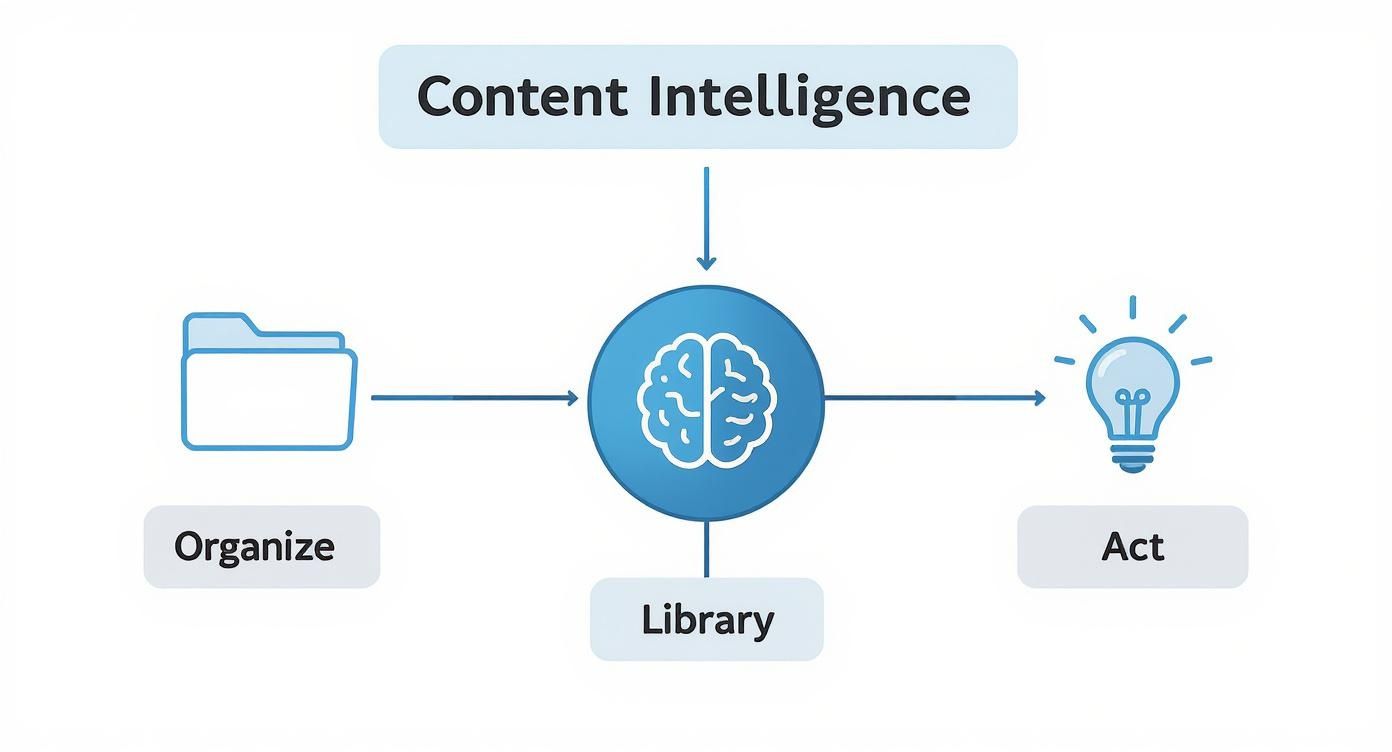
As you can see, the platform first organizes your library, then uses AI to deeply understand it, which is what lets you take smart, data-driven action on your content.
Generating Actionable Insights
The final step is turning all this organized data into actionable insights. A good content intelligence platform doesn't just sit there waiting for you to search. It proactively analyzes your entire library to spot patterns and opportunities you would have missed completely. For more on this, check out our guide on how to analyze content performance.
This proactive analysis can uncover gold, like:
- Which topics consistently get the most engagement across all your videos.
- Recurring questions your audience asks that could become your next hit video.
- Contrasting viewpoints you've shared on a subject over the years, perfect for a "then vs. now" compilation.
By handling the grunt work of ingestion, organization, and analysis, content intelligence platforms free you up to focus on the most important part of your job: creating amazing content.
Strategic Benefits for Modern Creators and Publishers
Beyond the flashy tech, what can a content intelligence platform actually do for your business? This is where the rubber meets the road. For creators and publishers, this isn't about chasing the next shiny object; it’s about getting real results that impact your growth, workflow, and bottom line.
Think of these platforms as a force multiplier for your creative energy.
Imagine no longer spending hours scrubbing through old videos just to find that one perfect clip for a Reel or Short. A content intelligence platform brings those golden moments to the surface automatically. It lets you upcycle your old content, reignite your library, and create infinite content value. Your long-form library suddenly becomes an endless supply of high-impact social content, letting you work smarter to create more touchpoints for your audience.

Accelerate Your Content Creation Workflow
One of the biggest drags on any creator is the research and ideation phase. When your entire library becomes a searchable knowledge base, that whole process gets dramatically faster. You can instantly pull up every point you've ever made on a topic, find supporting data from past research, and build on old ideas without starting from a blank page.
This has a massive impact on both speed and quality. Instead of relying on memory, you can generate fresh, well-researched content faster than ever. It also keeps your new videos, articles, and podcasts consistent with your past work, strengthening your brand's authority.
A content intelligence platform doesn't just organize your past; it actively fuels your future. By making your own expertise instantly accessible, it becomes your most powerful tool for sparking new ideas and creating better content, faster.
On top of that, these systems make collaboration a breeze. For teams moving from a solo gig to a professional operation, this is huge. Writers, editors, and video producers can all tap into a single source of truth, finally killing those confusing email threads and chaotic shared drives.
A platform like Contesimal is built for this kind of creative teamwork, letting everyone collaborate around a central hub of knowledge. It fosters a healthy, seamless collaboration between humans and AI, revolutionizing research so everyone can benefit.
Maximize Your Content Return on Investment
Every piece of content you make is an investment—of time, money, and creative energy. Content intelligence platforms are designed to help you get the absolute most out of that investment. By understanding which themes truly connect with your audience, you can make smarter calls about what to create next. No more creating content that just falls flat.
This strategic insight is what separates thriving content businesses from those that just get by. Mature organizations already get this; around 78% of them regularly evaluate their content’s impact using multiple data sources. In contrast, only 29% of organizations in earlier stages do the same, showing a clear gap in data-driven thinking.
By using a data-backed approach, you can focus on projects with the highest odds of success. To dig deeper, check out our article on maximizing ROI by transforming your content library for lasting value. This shift from guessing to knowing is the key to sustainable growth.
Shape a Winning Content Strategy
Ultimately, the biggest win is the ability to shape a powerful, data-driven content strategy. These platforms give you deep insights into what actually captivates your audience, helping you answer the critical questions that drive real growth:
- What hidden themes are most popular across my library? Uncover recurring topics you can build entire playlists or content series around.
- Which of my talking points get the most engagement? Pinpoint the soundbites and ideas that are perfect for repurposing into viral clips.
- Where are the content gaps in my library? See what topics your audience is hungry for that you haven't fully explored yet.
By giving you clear answers, a content intelligence platform shifts you from being a reactive content producer to a proactive strategist. You can confidently put your creative energy where it matters most, building a stronger connection with your audience and driving real business results.
Real-World Use Cases for Your Content Business
Knowing the theory behind content intelligence is one thing. Seeing it solve real-world problems for creators and publishers? That’s where it all clicks. Let's get out of the clouds and look at some concrete examples of how these tools fix the headaches you're actually dealing with.
Each scenario here will follow a simple path: a common problem, how a platform solves it, and the business-boosting outcome. This should help you picture exactly how this tech could fit into your own workflow and help you hit your goals.
For the YouTuber Transitioning to a Pro Operation
Imagine you’re a YouTuber who's built a library of over 300 videos. Your channel is finally taking off, shifting from a passion project to a real business. You have a great idea for a "Best Tech of the Year" compilation, but you need to find every single clip where you've reviewed a specific brand of headphones.
The Problem: Manually scrubbing through hundreds of hours of your own footage is a nightmare. It would take days, maybe even weeks, and you’d still miss key moments. Honestly, you'd probably just give up on the idea.
The Platform Solution: With a content intelligence platform, you run one simple search: "impressions of [Headphone Brand]." The system instantly scans every video transcript and pulls up timestamped clips from dozens of different videos where you talked about the product, even if you phrased it differently each time.
The Business Outcome: You just saved yourself dozens of hours of grunt work. You can now put together a high-value, deeply researched compilation video in a fraction of the time. This new video not only gives your audience something amazing to watch but also becomes an evergreen asset that drives affiliate revenue for months.
By making your entire archive instantly searchable, a content intelligence platform turns your past work into a readily available asset for creating new, high-impact content. The barrier to repurposing is completely removed.
For the Publisher Launching a New Vertical
Think about a digital publisher with a decade's worth of articles and interviews sitting in their archives. They spot a huge opportunity to launch a new newsletter focused on "The Future of Remote Work," but first, they need to figure out what their best content on the topic actually is.
The Problem: Their content is scattered across old content management systems and various archives. Trying to identify the recurring themes, top authors, and the most powerful arguments on this topic would require a massive, soul-crushing manual audit.
The Platform Solution: The publisher ingests its entire archive into the platform. The AI gets to work, analyzing everything and identifying "remote work" as a major theme. It goes deeper, breaking it down into sub-topics like "asynchronous communication" and "virtual team management." The platform then highlights the specific articles and authors that drove the most engagement around these subjects.
The Business Outcome: Armed with real data, the publisher confidently launches the new newsletter. The first few editions are pre-populated with curated links to their proven, best-performing content. This delivers immediate value to subscribers, establishes the publisher as an authority, and opens up a new revenue stream through sponsorships.
For the Marketing Executive Mapping the Customer Journey
Now, picture a marketing executive at a software company. They've built up a rich library of blog posts, podcasts, and webinars, but they have zero clarity on how any of it maps to the different stages of the customer's journey.
The Problem: The content strategy feels like a shot in the dark. They have no idea if they have enough content for people just discovering them (top-of-funnel), those considering their options (mid-funnel), or those ready to buy (bottom-funnel). It's all guesswork.
The Platform Solution: The marketing team uses the content intelligence platform to create custom tags based on their sales funnel stages ("Awareness," "Consideration," "Decision"). The AI helps analyze and classify all existing content, revealing a critical insight: they have tons of "Awareness" content but are seriously lacking assets for the "Decision" stage.
The Business Outcome: The team can finally see their content gaps with perfect clarity. They can now prioritize creating targeted case studies and product comparisons designed to help buyers make a final decision. This directly impacts lead conversion and sales. This isn't just a niche trend; the media and entertainment sector's massive adoption is projected to account for 35.3% of the content intelligence market by 2025 as companies wrestle with huge volumes of unstructured data. These tools are becoming essential for any business that's serious about its content. You can learn more about how the content intelligence market is growing and its impact on various sectors.
Choosing the Right Content Intelligence Platform
Alright, you get it. Content intelligence is powerful. But knowing that is one thing; picking the right platform is how you actually turn that potential into profit. The market for these tools is blowing up, and the sheer number of options can feel like a tidal wave.
You need a clear way to cut through the noise. This isn't about finding the platform with a million features you'll never use. It's about finding the one that clicks with your specific workflow, your content formats, and where you want to take your business. A YouTuber's needs are worlds apart from a book publisher's, and the right tool gets that. This is especially true when you're making the leap from hobbyist to pro, where suddenly, collaboration and efficiency are everything.
Start with How You Actually Work
Before you even think about watching a demo, grab a whiteboard and map out your content process. What does it look like now? What do you want it to look like? A great platform should slide right into your existing flow, not force you to burn it all down and start over. The whole point is to remove friction, not create a new headache.
Ask yourself these gut-check questions:
- What am I actually making? Does the platform handle video, podcast audio, and blog text without choking? If it can’t manage your core formats, it's an immediate deal-breaker.
- Where is all my stuff? Look for smooth, no-brainer integrations with places like YouTube, Vimeo, your WordPress blog, or cloud storage like Google Drive or Dropbox.
- Who is on the team? Is it just you, or are you bringing in writers, editors, or a social media manager? You need an interface that your whole team can pick up and use without needing a six-week training course.
Zero in on Features That Fuel Growth
Once you’ve nailed the basics, it's time to look at the features that will actually help you scale. For serious creators, this usually boils down to two things: collaboration and scalability. You're not just making one-off videos anymore; you're building a central brain for your entire business.
This is exactly the problem a platform like Contesimal was built to solve. It’s designed to be the central hub where your team can circle up, dig into your content library together, brainstorm, and pull new ideas from assets you've already created. That collaborative core is what turns a simple tool into a business-building engine.
Think about the future, too. As your library grows from a few hundred videos to thousands, the platform has to keep up. The last thing you want is a tool that buckles right when you start seeing real success. Make sure whatever you choose can handle the volume without grinding to a halt.
Look for a Partner, Not Just a Product
The demand for these tools is exploding for a reason. The global content intelligence market is set to hit anywhere from USD 7.27 billion to a massive USD 12.50 billion by 2030. A huge part of that growth comes from creators demanding flexible, cloud-based tools that can keep up with them. You can see the full market growth projections for content intelligence for yourself.
This boom means the tech is getting better every day. You want to partner with a company that has a real vision for the future, not one that’s just coasting. A good partner doesn't just solve today's problems—they give you the tools you'll need to win tomorrow.
Focus on your workflow, find the features that truly matter for growth, and pick a forward-thinking partner. Do that, and you'll find a platform that doesn't just organize your content, but helps you build a lasting business.
Your Implementation Roadmap
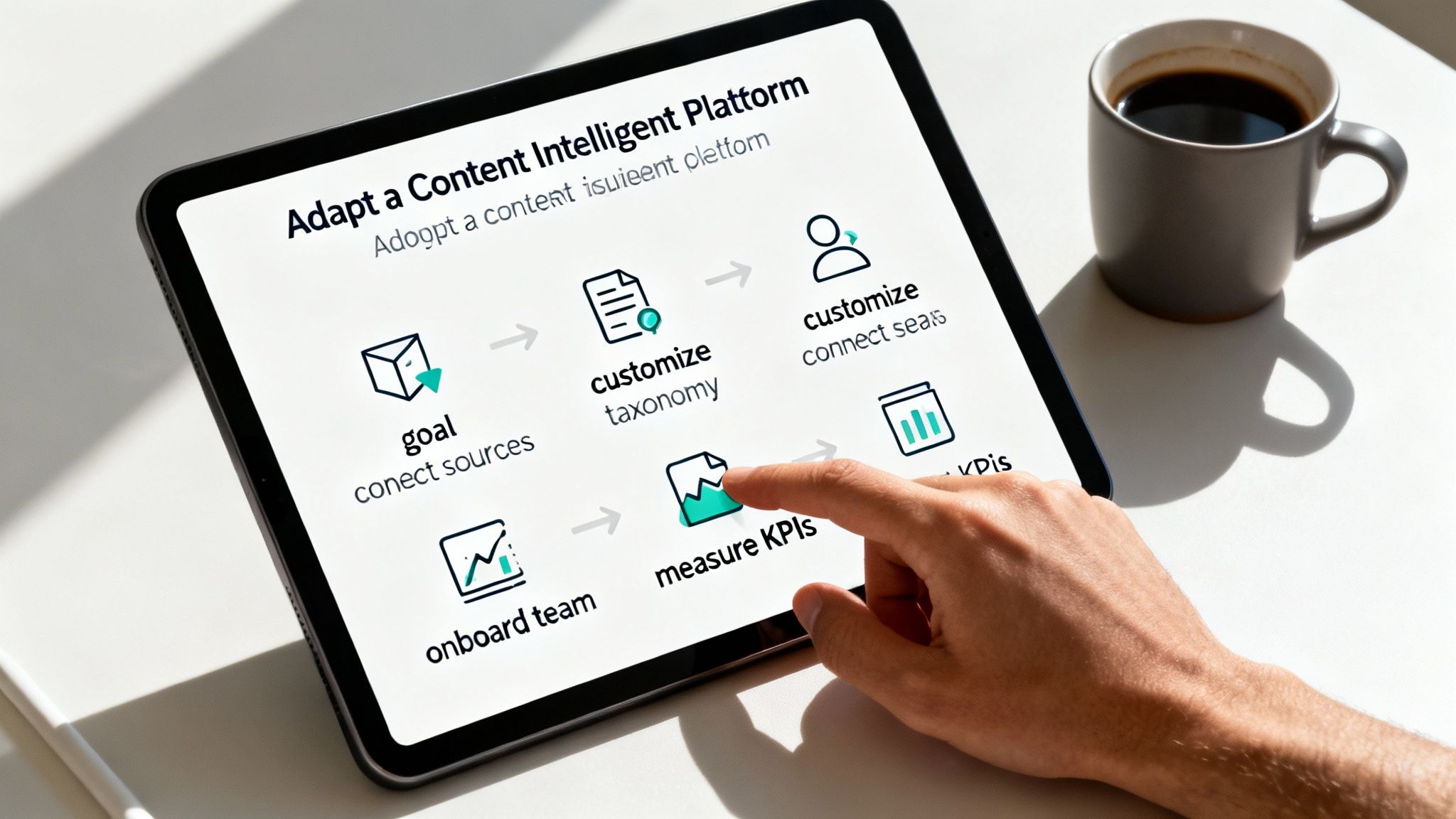
Adopting a new tool can feel like a massive undertaking, but a successful rollout of content intelligence platforms isn't about boiling the ocean. It’s about taking smart, manageable steps. This practical roadmap breaks the process down into a clear, achievable path to finally unlocking your content's real potential.
First thing's first: define your primary goal. Why are you even doing this? A fuzzy objective always leads to a messy implementation.
You have to get specific. Are you trying to accelerate content repurposing to feed your hungry social media channels? Maybe the main pain point is giving a growing team better access to your archive. Or perhaps the goal is discovering hidden gems to spark new video ideas. Pinpointing your number one priority will guide every single decision you make from here on out.
Phase 1: Start With Your Core Assets
Once your goal is crystal clear, fight the urge to connect every single content source you own. This is a classic pitfall, and it’s a direct path to immediate overwhelm.
Instead, start by connecting only your most valuable and active content sources first. This might be your main YouTube channel or your company's primary blog. This focused approach lets you see results faster and learn the system with your best, most familiar content. You can always add more sources later.
Phase 2: Refine and Onboard
With your core content ingested, the AI will generate an initial taxonomy of tags and topics. Now it's your turn to add that critical human touch.
Customize this structure to fit your unique brand and content strategy. Add custom tags that reflect your specific product lines, content pillars, or audience segments. This is the step that transforms a generic system into one that actually speaks your language.
Next, get your team on board with clear, simple workflows.
- Start small: Introduce just one or two key workflows, like "How to find clips for a social media post" or "How to research your next article."
- Show, don't just tell: Run a live session showing them how the platform solves a real problem they face every single day.
- Create a resource hub: A simple document with login details, workflow guides, and key contacts can head off endless questions down the line.
The goal of onboarding isn't to teach every single feature. It's to build confidence and show your team how this new tool makes their job easier, not harder.
Phase 3: Measure and Expand
Finally, you need to know if all this effort is actually paying off. Measure your success by tracking the KPIs that connect directly back to that primary goal you set in the beginning.
If your objective was faster repurposing, track the number of social clips produced per week. If it was better team access, survey your team on how much time they're saving.
Once you have a solid, proven workflow and can point to a clear return, then you can begin expanding. Connect more content sources, introduce more advanced workflows, and keep refining your processes based on what the data tells you. Taking this phased approach makes the whole thing feel achievable and sets you up for long-term success.
For more inspiration on what’s possible once you're up and running, explore our guide on the art of mining your content library for fresh ideas.
Got Questions? We've Got Answers
Stepping into new tech always brings up a few questions. Let's tackle the most common ones about content intelligence platforms so you can see exactly how they fit into a modern creator's toolkit.
How Is a Content Intelligence Platform Different From a DAM?
Think of a Digital Asset Management (DAM) system as a super-organized digital filing cabinet. It’s perfect for storing, organizing, and grabbing final, approved files like logos, brand guides, or finished videos. A DAM knows what the file is—say, "Final_Ad_Campaign_Video.mp4"—but it has no idea what's actually inside it.
A content intelligence platform, on the other hand, is like a brilliant research assistant who has watched every video and read every article in your entire library. It moves way beyond just storing files to actually analyze the substance of your content—the topics, ideas, and stories you’ve told. It’s built for discovery and insight, not just file management.
Is This Kind of Tech Only for Huge Companies?
Not anymore. While the first generation of these tools was definitely built for massive corporations with bottomless budgets, that world has completely changed. Today, a new wave of platforms is designed specifically with professional creators, niche publishers, and growing marketing teams in mind.
Modern cloud-based solutions and more focused feature sets have made this technology both accessible and affordable. For any creator who's serious about building a scalable content business and actually monetizing their library, it’s become an essential piece of the puzzle.
How Much Manual Work Is Involved to Get Started?
Honestly, today's platforms are designed to do most of the heavy lifting for you. The initial setup is surprisingly straightforward—it's mostly about connecting your main content sources, like your YouTube channel, podcast feed, or blog. From there, the AI takes over the most tedious, time-sucking tasks.
The system just handles it. Things like:
- Automatic Transcription: Instantly creates a searchable text version of every video and audio file you own.
- Topic Detection: Figures out the main themes and concepts discussed in each piece of content.
- Initial Tagging: Builds a solid organizational structure right out of the box, without you lifting a finger.
Your main job is to come in and refine that foundation. You'll add the custom tags and categories that reflect your unique business goals and strategy. That little bit of upfront time you invest in fine-tuning pays off massively down the road, saving you countless hours and uncovering opportunities you never knew you had. You're essentially setting up an intelligent system that works for you 24/7.
Ready to stop guessing and start building a smarter content strategy? Contesimal is the collaborative hub that helps you organize your library, understand your content's true value, and take decisive action to grow your business. Turn your content library into your most valuable asset today.