
You've probably felt this before. One month you're producing client work, publishing content, taking meetings, chasing invoices, and saying yes to opportunities that look promising. A few months later, your body of work has grown, but your career still feels oddly unplanned.
That's common for creators, freelancers, and entrepreneurial professionals. You can be productive without being directional. You can build a reputation without building a path.
A good career development plan template fixes that. Not by forcing your life into a corporate ladder, but by giving your ambition a structure. For creative people, that structure matters even more because your career usually isn't one job title. It's a portfolio of skills, proof, relationships, and strategic bets that compound over time.
Why Your Career Needs a Content Strategy
Creators already understand something many traditional career guides miss. Value compounds when you organize it.
A strong channel, publication, or body of work doesn't happen because someone wakes up inspired every morning. It grows because ideas are sorted, themes are repeated, weak formats are cut, strong formats are expanded, and progress is reviewed. Your career works the same way.
Random motion is not career momentum
A lot of talented people confuse activity with advancement. They stay busy. They ship. They collaborate. They say yes to interesting projects. But when they stop and ask, “What am I building?”, the answer is fuzzy.
That fuzziness creates three problems:
- Opportunity drift means you take projects that pay today but don't strengthen tomorrow.
- Skill sprawl means you learn a little about everything but don't become known for a valuable combination.
- Narrative fragmentation means your portfolio looks like disconnected outputs instead of evidence of a clear professional direction.
If you've ever built a content calendar, you already know the cure. You need a strategy that helps you decide what belongs, what doesn't, and what you're trying to become known for. If you want a useful parallel, this guide on how to grow on X with content strategy shows the same underlying principle. Consistency works better when it's tied to a clear editorial direction.
Your career is an asset library
For creative professionals, a career isn't just a sequence of roles. It's a library.
That library includes your published work, client outcomes, creative instincts, technical skills, collaborative reputation, network, and recurring themes. When you treat those as organized assets, career planning stops feeling stiff and starts feeling strategic.
Practical rule: Don't ask only, “What job do I want next?” Ask, “What body of evidence am I building?”
That question changes the quality of your decisions. It pushes you to think about what each project adds to your long game. It also helps when your career path isn't linear, which is true for most creators.
A useful companion to this mindset is thinking about your broader editorial direction. The same discipline that shapes a durable content engine also helps shape durable positioning. This piece on SEO content strategy is a good reminder that clarity compounds when your work is organized around themes instead of one-off efforts.
Burnout often comes from misalignment
Creative burnout isn't always about volume. Sometimes it comes from spending energy on work that doesn't connect to a larger direction.
A career development plan gives your effort context. It helps you decide which skills to deepen, which relationships to build, and which projects deserve your best attention. That doesn't make your path rigid. It makes it legible.
When your career has a strategy, your next move stops feeling random. It starts feeling cumulative.
Your Ready-to-Use Career Development Plan Template
Many individuals don't need a prettier template. They need one that forces clear thinking.
The strongest version I've seen uses a four-part workflow: document your current skills, define your desired career outcome, convert the gap into specific actions, and identify resources that can help. That structure is used by UBC Human Resources in its career development planning approach, and it works because it forces a skills-gap analysis before goal-setting instead of letting you write vague aspirations with no path to execution (UBC Human Resources career development plan template).
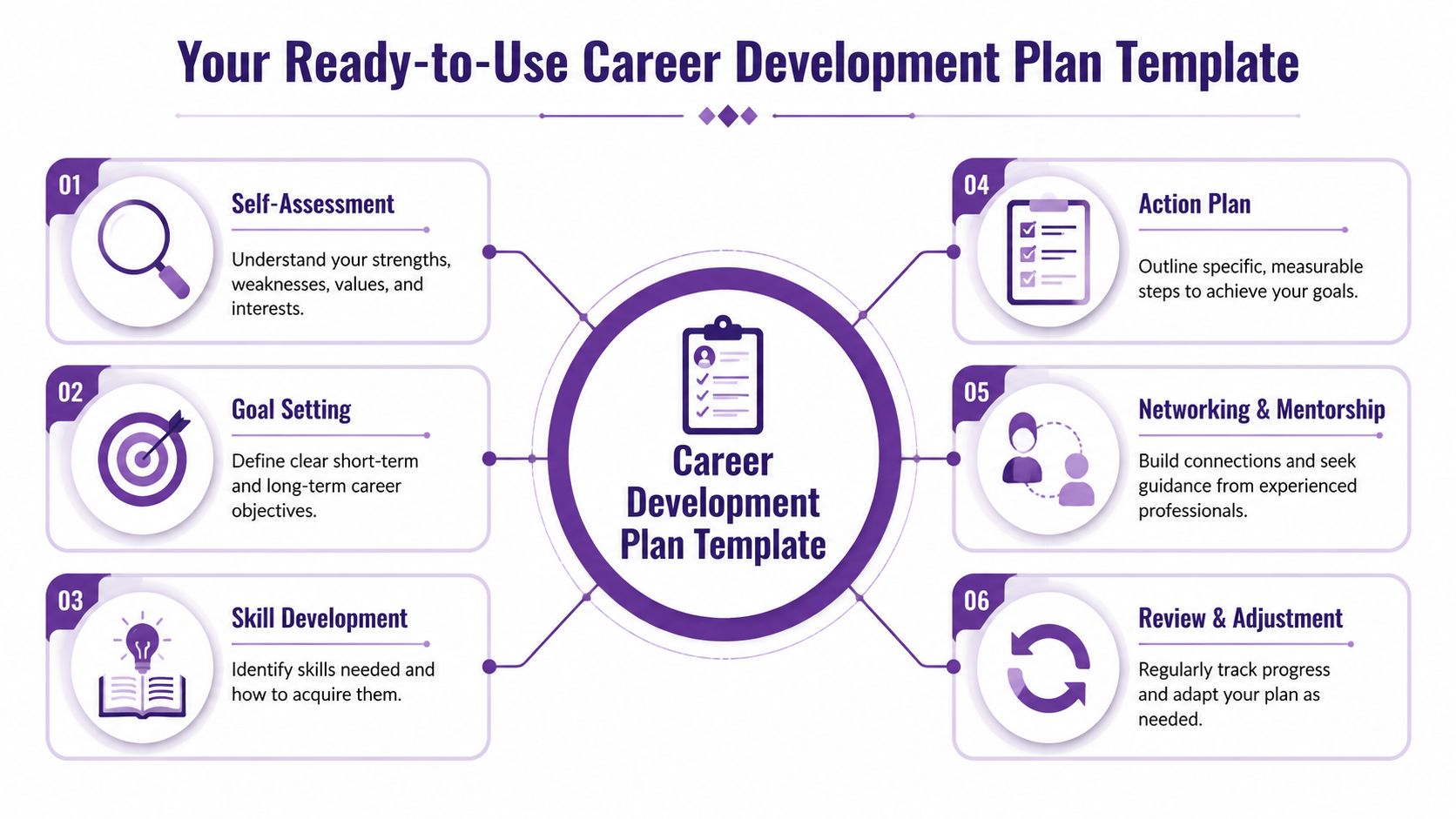
The template
Use this as a working draft, not a one-time worksheet.
Part 1. Current state
Start with what is true now.
Current role or work mix
Write the simplest accurate description of what you do today. If you wear multiple hats, list the mix.Core strengths
Name the skills people already trust you for.Current proof of capability
List portfolio pieces, published work, major projects, testimonials, repeat clients, or responsibilities that show what you can already do.Skills to strengthen
Focus on the gaps that are limiting your next move.Constraints
Time, money, geography, burnout risk, family commitments, lack of access, or confidence gaps. Put them on paper so they can be designed around.
Part 2. Career outcome
Now define where you're headed.
| Field | What to write |
|---|---|
| Target direction | A role, niche, business model, or type of work you want to move toward |
| Why it fits | Your values, interests, strengths, and lifestyle goals |
| Success picture | What “working” looks like in practice |
| Transferable assets | What from your current work carries forward |
For creators, this section often works better when you describe a type of contribution instead of locking yourself into a title too early. “Build and lead narrative content systems for entertainment brands” is often more useful than obsessing over one exact job label.
Part 3. Development plan
The template becomes useful instead of aspirational.
Break the gap into action areas:
Skill building
What do you need to learn or improve through courses, deliberate practice, stretch projects, or repetition?Experience building
What real work will prove that capability? Creative careers advance on evidence, not declarations.Visibility building
What needs to be seen by the right people? This could mean a sharper portfolio, thought leadership, strategic collaborations, or better packaging of your past work.Timeline and milestones
Add deadlines, checkpoints, and signs that each action is complete.
A career plan should answer, “What will I do next week?” not just “What do I want eventually?”
Part 4. Support network
Creative careers stall when people assume they have to figure everything out alone.
Add a support matrix with:
- Mentors or advisors who can spot weak thinking
- Peers who can give honest craft feedback
- Gatekeepers or buyers who influence opportunities
- Communities where your target work is visible
- Tools and resources that reduce friction
This part matters because progress rarely comes from effort alone. It comes from effort that's visible, guided, and connected.
Keep the template lean enough to use
The best career development plan template is not the most detailed one. It's the one you'll revisit.
If your document feels heavy, shrink it. Keep only the fields that sharpen decisions. A plan should create motion, not paperwork.
From Blank Template to Actionable Roadmap
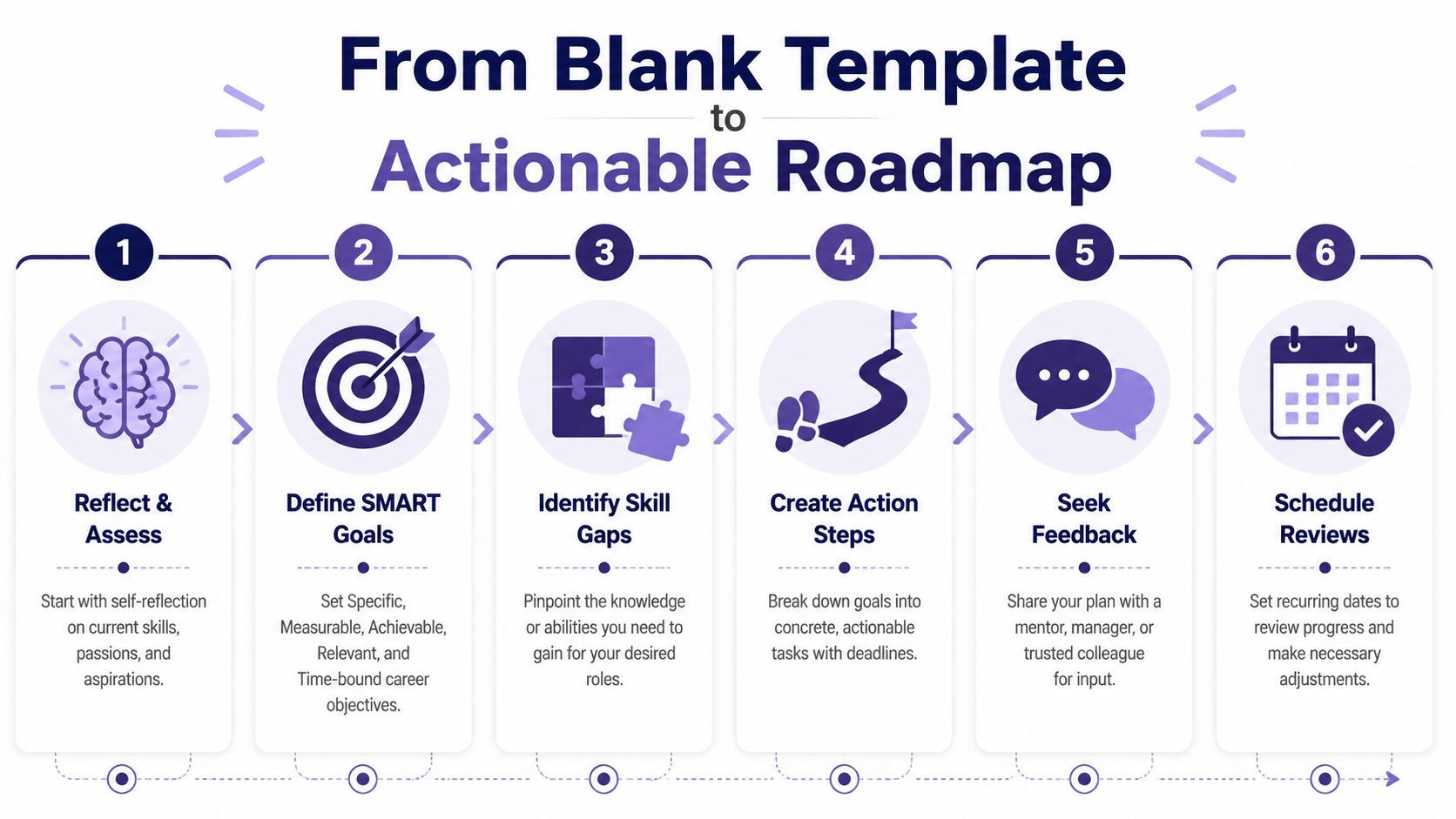
A blank template can still intimidate smart people. Not because they don't care, but because self-assessment is hard when you're close to your own work.
Modern career planning works best when you start with a structured baseline and then validate it with outside input. Current guidance also recommends narrowing focus to 1-3 key development areas at a time so you don't try to reinvent your whole career in one pass (career planning guidance from monday.com).
Start with a brutal but useful inventory
Before you set goals, audit the work.
Ask yourself:
- What do people consistently hire or recommend me for
- Which projects gave me energy
- Where do I produce strong work but still move too slowly
- What type of feedback shows up repeatedly
- Which part of my portfolio feels accidental rather than intentional
This is the point where creative professionals often discover the mismatch. They may want to be known for strategy but most of their public work signals execution. Or they want bigger narrative projects but their portfolio overrepresents small tactical gigs.
A planning document is only honest if the inventory is honest.
Write goals that can survive real life
Vague goals feel inspiring for about two days. Then they collapse.
“Become more established.” Too vague.
“Do more creative work.” Also too vague.
“Shift from client-only editing into story development by building a portfolio of narrative samples, seeking feedback from industry peers, and pitching for adjacent assignments.” Better. It creates decisions.
If you struggle to bridge ambition and execution, this article on turning life aspirations into a career path is a useful prompt for translating broad desire into something operational.
Use a short filter before keeping any goal:
- Can I tell if it happened
- Can I identify the next concrete action
- Does it connect to the direction I named
- Can I gather evidence of progress before any title change
Limit your focus on purpose
You don't need a massive development agenda. You need strategic focus.
Pick 1-3 key development areas. That's enough to create meaningful movement without scattering your attention. For a creator, those areas might look like this:
| Development area | Example |
|---|---|
| Craft | Sharpen long-form storytelling, interviewing, editing, or on-camera performance |
| Business | Improve pricing, packaging, negotiation, or client retention |
| Positioning | Clarify niche, rebuild portfolio, or publish work that attracts the right audience |
That kind of limit is not restrictive. It's protective. It keeps your plan from turning into a guilt list.
Here's a visual guide that pairs well with the worksheet approach:
Validate your self-view with other people
Creative professionals are notorious for blind spots. Some underrate themselves. Others overestimate what their current portfolio proves.
That's why external validation matters. Ask a mentor, editor, manager, collaborator, or trusted peer questions like:
- What am I strongest at right now
- What work do you think I'm ready for that I'm not pursuing
- Where do you still see hesitation, inconsistency, or missing proof
- If you were hiring me for my next-level work, what would you need to see
Don't ask for generic encouragement. Ask for calibration.
You'll usually get the most useful responses when you share a draft plan and ask for commentary on specifics. That also makes it easier to turn advice into action.
If your work involves multiple moving parts, this kind of disciplined planning process looks a lot like a production workflow. The same logic used in a strong project plan document applies here. Clear objective, visible dependencies, deadlines, and accountable follow-through.
Turn the draft into a live roadmap
Once you've gathered feedback, rewrite your plan in active language.
Instead of “improve networking,” write “reconnect with former collaborators, request focused conversations with people already doing the kind of work I want, and document insights after each conversation.” Instead of “build credibility,” write “publish samples that signal the exact type of work I want more of.”
That shift matters. A career development plan template becomes useful when each line produces a real decision.
Career Plan Examples for Creators and Pivots
Templates feel abstract until you see how they adapt to different kinds of ambition.
That's where most career advice falls short. It assumes one target role, one company ladder, and one manager reviewing your progress. That model doesn't fit many modern careers, especially for creators and pivots. That gap matters because a LinkedIn analysis cited by Leapsome found 75% of hirings in 2024 were for people outside the target industry, which makes planning around transferable skills more important than planning around a single ladder (Leapsome on career development plan templates).
Example one for a creator moving up a familiar path
A content marketer wants to move into a director-level leadership role. This is still a career shift, but the shape is recognizable.
Current state
They're strong at editorial planning, campaign execution, and cross-functional collaboration. Their proof includes published campaigns, process ownership, and team coordination. Their weakness is strategic leadership visibility. They've done the work, but they haven't consistently shown executive-level thinking.
Career outcome
They want to lead content strategy across a broader brand function, not just manage output. The role they're moving toward requires stronger planning authority, stakeholder communication, and team development.
Development plan
Their action steps focus on leading bigger planning conversations, documenting strategic recommendations, mentoring junior contributors, and building evidence that they can think beyond channel execution.
Support network
They identify one senior leader for strategic feedback, one peer in an adjacent department for collaboration, and one outside community where they can sharpen their leadership language.
This kind of plan works because the next step is adjacent. The gap isn't “become a different person.” It's “prove readiness at a larger scope.”
Example two for a non-linear creative pivot
Now take a YouTuber who wants to move into screenwriting.
Standard templates often break under certain conditions. There may be no manager. The next title may not be the right anchor. The existing work may be relevant, but only if translated well.
Current state
The creator already understands audience tension, pacing, hooks, episode structure, and revision under deadline. They may also have experience directing collaborators, shaping narratives from raw material, and sustaining a voice across a series.
Career outcome
Instead of writing “become a screenwriter” and stopping there, the plan names a more useful target. Build a credible body of narrative writing, develop relationships inside scripted storytelling circles, and create samples that demonstrate command of scenes, character, and long-form structure.
Transferable skills matter more than titles
For a pivot like this, the most important section in the career development plan template is often the one people skip: transferable assets.
A YouTuber may not have formal screenwriting credits, but they may already have:
- Narrative instincts from scripting episodes
- Audience awareness from publishing to real viewers
- Editorial discipline from working to recurring deadlines
- Production fluency from collaborating with editors, talent, or crews
That doesn't mean the pivot is automatic. It means the plan should be built around converting existing strengths into credible evidence for the new arena.
If your next step doesn't have a neat job title, define the work, the proof, and the circle you need to enter.
In this kind of plan, the milestones might include writing new sample pages, joining peer feedback groups, studying produced scripts, and making the body of work legible to people in the field.
Brand clarity helps here too. When your portfolio spans formats or industries, your presentation needs to unify the throughline. This guide to a brand management strategy template is useful for thinking through how your public identity supports a career transition.
The template bends if the thinking is solid
That's the lesson from both examples.
The same planning structure can support a director promotion, a creative pivot, a freelance expansion, or a portfolio career. What changes is the target, the proof required, and the network you need around you.
Implementing and Measuring Your Career Growth
A career development plan is only valuable if it stays in motion.
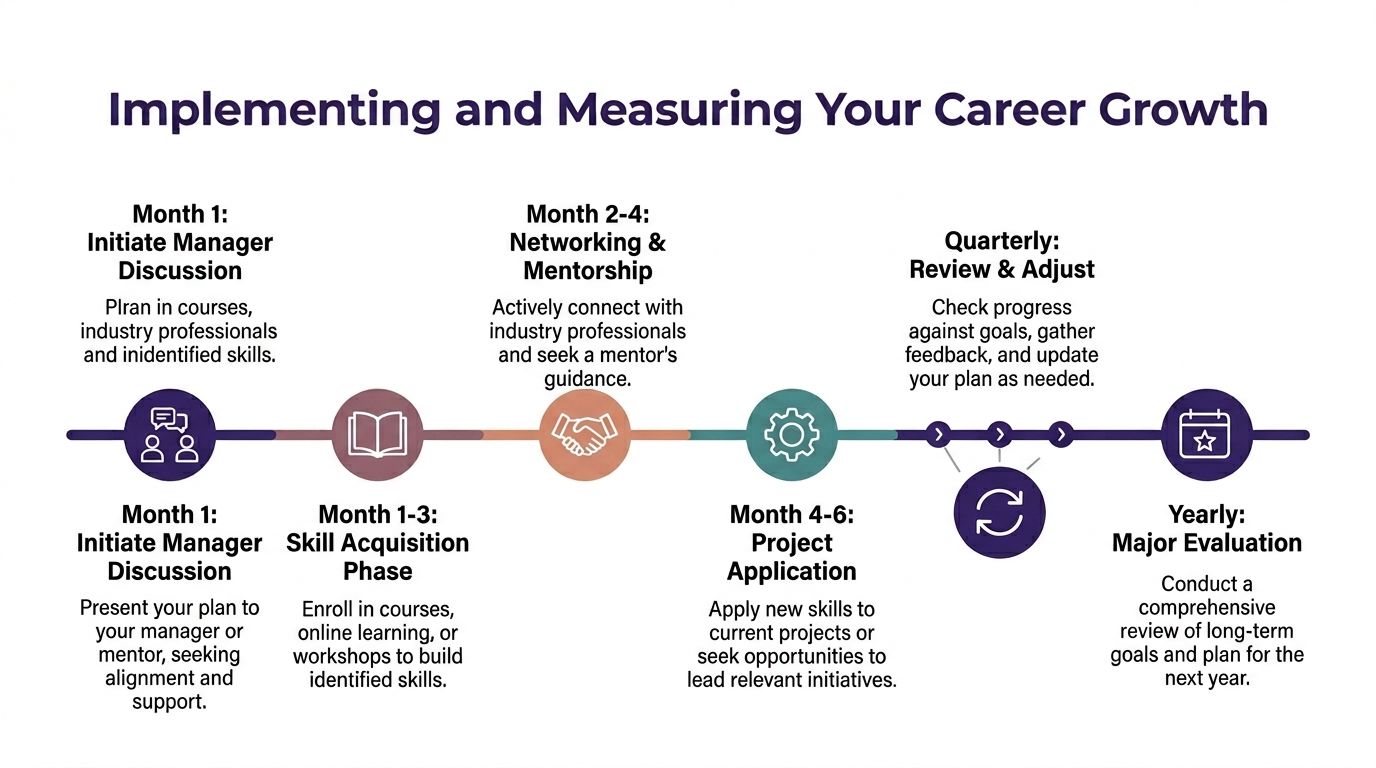
The most effective plans are measurable and time-bound. Leading templates recommend setting 3-5 goals per review cycle and using a review cadence of weekly reviews (15 minutes), monthly check-ins (30 minutes), and quarterly deep dives (1 hour) to keep progress visible and relevant (Atlassian Confluence career development plan template).
Use a review rhythm that matches real work
That cadence works because each review has a different job.
Weekly review
Keep it short. Check whether you completed the next actions you assigned yourself. If not, identify the blockage.Monthly check-in
Look for pattern shifts. Are your actions producing better work, better proof, stronger relationships, or sharper positioning?Quarterly deep dive
Reassess the plan itself. Your direction may still be right while your methods need to change.
This rhythm matters a lot for creators because the workweek can blur. Without a review system, urgent tasks crowd out developmental work every time.
Measure progress with evidence, not vibes
Don't rely on how motivated you feel. Track proof.
A simple measurement table works well:
| Goal | Evidence of progress | Review question |
|---|---|---|
| Build stronger samples | New portfolio pieces, revised scripts, improved case studies | Does this work better represent where I'm going? |
| Increase strategic visibility | Better pitches, meeting ownership, thought pieces, speaking opportunities | Are the right people seeing the right capabilities? |
| Strengthen network quality | More relevant conversations, introductions, collaborations | Am I getting closer to the circles that matter? |
For job-search moments, presentation matters too. Once your proof improves, your materials should reflect it clearly. A tool like an AI resume builder can help translate your experience into stronger positioning if you're applying for roles, fellowships, or contract opportunities.
Bring other people into the process
If you have a manager, don't drop a fully formed plan on their desk and ask for approval. Bring them into a focused conversation.
Try this structure:
- State the direction you're working toward.
- Show the evidence gap you've identified.
- Name the development actions you're taking.
- Ask for specific support, such as stretch assignments, feedback, introductions, or visibility.
If you don't have a manager, use the same structure with a mentor, creative partner, mastermind group, or trusted peer.
Progress improves when someone else can see what you're trying to build.
Protect the plan from perfectionism
A career plan often fails for one of two reasons. It's either too vague to act on, or too elaborate to maintain.
Keep it simple enough to update. Your job is not to design a flawless system. Your job is to build one that survives ordinary weeks, changing priorities, and the occasional messy month.
Common Questions About Career Development Plans
What if my manager doesn't support my goals
Don't wait for perfect support to start planning. Build a version of the plan you can control.
Focus on skills, proof, and relationships that are portable. If your current workplace won't sponsor your growth, you can still gather evidence through side projects, cross-functional collaboration, peer feedback, and stronger public-facing materials. The plan becomes your private operating document until the environment catches up or you move.
How should freelancers or solopreneurs use a career development plan template
Treat yourself as both the talent and the manager.
That means your plan should include craft goals, business goals, and visibility goals. A freelancer's growth often depends less on promotion and more on better positioning, better offers, better clients, and better influence. Your review process should look at what work you're attracting, what work you're overdelivering on, and what work you want to stop doing.
What if I don't know my next job title yet
That's normal in creative and non-linear careers.
Build the plan around capabilities, proof, and direction instead of a single title. Define the kind of problems you want to solve, the type of work you want to be hired for, and the evidence that would make you believable in that space. Titles can come later.
How do I know the plan is working if my role doesn't change
This is one of the most important questions. Most templates don't give a strong answer.
Recent guidance highlights that evidence beyond promotion matters, especially as skill requirements shift. The World Economic Forum's jobs report, as cited in Stonebridge, says 59% of workers will need training by 2030, which makes signals like project outcomes, portfolio artifacts, and peer feedback more useful indicators of growth than waiting for a title change alone (Stonebridge on career development plan templates).
Look for signs like these:
- Better proof through stronger samples, case studies, or finished work
- Better feedback from peers, clients, collaborators, or mentors
- Better access to rooms, projects, or conversations you weren't in before
- Better alignment between what you want and what your work now demonstrates
If those are improving, the plan is working.
A good career plan doesn't just help you think. It helps you organize what you already know, surface what you've already built, and turn scattered effort into a clearer body of value. That's why Contesimal makes sense for creators and content teams with large bodies of work. It helps you classify, search, and collaborate around your existing library so your past output becomes easier to reuse, reframe, and build on. If your career is shaped by what you've made, better access to that archive can become a practical advantage.