
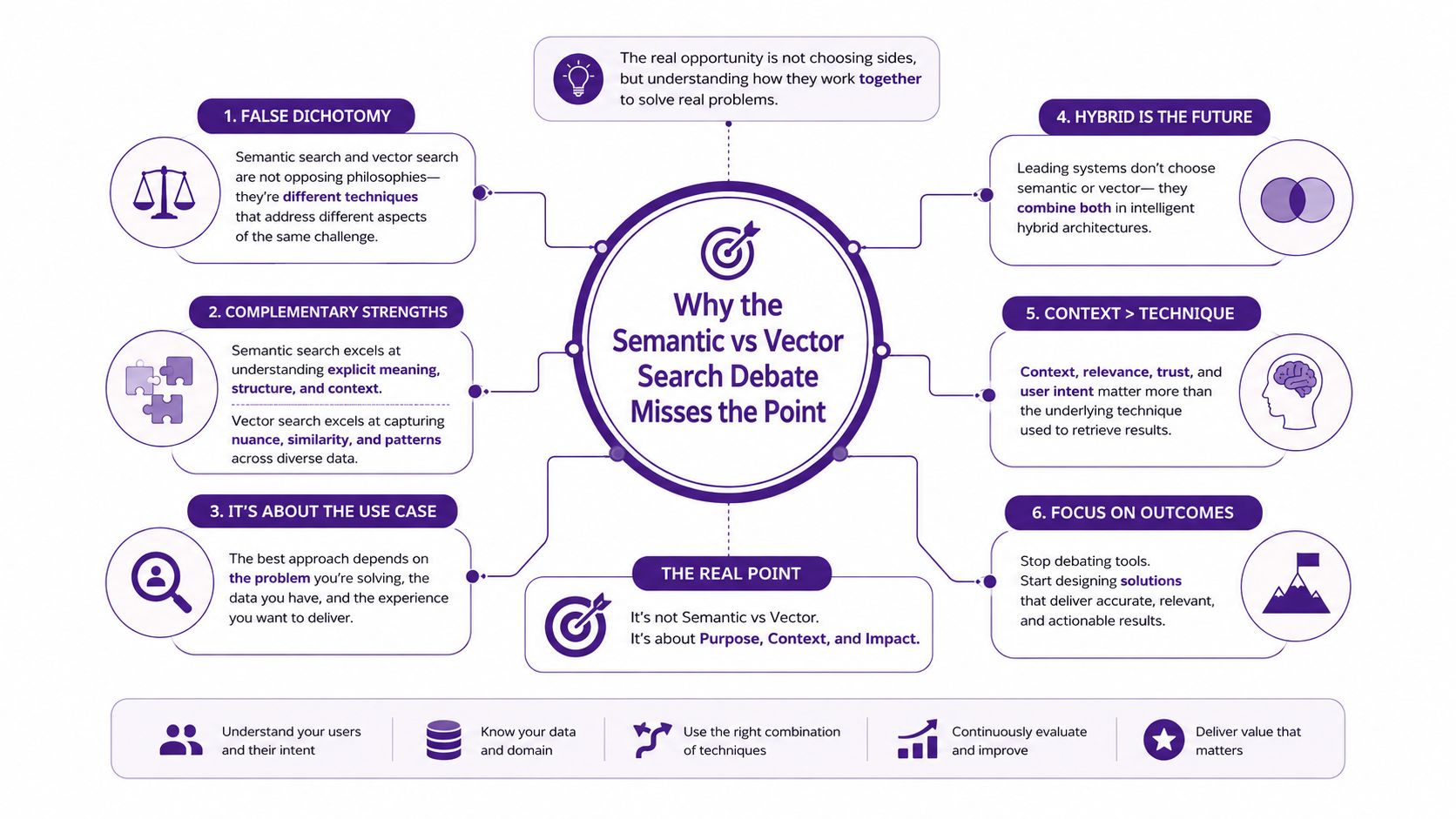
The popular advice says semantic search and vector search are competing choices. That framing is wrong often enough to cause expensive architecture mistakes. Semantic search describes the experience you want, finding content by meaning and intent. Vector search describes one retrieval mechanism that can help produce that experience.
In a production system, the practical choice usually isn't semantic search or vector search. It's whether you need lexical matching, dense retrieval, reranking, metadata filters, and possibly agentic tool selection working together. A creator searching a podcast archive for a concept needs a different signal from an editor searching for an exact product name, API identifier, speaker, or title.
This matters for anyone managing a growing library of transcripts, videos, articles, research notes, books, or campaign assets. Better retrieval doesn't just answer a query. It helps a team organize old work, discover connections, and turn existing material into new content across platforms.
Why the Semantic vs Vector Search Debate Misses the Point
The most common textbook answer is that semantic search understands meaning while vector search finds nearby embeddings. Technically, that distinction is useful. Architecturally, it can mislead you. Most systems marketed as semantic search now use vector similarity somewhere in the retrieval path, then add query processing, filtering, fusion, or reranking around it.
The honest distinction is outcome versus mechanism. Semantic search is judged by whether the returned results satisfy the user's intent. Vector search is judged by whether an index can retrieve mathematically similar representations efficiently. One describes the destination. The other describes part of the road.
Production retrieval is layered
A search stack commonly combines:
- Sparse lexical retrieval, often through BM25, for exact titles, names, codes, dates, and rare terms.
- Dense retrieval, using embeddings to find paraphrases and conceptually related passages.
- A reranker, often a cross-encoder, to inspect query and candidate text together and improve ordering.
- An agentic layer, where a language model may decide whether to search, rewrite a query, apply a filter, or call another tool.
Pure vector search can miss a canonical document because the embedding model interprets a proper noun as a broader concept. Pure lexical search can miss a useful passage because the author used different wording. Neither failure means the underlying technology is useless. It means the system asked one signal to solve a problem that requires several.
Design rule: Choose retrieval components based on query failure modes, not on the label attached to the product.
The history also argues against treating vector retrieval as a brand-new synonym for semantic search. Semantic-web work traces to Tim Berners-Lee's 1999 introduction of the semantic web idea, while one account places practical semantic-search pioneers in 2004. Google launched its Knowledge Graph in 2012, reportedly beginning with 500 million entities and 3.5 billion relationships in this history of semantic search. Vector search has older theoretical roots, reaching back to the 1950s, with later advances including latent semantic analysis and word2vec in 2013.
The rest of this guide treats semantic search and vector search as parts of a retrieval system. That's the model that survives contact with real content libraries.
What Semantic Search Actually Does Under the Hood
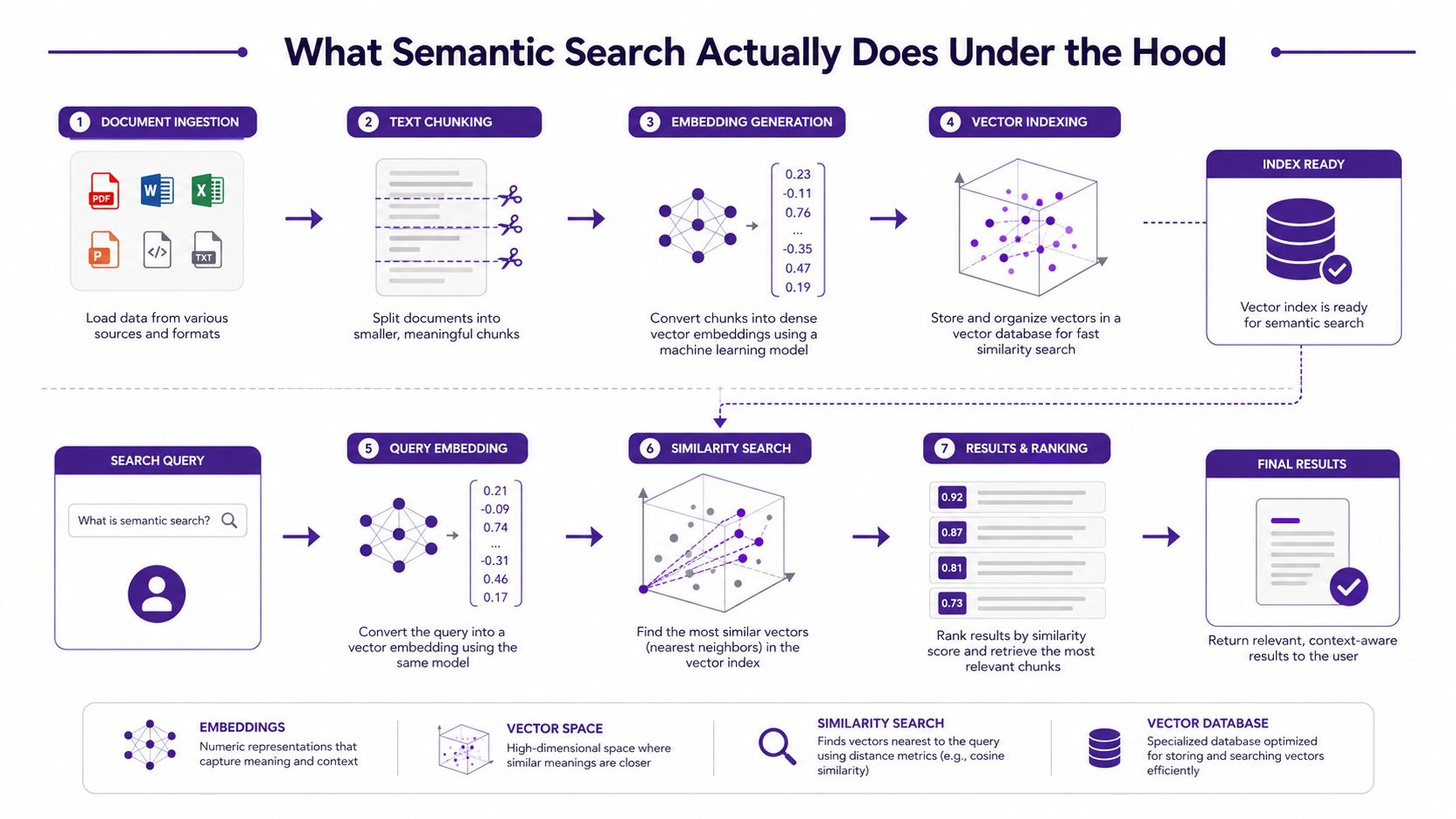
Semantic search is an outcome, not a single algorithm. A system delivers semantic behavior when it returns content that matches the user's intended meaning, even when the query and document don't share the same wording.
A typical request passes through several decisions:
- Query understanding identifies the likely intent, entities, constraints, and conversational context.
- Normalization cleans spelling, punctuation, casing, and common variants.
- Expansion or rewriting may add related terms, translate a question into a search form, or split a complex request.
- Representation converts the query into a form a retriever can compare with indexed content.
- Candidate retrieval gathers potentially relevant documents.
- Reranking evaluates the query against each candidate with a richer model.
- Presentation returns results with snippets, metadata, timestamps, or citations.
The representation step often uses embeddings, which is why people regularly collapse semantic search into vector search. For a practical grounding in language processing concepts that influence search interpretation, the NLP SEO guide is a useful companion.
Meaning still needs a retrieval mechanism
A semantic system doesn't have to use a vector database. A cross-encoder can score every query-document pair directly, although that approach becomes costly as the candidate set grows. A knowledge graph can resolve entities and relationships. A carefully designed lexical system with synonym expansion can produce semantic behavior for a narrow domain.
The reverse is also true. A vector system isn't automatically semantic. If you embed arbitrary hashes, poor text chunks, or mismatched data with a weak model, cosine similarity still returns neighbors, but those neighbors may not reflect user intent.
That distinction makes evaluation more honest. Judge the system by relevance, ordering, coverage, freshness, and user task completion, not by whether the vendor calls the index semantic. A search engine can return a close vector match that answers the wrong question. Conversely, a lexical result can be the best answer when the user enters an exact title.
For content teams, the difference appears in ordinary requests. “Find every discussion about reducing production delays” demands conceptual matching. “Find the episode mentioning Project Atlas” demands exact entity handling. Both are semantic tasks in the broad human sense, but they need different retrieval signals. The semantic search versus keyword search guide offers a useful framing for that distinction.
What Vector Search Actually Does Under the Hood
Vector search turns content into numerical representations and retrieves items that sit close to a query representation. The process is mechanical, even when the resulting behavior feels intelligent.
The indexing path
At ingestion time, a pipeline usually:
- Splits documents, transcripts, or pages into retrievable chunks.
- Chooses an embedding model suited to the language and domain.
- Generates a dense vector for each chunk.
- Normalizes vectors when the selected similarity function requires it.
- Stores vectors with document IDs, metadata, and source versions.
- Builds an approximate nearest-neighbor index.
A production index may use structures such as HNSW, IVF-PQ, or ScaNN. These indexes avoid comparing a query with every stored vector. They trade some exhaustive accuracy for lower search latency, which is why a vector benchmark should compare systems at the same recall target rather than at raw speed alone. Practical vector-search benchmarking guidance recommends latency-versus-recall analysis and p50, p95, and p99 measurements under realistic filtering and concurrent read/write conditions.
At query time, the system embeds the incoming text with the same model, searches the ANN index, applies filters, and returns the nearest candidates by cosine similarity or inner product.
| Component | What It Does |
|---|---|
| Chunker | Creates retrievable passages from source content |
| Embedding model | Maps text or other content into a dense vector |
| Vector index | Makes nearest-neighbor lookup practical |
| Similarity function | Scores geometric closeness between query and candidate |
| Metadata store | Preserves titles, dates, authors, timestamps, and permissions |
| Filter layer | Removes candidates that violate task constraints |
| Fusion or reranker | Combines signals or improves final ordering |
Similarity isn't understanding
Two sentences can express nearly identical ideas yet land farther apart than expected. The model may emphasize different entities, sentence structure, domain vocabulary, or surrounding context. Chunk boundaries can also separate the evidence needed to interpret a passage.
Embedding generation adds another operational cost. Every new or edited chunk may need reprocessing, and a model change can require rebuilding the collection. A larger vector representation can increase memory and storage pressure, while aggressive ANN settings can reduce recall. Those trade-offs don't appear in a simple “semantic versus keyword” feature list.
Vector search is therefore best treated as retrieval infrastructure. It gives a system a powerful way to find approximate conceptual neighbors. It doesn't decide whether a result is authoritative, current, exact, permitted, or useful for the user's actual task.
Side by Side on the Criteria That Matter
A design review shouldn't ask which label sounds more advanced. It should ask which signal handles the queries your users submit, and what happens at the tail of the latency distribution.
| Criterion | Semantic Search | Vector Search |
|---|---|---|
| Query interpretation | Focuses on intent, context, paraphrase, and task meaning | Encodes the query and retrieves nearby representations |
| Ranking signal | May combine lexical, dense, behavioral, graph, and reranking signals | Usually cosine or inner-product similarity over indexed vectors |
| Latency profile | Varies by query processing, candidate retrieval, and reranking depth | Depends on embedding time, ANN settings, filters, and index size |
| Cost profile | Can include rewriting, multiple retrieval passes, and reranking | Includes embedding generation, vector storage, and ANN infrastructure |
| Explainability | Can expose matched terms, entities, filters, and rationale signals | Similarity scores alone are difficult to interpret |
| Cold start and rare terms | Can use lexical rules or entity handling when embeddings lack evidence | Often struggles with unseen identifiers, exact names, and sparse context |
Query interpretation
Semantic search has a broader contract. It may recognize that “how did the host fix the launch delay?” asks for a process and an event, not merely pages containing those words. But that interpretation still needs retrieval. In many systems, the semantic layer calls a dense retriever and then a reranker.
Vector search starts with less context. It receives a vector and finds neighbors. That makes it predictable and composable, but it won't know that a product code must match exactly or that a newer policy should outrank an older explanation.
Latency and cost
Don't publish a single latency number and call the system production-ready. Measure p50, p95, and p99 under real concurrency, metadata filters, index refreshes, and mixed reads and writes. ANN benchmarks commonly use latency-versus-recall curves because a faster query that loses relevant candidates isn't necessarily a better query as documented in benchmarking practice. The same source also emphasizes that read-only throughput on a freshly built index can misrepresent live behavior.
Embedding calls add work before vector lookup. Semantic pipelines can add query expansion and reranking on top. Lexical retrieval is often cheaper and easier to explain, but it can't bridge every vocabulary gap.
Explainability and cold start
A BM25 match can show the title or phrase that triggered it. A dense similarity score rarely tells an editor why two passages were considered close. Cold-start content creates another split. A new document with strong exact terms may perform well lexically before its vector is available, while vector retrieval needs a completed embedding and index update.
For libraries that combine search with editorial workflows, the document search engine overview is relevant because retrieval quality depends on metadata, organization, and the actions users take after finding a result.
Senior-engineer verdict: Dense retrieval improves coverage, but lexical retrieval protects precision. If your library contains names, codes, titles, or dates, pure vector search is an unnecessary risk.
The Tradeoffs Nobody Plots for You
Vendor dashboards turn retrieval into a speed contest. Production systems expose a harder question: how much recall begins to fall as latency improves, and whether that threshold survives busy indexes, filters, and updates.
The curve has a knee
Run the same judged query set through BM25-only, dense-only, and hybrid configurations. Set the recall target first, then vary ANN search breadth, candidate counts, reranker depth, and filter behavior. The useful operating point is usually the knee of the curve, where extra latency no longer produces meaningful relevance gains.
Corpus shape changes that point. A transcript archive with paraphrased speech may benefit from dense candidates. A library of named projects and exact titles may gain more from sparse retrieval. Hybrid retrieval can allocate capacity by query class instead of sending every request through the most expensive path.
The costs arrive in layers
Embedding generation consumes compute when content changes and when queries need encoding. Vector indexes require memory and disk, with usage increasing as dimensionality and corpus size grow. Rerankers add inference work and can dominate tail latency when candidate sets expand.
A news archive can expose the failure mode during reindexing: refresh work evicts warm data from cache while searches continue, so p99 latency rises sharply and some recently changed documents remain unavailable. A quiet benchmark misses both effects. The same production test should cover:
- Freshness lag: Time between source ingestion and queryability.
- Update contention: Behavior during simultaneous indexing and searching.
- Cold-cache performance: Results after restart or reindexing.
- Model consistency: Whether old and new embeddings remain comparable.
- Rare-entity recall: Performance for names, codes, versions, and unusual phrases.
Embedding model drift can change rankings even when source content stays unchanged. Edited transcripts can retain stale vectors if deletion and replacement are not atomic. Reindexing can impose a cold-cache penalty that users experience as slow or incomplete search.
Operational rule: Derived indexes belong in background pipelines, not in the foreground request path.
The threshold flips when a missed result costs more than the additional infrastructure. Dense-only can fit casual discovery, especially when approximate topical matches are acceptable. Research archives, support systems, and publishing workflows usually need exact passages as well as conceptual matches, making sparse-plus-dense retrieval with reranking the safer production default. Pure vector search stops being the default once names, identifiers, freshness, or auditability carry more weight than broad semantic recall.
How Hybrid Retrieval Fits These Two Together
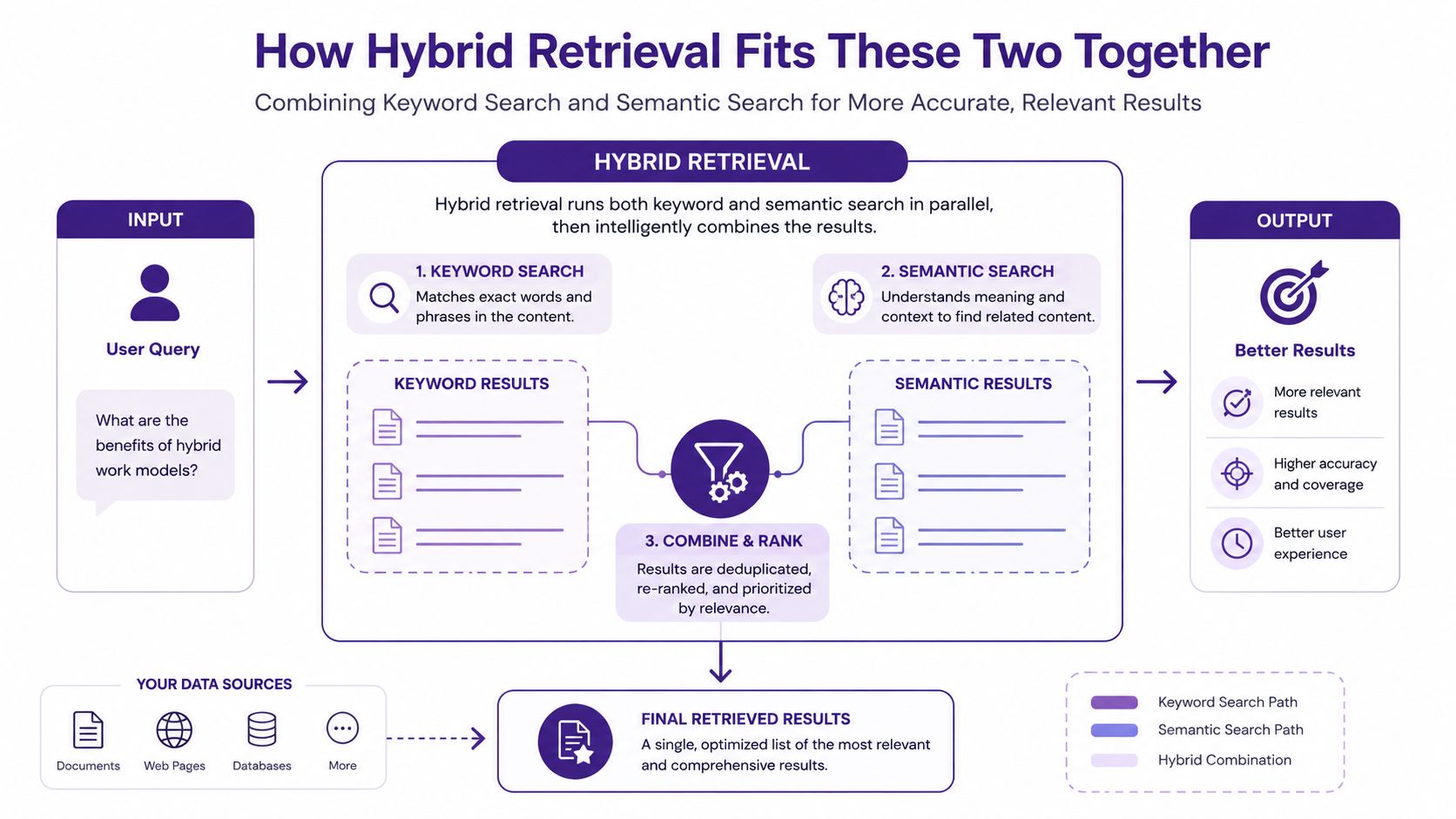
Hybrid retrieval isn't just “run keyword and vector search.” It is a staged system in which each layer has a narrow responsibility.
BM25 or sparse lexical retrieval contributes precision. It catches exact titles, proper nouns, product identifiers, dates, error messages, and phrases that an embedding model may smooth into a broader concept. Its weakness is vocabulary mismatch. A user can ask for “cutting production delays” while the document says “shortening the release cycle,” and lexical matching may miss the connection.
Dense retrieval contributes semantic recall. It finds related language, paraphrases, and conceptually similar passages. Its weakness is exactness. A vector can place a broad discussion near a specific named entity, especially when the entity is rare or the chunk contains little context.
A cross-encoder reranker contributes ordering. It reads the query and candidate passage together, then decides which candidates deserve the highest positions. It can improve the final list, but it adds inference work, so the candidate set and latency budget need deliberate limits.
Fusion choices matter
Teams commonly merge result lists with Reciprocal Rank Fusion, which rewards candidates appearing near the top of multiple lists without requiring scores from different systems to be directly comparable. Score normalization can work when both scoring distributions are stable, but it requires more calibration and monitoring.
Fan-out strategy changes the trade-off. You can send the original query to both retrievers, rewrite it before one branch, or produce several query variants and merge their candidates. More fan-out can improve coverage while increasing embedding, retrieval, and reranking work.
For podcast transcripts, dense retrieval can surface a discussion despite paraphrased speech, while lexical matching protects show names and guest names. For a video archive, timestamps and speaker metadata should remain first-class filters. For a long research project, exact terminology may matter in one workflow while conceptual discovery matters in another.
The same library may therefore use several retrieval profiles. A “find the source for this claim” task should favor precision and provenance. A “generate the next episode from related ideas” task can favor semantic breadth. An agent that chooses between those tasks adds another boundary, it must select tools, rewrite queries, and decide when the retrieved evidence is sufficient.
Hybrid retrieval has become the practical answer because it respects these different jobs. The question isn't whether vectors are semantic. The question is which combination gives each workflow the evidence it needs within its service-level objectives.
Matching the Retrieval Stack to Your Content Library
Retrieval should follow the shape of the library and the questions people ask. A content organization shouldn't impose one search mode on every archive because the infrastructure team already has one index.
| Content Library | Primary Retriever | Augmentation | Watch-Out |
|---|---|---|---|
| Podcast archives | Dense retrieval | Transcript reranking, speaker and timestamp metadata | Topic drift and speaker turns can blur chunk meaning |
| Video transcripts | Dense retrieval | BM25 for titles, names, and timestamps | Poor chunk boundaries can hide the useful moment |
| Long-running research projects | Sparse plus dense fusion | Date, author, project, and version filters | Stale vectors can surface outdated findings |
| Internal FAQs | Lexical retrieval | A vector pass for natural-language questions | Synonyms may hide the canonical answer |
| Tag-heavy knowledge bases | Lexical retrieval | Metadata filtering and selective dense retrieval | Broad embeddings can overmatch neighboring tags |
| News archives | Sparse retrieval with freshness controls | Dense retrieval for discovery | Index lag can make current coverage hard to find |
Measure the failure mode
For lexical retrieval, track Precision@k, NDCG, and MRR against human-judged queries. These metrics tell you whether relevant results appear early and whether the first result is useful.
For dense retrieval, add recall-at-latency. A dense system can preserve attractive top results while losing relevant candidates from the ANN stage. Also track p95 and p99 behavior under writes, filtering, and realistic concurrency, not just a quiet QPS test. The semantic-search field has historically lacked a standard annual benchmark, with early evaluation spread across series such as TREC Entity Track, SemSearch Challenge, and INEX in this survey of semantic search.
A podcast team should care about whether a question retrieves the right segment. A publisher may care more about exact title recovery and document freshness. An editor building playlists needs both, because discovery and verification happen in the same session.
For teams evaluating semantic search tools, the shortlist should include ingestion behavior, metadata support, index refresh controls, explainability, and export options. Search isn't finished when a result appears. The result must support the next editorial action.
Measuring What Each Approach Actually Delivers
Use metrics that expose the layer's likely failure. Precision@k, NDCG, and MRR are useful for judging whether human-relevant results appear near the top. Recall@k matters when the system must expose a broad candidate set for a reranker or an answer-generation model. Guidance on semantic-search evaluation emphasizes Recall@k and NDCG because early ranking position matters, not just retrieval somewhere in the list in this evaluation guide.
Dense systems need a second dashboard. Plot recall against latency, then record p50, p95, and p99 under concurrent reads and writes. Track indexing lag, shard-level QPS ceilings, filter behavior, cache warmth, and embedding cost per million queries. A fast ANN query isn't a win if it drops the evidence needed by the downstream answer.
Reranking introduces another measurement boundary. Judge the quality of the final answer or editorial action that consumes the retrieved passages, not only the reranker score. A candidate can rank well while lacking the context required for a grounded response.
The situational recommendation is straightforward:
- Use lexical retrieval when exact terms, freshness, or explainability dominate.
- Use dense retrieval when paraphrase, conceptual discovery, or cross-format matching dominates.
- Use hybrid retrieval plus reranking when the library contains both kinds of work, which is common for serious content teams.
- Consider tool-based or just-in-time retrieval for agentic workflows where the model can choose a targeted search tool instead of querying a vector database for every step. One reported Amazon Science AAAI 2026 result claimed agentic keyword search reached 94.5% RAG fidelity without a vector database, so vector search shouldn't be treated as mandatory in every agent architecture in this practitioner discussion.
Contesimal fits this hybrid posture by helping content organizations organize and search documents, podcasts, videos, and articles so people and AI systems can discover relationships across an existing library. Visit Contesimal to explore how your archive can support research collaboration, content planning, and the next piece of work instead of remaining a static back catalog.