
Your content library—every video, podcast episode, and blog post—is a goldmine of untapped potential. But finding the exact insight or clip you need often feels like searching for a needle in a haystack with a simple keyword search. This is where semantic search tools change the game, helping you reignite your content library and bring it back to life.
Unlike traditional search that just matches exact words, semantic search understands context, intent, and meaning. It allows you to ask complex questions and find conceptually related content, not just keyword matches. To fully grasp the power of this technology, it's essential to start by understanding the core differences between semantic search and keyword search, as this distinction is central to unlocking your library's value.
For creators transitioning from hobbyist to professional, publishers aiming to monetize archives, and marketers needing to align content across platforms, this capability is essential. It’s the key to upcycling your old content, discovering hidden connections for new ideas, and creating infinite value from the work you’ve already done.
This guide breaks down the top 12 semantic search tools that can help you organize, understand, and take action on your content library. We'll explore each platform's features, ideal use cases, and implementation needs, complete with screenshots and direct links. Our goal is to help you find the right system to transform your library from a passive archive into an active, money-making asset.
1. Contesimal
Contesimal is an AI-powered platform designed to help creators and publishers organize their content library to create new value and ultimately make money with it. It moves beyond simple file storage, offering a sophisticated system that helps you understand, organize, and take action on large libraries of documents, videos, and podcasts. Its core strength lies in its ability to help humans and AI collaborate seamlessly, turning historical content into a source for new opportunities and making it the ideal partner for creators moving from hobbyist to revenue-generating professional.

The platform distinguishes itself with a dual-interface approach that combines a chat-based research tool with a functional tooling layer. This design allows teams to conduct deep, context-aware searches and then immediately act on the findings. Users can surface thematic patterns, identify audience preferences, and pinpoint content gaps that were previously difficult to discover. By blending AI-driven insights with traditional search functions, Contesimal provides a more complete understanding of a content library, helping you figure out what new video to create next. A deeper explanation of the differences between search approaches can be found by reading more about semantic search versus keyword search on their blog.
Core Strengths & Use Cases
Contesimal is focused on revolutionizing research collaboration and enabling content library owners to expand value across their existing assets. Its operational capabilities are built for scale, supporting programmatic uploads and fast file ingestion, which is critical for publishers and studios with extensive media libraries.
- For Podcasters & YouTubers: Discover connections between past episodes to create compilation shows, generate clips for social media, or develop new content series based on successful concepts and playlists.
- For Publishers & Marketers: Take your longform content across platforms in one click. Repurpose articles, white papers, and webinars into fresh formats to generate more audience engagement and page views.
- For Researchers & Authors: Organize and query vast amounts of source material, interview transcripts, and notes to find specific concepts and build compelling narratives through collaboration.
Key Considerations: The platform does not list public pricing or detailed enterprise terms on its website. Teams interested in its full capabilities, data security protocols, and costs will need to contact Contesimal directly for a consultation. While powerful, the advanced taxonomy and tooling layer may require a brief onboarding period for teams new to AI-assisted research workflows.
- Website: https://contesimal.ai
2. Algolia NeuralSearch
Algolia NeuralSearch stands out by combining traditional keyword-based search with advanced AI-driven semantic understanding. This hybrid approach delivers exceptionally fast and relevant results, making it a strong choice for high-traffic websites and applications where user experience is paramount. Its system is engineered for speed, often returning queries in under 50 milliseconds, which is critical for e-commerce product discovery, media site navigation, and help center efficiency.
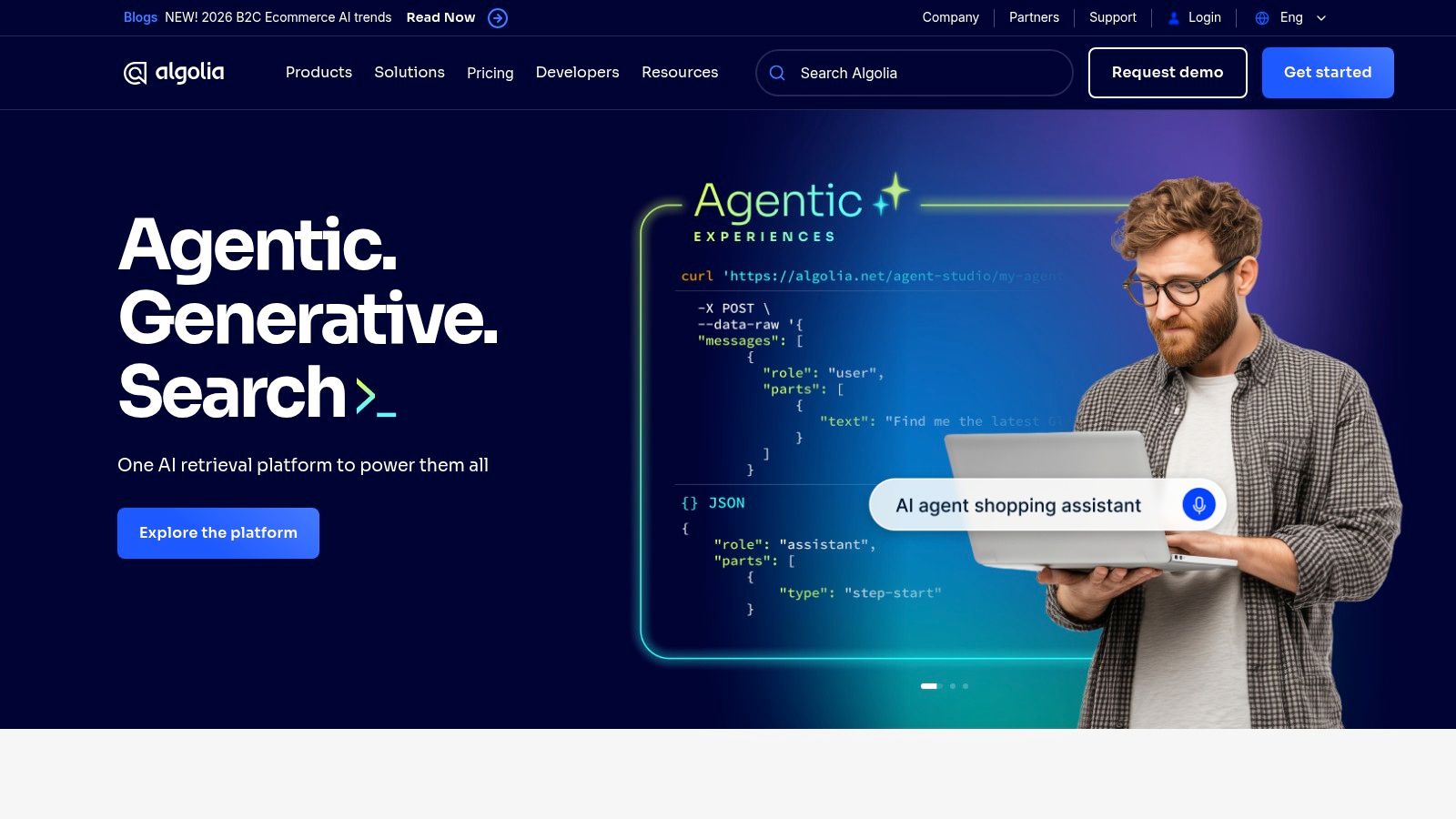
The platform’s strength lies in its mature developer ecosystem, complete with robust APIs, SDKs, and UI libraries that simplify implementation. For content marketers and publishers, this means you can build a sophisticated, intent-driven search experience into your site without starting from scratch. Algolia also offers detailed analytics and administrative tools to help you continuously refine search performance based on user behavior.
Key Details & Use Cases
- Best For: Media organizations, large-scale publishers, and content creators with high-volume platforms who need a fast, reliable site search that understands user intent beyond simple keywords.
- Pricing: Algolia's pricing model is usage-based and can become complex for organizations with very high query volumes and large numbers of records.
- Limitation: A notable constraint is that NeuralSearch is not HIPAA-enabled, which may exclude its use for certain health-related or regulated content libraries.
- Website: https://www.algolia.com
Its focus on hybrid retrieval and re-ranking makes Algolia a powerful asset among semantic search tools for creators who want to surface the most relevant articles, videos, or products instantly.
3. Elastic (Elasticsearch with ELSER + Semantic Rerank)
Elastic, widely known for the powerful Elasticsearch engine, has advanced its classic full-text search with robust semantic capabilities. Through its learned sparse encoder model, ELSER, and the option for semantic reranking, Elastic provides a unified system for hybrid search. This allows content creators and publishers to combine traditional keyword matching (BM25) with modern vector and sparse semantic search, all within a single, mature platform.
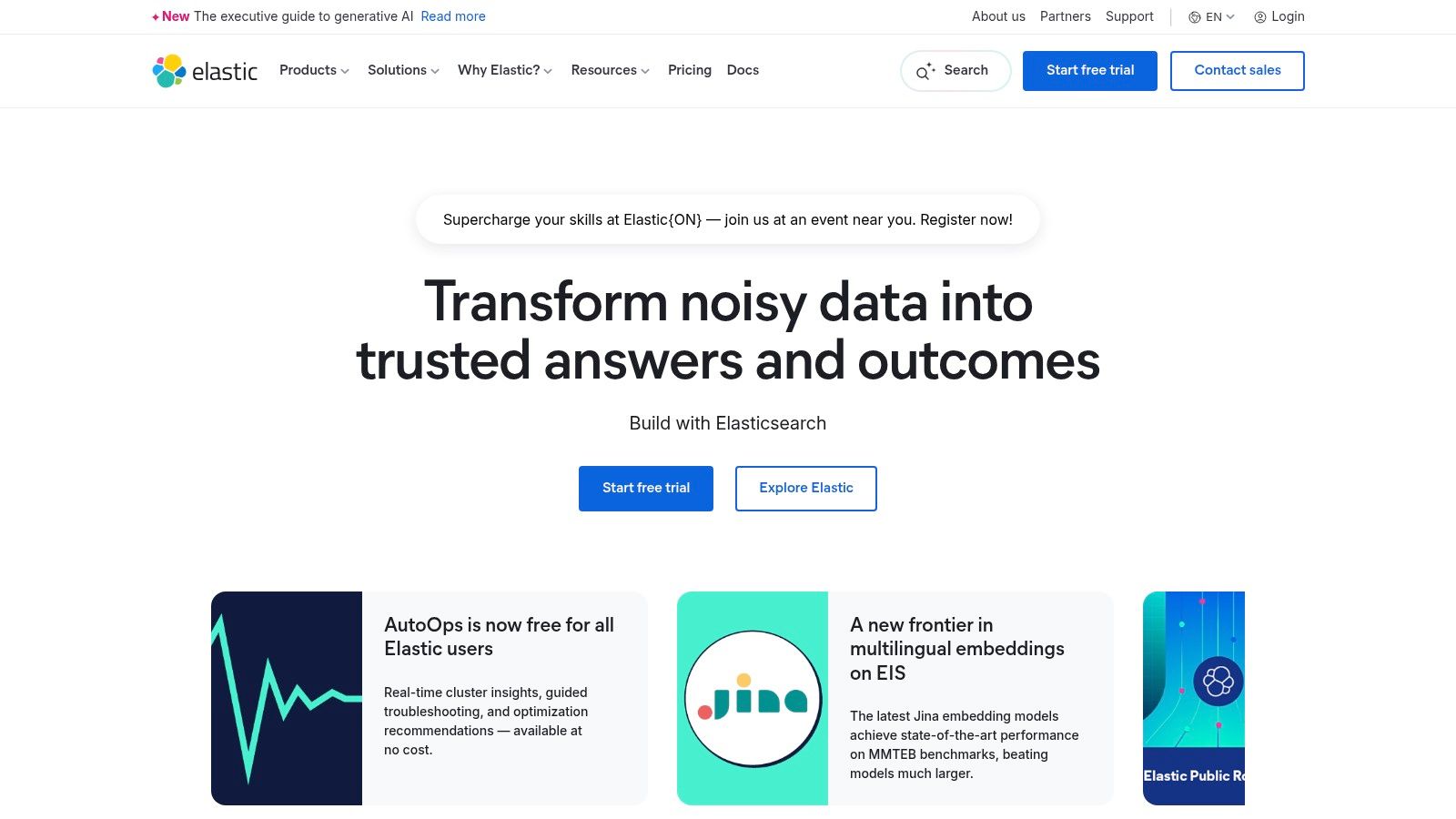
The platform’s major benefit is its all-in-one approach. For organizations managing extensive video libraries, article archives, or research databases, this means you can build complex retrieval-augmented generation (RAG) and enterprise search applications without integrating multiple services. Elastic’s tooling and first-party inference API support both its own models like ELSER and third-party models, offering flexibility. As detailed in this enterprise search software comparison, a unified engine simplifies development and maintenance.
Key Details & Use Cases
- Best For: Publishers, large content teams, and enterprises with existing technical expertise who need a single, powerful engine to handle lexical, vector, and sparse semantic search for complex applications.
- Pricing: Access to ELSER and other machine learning features requires an appropriate subscription tier. Resource and capacity planning are necessary to manage the cost of ML nodes effectively.
- Limitation: The complexity of managing ML nodes and ensuring sufficient throughput for inference can present a steep learning curve and operational overhead for smaller teams.
- Website: https://www.elastic.co
By integrating multiple search methodologies, Elastic offers one of the most versatile semantic search tools for organizations looking to create nuanced and highly relevant content discovery experiences.
4. Microsoft Azure AI Search (formerly Cognitive Search)
Microsoft Azure AI Search is a fully managed cloud search service designed for developers building rich search experiences into their applications. It stands out for its deep integration into the Azure ecosystem, making it a natural choice for organizations already invested in Microsoft’s cloud platform. The service combines traditional lexical search with modern vector search capabilities, enhanced by a Bing-derived semantic ranker that uses deep learning models to improve the relevance of search results significantly.
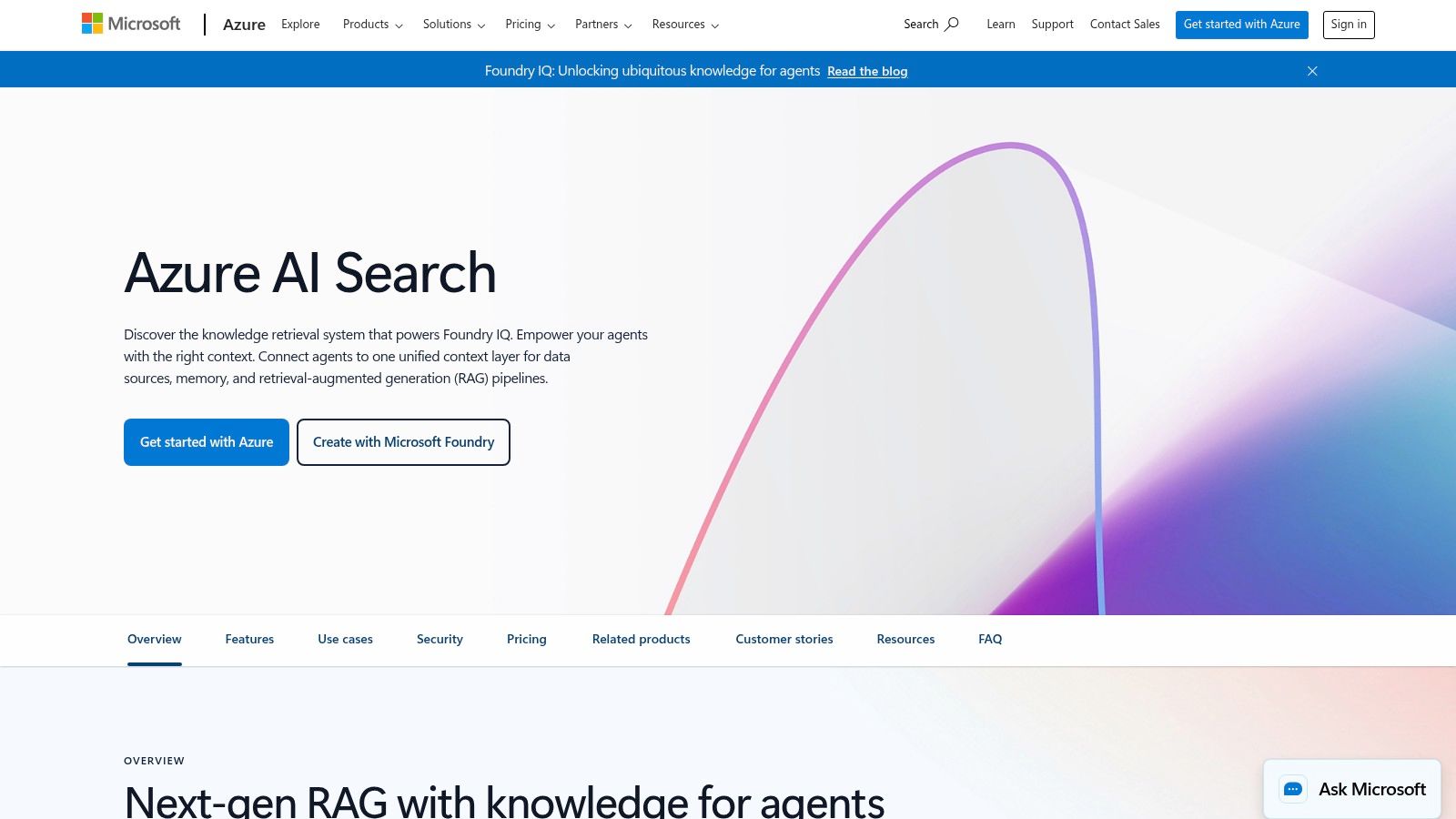
For publishers and enterprise content teams, Azure AI Search offers a powerful solution for permission-aware search across Microsoft 365, SharePoint, and OneDrive content. Its extensive connector ecosystem simplifies indexing from various data sources. The platform is also central to building Retrieval-Augmented Generation (RAG) applications by pairing it with Azure OpenAI, enabling creators to build chatbots or internal knowledge bases that query their private content libraries. Understanding the core concepts of this technology can be explored further by learning about what natural language processing is and how it powers such systems.
Key Details & Use Cases
- Best For: Enterprise content teams and publishers deeply integrated with the Microsoft/Azure ecosystem who need a secure, permission-aware search for internal documents, research materials, and SharePoint content.
- Pricing: The cost structure varies by tier and region, with the semantic ranker feature incurring extra costs after a free monthly quota is exceeded, which can complicate budget planning.
- Limitation: While powerful, its complexity and pricing model are better suited for enterprise-level projects rather than individual creators or small teams just starting to organize their content.
- Website: https://azure.microsoft.com/en-us/services/search
Azure AI Search is one of the more robust semantic search tools for organizations that require enterprise-grade security, governance, and seamless integration with existing Microsoft data sources.
5. Google Cloud Vertex AI Search (Agent Builder)
As part of its expansive Vertex AI platform, Google offers a powerful, managed enterprise search solution that allows creators and organizations to build sophisticated Q&A and search applications. Vertex AI Search is designed for those who need a turnkey way to index diverse content sources, such as websites, internal documents, and structured data, and make them discoverable through natural language queries. It excels at quickly standing up a search engine that understands context and user intent.
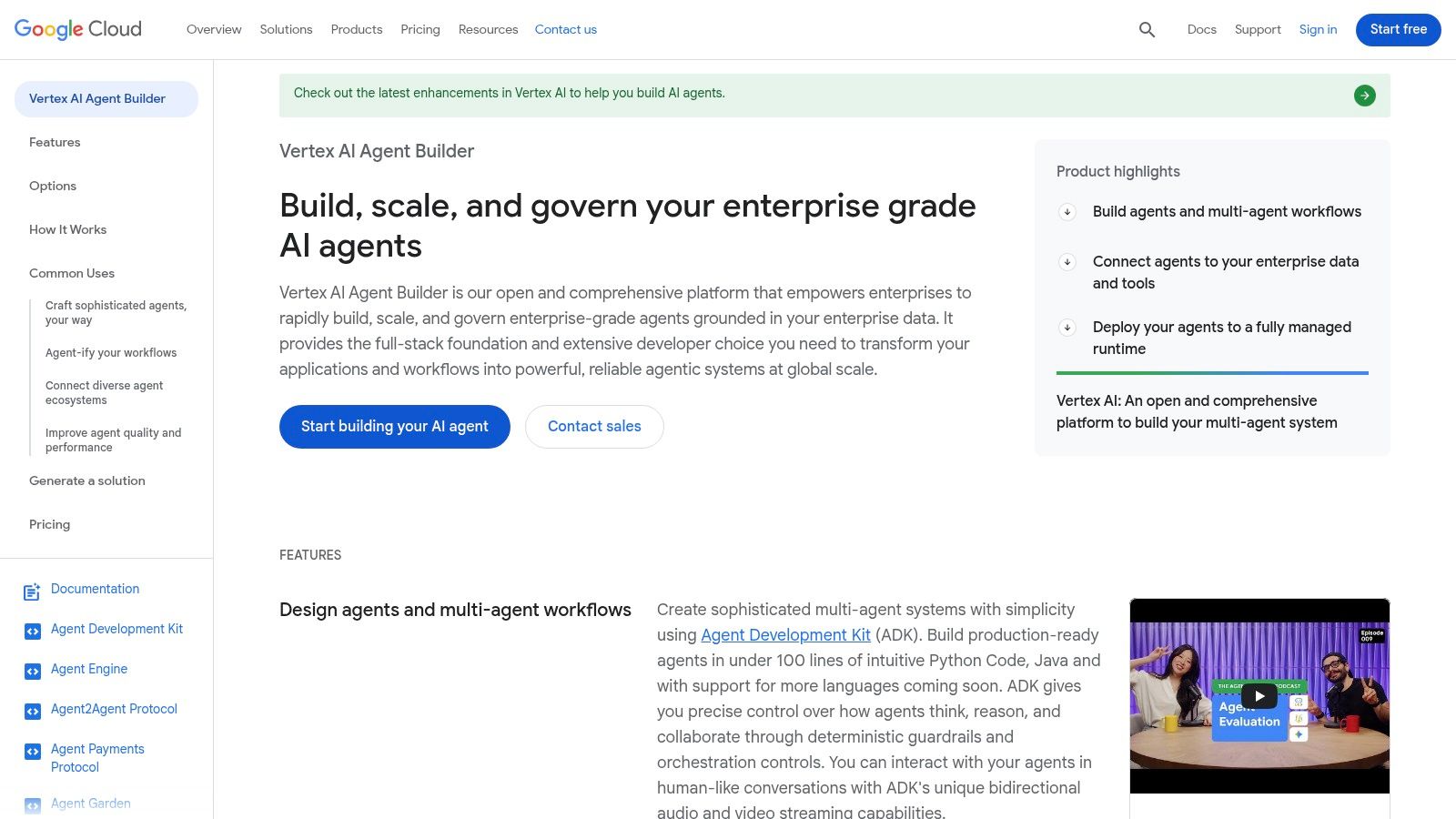
The platform's main advantage is its tight integration with the broader Google Cloud ecosystem, enabling it to ground generative AI models with your specific content library. This means you can create chatbots or search interfaces that provide factual, cited answers directly from your own materials. For publishers or content marketers, this provides a direct path to building a trusted, AI-powered assistant for their audience without deep technical overhead, thanks to managed data ingestion and UI starter components.
Key Details & Use Cases
- Best For: Publishers, content marketers, and organizations with extensive internal knowledge bases who want to build a reliable, AI-driven Q&A system or site search using Google’s infrastructure.
- Pricing: The pricing model is capacity-based (Queries Per Minute), which can be complex to forecast. Generative AI features are billed separately based on token usage.
- Limitation: The cost structure can be non-intuitive for beginners, and a free monthly query allocation, while helpful for trials, may not cover sustained production loads for larger operations.
- Website: https://cloud.google.com/generative-ai-app-builder
Its ability to merge semantic search with generative AI makes Vertex AI Search a compelling choice among semantic search tools for creators aiming to provide instant, accurate answers from their content libraries.
6. Amazon Kendra
Amazon Kendra is AWS’s managed enterprise search service, designed to bring intelligent search capabilities to internal documents, websites, and applications. It uses deep learning to understand natural language queries, allowing users to find specific answers within vast repositories of unstructured content. For content creators and publishers, this means Kendra can power a highly accurate internal knowledge base or a customer-facing help center that provides direct answers instead of just a list of links.
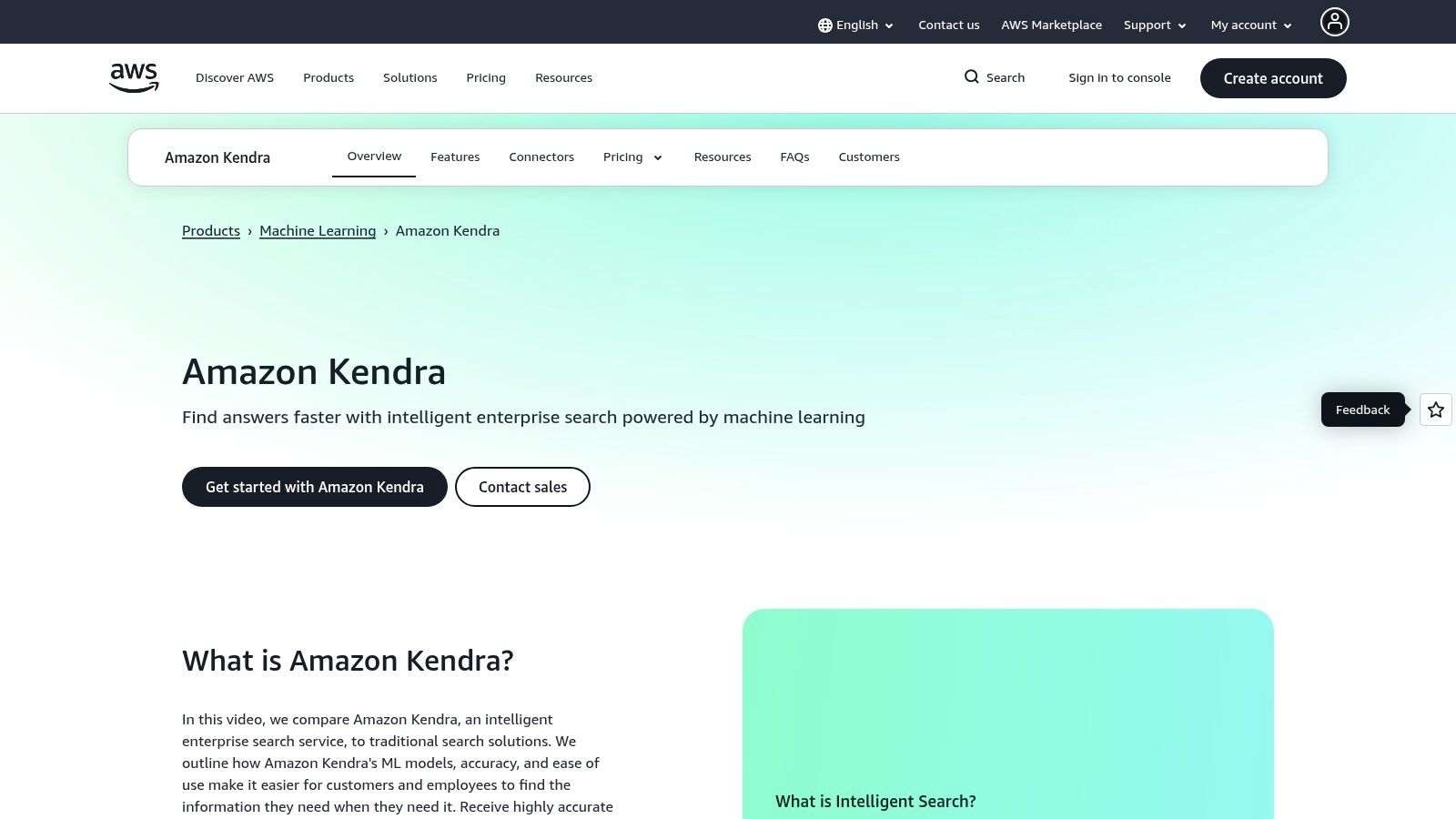
Its core strength lies in its extensive library of managed connectors, which simplify the process of indexing content from sources like SharePoint, Salesforce, and S3. Kendra also supports permission-aware search, ensuring that users only see results they are authorized to access. This feature is crucial for media organizations or publishing houses managing sensitive or tiered-access content libraries. The service integrates directly with other AWS tools, including Amazon Bedrock, making it a natural choice for building RAG applications on the AWS stack.
Key Details & Use Cases
- Best For: Organizations already invested in the AWS ecosystem that need a powerful, secure internal search for knowledge bases, archives, or research databases. It excels at answering specific questions from technical manuals or company wikis.
- Pricing: Kendra's pricing can be complex. Costs are based on per-hour index runtime plus API usage fees, which requires careful monitoring and planning to avoid unexpected expenses, especially if indices are left running continuously.
- Limitation: The cost structure makes it less suitable for public-facing, high-query-volume websites where traffic is unpredictable. Its primary focus is on enterprise-level internal search rather than general site search.
- Website: https://aws.amazon.com/kendra
With its focus on security and deep Q&A capabilities, Amazon Kendra stands out among semantic search tools for creators who need to build a precise, context-aware search engine for their internal or specialized content collections.
7. Coveo Relevance Cloud (AI Search)
Coveo Relevance Cloud is an enterprise-grade AI platform designed to power search and recommendations across websites, e-commerce platforms, and internal workplace systems. It excels at creating personalized experiences by combining semantic search with machine-learned ranking and user behavior analytics. For large publishers or media organizations, this means they can deliver highly relevant content suggestions, driving engagement and surfacing valuable library assets.
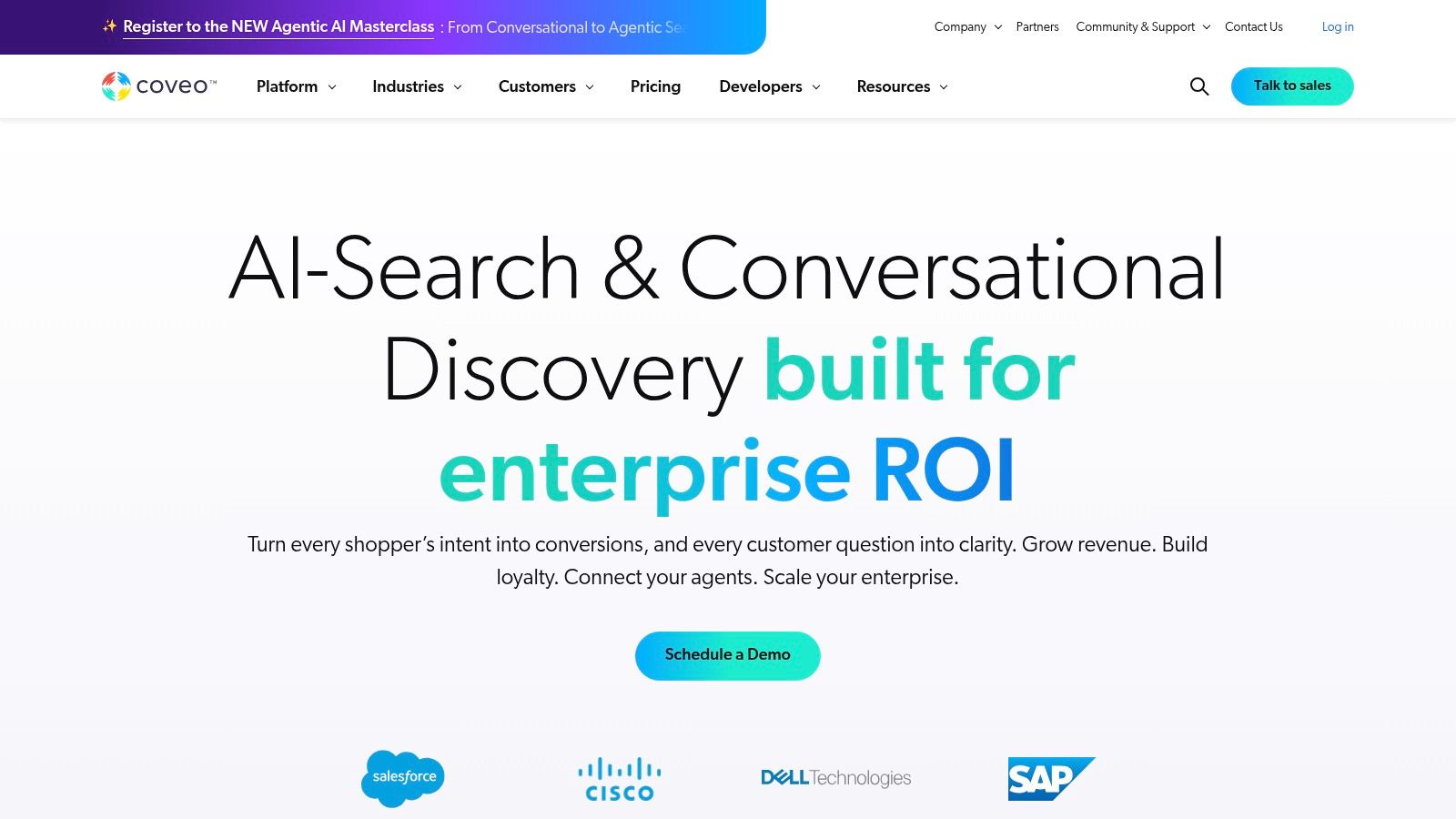
The platform’s unified indexing connects to multiple content sources while respecting existing permissions, making it a secure option for complex content ecosystems. Coveo also offers powerful relevance tuning and detailed analytics, allowing content marketers to understand what their audience is searching for and continuously refine the results. Its optional generative answering add-ons can further enrich the user experience by providing direct, synthesized answers to complex queries.
Key Details & Use Cases
- Best For: Enterprise-level media companies, large publishers, and organizations with diverse content channels (e.g., website, support portal, internal knowledge base) needing a unified, analytics-driven search solution.
- Pricing: Pricing is custom and tailored to enterprise needs, which generally places it at a higher price point compared to developer-first search APIs.
- Limitation: The cost and complexity can be a significant hurdle for smaller creators or businesses. Additionally, its powerful generative AI features are priced as separate add-ons.
- Website: https://www.coveo.com
Coveo’s strength as one of the leading semantic search tools lies in its mature, all-in-one approach to relevance, making it a strong contender for organizations ready to invest in a deep, multi-channel search strategy.
8. Glean (Enterprise AI Search)
Glean is designed for internal, enterprise-level knowledge discovery, offering a secure, AI-powered search experience across an entire organization's digital workspace. It connects to over 100 workplace apps, like Slack, Google Drive, and Jira, to create a unified search bar for employees. The platform's core strength is its permission-aware indexing, ensuring that search results always respect existing access controls, so users only see information they are authorized to view.
For large media organizations or publishing houses, Glean acts as a powerful internal semantic search tool, allowing teams to find specific assets, contracts, or research documents instantly. Its AI assistant and chat functions help employees get answers grounded in company knowledge, which can accelerate content creation and internal collaboration. The system is built with administrative controls for relevance tuning and offers developer APIs for creating custom integrations.
Key Details & Use Cases
- Best For: Large organizations, publishers, and media companies that need a secure, unified search solution to help internal teams discover and access information across a wide range of workplace applications.
- Pricing: Glean’s pricing is not publicly available and is quoted on a case-by-case basis. It is positioned for enterprise-level buyers who must engage the sales team for a custom plan.
- Limitation: The focus on internal enterprise use and the lack of transparent pricing make it less suitable for individual creators, researchers, or smaller content teams looking for an external-facing site search.
- Website: https://www.glean.com
Glean’s deep connector library and emphasis on security make it a top choice among semantic search tools for companies aiming to improve internal productivity and knowledge management.
9. Sinequa (by ChapsVision)
Sinequa serves the enterprise-level market, providing a robust search platform designed for large, regulated organizations with complex content ecosystems. It excels at unifying information from disparate sources, combining powerful linguistic processing with hybrid neural and lexical retrieval. This makes it a serious contender for large publishing houses, financial institutions, or public sector organizations that need to ground generative AI assistants in verified, secure internal knowledge. The platform is built to handle massive, multilingual content libraries while enforcing strict security and compliance rules.
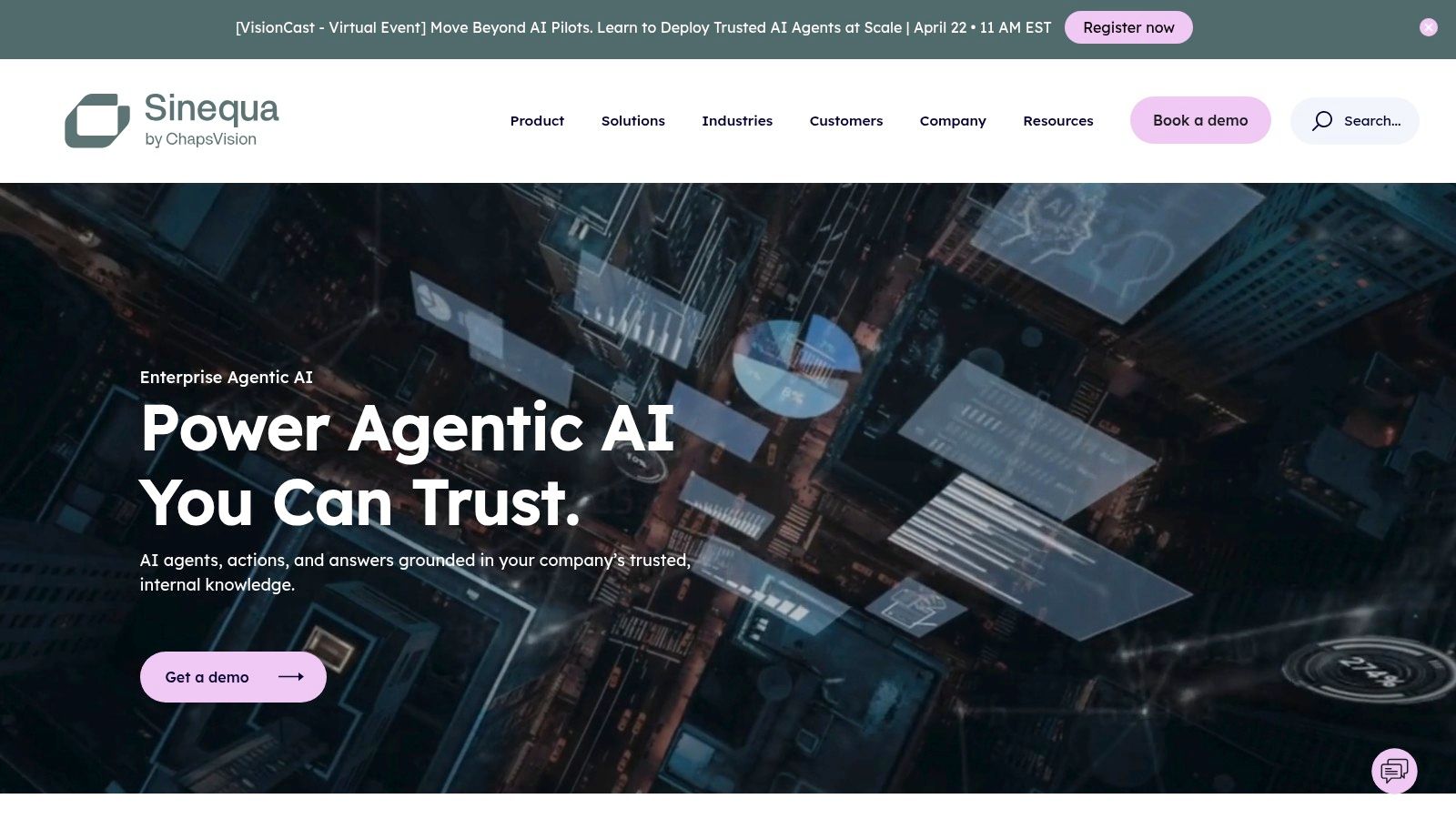
The platform’s real strength is its low-code framework for building 'search-based applications' and AI-powered copilots. For a large media company, this could mean creating a custom internal research tool for journalists that pulls from decades of archives, or for a book publisher, it could power a rights management system that understands contractual nuances. Sinequa's extensive connectors and security trimming ensure that users only see the information they are authorized to access, which is critical in enterprise settings.
Key Details & Use Cases
- Best For: Large publishers, global media conglomerates, and research organizations managing extensive, multilingual, and highly regulated content repositories that require deep security and compliance.
- Pricing: Pricing is customized for enterprise-level engagements and is not publicly listed. It reflects the significant scope of implementation projects.
- Limitation: The platform is not a turnkey solution for smaller creators or teams. Implementation is a considerable project requiring significant technical resources and investment.
- Website: https://www.sinequa.com
Sinequa is one of the most powerful semantic search tools available for enterprises needing to build a secure, intelligent information backbone for their content operations.
10. Pinecone (Managed Vector Database)
Pinecone provides a fully managed vector database designed to power AI-driven search and retrieval applications. It simplifies the infrastructure needed for high-performance semantic search, making it a go-to for developers building recommendation engines, retrieval-augmented generation (RAG) systems, and multimedia search into their products. The platform abstracts away the complexity of managing and scaling a vector index, allowing creators and organizations to focus on application logic.
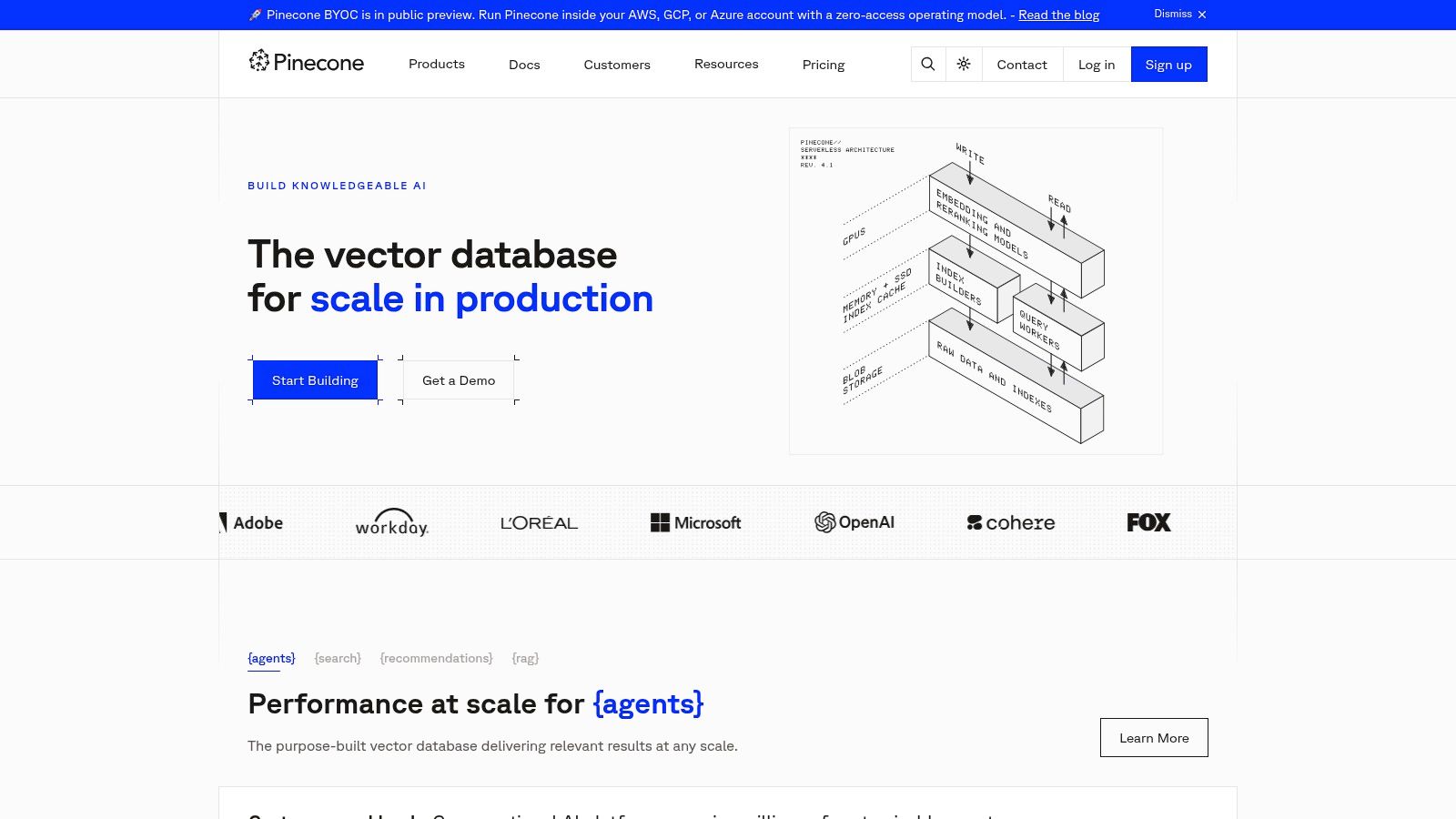
Its main appeal lies in its quick time-to-production. With clear SDKs for popular frameworks and a serverless deployment option, getting a proof-of-concept running is straightforward. For content marketers and publishers with extensive media libraries, Pinecone offers a reliable backend for building tools that can search through video, audio, and article archives based on conceptual meaning rather than just metadata tags. This positions it as a foundational piece of many modern semantic search tools.
Key Details & Use Cases
- Best For: Developers, publishers, and content creators building custom RAG applications or semantic search features who need a simple, scalable, and fully managed vector database.
- Pricing: A usage-based model with a generous free tier for small projects. The serverless option offers granular billing, but total cost depends on your workload and external embedding model expenses.
- Limitation: Pinecone only handles the vector storage and retrieval. Users are responsible for generating embeddings and managing the inference costs, which adds to the total cost of ownership and operational complexity.
- Website: https://www.pinecone.io
For teams building sophisticated internal knowledge bases or user-facing search, Pinecone’s managed experience removes a significant engineering barrier, allowing for faster development of powerful AI features.
11. Weaviate (Open Source + Weaviate Cloud)
Weaviate offers a flexible, AI-native vector database that caters to developers who need granular control over their semantic search infrastructure. It is available as a powerful open-source tool for self-hosting or as a managed Weaviate Cloud Service (WCS). This dual-offering makes it an excellent choice for creators and organizations that want to start with a self-managed solution and scale to a managed service as their content library grows. Its architecture supports hybrid search, combining vector similarity with traditional keyword filtering for more accurate results.
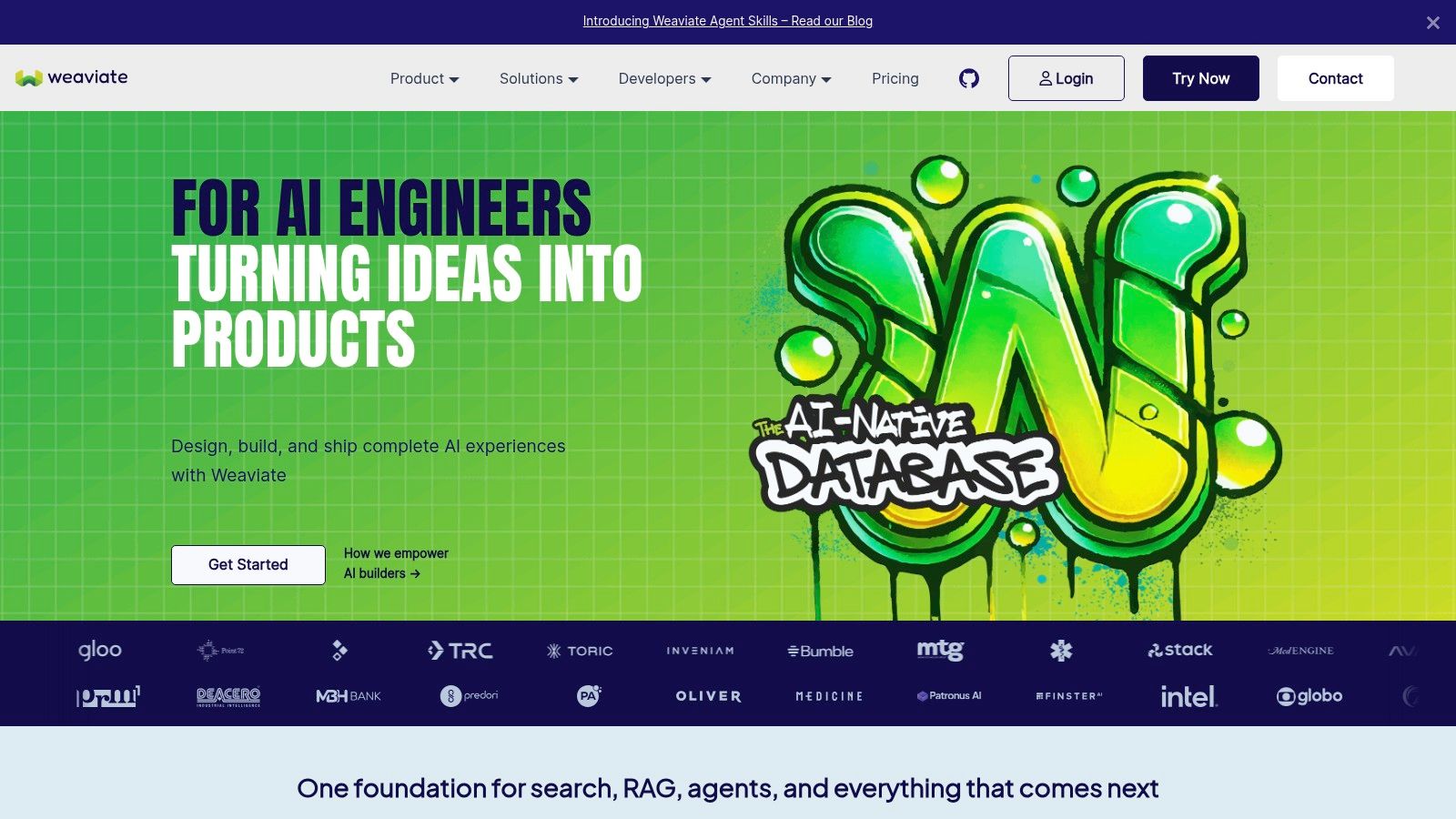
The platform is distinguished by its built-in modules, which allow for seamless integration of various embedding models and rerankers directly within the database. For creators with large archives of documents or multimedia files, this simplifies the technical stack needed to build a robust semantic search tool. The active open-source community provides strong support, while the schema-first design appeals to developers who prefer a structured approach to data management. Weaviate is a solid foundation for building custom search applications on top of extensive content libraries.
Key Details & Use Cases
- Best For: Publishers, developers, and media organizations with technical teams who need a flexible vector database that can be self-hosted or managed. It's ideal for building custom document, image, or video search applications.
- Pricing: Pricing for the Weaviate Cloud Service is complex and varies based on vector dimensions, storage, and add-on modules. Careful cost estimation is necessary for large-scale deployments.
- Limitation: While flexible, the self-hosted version requires significant technical expertise to set up, maintain, and scale effectively. The cloud pricing model can also become costly without careful planning.
- Website: https://weaviate.io
With its combination of open-source freedom and managed cloud convenience, Weaviate stands out among semantic search tools for those who want to build a highly customized and scalable search engine.
12. Qdrant (Open Source + Qdrant Cloud)
Qdrant is an open-source vector database and vector similarity search engine, offering a managed cloud platform alongside its self-hosted option. It’s designed for high performance, especially in scenarios that require filtering search results based on specific metadata or payloads. This makes it a great foundational piece for creators and organizations building bespoke semantic search tools, as it allows for precise, conditional queries alongside vector-based relevance. The platform is known for its strong cost-to-performance balance.
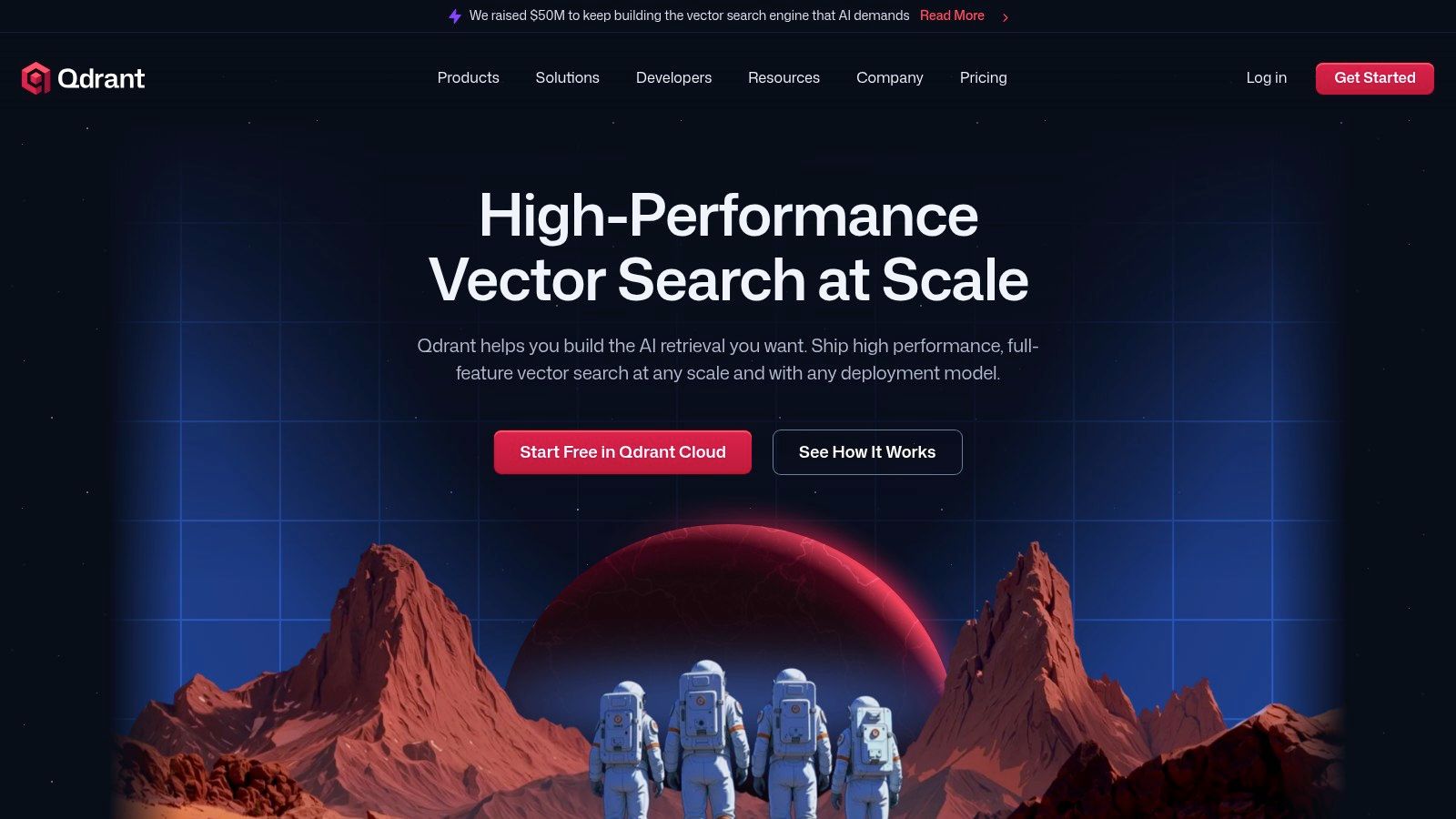
As a dedicated vector database, Qdrant focuses purely on storing, indexing, and retrieving vectors efficiently. This means teams must integrate their own embedding and reranking models, giving them full control over the AI components of their search stack. For developers, this DIY approach provides flexibility, while the availability of a free 1 GB managed cluster is a significant advantage for prototyping and running proofs-of-concept without initial investment. This makes it an accessible starting point for exploring vector search.
Key Details & Use Cases
- Best For: Technical teams, developers, and researchers who need a powerful, filterable vector database to build a custom semantic search application from the ground up.
- Pricing: Features a transparent, usage-based model for its managed cloud service, with a permanently free 1 GB cluster that is ideal for small projects and trials.
- Limitation: The platform requires users to bring their own embedding models and reranking logic. It is not an all-in-one search solution, but rather a critical backend component.
- Website: https://qdrant.tech
With its powerful filtering and open-source foundation, Qdrant is an excellent choice for creators who require a highly customizable and scalable backend for their semantic search projects.
Top 12 Semantic Search Tools Comparison
| Product | Core features | UX & performance | Value proposition | Target audience | Pricing & notes |
|---|---|---|---|---|---|
| Contesimal (Recommended) | Chat-based research UI, layered taxonomies, programmatic ingestion for docs/podcasts/videos | Real-time exploration, collaborative tooling, scales for large libraries | Turns archival content into new value; helps repurpose, grow audience, and monetize | Podcasters, YouTubers, publishers, marketers, content executives | Free starter session & beta; contact for enterprise pricing and security |
| Algolia NeuralSearch | Hybrid semantic + keyword retrieval, neural hashing, AI re-ranking, global CDN | Extremely low latency (sub-50ms), mature SDKs & analytics | Blazing-fast on-site discovery and merchandising with hybrid relevance | Commerce, media sites, help centers, developer teams | Scales well but can be complex/expensive at high volume; limited regulated use cases |
| Elastic (Elasticsearch + ELSER) | ELSER sparse encoder, hybrid BM25/vector pipelines, inference API | Integrated Kibana tooling, observability; requires capacity planning | Single engine for lexical/vector search enabling strong hybrid RAG patterns | Enterprises needing hybrid search, observability, custom pipelines | ML features need subscription/resources; capacity planning required |
| Microsoft Azure AI Search | Vector + lexical retrieval, Bing-derived semantic ranker, connectors, ACLs | Permission-aware search, Azure-native scaling and monitoring | Strong Microsoft 365/SharePoint relevance with enterprise governance | Azure/Microsoft 365-centric organizations, regulated enterprises | Tiered pricing; semantic ranker has extra costs after free quota |
| Google Cloud Vertex AI Search | Turnkey semantic search & Q&A, multi-source ingestion, Vertex AI grounding | Fast to pilot with managed ingestion and UI starter components | Quick launch for semantic Q&A and agent-driven experiences | Google Cloud customers, knowledge bases, web/content teams | Capacity-based pricing (QPM); generative AI billed under Vertex AI |
| Amazon Kendra | Semantic ranking, FAQ matching, large connector library, retriever API | Permission-aware indexing, integrates with AWS stack and Bedrock | Enterprise Q&A with rich connectors for AWS environments | AWS-centric enterprises, large knowledge bases | Per-hour index pricing + API usage; costs can accumulate |
| Coveo Relevance Cloud | Unified indexing, ML-driven ranking, analytics, generative add-ons | Mature enterprise UX, omnichannel analytics and tuning | Relevance and merchandising for commerce & service portals | Enterprise commerce, support, and workplace search teams | Custom enterprise pricing; generative features priced separately |
| Glean (Enterprise AI Search) | ACL-aware connectors, chat assistant, admin controls, APIs | Strong end-user UX for workplace discovery and assistants | Context-grounded enterprise assistant for knowledge work | Large orgs focused on employee search and productivity | Enterprise-level custom pricing; sales engagement required |
| Sinequa (by ChapsVision) | Hybrid neural/lexical retrieval, linguistic processing, low-code apps | Deep multilingual/compliance capabilities; implementation-heavy | Built for complex, regulated corpora and global deployments | Pharma, finance, public sector, global publishers | Custom enterprise engagements; significant implementation scope |
| Pinecone (Managed Vector DB) | Serverless & pod options, HNSW search, filtering, namespaces | Quick to production, simple managed experience, clear billing tiers | Managed vector infra for RAG, recommendations, multimedia search | Developers building RAG, recommender systems, ML teams | Usage-based pricing; embedding/inference costs separate |
| Weaviate (OSS + Cloud) | Open-source + managed cloud, modules for embeddings/rerank, hybrid search | Flexible deployment (self-host or WCS), active community support | Modular vector DB with built-in ML modules and schema-first design | Startups to enterprises needing flexible vector DB options | Pricing varies by dimensions; estimate storage/dimensions carefully |
| Qdrant (OSS + Cloud) | HNSW vector search, payload filtering, managed cloud, APIs/SDKs | Strong cost/performance, free 1 GB managed cluster for trials | Cost-effective vector DB with robust filtering for production & POCs | Developers, teams running proofs-of-concept and production workloads | Transparent pricing, free 1 GB trial; embeddings/rerank managed separately |
From Archive to Action: Choosing the Right Tool to Reignite Your Content
The journey through the world of semantic search tools reveals a fundamental shift in how we interact with our own content libraries. We've moved beyond simple keyword matching and into a realm where context, intent, and meaning reign supreme. The tools we’ve examined, from enterprise-grade platforms like Sinequa and Azure AI Search to specialized vector databases like Pinecone and Weaviate, all tackle the same core challenge: transforming a static archive into a dynamic, queryable asset. For content creators, publishers, and marketers, this isn't merely a technical upgrade; it's a strategic imperative to upcycle old content and create new value.
Choosing the right tool is less about finding the "best" option and more about identifying the one that aligns with your specific operational reality. A development team comfortable with APIs and infrastructure management might find the flexibility of an open-source solution like Qdrant or a powerful managed service like Elastic to be the perfect fit. Conversely, a large corporation needing a secure, unified search layer across disparate internal systems will see immediate value in platforms like Glean or Coveo. The decision hinges on your technical resources, your budget, and the precise problem you're trying to solve.
Key Takeaways for Making Your Decision
As you evaluate these powerful options, keep the central goal in focus: to organize, understand, and act on your content. Your final choice should be guided by a clear-eyed assessment of your needs.
- Assess Your Technical Capacity: Be honest about your team's ability to implement and maintain a solution. Developer-centric tools offer immense power but require engineering expertise. All-in-one platforms reduce the technical burden but may offer less customization.
- Define Your Primary Use Case: Are you a podcaster needing to find specific soundbites? A YouTuber looking to build on successful concepts? A publisher wanting to turn your old longform content into a money maker? The tool that excels at surfacing video clips might not be the best for analyzing dense academic papers. Your primary goal should steer your selection.
- Prioritize Collaboration: The most advanced search algorithm is useless if your team can't easily use it to collaborate. Consider who will be interacting with the system daily. For many professional creators and content marketers, the ideal solution is one that integrates search directly into their creative and collaborative workflow, not just a backend technology.
The Bridge Between Search and Creation
Ultimately, the most impactful semantic search tools are those that do more than just return results. They become a catalyst for creation. They help you see the hidden connections between a podcast episode from last year and a blog post from last week, enabling you to take your longform content across platforms and generate fresh ideas. This is the critical gap that solutions like Contesimal are built to fill, bridging the divide between a powerful search index and the collaborative human effort required to produce new, valuable content.
By implementing the right tool, you're not just organizing a digital closet. You are reigniting your content library, turning dormant assets into active participants in your growth. You equip yourself and your team to find the perfect quote, clip, or data point not in hours, but in seconds, freeing up valuable time to focus on what you do best: telling amazing stories and creating.
Ready to move from simply finding content to actively creating new value from it? Contesimal is designed for creators and publishers who need more than just a search bar. It’s a collaborative platform where humans and AI work together to help you organize your library, understand your assets, and turn your old longform content into your next big success. Explore how you can reignite your content at Contesimal.