
Every video, podcast, and article you've ever created is sitting there, waiting. But is it a valuable asset or a digital ghost? For content creators, Youtubers, and publishers, digital asset management AI is what turns your messy archive from a content graveyard into a goldmine. It’s the difference between a warehouse full of dusty, unmarked boxes and a smart, automated fulfillment center for your creative work, ready to help you create infinite content value.
Your Content Library Is A Goldmine Not A Graveyard
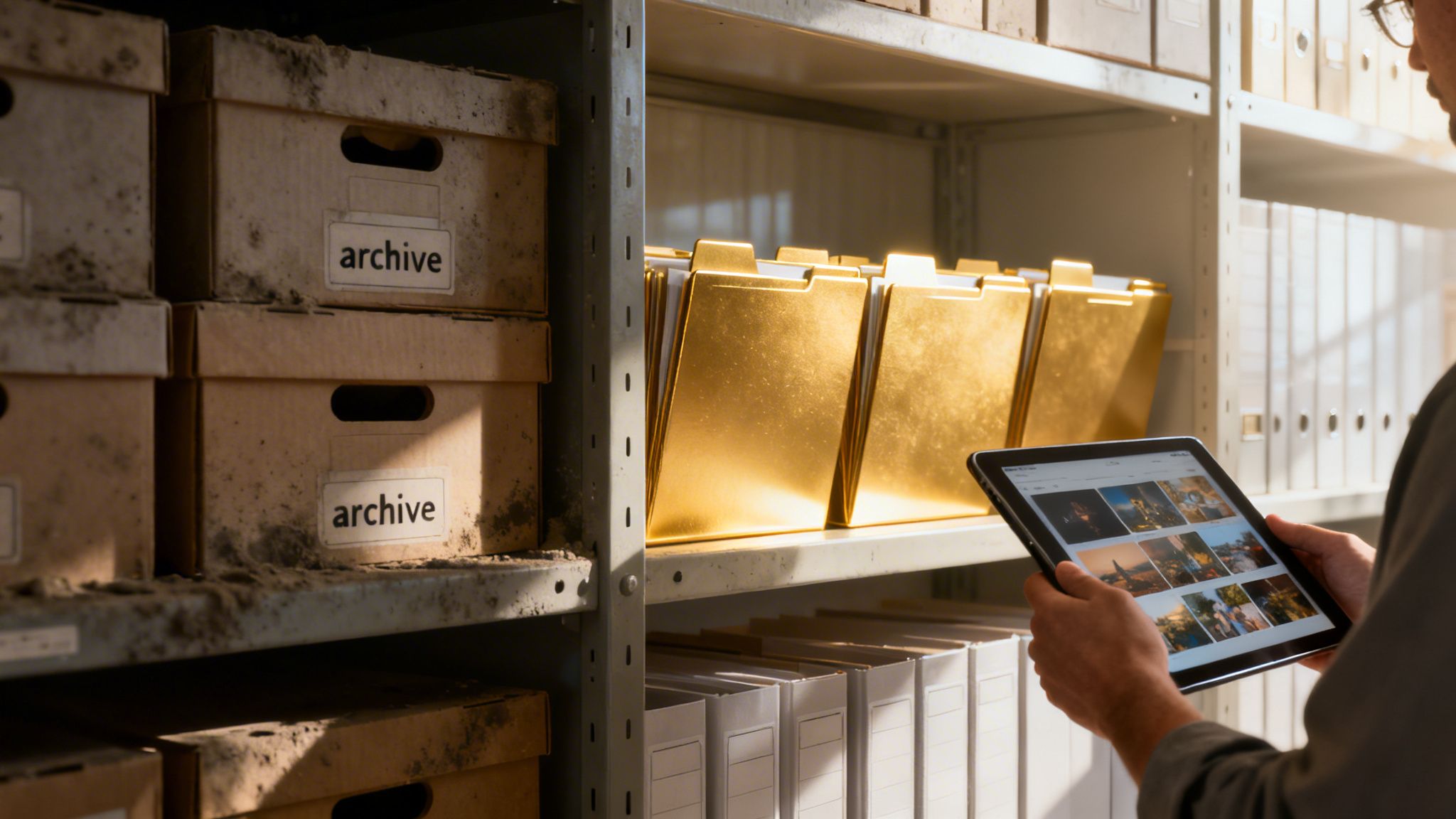
If you're a creator, you know the feeling. Your library of videos, blog posts, podcast episodes, and images just keeps getting bigger. It's supposed to be your greatest strength, but it often feels more like a digital junk drawer—a chaotic mess of files scattered across Google Drive, Dropbox, and a few old hard drives.
When you need to find that one perfect clip or quote, it turns into an archaeological dig. This is where the old way of doing things—manual folders and file names—completely falls apart. As your library grows, trying to tag, sort, and search for everything by hand becomes an impossible chore. You’re left with a huge archive of untapped potential, unable to repurpose your content and grow the value of your library.
The Problem With Manual Methods
Look, a simple folder system on your laptop works fine when you're just starting out. But the moment you start treating your content like a business, that system hits a wall. Think about all the hours wasted hunting for a specific file, or the missed opportunities to jump on a trend by repurposing an old video because you couldn't find the original clips.
The real problem isn't storage; it's discoverability. Your content is worthless if you can't find it the moment you need it. An AI-powered system makes every piece of your creative history instantly accessible and ready to go.
This inefficiency is exactly why the industry is changing so fast. The global Digital Asset Management (DAM) market was valued at USD 3.96 billion in 2023 and is on track to hit a staggering USD 16.18 billion by 2032. That explosive growth is all about one thing: creators and media companies are desperate for a better way to handle the overwhelming amount of content they produce.
Unlocking Your Library's True Value
This is where a Digital Asset Management (DAM) system, especially one powered by AI, completely changes the game. It’s a central hub that doesn't just store your files—it actually understands them. Before you can build an intelligent system, though, you need to get the basics right and organize your digital assets in a way that sets you up for success.
A smart DAM gives you the structure to:
- Organize: Automatically categorizes and tags every video, audio file, and image you upload. No more manual data entry.
- Understand: Analyzes your entire library to spot themes, topics, and even performance patterns you might have missed.
- Take Action: Instantly find assets to repurpose, create new content from old ideas, and collaborate with your team without endless back-and-forth.
Instead of letting your best work gather digital dust, a DAM helps you bring it back to life, creating endless new value from the content you've already made. By creating a detailed catalog of your library, much like you would with a content inventory template, you lay the foundation for a system that turns your archive into your most powerful creative tool. This is how you upcycle old content and reignite your content library.
Manual vs AI-Powered DAM
It helps to see the difference side-by-side. A traditional folder system is just storage. An AI-powered DAM is an active partner in your creative workflow.
| Feature | Manual Folder System | AI-Powered DAM |
|---|---|---|
| Search | Relies on file names and folder paths. | Semantic search; understands concepts and context. |
| Tagging | Manual, inconsistent, and time-consuming. | Automatic, AI-driven tagging for objects, people, and topics. |
| Organization | Rigid folder hierarchy. | Flexible, metadata-based organization. |
| Discovery | You have to know what you're looking for. | Surfaces relevant content you forgot you had. |
| Efficiency | High manual effort, prone to human error. | Automates repetitive tasks, saving hours. |
| Scalability | Breaks down as content volume grows. | Built to handle massive, growing libraries with ease. |
The takeaway is clear: while manual methods get you started, they simply can't keep up. As you grow from hobbyist to professional, an AI-powered system becomes less of a luxury and more of a necessity for staying competitive and sane.
How AI Puts Your Asset Management on Autopilot

Think of a standard Digital Asset Management (DAM) system as a warehouse for your content. It’s organized, sure, but it's still just a place to store boxes. Now, add artificial intelligence to the mix. Suddenly, you have a brilliant, hyper-efficient crew running the entire operation—that’s the difference between a simple storage folder and a true digital asset management AI platform.
This isn't just about storage anymore. It’s about having an AI that actively works to understand every video, podcast, and document you’ve ever created.
It’s like hiring a personal librarian who has binge-watched your entire creative history. They've seen every video, listened to every podcast, and read every article. Now they stand ready to pull the exact moment, clip, or quote you need in seconds. Your content archive goes from being a passive headache to an active creative partner, helping humans and AI collaborate seamlessly.
This shift is more than a nice-to-have; it’s a strategic move. We're seeing organizations embrace this at a breakneck pace. Back in 2025, predictions were that over 60% of enterprise organizations would be relying on AI to manage their content. Research at the time found that 33% of organizations were prioritizing AI specifically for their DAM software, with 41% of them zeroing in on predictive capabilities to boost their efficiency.
The Core AI Tech Doing the Heavy Lifting
So, what is this "AI" actually doing in the background? It’s not one single piece of magic. It’s a team of powerful technologies working together to make your library genuinely intelligent.
Automated Transcription: This is the foundation. The AI listens to every audio and video file, turning all the spoken words into a searchable text transcript. For podcasters and YouTubers, this is a total game-changer. You can finally search for a specific spoken phrase instead of endlessly scrubbing through hours of footage.
Intelligent Metadata Tagging: The AI doesn’t just look at file names. It digs into the content itself to automatically add descriptive tags (metadata), identifying people, objects, topics being discussed, and even the emotional tone of a conversation.
Semantic Search: This is where things get really powerful. Unlike a basic keyword search that just looks for an exact word, semantic search understands your intent. You can ask a question like, "Find clips where I talked about repurposing content," and the AI will find relevant moments, even if you never used that exact phrase.
These technologies all feed into each other, creating a deep, searchable understanding of your entire library. It’s a core function of modern content intelligence platforms designed to help you find the hidden gems in your own work.
From Simple Tags to Smart Suggestions
The journey with a digital asset management AI doesn't happen all at once. It builds on itself, starting with simple automation and leading to proactive discovery that makes your whole workflow smarter.
Automated Organization: The moment you upload a file, the AI jumps into action. It transcribes the audio, uses image recognition software to identify what's in your photos and videos, and applies all the relevant tags. This first step alone can save you hundreds of hours of mind-numbing manual work.
Enhanced Discovery: Once your library is fully indexed, you can find anything almost instantly. A publisher can locate every article that mentions a certain expert. A content marketer can pull every visual related to a holiday campaign in seconds. No more digging through nested folders.
Predictive Recommendations: The most advanced systems take things even further. By analyzing your most popular content and seeing what performs best, the AI can start suggesting new ideas. It might notice your audience really engages with videos on a specific topic and recommend you create a new playlist or a follow-up video about it.
In the end, a digital asset management AI platform isn't just about storing your files. It’s about creating a partnership between your own creativity and the power of machine intelligence—helping you discover new value and spark ideas you never would have found on your own.
This is where the theory stops and the real work begins. We've talked about what an AI-powered DAM is, but what does it actually do for a working creator? This is where your dormant content archive wakes up and becomes an active assistant—one that helps you find new ideas, move faster, and even open up new ways to make money.
Let's get past the technical talk and look at how actual creators are using these tools. These aren't just made-up stories; they're the daily wins that turn a messy library from a storage headache into your biggest strategic asset. Your entire history of work becomes the starting point for whatever you do next.
The Podcaster: From Search to Social in Minutes
Picture this: you're a podcaster with 200 episodes in the bank. A big news story breaks, and it’s directly related to a topic you covered perfectly six months ago. In the old days, finding that specific clip meant hours of manually scrubbing through audio files. Now, you can jump on the conversation while it’s hot.
With an AI-powered DAM, you can just type a simple question like, "Find the part where I talked about financial independence for creators." Because the system has already transcribed every word you've ever spoken, it pulls up the exact moments in seconds. From there, you can:
- Clip the perfect 30-second soundbite right inside the platform.
- Whip up an audiogram with animated captions that are ready for social media.
- Push it out to TikTok, Instagram, and X while the topic is still trending.
A frustrating task that used to eat up an afternoon now takes less than five minutes. That kind of speed is what lets you stay relevant and keep your audience hooked with timely content pulled straight from your archives.
This simple workflow shows how AI turns a clunky process into three quick steps.
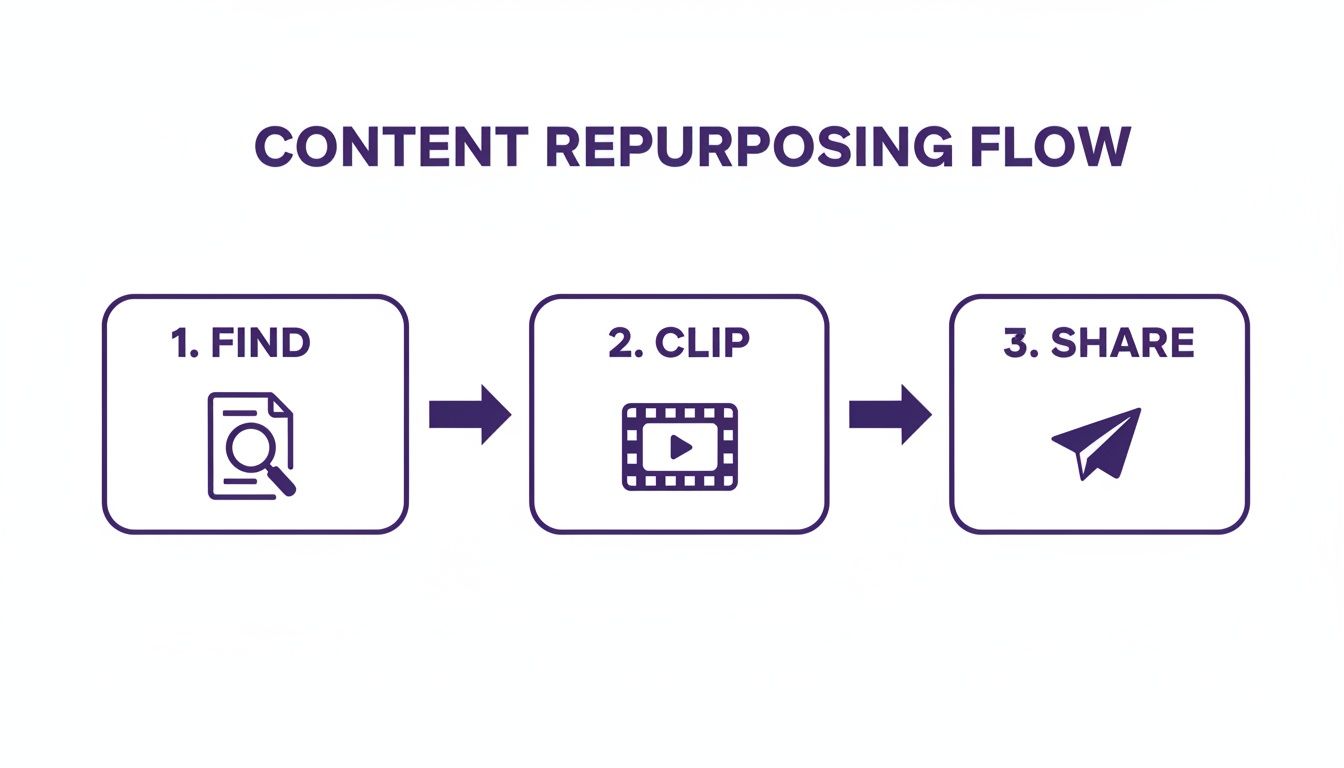
It’s a clear path from discovery to distribution, all happening at a speed that was impossible before.
The YouTuber: Uncovering Hidden Gold
For any YouTuber, burnout is a constant threat. The pressure to dream up fresh ideas never stops, and it’s draining. An intelligent DAM can act like a creative partner, showing you what to make next by analyzing what’s already worked for you.
Think about a YouTuber with hundreds of videos. When they feed their whole library into a system like Contesimal, the AI gets to work analyzing transcripts, titles, and even viewer comments. It starts spotting the patterns—the recurring themes that always get your audience fired up.
The AI might find that your viewers are most passionate whenever you discuss a specific piece of gear or a certain editing trick. This isn't just a hunch; it's a real insight pulled directly from your own content and your own audience.
An insight like that is pure gold. Suddenly, you have a clear, data-backed direction for your next video series, a new playlist, or a deep-dive tutorial you know people want. You’re no longer staring at a blank page; you’re building on your own proven success.
The Publisher: Monetizing Decades of Content
Publishers, whether they deal in magazines or books, are often sitting on huge archives of valuable work that’s trapped in old, hard-to-access formats. A digital asset management AI is the key that finally unlocks all that value for a new audience.
Take a publisher with 30 years of articles. Trying to sort through that by hand would be a nightmare. But an AI system can absorb, scan, and index every last piece. All at once, that publisher can:
- Pinpoint every article ever written about a specific historical figure. This can be bundled into a new ebook or a special edition.
- Find every recipe from a particular chef and spin up a digital cookbook.
- Group articles by a common theme to create a paid newsletter or an online course.
This isn’t just about getting your old files organized. It's about creating entirely new products and revenue streams from assets that were basically lost. Platforms like Contesimal make this happen by letting teams collaborate around this newly surfaced knowledge, turning a static library into a living, money-making machine.
Implementing Your Intelligent Content Hub
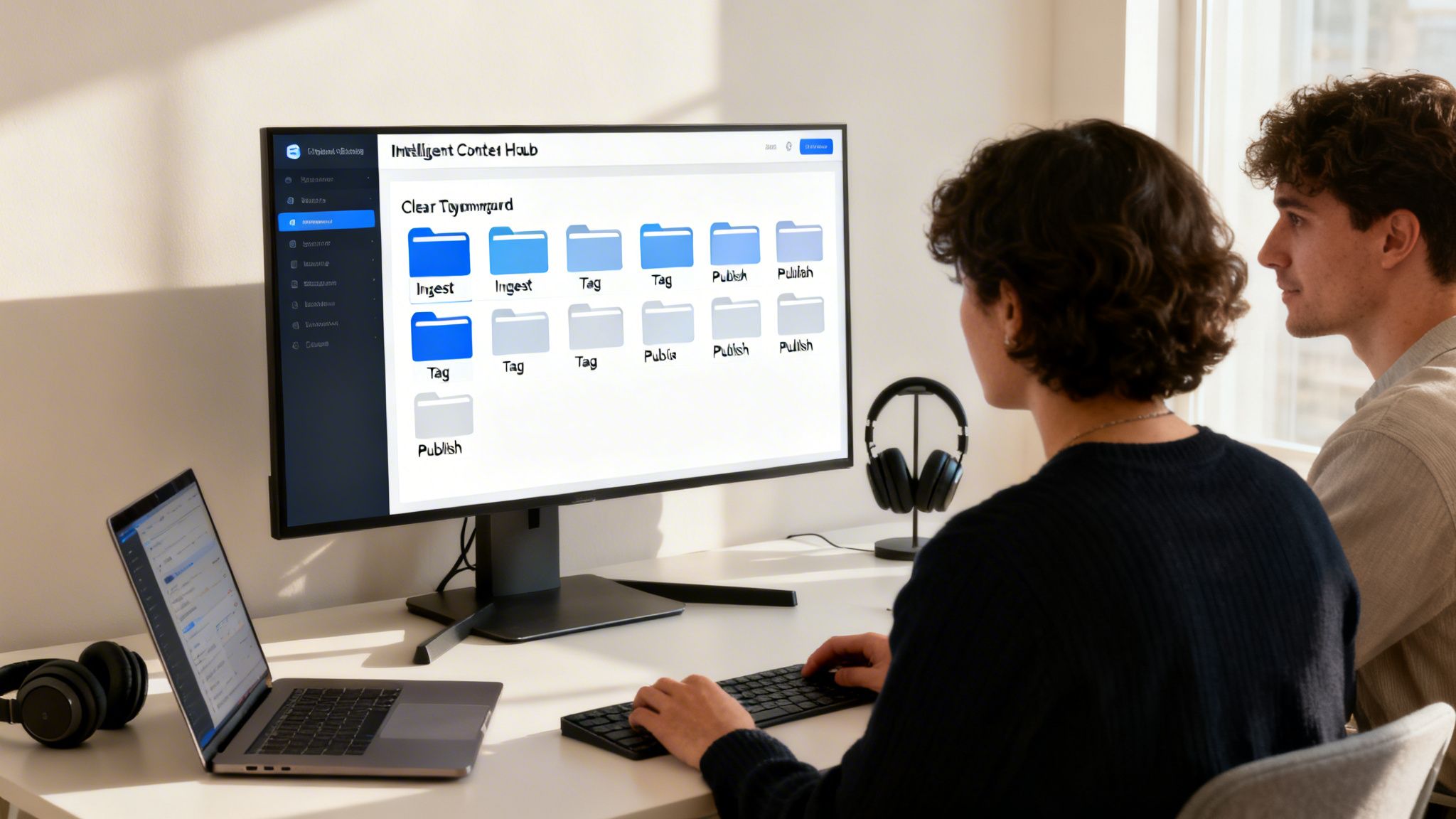
Moving to an intelligent content hub can feel like a massive undertaking. But think of it less like a painful migration and more like a serious power-up for your entire operation.
This is the real-world guide for creators looking to go pro and publishers ready to leave their old, clunky workflows behind. The goal here is simple: build a system where you and the AI work together, turning your content archive from a dusty closet into a launchpad for your next big move.
It all starts with a change in perspective. You have to stop seeing your library as just ‘storage’ and start seeing it as a hub for ‘discovery.’ Every file you add isn't being filed away; it's being primed for action. This one shift changes everything.
Preparing Your Content Library For AI
Before you flip the on-switch for a digital asset management AI system, a bit of prep work will pay off massively. The AI is a workhorse, but it works best when you give it a clean, organized space to start.
First, round up all your assets. I mean everything—from Google Drive, Dropbox, random external hard drives, and that old laptop in the corner. Pull it all into one place. This is also your chance to declutter. Ditch the duplicates, the ancient drafts, and anything else that's just digital junk. A clean library means the AI can get straight to indexing your best stuff.
Getting organized is the bedrock of making your content searchable. If you want to go deeper on this first, critical step, check out our guide on what document indexing is and why it’s the engine behind content discovery.
Setting Up Your Taxonomy and Ingestion
With your library all tidied up, it’s time to set up your taxonomy—the internal logic that will organize everything. Don’t let the word scare you. A good taxonomy is just a common-sense way to categorize your content based on how your team actually thinks and searches.
Think less like a librarian shelving books by the Dewey Decimal System and more like a Netflix user browsing by genre. Your taxonomy should reflect how your team talks, using categories like "Product Demos," "Podcast Guest Clips," or "2026 Campaign Assets."
A platform like Contesimal lets you define these categories right from the start. Then, as you begin the ingestion process—uploading your files—the AI gets to work. It automatically transcribes your audio and video, spots objects and faces in your footage, and slaps on the tags you’ve already defined. Just like that, every asset is loaded with searchable metadata.
Training Your Team For A New Workflow
The final piece of this puzzle is your team. The fanciest tools on the planet are useless if nobody knows how to use them. The most important thing you can teach everyone is to adopt a collaborative, discovery-first mindset.
Here’s how to get your team on board without the groans:
- Focus on the "Why": Don't just show them a new tool. Show them how it erases their most annoying problems. Explain how a 3-second search just replaced a 3-hour hunt for an old clip.
- Show, Don't Tell: Walk them through real-life scenarios. Find every single clip of a specific podcast guest to build a "best of" reel. Gather all the B-roll from that one shoot last year. Make it tangible.
- Make It Collaborative: Show everyone how to share collections, leave comments, and build projects together inside the platform. This isn't just a new set of personal folders; it's a shared creative space.
By prepping your library, building a smart structure, and getting your team excited, you're not just installing some software. You're building an intelligent engine that will let you create infinite new value from the content you've already worked so hard to make.
The Future Of Content Is Collaborative And Intelligent
Looking ahead, the wall between creating content and managing it is crumbling. What we're seeing is a single, intelligent workflow taking its place. The future isn't about just storing your assets anymore; it's about building a living, breathing ecosystem around them.
This is where digital asset management AI stops being a simple filing cabinet and becomes a true creative partner.
The next wave of success for creators and publishers will stand on three pillars: generative AI, team-based research, and real ownership of your content universe. The people who get this won't just keep up—they'll set the pace. They’ll move faster, create smarter, and build stronger bonds with their audience by giving them exactly what they need.
The Rise of Generative AI In Content Repurposing
Generative AI is already flipping the script on repurposing. It’s moving past basic transcription and tagging and is now actively helping you create entirely new assets from your old ones. Imagine an AI that not only finds the best clips in your library but also drafts social media posts for them, suggests a few alternative video titles, and even generates highlight reels automatically.
This is a huge change. Instead of you doing all the heavy lifting, the AI becomes your production assistant. And it's happening fast. As of late 2025, global generative AI adoption hit 16.3% of the world's population, meaning about one in six people are already using these tools.
Adoption isn't uniform, of course. Countries like the United Arab Emirates are seeing a 64.0% usage rate among their working-age population, while the United States is at 28.3%. These numbers all point in one direction: AI is becoming a standard piece of the creative toolkit. You can learn more about the global AI adoption trends that are shaping our industry right now.
Collaboration As The New Creative Engine
The idea of the lone creator working in a silo is quickly becoming a relic. The future belongs to those who can collaborate effectively—not just with other people, but with smart systems, too. A platform like Contesimal is built around this exact concept. It’s a space where you can curate a specific body of knowledge from your library and invite your team to gather around it.
The real magic happens when people and AI work together to find meaning in a sea of content. A writer, a video editor, and an AI can all collaborate to find a new angle for a story, pulling insights from dozens of different assets at once.
This approach turns your content library into a shared brain. As your team explores, discusses, and connects ideas inside the system, they generate new value that would have been impossible to find alone. It’s a simple, powerful cycle: organize, understand, and then take action together.
By embracing this intelligent and collaborative future, you're not replacing your creativity; you're supercharging it. You're building a system that helps you serve your audience better, stay ahead of the competition, and unlock infinite new value from the amazing content you've already made.
Common Questions About AI in Digital Asset Management
Let's cut through the noise. When new tech like digital asset management AI shows up, it brings a lot of questions and a healthy dose of skepticism. You've seen the promises, but what does it actually look like to put this to work?
This is where we get practical. We’re going to tackle the real-world questions that pop up when creators and publishers think about using an intelligent DAM. We'll cover everything from setup headaches to whether a robot is about to steal your creative mojo.
Is an AI DAM Hard to Set Up with My Existing Content?
This is the first wall most people run into—the fear of a massive, months-long IT project. But honestly, modern platforms have moved past that. Systems like Contesimal are designed to get you up and running fast.
The process is usually as simple as pointing the system to where your files already live—think Google Drive, Dropbox, or your own server. The AI then quietly starts doing its thing in the background, watching, transcribing, and indexing everything. While a little bit of upfront organization never hurts, the soul-crushing work of tagging every single asset is handled for you. You get to focus on your content, not on complex configurations.
How Does This Actually Help Me Make Money From Old Content?
This is the big one, and it’s where a digital asset management AI really proves its worth. It flips your archive from a dusty digital closet into a living, breathing part of your business that can generate new revenue.
Suddenly, your entire library becomes "remixable." The AI can instantly find every single moment you mentioned a specific guest, topic, or brand across hundreds of hours of video and audio. Think about what you can do with that. You could pull all those clips together into a new “Best Of” compilation or even use them as the building blocks for a new paid course.
It's also a powerhouse for finding evergreen content that’s ripe for a fresh social media push or grabbing the perfect soundbite for a new promo.
By helping you truly see what's inside your library, the AI gives you the power to create new value and open up new income streams without having to film or record a single new thing.
This shift from passive storage to active monetization is how creators turn a passion project into a professional career. It's the tool that lets you build on your past wins and get paid for the hard work you've already done.
Will AI Take Over the Creative and Research Process?
I get it. This is a real concern. But it stems from a misunderstanding of what this kind of AI is for. A platform like Contesimal is built for collaboration, not replacement.
Think of it as the best research assistant you’ve ever had. It never gets tired, it never complains, and its memory is flawless.
The AI can't replicate your voice, your vision, or the unique connection you have with your audience. That’s your magic. What it can do is obliterate the tedious, mind-numbing tasks that get in the way of your creativity and lead straight to burnout.
- It can scan 500 hours of video to find that one specific quote you need.
- It can transcribe a weekend's worth of interviews in a matter of minutes, not days.
- It can surface connections between topics in your own content that you might have totally missed.
This frees you up to do the work that only you can do—the high-level thinking, the storytelling, the creating. It’s about making you faster and smarter, not making you obsolete.
My Content Is Spread Across YouTube, Podcasts, and My Hard Drive. Can a DAM Handle That?
Yes, and honestly, this is one of the main reasons to use one. A scattered content library is a broken content library. A good DAM is designed to fix that by creating a single source of truth for everything you've ever made.
Modern systems are built to pull content from all those different silos. They can:
- Ingest videos automatically from platforms like YouTube.
- Pull in your entire podcast archive just from an RSS feed.
- Connect directly to cloud storage like Dropbox and Google Drive.
- Index files you have sitting on local hard drives.
Instead of jumping between a dozen different folders and platforms that can't talk to each other, you get one unified, powerful search bar for your entire content universe. For any creator trying to build a real brand across multiple channels, this isn't just a nice-to-have feature—it’s an absolute necessity.
Ready to stop asking questions and start finding answers in your own content? Contesimal is built to help you and your team organize, understand, and take action on your entire content history. Discover how our AI-powered platform can turn your archive into your most valuable creative asset. Learn more at Contesimal.