
The days of spending endless weeks buried in library stacks or wrestling with clunky search databases are numbered. For content creators, researchers, and publishers, the literature review is a critical, but often grueling, first step. It is the foundation for new videos, podcasts, articles, and scholarly papers.
What if you could accelerate this process, uncover hidden connections, and organize insights more effectively? This is where the new wave of AI tools for literature review comes in. These platforms are not just about finding papers faster; they are about understanding the entire landscape of knowledge, synthesizing complex information, and even collaborating with AI to spark new ideas. For a comprehensive guide on the process, including strategies to synthesize existing research effectively, explore how to write a literature review that gets noticed.
Whether you're a YouTuber trying to ground your next video essay in solid evidence, a podcaster exploring a complex topic, or a publisher looking to create new value from your content library, the right AI tool can be a game-changer. This guide explores the 12 best tools available today, including platforms like Contesimal, Elicit, and SciSpace. We will dive deep into their unique strengths, ideal use cases, and how they can integrate into a modern content creation workflow. Our goal is to provide a thorough resource with direct links and screenshots for each tool, helping you find the perfect fit for your specific needs. We'll show you how to move from research to revenue faster, reigniting your content library and bringing your best ideas to life.
1. Contesimal
Contesimal presents a powerful and distinct approach for creators and researchers looking to turn extensive content libraries into active, searchable knowledge bases. Instead of functioning solely as a paper summarizer, it acts as a comprehensive content activation platform. This makes it a standout choice among AI tools for literature review, particularly for those working with mixed-media sources like documents, podcasts, and videos, not just traditional academic papers.

The platform’s core strength lies in its ability to ingest and structure large, diverse archives. Its chat-based interface, combined with layered taxonomies and functional search, allows users to ask complex questions across their entire library. This process uncovers hidden patterns and thematic connections that are difficult to spot manually, making it ideal for systematic reviews, thematic synthesis, or generating new content ideas from existing material. You can explore how this functions as a new kind of AI research assistant that goes beyond simple summarization.
Contesimal is built for collaboration, supporting workflows where teams of human and AI contributors can work together. This is a significant advantage for research teams, documentary producers, and content marketing departments who need to ideate, fact-check, and repurpose content collectively.
Key Features & Use Cases
- Mixed-Media Analysis: Ingests and analyzes text documents, audio files, and video transcripts in one unified system.
- Blended Search & AI Chat: Combines keyword search with conversational AI queries to deeply explore your content archive.
- Collaborative Workflows: Tools designed for teams to work with both human and AI contributors, from research to distribution.
- Fast Content Onboarding: Programmatic uploads simplify the process of adding large volumes of historical content.
Ideal for: Academics conducting multi-format systematic reviews, podcasters repurposing episode archives, and publishers looking to monetize back catalogs.
| Pros | Cons |
|---|---|
| Transforms dormant archives (text, audio, video) into actionable insights. | Pricing is not public; requires contacting the company for details on plans. |
| Chat-based interface and layered taxonomies make large libraries easy to navigate. | May require initial effort to organize legacy content for best results. |
| Designed for team collaboration between human and AI contributors. | Focuses on analyzing your own library, not a general database of external academic papers. |
| A free first session is available to test the platform's value. |
Access: A free trial session is available on the website. For full access and tiered plans, organizations are encouraged to contact the Contesimal team for details.
Website: https://contesimal.ai
2. Elicit
Elicit positions itself as a purpose-built AI research assistant, designed to mirror the actual steps of conducting a literature review. Unlike general-purpose AI chats, it provides a structured environment for searching, screening, extracting data, and synthesizing findings from a vast academic database. This makes it one of the more robust AI tools for literature review, especially for users needing end-to-end support for a project.
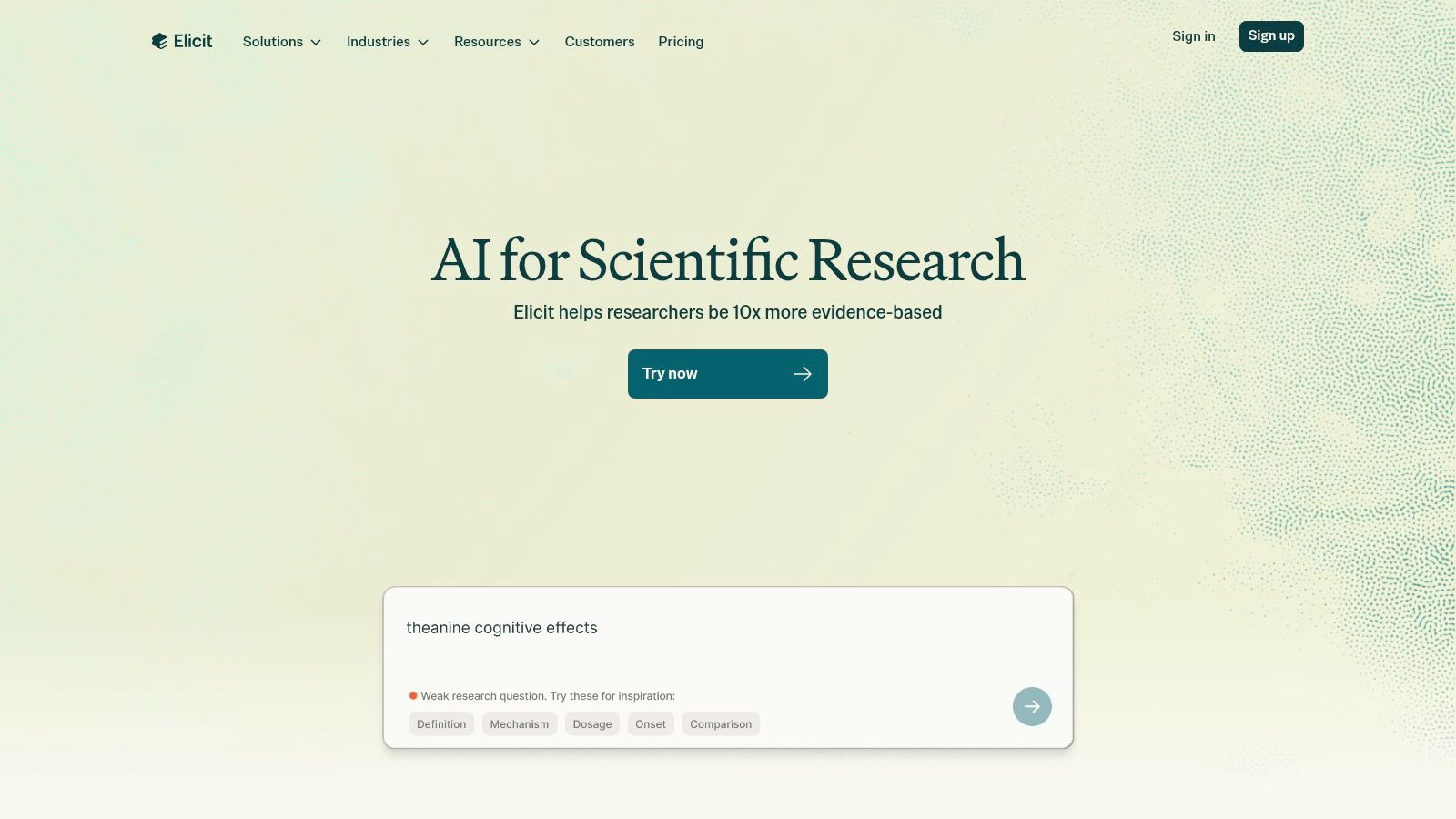
Its "Systematic Review" workflow is a standout feature, allowing researchers to screen thousands of papers efficiently. Elicit extracts key information and presents it in a customizable table, with each data point linked directly to the source sentence in the original paper. This transparent evidence trail is crucial for maintaining academic integrity. For those working on complex projects, a strong understanding of the research process itself is beneficial; you can review the basics of a systematic literature review methodology to get the most out of Elicit’s structured approach.
Key Features & Use Cases
- Workflow: Search → Screen → Extract → Report
- Ideal for: Systematic and rapid reviews, thematic synthesis, finding key concepts across many papers.
- Unique Offering: Creates automated, citation-backed tables of evidence from source documents.
Practical Assessment
Pros:
- Deep workflow support beyond simple search and summary.
- Excellent for data extraction into structured, comparable formats.
- API access allows for integration into custom research pipelines.
Cons:
- The most powerful features, like large-scale screening, are behind a paywall.
- Search coverage is strongest for English-language and biomedical/social science literature.
Elicit offers a free tier with monthly credits, with paid plans (Plus and Enterprise) unlocking higher credit limits and advanced features.
Website: https://elicit.com
3. scite
scite takes an evidence-first approach to academic research, moving beyond simple paper discovery to evaluating the credibility of claims. Its core function is the "Smart Citation," which analyzes how subsequent publications cite a paper, categorizing the reference as supporting, contrasting, or merely mentioning. This makes it an exceptional AI tool for literature review when you need to understand the academic conversation around a topic, not just find relevant articles. It helps gauge the weight of evidence for or against a particular finding.
The platform's AI Assistant allows you to ask direct questions about your research topic, generating answers grounded in the academic literature. A key strength is the ability to filter the sources the assistant uses, restricting it to specific journals, publication years, or even curated collections of papers. This control ensures the answers are highly relevant and drawn from a specific body of knowledge, which is critical for projects where source quality is paramount.
Key Features & Use Cases
- Workflow: Search → Evaluate Citations → Ask Questions → Synthesize Evidence
- Ideal for: Gauging the impact of a study, finding contradictory evidence, building a strong, evidence-backed argument.
- Unique Offering: Smart Citations show the context of how a paper is cited (supporting, contrasting, mentioning).
Practical Assessment
Pros:
- Excellent at judging the weight of evidence and the academic reception of research.
- Controls to constrain the AI Assistant to curated sets or specific journals.
- The "Reference Check" feature verifies the citations in your own manuscripts.
Cons:
- The interface has a lot of depth, which can present a learning curve for new users.
- Full access to team features and advanced tools often requires an organizational subscription.
scite provides a limited free plan, with paid Individual and Institutional plans unlocking unlimited reports and advanced assistant features.
Website: https://scite.ai
4. Consensus
Consensus operates as a specialized AI search engine for research, focusing on providing direct, citation-backed answers from peer-reviewed literature. Instead of just listing papers, it synthesizes findings to answer natural language questions, making it one of the most accessible AI tools for literature review when you need quick, evidence-based insights. It's particularly useful for scoping a topic or verifying a specific claim without diving into a full systematic search.
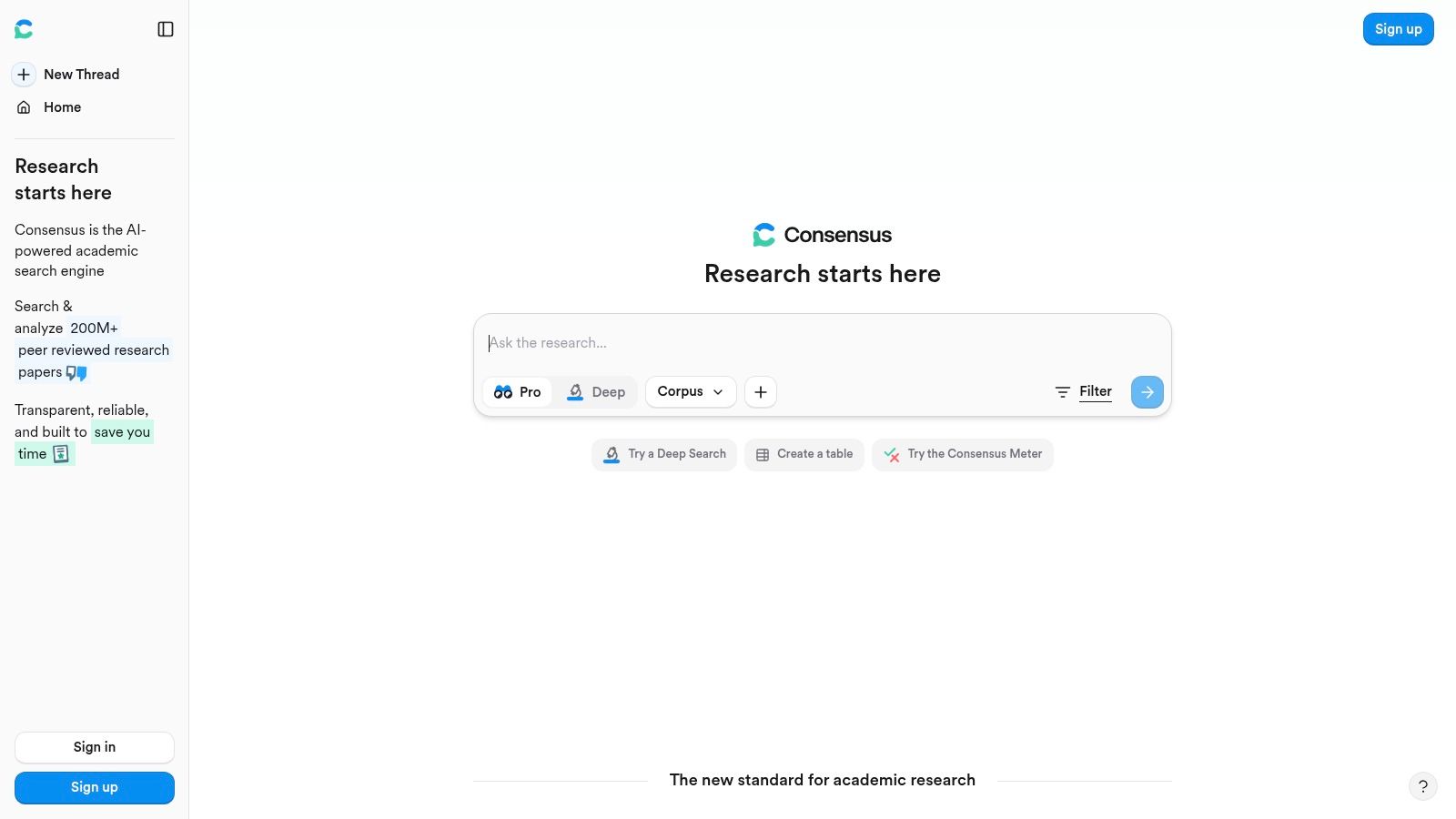
The platform’s "Consensus Meter" is a key feature, visually summarizing whether the findings from multiple papers support, contradict, or are neutral on a given topic. This allows content creators and researchers to quickly gauge the state of evidence. For those new to academic writing, using a tool like this is a great first step, and learning how to write a review paper can help you structure the insights you gather into a formal output.
Key Features & Use Cases
- Workflow: Ask Question → Get Synthesized Answer → Review Evidence
- Ideal for: Quick evidence checks, initial topic scoping, finding quotable claims with direct citations.
- Unique Offering: Visualizes agreement and disagreement across studies with its Consensus Meter and provides direct answers.
Practical Assessment
Pros:
- Very low learning curve and delivers fast, understandable summaries of scientific findings.
- Clear, clickable links to the original source paper for every claim.
- Growing library of academic guides and medical topic hubs.
Cons:
- Not a full systematic review tool; its screening and data extraction functions are limited.
- The depth of analysis can vary depending on the research domain and question complexity.
Consensus offers a free plan with limited searches, while paid plans (Premium) unlock unlimited searches and advanced analysis features.
Website: https://consensus.app
5. SciSpace
SciSpace operates as an integrated research workspace focused on enhancing the reading and comprehension of academic papers. It centers around an AI Copilot designed to interact directly with PDFs. You can upload a document and immediately start asking questions, getting explanations for complex equations or methods, and extracting key information. This makes it a strong contender among AI tools for literature review, especially for the initial phase of deeply understanding individual papers before synthesizing them.
The platform stands out by surfacing per-paper agents directly on the article page. When you're viewing a document, you can launch a "Literature Review" agent to find related works or use the "Chat with paper" function to query its contents. This approach keeps the focus on the document at hand while providing pathways for further exploration, turning a static PDF into a dynamic source of information.
Key Features & Use Cases
- Workflow: Upload → Read & Query → Explore Related Works → Extract
- Ideal for: Deep reading of individual papers, clarifying technical concepts, finding follow-up research from a single source document.
- Unique Offering: A per-paper AI Copilot that can explain, summarize, and answer questions specific to the PDF you are reading.
Practical Assessment
Pros:
- Excellent for improving reading comprehension and paper-level Q&A.
- Helpful on-page agents for immediate follow-up exploration and finding similar papers.
- Supports a wide range of document formats, including PDF, DOCX, and EPUB.
Cons:
- Users have reported mixed satisfaction regarding pricing plans and usage limits.
- The literature review generation is more assistive and best for topic exploration, not a replacement for a rigorous, methods-driven systematic review.
SciSpace offers a free plan with basic features and monthly credits. Paid plans (Premium and Teams) provide higher limits, unlimited private uploads, and advanced AI features.
Website: https://scispace.com
6. Semantic Scholar
Semantic Scholar is an AI-powered literature discovery platform from the nonprofit Allen Institute for AI, designed to accelerate the initial phases of research. Instead of offering full workflow automation, it focuses on helping researchers triage and understand papers more quickly. This makes it one of the most accessible AI tools for literature review, especially for getting a rapid overview of a field.
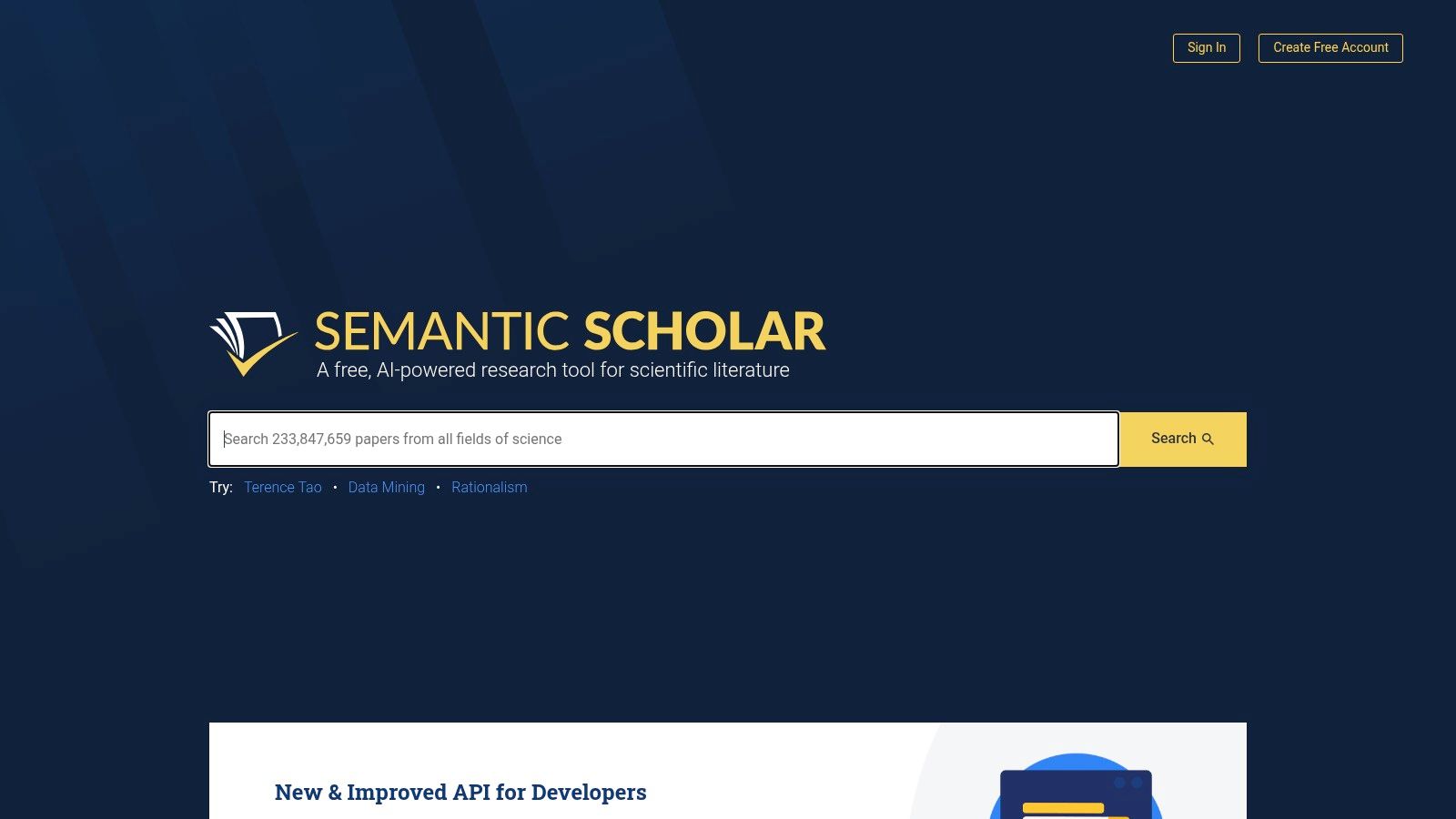
Its standout feature is the "TLDR" function, which generates a single-sentence summary for many papers, allowing for rapid-fire screening of search results. The Semantic Reader enhances this by providing inline citation cards and skimming highlights directly within the document view. For long-term projects, its adaptive research feeds learn your interests over time, suggesting new and relevant papers to help you stay current without constant manual searching.
Key Features & Use Cases
- Workflow: Discover → Triage → Read
- Ideal for: Initial topic exploration, staying current with new publications, quickly assessing a paper's relevance.
- Unique Offering: AI-generated "TLDR" one-sentence summaries and an adaptive research feed that personalizes recommendations.
Practical Assessment
Pros:
- Completely free to use, backed by a reputable nonprofit research institute.
- TLDRs and adaptive feeds are excellent for quickly filtering through large volumes of literature.
- Strong academic search functionality with good coverage across many disciplines.
Cons:
- Does not automate later-stage review steps like structured data extraction or synthesis.
- Feature depth and paper availability can vary depending on the research field and open-access status.
Semantic Scholar is a free service for all users.
Website: https://www.semanticscholar.org
7. ResearchRabbit
ResearchRabbit approaches literature discovery from a highly visual and interactive angle. It builds dynamic graphs showing how papers, authors, and topics are connected, turning the often linear process of following citations into an exploratory journey. Instead of just listing papers, it shows you the entire "rabbit hole" of research, allowing you to see influential works, identify key authors in a niche, and discover adjacent subfields you might have otherwise missed. This visual mapping is what makes it a standout among AI tools for literature review.
The platform is built around creating "Collections" of papers. Once you add a few seed papers to a collection, ResearchRabbit’s AI suggests new, relevant papers and visualizes their relationships. It also provides alerts for new publications, keeping your research current. For teams, its collaboration features and intuitive maps are perfect for explaining a complex research domain and ensuring everyone is on the same page. The ability to connect directly with Zotero streamlines the process of saving and organizing findings.
Key Features & Use Cases
- Workflow: Discover → Explore → Collect → Organize
- Ideal for: Exploratory searches, scoping reviews, identifying seminal papers and key researchers, and understanding the intellectual structure of a field.
- Unique Offering: Interactive citation and author network graphs that visually map a research landscape.
Practical Assessment
Pros:
- Excellent for discovering unexpected connections and adjacent fields.
- Intuitive visual maps are great for explaining a research area to collaborators.
- Zotero integration and collaboration features are built-in.
Cons:
- Focus is on discovery and mapping, not deep data extraction or synthesis.
- Advanced features require an RR+ subscription, and pricing can vary by location.
ResearchRabbit is free to use, with an optional RR+ subscription for advanced capabilities.
Website: https://www.researchrabbit.ai
8. Connected Papers
Connected Papers offers a unique, visual-first approach to exploring academic literature. Instead of providing lists of results, it generates a dynamic graph from a single "seed paper," visually mapping its relationship to other works. This allows users to quickly understand the scholarly landscape, identify seminal papers that influenced the field, and discover derivative works that build upon the original research. It is an excellent tool for rapidly orienting yourself in a new research area or for teaching the structure of a field to others.
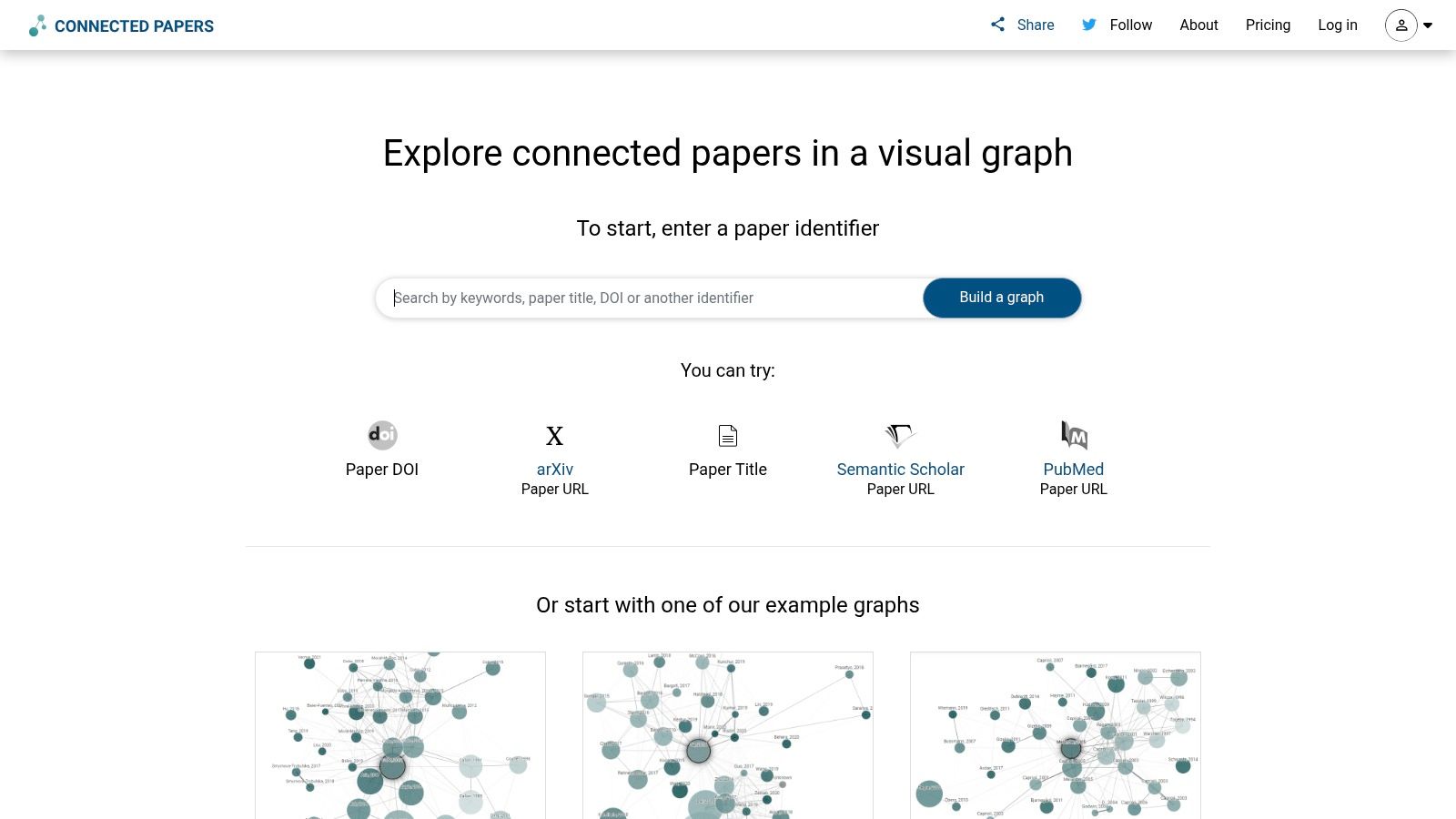
The platform's strength lies in its ability to build these graphs using co-citation and bibliographic coupling analysis. This reveals clusters of related research and "bridge papers" that connect different sub-domains. The interactive "Prior works" and "Derivative works" views help trace the intellectual lineage of an idea, making it one of the most intuitive AI tools for literature review when your goal is exploration rather than exhaustive data extraction. This visual method is especially useful for content creators and marketers looking for the foundational ideas behind a trend to create more authoritative content.
Key Features & Use Cases
- Workflow: Explore → Orient → Discover → Synthesize
- Ideal for: Rapid domain orientation, identifying seminal works, understanding a field's structure, finding related papers for a presentation or video.
- Unique Offering: Generates interactive citation-based network graphs from a single academic paper.
Practical Assessment
Pros:
- Highly intuitive visual overview for spotting key papers and research clusters.
- Excellent for teaching or explaining the structure and history of a research field.
- Simplifies the process of finding both foundational and recent related work.
Cons:
- The JavaScript-heavy site is best experienced on a desktop computer.
- Paid plan details and limits can change, so teams should verify current offerings before committing.
Connected Papers offers a free version with a limited number of graphs per month. Paid plans are available for individual researchers, teams, and institutions, unlocking unlimited graphs and advanced features.
Website: https://www.connectedpapers.com
9. Litmaps
Litmaps offers a visual approach to literature discovery, transforming a single research paper into an interactive map of interconnected knowledge. Instead of just listing papers, it visualizes the citation network, helping you see how research topics have evolved and identify seminal works. This makes it one of the most intuitive AI tools for literature review when your goal is to understand a field's landscape, not just find individual articles.
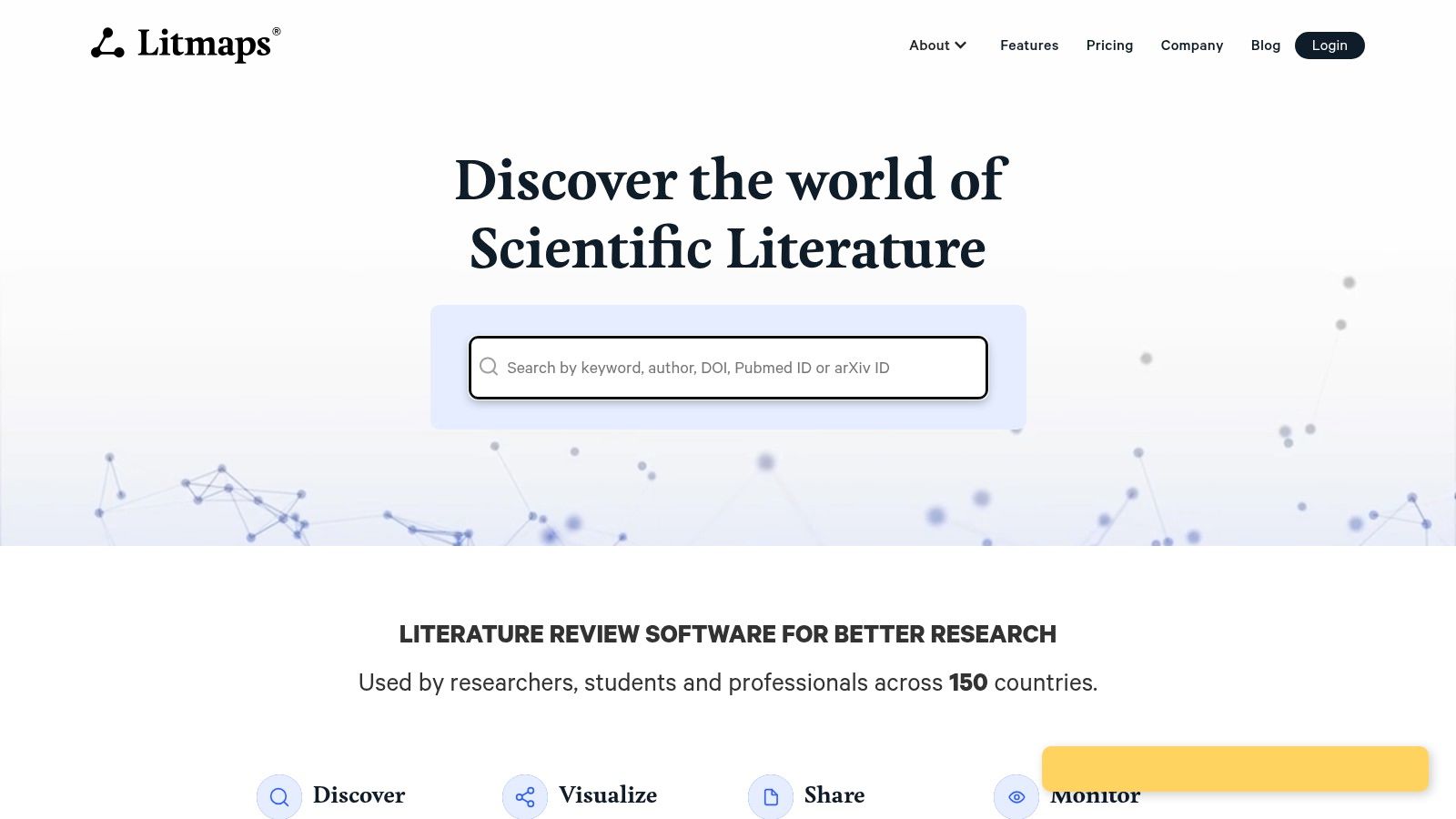
The platform’s strength lies in its "living literature review" concept. Once you create a map from a set of seed papers or by uploading your own references, Litmaps can monitor new publications and alert you when relevant articles are published. This is especially useful for long-term projects or for creators who need to stay current on a topic, as it automates the discovery process and pushes updates directly to you.
Key Features & Use Cases
- Workflow: Seed → Discover → Monitor → Export
- Ideal for: Exploratory reviews, staying current on a topic, identifying foundational papers, visual discovery.
- Unique Offering: Creates automated, living literature maps that send alerts for new, relevant research.
Practical Assessment
Pros:
- Strong alerting system tied directly to your existing research maps, reducing noise.
- Easy to create and maintain a dynamic, visual map of your literature.
- Zotero sync (Pro plan) simplifies importing your existing library.
Cons:
- The free plan has tight limits; serious researchers and content teams will need a paid plan.
- Map quality and discovery accuracy depend heavily on the completeness of source metadata.
Litmaps provides a free plan for basic use. The Pro and Teams plans unlock unlimited maps, advanced monitoring, and integration features.
Website: https://litmaps.com
10. Scholarcy
Scholarcy operates less like a search engine and more like a highly intelligent reading assistant. Its primary function is to take an existing article or research paper you provide-either as a PDF or a web link-and break it down into a structured, digestible summary called a 'Flashcard'. This makes it one of the most practical AI tools for literature review when your goal is rapid comprehension and note-taking, rather than initial discovery.
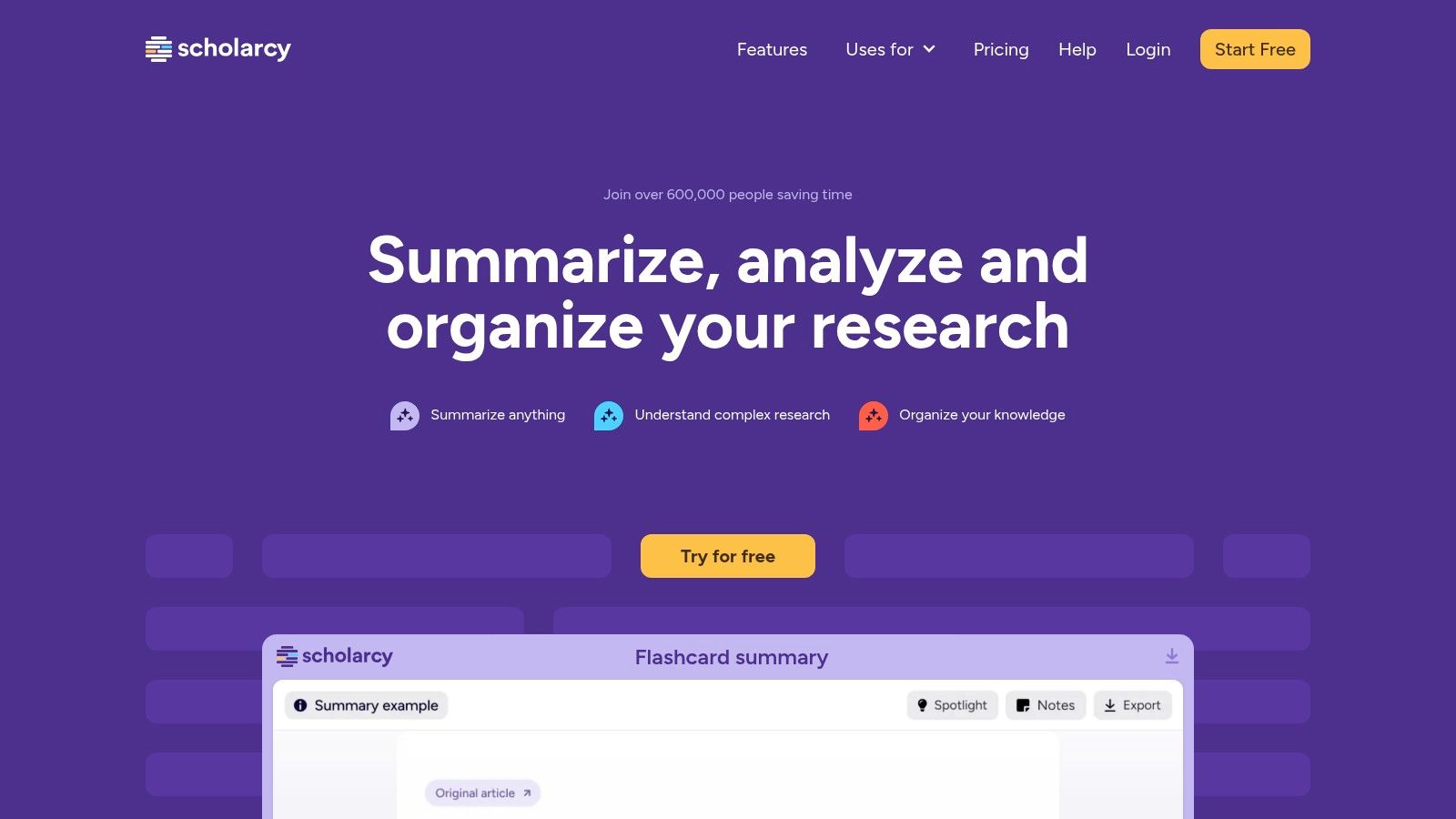
The tool automatically identifies and extracts key findings, highlights, cited sources, and even tables and figures from the source document. This condensed output is perfect for quickly assessing a paper's relevance or for populating a research management system. For creators building a content library, Scholarcy can accelerate the process of turning dense academic papers into background material for scripts or articles. Its ability to export data into formats like Word or BibTeX makes it a valuable bridge between reading and writing.
Key Features & Use Cases
- Workflow: Import Document → Analyze & Summarize → Export Notes
- Ideal for: Rapidly skimming reading lists, extracting key evidence from known papers, building an annotated bibliography.
- Unique Offering: Creates consistent, structured "Flashcards" from varied documents, with direct export of tables, figures, and references.
Practical Assessment
Pros:
- Significantly speeds up the process of skimming and note-taking for large reading queues.
- Provides a reliable 'paper-to-brief' output that is easy to export into writing tools.
- Browser extension allows for on-the-fly analysis of web articles.
Cons:
- It is not a search or discovery engine; it must be paired with other discovery tools.
- Performance is best with high-quality, text-based, accessible PDFs.
Scholarcy offers a free browser extension and web app with limited use, while paid Personal and Academic Licenses provide unlimited access and advanced features.
Website: https://www.scholarcy.com
11. Perplexity
Perplexity operates as an AI "answer engine," a conversational search tool that excels at early-stage scoping and gathering background information. Instead of just providing links, it synthesizes information from across the web and presents a direct answer with inline citations. This makes it an effective AI tool for literature review during the initial reconnaissance phase, helping you quickly get a lay of the land on a topic before diving into academic-only databases.
Its ability to process uploaded files, like a single research paper, and answer questions about them is particularly useful for quickly grasping the core arguments of a new document. Unlike specialized academic engines, Perplexity’s search is not restricted to peer-reviewed sources by default, which can be a double-edged sword. While it provides broader context, including industry reports and news, users must be diligent in verifying the rigor of each source it cites. For creators and marketers, this can be a benefit for finding audience-friendly statistics and real-world examples.
Key Features & Use Cases
- Workflow: Explore → Scope → Verify → Deepen
- Ideal for: Initial topic exploration, finding quick facts with sources, understanding industry context, summarizing individual documents.
- Unique Offering: Conversational search that provides direct answers backed by a list of cited web sources.
Practical Assessment
Pros:
- Excellent for rapid, exploratory research and finding leads for further investigation.
- Clear citations allow users to easily pivot from the summary to the primary source material.
- File Q&A feature is a fast way to digest single articles or reports.
Cons:
- Does not search academic-only databases by default, requiring manual source validation.
- Advanced features and higher usage limits are locked behind the 'Pro' subscription tier.
Perplexity offers a capable free version. The paid 'Pro' plan provides access to more powerful AI models, unlimited file uploads, and a higher number of daily queries.
Website: https://perplexity.ai
12. Iris.ai
Iris.ai is an enterprise-oriented AI platform geared toward serious, large-scale research needs. It moves beyond simple summarization to offer a suite of tools for literature discovery, screening, topic modeling, and retrieval-augmented generation (RAG) for question answering. The platform is designed for organizations that require security, custom data ingestion, and traceable, verifiable results.
Its strength lies in its deep understanding of scientific text and its focus on traceability. The RAG-based chat provides answers with direct citations, which is critical for maintaining accuracy in corporate research or post-market surveillance. This makes it one of the more powerful AI tools for literature review when rigor and verifiability are non-negotiable. For teams collaborating on complex projects, the platform's configurable dashboards help monitor progress and evaluate findings systematically.
Key Features & Use Cases
- Workflow: Discover → Filter → Analyze → Extract → Report
- Ideal for: Corporate R&D, market analysis, systematic reviews for institutions, post-market surveillance.
- Unique Offering: Enterprise-grade security and custom ingestion, combined with powerful topic modeling and auditable RAG chat.
Practical Assessment
Pros:
- Designed for organizational scale with a focus on security and custom data sources.
- Excellent traceability, with features that link claims directly back to the scientific text.
- Specialized in understanding complex scientific and technical language.
Cons:
- Primarily for teams and institutions; not a plug-and-play tool for individual researchers.
- Pricing is provided via quote after a demo, indicating a higher-cost enterprise solution.
- Setup and integration require more time and technical overhead than other tools.
Iris.ai is a premium B2B solution, so access is typically arranged through institutional or corporate licenses.
Website: https://iris.ai
12 AI Tools for Literature Review — Feature Comparison
| Tool | Core capabilities | Best for | Key strengths | Pricing / access |
|---|---|---|---|---|
| Contesimal | AI research + content-activation, chat interface, layered taxonomies, fast ingestion | Podcasters, publishers, creators, researchers, content teams | Converts archives into actionable ideas, human+AI collaboration, programmatic uploads — Recommended | Free first session; detailed plans via sales |
| Elicit | Systematic review workflows, search, screening, data extraction, API | Academic researchers, SLR practitioners | End-to-end SLR support, sentence‑level citations, programmatic access | Free/basic, advanced features behind paid tiers |
| scite | Smart Citations, AI assistant, evidence-weighting dashboards | Evidence evaluators, meta-researchers, librarians | Shows supporting/contrasting citations, gauges weight of evidence | Freemium; team/advanced features require org plans |
| Consensus | NL Q&A with citation-backed answers, agreement visualization | Quick scoping, non-specialists, clinicians doing rapid checks | Fast, low learning curve summaries with clear sources | Free/basic access; depth varies by topic |
| SciSpace | PDF AI copilot, per-paper Q&A, extraction agents | Students, individual researchers, readers | Strong paper-level comprehension, 'Chat with paper' agents | Freemium; some users report pricing/limit concerns |
| Semantic Scholar | Discovery, TLDR summaries, semantic reader, adaptive feeds | Broad researcher community, students | Free, nonprofit-backed, good triage and feeds | Completely free; coverage varies by field |
| ResearchRabbit | Interactive citation/author graphs, collections, alerts | Exploratory researchers, teams mapping domains | Visual maps of related work, surfaces adjacent subfields | Free basic, RR+ for advanced features (paid) |
| Connected Papers | Citation-based landscape maps from a seed paper | Domain orientation, teaching, thesis planning | Clear cluster maps, shows prior/derivative works | Paid plans; best on desktop (JS-heavy) |
| Litmaps | Living maps, monitoring alerts, Zotero sync | Ongoing discovery, researchers monitoring fields | Map-linked alerts, maintainable living literature maps | Free limited tier; Pro/Team for power users |
| Scholarcy | PDF summarizer, flashcards, table/figure extraction, exports | Writers, note-takers, high-volume readers | Fast paper-to-brief output, exportable highlights & refs | Freemium; best with good-quality PDFs |
| Perplexity | Conversational web + file search, cited answers, multiple models | Early-stage scoping, industry research, reconnaissance | Fast exploratory answers with citations, API/agents | Free/basic; advanced/'Max' tiers paid and can be costly |
| Iris.ai | Enterprise discovery, topic modeling, RAG chat with citations | Organizations, pharma, institutional teams | Scales for orgs, secure ingestion, traceable RAG workflows | Quote/demo-based enterprise pricing; longer setup |
From Research to Revenue: Integrating AI Tools into Your Content Workflow
The journey through the expanding universe of ai tools for literature review can feel overwhelming, but it's a critical first step for any serious creator or publisher. We've explored a dozen powerful platforms, from visual mappers like Connected Papers and Litmaps to deep-synthesis engines like Elicit and Scholarcy. Each tool offers a unique lens through which to view the vast body of published knowledge, transforming what was once a manual, time-consuming slog into an accelerated process of discovery.
The real power, however, is not found in just one tool. It materializes when you build a workflow that connects these specialized platforms, turning raw research into polished, monetizable content. The core takeaway from this guide is that you must think beyond individual features and focus on creating a strategic system.
Building Your Content Generation Engine
For content creators like podcasters and YouTubers, this means designing a process. You might start with a broad, exploratory tool like ResearchRabbit to get a feel for a new topic and identify seminal works. From there, you could import your findings into SciSpace or Consensus to ask specific questions and get direct, evidence-backed answers for a script.
A publisher, on the other hand, might use scite to validate the credibility of sources for a new book or article, checking how a paper has been supported or contradicted. An academic researcher might pair Semantic Scholar's powerful search with Litmaps to ensure no critical connection in their systematic review is missed. The key is to match the tool to the task and create a handoff from one stage to the next.
From Disparate Insights to a Cohesive Strategy
This is where the challenge often lies. You end up with insights scattered across multiple platforms: a collection of papers in one, a summary in another, and a visual map in a third. This is precisely the problem platforms like Contesimal are built to solve. It acts as the central hub where you and your team can organize, understand, and take action. You can ingest the research gathered from these specialized ai tools for literature review and begin the collaborative work of creating new value.
Think of it this way: your AI research tools are the prospectors finding gold. A platform like Contesimal is the refinery where you and your team turn that raw gold into currency.
This structured approach is what separates hobbyists from professional, revenue-generating entities. It allows you to reignite your content library by finding new angles on old topics, building out successful content playlists, and generating a steady stream of ideas for your next big project. By connecting initial discovery with collaborative synthesis, you create a system that consistently produces value. Beyond the literature review itself, AI also streamlines other aspects of academic work. For instance, researchers handling qualitative data from interviews or lectures can benefit from specialized, AI-powered academic transcription services to prepare their findings for analysis.
Ultimately, the goal is to create a seamless flow from initial curiosity to final product, whether that’s a podcast episode, a YouTube video series, a new book, or a marketing campaign. These AI tools provide the intellectual fuel, but a well-designed workflow is the engine that drives your content business forward, helping you organize your assets and create infinite value from your library.
Ready to turn your scattered research and content library into a revenue-generating asset? Contesimal provides the collaborative hub to organize your insights, connect them to your existing content, and empower your team to create new value. Start building your content engine by visiting Contesimal today.