
Think of an AI research assistant as a brilliant partner designed to dig through your entire content library—all your videos, podcasts, and documents—and find the hidden gold inside. For content creators, podcasters, and publishers, it goes way beyond a simple keyword search to understand the actual meaning behind your words, making every piece of content you've ever created instantly searchable and ready to upcycle.
What Is An AI Research Assistant
Imagine you had a librarian who hasn't just read every book you own, but has also watched every video and listened to every podcast in your archive. That’s pretty much what an AI research assistant does. It tackles a massive headache for content makers: your best ideas are often buried in old files, making them almost impossible to find when you need them to create new value.
An AI research assistant is a system that uses artificial intelligence, specifically tech like Natural Language Processing (NLP), to consume, understand, and organize huge piles of unstructured data. Unlike a standard search bar that just hunts for specific words, this kind of assistant gets the context, the sentiment, and the connections between different topics, helping humans and AI collaborate seamlessly.
Beyond a Simple Search Function
A typical file search can tell you if a keyword is in a document. An AI research assistant can tell you why it matters. That one difference changes everything for anyone sitting on a mountain of content. Instead of spending hours scrubbing through video timelines or flipping through hundreds of pages, you can just ask a direct question and get a synthesized answer, making it easier to figure out how to create the next new video or blog post.
This is all possible because of some pretty smart algorithms that:
- Transcribe and Analyze: They automatically turn your audio and video into text, then analyze it for the important stuff.
- Identify Themes: They spot recurring concepts and ideas, even if you use different words to describe them across different formats.
- Map Connections: They uncover relationships between topics you might never have noticed on your own, helping you build on successful concepts.
For instance, a podcaster could ask, "What were the top three challenges our guests mentioned about audience growth last year?" The AI wouldn't just spit out a list of episodes. It would pull together the core challenges and point you to the exact moments where they were discussed. To get a better sense of the engine behind this, you can explore our detailed guide on content intelligence platforms and see how they turn static files into a dynamic knowledge base.
At its core, an AI research assistant transforms a passive content archive into an active, intelligent partner. It’s a collaborator that helps you organize your library, understand your own material on a deeper level, and take decisive action to create new value.
Reignite Your Content Library
For creators and publishers transitioning from hobbyist to professional, this tech turns a forgotten content library into a goldmine of new opportunities. Every single piece of content you've produced holds untapped value—ideas for new articles, clips for social media, themes for a new video series, or data to back up your next big project. The main job of an AI research assistant is to make all that value easy to get to.
By organizing your knowledge and making it interactive, the AI helps you dust off your library and bring it back to life. It’s the key to upcycling old material, sparking fresh ideas, and ultimately making your content work a whole lot harder for you.
How AI Unlocks Your Content's Hidden Value
Every piece of content you’ve ever made—from a ten-minute video to a 300-episode podcast series—is sitting on a pile of untapped potential. The problem is that value is locked away, buried under a mountain of digital files. An AI research assistant is the key that turns that chaotic library into a structured, intelligent brain you can actually talk to.
The journey starts with ingestion. The AI doesn’t care if it’s video, audio, or a dense PDF; it consumes it all, laying the groundwork for what comes next.
Think of it as a master archivist on steroids. It doesn't just file your content away. It creates rich metadata, figures out the core topics, and starts mapping connections between themes—the kind of stuff no human could ever spot across thousands of assets.
Turning Your Library Into An Interactive Brain
Once everything is processed, your library stops being a digital storage unit and becomes something you can interact with. You're no longer stuck hunting for files with rigid keywords. Instead, you can have a real conversation with your entire body of work through a simple chat interface. This completely changes the game for research and content strategy.
Imagine asking your content library, "What were the biggest pain points our audience mentioned in last year's podcasts?" An AI research assistant can pull together a direct answer, complete with links to the exact moments in your episodes where those points were made. You've just moved beyond searching and into genuine discovery.
The whole process is a clean, three-step flow from raw content to strategic insights.
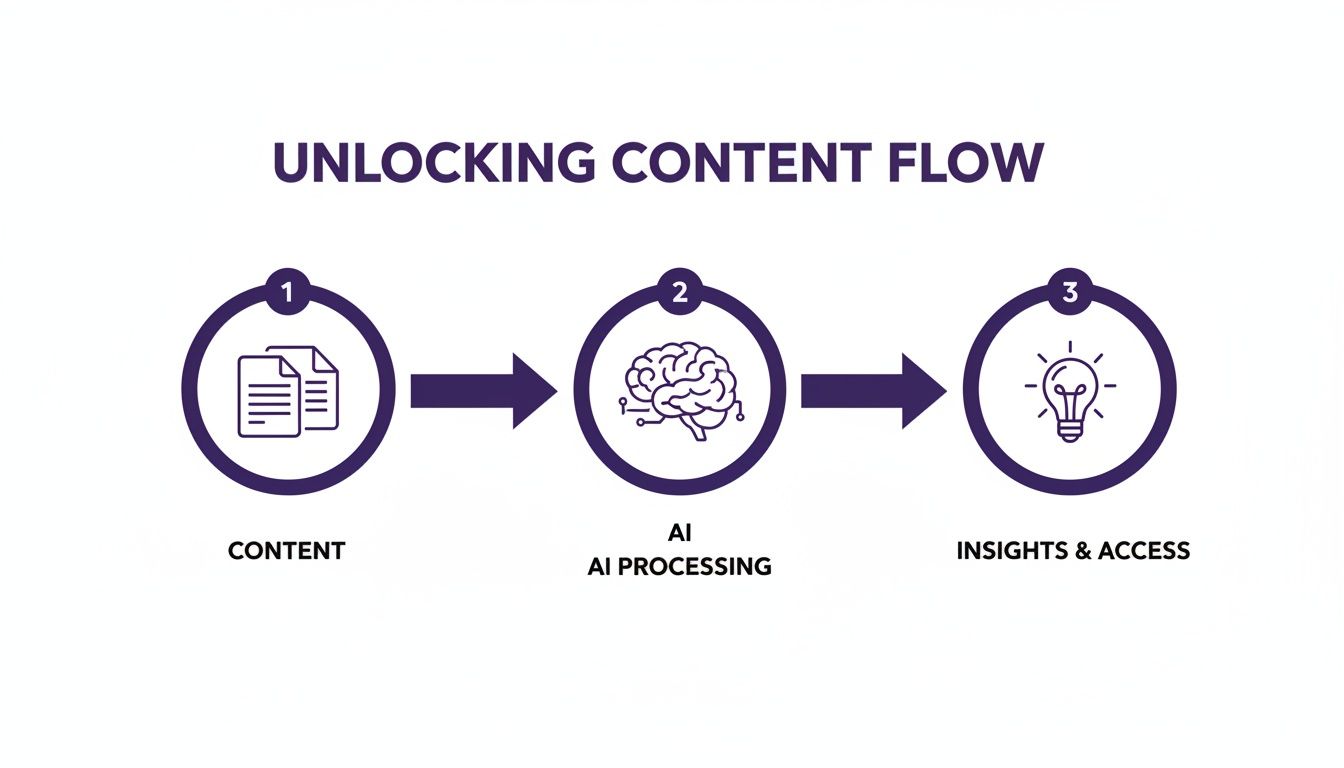
This shows how your raw stuff gets fed into the AI, which then processes it into clear, actionable ideas your team can use right away.
From Document Chaos to Clear Insights
Text-heavy files have always been a special kind of headache. Sifting through dense research papers, long-form articles, and detailed transcripts for one key piece of information is a grind. The rise of advanced AI PDF Reader tools is a perfect micro-example of how this tech makes dense documents manageable. An AI research assistant just applies that same power to your entire library.
This shift from searching for keywords to discovering patterns is where the real magic happens. By talking with your content, you can uncover:
- New Content Opportunities: Find gaps in your material or popular themes that are begging for a follow-up series.
- Audience Insights: Pinpoint recurring questions, frustrations, or desires mentioned by guests or in audience comments.
- Strategic Patterns: See which topics consistently generate high engagement across different platforms and formats.
Getting your library organized is the foundation. Once you have a clear view of what you’ve got, you can start making smart moves. For creators looking to squeeze every drop of value from their work, exploring ideas around AI content repurposing can show just how much gold is waiting in the archives.
By transforming your archive into a queryable knowledge base, an AI research assistant doesn't just help you find old files. It helps you build future content with the confidence that it’s based on the proven successes of your past work.
Ultimately, an AI research assistant is the bridge between what you've created and what you can create next. It eliminates the friction of manual research, freeing you and your team up to spend less time digging and more time creating high-impact content that your audience actually cares about. This is how you reignite your content library and turn old assets into your most valuable creative resource.
The Rapid Growth of AI Knowledge Tools
The buzz around AI-powered knowledge tools isn't just hype. It's a direct answer to the tidal wave of digital content we're all swimming in.
For content creators, publishers, and marketers, the game has changed. The challenge isn't just about making new things anymore—it’s about managing, understanding, and actually using the massive libraries you already have. This is exactly why businesses are sinking serious money into technologies that can make sense of it all.
An AI research assistant has gone from a nice-to-have luxury to an essential part of the toolkit. This isn't just about storing content; it's a strategic shift to actively managing knowledge. For any content-heavy operation, from a growing YouTube channel to a legacy publishing house, the ability to instantly pull value from existing assets is a huge competitive edge.
Market Momentum and The Creator Economy
The market data tells a pretty clear story here. The AI research assistant market is exploding, driven by an urgent need for smarter ways to find information.
The larger AI assistant market, valued at USD 3.35 billion in 2025, is on track to hit an incredible USD 21.11 billion by 2030. That’s a compound annual growth rate (CAGR) of 44.5%.
But here’s the really interesting part: within that boom, Knowledge & Research Assistants are the fastest-growing slice of the pie, projected to grow at an even higher CAGR of 49.3%.
This growth isn't just happening in corporate boardrooms. It’s deeply tied to the creator economy. As YouTubers and podcasters level up from hobbyists to full-blown media businesses, their archives become both a goldmine and a logistical nightmare. They need tools that can help them organize, rediscover, and repurpose old content to keep their audience hooked without burning out.
Adopting an AI assistant is no longer just about improving efficiency. It’s about staying competitive in a world where your past content is the fuel for your future growth.
A Strategic Investment for Content Creators
This whole shift points to a fundamental change in how we think about content's value. An old video or podcast episode isn't just a dead file sitting on a server; it's a collection of ideas, insights, and data points that can be brought back to life. An AI research assistant makes this possible, letting creators ask questions of their own library and pull out themes, topics, and memorable moments in seconds.
This has a direct impact on the day-to-day creative workflow. We're seeing more specialized tools pop up, like dedicated AI-powered description maker tools that help with the nitty-gritty of YouTube optimization. These are all part of a broader trend: using AI to handle the repetitive, data-heavy tasks so creators can focus on what they actually do best.
Ultimately, the growth in this space sends a clear signal. The value of a content library isn't measured by its size, but by how easy it is to access and use. If you're looking for ways to improve your own process, check out our guide on the best AI tools for content creators. An AI research assistant is a cornerstone of that modern toolkit, turning your archive from a storage cost into a constant source of inspiration and revenue.
Transforming Research Into A Collaborative Advantage
Research has always felt like a solo mission, hasn't it? A quiet, lonely dive into a rabbit hole of folders and files. But what happens when you bring the whole team into that rabbit hole? An AI research assistant completely flips the script, turning isolated work into a dynamic, collaborative team sport.

This is about so much more than just sharing documents a little faster. It’s about creating a single source of truth where your team’s collective intelligence can finally take off. The AI becomes the central hub, tearing down information silos and letting everyone build on each other's discoveries in real time.
When your entire content library becomes a shared, searchable knowledge space, your team moves faster and needs to collaborate. They make smarter, data-informed decisions. This collaborative power sparks a kind of collective creativity that was simply out of reach before.
Breaking Down Creative Silos
In most creative teams, knowledge is scattered. The video team knows what kills it on YouTube. The podcast producer has a gut feeling for topics that hook listeners. The blog editor is a master of SEO-driven content. An AI research assistant acts as the universal translator, pulling all that siloed expertise into one shared brain.
Suddenly, you have powerful opportunities for ideas to cross-pollinate. Think about these real-world scenarios:
- Marketing Campaign Brainstorm: A marketing team can instantly pull the core themes from every top-performing blog post from the last two years. Just like that, they have a list of proven concepts for a new ad campaign.
- New Series Development: A podcast team can ask the AI to find recurring topics brought up by guests across hundreds of episodes. The AI reveals a clear, compelling theme for their next big series.
- Publisher Anthologies: An editor at a publishing house can uncover thematic links across their entire backlist of books and articles, making it easy to curate a new, highly relevant anthology.
This is the real power of a shared knowledge base. It lets your team see the big picture and connect dots that were invisible before.
By unifying access to your content library, an AI research assistant transforms individual insights into a powerful, shared organizational asset. It allows your team to stop searching and start discovering, together.
From Solo Work to Team Sport
The jump from old-school, manual research to AI-assisted collaboration is a big one. It shifts the process from a slow, linear chore to a fast, iterative conversation where you can test ideas against your own data in seconds. The difference is night and day, impacting everything from raw efficiency to creative breakthroughs.
This table really highlights the evolution from isolated manual work to an integrated, AI-powered workflow.
Traditional Research vs AI-Assisted Collaboration
| Aspect | Traditional Research | AI-Assisted Collaboration |
|---|---|---|
| Discovery | Manually searching individual files and folders, relying on memory. | Asking natural language questions to the entire content library at once. |
| Speed | Can take hours or days to find a specific piece of information. | Provides synthesized answers with source links in seconds. |
| Team Access | Knowledge is often siloed with individual team members. | Creates a centralized, shared knowledge space accessible to everyone. |
| Insight Quality | Insights are limited by what an individual can manually uncover. | Uncovers deep thematic connections and patterns across all content. |
| Creative Process | Ideas are based on intuition and limited data. | Ideas are informed by comprehensive data from past successes. |
Ultimately, an AI research assistant acts as a force multiplier for your team's creativity. It handles the grunt work—finding and connecting information—freeing up your creators to do what they do best: build on great ideas, tell compelling stories, and engage your audience in new and exciting ways. This is the collaborative advantage that helps you finally unlock the infinite value hiding inside your content library.
Practical Ways to Use Your AI Research Assistant
Let's get past the technical jargon. The real magic of an AI research assistant isn't how it works, but what it does for your creative workflow. We're going to move beyond theory and look at real, practical ways creators can put this tool to work right now.
The goal here is simple: turn your content archive from a dusty digital attic into an active partner in creation. It's about asking better questions to get answers that not only save you hundreds of hours but also spark your next big idea.
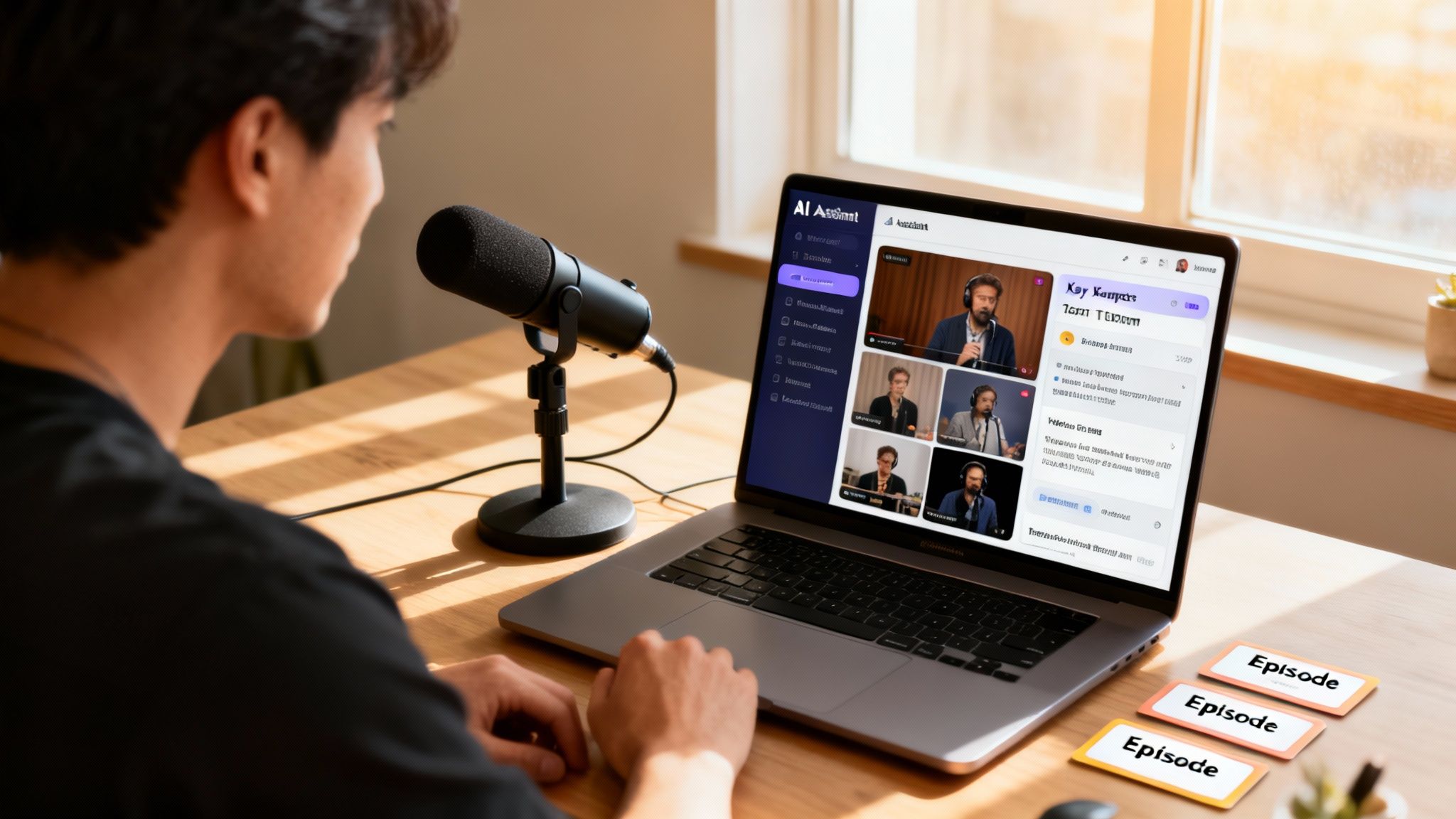
Think of the following as mini-case studies. They show how the AI becomes a strategic partner, helping you repurpose, remix, and build on the foundation of your best work.
For The YouTuber Planning The Next Hit Video
Imagine you’re a YouTuber with a library of 200+ videos. You know your content on "audience growth" always hits, but you're not sure which angle to tackle next. Re-watching dozens of hours of your own footage is just not going to happen.
This is where your AI assistant becomes a secret weapon. You can ask it a direct, strategic question:
"What were the five most engaging points from my top videos on 'audience growth'?"
The AI scans the transcripts from your highest-performing videos on that topic and pulls out the key takeaways. It might spot recurring themes, specific tips that blew up the comment section, or data points that your audience loved. Instantly, you have a data-backed blueprint for a new video script that you know has a high chance of success. It's no longer a guess; it's a strategy built from your own proven hits.
For The Podcaster Creating a "Best Of" Compilation
You're a podcaster with a back catalog of 300 episodes. You want to create a special compilation episode featuring insights from an expert who's been a guest or was mentioned frequently. The thought of manually scrubbing through hundreds of hours of audio is completely overwhelming.
With an AI research assistant, this task becomes almost trivial. You can give it a clear command:
- Query: "Find every instance where 'Dr. Jane Smith' was mentioned across all podcast episodes and provide a timestamped transcript of her key points on content marketing."
Within minutes, the AI hands you a complete list of every relevant segment. You can instantly see where she was a guest, where others quoted her, and the context of each mention. This lets you effortlessly assemble a high-value "Best of Dr. Smith" episode, creating fresh content from old assets while giving your listeners something amazing.
For The Publisher Compiling a Timely E-Book
As a publisher, you’re sitting on years of articles, whitepapers, and reports. A topic like "AI ethics" is suddenly trending, and you see an opportunity to quickly create a relevant e-book. But how do you find every piece of content you've ever published on the subject without losing your mind?
You can send your AI research assistant on a targeted mission:
- Task: "Identify all articles, reports, and interviews published in the last three years that discuss 'AI ethics,' 'responsible AI,' or 'machine learning bias.' Group them by sub-topic."
The assistant dives into your entire digital library and organizes the content thematically. It pulls together everything from deep-dive analyses to brief mentions, handing your editorial team a perfectly curated collection of source material. This massively speeds up the production of a new e-book, letting you jump on a trending topic and generate a new revenue stream from your existing IP.
In each of these scenarios, the AI doesn't just find information—it surfaces opportunities. It turns your historical content into your most valuable asset for future growth.
Got Questions About AI Research Assistants? We’ve Got Answers.
As creators and publishers start looking into an AI research assistant, a few practical questions always pop up. It makes sense. This is new territory for many. Let's tackle these concerns head-on to clear up the confusion and show how this tech can be a powerful creative partner, not a mysterious black box.
Is My Content Secure?
This is the big one, and it's non-negotiable. Your content is your gold.
Reputable platforms treat it that way, using robust, end-to-end encryption to protect your data from the moment you upload it to the second it's stored. Your content library is—and always will be—your proprietary asset. It lives in a private, secure environment just for you.
Crucially, the AI doesn't use your private data to train its models for anyone else. Your insights stay your insights. Always dig into the privacy and security policies of any tool you’re considering, but know that for serious platforms, security is priority number one.
Will This Thing Replace My Creative Team?
Absolutely not. Think of it as a collaborator, not a replacement.
The whole point of an AI research assistant is to augment your team by automating the tedious, soul-crushing work of digging up information and connecting the dots. This frees your writers, strategists, and producers to focus on what they do best: strategy, big-picture thinking, and creating exceptional content.
It handles the heavy lifting, letting your team work smarter and faster and allows humans and AI to collaborate in a healthy way.
How Painful Is It to Get Started?
Modern platforms are designed to be simple. You’re a creator, not an IT department.
Getting started usually just means connecting your existing content sources or using a simple uploader that takes pretty much any format you can throw at it—video, audio, text, you name it.
The system is built to handle all the complex technical stuff behind the scenes. This means your team can go from uploading your archive to asking questions and pulling out incredible insights in a remarkably short amount of time. Your library becomes an active, valuable asset almost immediately.
Ready to turn your content library into your most valuable creative asset? Contesimal gives you the tools to organize your knowledge, collaborate with your team, and unlock new value from the work you've already done. Start your journey at https://contesimal.ai.