
Think of your research paper's methodology as its spine. It's the core structure holding everything together, making your entire argument stand up straight and look credible. For any content creator, from a YouTuber to a podcaster, this section is all about answering one simple but powerful question: How did you arrive at your conclusions?
A rock-solid methodology doesn't just list steps; it tells a story of rigor and careful planning, proving your results are the real deal and building a bridge of trust with your audience. This isn't just for academics; it's a blueprint for making smarter, data-driven decisions about the content you create and repurpose.
Your Research Paper's Credibility Blueprint

Let's imagine your latest content project—a deep-dive video or a multi-part podcast series—is a meticulously constructed building. Your introduction lays the foundation, and your conclusion is the stunning rooftop view. But what about everything holding it up? That’s your methodology—the architectural plan, the specific materials you chose, and the construction process that gives the entire structure its integrity.
Without a detailed blueprint, your findings are just a floating roof with no walls to support it. A viewer or listener can't see the logic, the careful choices, or the effort that makes your work valid.
This is your chance to justify why you did it that way. You’re providing a clear, logical roadmap that allows anyone—from a skeptical peer to a curious subscriber—to follow your journey, understand your decisions, and ultimately, trust your results. A well-crafted methodology shouts from the rooftops that your conclusions aren't just guesses; they're the product of a systematic and defensible process.
To put it in perspective, let's quickly break down the methodology's job.
Methodology at a Glance
| Core Question It Answers | What It Does | Why It Matters for Creators |
|---|---|---|
| "How did you do your research?" | Explains the step-by-step process of your investigation. | Allows you to replicate successful content strategies and build on what works. |
| "Why did you choose these methods?" | Justifies your research design, tools, and analytical choices. | Proves your content decisions are based on data, not just a hunch. |
| "Are your results trustworthy?" | Demonstrates the validity and reliability of your work. | Builds credibility and authority with your audience and collaborators. |
Ultimately, this section is all about showing your work. The more transparent you are, the more seriously your content—and your brand—will be taken.
The Power of Transparency
Being crystal clear about your methods has a direct impact on how influential your work becomes. It's not just about getting a good grade or a passing comment; it's about making a real contribution and growing your channel or platform.
In fact, a study that combed through over 21,000 biomedical papers found a fascinating link: papers with detailed, transparent methodology descriptions had 35% higher citation rates compared to those with vague ones. That's a huge difference! It proves that when you show your work, other researchers are more likely to trust it, build on it, and cite it.
This principle is just as crucial for content creators and publishers. Whether you're analyzing audience feedback from your 5,000+ subscribers, testing new video formats, or organizing your content library to find the next big hit, having a clear process means your decisions are grounded in solid evidence, not just gut feelings.
Mastering what methodology is in a research paper is really about mastering the art of building a believable, bulletproof argument from the ground up. If you're digging into the foundations of solid research, you might also find our guide on how to identify a credible source helpful.
The Essential Building Blocks of a Strong Methodology
Every rock-solid methodology is built on a few key pillars. Think of them as the load-bearing walls of your content project—each one is absolutely essential for supporting your final conclusions. Once you get these components down, you’ll not only have a clear roadmap for your own work, but you’ll also be able to spot a flimsy argument in someone else’s video from a mile away.
A great methodology tells the whole story. It leaves no room for a viewer to scratch their head and ask, "But how did you actually figure that out?" The goal is to be so transparent that another creator could, in theory, follow your exact recipe and get a similar result.
Your Research Design
First up is your research design. This is your overall strategy, your blueprint for the entire investigation. It’s the master plan. Are you trying to prove that Thumbnail A gets more clicks than Thumbnail B? Are you diving deep to explore a brand-new content niche? Or are you simply trying to describe the common themes in your most popular videos?
Choosing your design is the first big fork in the road. For instance, a YouTuber A/B testing two different thumbnail styles to see which one gets more views is running an experimental design. On the other hand, a podcaster conducting long-form interviews to understand a guest's personal journey is using a case study design.
Your research design isn't just a technical box to check; it's a strategic decision. It dictates the kind of evidence you can gather and, ultimately, the kinds of claims you can confidently make when you're done.
Sampling and Data Collection
Next, you have to talk about your sampling strategy. This is where you answer two critical questions: who (or what) did you study, and how did you pick them? It's pretty rare to study your entire audience, so you almost always have to select a representative sample. A blogger, for example, might survey 100 subscribers who were randomly picked from their email list to get a pulse on their entire readership.
This flows right into your data collection methods—the actual tools and procedures you used to get your hands on the information. This is where you lay out the nitty-gritty details.
Common approaches for creators include:
- Surveys and Questionnaires: Fantastic for grabbing quantitative data from a big group, like polling your YouTube community.
- Interviews: Perfect for digging up those rich, in-depth qualitative insights and personal stories for a podcast or documentary.
- Observations: The go-to method for studying behavior in its natural habitat, like a researcher analyzing viewer comments on a video series to find content gaps.
- Document Analysis: A favorite of content marketers who need to analyze their entire library of blog posts to spot recurring themes and repurposing opportunities.
Data Analysis and Justification
Finally, you have to explain your data analysis plan. This is where you reveal how you took all that raw data and turned it into something meaningful. Did you fire up a spreadsheet to find correlations in your YouTube analytics? Or did you meticulously code interview transcripts to pull out common themes for your next video series? This step is what transforms a messy pile of information into a coherent story.
The glue holding all this together is justification. You can't just list your choices; you have to explain why you made them. Why a survey instead of one-on-one DMs? Why that specific playlist for your analysis? Defending your decisions shows you’ve thought critically about your approach, and that's what builds trust and makes your content truly authoritative.
Choosing the Right Research Approach for Your Goal
Think of picking a research methodology like choosing the right tool for a job. You wouldn't use a sledgehammer to edit a video, right? In the same way, your content goal dictates the approach you take. Get this part right, and you're setting yourself up for clear, credible findings that can guide your next viral hit. Get it wrong, and you might end up with a mess of unusable data.
Let's break down the three main roads you can take. Every other decision in your methodology will flow from this initial choice.
The Big Three Research Approaches
Your first big decision is about what kind of story you need to tell. Are you painting a big-picture landscape with numbers and statistics from your analytics, or are you zooming in to capture a detailed, personal portrait through audience interviews?
Quantitative Research: This is your wide-angle lens. It’s all about the numbers, the data, the stats. You use this approach when you need to measure something, spot trends, test a hypothesis, or generalize findings from a large group of people. Imagine a YouTuber polling their 5,000+ subscribers to see what percentage prefers long-form videos versus shorts. That's a quantitative question.
Qualitative Research: Now, switch to your macro lens. This approach is for digging deep into the "why" behind the numbers. It focuses on exploring ideas, feelings, and experiences in rich detail through methods like interviews or focus groups. Instead of a poll, a podcaster might sit down with ten loyal listeners to truly understand the emotional connection they have to the show.
Mixed Methods Research: Why not use both lenses? This approach is a powerful combination of quantitative and qualitative methods. It gives you the full story by backing up broad statistical trends with deep, human insights. For instance, a content marketer might see survey data showing a drop in engagement, then conduct interviews to uncover the real reasons people are tuning out.
This decision-making process is really a flowchart. Your goal points you toward the right path, which then leads you to the specific methods you'll use.
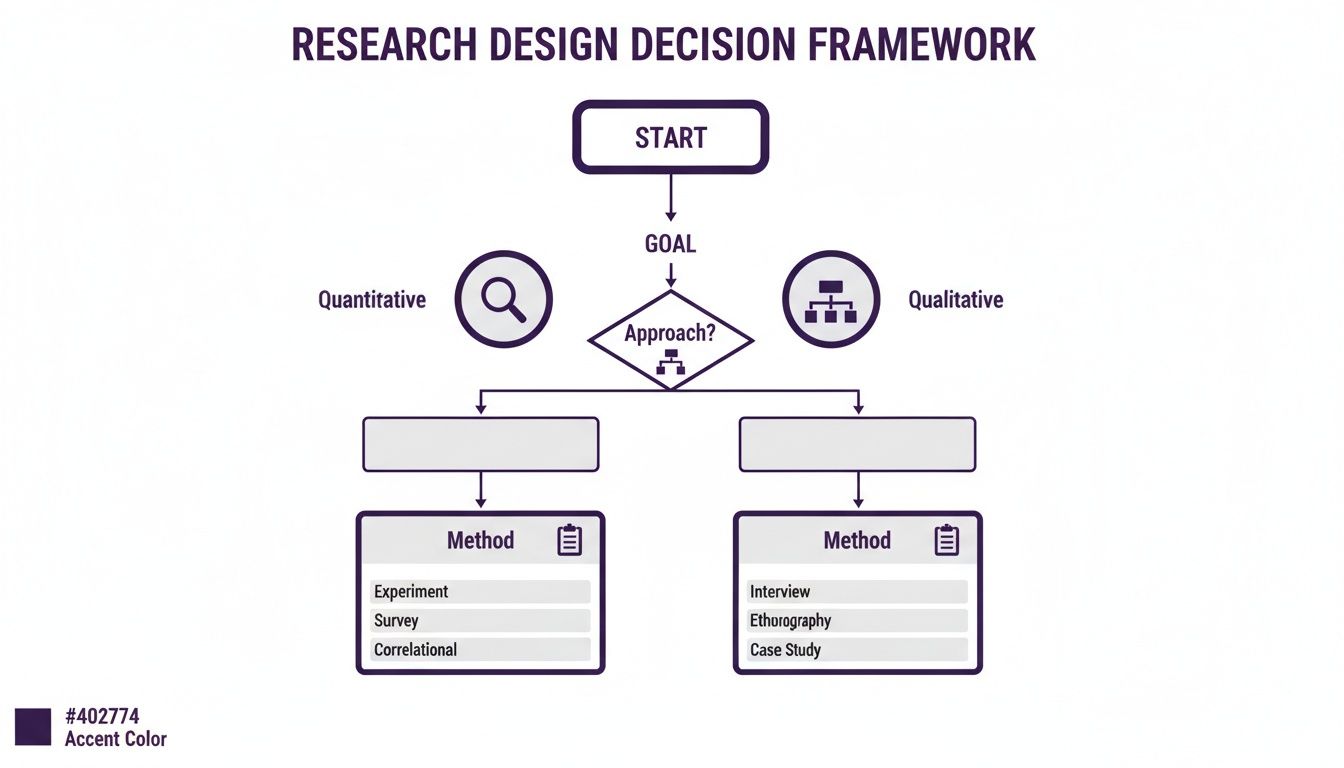
As the visual makes clear, it all starts with your primary goal. That initial question is the compass that guides you toward a numbers-based investigation, a story-based one, or a blend of both.
To make this even clearer, here’s a quick breakdown of how these three approaches stack up against each other.
Qualitative vs Quantitative vs Mixed Methods
| Approach | Primary Goal | Common Methods for Creators | Best For |
|---|---|---|---|
| Qualitative | To explore ideas, thoughts, or experiences in depth. Answering the "why." | Interviews, focus groups, case studies, comment analysis. | Understanding complex audience motivations, developing new content concepts, and getting rich feedback. |
| Quantitative | To test theories or hypotheses by measuring and analyzing numerical data. | Surveys, A/B tests, analytics analysis, polls. | Confirming content strategies, establishing facts about audience behavior, and generalizing results. |
| Mixed Methods | To integrate both qualitative and quantitative data for a more complete understanding. | Combining analytics data with viewer interviews, or A/B tests with qualitative feedback. | Getting the full picture, providing richer context to your numbers, and answering complex, multi-faceted content questions. |
Choosing the right approach gives your content strategy a solid foundation, ensuring your methods align perfectly with what you’re trying to discover.
It’s also worth noting that technology is constantly changing the game here. The market research sector has ballooned to $150 billion, partly because new tools are making complex analysis easier for everyone. In fact, 13% of researchers see this democratization of insights as AI's biggest benefit, as it allows even non-experts to run powerful analyses. Getting a handle on these different forms of research is the first, most critical step in building a rock-solid strategy.
How to Write Your Methodology Section Step by Step

Alright, let's move from theory to practice. Turning the idea of what a methodology is in a research paper into a clear, solid section of your own is much easier than it seems. The best way to think about it is you're walking a collaborator through your process after it's all done. That's why you always write this section in the past tense—you’re describing what you’ve already done.
The real trick is finding the sweet spot. You need to give enough detail so another creator could pick up your notes and replicate your content experiment. But you don't want to drown them in tiny, irrelevant details. Getting this balance right is what makes your methodology—and your entire content strategy—credible.
Start With the Big Picture
Before you get into the weeds, you need to set the scene. Kick things off by reminding the reader of your research problem and then state your overall approach. Did you go with a quantitative, qualitative, or mixed-methods design?
Justifying that first big choice is absolutely essential. For instance, a YouTuber could write something like: “To understand the impact of video length on audience retention, we used a quantitative experimental design. This approach was chosen because it allows for the precise measurement of causal relationships between variables (video length and watch time).”
See how that works? It immediately gives your collaborator a mental map for everything that comes next. It’s like telling someone you’re baking a cake before you start rattling off the ingredients. If you want to see how this looks in a finished paper, check out these helpful samples of methodology in a research paper for some great examples.
Detail Your Data Collection Process
Okay, now it’s time to get specific. In this part, you explain exactly how you got your hands on the information you needed. This is where you talk about your specific methods and the tools you used.
If you ran a community poll, what did it look like? Describe how you put it together, the types of questions you asked (e.g., multiple choice, scale of 1-5), and how you promoted it. If you did interviews with subscribers, were they structured or semi-structured? How long did they typically last, and how did you record and transcribe them?
Think of your data collection description as a clear, repeatable recipe. Another creator should be able to read it and know exactly which tools you used and how you used them to gather your raw data.
Explain Your Analysis Methods
Finally, you need to connect the dots. How did you get from a pile of raw data to the fascinating insights that will fuel your next piece of content? This step completes your methodological story.
For a quantitative study, this means you need to lay out the analysis you ran. Be specific. Name the software you used (like YouTube Studio Analytics or Google Sheets) and the exact metrics you looked at (e.g., click-through rates, audience retention graphs).
If your research was qualitative, describe your approach to making sense of it all. Did you use thematic analysis to hunt for patterns in your video comments? Or maybe you used discourse analysis to dig into how language was used in a particular online community?
Clearly explaining these steps proves that your content decisions weren't just pulled out of thin air. It shows they are the result of a systematic, rigorous process. For professional creators, this is exactly where tools like Contesimal can be a game-changer, letting you organize and systematically analyze your entire content library to find those hidden, actionable patterns.
Common Methodology Mistakes and How to Avoid Them
Even the most brilliant content idea can fall flat if it’s backed by a weak or sloppy methodology. Think of your methodology as the foundation of a house. If it’s cracked, it doesn’t matter how beautiful the rest of the structure is—no one’s going to trust it. Crafting a solid plan is about more than just checking boxes; it’s about sidestepping the common traps that can sink your credibility with your audience and potential collaborators.
One of the biggest blunders is being too vague. If your audience has to guess what you did, they’re not going to believe what you found. You need to be crystal clear, laying out your process so another creator could theoretically follow your footsteps and get similar results. Ambiguity is the enemy of trust.
Another classic mistake is a mismatch between your research question and your method. This is like trying to measure the emotional impact of your podcast by only looking at download numbers. Sure, it’s a metric, but it’s the wrong tool for that specific job. Your methods have to be a direct, logical response to the question you’re trying to answer.
Failing to Justify Your Choices
Simply listing what you did is only half the battle. The real mark of a pro is explaining why you did it that way. Why did you choose a community poll over one-on-one interviews? What was the thinking behind your sampling strategy for viewer feedback? Justifying these decisions demonstrates critical thought and makes your entire content strategy feel deliberate and robust.
Without that justification, your methodology comes across as arbitrary, almost like you picked your methods out of a hat. For creators, this might mean explaining why you analyzed comment sentiment on your top 10 videos instead of your entire channel. The "why" is just as crucial as the "how."
A methodology without justification is just a list of actions. A methodology with justification is a defensible argument that builds trust and authority with your audience.
The High Cost of Poor Reporting
The consequences of getting this wrong are huge. Shoddy methodologies don't just weaken a single piece of content; they chip away at the credibility of your entire brand. It’s a major contributor to the growing problem of non-replicable research, which erodes trust for everyone.
It’s not just a theoretical problem, either. A landmark meta-analysis that dug into over 10,000 papers found that poor methodology reporting was the culprit behind a shocking 52% of findings being non-replicable. This has kicked off a replication crisis that costs the U.S. research economy more than $28 billion every year in wasted time and money. You can explore more about these trends and their impact on market research.
By avoiding these all-to-common errors, you strengthen your own work, build unshakable trust, and make sure your content gets the respect it deserves. This is a fundamental part of understanding what methodology is in a research paper and applying it to grow as a creator.
The Future of Research and Data-Driven Storytelling

The world of research is going through a huge shake-up, and the old ways of doing things are changing right along with it. For content creators, understanding what methodology is in a research paper is no longer just some stuffy academic requirement. It’s about learning to think systematically so you can upcycle your old content, unlock fresh value from the content you already have, and start crafting stories that genuinely hit home with your audience.
The rise of AI and machine learning is a complete game-changer here. Think about being able to feed your entire library of videos or podcasts into a system that spits out hidden audience patterns or predicts what your next viral topic will be. This isn't science fiction anymore; it's the new reality of data-driven storytelling. Tools like Contesimal are leading the charge, helping humans and AI collaborate to turn massive content libraries into searchable, actionable knowledge bases.
The Rise of Digital Insights
Beyond just AI, the methods themselves are evolving. We’re seeing a massive boom in digital ethnography—which is a fancy way of saying researchers are studying online communities right where they hang out. This means diving headfirst into TikTok trends, Reddit forums, and YouTube comments to get a real-time pulse on culture.
What we're witnessing is a powerful fusion of different research streams. Academic methods are now blending hard numbers with human stories, and digital ethnography has seen a 55% jump in popularity, largely because it's so easy to access the platforms where creators are already building their communities. Researchers are combining forum data with survey results for richer insights, and some AI agents now promise to oversee more than 50% of research projects from start to finish. You can discover more insights about these research trends and what they mean for the road ahead.
The future of research isn’t about gatekeeping knowledge; it’s about democratizing it. Modern tools are empowering YouTubers, podcasters, and publishers to apply rigorous methods to their own work, turning creative instincts into strategic, evidence-backed decisions that make money.
This new era is about more than just pumping out content. It's about systematically understanding it. By adopting a clear methodology, you can reignite your content library, organize your insights, and take concrete action to build a more engaged and loyal audience across platforms. Organize. Understand. Take Action.
Got Questions About Research Methodology? We've Got Answers.
Even after you’ve got a handle on the main components, a few nagging questions always seem to pop up when you're in the thick of planning your research. Nailing these details is what separates a flimsy content strategy from a rock-solid one.
Let's clear up some of the most common sticking points so you can build your next project with confidence.
What Is the Difference Between Method and Methodology?
This one trips people up all the time, but the distinction is actually pretty simple.
Think of methodology as your grand strategy—the overarching blueprint for your research. It’s the "why." For instance, your methodology might be qualitative because you need to explore the rich, nuanced experiences of your subscribers.
Methods, on the other hand, are the specific tools and tactics you use to pull off that strategy. They're the "how." Following our example, your methods would be things like conducting ten in-depth interviews via Zoom or using thematic analysis to sift through your video comments for common patterns. One is the game plan, the other is the individual plays.
Where Does the Methodology Section Go in a Research Paper?
Your methodology section has a very specific and logical home in a research paper. It slides right in between your literature review and your results.
This placement creates a natural story for your reader:
- First, you set the stage with your topic and research question.
- Then, you show you've done your homework by reviewing what others have already found.
- Next, you explain exactly how you conducted your own study (that's your methodology).
- After that, you present what you discovered (the results).
- And finally, you explain what it all means (the discussion and conclusion).
It’s the bridge between what’s already known and what you’ve personally discovered.
How Long Should a Methodology Section Be?
There’s no magic word count here. The length really depends on how complex your study is. The golden rule? Be concise but comprehensive. You want to give another creator or collaborator enough detail to replicate your study, but you don't want to bore them with fluff.
Cut out any irrelevant details, but make sure you don’t leave out a single critical step. As a rough guide, for a typical academic paper, the methodology usually makes up about 10-15% of your total word count.
Can I Use AI to Help Write My Methodology?
Absolutely. AI tools can be a fantastic co-pilot for things like outlining your section, checking your writing for clarity, or even summarizing a complicated procedure you've followed. They're great for polishing your language and structuring your thoughts.
But—and this is a big but—you are the expert on your research. An AI can't know the specific reasons you chose one technique over another or the unique context of your work. So, use it as an assistant to sharpen your writing, not as a replacement for your own expertise. A seamless collaboration between humans and AI is key. And always make sure the final text is a true reflection of your study, and remember to disclose its use if your institution requires it.
Ready to turn your content library into a goldmine of insights? Contesimal is software that helps creators organize their past work, collaborate with their team, and discover new, data-driven ideas for what to create next. Stop guessing and start knowing. Explore how Contesimal can reignite your content and help you create new value at https://contesimal.ai.