
You've got a content library that already carries weight, videos, podcasts, articles, and old pages that still have something to say. The problem isn't the lack of material, it's that most of it is trapped in one format, one URL, or one workflow. Programmatic SEO tools give you a way to reorganize that archive into pages that can answer the long-tail queries people are already typing, and the scale case for that is hard to ignore, since 91.8% of Google search queries are long-tail keywords and 94.74% of keywords in Ahrefs' database receive 10 or fewer monthly searches Shno's programmatic SEO statistics roundup.
That's why this topic matters to creators, publishers, and content teams who already have a library. The best pSEO systems don't just create net-new pages from scratch, they help you turn existing assets into structured, search-ready formats that can be republished across markets, intents, and page types. In practice, that means less manual rewriting and more deliberate reuse, which is exactly what a mature content operation needs when it's trying to grow audience and revenue without starting from zero every time.
1. pSeoMatic
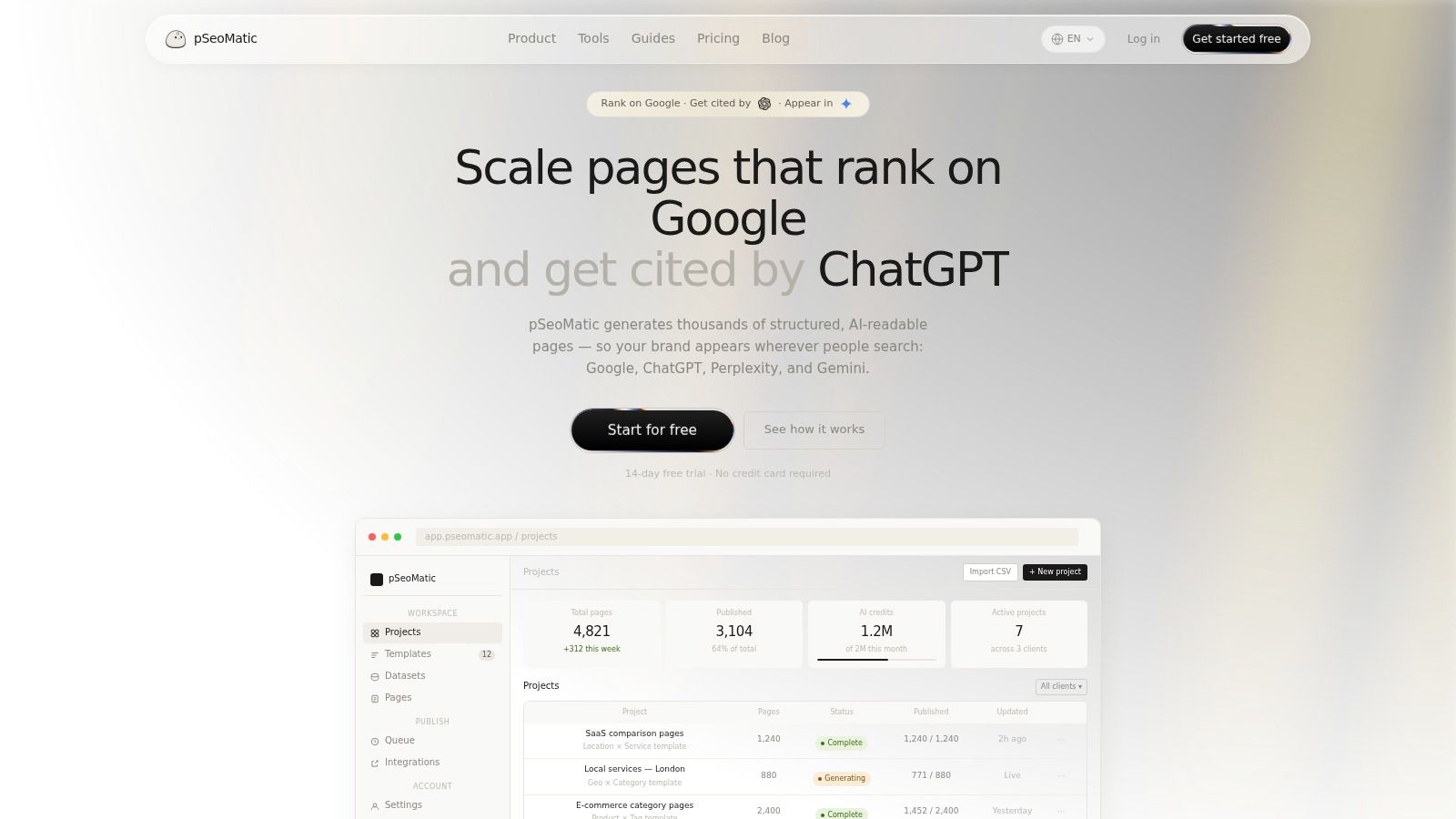
pSeoMatic is a strong fit when you want a single workflow from dataset to published page. It connects structured data to reusable templates and pushes that output into major CMSs, including WordPress, Webflow, Shopify, and Ghost, which lowers the friction if your content already lives in more than one system. That matters for creators and publishers who've accumulated assets over time and don't want a migration project just to test programmatic pages.
Why it works for content libraries
The strongest appeal here is the data to template to publish pipeline. If your archive already has repeatable fields, episode topics, destination names, product categories, or comparison attributes, pSeoMatic can turn that structure into many unique pages without forcing you into a manual page-by-page build. It also offers CSV export, AI content generation per page, and bulk publishing workflows, which makes it more useful for teams that need production speed but still want editorial control.
The trade-off is simple. Heavy AI generation can help fill page scaffolding, but it also raises the bar for review, uniqueness, and tone consistency. If your archive is the asset, treat AI as the assembly layer, not the source of truth.
Practical rule: use pSeoMatic when your library already has clean fields and a repeatable template, then keep a human pass on the pages that matter most.
Where it fits best
Its plan tiers scale by page volume, from roughly 500 pages per month to 20,000+, which is useful if you're testing a repurposing strategy before committing to a massive rollout. That kind of packaging fits a team that wants to start with a modest subset of its archive, learn what gets indexed, then expand the program without switching tools.
Visit the product site at pSeoMatic if you want an end-to-end system that can take an existing dataset and push it into live pages with minimal glue work.
2. SEOmatic
SEOmatic is one of the clearest choices when the goal is to transform structured content into scaled pages without building a custom stack. It's built around the core pSEO pipeline, dataset sync, template building, AI-written page elements, schema, and indexing workflows, and it supports 15+ CMSs, including WordPress, Webflow, and Shopify. If your content team needs one tool that can sit between a spreadsheet and a publish button, that combination is hard to beat.

The best reason to consider it
The strength is that it treats programmatic SEO as a publishing problem, not just a writing problem. You can connect CSV or Google Sheets, build a reusable template, and generate unique pages from the same base structure. That's especially useful if you've already organized your library by topic, guest, location, service, or use case and want to convert that into an SEO asset rather than another spreadsheet nobody opens twice.
It also ships with the kind of connective tissue teams often end up stitching together separately, like schema management and indexing support. That makes it practical for creators who want to repurpose old content into many new pages without spending all week on CMS plumbing.
What to watch for
Output quality still depends on the dataset. If the source information is thin, the pages will feel thin. If the source data is strong, SEOmatic can help you package it into a much more scalable page system. For teams thinking about AI in the SEO workflow more broadly, this AI for SEO guide is a useful companion read because it frames automation as an editorial aid, not a replacement for strategy.
The practical upside here is workflow maturity. SEOmatic is a good match for content operators who already understand that scale comes from structure, not from blindly publishing more pages.
3. SEO Fabric
SEO Fabric is the most Webflow-native option in this list, which immediately makes it attractive if your library already sits inside a design-led publishing stack. It generates location and cluster pages from keyword lists and templates, then publishes directly to Webflow CMS. That's a very clean fit for teams that care about visual quality and don't want to bounce data through extra systems before pages go live.

Why Webflow teams like it
The advantage is less about novelty and more about convenience. If your content strategy relies on location matrices, service area pages, or other repeatable structures, SEO Fabric keeps the work inside the Webflow ecosystem. That can save time for creators who already use Webflow as the home for their brand assets, landing pages, or editorial content.
It also includes CiteControl, which adds LLMs.txt and citation controls. That makes sense as search visibility and AI discoverability are starting to overlap. You still need good page content and a defensible dataset, but these controls give you more deliberate management over how the output is framed.
Where it breaks down
The obvious downside is platform lock-in. If you're not on Webflow, SEO Fabric isn't the right tool. It also uses a credit-based system, so high-volume programs need cost planning before they scale out a large archive repurposing effort.
When a tool is tightly aligned to one CMS, it usually wins on speed and loses on portability.
There's a free mode for smaller batches through the marketplace listing, which is useful if you want to test the shape of a few pages before committing a larger content library to the workflow. For Webflow-first teams, that makes SEO Fabric a practical way to turn old material into indexable page systems.
4. Page Generator Pro
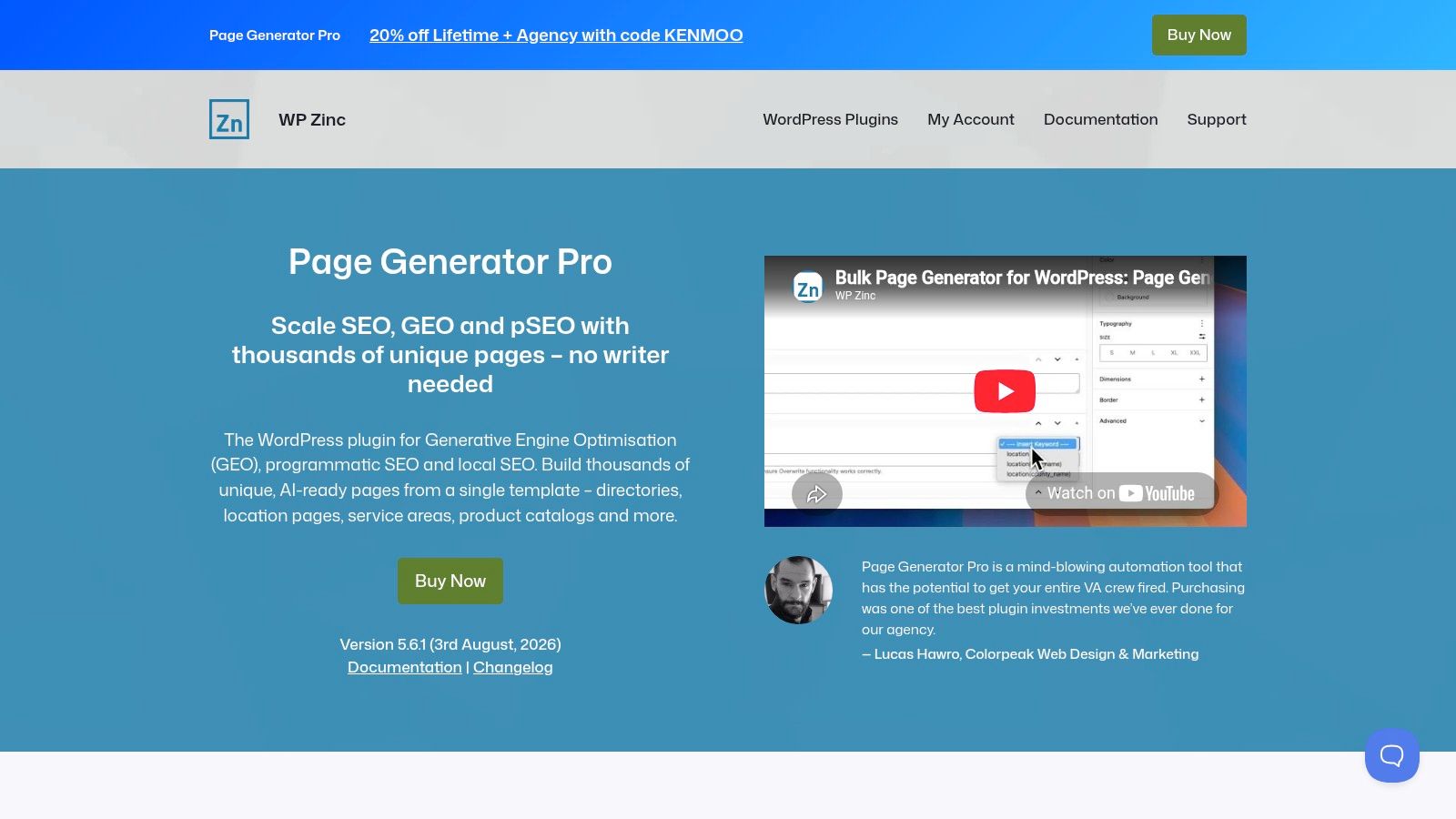
Page Generator Pro has the feel of a veteran WordPress tool, and that matters if your content library already lives in WP. It can generate thousands of pages, posts, or custom post types from templates using keywords or external datasets like CSV, Google Sheets, Airtable, Notion, and database tables. If you've got a long-running site with archives, category pages, or location content, this kind of breadth can be very useful.
What makes it dependable
The biggest advantage is familiarity. WordPress teams already know how to think in posts, templates, taxonomies, and plugins, so Page Generator Pro often slots into existing workflows instead of forcing a new publishing model. It also supports spintax, AI assists, internal linking elements, scheduling, and WP-CLI/server generation, which gives experienced teams more control over bulk runs.
That control matters when you're repurposing a library. You're not only asking, “Can this tool create pages?” You're asking, “Can it create the right pages, at the right cadence, without breaking my CMS?” For many publishers, the answer is yes, as long as the pages are reviewed and the dataset is differentiated.
Where the risks show up
The WordPress-only limitation is real. It's not the right choice for non-WP stacks. Bulk generation also increases the risk of thin or duplicated output if the same logic gets reused too aggressively, especially when a content team starts treating spintax like a substitute for original structure.
Editorial warning: bulk output is easy to publish and hard to repair later.
The good news is that the product has clear license options and regular updates, which suggests it's still actively maintained for teams that want a stable WordPress route. If your archive already lives in WordPress, Page Generator Pro remains one of the most direct ways to convert that library into scaled landing pages and posts.
5. PageScale
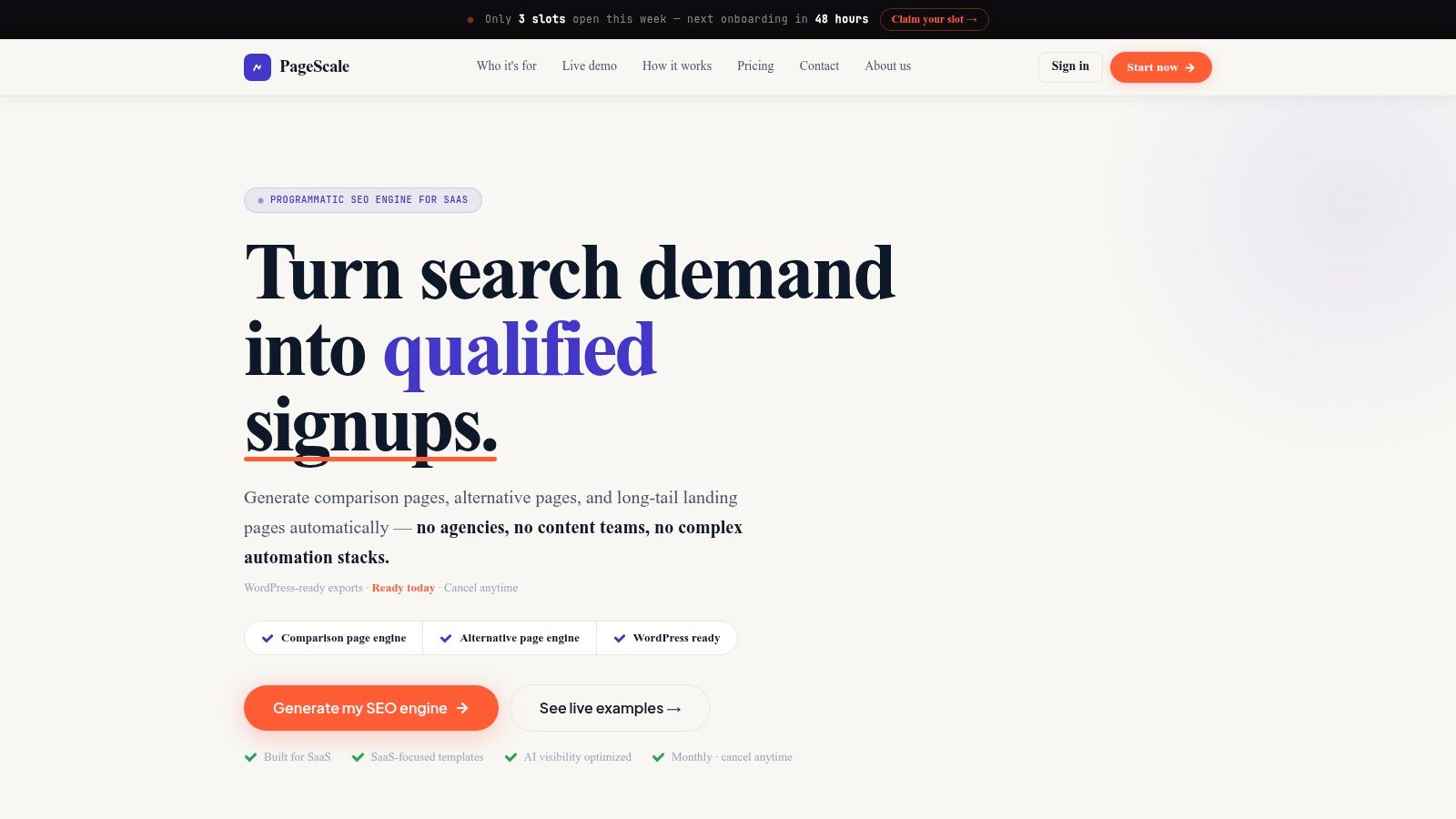
PageScale is built with a narrow purpose, and that makes it easier to evaluate. It focuses on comparison, alternatives, and use-case pages for SaaS, plus automatic internal linking and built-in schema. If your existing content library includes product education, category roundups, or feature explainers, PageScale can help you turn those assets into conversion-oriented landing pages instead of generic blog derivatives.
Why SaaS teams care
SaaS marketers often sit on a pile of useful material that never gets reused properly, feature briefs, competitor notes, use-case writeups, and old launch copy. PageScale is opinionated about those page types, which is a strength if your goal is to turn research and product knowledge into pages that can capture bottom-funnel demand. The internal linking feature also helps build topical clusters without hand-wiring every connection.
That matters because programmatic SEO isn't just about volume. It's about creating page families that support one another and give search engines a clear map of intent. PageScale leans into that logic instead of trying to be a general-purpose CMS tool.
What to keep in mind
Its focus is narrower than some of the other platforms here. That's not a flaw if you're in SaaS, but it is a limitation if your library spans media, education, local services, or ecommerce. Exporting to WordPress or CSV also means you may still need a publication step depending on how your stack is set up.
For teams that want a more automation-heavy operational lens on SEO workflows, this SEO automation platform guide pairs well with the PageScale mindset because both emphasize systems, not one-off posts. PageScale is best when you already know which page patterns deserve scale and just need a cleaner way to ship them.
6. NexSERP
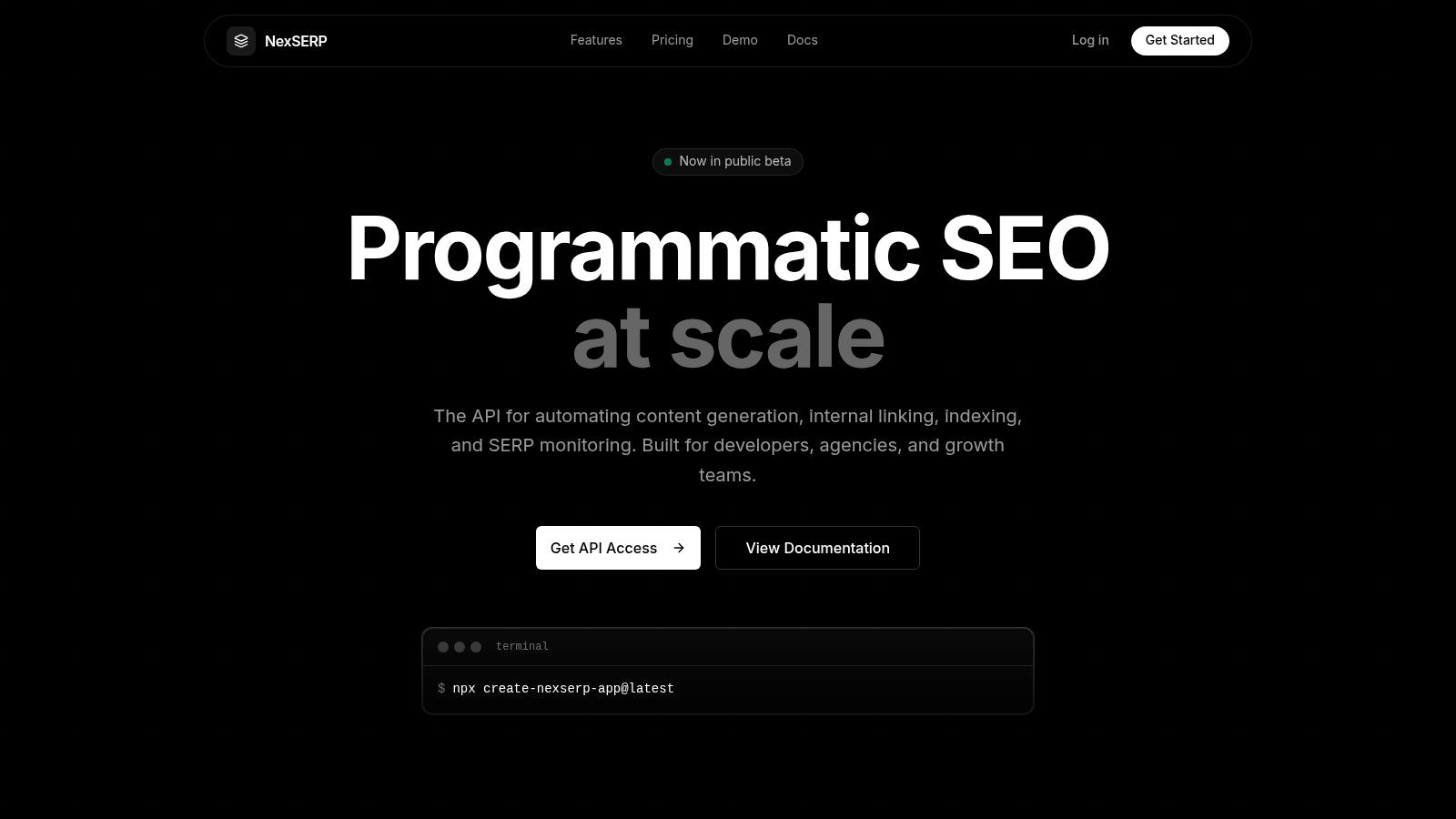
NexSERP is the developer-centric option here. It's API-first, which means it fits teams that want programmatic SEO built into engineering workflows instead of handled as a separate marketing tool. The product exposes endpoints for content generation, internal linking, indexation control, and SERP tracking, so it behaves more like infrastructure than a no-code editor.
Best use case
This is the right shape for agencies, product teams, and in-house builders who already think in APIs, CI/CD, and automation. If your content library is stored in a database, synced from product systems, or updated by engineering, NexSERP gives you a way to connect that source data to page generation without passing through a no-code layer first.
That can be a huge advantage for teams that need deterministic output and clear logic. It also helps if you're managing multiple sites or white-label programs and want the same infrastructure to support each one.
What it demands from the team
The cost of that flexibility is responsibility. You need engineering resources, and you need editorial QA. NexSERP won't save you from thin content, weak templates, or bad datasets. It just gives you the plumbing to move data at scale.
Practical rule: choose API-first tooling only when your content system already behaves like a product system.
The free starter plan makes it easier to prototype before you commit, which is useful for testing how your archive behaves in a scaled workflow. If your team is ready to operationalize SEO as part of its engineering stack, NexSERP is worth a hard look.
7. Commenze
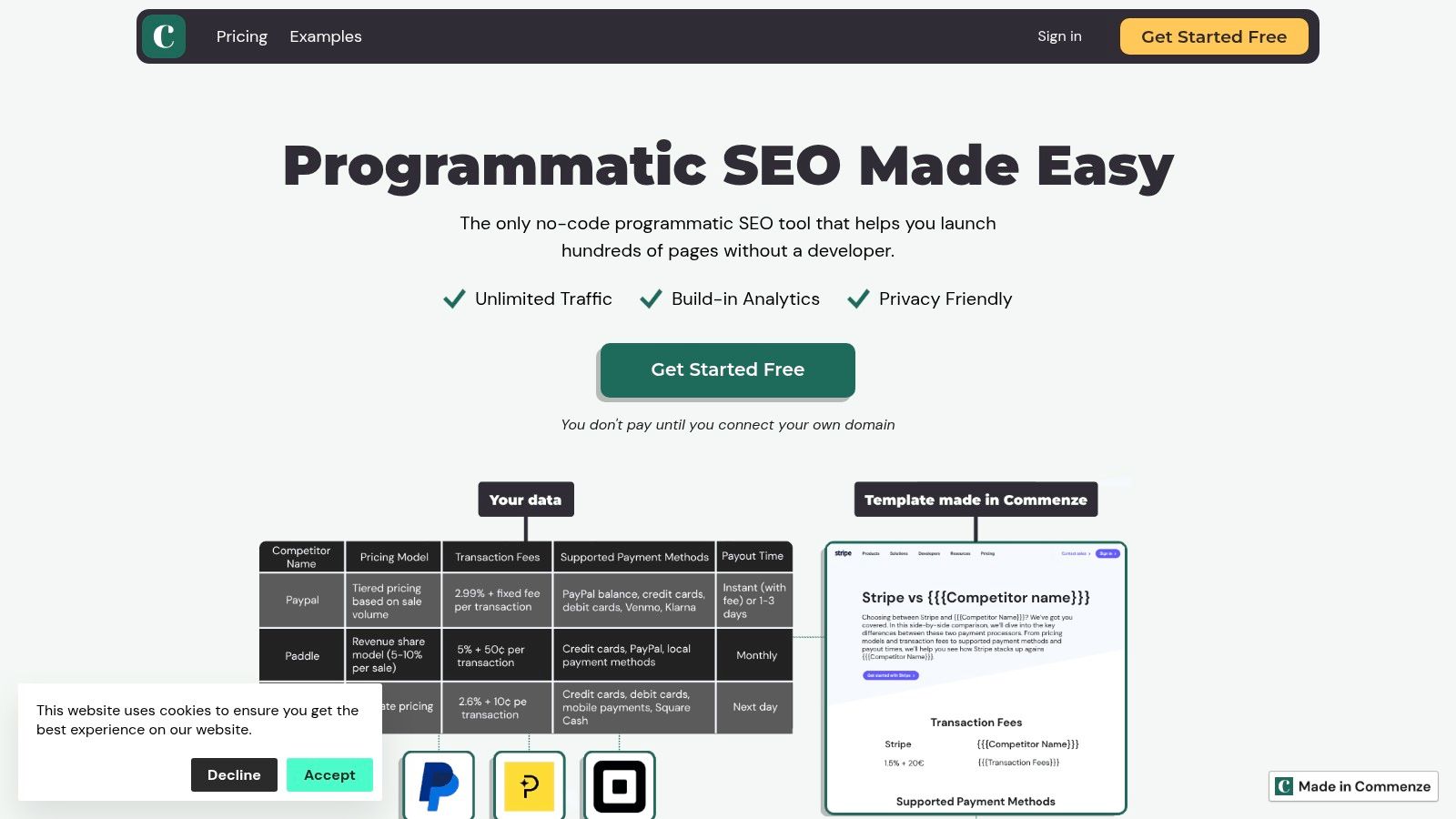
Commenze is a good fit for teams that want programmatic pages under their own domain structure without giving up a no-code workflow. It pulls from Airtable, Google Sheets, or APIs, then publishes dynamic pages under your domain or subfolders. That subfolder model matters because it helps consolidate authority instead of scattering your library across disconnected properties.
Why content teams should care
Commenze is especially appealing if your existing library already lives in spreadsheets or shared databases. The no-code template designer makes it easier to convert that data into publishable pages, and the built-in A/B testing and analytics reduce the number of extra tools you need to stand up a pilot.
It also supports i18n, which makes multilingual repurposing more realistic. That matters for content libraries that already have international potential, or for creators who want to expand a successful archive across markets without rebuilding everything by hand.
Trade-offs to weigh
The hosted subfolder model is a strength, but it also defines how you'll work. Teams that want maximum control over infrastructure or highly custom schemas may still run into edge cases that require engineering support. The more complex the content model, the more likely you'll need to stretch beyond the no-code layer.
For simpler programs, though, the price of entry is friendly because there's a free start before custom domain connection. That makes Commenze a smart testing ground for publishers who want to see whether their archives can produce useful programmatic pages without committing to a heavy build.
8. Synscribe AI Landing Page Generator
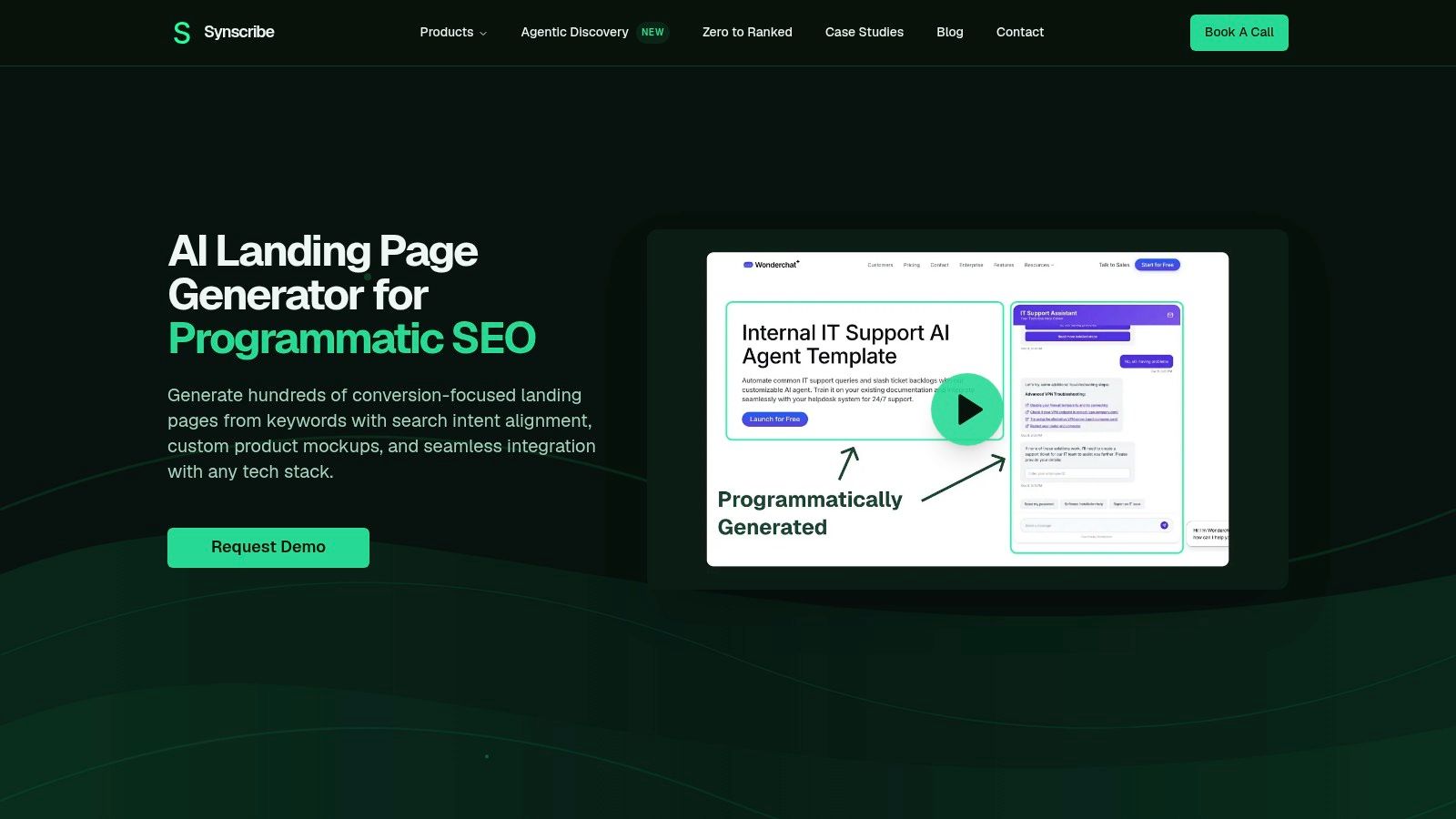
Synscribe is aimed squarely at conversion-oriented landing pages, which is useful when your content library includes product messaging, feature summaries, or comparison research that can be turned into bottom-funnel pages. It focuses on intent alignment, programmatic visual assets, and on-brand consistency across generated pages, which separates it from tools that just crank out text blocks.
Why the visual layer matters
For many content libraries, the problem isn't only the words. It's the way old content gets recycled into pages that all look the same. Synscribe addresses that by generating programmatic visuals and mockups at scale, which helps the pages feel like part of a real product system instead of a copy-paste experiment.
That matters a lot for SaaS and B2B teams where trust is part of the conversion path. If the page looks synthetic, the page feels synthetic. Synscribe is trying to solve that problem from the first interaction, not after a redesign sprint.
The practical downside
You'll need a demo, because pricing isn't public. That usually means sales-assisted onboarding, which is fine for serious teams but less attractive if you're just testing a small repurposing program. It can also require integration work depending on your stack.
There's a related perspective on landing page automation in this guide about reducing paid social costs, but Synscribe's angle is different because it's built around organic page generation and visual consistency. If your archive includes a lot of BOFU material, it's a credible option for turning that content into pages that look like they belong on the same site.
9. PSEO Builder
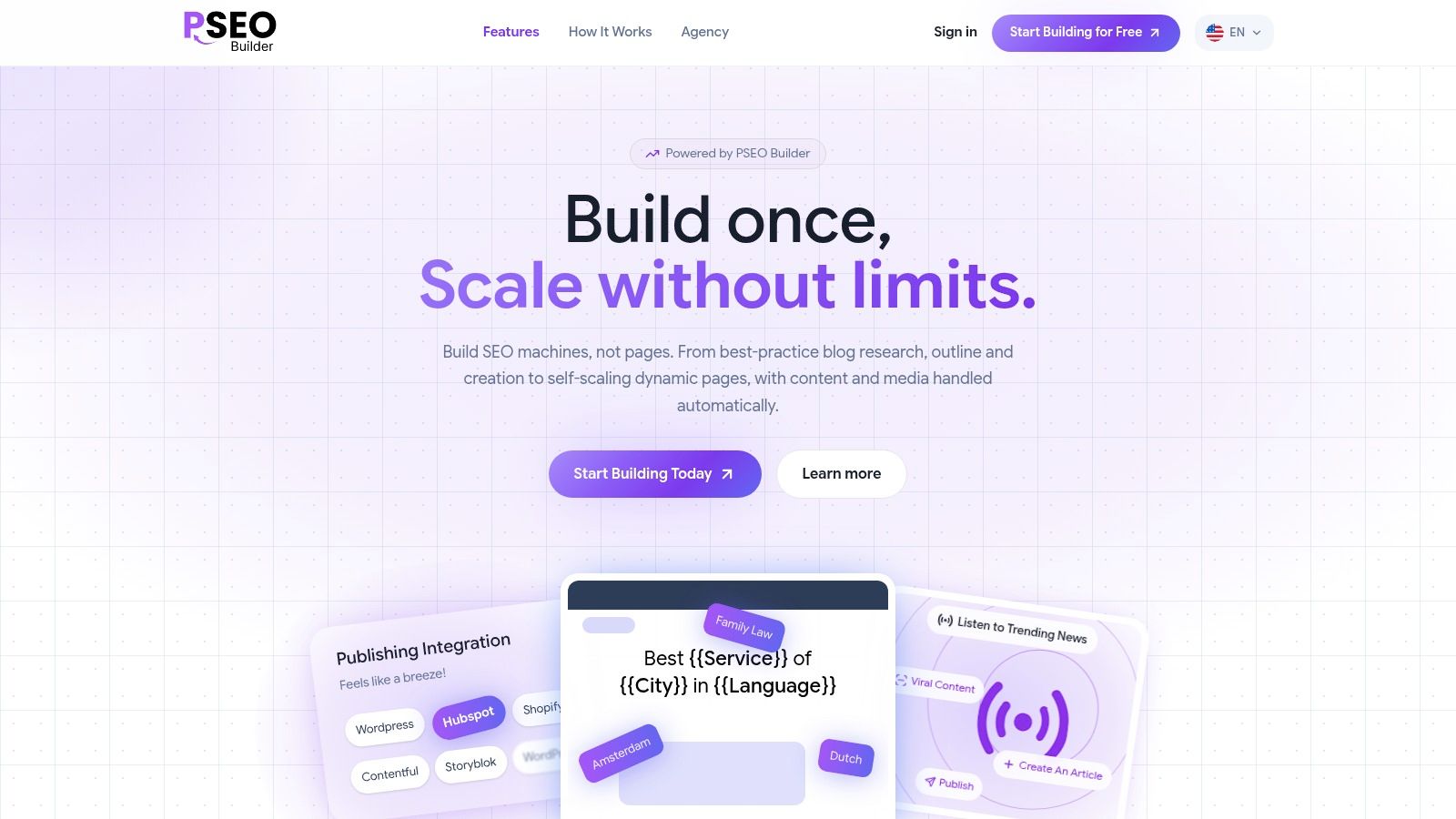
PSEO Builder is one of the broadest systems on the list because it tries to cover research, templating, generation, and publishing in one place. It publishes to WordPress, Shopify, Contentful, HubSpot, and Webflow, which makes it appealing for teams that don't want their repurposing strategy trapped in one CMS. If your library spans directories, marketplaces, or campaign pages, the breadth here is a real advantage.
Why breadth helps
The product includes a long-tail keyword mapper, campaign builder, and multi-CMS integrations, which makes it well suited to teams that already think in page families rather than isolated posts. That's especially relevant if your content archive has multiple layers of intent, because you can move from raw data to location pages, comparison pages, and marketplace-style pages without switching tooling.
The free start option is useful for agencies and partners who want to prove the model before they commit. It also scales into performance-based optimization, which suggests the product is designed to support ongoing iteration rather than one-time publishing.
What makes it harder
Breadth also creates complexity. The learning curve is steeper than with a narrow tool, and success still depends on differentiated datasets and strong QA. A platform can publish the page, but it can't fix a weak content model for you.
Remember this: more publishing targets don't solve a bad page strategy.
For teams with serious repurposing plans and multiple content surfaces, PSEO Builder offers a lot of flexibility. It's the kind of tool you reach for when your archive is already valuable and your challenge is orchestration, not just page creation.
10. TopicForge
TopicForge is the article-centric option in this list, and that gives it a different role. Instead of focusing on landing page layouts, it runs a multi-stage editorial pipeline, outline, draft, voice, CTA, and meta/schema. That makes it a smart choice for teams that want long-form content generated from structured inputs without losing all editorial shape along the way.
Why it stands out
The biggest advantage is guardrails. One-shot AI output can be fast, but it often needs major cleanup before it's publishable. TopicForge gives you a staged process that feels closer to how a strategist or editor would work, which is useful if you're repurposing a library of older articles, transcripts, or show notes into fresh search assets.
It also supports batch API usage, WebMCP integration, and credit packs, so it can flex up or down depending on how often you publish. If your content volume fluctuates, that pay-as-needed structure may be more practical than a rigid subscription.
Where it fits
This is not the best choice for teams that need deep page layout control or complex landing page components. It's better for content organizations that want scaled articles with structure and consistency. The optional internal link to this content optimization platform guide fits naturally here because both tools are about improving how existing content becomes more usable, more searchable, and more valuable.
For creators with a large archive of long-form material, TopicForge is less about churning out filler and more about making repeated content transformation easier to manage.
Top 10 Programmatic SEO Tools Comparison
| Product | Core features | Unique selling point | Best for / Target audience | Quality & UX / Pricing |
|---|---|---|---|---|
| pSeoMatic | Dataset → template → bulk page generation; AI per-page; direct WP/Webflow/Shopify/Ghost integrations | Broad multi‑CMS coverage + end‑to‑end page‑at‑scale workflow | Agencies, publishers, multi‑CMS teams | Smooth pipeline; needs editorial guardrails; page‑volume tiers (~500–20k+); 14‑day trial; some pricing details not public |
| SEOmatic (Programmatic SEO Tool) | CSV/Google Sheets sync; template→unique pages; AI copy/meta/FAQ; schema & indexing | Mature template pipeline with public social proof | Mid/large teams needing proven multi‑CMS solution | Practical connect→generate→publish UX; free start/trial; advanced features on higher tiers |
| SEO Fabric | Credit‑based generator; direct Webflow CMS publishing; AEO tools (CiteControl) | Deep Webflow‑native integration | Webflow users; local SEO / location pages | Easy Webflow publishing; free limited mode; credit pricing, good for focused local use |
| Page Generator Pro (WP Zinc) | WP plugin: bulk pages/posts/CPT; connects Sheets/Airtable/Notion; spintax, AI assists, WP‑CLI | Battle‑tested WordPress solution with clear licensing | WordPress sites, agencies using WP builders | Rich docs, regular updates; risk of thin/duplicate content if misused; clear pricing/licences |
| PageScale | Automated comparison/alternatives/use‑case pages; auto internal linking; built‑in schema; WP/CSV export | Opinionated SaaS page archetypes designed for conversions | SaaS companies, conversion‑focused teams | Focus on topical authority; transparent pricing; export may need developer handoff |
| NexSERP | REST API for generation, internal linking, indexation, SERP tracking; white‑label | Developer‑first, deterministic programmatic SEO infrastructure | Engineers, agencies, product teams building CI/CD workflows | Scales well; free starter plan; requires engineering resources; usage‑based pricing |
| Commenze | No‑code template designer; pulls Sheets/Airtable/API; subfolder hosting; A/B testing & analytics; i18n | Subfolder hosting + built‑in A/B testing and privacy‑friendly analytics | Non‑technical marketers; teams wanting consolidated domain authority | No‑code UX; free until custom domain; good for quick launches; complex integrations may need dev help |
| Synscribe, AI Landing Page Generator | Bulk BOFU landing pages; intent alignment; programmatic visuals & mockups | Conversion‑first pages with on‑brand visuals at scale | B2B SaaS and product marketing teams | High visual quality; sales‑assisted onboarding; demo pricing (no public rates); integration work often required |
| PSEO Builder (Programmatic SEO B.V.) | Campaign builder, long‑tail keyword mapper, multi‑CMS publishing; scales to large volumes | Broad support for directories/marketplaces and agency workflows | Large publishers, marketplaces, agencies | Powerful but steeper learning curve; free start available; success depends on datasets & QA |
| TopicForge | Multi‑stage editorial pipeline (outline→draft→voice→CTA/meta/schema); batch API; credits | Strong editorial guardrails for consistent long‑form output | Teams producing long‑form, on‑brand articles at scale | Agent/API friendly; pay‑as‑needed credit packs; free sample; publishing connectors may need custom wiring |
Your Content's Future Is Programmatic
The right programmatic SEO tools don't just make publishing faster. They make your existing library more legible, more searchable, and easier to turn into new value. That's the shift for creators and publishers, not the ability to generate more pages for its own sake, but the ability to organize what you already have and use it to meet demand that would otherwise stay buried in long-tail queries.
The strongest programs start with a defensible asset. That could be a catalog, a transcript library, a video archive, a set of location pages, or a deep collection of product and category data. Once that asset is structured well, programmatic systems can help you repurpose it into pages that answer real searches, support internal linking, and give older material a second life. That's also why quality control matters so much. A guide from Search Engine Land on programmatic SEO emphasizes human review, automated checks, and retiring underperforming content, which matches what strong operators already know, scale only works when quality stays visible.
The smarter question isn't “Which tool can publish the most pages?” It's “Which tool can help my library become a better product?” Some teams need a no-code stack. Others need WordPress familiarity, Webflow control, or API-first infrastructure. The best choice depends on where your content already lives, how clean your data is, and how much editorial oversight you can sustain.
If you're sitting on a large archive, the opportunity is probably already there. The difference now is whether you keep treating that library as finished work, or whether you turn it into a living system that can keep creating audience growth over time. For a broader look at automation and search strategy, automate SEO with artificial intelligence is a useful next read.
Contesimal helps you organize, understand, and activate the content you already own, so it fits naturally with a programmatic SEO workflow built around repurposing. If you're ready to turn archives, transcripts, articles, and other assets into structured opportunities, visit Contesimal and see how it can help your library become a content engine.