
AI content repurposing is just what it sounds like: using artificial intelligence to breathe new life into your existing content. It’s your secret weapon for turning videos, articles, or podcasts into entirely new formats. But this is way more than a simple copy-and-paste job. A smart AI strategy involves having the AI analyze, summarize, and adapt your content automatically for all the different platforms and people you want to reach, reigniting your entire content library.
Turn Your Content Archive Into an Asset

If you're a YouTuber with hundreds of videos or a blogger with years of articles under your belt, you’re sitting on a content goldmine. The real headache for professional creators, especially those transitioning from hobbyist to pro, isn't a lack of material; it's the constant, grinding pressure to churn out something brand new. This is where AI content repurposing completely changes the game.
This isn’t just a time-saver—it’s a core strategy for reigniting your entire library. It lets you upcycle old content, create new value, and turn dormant assets into a nearly endless well of fresh, relevant material for your audience.
More Than Just Changing Formats
Modern AI tools, like our own Contesimal, go way beyond just turning a blog post into a video script. They’re built to dive deep into your complete content library and get to work. They can:
- Uncover hidden themes and connections you never even noticed between seemingly unrelated pieces.
- Pinpoint what really resonates with your audience by figuring out which concepts get the most views and engagement.
- Build cohesive, multi-platform campaigns from a single piece of long-form content, helping you align your message everywhere.
Before we jump into the nuts and bolts of AI-driven transformation, it helps to get a solid handle on what content repurposing is at its core. Nailing down the fundamentals makes it much clearer how AI takes this classic marketing tactic to a whole new level.
The goal here is to shift your mindset. You stop being a day-to-day content creator and start acting like a strategic publisher who manages a portfolio of valuable assets. When you treat your back catalog as an active resource, you create a sustainable engine for growth that ultimately makes you money.
This approach is absolutely crucial for creators trying to turn their hobby into a real, revenue-generating business. Instead of being stuck on the content creation treadmill, you can finally organize, understand, and act on the massive library you’ve already built.
This guide will give you the practical, step-by-step workflows you need to put an effective AI content repurposing strategy into motion. You'll learn how to audit your archive, squeeze every last drop of value out of it, and distribute new assets that expand your reach and deepen engagement—all without burning out.
Getting Your Content Library Ready for AI
Before you can let an AI loose on your content, you've got to clean up the kitchen. Think about it: you can't cook a five-star meal if your ingredients are scattered, unlabeled, and shoved in the back of a messy pantry. It's the same with your content. A chaotic archive of files is the single biggest thing that will stop you from effectively repurposing content with AI.
This foundational work is what separates creators who scale from those who get stuck spinning their wheels. When you organize your content library, you're not just tidying up. You're building an intelligent, searchable database that an AI can actually understand and find connections within. This is how you start to see repurposing opportunities you would have completely missed otherwise.
Kick Things Off with a Smart Content Audit
Your first move is a full-blown content audit. This just means getting all your assets—videos, podcast episodes, articles, even old webinar recordings—into one central spot. For most professional creators, this stuff is all over the place: different folders, random cloud storage accounts, and various platform backends.
Once everything is in one place, the real work begins. An AI can speed this part up massively by automatically handling the grunt work:
- Transcribing every video and audio file into text.
- Tagging all the content with relevant keywords and topics.
- Categorizing your assets based on themes, formats, and even audience sentiment.
This first pass turns your messy digital attic into clean, machine-readable data. That data is the fuel for any AI-powered system you use.
Build a Taxonomy That Actually Works
With your content transcribed and tagged, the next step is building a smart taxonomy. That's just a fancy way of saying a structured classification system. Instead of generic folders like "2023 Videos," you start creating categories based on what actually matters to your audience and your business.
A solid taxonomy might organize content by:
- Core Topics: The main subjects you cover (e.g., "AI for business," "content strategy").
- Audience Segments: Who the content is for (e.g., "beginners," "executives").
- Performance Metrics: How well it did (e.g., "top 10% views," "high engagement").
- Funnel Stage: Where it fits in the customer journey (e.g., "awareness," "decision").
By structuring your library this way, you give the AI the context it desperately needs. It can now understand that a high-performing "beginner" video on "content strategy" is a perfect candidate for being sliced into a series of introductory social media clips.
Before we move on, it’s worth taking a moment to see just how much this AI-driven approach changes the game compared to the old, manual way of doing things.
Manual VS AI Content Auditing
| Aspect | Manual Auditing | AI-Powered Auditing (e.g., Contesimal) |
|---|---|---|
| Time | Weeks or months of tedious, manual work. | Hours or days for automated transcription & tagging. |
| Cost | High labor costs for staff or freelancers. | Significantly lower; based on platform subscription. |
| Depth | Subjective, limited to human capacity for analysis. | Deep, objective analysis of themes & sentiment at scale. |
| Scalability | Extremely difficult to scale; more content = more people. | Highly scalable; handles thousands of assets easily. |
| Consistency | Prone to human error and inconsistent tagging. | Consistent, standardized taxonomy across the entire library. |
The difference is pretty stark. The old way was a necessary evil, but AI turns it into a strategic advantage that unlocks hidden value instead of just being a massive time sink.
Plug Into an AI Platform
The final step is to feed this newly organized library into a platform built specifically for this job. A system like Contesimal becomes a central brain, letting you and your team collaborate with the AI. It transforms your library from a static digital filing cabinet into a dynamic, interactive asset. You can get a better sense of how these systems operate by checking out our guide on content intelligence platforms.
This is why the AI content creation market is exploding. It was valued at $9.3 billion in 2022 and is on track to hit $47.5 billion by 2030. That growth is all about efficiency. By 2027, AI is expected to automate 75% of repetitive tasks like tagging metadata and adapting content for different channels. You can read more analysis on the AI content creation market over on patentpc.com. Getting your library organized is your ticket to tapping into that efficiency.
Your AI Repurposing Workflow in Action
Alright, let's get out of the weeds of theory and into what this actually looks like day-to-day. Once you've got your content library organized, it’s time to fire up the AI content repurposing engine.
Think of the AI as your new production assistant. It’s there to do the heavy lifting—the tedious, time-consuming stuff—while you provide the strategic direction and the final creative sign-off. You're the director; it's your tireless crew.
Imagine you just wrapped up a one-hour podcast interview. A few years ago, that single episode might have been your entire output for the week. Now, it's just the starting point.
The whole process kicks off when you feed that raw audio file into your AI platform. From that one asset, an entire campaign can spring to life. This isn't about replacing your creative spark; it's about making it exponentially more efficient so you can focus on the big-picture strategy that actually grows your audience.
From a Single Podcast to a Fleet of Content
The first thing you'll ask the AI to do is simple: "Transcribe this audio." In just a few minutes, you’ll have a full, timestamped text version of your entire conversation. This transcript is now the bedrock—the foundational document for everything that comes next.
From here, you can start issuing a series of prompts to break down and rebuild the content into something new.
- Summarization: "Pull a 500-word summary from this transcript, but focus on the three core arguments my guest made."
- Quote Extraction: "Find the 10 most powerful and shareable quotes from the speaker."
- Key Takeaways: "Give me a bulleted list of the top five actionable tips mentioned in this episode."
Once these core elements are extracted, you can start building out a whole suite of new assets. Each one is a targeted piece of content designed for a specific platform and a specific audience. You're no longer just dropping a podcast episode; you're launching a coordinated, multi-channel content blitz.
The real magic here is speed and scale. What would have taken a small team days of manual work—listening, transcribing, summarizing, writing—can now be done in under an hour. And you keep full creative control, guiding the AI at every step.
This infographic gives you a simplified look at how this initial prep work gets started.
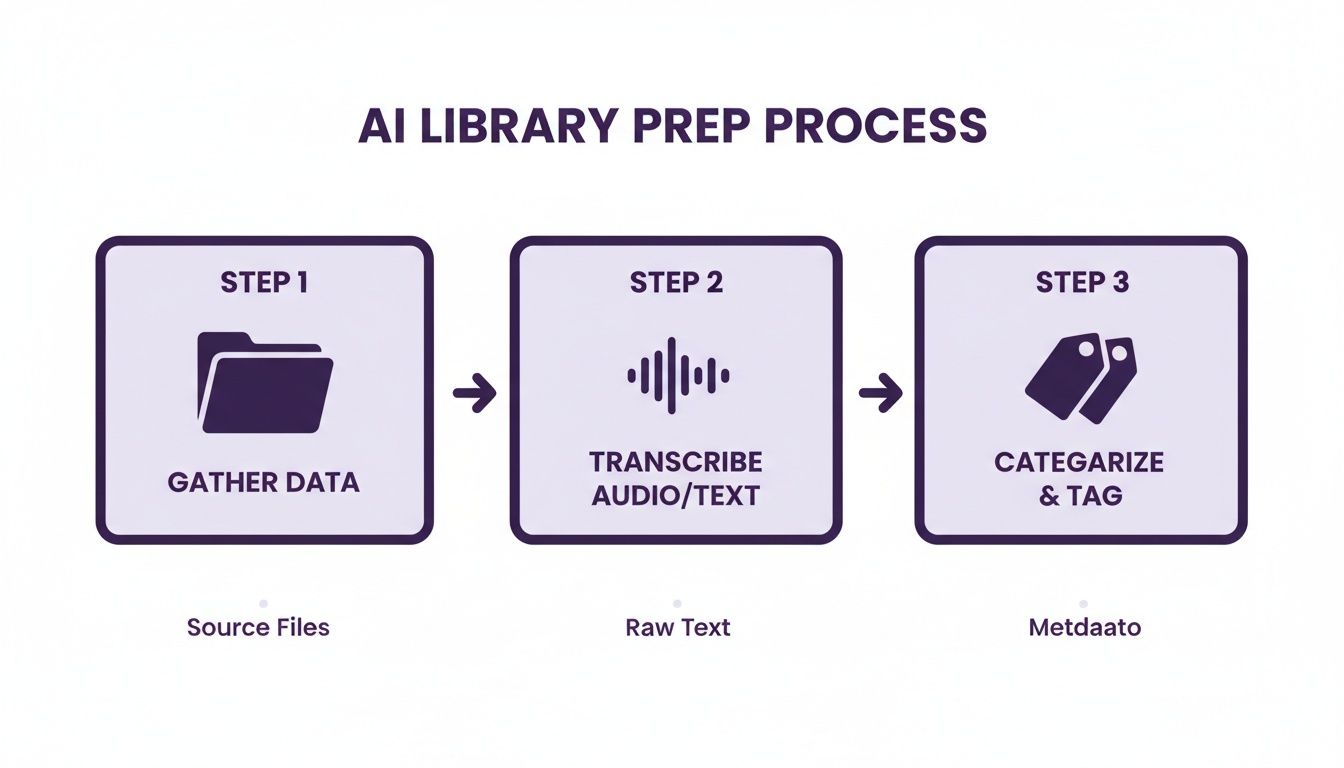
This first phase—gathering, transcribing, and categorizing—is the critical foundation for turning one asset into many.
Turning Raw Materials into Finished Assets
Now that you have your AI-generated summaries, quotes, and takeaways in hand, you can start directing the creation of specific content pieces. This is where the human-AI partnership really shines.
Example AI Prompt for a Blog Post:"Use the summary and key takeaways I've provided to write a 1,200-word blog post titled 'The 3 Pillars of Effective Content Strategy.' I need an informative but conversational tone. Structure it with a short intro, three main sections based on the core arguments, and a concluding call-to-action."
Example AI Prompt for Social Media:"Take these 10 extracted quotes and create a series of five engaging LinkedIn posts. For each post, include the quote, add a sentence or two of context, and give me three relevant hashtags."
For podcasters, this process is an absolute game-changer. If you want to really dial in your workflow, checking out resources like the best AI tools for podcasters can show you what tech is out there to automate this stuff. And if you're looking to build out your toolkit even further, we put together a detailed guide on other essential content repurposing tools you might find useful.
This isn't just a hypothetical, either. We've seen a company turn a single 60-minute product demo video into 47 different pieces of content for seven platforms. The result? Lead generation shot up by 340%, and their content production costs dropped by 65%. On average, teams that embrace AI for repurposing can cut their production time by 75%, freeing them up to actually think about strategy instead of just churning out content.
Mastering the Human Touch in an AI World

Let's be perfectly clear: AI is an incredible assistant, but it can't replace your unique voice and hard-won expertise. The single most important part of any AI content repurposing workflow isn't the prompt you write—it's the quality check that comes after. This is where you shift from being just a creator to a strategic editor.
I like to think of AI as the tool that gets you 80% of the way there. It handles the heavy lifting—the structure, the summaries, and all the tedious reformatting. Your job is to nail that final 20%. This is where you inject personality, authority, and the kind of connection that only a human can build.
That final touch is what stops your content from sounding generic. It's how you build a real relationship with your audience and turn casual followers into genuine fans.
Your Quality Control Checklist
Before you dream of hitting "publish" on an AI-generated draft, you need to run it through a serious review. Don't just skim for typos. You have to dive in and make sure it meets your standards and actually serves your audience. A solid quality check is non-negotiable.
Here’s a practical checklist I use to guide my own reviews:
- Factual Accuracy: Did the AI pull the right data? Are all the names, dates, and stats correct? Never, ever trust AI-generated facts without checking them against the original source.
- Brand Voice Consistency: Does this actually sound like you? An AI doesn’t know your inside jokes or the specific tone that resonates with your community. Rewrite sentences until they match your established voice.
- Narrative Flow and Cohesion: Read the whole thing out loud. Seriously. Does it flow logically from one point to the next? AI-generated content can feel choppy, so it's your job to smooth out the transitions and make the narrative stick.
- Audience Resonance: Is this piece actually speaking to your audience's pain points and questions? Is the language and framing right for their level of expertise?
The goal here isn’t just to approve what the AI did; it’s to elevate it. Your human insight is what transforms a decent draft into a memorable piece of content that builds trust and makes your brand stand out.
Injecting Your Unique Value
Once the draft clears that initial quality check, it's time for the fun part—adding the stuff an AI simply can't create. This is where you make the content undeniably yours.
Start by weaving in your own experiences. Where can you drop in a short anecdote or a real-world example from your own work? These stories are what make your content relatable and authentic.
Next, layer in your unique insights and opinions. What’s your specific take on this topic that nobody else has? Don't be afraid to challenge the common wisdom or offer a perspective that makes people think.
Finally, make sure the content connects on an emotional level. AI runs on logic, but humans run on emotion. Tweak the language to spark curiosity, empathy, or excitement. This final, human-led polish is what turns repurposed content into a powerful asset that actually drives engagement.
How to Measure Your Repurposing Success
Churning out more content is one thing, but how do you actually know if your AI content repurposing efforts are moving the needle? If you want a real answer, you have to look past the usual vanity metrics like likes and page views. The real goal is tracking the tangible impact—the return on investment (ROI) that directly fuels your business growth.
This shift in focus is what separates hobbyists from professionals. It’s about building a sustainable content engine with a data-driven approach, making the crucial switch from just being busy to being genuinely productive.
Moving Beyond Vanity Metrics
The true value of your repurposed content isn’t measured in fleeting impressions; it's measured in concrete actions. You have to connect the dots between the assets you’re creating and the results they generate. It takes a much more focused and strategic approach to your analytics.
Instead of just celebrating a high view count, start asking the right questions:
- Lead Generation: Are the blog posts you spun up from podcast episodes actually capturing email sign-ups? Use unique tracking links to pinpoint exactly which repurposed assets are driving the most conversions.
- Engagement Rates: How are people interacting with the short video clips you pulled from that long webinar? A surprisingly high engagement rate (comments, shares, saves) on a specific clip is a huge signal that you’ve struck gold with a topic worth exploring further.
- Audience Growth: Did that series of repurposed LinkedIn articles attract new, relevant followers to your page? Keep an eye on follower growth in the days right after you release a new content cluster.
The core idea here is to create a powerful feedback loop. By analyzing which formats, topics, and channels are hitting the mark, you can continuously sharpen your strategy. This is how you stop guessing what your audience wants and start giving them exactly what they’re asking for.
Using AI to Connect the Dots
This is where AI-driven platforms like Contesimal give you a serious edge. These tools don't just help you create content; they help you understand it. By analyzing performance across every channel, an AI can surface insights that are nearly impossible to find on your own. It can show you that while your long-form videos kill it on YouTube, the short, punchy clips from those same videos get 3x the engagement on Instagram.
This level of detailed feedback is quickly becoming the standard for smart marketers. Content repurposing with AI is a fast-growing skill, with 32% of marketers already using it as a top generative AI application. For B2B folks, the benefits are even clearer: 51% report fewer repetitive tasks and 42% see better optimization.
If you're looking for more ways to dig into your data, our guide on how to analyze content performance offers more practical steps. This data-driven cycle of creation and analysis is what transforms your content library from a simple archive into a powerful business asset. For more on this, check out these content marketing statistics on wellows.com.
Got Questions About AI Content Repurposing?
Jumping into any new workflow is going to bring up questions, and using AI for your content is no different. I see it all the time: creators and marketers are intrigued but also a little hesitant. They worry about quality, cost, and honestly, where to even begin.
Let's clear the air and tackle some of the most common concerns I hear. The goal isn't to replace your creative spark; it's to give your workflow a massive efficiency boost so you can focus your energy where it actually matters.
Will AI Make My Content Sound Robotic?
This is probably the biggest fear out there, and it's a completely valid one. Short answer? No, not if you're smart about it.
The secret is to treat AI as your creative partner, not a ghostwriter. Your unique perspective, your voice, and your stories are what make people connect with your content. You can't outsource that.
Here’s the best practice: Use AI to generate a solid first draft. Let it handle the heavy lifting—the transcription, the summarization, the tedious reformatting. Your job is to be the director and editor. You step in to polish the output, inject your personality, and add the insights or anecdotes that only you can.
This human-AI partnership is the key. It ensures the final product is both efficiently produced and authentically you. Think of it this way: the AI builds the house, but you're the one who decorates it and makes it feel like home.
That final human touch is absolutely non-negotiable for creating content that actually connects with people.
My Content Library Is a Total Mess. Where Do I Even Start?
You're not alone. Most creators with a few years under their belt are sitting on a sprawling, disorganized archive. The thought of sorting through it is overwhelming.
The first step is to run an AI-powered audit, but don't try to boil the ocean. Start with your greatest hits—the videos with the most views, the podcast episodes with the most downloads, or the articles that still pull in steady organic traffic.
This "greatest hits" approach gives you two huge advantages:
- You're working with your best raw material right out of the gate.
- It delivers the quickest wins, showing you the immediate value of this workflow and building momentum.
Gather this top-tier content and feed it into a tool that can automatically transcribe, tag, and categorize everything. This one move turns a messy folder into a structured, searchable asset, ready for you and your AI partner to start creating.
Is This Too Expensive for a Solo Creator?
It's easy to look at some of the enterprise-level AI platforms and think this is out of reach, but the market is full of scalable and affordable options built for solo creators and small teams. The most important thing isn't the upfront cost; it's the return on your investment (ROI).
Think about it in terms of time saved. How many hours do you spend on manual transcription, pulling clips, or writing summaries?
If an AI tool saves you 20 hours a month, that's a massive amount of time you can reinvest into high-level strategy, engaging with your audience, or creating your next big piece of pillar content. The efficiency gains and the sheer volume of new assets you can create often pay for the tool many times over.
Ready to get off the content treadmill and unlock the goldmine sitting in your archives? Contesimal is where this human and AI collaboration comes to life. Organize your library, discover hidden opportunities, and create infinite content value from your existing work. Start building your content engine today at https://contesimal.ai.