
Welcome to a new era of content creation. The big idea here isn't about AI replacing you—it's about giving you a creative co-pilot. This is about handing you superpowers to organize, understand, and monetize your entire content library in ways you never thought possible. Think of AI as the ultimate research assistant, ready to dive deep into your archives to upcycle old content, reignite your library, and unlock hidden value.
The New Frontier of AI for Content Creation

For years, creators have hit the same wall. You build an amazing library of videos, podcasts, and articles, but eventually, it becomes impossible to manage. Valuable insights get buried, brilliant ideas are forgotten, and countless chances to repurpose content just slip away. Your past work becomes a barrier to creating what's next.
This is where AI for content creation completely changes the game. It’s a shift from just producing more to working smarter with what you already have. This guide will cut through the hype and show you how AI is actually reshaping workflows for everyone, from solo YouTubers transitioning from hobbyist to professional, to major publishers looking to grow the value of their archives.
Augmenting Creativity, Not Automating It
Let's get one thing straight: the point of modern AI tools isn't to remove the human element. Far from it. This is about a powerful partnership between you and the AI, where it handles the tedious grunt work. That frees you up to focus on what really matters: creativity, storytelling, and connecting with your audience.
We are truly stepping into a new era where Artificial Intelligence content creation is reshaping how we approach everything. It all boils down to three key actions:
- Organize: Pull your entire library—videos, audio files, text—into a single, intelligent system.
- Understand: Let the AI analyze your content, spot recurring themes, and uncover hidden connections between topics you might have missed.
- Take Action: Turn those insights into brand new, high-value content, from fresh video ideas to perfectly targeted social media clips.
This approach turns a static, dusty archive into a dynamic, revenue-generating asset. The market growth reflects this powerful shift. The AI-powered content creation market is projected to skyrocket from $2.15 billion in 2024 to an estimated $10.59 billion by 2033. That’s a huge signal that creators and businesses are adopting these tools to scale their efforts. You can find more details about these AI content creation statistics online.
AI gives you the power to have a conversation with your own content. Imagine asking your video archive, "Show me every clip where I discussed audience engagement," and getting an instant, actionable answer.
Platforms like Contesimal are built for this exact purpose. They help you turn your content library into a living knowledge base, making it easier for you and your team to collaborate and create. Contesimal is focused on revolutionizing research collaboration and enabling content library owners to expand value across their existing assets. Check out our guide on how content intelligence platforms are making this possible for creators today. This guide will show you how to join this new frontier.
How AI Actually Understands Your Content
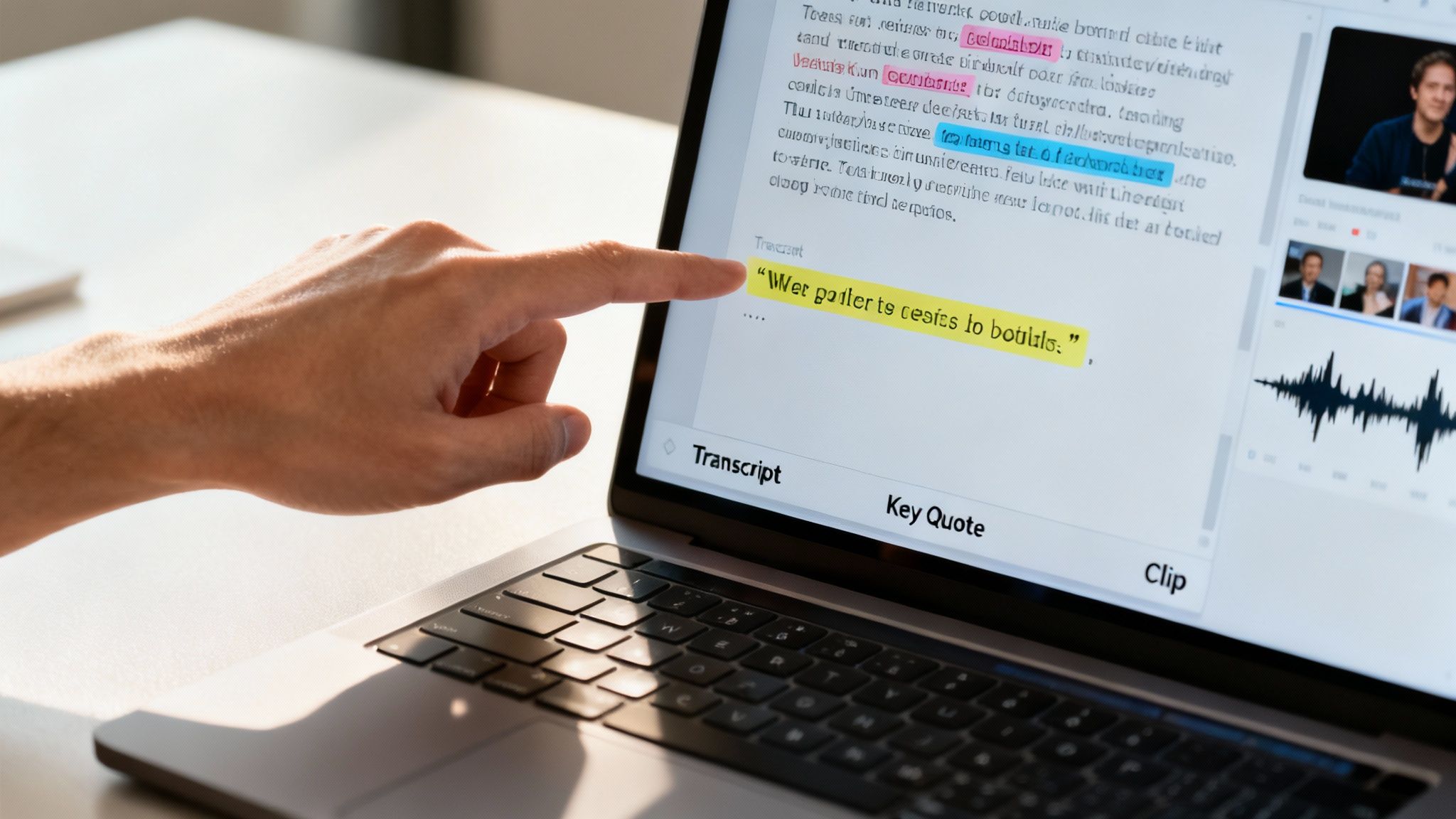
To really get what AI for content creation can do, you need to peek under the hood. Don't worry, you don't need a computer science degree—just a simple way of thinking about how these tools work their magic. It’s less about some mysterious black box and more about pattern recognition on a mind-boggling scale.
At its core, AI learns to “understand” your content much like a human does, but with superhuman speed and a perfect memory. Think of it as the ultimate speed-reader. While you might remember the key takeaways from your last ten videos, an AI can process and recall every single word, scene, and sound from your entire library in minutes.
This is all made possible by technologies like Natural Language Processing (NLP). NLP is the bridge that lets a machine read, interpret, and actually find meaning in human language—whether it's spoken in a podcast or written on a blog.
The AI's Toolkit Explained
Imagine you have a team of highly specialized assistants. One is a transcriber who never misses a single word. Another is a librarian who knows exactly where every topic is mentioned across hundreds of hours of footage. And a third is a creative partner who can spot connections and ideas you might have missed. AI tools roll all of these jobs into one.
When a podcaster uploads a new episode, for example, the AI kicks into gear and handles several jobs at once:
- Transcription: It converts the audio into a precise, time-stamped text document.
- Entity Recognition: The AI identifies key speakers, brands, and topics as they're mentioned.
- Sentiment Analysis: It can even read the emotional tone of different segments, highlighting powerful, funny, or controversial moments.
This is the detailed breakdown that lets you start asking your content library questions. You can search for a guest's most impactful quote or find every single time you talked about a particular strategy, and the AI serves up the exact clips or text instantly.
For a creator, this is like having a perfect photographic memory of everything you’ve ever produced. It moves your content from being a collection of static files to a living, searchable knowledge base.
This shift is already reshaping creative workflows. The use of generative AI for content creation shot up from 33% of organizations in 2023 to an incredible 71% in 2024. Why the jump? It's driven by productivity gains of around 40%, with creators clawing back a huge amount of time each week. You can dig into more data on these AI adoption trends to see the full picture.
Matching AI Capabilities to Your Content Needs
Different creators need different tools, and that's the beauty of it. A YouTuber's daily grind looks nothing like a blogger's, but the underlying AI technology adapts to deliver specific value for each.
A writer, for instance, might use AI to supercharge their research by asking it to summarize the key themes from dozens of articles. At the same time, a YouTuber can use that same core tech to analyze their footage and automatically suggest the most engaging 30-second clips for social media.
To help you figure out what to look for, this table breaks down key AI capabilities and shows which types of creators benefit most from each. It's a quick way to identify the right tools for your specific workflow.
Matching AI Capabilities to Your Content Needs
| AI Capability | What It Does for You | Ideal for These Creators |
|---|---|---|
| Automated Transcription | Converts audio and video into searchable text, with timestamps and speaker identification. | Podcasters, YouTubers, Filmmakers, Content Marketers |
| Content Summarization | Condenses long-form articles, videos, or podcasts into key bullet points or a short paragraph. | Bloggers, Researchers, Publishers, Content Executives |
| Clip Identification | Scans video or audio files to find the most engaging, shareable moments based on keywords or sentiment. | Video Creators, Podcasters, Social Media Managers |
| Topic & Theme Analysis | Analyzes your entire library to identify recurring themes, popular topics, and content gaps. | All Creators, Storytellers, Marketing Executives, Authors |
As you can see, the goal isn't just to use AI, but to use the right AI. By matching the capability to your creative output, you move from just saving time to actively finding new ways to grow and engage your audience.
Turning Your Content Library Into a Goldmine

If you've been creating content for a while, you're sitting on a goldmine. Seriously. Every video, podcast episode, and article in your backlog is more than just a past achievement; it's a rich library of ideas and insights waiting to be dug up. The biggest hurdle has always been finding a shovel big enough for the job.
Think of your content library as a giant, messy warehouse. Your best ideas are buried somewhere in unmarked boxes, making it next to impossible to find what you need when you need it. Using AI for content creation is like hiring a master organizer who not only labels every box but also builds a searchable digital catalog of your entire inventory.
This single shift changes your archive from a passive collection of files into an active, intelligent knowledge base. You start to see your past work not as something that's "done," but as the raw material for everything you do next—a true money-maker.
Ask Your Content Library Anything
The real magic happens when you can literally start a conversation with your own content. Modern AI tools can ingest your entire back-catalog—transcribing videos, indexing articles, you name it—and stitch it all together into one powerful database. For creators looking to go from hobbyist to a revenue-generating entity, this is a game-changer.
Instead of manually scrubbing through hours of old footage to find that one perfect clip, you can just… ask.
Here are a few questions you could toss at your newly intelligent content library:
- For Podcasters: "Find every clip where a guest mentioned 'audience growth strategies' and give me the timestamps."
- For YouTubers: "What were the three most common themes in last year's most-viewed videos?"
- For Bloggers: "Pull all paragraphs where I explained SEO and create a summary."
- For Publishers: "Identify all articles that mention our top competitor and analyze the sentiment."
This is what it means to turn your history into an interactive resource. It's no longer about what you can remember; it's about instantly accessing the exact knowledge you need, right when you need it.
Uncover Hidden Patterns and Opportunities
Beyond just finding things, AI is brilliant at spotting patterns a human might easily miss. By analyzing your entire body of work, these platforms can reveal surprising connections between topics, pinpoint your most successful content formats, and even help you figure out the next new video to create.
Think of it this way: your content library holds the DNA of your success. AI gives you the microscope to see that DNA clearly, showing you which traits resonate most with your audience so you can replicate and build upon them.
Platforms like Contesimal were built for this very purpose. They help humans and AI collaborate seamlessly, allowing teams to discover new insights from existing assets. With Contesimal, users curate information to create a shared set of knowledge. As they collaborate, they generate new meaning and value from their content library, ultimately helping them make money with it.
This process is critical for any creator or publisher who's serious about growth. To learn more about how to put these ideas into practice, check out our guide on AI content repurposing strategies that turn old gems into new engagement.
By reigniting your library, you don't just find inspiration for your next video or article. You create a sustainable engine for growth, ensuring that no piece of content ever goes to waste again.
Your AI-Augmented Content Creation Workflow

Alright, let's move from theory to action. This is where you actually see what AI for content creation can do. Bringing AI into your process isn't about replacing what you already do well. It's about adding a smart layer of speed and insight on top of it. The best way to start is with a simple, structured workflow that makes your entire content archive an active partner in your daily work.
We can break this down into a practical four-stage loop. Each step feeds the next, creating a system where AI does the heavy lifting, freeing you and your team up for the human stuff—storytelling, strategy, and actually connecting with your audience. Think of it as a healthy collaboration between you and the machine.
Stage 1: Ingest and Organize
First things first, you have to feed the machine. This means gathering your entire content library—every video, podcast, blog post, and transcript—and pulling it into one central AI platform. It’s a foundational step that turns a mountain of scattered files into a single, intelligent asset.
You’re essentially building a brain for your brand. The AI chews through everything, transcribing, indexing, and creating a searchable map of your entire creative history. For anyone trying to go from hobbyist to a professional operation, getting organized like this is non-negotiable. It’s the setup for everything else that comes next.
Stage 2: Discover and Ideate
With all your content organized and indexed, the fun part begins. Now you can literally have a conversation with your own work. Instead of trying to remember that one thing you said two years ago, you can ask specific questions to find hidden gems and spark new ideas.
For example, a YouTuber could ask, "Show me every shot from my last ten videos filmed outdoors at golden hour," and instantly get a visual playlist. This saves hours of digging through old project files. This stage is all about mining your own archive for inspiration.
This process turns your archive from a passive storage unit into an active brainstorming partner. The AI helps you see the patterns and potential in your work that were previously invisible, fueling your next great idea.
A podcaster could use this to pull the five most powerful quotes from a two-hour interview in seconds. This not only helps them find the core theme of the episode but also gives them the perfect soundbites for promotional clips.
Stage 3: Create and Collaborate
Now it's time to make something new. Armed with all the clips, quotes, and ideas from the discovery phase, you and your team can start drafting content with AI as your assistant. This is not about letting a robot write for you. It's about giving your team a super-powered head start.
The AI can generate a solid first-draft outline for a blog post based on a recent podcast series. It can draft social media captions using the best quotes it already found for you. This collaborative model keeps your voice and expertise front and center while cutting down production time in a big way.
Stage 4: Repurpose and Distribute
The final stage is all about multiplication. A single piece of long-form content, like a deep-dive video or a full webinar, becomes the raw material for dozens of smaller assets. AI is brilliant at spotting the most shareable moments and reformatting them for different channels.
- Video to Blog: The AI can take a video transcript and whip it into a well-structured, SEO-friendly article.
- Podcast to Social Media: It can automatically grab compelling quotes and package them into audiograms for Instagram or LinkedIn.
- Webinar to Clips: That one-hour presentation can be chopped into five to ten short, punchy clips perfect for YouTube Shorts or TikTok.
And if you’re looking to really scale your production, exploring webinar automation software can be a game-changer for streamlining how you create and distribute this kind of content.
By following this four-stage model, you create a sustainable loop where your old content is constantly breathing new life into your strategy. You'll reignite your library and grow your audience everywhere, all at once.
Choosing the Right AI Tools and Avoiding Pitfalls
Jumping into AI for content creation can feel a lot like walking into a massive electronics store. The options are endless, the marketing is loud, and not every flashy gadget is going to do what you actually need.
Picking the right tool isn’t about finding the single “best” one on the market. It’s about finding the one that fits your specific creative workflow like a glove. It’s the difference between hiring a brilliant assistant and buying a frustrating paperweight.
Not all AI platforms are built the same. Some are great for spitting out quick text snippets, while others are designed to handle complex media libraries packed with video and audio. Making the right choice from the start saves you a ton of headaches down the road and sets you up for real growth.
This is especially true when you're moving from a hobby to a business. The tools you choose become the foundation of your entire production system, so you better make sure they align with where you're headed.
Key Criteria for Evaluating AI Tools
When you start weighing your options, you have to look past the slick landing pages and focus on the core features that will actually make a difference in your day-to-day grind. A tool that looks amazing in a demo but doesn’t mesh with your process is just another subscription fee you’ll forget to cancel.
So, what should you really be looking for?
- Media Type Handling: Does the tool specialize in your primary format? A YouTuber needs a platform that truly understands video analysis, while a podcaster needs world-class audio transcription and search. Don't settle for a jack-of-all-trades if you're a master of one.
- Ease of Use: You shouldn't need a computer science degree to get started. A clean, intuitive interface means you spend less time fighting with software and more time actually creating.
- Accuracy and Reliability: How good is the transcription, really? How accurate are the summaries? If the AI's output is sloppy, you end up creating more editing work for yourself, which completely defeats the purpose.
- Collaboration Features: If you work with a team, can you easily share projects, drop notes, and pass assets back and forth? A siloed tool creates bottlenecks and kills momentum.
For a deeper look at specific platforms, you might want to check out our guide on the best AI tools for content creators, where we break down the top options for different kinds of creators.
Sidestepping Common AI Pitfalls
Bringing AI into your workflow is exciting, but there are a few common traps that can trip up even the most seasoned creators. Knowing what they are ahead of time helps you use AI as a co-pilot, not an autopilot that strips the soul right out of your work.
The biggest mistake is over-reliance. The moment you let the AI do all the thinking, you risk producing generic, cookie-cutter content that sounds like everyone else. Your audience follows you for your unique voice and perspective, not for something that an algorithm could have written.
Another classic blunder is failing to guide the AI. You have to teach it about your brand’s specific tone, style, and point of view. Without that direction, the tool will just default to a bland, neutral output that has zero personality.
The Human Touch is Non-Negotiable
Your goal isn't to automate your creativity; it's to augment it. Use AI to handle the 80% of grunt work—like transcribing interviews, finding clips, and organizing research—so you can pour 100% of your creative energy into the final product.
Ultimately, that human touch is what separates great content from all the forgettable noise out there. The most successful creators use AI to spark ideas and slash away at tedious tasks, but they always, always remain the final editor, storyteller, and creative director. By choosing a tool that supports that partnership, you’re making a smart decision that will empower both your creative vision and your business goals.
Common Questions About AI for Content Creation
Jumping into AI for content creation always brings up a few big questions. It's totally normal. Anytime a powerful new tool comes along, there's a mix of excitement and a healthy dose of "wait, how does this actually work?" We're going to tackle those common concerns head-on, so you can move forward with a clear head.
The idea here isn't to sell you on hype. It's to show you how these tools can realistically slot into a professional creator's workflow. Let's clear up some of the biggest questions you probably have.
Will Using AI Make My Content Sound Robotic?
This is the number one worry for creators, and for good reason. The short answer? Only if you let it.
The trick is to think of AI as a collaborator, not a ghostwriter. Your audience is here for your unique perspective, your personality, and your expertise. That should never, ever change.
Think of it like getting a new, high-end camera. The camera doesn't come up with the shot; you do. AI is no different. It can handle a ton of the technical heavy lifting, but the vision, the direction, and that final creative spark have to come from you.
The best tools are built for exactly this kind of partnership. They shine at tasks like:
- Digging through your own library: Instantly finding past quotes, clips, or data points to back up a new idea.
- Sparking new ideas: Spotlighting popular themes in your past work to help you figure out what to create next.
- Building first drafts: Generating a solid outline or initial script based on your own content, which you then shape and refine.
Your job is to guide the AI, edit its output, and infuse it with the voice only you have. The goal is always to augment your work, not automate it away. That's how you ensure the final product is 100% authentically you.
How Does AI Help if I Already Have a Huge Content Library?
A massive library isn't a problem; it's a goldmine. In fact, the more content you have, the more value an AI can pull from it. Instead of letting old videos, podcasts, and articles gather digital dust, AI turns your archive into your most powerful, active asset.
Just try to remember every single point you've ever made on a specific topic. It's impossible for a person, but it’s a piece of cake for an AI.
When an AI platform ingests your library, it builds a perfect, searchable memory of your entire creative history. This transforms your archive from a static storage folder into a dynamic, interactive knowledge base you can consult at any time.
This lets you do things that used to be incredibly tedious or just flat-out impossible. For instance, you can instantly find every single time you mentioned a certain product, pull all the questions your podcast guests have ever asked, or pinpoint your most successful video formats from the last five years. Suddenly, you have an almost infinite well of inspiration and repurposing content becomes effortless.
Is AI Complicated to Set Up and Use?
While the tech humming under the hood is complex, the tools made for creators are getting incredibly simple to use. Many platforms now have clean, intuitive interfaces that don't require you to be a tech wizard. Often, the setup is as easy as connecting your accounts or just uploading your files.
The learning curve is way gentler than you'd think. Modern tools are built for creative workflows, not for engineers. If you can handle video editing software or manage a social media page, you've got this. The focus is on clear, simple actions that give you immediate value, like searching your entire library with a plain-English question.
What Is the Most Important Feature in an AI Content Tool?
Flashy text and image generators get a lot of buzz, but the single most critical feature for a professional creator is how well the tool helps you understand and use your own content library. A tool that can spit out a generic blog post is a dime a dozen. A tool that can analyze your entire video archive and tell you what your audience truly loves? That's a game-changer.
Look for a platform that nails these core functions:
- Comprehensive Media Handling: It has to work smoothly with your main content formats, whether that's video, audio, or text.
- Powerful Organization: The ability to tag, categorize, and build a smart taxonomy around your work is what creates long-term value.
- Intuitive Search and Discovery: You need to be able to find what you're looking for instantly with natural language questions.
Ultimately, a system that makes you smarter about your own work is far more valuable than one that just writes for you. It’s about building a workflow that scales with you as you grow from a creator into a professional content business.
Ready to turn your content library into a dynamic, searchable goldmine? Contesimal is built to help creators organize, understand, and act on the value hidden in their archives. Discover how our AI-powered platform can help you reignite your content and create new value today at https://contesimal.ai.