
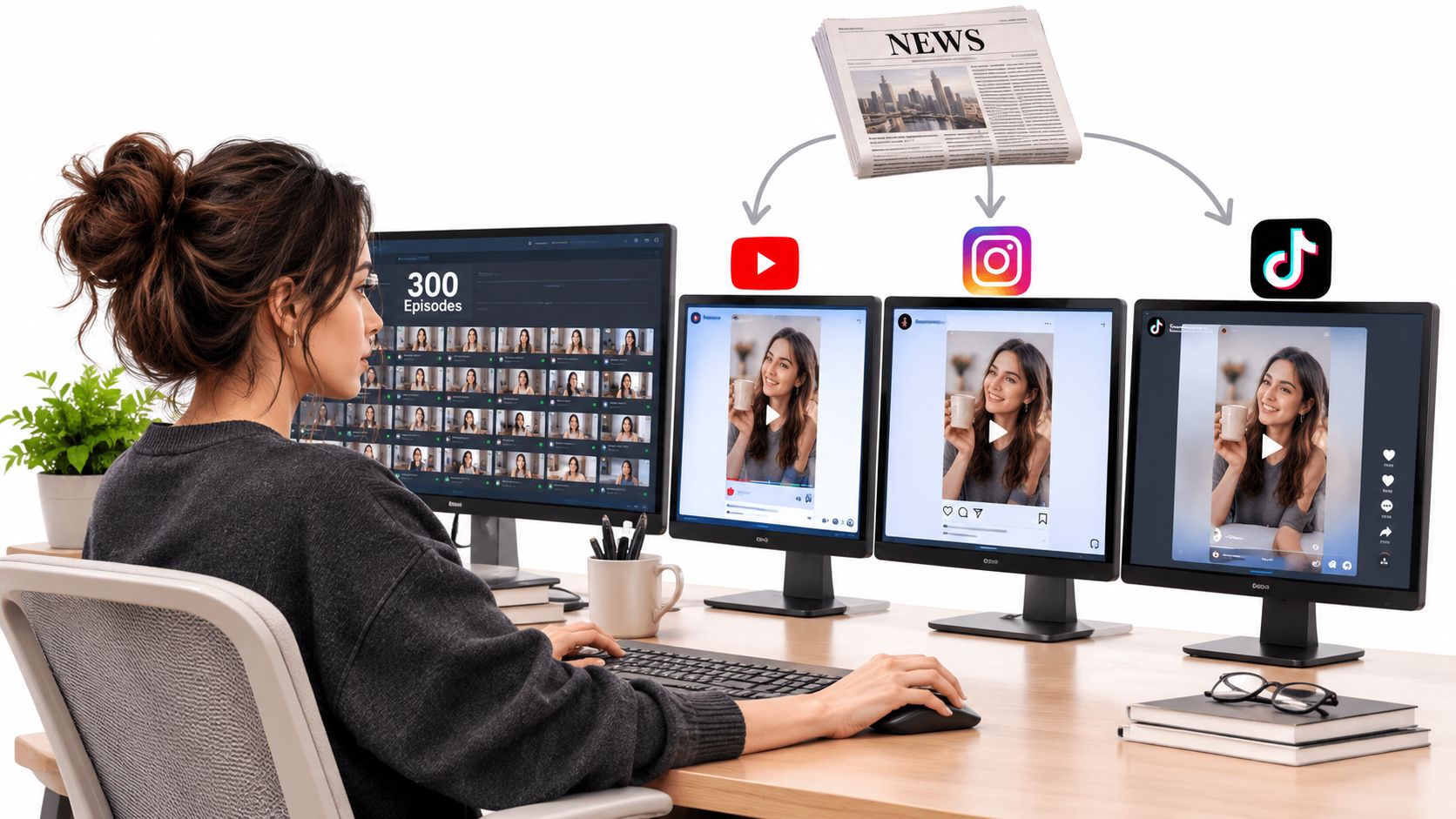
You've got a folder full of finished work, a publishing calendar with empty spaces, and another afternoon disappearing into copying captions between tabs. Say you've recorded 300 episodes, each collecting a few views, while you manually post the same clip to three networks. The next useful idea might already be in your archive, but finding and adapting it feels harder than recording something new.
A content distribution platform should help you start with that library, not another blank document. The useful question isn't how to publish everywhere. It's how to find something worth reusing, prepare it for a particular audience, and learn whether anyone stayed long enough to care.
What a Content Distribution Platform Does
Think of a newspaper wire desk. A story arrives, editors check it, prepare versions for print, web, and broadcast, and route each version to the appropriate destination. They don't just photocopy the original and hope every audience enjoys the same layout.
A content distribution platform applies that sorting-hub approach to an existing library. It ingests material such as YouTube videos, podcast audio and transcripts, blog posts, and text documents, then helps organize, adapt, publish, and measure the resulting work.
The desk may look digital, but someone still needs to decide what deserves an audience.
Hosting, Scheduling, and Distribution Aren't the Same
A hosting service stores and delivers files. Your podcast host makes audio available; it doesn't necessarily recognize that a forgotten interview contains an excellent explanation of pricing.
A content management system, such as WordPress, primarily manages publication on a website. A social scheduler queues finished posts, but may know nothing about the source material behind them.
A library-centered distribution platform connects those jobs:
- Understand the source: Make the archive searchable and identify useful subjects.
- Prepare derivatives: Turn selected material into channel-appropriate formats.
- Route and learn: Publish approved work and connect outcomes to its origin.
Individual tools overlap, so evaluate the actual workflow rather than the category label.
Why the Library Comes First
Online platforms accounted for 94.8% of digital content distribution in 2025, representing an estimated $376.6 billion in value, according to DataIntelo. That measures the importance of online distribution, not a guarantee that adding more destinations will improve your results.
Your practical constraint is editorial time. Someone must find the passage, verify its meaning, clear its reuse, and approve the adaptation. Automating file movement helps, but it won't rescue a clip that leaves out the speaker's qualification.
Quick self-test: If your best work lives in one place and every useful repost requires a manual hunt, you have a distribution problem, not necessarily a content shortage.
Core Features Every Platform Should Include
Use this checklist to score platforms against your workflow, not to crown a universal winner. Ask vendors to demonstrate each feature using your material. A polished sample library won't reveal how a tool handles your inconsistent episode titles or messy document folders.
Core features of a content distribution platform
| Feature | What it does | Example for a library |
|---|---|---|
| Library import | Connects YouTube channels, podcast feeds, blogs and document archives | Imports recordings and their existing descriptions together |
| Thematic tagging | Organizes each asset by topic, speaker, claim and format | Every interview tagged by guest expertise |
| Search and research | Finds keywords, topics and claims across the whole library | Locating every mention of a product launch across ten years of videos |
| Format conversion | Turns long-form sources into blogs, social posts, scripts or podcasts | A hypothetical 45-minute video becomes a blog post and five short clips |
| Brand refresh | Updates older assets to the current voice before reuse | Rewrites an old introduction using the current editorial style |
| Scheduling and publishing | Sends approved derivatives to connected channels | Queuing clips across social accounts and an email list |
| Analytics | Reports performance by asset, channel and derivative | Comparing which clip drove newsletter sign-ups |
Prevent Retrieval Problems First
Library import prevents repeated uploading, but only if it preserves relationships. Test whether audio, video, transcripts, and descriptions remain connected instead of becoming unrelated files. Initial cleanup takes attention, particularly when filenames don't identify the source.
Thematic tagging prevents the archive from becoming a bigger pile. In the hypothetical episode library, useful labels distinguish a guest's expertise from the subject of a particular passage. Otherwise, searching for pricing might return every interview with a pricing consultant, including conversations about hiring.
Search and research prevent unnecessary rereading. Try a literal keyword search, a topic query, and a question that requires finding contrasting views. Inspect the original passages behind the answer, not just the fluency of the summary.
Prevent Production and Measurement Problems Next
Format conversion reduces blank-page work, but an editor still needs to choose the argument and check the result. A transcript pasted into a blog template isn't automatically a readable article. Budget review time for structure, quotations, and unsupported transitions.
Brand refresh prevents old introductions, outdated descriptions, and retired terminology from slipping into new publications. Keep changes to presentation separate from changes to factual meaning. Refreshing the voice shouldn't rewrite what a guest said.
Scheduling and publishing prevent repetitive handoffs. Test channel-specific previews, approval permissions, and failed-post notifications. A queue isn't useful if nobody notices that an authorization expired.
Analytics prevent every repost from becoming a guess. Require source-to-derivative relationships and an explicit outcome, such as a newsletter subscription, rather than a dashboard filled only with impressions.
Choose the feature that removes your current bottleneck, not the one that makes the busiest demonstration.
For example, a creator with 20 long videos and no time to adapt them may prioritize conversion and scheduling. A publisher with a deep archive may need tagging and search first. Mark the missing feature in your current workflow before comparing subscriptions.
How One Asset Moves Through the Workflow
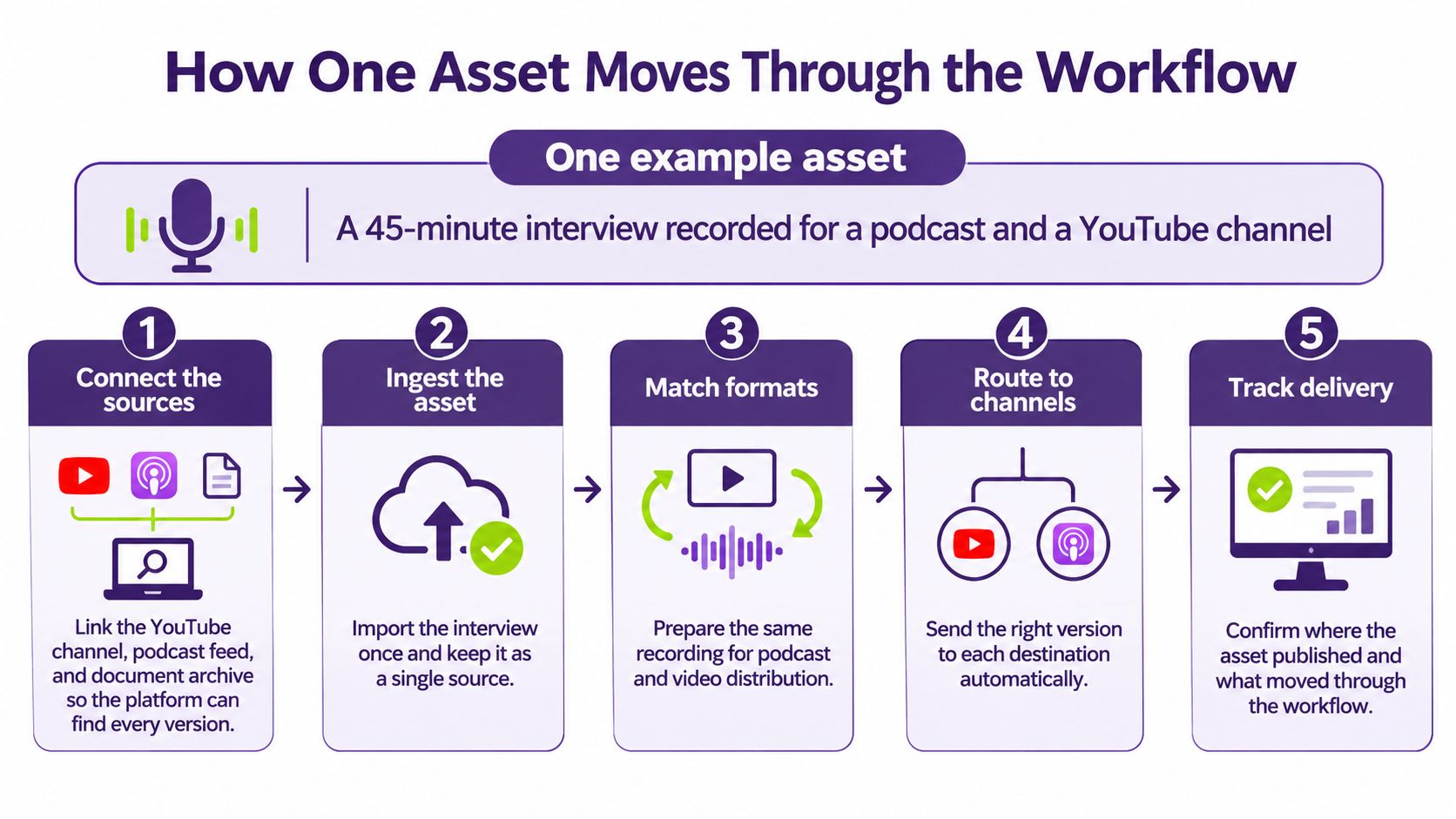
A 45-minute interview can become a podcast episode, a YouTube video, a blog post, and a newsletter section. The original recording remains the reference point; each derivative serves a different purpose. The work starts in the content library, where the team can find related material before deciding what to publish.
From Source to Approved Derivatives
Connect the sources. Bring together existing content, such as the YouTube channel, podcast, and document archive. Contesimal organizes and tags connected content thematically, making it easier to find the authoritative recording and related material.
Ingest and transcribe. Import audio, video, and supporting text. Review names, technical terms, and speaker labels in the transcript before using it for research or quotation. Transcription can reduce manual typing, but corrections still take editorial time.
Tag thematically. Label useful topics, speakers, and formats so related passages are easier to locate. Set tags carefully: a brief mention of a subject may not support the same conclusions as a full discussion.
Research the library. Search across related material for examples, disagreements, and unanswered questions. Contesimal's AI agents can help users research their library, combine ideas, and develop new formats. An editor still chooses which findings support a worthwhile angle.
Adapt the content. For this interview, prepare a blog post, three captioned clips, and a newsletter section. Give each a fitting title and opening, and preserve enough context that a memorable excerpt does not distort the speaker's meaning.
Schedule and publish. Send approved derivatives to their intended destinations on a chosen day. Scheduling manages timing; publishing sends the finished content to a channel. Sequence the releases so a clip does not point readers to an article that is not live yet. For recurring social posts, Pin Generator's guide to automated posting offers a useful reference for mapping the scheduling task.
Measure and feed back. Review the signals that match each derivative's purpose, then use them to choose what to revisit in the archive. A response to one opening may suggest a new presentation, while interest in a topic may justify researching related recordings.
Where Automation Helps and Editors Stay Involved
A distribution platform can connect and organize content, support library research, prepare derivatives, and help route approved work to channels. Hosting, scheduling, and distribution are separate jobs: storing an asset does not put it in a publishing queue, and a scheduled item still needs to reach its destination. Teams mapping those handoffs can use this guide to content workflow management.
Source cleanup and editorial review take hands-on time. Track where corrections recur, and make approval responsibility clear before increasing the publishing queue. The accompanying video offers another reference for documenting the workflow.
Matching Each Format to the Right Channel
Derivative formats by source asset and channel
| Source asset | Derivative | Channel | Adaptation needed |
|---|---|---|---|
| Long-form video | 60-second vertical cut | YouTube Shorts, TikTok, Instagram Reels | New hook in the first three seconds, captions, vertical crop |
| Podcast episode | Audiogram clip with transcript excerpt | YouTube, social feeds | Video version, shorter title, chapter markers |
| Podcast episode | Show notes with full transcript | Search, RSS, blog | Keyword title, timestamps, metadata |
| Blog post | Carousel or newsletter digest | Instagram, email newsletter | Rewritten lead, cut to the key claims |
| Interview transcript | Quote cards and excerpt article | X, LinkedIn, Medium | Speaker context kept, quotes attributed |
These are production examples, not universal duration rules. Video content accounted for 65.54% of the global content distribution market in 2025, according to Mordor Intelligence. That makes video worth evaluating, but doesn't mean every written asset deserves a filmed version.
Adapt the Entry Point, Preserve the Meaning
For the vertical cut, start with a clear problem or useful statement rather than the original episode introduction. Check the crop manually when speakers move or a demonstration appears near the edge. Captions should support understanding, not cover the object being discussed.
For the audiogram, give viewers enough visual information to understand what they're hearing. A shorter title should identify the topic rather than rely on an unfamiliar episode name. Reserve chapter markers for a video version with meaningful sections.
For show notes and transcripts, prioritize retrieval. Write a descriptive keyword title, align timestamps with the recording, and preserve names and source references. RSS distributes episode information and media references; your website provides a readable home for the full transcript.
Match Discovery to a Useful Next Step
Among U.S. podcast listeners, 57% use social media for recommendations, compared with 49% who use podcast apps, according to the findings reported by Inside Radio. Discovery and long-form consumption are different jobs, so give viewers a relevant next destination.
A carousel needs a sequence readers can follow without the original article. A newsletter digest needs a reason the subscriber should care now. Neither benefits from an introduction that spends its opening explaining where the source originally appeared.
A quote card needs the speaker's identity and enough context to prevent a misleading interpretation. Keep exact quotations separate from paraphrased takeaways, especially when an excerpt travels without its accompanying caption.
Change the packaging, not the claim.
Copying unchanged material across networks ignores differences in viewing context and available formats. Connect each derivative to its source, then label the original by subject, audience, and format before choosing destinations. You'll be able to compare edits rather than treating unrelated post totals as evidence.
Metrics That Show Distribution Is Working
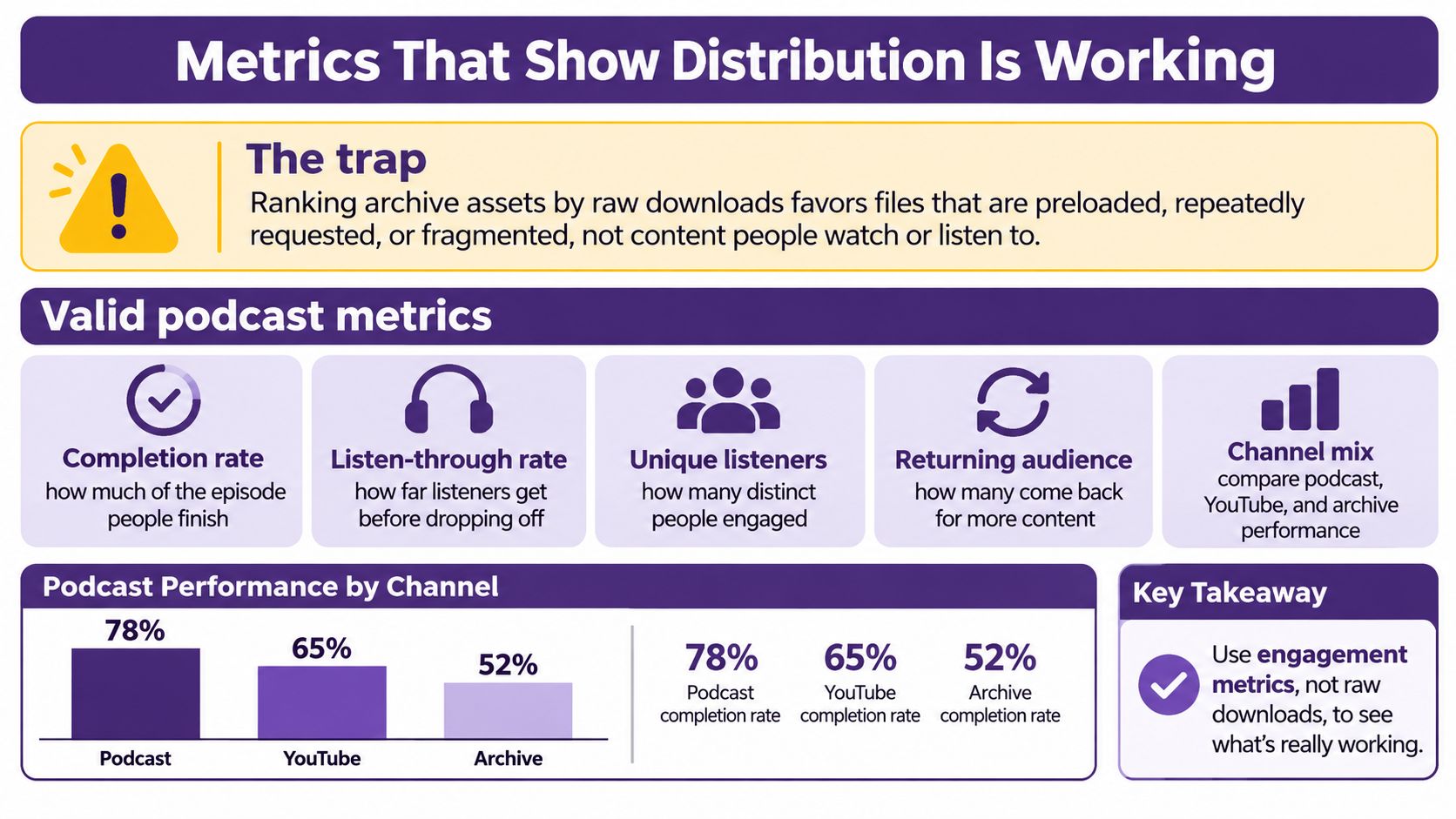
Ranking archive assets by raw downloads can favor preloaded, repeatedly requested, or fragmented files instead of material people consume. A file transfer isn't a listening session, and a large delivery total shouldn't automatically decide your next editorial assignment.
The IAB podcast measurement framework generally requires the ID3 header plus enough audio data to play at least 60 seconds for a valid podcast download. It also describes filtering and uniqueness estimation, which help distinguish qualified delivery from raw requests.
Distribution metrics and what each one proves
| Metric | What it measures | What it cannot prove | Use it to |
|---|---|---|---|
| Raw requests | Every HTTP hit on an audio or video file | Any listening or viewing | Spotting bot noise to filter out |
| Qualified downloads | Files meeting the header and audio threshold described above | That the content was played | Comparing availability across episodes |
| Unique downloaders | Estimated unique downloading clients in a time window | Person-level identity | Rough reach estimates |
| Verified playback | Start, completion and resume events from the player | Behaviour where no player data exists | Ranking topics by sustained engagement |
| Returning audience | Repeat listens or visits from the same audience | Why people came back | Choosing the next archive item to repackage |
| Conversions | Subscriptions, inquiries or sign-ups after a derivative | Reach or attention | Judging whether short-form exposure produces long-form audiences |
Separate Delivery From Engagement
Start with raw requests, filter bot noise, and retain the filtering decisions. Qualified downloads can reveal delivery patterns across episodes, but they still don't establish that someone pressed play.
Unique downloaders commonly use an IP-address and user-agent combination within a defined window. Treat that as a reach proxy, not a verified count of individual people, and handle identifiers with appropriate privacy safeguards.
The distinction matters visually as well as numerically.
Choose Signals That Support Decisions
The IAB technical measurement guidance distinguishes download-based delivery from confirmed consumption. Where player integration and consent allow, collect starts, duration, completion, and resume events separately.
Returning audience helps you spot subjects people revisit, although it won't explain their motivation. Conversions show whether an exposure led to a desired action, but attribution needs care: a sign-up after a clip isn't proof that the clip alone caused it.
Keep raw delivery logs under a defined retention policy, alongside separate delivery and engagement metrics. Preserve timestamps, asset identifiers, status, bytes served, user agents, privacy-safe keys, and filtering outcomes so calculations can be checked.
Use delivery metrics for availability and ingestion health. Use verified engagement to refine topic labels and prioritize repackaging, with content performance analysis organized around the decision you need to make.
Turning Your Taxonomy Into Distribution Decisions
Tags earn their keep when they answer a publishing question. Group related assets into topic clusters, such as pricing discussions, founder interviews, or tutorials about a particular tool. Each cluster can become a bucket or playlist you continue building rather than a folder you forget.
Then inspect the gaps. Suppose a cluster contains ten episodes but only two written treatments. A practical next assignment might be a searchable explainer assembled from the clearest passages, provided the subject still matters and the claims remain accurate.
Give Each Cluster an Action Record
A content tagging taxonomy becomes operational when it includes decisions as well as descriptions:
- Asset to reuse: Identify the source passage and any supporting material.
- Audience and channel: Specify who needs it and where the treatment belongs.
- Editorial task: Name the missing explanation, update, or adaptation.
- Success signal: Choose the behavior that would justify continuing.
- Owner and result: Assign responsibility and retain the outcome.
A claim-heavy cluster may suit an explainer video or newsletter analysis. A story-led cluster may offer a strong vertical excerpt, provided the ending and context survive the cut. The label alone doesn't choose the format; the audience's need does.
In our research process, people can curate knowledge from the archive and collaborate around shared source material. That gives writers, editors, and researchers a common reference instead of separate notes with uncertain origins. Keep their decisions beside the cluster so the next assignment starts with an evidence trail, not somebody's memory.
Integration and Automation Checks Before You Commit
Treat integration as a permissions and reliability exercise, not just a connection button. Run these yes-or-no checks before giving a platform access to a valuable archive. An unclear answer is a task to resolve, not a box to tick optimistically.
Confirm Control and Data Movement
Ownership: Does the agreement confirm that your content stays yours and explain the permitted processing? Our customers retain ownership, and we process their content securely to build a searchable taxonomy and power our internal AI agents.
Publishing data flow: Is it clear how content reaches a social network and which privacy policy applies there? When users publish through us to a social platform, we transmit the content through that platform's API, and its privacy policy governs how it's processed.
Third-party sharing: Do you know which service providers receive information and for what purpose? We share information with service providers for hosting, email delivery, and analytics services.
Verify the Exit and the Safety Catch
Import paths: Does automatic import preserve titles, dates, and metadata? We automatically import from WordPress and other digital platforms; inspect an imported item against its original before approving a broader migration.
Export and reversibility: Can you obtain transcripts and metadata in a structured format you can use elsewhere? Test the export you'll need, including source relationships and tags, rather than assuming a downloadable document preserves everything.
Automation limits: Is human approval required before a derivative publishes? Give translated and localized versions explicit review when idioms, references, or uncertain wording could change the meaning.
Test run: Have you published a derivative to a private or low-stakes destination and inspected the result? Check captions, links, attribution, thumbnail crops, and whether the correct account received it.
Record failures and assign someone to fix them before expanding access. Don't connect an entire organization merely because a personal test account worked. Automation should follow a verified workflow, not replace one.
Choose a Platform and Run One Asset Through It
Choose a platform by matching library formats, audience channels, team size, review capacity, and data control. A creator moving toward professional publishing needs a manageable production queue. A publisher coordinating editors and researchers also needs dependable retrieval, permissions, and source tracking.
Consider where the money could come from before increasing output. A derivative might support a subscription, an inquiry, a sponsored series, or a deeper relationship with an existing audience. Choose a route you can measure rather than assuming more views will become revenue.
Make the Trial Answer a Real Question
Contesimal is one fit for a library-first workflow: we help creators organize content, curate knowledge sets, and collaborate around them. Supported material includes YouTube videos, podcast audio and transcripts, blog posts, and text documents. We convert long-form material into blogs, social posts, podcasts, and scripts, and finished content can be published across social platforms, blogging platforms, email providers, and podcasts.
Validate current import, export, and destination-specific publishing behavior against your requirements before committing. Don't infer a particular integration from a broad category description.
Run a 30-day test: select ten archive items with strong past performance, move one through the seven-step workflow, and publish two derivatives. Record hands-on review time, then compare verified playback and conversions after 30 days. Scale only when the outcome justifies the work.
Contesimal helps you organize your existing library, research it with human and AI collaborators, and turn useful discoveries into new content formats. Visit Contesimal with an archive asset in mind, and explore how to move it from forgotten file to a measurable publishing experiment.