
You're posting consistently, your work looks good, and you still aren't getting PR from brands. Meanwhile, creators with smaller audiences somehow keep landing package sends, affiliate offers, and paid collabs.
That usually isn't a content problem. It's a positioning problem.
Most creators approach brand outreach like they're asking for a favor. Brands don't see it that way. They're managing risk, budgets, inbox volume, and internal pressure to show results. If you want to learn how to get PR from brands, start by thinking like the person on the other side of the email. They're not asking, “Is this creator talented?” They're asking, “Is this creator likely to make my job easier or harder?”
The creators who get picked most often are the ones who feel low-risk and high-value. They look organized. They understand their audience. They pitch clearly. They make it obvious that a gifted send, a trial partnership, or a paid collaboration has a real shot at turning into usable content and measurable outcomes.
Lay the Groundwork for Brand Partnerships
A brand manager opens your profile after seeing your name in their inbox. In under a minute, they decide whether you look like a safe bet for a PR send, a maybe for affiliate, or someone they should skip.
That decision happens before your pitch gets real consideration.
Creators who get picked for PR usually make one thing clear fast. They know what they make, who it reaches, and why a product would fit naturally into that content. Brands are screening for execution risk. If your profile looks scattered, inactive, or hard to categorize, you create work for the person reviewing you. Extra work lowers your odds.
Define your niche so a brand can place you fast
Clear positioning makes you easier to buy.
When I review a creator for a brand fit check, I look for three signals right away:
- What content shows up repeatedly
- Who the content is clearly serving
- Which product categories belong there without forcing it
A skincare creator with routine breakdowns, ingredient explainers, and wear tests is easy to route to the right team. A general creator mixing beauty, gaming, reaction clips, and unrelated trends can still get deals, but the pitch has to work harder because the fit is less obvious.
Breadth is not the problem. Confusion is.
A good test is simple. If someone on the brand side cannot describe your channel in one sentence after thirty seconds, your positioning needs work.
Audit your recent content like a partnerships manager would
Review your feed the way a cautious buyer would. The question is not whether the content feels creative to you. The question is whether it signals follow-through, relevance, and brand safety.
Check your recent posts for these points:
- Publishing reliability: Do you post often enough that a brand can expect the product to show up in content, not disappear into a backlog?
- Integration fit: Do your formats give you natural places to feature products, mention results, or show usage?
- Production quality: Are your visuals, audio, captions, hooks, and editing consistent enough for a brand to repurpose or share?
- Audience quality: Do comments show real interest, specific questions, product curiosity, or signs of trust?
- Category proof: Have you already made content in the product category you want to pitch?
If you need a clearer process, this guide to analyzing content performance helps you review which formats and topics support partnership outreach.
Creators often miss the brand perspective. A decent audience with a reliable content pattern is usually less risky than a larger audience with uneven execution.
Clean up your public-facing brand
Small points matter here because they reduce friction for the buyer.
Your bio should explain your niche and content angle in plain language. Your contact email should be visible. Your link hub should work on mobile. If you publish on multiple platforms, connect them properly so a brand can understand your ecosystem without hunting for it.
A creator with 12,000 followers and a clean, well-organized presence often beats a creator with 80,000 followers whose pages feel neglected. I have seen that happen many times, especially with lean teams that need quick approvals.
If you want a better sense of brand-side expectations, study examples of how to craft partnership emails before you start pitching. The strongest outreach matches a profile that already looks organized.
Build proof before you ask for anything
Before you request PR, give brands evidence that you can turn products into useful content.
That proof can come from your public content long before a deal exists:
- Organic product mentions: Feature products you already use and explain why they earned a place in your routine or workflow.
- Selective tagging: Tag brands on posts that reflect your best category-relevant work.
- Repeatable content angles: Show that you can cover a product type more than once without sounding forced.
- Consistent standards: Keep your taste level, posting cadence, and audience interaction steady enough that a brand can predict the experience.
The creators who get consistent PR are not always the loudest or the biggest. They are the easiest to trust.
If you want to be seen as a low-risk, high-value partner, build a profile that answers the brand team's silent questions before they ask them. Can this creator represent us well? Will they post? Will the content fit their audience? Will managing them be straightforward? Your groundwork should make those answers feel obvious.
Build a Media Kit That Proves Your Value
A creator sends a pitch. The brand team clicks their profile, likes the aesthetic, and asks for a media kit. What happens next often decides whether the conversation keeps moving or dies in review.
A strong media kit lowers friction for the person approving PR. It gives them enough evidence to say, “This creator looks safe to test, and useful if it works.” That is the standard. Your kit needs to position you as a low-risk, high-value partner, not just a creator with a nice feed.

What a strong media kit needs
Keep it concise, but make it decision-ready.
These are the pieces I want creators to include:
- Positioning summary: A clear bio, your niche, and the type of audience attention you hold.
- Audience insights: Demographics, top locations, age ranges, and platform trends pulled from your own analytics.
- Performance metrics: Reach, views, saves, replies, clicks, watch time, or other results that fit your format.
- Content proof: Screenshots, thumbnails, links, or short case-study slides showing brand-relevant work.
- Partnership formats: Gifted campaigns, affiliate content, sponsored posts, UGC, whitelisting, newsletter placements, podcast reads, or bundled packages.
A busy PR manager should be able to scan your kit in two minutes and still come away with a clear recommendation. If your file is overloaded, the reviewer has to do extra work. That raises the chance they pass.
Show the metrics brands use to assess risk
Follower count has a role, but it rarely closes the case on its own. Brands want evidence that your audience matches the category and responds when you post.
The useful question is simple: if a product lands in your hands next week, what proof suggests you can turn it into credible content?
Surface that proof in a way that is easy to verify:
| Asset | What to show | Why it matters |
|---|---|---|
| Social profiles | Audience breakdown and recent engagement trends | Helps the brand judge fit and consistency |
| Long-form content | Average views, retention signals, comments, or listener response | Shows depth of attention |
| Website or newsletter | Traffic patterns, click behavior, subscriber quality | Useful for conversion-focused campaigns |
| Past product content | Organic or paid examples that drove comments, saves, or clicks | Proves execution in context |
Smaller creators should not hide their size. They should frame what brands actually buy when they send PR: relevance, predictability, and category fit.
A creator with 8,000 followers in a tight niche can be easier to approve than a creator with 80,000 followers and no clear audience pattern.
Turn your content archive into sales proof
Creators often say they do not have case studies yet. In practice, they usually have the raw material and have not organized it.
Organic posts count. Repeat mentions count. A video that pulled strong comments about your routine counts. A newsletter issue that drove replies about a product category counts. The job is to pull those pieces together so a brand can see the pattern fast.
Group your evidence by category or outcome:
- Natural product mentions
- Posts with strong saves, shares, or replies
- Videos or episodes that sparked buying questions
- Recurring content themes that show authority
- Examples that match the brand's format and price point
A clean content library is key for creators to win. If you cannot quickly find your best examples, you cannot prove your value well.
If your archive is messy, fix that before you ramp up outreach. Even basic tracking helps. Some creators use spreadsheets. Others use CRM-style systems or tools like HarvestMyData for lead generation to organize contacts, content examples, and outreach notes in one place. The method matters less than being able to pull the right proof fast.
Make your kit easy to send and easy to maintain
Use a format that opens cleanly on desktop and mobile. Check every link. Replace stale screenshots. Refresh your numbers on a regular schedule.
These details shape brand confidence more than creators realize. A current, tidy media kit signals that working with you will be straightforward. An outdated one suggests slow follow-through, messy reporting, or extra hand-holding.
Email is still a common review path for PR and partnership requests, as noted earlier in the article. Your media kit supports that process by helping the person on the brand side forward one file internally and get a fast yes or no.
Your profile may get attention. Your media kit is what helps a brand justify the decision.
Find and Vet the Right Brand Contacts
Two creators want to work with the same skincare brand.
The first sends Instagram DMs to the main brand account, comments “would love to collab,” and fires the same email to a generic contact form used for customer support. Then they decide the brand ignored them.
The second creator checks the brand's recent campaigns, looks for partnership language on LinkedIn, identifies the person handling influencer or PR relationships, and sends a short note that clearly matches the brand's current direction. That creator may still not get an instant yes, but they've at least entered the right conversation.
That difference matters because the PR market is big, attention is limited, and inbox competition is brutal. Avaans Media notes that the global PR market is projected to reach $129 billion by 2026, yet only 3% of media pitches get a response. If you want to know how to get PR from brands, start by refusing to waste your best pitch on the wrong contact.

Who to look for inside the brand
The right contact depends on the company structure. Common titles include:
- Influencer Marketing Manager
- PR Coordinator
- Brand Partnerships Lead
- Social Media Manager
- Communications Manager
Smaller brands may roll all of that into one marketing lead. Larger brands may split responsibilities between internal teams and an outside PR agency.
If a brand works with an agency, don't treat that as a dead end. It can be helpful. Agencies often manage gifting, seeding lists, product sends, and campaign coordination.
How to research without turning it into a scavenger hunt
Use a simple workflow:
- Check the brand website for press, media, or contact pages.
- Search LinkedIn for current employees in partnerships, influencer, social, or PR roles.
- Review recent posts to see what creator relationships the brand is already leaning into.
- Look for campaign language that tells you what they care about right now.
- Build a small target list instead of chasing every brand in your category.
For creators who want extra help structuring prospect research, resources on HarvestMyData for lead generation can be useful for thinking through contact discovery and list building.
Why three to five targets beats a giant spreadsheet
A lot of outreach fails because the creator confuses volume with momentum.
A focused list of 3 to 5 target brands usually performs better than a bloated list of random names because you can learn each brand's tone, product priorities, and current marketing style. That makes your outreach sharper and your follow-up more credible.
If your pitch could be sent to ten brands without changing a word, it's probably too generic to send to one.
The creators who get traction don't just find contacts. They vet them. They make sure the brand is active, the fit is real, and the person receiving the pitch has a reason to care.
Craft an Outreach Pitch That Gets a Reply
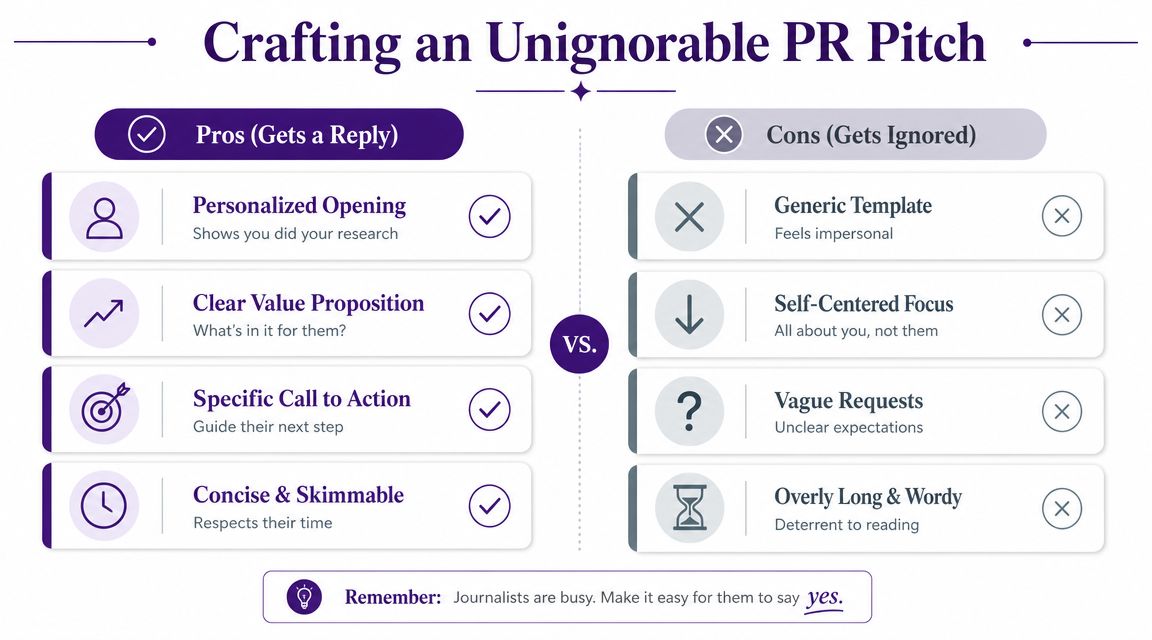
Most bad pitches fail in the first two lines. They're vague, self-focused, or overloaded with backstory.
Good outreach feels easy to process. The brand immediately understands who you are, why you fit, and what the next step is. That matters because, as White Rabbit Social notes, over half of brands prefer creator outreach by email, strong pitches should include measurable proof points like engagement rate and audience demographics, and a follow-up after a couple of weeks is recommended because messages get missed in crowded inboxes.
The shape of a reply-worthy pitch
A strong creator email usually does four things in a tight space:
- Opens personally: Mention something specific about the brand, campaign, product line, or category direction.
- States the fit: Explain who your audience is and why this product belongs in your content.
- Shows proof: Link your media kit and mention relevant metrics or prior examples.
- Makes the ask simple: Suggest one next step, not five options and a life story.
Useful structure matters more than clever writing. If you need examples to pressure-test your format, these best cold email templates are a helpful reference point for concise outreach.
A practical email blueprint
Here's the version I'd rather receive than the overproduced “brand love letter” many creators send.
Subject line ideas
- Collab idea for [Brand] and my [niche] audience
- Creator partnership inquiry for [Brand]
- PR consideration for [Brand] from a [category] creator
Email body
Hi [Name],
I'm a [creator type] focused on [niche], and I create content for [audience description]. I've been following [Brand], especially [specific product, campaign, or angle], and I think there's a strong fit with the way I cover [relevant topic].
My audience responds well to [content format or category], and I'd love to explore a gifted or paid collaboration if that's a fit. I've included my media kit here, which covers audience demographics, engagement, and recent examples: [media kit link].
If helpful, I can also share a few customized content ideas for [specific product line or launch].
Best,
[Name]
[Email]
[Primary platform]
[Media kit or website]
That structure works because it respects the reader's time.
Field note: The best pitches sound like they were written by someone who already knows how the collaboration would work.
A first message also doesn't need to explain every deliverable. It only needs to earn the next reply.
Here's a useful breakdown of pitch thinking in video form:
Keep it short enough to skim
Long emails usually signal one of two problems. The creator hasn't clarified the offer, or they're trying to compensate for weak proof with extra words.
A good pitch is compact, readable on mobile, and easy to forward internally. Short paragraphs help. So does limiting links to the ones that matter most.
For brand outreach, don't make the reader hunt for:
- your main platform
- your niche
- your audience fit
- your contact details
- your media kit
Follow up like a professional, not a spammer
Follow-up is normal. Silence isn't always rejection. People miss emails, campaigns shift, and inboxes pile up.
A simple follow-up after a couple of weeks works well:
Hi [Name],
Just following up in case my earlier note got buried. I'd still love to explore whether there's a fit between [Brand] and my audience in [niche]. Happy to resend my media kit or share specific ideas if useful.
Best,
[Name]
That's enough. If there's still no response after a reasonable pause, move on and revisit later with stronger evidence or a more relevant angle.
For creators trying to master how to get PR from brands, this is the part that separates persistence from pestering.
You're not chasing attention. You're presenting a clean business opportunity.
For sharper messaging on your landing pages, portfolio, or creator site, it also helps to study strong website copywriting principles so your email promise matches the experience someone sees after they click.
Navigate Negotiations and Legal Basics
A yes to your pitch is not the finish line. It's the handoff from outreach to business.
At this stage, a lot of creators get loose. They get excited, rush the reply, and agree to terms that are vague, uneven, or hard to deliver. The fix is simple. Slow the conversation down just enough to define what's being exchanged.
Know what kind of deal you're discussing
Not every “collab” means the same thing.
Here's the practical distinction:
| Deal type | What you receive | What the brand usually expects |
|---|---|---|
| Gifted | Free product | Content consideration or agreed deliverable |
| Affiliate | Commission on tracked sales | Promotion tied to link or code |
| Paid sponsorship | Direct payment | Specific deliverables, timing, and usage terms |
Problems start when the brand says “gifted collab” and the creator hears “light obligation,” while the brand expects polished content on a deadline. Don't rely on vibes. Clarify the deliverable.
Negotiate the parts that affect your workload
Creators often fixate on rate and forget the terms around it.
You need to know:
- Deliverables: What exactly are you making?
- Timeline: When is it due, and is there an approval process?
- Usage rights: Can the brand repost your content, run it as an ad, or use it on their website?
- Exclusivity: Are you blocked from working with competitors for a period?
- Revision expectations: How many rounds of feedback are included?
According to Triple Crown Products, a strong initial pitch is often 150 to 200 words, and from the brand side a professional PR package includes materials like fact sheets and high-res images to make publication easier. The same source also notes that effectiveness is measured with KPIs like mentions and traffic, which often becomes part of the negotiation. That's useful because it reminds creators that brand teams are often judging the collaboration by operational clarity, not just creative excitement.
If the brand can define what success looks like, you should define what work is required to get there.
Get the agreement in writing
This doesn't need to be intimidating. It does need to be explicit.
At minimum, the written agreement should cover:
- the product or payment
- the content to be delivered
- due dates
- review process
- usage permissions
- disclosure expectations
- cancellation or change terms
Even when the deal is small, written terms protect both sides from “I thought you meant…” confusion.
Don't get casual about disclosure
If content is sponsored, gifted with an expectation of coverage, or tied to affiliate compensation, disclose it clearly and plainly. Don't hide the relationship in a pile of hashtags or vague wording.
Creators who handle legal basics well come across as more professional, not less creative. Brands notice that. So do agencies.
The easiest negotiation stance is this: be friendly, be flexible where it makes sense, and be precise where confusion would cost you time, trust, or revenue.
Turn One-Off Gigs into Lasting Partnerships
Most creators waste the best moment in a brand relationship. It happens right after the campaign goes live.
They post the content, maybe send a thank-you, then disappear. That's a mistake. A finished partnership is one of the strongest assets you have for winning the next one, especially if you package the outcome well.
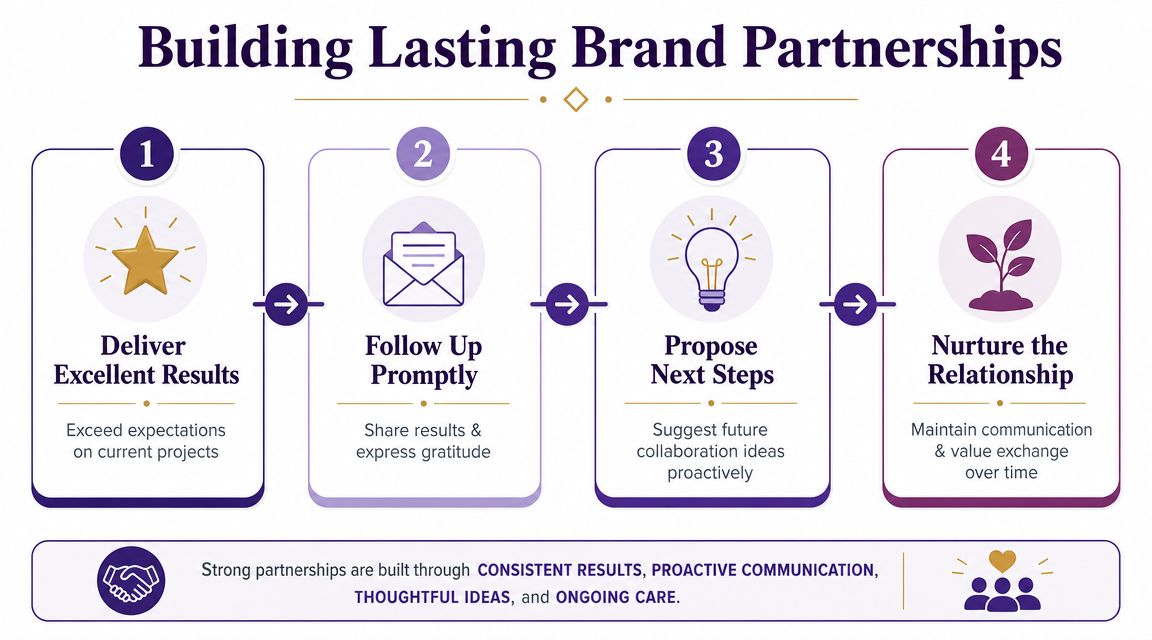
Send a post-campaign recap without being asked
A creator who reports back well instantly looks easier to rehire.
Your recap doesn't need to be elaborate. It should be clean and useful. Include:
- What was delivered
- How the content performed
- What audience response looked like
- Any notable comments, questions, or sentiment
- A short note on what could work next
If a brand has to ask you whether the content did anything, you've already missed a chance to look strategic.
Turn campaign results into reusable proof
Every good partnership should feed your future outreach.
That means updating your media kit, saving screenshots, logging feedback, and archiving links to published content. If your best examples are buried across email threads, cloud folders, and random notes, you'll underuse your own work.
Organizing your archive matters because content value compounds when you can retrieve and repurpose it. A thoughtful content repurposing strategy helps you turn past collaborations, top-performing mentions, and audience reactions into stronger future pitches.
Make the next ask while the value is fresh
A lot of creators wait too long to suggest the next project.
If the partnership went well, propose a natural follow-on:
- a second product angle
- a seasonal refresh
- a longer-form integration
- a cross-platform version of the same concept
- an affiliate extension
- a recurring series
This works because the brand already knows you can execute. You're no longer a cold prospect. You're a known operator.
The easiest brand deal to win is often the next one with someone who already trusts your process.
Treat your content library like a deal engine
Here's the bigger shift. Your past brand work is not dead content. It's commercial proof.
Every partnership gives you new assets:
- creator-friendly examples
- audience fit evidence
- negotiation advantage
- category positioning
- stronger ideas for the next pitch
Creators who scale usually don't start from zero each time. They build a system. They know where their best examples live. They know which content formats attract replies. They know which audience segments convert interest into action.
That's why learning how to get PR from brands isn't only about the first email. It's about building a body of work that keeps making the next yes easier.
If you want to turn old videos, episodes, articles, and campaign assets into better pitches and more reusable proof, Contesimal helps you organize your content library so you can find what works, surface your strongest examples fast, and create new value from work you've already done. For creators moving from hobbyist mode to a real revenue engine, that kind of clarity is a serious advantage.