
A systematic literature review methodology is a structured, transparent, and repeatable process for finding, evaluating, and synthesizing all available evidence on a specific topic. For creators, it's a powerful game plan to slice through the online noise and discover what actually works for your audience, trading guesswork for decisions backed by solid data. It’s how you move from just making content to building a library of high-value assets.
Moving Beyond Guesswork in Content Creation
If you're a YouTuber staring at analytics, a podcaster scrolling through endless "how-to" articles, or a publisher deciding which content vertical to invest in next, you know the feeling of being buried in information. The problem isn't a lack of data; it's the overwhelming noise.
This is where a systematic review process becomes a game-changer for creators. It's not a stuffy academic exercise. Instead, it’s a framework for making smart decisions that actually grow your audience and the value of your content library.
Unlike a typical Google search driven by algorithms and gut feelings, a structured approach puts evidence first. It forces you to define your question, search comprehensively, and judge sources with strict rules. This process turns a vague idea like "what video should I make next?" into a sharp, answerable question that leads to real growth. It helps you organize your ideas, understand what works, and take action.
This structured method turns messy data into actionable clarity.
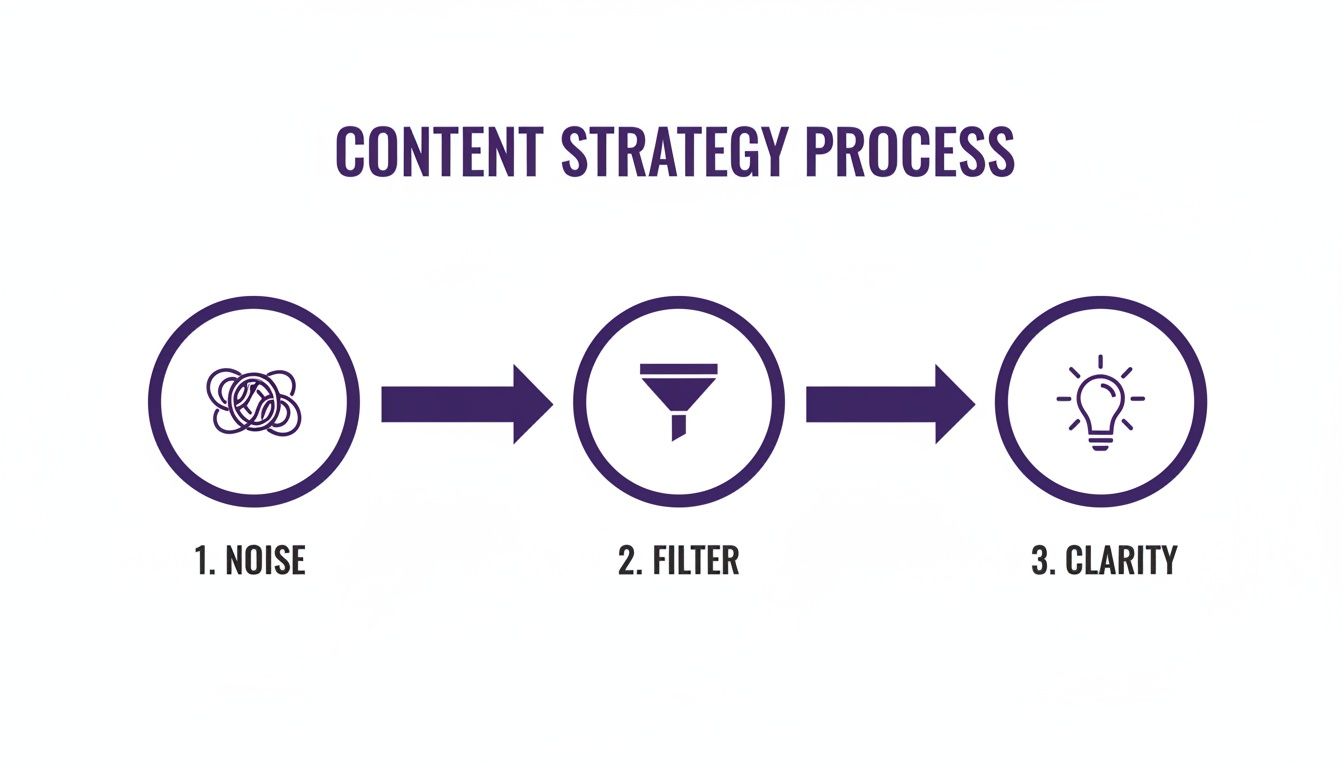
This is how you filter out the junk—turning chaotic information into a clear path forward for your content strategy and creating new value from what you learn.
To see the difference, let’s compare a systematic review to how most of us typically hunt for content ideas.
Systematic Review vs Traditional Content Research
| Aspect | Traditional Research | Systematic Review Methodology |
|---|---|---|
| Question | Broad, often undefined. "What's a good topic?" | Specific and focused. "What video format drives the most engagement for tech tutorials?" |
| Search | Quick, relies on top search results or familiar sources. | Exhaustive and comprehensive, covering multiple databases and sources. |
| Criteria | Informal, based on intuition or what "looks good." | Pre-defined, explicit criteria for including or excluding sources. |
| Bias | High potential for confirmation bias and random influence. | Systematically designed to minimize bias and subjectivity. |
| Outcome | An idea, often based on a hunch or trend-chasing. | A defensible, evidence-based conclusion. |
The table makes it clear: one path is about hoping you get it right, while the other is about building a process to get it right.
From Medical Journals to Marketing Plans
This reliable method wasn't dreamed up in a marketing meeting. The systematic literature review methodology took shape in the late 20th century as researchers drowned in a sea of medical studies and needed a better way to synthesize evidence. An epidemiologist named Archie Cochrane famously complained about the lack of organized summaries, which helped kickstart a movement that led to the Cochrane Collaboration in 1993.
The core idea was to use explicit criteria and comprehensive searches to minimize bias—a principle that’s just as valuable for a creator’s content strategy as it is for a clinical trial.
The real benefit here is making your content decisions repeatable and defensible. Instead of just hoping a topic hits, you're building a case based on solid evidence. This is exactly how Contesimal helps you run an internal ‘systematic review’ on your own content library, finding the hidden patterns in your past wins to guide what you do next and bring your entire content library back to life.
Key Takeaway: A systematic review isn't about finding more information; it's about finding the right information in a structured way that leads to better, data-driven creative choices.
This method gives you a framework to tackle creative challenges with discipline. To truly move past making content on a whim, you have to build a reliable process for creativity and growth. It's a lot like applying a systematic approach to destroying writer's block—it’s all about the system.
Defining a Clear and Answerable Research Question
Every great piece of content—whether it’s for YouTube, a podcast, or a blog—starts with a single, powerful question. It’s the difference between a rambling, unfocused video and a sharp post that nails a specific problem for your audience.
A vague goal like "make a video about productivity apps" is a recipe for a flop. A much better approach is to frame your goal as a specific, answerable question. This question becomes your north star, guiding every decision, from research to script. It’s the foundation of any solid systematic review, and it's just as vital for professional creators.

This simple shift turns a creative hunch into a focused investigation, guaranteeing your final product is actually valuable.
Adapting PICO for Content Creators
In the academic world, researchers use frameworks like PICO to build their questions. It sounds formal, but it’s an incredibly useful tool for any podcaster, YouTuber, or content marketer trying to align content across platforms.
Let's break down PICO for the world of content creation:
- Population: Who, exactly, is your audience? "Tech enthusiasts" is too broad. "Early-career software developers who use Python" is a specific group with specific needs.
- Intervention: What’s the specific strategy or format you're testing? Get granular. Something like "15-minute deep-dive tutorial videos."
- Comparison: What are you measuring it against? This could be your current approach, what a competitor is doing, or another format like "5-minute quick-tip shorts."
- Outcome: What result are you trying to achieve? "More engagement" is wishful thinking. "Increased average viewer retention by 20%" is a concrete, measurable goal.
Putting it all together, a weak idea like "What kind of videos should I make?" becomes a powerhouse research question:
For my audience of (P) early-career Python developers, what is the impact of (I) 15-minute deep-dive videos versus (C) 5-minute shorts on (O) average viewer retention?
This level of clarity is a superpower. You know what data you need, whose content to analyze, and exactly how you’ll measure success.
Creating a Protocol to Keep You on Track
Once you have your question, the next step is building a protocol. It's just a simple project brief or roadmap for your review. Its main job is to prevent "scope creep"—that thing where a simple project suddenly becomes an unmanageable monster.
Your protocol should lay out the ground rules:
- Your Research Question: The focused PICO question you just built.
- Inclusion/Exclusion Criteria: What sources will you look at? You might decide to only include videos published in the last 12 months with over 10,000 views, while excluding any sponsored content.
- Search Strategy: Where are you going to look? Think YouTube analytics, competitor channels, Google Trends, or specific forums where your audience hangs out.
- Data to Extract: What key info will you pull from each source? This could be video length, view count, audience retention graphs, or even the themes from top comments.
Having this protocol is like having a map for a road trip. It stops you from getting lost. If you need a template, check out our guide on creating a sample research plan that you can easily adapt.
This whole process—defining a question, setting a protocol—is exactly how a tool like Contesimal works. It lets you ask precise questions of your own content library, helping humans and AI collaborate to uncover which strategies have historically crushed it for your brand. Suddenly, your archives aren't just a dusty collection of old work; they're an engine for your next viral hit.
Finding Your Evidence: How to Run a Comprehensive and Unbiased Search
Alright, you've got your question locked in. Now it's time to gather the evidence.
A core principle of a systematic literature review is that your search must be exhaustive and repeatable. This isn't about cherry-picking the first few search results that confirm your bias. The goal is to build a bulletproof strategy to find all the relevant information, whether it supports your initial hunch or completely blows it up.
This step is your biggest weapon against confirmation bias—that pesky human tendency to grab onto information that confirms what we already believe. For a content creator, this might look like only studying competitors who use a style similar to your own. A truly deep search forces you to look beyond your usual haunts and challenge your own assumptions.
Building Your Search Arsenal
Your search shouldn't just live on one platform. A solid strategy pulls from a diverse set of sources to paint the full picture. Getting familiar with different research data collection methods is a huge help here, as it opens your eyes to where valuable insights might be hiding.
Here are some key places to look, specifically for content pros:
- Academic Databases: Sources like Scopus or PubMed might feel a bit stiff, but they can be goldmines. You can find research on audience psychology or media consumption habits that are the bedrock of great content.
- Creator-Centric Platforms: This is your home turf. Dig deep into YouTube Analytics, Google Trends, podcast directories, and social media listening tools. These platforms offer real-time data on what people are actively searching for and engaging with right now.
- Grey Literature: This is the secret weapon for many researchers. "Grey literature" is all the valuable info that isn't formally published. For creators, this means competitor reports, deep-dive forum discussions on Reddit, conference notes, and even customer feedback from your own community. This is where you'll often find the most candid and actionable insights.
Crafting Powerful Search Strings
Once you know where to look, you need to know how to look. This is where Boolean operators become your best friend. These simple commands—AND, OR, NOT—turn a basic keyword search into a precision instrument.
Think of it like this:
"video marketing" AND "audience retention"will only pull up results that contain both phrases. It’s perfect for narrowing your search."podcasting" OR "audio content"will give you results that include either term. Use this to broaden your search."content strategy" NOT "B2B"finds information about content strategy but kicks out anything focused on the B2B world, filtering out noise.
Let’s say a podcaster is researching interview formats. Instead of just searching for "podcast interview tips," they could use a more powerful string like: ("podcast interview" OR "guest conversation") AND ("audience engagement" OR "listener feedback") NOT "celebrity". This sophisticated query zeroes in on techniques for engaging listeners with non-celebrity guests, yielding much more targeted and useful results.
Key Takeaway: A repeatable and well-documented search strategy is your best defense against bias. By using a mix of sources and precise Boolean searches, you ensure the evidence you gather is balanced, comprehensive, and truly representative of the topic.
This methodical process of scouring multiple, diverse sources is exactly how Contesimal’s AI-powered search works on your own content library. It digs through everything—video transcripts, article text, podcast show notes—to make sure you’re conducting a truly exhaustive internal search. This uncovers hidden connections and successful patterns that a manual review would miss, giving you a complete picture of what has truly worked. To dive deeper into finding the best sources for your projects, learn more about identifying reliable research sources in our detailed guide.
Screening and Selecting Your Final Evidence
So you ran your search, and now you’re staring at a mountain of results—hundreds, maybe even thousands, of articles, videos, and reports. The sheer volume can feel paralyzing. How do you find the real gems buried in all that noise?
This is where the screening phase comes in, and it's where a systematic methodology truly proves its worth. The trick is to avoid getting bogged down in the details too early. Instead, you'll use a practical, two-stage process to filter everything down to a manageable and highly relevant final set.

The secret is having clear, pre-defined rules for what gets in and what gets tossed out. This isn't about your gut feeling; it’s about making objective, repeatable decisions.
Stage One: The Quick Title and Abstract Scan
The first pass is all about speed. You are not reading every word. Instead, you're scanning titles and abstracts (or for video content, the descriptions and opening hooks) with a single goal: to quickly eliminate anything obviously irrelevant.
Your pre-defined inclusion and exclusion criteria are your best friends here. Let's say a YouTuber is researching "the impact of thumbnail design on click-through rates." Their rules might look something like this:
- Inclusion: Must be a video, blog post, or case study published in the last 24 months that presents data on thumbnail A/B testing.
- Exclusion: Must not be a general "graphic design tips" article or a piece focused solely on YouTube's algorithm without specific thumbnail data.
Armed with these rules, you can fly through your initial list. Does the title mention A/B testing? Keep it. Is it a generic post from 2018? Toss it. This first filter will dramatically shrink your pile of potential sources.
Stage Two: The Full-Text Review
Now you have a much smaller, more promising list. In the second stage, it's time to dive deeper and review the full text of each remaining piece of content. This is where you confirm that the source actually meets all your inclusion criteria.
It happens all the time: a title and abstract can be misleading. A video might promise "A/B test results" but then only offer up anecdotal evidence. A blog post could seem relevant but ultimately lack the specific data points you need. Think of this full-text review as your final quality check.
Pro Tip for Unbiased Results: A hallmark of a rigorous review is having a second person check a sample of your decisions. This practice, known as checking for inter-rater reliability, is a powerful way to catch your own biases, especially when you need to collaborate on research. Just ask a colleague to screen a small portion (say, 10-20%) of your results using the same criteria and then compare your notes.
This dual-reviewer approach isn't just for show; it's proven to enhance the quality of the final output. Methodological audits have found that using two reviewers can slash screening errors by 20-50%, ensuring your conclusions are built on a much more reliable foundation. This commitment to rigor is why frameworks like PRISMA, which formalize this process, have become so critical, helping to ensure reliability in systematic reviews.
For creators managing their own content libraries, this screening process can be a massive time-sink. This is where a platform like Contesimal completely changes the game. It automates this process internally by tagging and categorizing your entire library based on custom rules you set. You can instantly 'screen' your work for assets that meet specific criteria—like "all podcast episodes featuring expert interviews with over 10,000 downloads"—turning what could be a week of manual work into a single click.
From Raw Data to Real Strategy
Alright, you’ve done the hard work of filtering down to your final, most relevant sources. Now for the fun part—this is where you stop just collecting information and start creating real knowledge. It's time to pull out the critical details and weave them together into a story that actually guides your content strategy.
This isn’t about just grabbing a few interesting quotes. A core principle of systematic reviews is pulling data in a structured way. I always recommend starting with a simple data extraction form—a spreadsheet is perfect for this. Creating a template ensures you capture the same key pieces of information from every single source, which is absolutely vital for an unbiased analysis down the road.
Pulling Out the Key Data Points
You’ll want to design your extraction form around your specific research question. If you're a content marketer digging into competitor blog posts, for instance, you'll probably want a mix of quantitative and qualitative data.
- Quantitative Data: This is your hard evidence, the numbers. Think word count, number of images, social share counts, or even average time on page if you can get that info.
- Qualitative Data: This captures the "why" behind those numbers. You might note the main arguments, the call-to-action used, the overall tone of voice, or key themes you're seeing in the comment section.
Let’s say a YouTuber wants to figure out their next big video series. They could create a form to analyze 20 top-performing videos in their niche. They might track video length, thumbnail style (e.g., face vs. text-only), number of cuts per minute, and the primary topics popping up in audience comments. A structured approach like this stops you from getting distracted by one flashy video and forces you to see the real patterns across the entire group.
This chart shows just how many studies are typically included in formal systematic reviews. It’s a great illustration of how a focused dataset can still lead to powerful insights.
The data makes it clear: most rigorous reviews zero in on a core set of 11-50 high-quality sources to build their conclusions. You don't need to boil the ocean.
Weaving Insights into a Cohesive Story
Once your data is neatly organized, the next phase is synthesis. This is where you blend all those individual findings into one coherent whole. It’s not just a summary; it's an interpretation that uncovers the deeper story your data is trying to tell. You've got two main ways to go about this, and your choice really depends on the kind of data you’ve collected.
Choosing the right synthesis method is what turns your raw data into a clear strategic direction. Here’s a quick breakdown to help you decide what fits your project.
Choosing Your Synthesis Method
| Synthesis Type | Best For… | Example Application |
|---|---|---|
| Narrative Synthesis | Analyzing qualitative data, like themes, opinions, and arguments. It focuses on identifying trends and telling a story. | A podcaster reviewing audience feedback from 50 episodes to spot the three most requested guest types for the next season. |
| Meta-Analysis | Statistically combining quantitative results from multiple sources to find an overall effect. This is more common in formal research. | A content team combining click-through rate data from 10 different A/B tests to determine the most effective headline formula. |
For most creators and content teams, a narrative synthesis is going to be the most practical and powerful tool in the shed. It lets you take all that qualitative feedback from dozens of videos and definitively say, "Okay, here are the top three topics our audience is begging us to cover next."
This whole process brings to light a key idea that's super important for publishers and podcasters: scalable synthesis. A massive 2023 analysis of 6,877 systematic reviews found that 46.4% included 11-50 studies and 33% featured just 1-10. The takeaway? Most of these robust reviews are built on manageable datasets. You don't need a mountain of sources to find meaningful patterns. You can dig into the full PMC analysis on systematic review scalability if you're curious.
The Creator's Edge: Don't just extract data—extract meaning. The synthesis phase is your opportunity to connect the dots and formulate a content hypothesis that is backed by evidence, not just a gut feeling.
This entire extraction and synthesis workflow is where a platform like Contesimal really shines. It handles the heavy lifting by automatically identifying and pulling key themes from your entire content library—videos, articles, and podcasts included. Instead of getting lost in spreadsheets for weeks, you get an AI-driven analysis that shows you what's working, why it's working, and where your next big opportunity is hiding.
Presenting Your Findings and Proving Your Point
You’ve done the heavy lifting—the searching, the screening, the synthesis. Now it’s time to share what you’ve found. Presenting your findings isn’t just about dropping the answer on someone’s desk; it’s about showing your work. That transparency is what makes your analysis credible and authoritative, giving stakeholders something they can actually trust.

This is where the PRISMA framework comes into play. Standing for Preferred Reporting Items for Systematic Reviews and Meta-Analyses, PRISMA is the gold standard for reporting research. It might have academic roots, but its principles are pure gold for any content professional trying to prove their point.
Making PRISMA Work for Your Content Strategy
You don’t need to be aiming for a scientific journal to get value out of PRISMA. At its core, it’s a checklist for clear, honest communication. It forces you to document every decision along the way, proving your conclusions are built on solid ground. You can easily adapt its core ideas for a content strategy report or a team presentation.
The most famous part of PRISMA is its flow diagram. It’s a simple visual that tells the entire story of your research process at a glance.
- Identification: This is your starting point—the total number of articles you found in your initial database searches.
- Screening: Here, you document how many you tossed out after a quick title and abstract scan.
- Eligibility: This number shows how many more you excluded after digging into the full text.
- Included: And finally, the total number of sources that made the cut and informed your analysis.
Whipping up a simplified version of this diagram for your own content review instantly dials up your credibility. It’s proof you didn't just cherry-pick a few convenient sources; you followed a methodical, unbiased process. This single visual shows exactly how you sifted through the noise to find the signal. For a deeper dive into documenting sources correctly, check out our guide on how to properly add citations to your work.
Proving Your Work Has Value
When you present your findings with this level of transparency, you're doing more than just sharing insights. You're demonstrating a rigorous, defensible process. This is absolutely critical when your analysis points to a big decision—like launching a new podcast or completely overhauling your video strategy.
By documenting your systematic literature review methodology from search to synthesis, you transform a mountain of disorganized information into a clear, actionable plan. This approach not only provides better answers but also builds the trust needed to get buy-in for your best ideas.
A well-reported review proves the value of your work. It shows that your content strategy isn't based on a hunch, but on a structured, thoughtful analysis of the best evidence out there.
Frequently Asked Questions
Even with a solid game plan, jumping into a new framework like this is bound to bring up some questions. I get it. To help clear things up, I’ve put together answers to a few common queries I hear from creators.
How Long Does This Whole Process Take?
This is the classic "it depends" question, and for good reason. A full-blown academic review? That can take months, sometimes even years. But for a content creator, you're likely running a "sprint" version focused on a very specific question. That could be anywhere from a few days to a couple of weeks.
The biggest time sinks are almost always the comprehensive search and then sifting through all the content you found. The trick is to keep your question tight. Something narrow like, "What thumbnail style performs best for Python tutorials?" is way faster to answer than a huge question like, "What's the best video marketing strategy?"
Do I Really Need to Use Academic Databases?
Not always, but don't write them off completely! Your go-to sources will probably be things like your YouTube Analytics, what your competitors are doing, and social media trends. That's your bread and butter.
But academic databases can be your secret weapon. Imagine searching for studies on "viewer psychology" or "information retention." You could uncover foundational principles that give you a scientific edge your competitors are completely ignoring. It’s about creating content that isn't just trendy, but genuinely effective because it's backed by real research.
The goal isn't to become an academic. It's about borrowing their tools to get a competitive edge. A little bit of formal research can uncover evergreen principles that apply directly to your content strategy, helping you build something with real, lasting value.
Ready to stop guessing and start building a content strategy based on what you know works? Contesimal uses AI to run a systematic review on your own content library, uncovering the hidden patterns of what truly clicks with your audience. Turn your content history into your next big hit with Contesimal.