
You're in the middle of a familiar mess. A guest said something sharp three months ago, you half-remember the phrasing, and now you're staring at hundreds of episodes trying to find the exact line before the moment passes. The same problem hits producers, editors, and publishers every week, because audio libraries grow faster than anyone's ability to skim them.
Search podcast transcripts is the practical fix, but it only works when the transcript is searchable, attributable, and fresh enough to trust. That's where many teams get stuck, because audio is easy to publish and hard to interrogate at scale.
The Problem With Searching Inside Audio
A researcher remembers a guest making a precise point, but the show has hundreds of episodes and no one wants to scrub through three seasons of playback to find it. A producer needs every time a host used the same phrase across a long-running series. A publisher wants to quote the strongest lines from an archive of interviews, but the archive only pays off if someone can find the good parts.
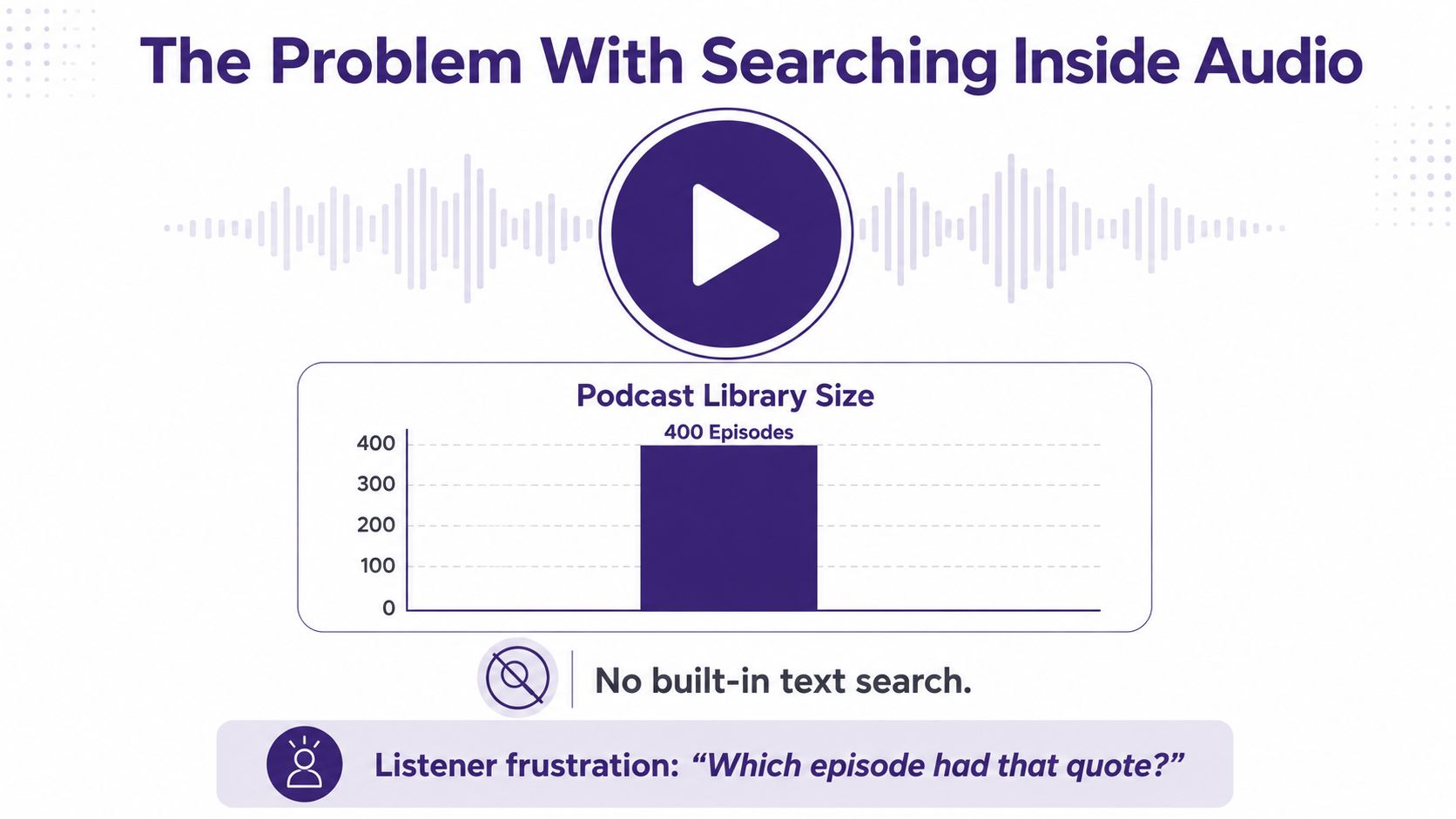
Audio libraries create a search gap
Public podcast indexing has reached a massive scale. Listen Notes reports 3,786,872 podcasts, 190,879,941 episodes, 38,193,362 searches, and 460,075,929 listens, which makes the discovery problem impossible to treat like a niche feature request anymore. The same indexing overview shows a second problem, because Podsearch reported 11,225,932 episodes across 4,613,981 podcasts with only 182,863 transcriptions, a reminder that searchable inventories are still mostly not transcribed. Listen Notes
That gap changes what people are trying to do. Listeners want to jump from memory to moment. Producers want to reuse spoken lines without relistening to everything. Publishers want to mine a library for quotes, topics, and evidence that can be repackaged into new formats.
Practical rule: if a library can't be searched by words, it isn't really organized, it's just stored.
Transcript search solves different jobs for different people
The listener job is simple, find the moment. The producer job is harder, find the same phrase across episodes, people, or seasons, then confirm it in context. The publisher job is harder still, because they need a transcript that supports reuse, attribution, and repurposing without introducing errors.
That's why transcript search matters as a content operations problem, not just a convenience layer. The value isn't only that someone can search faster. The value is that an archive becomes usable for clips, quotes, research, SEO, and internal knowledge work.
Getting and Cleaning Transcripts You Can Actually Search
A transcript only becomes useful when it's cleaned for search, not just generated. Raw ASR output can be good enough for a rough scan, but it usually breaks down when a show has overlapping voices, recurring guests, or inconsistent episode naming. Search systems don't forgive sloppiness in the source text.
Start with a transcript you can trust
The cleanest pipeline usually starts with one of three sources, platform transcripts, automatic speech recognition, or a manual review pass on top of either. The important part is not the source itself, it's whether the resulting artifact can support a real lookup later. A transcript-search workflow should preserve speaker labels, timestamps, and stable metadata formatting so a result can jump to the exact audio moment and still make sense when someone revisits it later. Contesimal's Spotify podcast transcript guide goes deeper on how surfaced transcripts behave in practice.
For teams that are building out their capture workflow, a useful companion is best tools for AI scraping from Scrapfly, because the same operational habit applies here, you want reliable extraction before you ask search to do anything clever.
Clean for structure, not decoration
Columbia University's transcript guidance is blunt about what matters, transcripts should include all speaker names, all spoken content, and relevant context like volume or tone. It also recommends using full names at first mention and then first names later for multi-speaker podcasts. That makes a transcript readable for humans and useful for machines at the same time. Columbia University podcast transcript guidance
A workable cleanup checklist looks like this:
- Standardize the episode title: Match the show metadata so the transcript, file name, and episode page line up.
- Attach publish date, guest, show, category, and series fields: Search gets weaker when metadata drifts.
- Verify speaker turns: Don't flatten a conversation into one text blob.
- Keep timestamps stable: If a hit can't resolve to audio, it's only half a search result.
- Store transcript and media IDs together: That prevents mismatches when libraries get reprocessed.
Search also depends on consistency in how lines are attributed. If a guest says something once in the intro and again in the main conversation, those are not the same search events. A library that respects that difference is much easier to query later.
Full-Text, Keyword, and Semantic Search Compared
A podcast team usually reaches this point after the transcript is already cleaned and indexed. The next question is simpler on paper than in practice, because the right search method depends on what the user is trying to recover. Exact wording, known names, and quote retrieval favor one approach. Broader topic exploration and fuzzy recall favor another. In a real library, you usually need all three, but not with the same priority or in the same part of the product.
| Search Approach for Podcast Transcripts | Best For | Weakness |
|---|---|---|
| Full-text search | Exact phrase matches, quote retrieval, quick lookup | Misses paraphrases and conceptually similar phrasing |
| Keyword search with filters | Narrowing by speaker, date, show, or guest once you know the term | Fails when the answer uses different words than the query |
| Semantic search | Conceptual matches, approximate phrasing, question-like queries | More tuning, more compute, and relevance can drift on messy transcripts |
Use full-text when the wording matters
Full-text search is the simplest tool in the stack. It is fast, cheap, and reliable when someone remembers a phrase, a name, or a line that was said almost verbatim. For quote lookup and citation work, it is usually the right first pass.
The limitation appears as soon as the wording is fuzzy. If the question is conceptual, full-text behaves like a strict librarian who only recognizes exact card catalog entries. That is not a defect, it is the wrong fit for exploratory search. Teams that want a cleaner comparison of these search modes can use semantic search vs keyword search as a reference point, but the practical takeaway is the same, full-text is strongest when the transcript and the query already overlap closely.
Use keyword filters when you need to narrow fast
Keyword search gets much better once filters like speaker, show, or date are added. That combination works well for editorial teams that already know the topic and just need to reduce noise. It is especially useful when the same guest, host, or segment repeats across episodes and the searcher wants to separate one appearance from another.
The weakness shows up in messy libraries. If someone says “creator economy” in one episode and “audience monetization” in another, a keyword-only workflow can split related material into separate silos. The system still has value, but only after the user already knows enough to choose the right term. That is why keyword search is often the operational layer, not the discovery layer.
Use semantic search when you care about meaning
Semantic search catches queries that sound like a person asking a question, not a person remembering a line. It can surface approximate matches, adjacent concepts, and passages that do not share the same wording as the query. That makes it useful for research, repurposing, and discovery across large audio archives.
The trade-off is relevance control. Semantic systems need more tuning, especially when transcripts are noisy, speaker labels are weak, or a guest moves through several topics in one answer. They also cost more to run at scale. For that reason, semantic search usually works better as a second layer on top of full-text and keyword search, not as a replacement for them.
Why Speaker Disambiguation Changes Everything
Most tools stop at finding the word. That sounds fine until a keyword lands in a joke, an aside, or the wrong speaker's turn. In podcast work, that is not a small edge case. It changes whether a result can be trusted at all.
Who said it matters as much as what was said
One of the most overlooked parts of transcript search is speaker disambiguation and quote provenance. Public guidance often treats a keyword hit as enough, but research and editorial work need more than a matched phrase. A result has to show who said it, where it was said, and whether the passage reflects the speaker's own view or just a passing mention.
That matters because transcript search is often used to identify guesting opportunities, extract evidence, or support fact-checking. The arXiv paper on podcast fact-checking defines factual descriptions as verifiable claims about people, places, events, or actions, which gives a useful boundary for deciding what should be searchable as evidence and what should stay in the realm of commentary. arXiv podcast fact-checking paper
A keyword hit without speaker context can look correct and still be wrong.
Build results around turns, not blobs
Flat transcript blobs are easy to generate and hard to trust. Search works better when each speaker turn becomes its own searchable unit, with the surrounding turns visible in the result card. That gives users enough context to check the hit before they clip, quote, or cite it.
A high-fidelity result usually needs a few things working together:
- Speaker-level indexing: Search each turn independently so attribution stays intact.
- Adjacent context snippets: Show the lines before and after the hit.
- Stable speaker names: Use one naming convention across the library.
- First-mention attribution: Full names first, then shorter references later, especially for multi-speaker shows.
This also changes how teams handle ambiguous transcripts. If two voices get merged, the search index may still return the right words while attaching them to the wrong person. In practical terms, that breaks editorial review, weakens fact-checking, and makes it harder to trace claims back to the audio that produced them.
The same issue shows up in libraries with weak metadata. A query can surface a passage that looks useful, but without a clear speaker label and nearby context, the result can become a dead end. That is why speaker cleanup has to happen before indexing, not after users start complaining about bad hits.
For teams comparing product options, Contesimal's podcast transcript search overview is useful because it frames search as a workflow that depends on transcript quality, attribution, and retrieval together, not as a single feature switch.
The most practical rule is simple. If a result can not show who spoke, it is not ready for research use. If it can not jump to the exact audio moment, it is not ready for production use.
Build Versus Buy for Podcast Search Infrastructure
Once the transcript is clean, the next decision is whether to assemble the stack yourself or use a platform. Building gives you control over indexing logic, freshness rules, and relevance tuning. Buying gives you speed and a shorter path to something usable.
What the DIY stack really involves
A custom setup usually means an ASR pipeline, a search index such as OpenSearch, a vector store for semantic queries, and orchestration to keep transcripts fresh. That looks tidy in architecture diagrams, then turns into real operational work as soon as retries, reindexing, and reviewer feedback enter the picture. The trade-offs in a custom search engine guide apply here too, because podcast search inherits the same maintenance burden once the library grows beyond a few test episodes.
DIY makes sense when the archive has unusual metadata, strict provenance requirements, or a very specific editorial workflow. It also makes sense when the team already has engineering support and wants to control how search behaves across episodes, guests, and content types. In that setup, the search layer can reflect the way the organization reviews and publishes audio, instead of forcing the team to adapt to a fixed product model.
What buying changes
Adopting a platform usually means giving up some flexibility in exchange for faster rollout. Transcription, indexing, and an interface arrive sooner than they do in a stitched-together system, but the vendor also defines relevance, freshness, and how much surrounding context appears with a hit. That trade can be the right one for teams that care more about shipping and maintaining searchable archives than about owning every layer.
Contesimal is one option in this category, and its podcast transcript search workflow sits alongside broader library search features. The more specific planning version is laid out in Contesimal's podcast transcript search guide, which is useful if you want to see how transcript cleanup, attribution, and retrieval fit into one operational loop. A platform like that matters most when a team wants one place to classify, query, and reuse a mixed archive instead of building each piece separately.
Choose by operational burden, not hype
A few hundred episodes are enough to expose bad metadata and weak cleanup. A much larger catalog raises the cost of every missed transcript refresh, every embedding rerun, and every reviewer correction. The question is not whether the stack can search. It is whether your team can keep it accurate week after week.
If one person has to manually fix transcripts for the system to stay useful, the setup is too fragile. If the product team needs to avoid thinking about ingestion for months at a time, the platform route is usually the safer choice.
Designing Search Interfaces Listeners Actually Use
A search engine can be accurate and still fail if the interface hides the useful parts. People don't want a bare results list when they're searching podcasts. They want a fast answer, enough context to trust it, and a way to jump straight into the audio.
Make the result card do real work
The best podcast search interfaces surface a timestamped snippet, the speaker name, and enough surrounding lines to confirm the match. A result card should answer the question before the user commits to playback. If it doesn't, the interface forces extra clicking and people stop using it.
Faceted filters matter here too. Show, guest, episode date, and topic are the filters most likely to turn a pile of transcript hits into something useful. That's especially true for producers and marketers who already know the content bucket they care about.
Practical insight: the search box is only the start, the result card is where trust gets built or lost.
Treat transcripts as an SEO surface
Transcript search shouldn't live only inside the app. Episode pages that surface the transcript, match the show's spoken language, and expose highlights become a discovery surface for search engines and humans alike. That's where content repurposing starts paying off, because the same spoken material can support internal lookup, external discovery, and downstream reuse.
Interfaces that make transcript search feel native usually do three things well:
- Expose search near the content: Don't hide it behind a settings menu.
- Show snippets with context: Let users verify a match quickly.
- Link the result to playback: Search should lead to audio, not replace it.
A podcast app that treats transcripts like an afterthought usually ends up with low trust and low usage. A podcast app that treats them like part of the product's core navigation tends to earn repeat use from both listeners and producers.
Practical Tips for Accuracy, Performance, and Discovery
A transcript can look search-ready and still fail the job. Weak timing, bad speaker labels, stale metadata, or a late refresh create results that seem complete but send editors and listeners to the wrong place. Accuracy, freshness, and discoverability have to hold together in the same workflow.
Spot-check the transcript before indexing it
One operational habit catches a lot of problems early. Review the first 5 minutes of every new episode, then flag cross-talk and music-heavy sections for manual triage. Apple Podcasts also says a new episode transcript may not appear immediately, and creators should allow at least 24 hours after publication before relying on it. It also warns that cross-talk and loud music can make transcripts harder to generate accurately. Apple Podcasts transcripts support
Freshness is not just a convenience issue. A transcript that goes live late, or a noisy recording that produces a shaky first pass, can mislead the editor who needs it most. In practice, the first transcript should be treated as a draft until someone checks it.
Make performance a pipeline problem
Near-real-time indexing only works when ingestion, cleanup, and refresh cycles stay predictable. If transcripts sit in a queue too long, users start treating the system like a delayed archive instead of a live search layer. If embeddings or indexes drift out of sync, semantic hits become harder to trust.
The fix is usually boring, and that is a good sign. Keep transcript and media IDs together, normalize episode metadata, and standardize the refresh cadence so every new upload follows the same path. That lowers the number of exceptions someone has to debug later.
Turn transcripts into discoverable assets
Columbia University's guidance on full speaker names and spoken context, along with Apple's note on quality constraints, point to the same operational truth, transcript quality shapes search quality. The better the transcript lines up with the episode page, the easier it is to reuse for SEO, highlight sharing, and editorial search. Columbia University podcast transcript guidance
The most useful checklist for this week is straightforward.
- Review the opening minutes: Catch obvious ASR errors early.
- Flag noisy segments: Cross-talk and music deserve manual attention.
- Keep metadata stable: Show, guest, and episode titles should match everywhere.
- Search with speaker filters: Attribution makes results easier to trust.
- Surface transcripts publicly: Do not hide the asset after you create it.
Contesimal helps teams organize content libraries, search across transcripts, and turn spoken archives into structured research assets. If you're trying to make podcast episodes easier to find, quote, and reuse, visit Contesimal and see how it can fit into a real content operations workflow.