
Think of a solid sample research plan as the blueprint for your content. It turns those vague, "this might be cool" ideas into an actual strategy backed by real data. It's the framework you need to build purposeful videos, articles, or podcasts that actually connect with people, saving you from wasted effort and getting your whole team pulling in the same direction.
Why a Research Plan Is Your Content's Secret Weapon

Let's be real: "winging it" has a ceiling. For any content creator, YouTuber, or publisher trying to level up from hobbyist to professional, a research plan is what separates a hopeful guess from predictable success. It’s the difference between making content you think your audience wants and making content you know they’re already looking for.
You wouldn’t start building a house without a blueprint, so why build your next big content series on nothing but a hunch? A well-thought-out plan gives every piece of content a clear purpose, ensuring your hard work generates real engagement and moves you closer to your goals.
Align Your Team and Efforts
If you're moving beyond working alone and starting to collaborate, a research plan is non-negotiable. It’s the single document that gets everyone—writers, editors, video producers—on the same page. That shared vision prevents redundant work and keeps your message tight and consistent, whether you're posting a video, a podcast episode, or a blog article.
Specifically, the plan helps by:
- Defining Clear Objectives: Everyone knows exactly what you’re trying to achieve, whether it's boosting views on a specific video series or driving engagement for a new podcast season.
- Assigning Roles and Responsibilities: It eliminates confusion over who’s doing what. The plan clarifies who owns each part of the research, from digging up data to analyzing audience feedback.
- Setting a Realistic Timeline: A good plan maps out the key milestones, keeping the project moving forward and preventing those last-minute scrambles to hit a deadline.
Uncover Hidden Content Opportunities
A formal research process forces you to look past your own assumptions. It makes you analyze what your competitors are up to, what your audience is really talking about online, and where the untapped goldmines in your niche are hiding.
A great research plan doesn't just confirm your ideas; it challenges them. It’s designed to uncover the topics your audience is desperate for but nobody else is covering. This is what gives you a real competitive edge and helps turn your content library into a sustainable, revenue-generating asset.
The Core Components of an Effective Research Plan
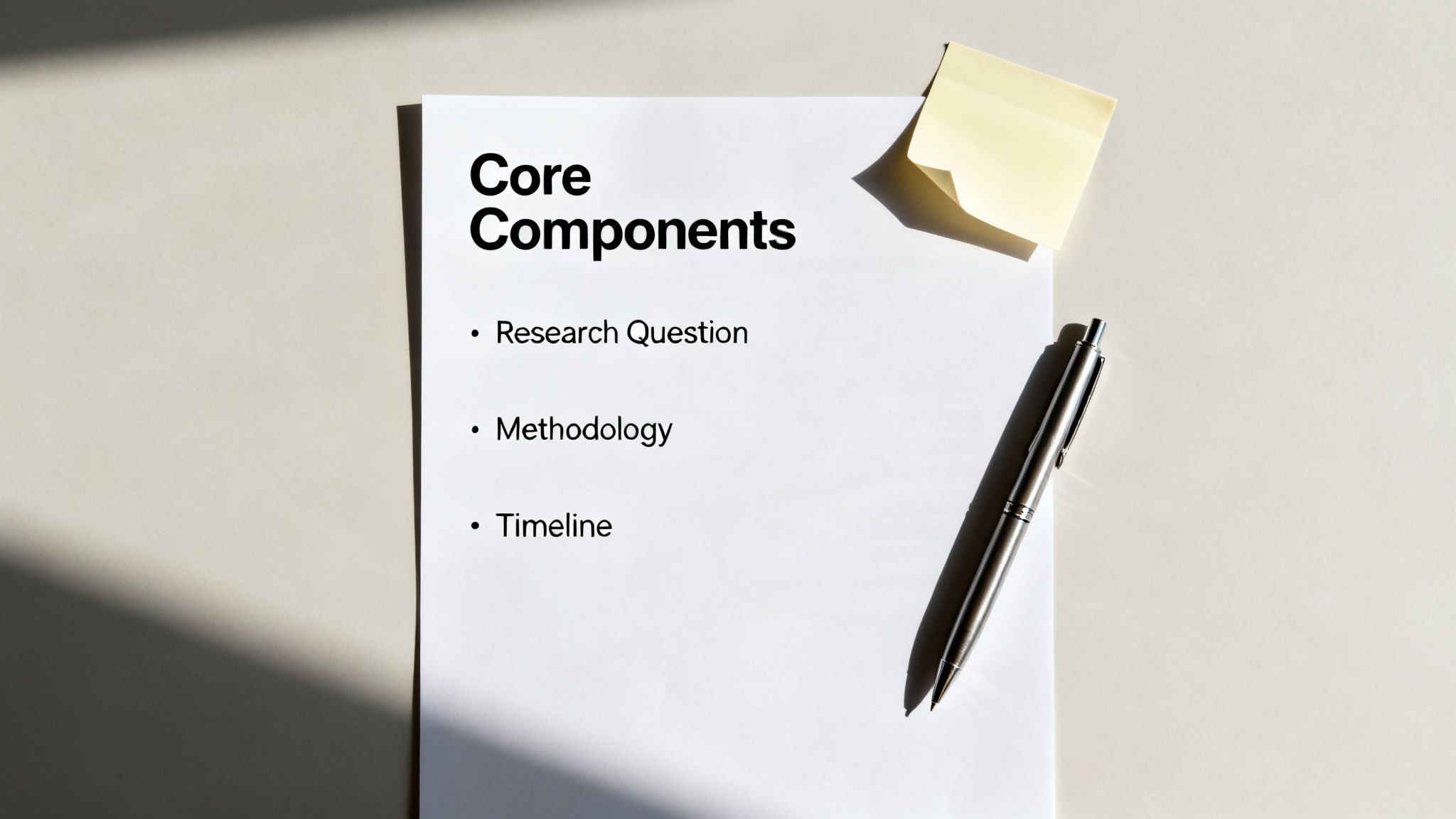
Whether you’re mapping out your next viral YouTube series or a groundbreaking book, every solid research plan rests on the same foundational pillars. Don’t think of these as a rigid checklist. Instead, see them as the core structure that gives your project direction. Trying to build content without them is like building a house on a shaky foundation—it’s just not going to hold up.
There's a reason the global market research industry is on track to hit $140 billion in 2024. Businesses understand the immense value of structured inquiry. For creators, the game has changed. With online and mobile research methods making up 35% of the market back in 2022, your plan has to live where your audience does: online.
Start With Your Problem Statement and Research Questions
Before you can even think about finding answers, you have to know what you’re asking. This starts with the problem statement—the "why" behind your entire project. It should be a clear, simple declaration of the issue you’re exploring or the gap you want to fill.
For a podcaster, it might sound something like this: "Our listener engagement plummets after the 15-minute mark, and we need to figure out why to stop the drop-off."
From that single problem, your specific research questions will bloom. These are the concrete, actionable questions your research is designed to answer.
- Which topics actually hold our audience's attention the longest?
- What interview formats get the most comments and shares?
- Where are the exact points listeners on different platforms tune out?
Choose the Right Methodology
Your methodology is simply the "how." It's the specific set of tactics you’ll use to get answers to your questions. This isn't about picking the trendiest new method; it's about choosing the right tool for the job.
Most of the time, you’ll end up with a mix of quantitative (think surveys, analytics data) and qualitative (interviews, focus groups) approaches to paint a full picture. A deep dive into various qualitative research analysis methods is a good idea to make sure you're picking an approach that fits your goals.
Your research sources are the very bedrock of your methodology. Weak sources always lead to weak conclusions. You have to know how to separate credible information from all the noise out there to ensure your findings are trustworthy.
Building that skill is non-negotiable. If you're not sure where to start, our guide on what is a credible source can help you develop a sharp eye for quality information.
Set Your Timelines and Deliverables
Let’s be honest: a plan without a schedule is just a dream. This is where you get real about what you’ll produce (deliverables) and when you’ll produce it (timeline).
Setting realistic deadlines with clear milestones keeps your project from drifting and makes sure everyone is on the same page. A deliverable doesn't have to be a massive report; it could be a competitor analysis spreadsheet, a one-page summary of survey findings, or even a list of 20 validated content ideas.
To pull it all together, here's a quick look at how these core components function within your plan.
Essential Research Plan Components at a Glance
| Component | Purpose | Key Question to Answer |
|---|---|---|
| Problem Statement | Establishes the core "why" of the project and the issue being addressed. | What specific problem or opportunity are we exploring? |
| Research Questions | Breaks the problem down into specific, answerable inquiries. | What exact questions will our research answer? |
| Methodology | Outlines the "how"—the specific methods and sources used to gather data. | How will we collect the information we need? |
| Sources & Credibility | Defines the criteria for selecting reliable and authoritative information. | How do we know our sources are trustworthy? |
| Timelines & Deliverables | Sets the schedule, key milestones, and the tangible outputs of the project. | What will we create, and by when? |
Think of this table as your blueprint's legend. Each component has a distinct job, but they all work together to ensure your research project is focused, actionable, and ultimately, successful.
Building Your Research Plan From the Ground Up
Alright, you’ve got the theory down. Now it’s time to roll up your sleeves and actually build this thing. This is the moment where a fuzzy idea floating around in your head starts to take shape as a real, tangible project. Think of it less like carving a plan into stone and more like building a roadmap—it gives your content idea the structure it needs to actually get somewhere.
Let's walk through this with a real-world example. Imagine you’re a podcaster. You've noticed your history deep-dive episodes always pop off, but you're not sure which era or topic to tackle for a whole new series. This is the perfect time to build a sample research plan from scratch.
Start With a Clear, Focused Objective
First things first: you need to turn that vague idea into a razor-sharp objective. "Research a new history series" is way too broad. It's like saying you want to "get in shape." What does that even mean? You need something specific and measurable—a finish line you can actually cross.
A much better objective looks something like this: "To identify and validate three potential historical series topics for our podcast by the end of Q3. Each topic must have enough source material for at least eight episodes and align with our audience's known interest in overlooked historical events."
See the difference? That objective tells you exactly what "done" looks like. You're not just wandering around the library; you have a mission.
Define Your Audience and Scope
Next up, get brutally honest about who this is for and, just as importantly, who it's not for. For our podcaster, the target audience isn't just "history buffs." That’s lazy. A better definition is: "Current listeners aged 25-40 who engage most with our long-form narrative episodes, plus potential new listeners from online history forums and communities like Reddit's r/AskHistorians."
Drawing boundaries around your scope is a lifesaver. It stops you from falling down an endless research rabbit hole. Are you only looking at 20th-century history? Are you deliberately avoiding military history because the market is totally saturated? Setting these rules from the start keeps you on track.
A well-defined scope is your project's guardrails. It keeps you focused on the most relevant information and stops you from wasting time and resources chasing down every interesting but irrelevant fact.
Pick Your Methods and Tools
Once you know your destination and your route, you can pick the right vehicle. You'll probably need a mix of research methods to get the full picture. For our podcaster, a solid toolkit might include:
- Competitor Analysis: Dive into the top 10 history podcasts. What are they covering? What formats are working for them? More importantly, what are they not covering? Look for the gaps.
- Audience Survey: Put together a quick survey for your email list. Ask current listeners to rank potential topics or even suggest their own ideas. People love being asked for their opinion.
- Keyword Research: Fire up an SEO tool like Ahrefs or Semrush to see what historical topics people are actually searching for. This is a direct line into audience intent.
- Content Library Audit: Go back and look at your own numbers. Use your podcast analytics to pinpoint which episodes had the best listener retention and social engagement. Your past successes leave clues.
Finally, get practical about your budget and resources. Do you need to pay for a tool like SurveyMonkey? How many hours can you realistically block out for this each week? Answering these nuts-and-bolts questions is what turns a wish list into a plan you can actually execute. By mapping all this out, you’ve created a powerful guide for your next big project.
Real-World Sample Research Plan Examples
Theory is one thing, but seeing how a research plan works in the wild is another entirely. A good framework is only useful when you can apply it. So, let's make this tangible and walk through three different, annotated scenarios to see how a sample research plan flexes for a YouTuber, a content marketer, and a publisher.
First, this infographic breaks down the three pillars that hold up any solid plan: your goals, your audience, and your methods.
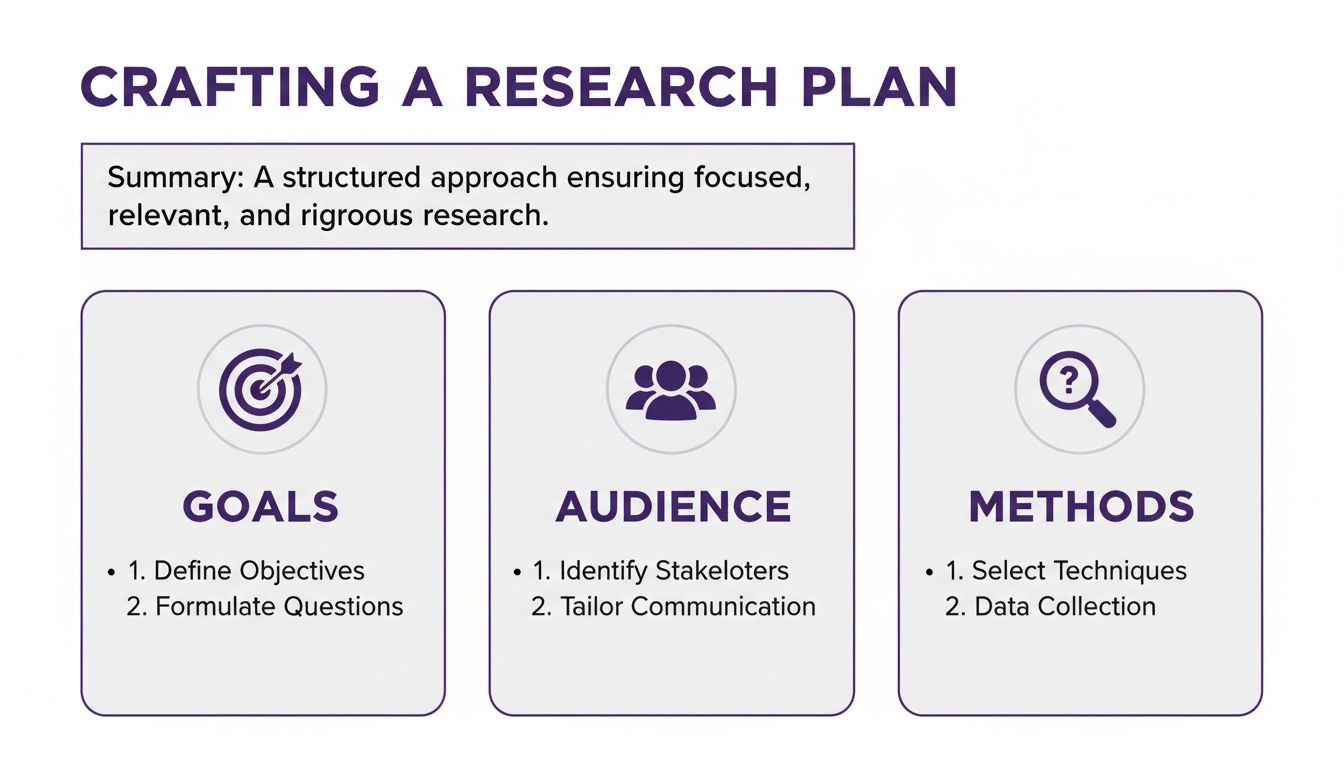
Think of these three elements as being completely interconnected. A clear goal, a deep understanding of who you're talking to, and the right research techniques will guide every single decision you make from here on out.
Sample Plan 1: The YouTuber's Documentary Series
Let's start with a creator who has a popular YouTube channel dedicated to overlooked historical events. Their next big project is a three-part documentary series on the "Space Race from the Soviet Perspective." For them, the research plan is all about narrative and visuals.
- The Goal: Produce a compelling, visually stunning documentary series that offers a fresh angle on a well-known story. The target is ambitious: 1 million views per episode in the first 30 days.
- The Method: This calls for a two-pronged attack. First, a deep dive into historical archives, declassified Soviet documents, and academic papers to build a rock-solid factual narrative. At the same time, they'd be on the hunt for visual assets—archival footage, rare photographs, and period-appropriate illustrations are absolutely essential for video storytelling.
- The Bottom Line: The key here is all about narrative structure. The research isn't just about collecting facts; it's about finding the story. The plan would map out a three-act structure for each video, pinpointing key turning points, personal anecdotes from cosmonauts, and moments of pure drama. Sourcing visual assets isn't just a task; it's a core research priority.
Sample Plan 2: The B2B Marketer's White Paper
Now, let's shift gears to a B2B content marketer at a SaaS company selling project management software. They want to create the definitive white paper on "The Future of Hybrid Work Productivity."
- The Goal: Generate 500 marketing-qualified leads (MQLs) by publishing an authoritative resource that establishes the company as a thought leader in the space.
- The Method: This plan is built on a foundation of data and expert validation. The marketer would kick things off with quantitative research, digging into market reports from firms like Gartner and Forrester. The next move is qualitative: lining up and conducting interviews with 10–15 industry experts, HR executives, and productivity consultants to get those unique insights and killer quotes you can't find anywhere else. To see what kind of research approach might fit best, it’s always smart to review some samples of methodology in research papers.
- The Bottom Line: This is a game of credibility and authority. Every single claim made in the white paper has to be supported by either a hard statistic or an expert’s opinion. The research plan itself would look like a battle plan, listing potential interviewees, outlining the specific questions designed to pull out great responses, and setting a firm timeline for synthesizing all that data.
Sample Plan 3: The Publisher's Content Repurposing Initiative
Finally, imagine a publisher sitting on a huge back catalog of articles about sustainable living. Their goal is to breathe new life into their content library to grab the attention of a younger audience on totally different platforms.
This kind of plan isn't about creating something from scratch. It's about finding the hidden gold within your existing assets. Think of it as an exercise in content intelligence.
- The Goal: Pinpoint the top 20 highest-potential articles from the last five years and map out a strategy to repurpose them into short-form videos and a podcast series. The success metric? A 25% jump in engagement from the 18–34 demographic.
- The Method: It all starts with a thorough content audit. Using their analytics, they'll tag articles that have both high traffic and evergreen appeal. Next up is deep audience analysis through surveys and social listening to figure out exactly what formats and topics resonate with their target demographic.
- The Bottom Line: The heart of this plan is audience analysis and content-to-format mapping. It would detail how to segment their audience, what questions to ask in surveys, and which social media platforms to monitor for trends. The final deliverable isn't a new piece of content, but rather a strategic brief for each repurposed asset, clearly outlining its new angle, target platform, and key talking points.
Supercharge Your Research with Modern Tools
Having a brilliant research plan is one thing. Actually executing it without losing your mind is another. It's the execution that separates the pros from the hobbyists.
A great plan deserves great tools. Today's platforms are built to turn the lonely grind of research into a dynamic, collaborative process. No more drowning in scattered notes, endless bookmarks, and mystery files saved on your desktop.
Modern tools help you organize, understand, and actually use your growing library of content. Platforms like Contesimal are designed specifically for creators who are ready to build a real system for their knowledge—a single source of truth for the entire team.
Build a Collaborative Knowledge Base
The real magic happens when you create a shared space where your team can pull new meaning from existing assets. When you build a collaborative knowledge base, you stop reinventing the wheel with every single project.
Just imagine being able to instantly find every interview, article, and video clip you have on a specific topic. That's where a solid taxonomy system comes in. You can tag and categorize every piece of research material, making it simple to find and use for future projects. This kind of structured approach is the backbone of powerful content intelligence platforms.
The whole point is to create a living library where your team can work together to generate new value. Your past work stops being a dusty, static archive and becomes an active asset that fuels your next great idea.
Let AI Become Your Research Assistant
AI has completely changed the game for executing a research plan. It’s no longer just a futuristic concept; it’s a practical tool that creators can leverage today. AI acts as a powerful collaborator, helping you make sense of large amounts of information and speed up the entire research process.
Why the big shift? Because AI-powered tools can analyze data, spot trends, and even help you bang out initial drafts, all of which help you execute your plan faster and more efficiently.
These tools do the heavy lifting, freeing you up to focus on strategy and creativity. They can summarize dense reports, transcribe hours of audio in minutes, and find patterns in audience feedback you might have missed. This human-AI collaboration is exactly what helps you discover new value and opportunities within your content library.
Common Questions About Creating a Research Plan
Even the most experienced creators get a little stuck when it's time to formalize their research process. I get it. Moving from creating on the fly to building a structured plan can feel like a huge leap. Here are some of the questions that come up most often, along with answers pulled straight from years of experience.
How Long Should My Research Plan Be?
Honestly, there’s no magic number. The length of your plan comes down to the project's size and complexity. For a single blog post or a quick YouTube short, a one-page outline is probably all you need. But if you’re mapping out a multi-part podcast series or a major publisher launch, you’ll need a much more detailed, multi-page document to keep everyone on track.
The real goal isn't hitting a specific page count; it's achieving absolute clarity. Your plan should be so clear that any team member can pick it up and instantly grasp the project's goals, methods, and timeline. Focus on substance, not length.
What Is the Most Common Mistake to Avoid?
By far, the biggest pitfall I see is having vague objectives. A goal like "research competitor content" is a recipe for wasted hours because it has no direction. It doesn't tell you what to look for or what success even looks like.
You have to get specific. A strong objective sounds more like this: "Analyze the top five competitors' video content strategies from the last quarter, focusing on thumbnail design, engagement metrics, and topic clusters to find three underserved content opportunities."
Specificity is your guiding star. It ensures every action you take is purposeful and directly contributes to your end goal, turning abstract ideas into measurable outcomes.
How Do I Adapt My Plan if Things Change Mid-Project?
Think of your research plan as a living document, not something carved in stone. It’s a roadmap, but you should always be ready for a detour. In fact, great research often uncovers unexpected insights that force you to pivot. That's a good thing.
When this happens, don't just ditch the plan—adapt it. Document the changes, explain why you're shifting gears, and update your objectives and timeline. The key is communicating clearly with your team through the whole process. Flexibility isn't a sign of a weak plan; it’s the hallmark of a strong, responsive research process.
Can I Use a Research Plan for Repurposing Old Content?
Absolutely—and you definitely should. A research plan is an incredibly powerful tool for breathing new life into your existing content. The focus just shifts from pure creation to strategic reinvention.
For a repurposing project, your plan would center on a few key things:
- Auditing your existing library to find top-performing assets based on traffic, engagement, and conversion data.
- Analyzing audience feedback and performance metrics to figure out why certain pieces hit so hard.
- Researching new formats and platforms where your proven content could find a fresh audience, like turning a popular blog post series into a podcast season.
Your objective might be something like, "Increase the value of our top 10 articles by converting them into a video series and an email course to grow our YouTube subscribers by 15%." This approach turns your archive from a static collection into a dynamic engine for growth.
Ready to transform your content library from a simple archive into a collaborative, revenue-generating asset? Contesimal provides the tools you need to organize your research, collaborate with your team, and uncover the hidden value in your past work. Stop guessing and start building with a clear plan. Discover how Contesimal can supercharge your content strategy today.