
You probably have more usable content than you think.
A podcast episode that performed well last year. A YouTube breakdown buried under newer uploads. A blog post that still gets the occasional search visit. A research memo your team used once and then forgot. Most creators and publishers don't have a content creation problem. They have an asset management problem.
The shift into professional content work starts when you stop treating each publish date as the finish line. A strong library isn't a graveyard of old posts. It's raw material for new long form content, better SEO coverage, deeper audience trust, and cleaner monetization paths across platforms.
Beyond the Endless Content Treadmill
A familiar pattern shows up when creators start getting traction. They publish, promote for a few days, collect the initial bump, and then move straight to the next upload. The calendar fills up, but the library stays underused.
That rhythm can keep a channel active. It rarely builds durable value.

Activity isn't the same as asset building
A short clip can win attention fast. A trend post can pick up a burst of visits. But if every piece expires quickly, your business stays dependent on constant output. That's exhausting for solo creators and expensive for teams.
Long form content changes the economics of the work. Instead of asking, "What do we publish next?" ask, "What can we build that keeps helping people months from now?" That one question usually improves topic selection, research quality, and editorial discipline.
According to 2026 long form content adoption data, adoption of long-form content in marketing strategies reached 61%, up from 42% in 2023, and 64% of creators increased their long-form output, citing greater creative freedom and better audience engagement. That lines up with what many working teams have already felt. A well-made deep dive gives you more room to explain, package, clip, email, update, and sell.
The strategic pivot that actually matters
Professional creators usually make a turning-point decision. They stop thinking in isolated posts and start thinking in systems.
That system often looks like this:
- Core asset first: Build one substantial piece that can hold search intent, audience attention, and product relevance.
- Distribution second: Pull clips, quotes, graphics, newsletter sections, and social edits from the core asset.
- Archive as inventory: Keep finished work organized so strong ideas can be revived instead of recreated.
Old content isn't dead inventory if you can classify it, retrieve it, and rebuild it into something more useful.
If your current workflow feels reactive, it's worth studying a stronger SEO content strategy for compounding growth. The useful shift isn't publishing more. It's producing work that keeps earning attention after launch.
What Exactly Defines Long Form Content
A lot of people define long form content by length alone. That's too loose to be useful.
A piece isn't "long form" because it has a high word count or a longer runtime. It's long form when it gives the audience a complete, structured answer to a meaningful problem.
Depth matters more than bloat
Think about the difference between a flyer and a reference shelf in a library. A flyer gives a quick point. A reference shelf helps someone understand the topic, make a decision, and come back later when they need it again.
That is the definitive standard. Long form content should do at least a few of these jobs well:
- Clarify a complex topic: It explains the terms, stakes, options, and trade-offs.
- Support action: It gives the audience a way to apply what they just learned.
- Reduce follow-up questions: It anticipates confusion and handles it before the reader leaves.
- Stay useful over time: It isn't built only for a brief news cycle.
A bloated article that repeats itself isn't long form. It's just long. The same goes for a rambling video essay or a podcast episode with no editorial spine.
Three traits worth checking before you publish
When evaluating whether an idea deserves long form treatment, use these filters.
It solves a problem with consequences
Good long form content usually sits near a decision. The audience is trying to choose a tool, understand a process, avoid a mistake, or develop an opinion they can stand behind.
It has internal structure
Readers need orientation. Viewers need progression. Listeners need a reason to stay with you. Without structure, depth turns into friction.
It creates reusable value
The strongest long form pieces don't live in one format. A guide can become an email sequence. A podcast series can become an article cluster. A research report can become a talk track for sales, media, and community content.
If you can't summarize the core promise of the piece in one sentence, it probably isn't ready to become a long form asset.
That framing helps creators avoid one of the most common mistakes. They start writing from abundance of material instead of clarity of purpose. The result is content with effort in it, but not enough design.
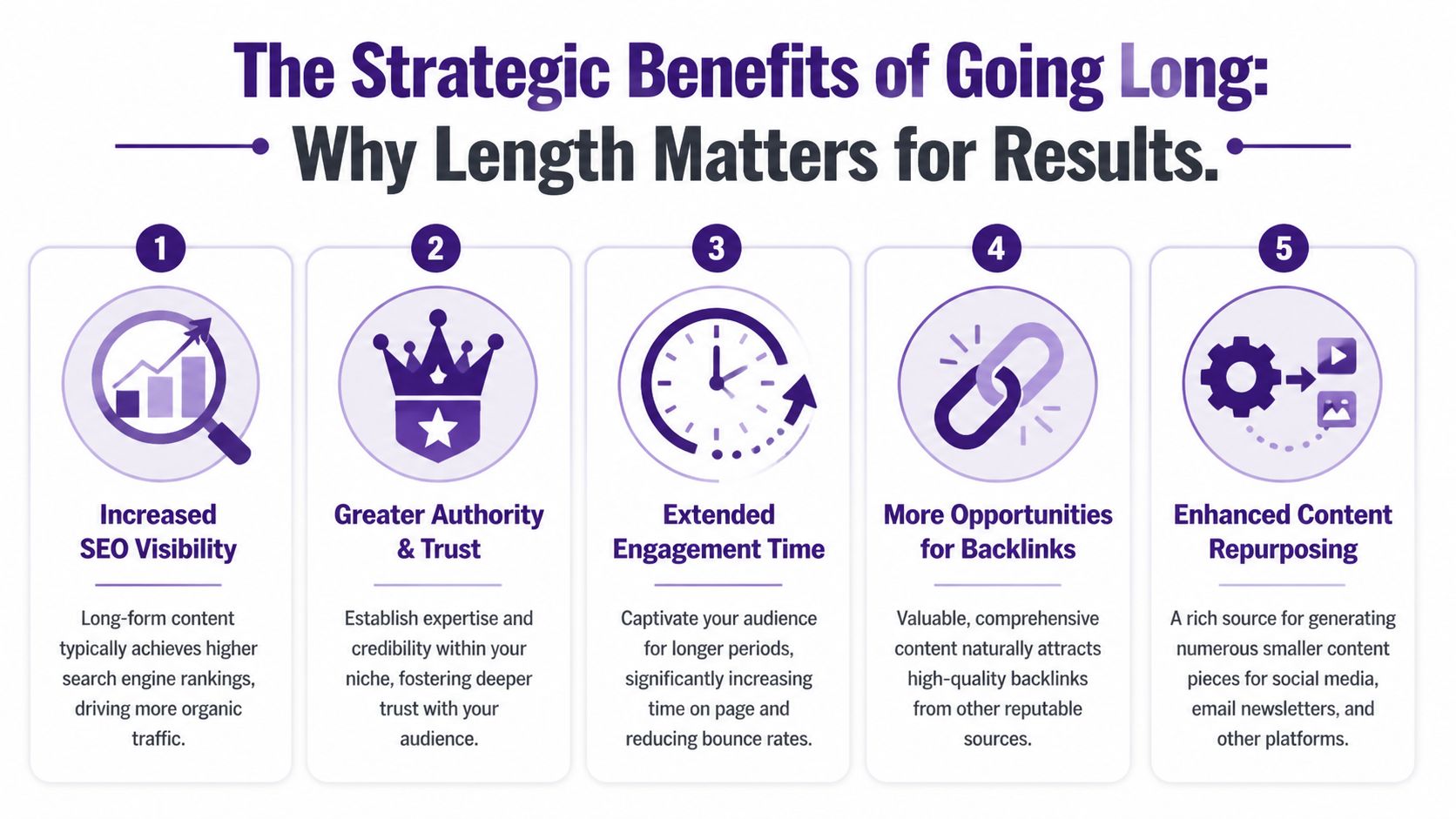
The Strategic Benefits of Going Long
Long form content takes more planning, more editorial judgment, and more patience. It also tends to produce stronger business results when the topic deserves that level of treatment.
Search performance improves when the piece earns it
Search engines don't reward length for its own sake. They reward pages that satisfy intent better than weaker alternatives. Long form often wins because it gives you room to answer the full query, address adjacent questions, and structure the page around real information needs.
According to long form content performance statistics, articles exceeding 2,500 words are shared 2.5x more on average, attract 77% more backlinks than short posts, and see average time on page increase by up to 70%, with HubSpot reporting a 3.2x higher conversion rate.
Those numbers matter because they connect editorial effort to outcomes that teams care about: discoverability, authority signals, engagement, and conversion.
Authority gets built through completeness
Anyone can post a quick opinion. Fewer creators can build a resource that people bookmark, forward internally, or return to during a project.
That's where long form content starts working like infrastructure. It can support:
- Sales conversations: Prospects use it to understand the category before they talk to you.
- Editorial trust: Readers begin to associate your brand with clarity instead of noise.
- Partnership opportunities: Extensive assets make outreach easier because there's something substantial to reference.
If you're working in a professional market, this is also why a solid comprehensive guide for B2B marketers is so useful. Strong strategy documents and pillar content reduce random acts of publishing.
Repurposing gets easier when the source is rich
A short post doesn't give you much to work with. A substantial guide, interview, or deep-dive episode can be sliced into many useful derivatives without becoming repetitive.
Those derivatives might include:
- Newsletter segments pulled from one argument or framework
- Short clips built around one sharp point from a larger episode
- Carousel posts that summarize a process or comparison
- Sales enablement snippets adapted from the same underlying research
Practical rule: The richer the source asset, the easier it is to create follow-on content that still feels original.
This is one reason experienced teams often prioritize fewer, stronger pieces. It lowers the pressure to invent from scratch every week.
Choosing Your Ideal Long Form Format
Long form content isn't one format. It's a family of formats. The right choice depends on what you're trying to accomplish, how your audience prefers to consume information, and what material you already have in your library.
Some creators default to a giant article because that's the most obvious option. That can work. It can also be the wrong container for the idea.
Match the format to the job
A tutorial-heavy topic often belongs in a guide or pillar page. A nuanced argument may work better as a video essay. A theme that developed across multiple conversations might become a podcast series or documentary-style episode.
Here are common formats worth considering:
| Format | Primary Goal | Best For | Resource Level |
|---|---|---|---|
| Ultimate guide | Organic search and education | Complex evergreen topics that need explanation and process | High |
| Pillar page | Topic authority and internal linking | Brands building structured content clusters | Medium to high |
| Original research report | Credibility and citations | Publishers, marketers, and category leaders with proprietary insights | High |
| In-depth case study | Conversion support | Service businesses, SaaS teams, agencies, consultants | Medium |
| Video essay | Attention and authority | Creators with a strong point of view and visual storytelling ability | High |
| Deep-dive podcast series | Audience loyalty and thematic exploration | Hosts with strong archives, interviews, or recurring subject matter | Medium to high |
The wrong format creates avoidable friction
A few common mismatches show up all the time.
- Too much analysis in a short video: The audience leaves with fragments instead of a full argument.
- A blog post built from transcript sprawl: The information exists, but the reading experience is weak.
- A case study used for a broad educational query: It may convert later, but it won't serve top-of-funnel readers well.
The better question isn't "Can I make this long?" It's "Which format lets this idea do its job well?"
Start from available source material
If you already have a strong archive, format selection gets easier.
A creator with dozens of interviews may be sitting on a theme-based series. A publisher with several related articles may have the core of a pillar page. A YouTuber with years of tutorials may have enough material for a definitive guide that unifies scattered lessons into one clean resource.
Choose the format that reduces reinvention. The archive should shape the output.
That mindset helps professional teams scale without becoming sloppy. You aren't forcing every idea into article form. You're selecting a structure that fits the audience and the business goal.
How to Research and Structure a Masterpiece
Strong long form content feels inevitable when you read it. Every section appears where it should. Every question gets answered before frustration kicks in. That doesn't happen by accident. Someone built the architecture first.
Build for topical depth
According to Jasper's discussion of long form content and topical depth, the average top-ranking page on Google contains around 1,447 words and achieves high topical depth by covering 5 to 10 related subtopics. That's a useful benchmark because it shifts the conversation away from pure word count.
A good piece doesn't just repeat the main keyword. It covers the surrounding concepts that a serious reader expects to find.
For example, if you're creating long form content about repurposing a podcast archive, related subtopics might include:
- Transcript quality: Bad source text creates bad derivative content.
- Taxonomy: You need tags, themes, and series logic to find reusable material.
- Editorial intent: Not every archive segment deserves revival.
- Format conversion: Spoken content often needs restructuring before it becomes a readable article.
- Distribution plan: A finished piece should fit email, search, and social workflows.
Start with questions, not paragraphs
Before drafting, collect the questions your audience is trying to resolve. Then group those questions into a logical sequence.
A practical structure often looks like this:
- Define the problem clearly
- Explain why the problem matters
- Compare the main options or methods
- Show the workflow
- Address mistakes and edge cases
- Close with an action path
That sequence keeps long form content from collapsing into a pile of good notes.
If you're sorting through software options to support this process, lists of tools for B2B growth marketers can help you compare workflow categories without guessing what belongs in the stack.
Make the piece scannable before you make it elegant
Readers don't consume long pages line by line on the first pass. They scan. They decide whether you understand the topic. Then they commit.
Use structure aggressively:
- Specific H3s: Headings should answer a question or signal a clear subtopic.
- Short paragraphs: Dense blocks punish attention.
- Tables and bullets: Use them where comparison or sequence matters.
- Quoted insights: Break up explanation with emphasis where needed.
A strong structural reference for this is clear article organization in writing, especially if your team has plenty of material but inconsistent editorial flow.
The outline isn't admin work. It's the first quality filter.
Writers who skip this step usually end up editing for structure after the fact, which takes longer and produces weaker pieces.
Promoting and Measuring Long Form Success
Publishing is the midpoint, not the win.
A long form piece usually needs time to find its audience. That means promotion should be steady, deliberate, and tied to channels that reward evergreen material instead of one-day spikes.
Promotion works best when it extends the original idea
Don't just post the link and hope. Pull apart the asset and match each angle to a distribution channel.
A useful rollout often includes:
- Email newsletter placement: Introduce the problem the piece solves, not just the headline.
- Targeted outreach: Share the asset with people who have covered related topics or referenced similar resources.
- Community discussion: Bring one sharp argument or example into a relevant forum, group, or comment thread.
- Format-specific derivatives: Turn one section into a clip, one framework into a social graphic, and one insight into a short email.
This approach keeps promotion from feeling repetitive because each touchpoint emphasizes a different benefit.
Measure what compounds
Launch-day page views are emotionally satisfying. They don't tell you much about whether the asset is becoming useful over time.
The metrics worth watching are usually more durable:
- Time on page or completion behavior: Are people staying with the material?
- Keyword movement over time: Is search visibility improving after indexing and updates?
- Backlink acquisition: Are other sites finding the piece reference-worthy?
- Conversions tied to intent: Are readers subscribing, booking, downloading, or moving deeper into your funnel?
A long form piece should be judged like an asset. Give it enough time to prove whether it can compound.
Refreshes are part of the model
The best long form content rarely stays frozen. Teams update examples, tighten framing, improve internal links, and add missing sections when new audience questions appear.
That revision cycle matters because the asset becomes smarter as it gets used. Promotion reveals what people care about. Measurement reveals what they skip. The next version should reflect both.
Turn Your Library Into an Infinite Content Engine
The most underused source of long form content is usually your own archive.
Creators spend a lot of time searching for the next topic while sitting on years of unresolved themes, overlooked explanations, and half-developed series ideas. A mature library already contains language your audience responded to, questions they kept asking, and formats that held attention better than others.

The archive is not storage. It's source material
According to analysis on untapped YouTube niches and archival repurposing, an underserved strategy is repurposing historical libraries into long-form series for low-competition niches, and AI-driven classification of archival podcasts and videos can fuel 15 to 30 minute deep dives that outperform new, short-form content.
That idea matters well beyond YouTube. The same principle applies to article archives, recorded interviews, research folders, and old editorial calendars. If your team can classify the library well, patterns start appearing.
A practical workflow for turning archives into new assets
Start simple. Don't begin by trying to process everything at once.
Audit the material with reuse in mind
Look for recurring themes, repeat questions, guest insights, and episodes or posts that still feel conceptually alive. Performance helps, but relevance matters more than nostalgia.
Group content into topic families
Tags and taxonomy matter. Organize by problem, audience, format, and use case. A loose folder system won't get you far if you're trying to build long form from multiple source assets.
Identify the strongest format conversion
A cluster of podcast episodes may become a written guide. A blog series may become a video essay script. A webinar may become a pillar page plus an email sequence.
One tool that supports this kind of library work is Contesimal's guide to content repurposing strategies. In practice, software in this category can help teams classify source material, search across old assets, and collaborate with AI on extracting reusable themes from large archives.
Human judgment is still the advantage
The archive can show you what exists. It can't decide what deserves renewed attention.
That part stays editorial. You still need taste. You still need to know what your audience is trying to solve now. The strongest long form content built from old material doesn't feel recycled. It feels clarified.
A short example is useful here. If you've published years of interviews with founders, don't republish transcript chunks. Pull the recurring patterns on hiring, focus, pricing, or distribution. Then build a new long form asset around the argument those interviews reveal.
Here's a visual walkthrough that complements that process:
When creators make this shift, the content operation stops being linear. You no longer move from idea to publish to oblivion. You move from archive to insight to new asset to derivative distribution, and then back into the library again.
If you're ready to turn old episodes, articles, videos, and research into structured long form assets, Contesimal is worth exploring. It helps teams organize large content libraries, search across historical material, classify patterns, and collaborate with AI to generate new value from work they've already done.