
Strong structure is the secret ingredient that turns confusing noise into content that hits hard. It’s the blueprint that guides your audience through your ideas, making sure your message lands exactly how you want it to, whether you're creating a viral video or a top-ranking article. This deliberate organization is what separates the hobbyist from the pro who creates new value with every piece of content they publish.
Why Structure in Writing Is Your Greatest Asset
Ever tried to build a house without a blueprint? You'd probably end up with a shaky foundation, hallways that lead nowhere, and a final product that's completely useless. The same goes for your content. Without a solid framework, even your most brilliant ideas can get lost in the shuffle, leaving your audience confused and clicking away.
Good structure transforms complex topics into a clear, digestible journey. It makes your videos, articles, and podcasts stick in people's minds and makes them want to share.
This is especially true if you're trying to grow an audience and turn your content library into a money-maker. A well-organized piece of content isn't just easier for your audience to follow; it's also easier for search engines to understand, which means more visibility for you. More importantly, it shows you respect your audience's time by getting straight to the point, which is how you build the trust that reignites your content library and brings it to life.
From Hobbyist to Professional Creator
The real leap from passionate hobbyist to a creator who generates revenue comes down to two things: consistency and clarity. A strong structure in writing is the tool that makes both possible. It gives you a scalable process so you can be confident that every single thing you publish meets a high standard.
A methodical approach helps you:
- Organize Your Thoughts: It forces you to nail down your main points before you start creating. No more rambling or getting lost on tangents.
- Keep Your Audience Hooked: A logical flow pulls your audience in from the first sentence and doesn't let go until the call to action. Hello, higher watch times and page views.
- Build Authority and Trust: When your content is clear and easy to follow, it immediately positions you as someone who knows their stuff. Understanding how to identify a credible source for your own research is a core skill that feeds directly into this.
- Unlock Repurposing Gold: A cleanly structured video or article is a goldmine for repurposing. You can easily slice it up into smaller, high-impact pieces for all your other platforms, creating new value from your old content.
If you’re serious about turning chaotic ideas into clear, persuasive content, you have to master the fundamentals. It’s not about putting your creativity in a box; it’s about giving it a strong foundation to stand on. To truly get a handle on this, you need to Unleash the Power of Structure in Writing. That’s how your ideas stand tall and make an impact that lasts.
Exploring Core Structural Frameworks for Every Creator
Alright, let's move past the theory and get our hands dirty with the models that power the world's most engaging content. Don't think of these frameworks as rigid, unbreakable rules. See them as proven blueprints—the kind that give your creativity a rock-solid foundation to build on.
Nailing down a few of these core structures gives you a massive advantage. You'll learn how to grab and hold your audience's attention, which is half the battle for any creator looking to grow their audience across platforms.
Just like a filmmaker uses specific shot sequences to build suspense, a creator uses structure to guide their audience on a carefully planned journey. These frameworks are the secret architecture behind content that just feels professional, clear, and impactful.
Think of it like this: a solid structure isn't just about keeping things tidy; it's a strategic tool for hitting your goals.
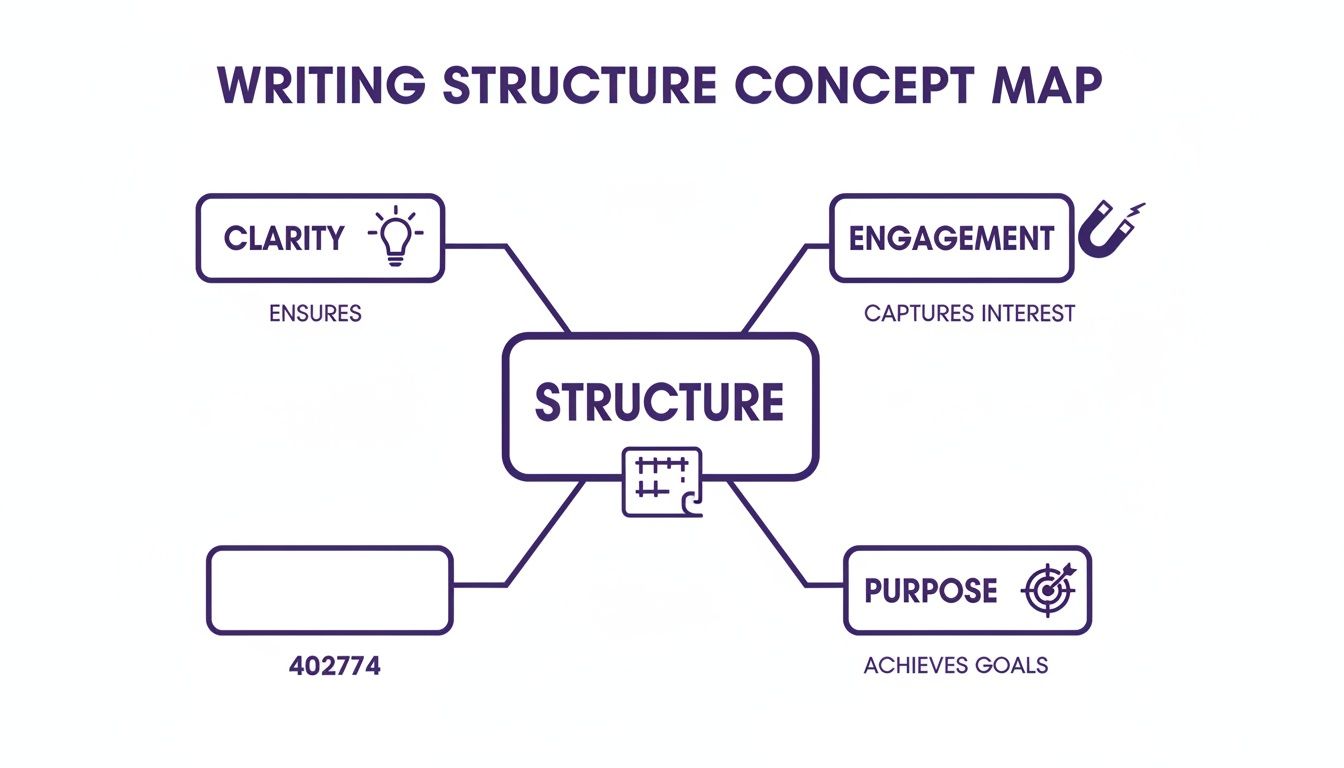
We're going to walk through three of the most versatile and powerful frameworks every single creator should have in their back pocket.
The Three-Act Structure for Storytellers
If you've ever been hooked by a great movie, a gripping vlog, or a can't-stop-listening podcast, you've felt the pull of the Three-Act Structure. It's the engine of cinematic storytelling, finely tuned to build tension and deliver a satisfying emotional payoff.
For YouTubers, filmmakers, and podcasters trying to level up from hobbyist to pro, this one is a total game-changer.
Here’s the simple breakdown:
- Act I: The Setup – You introduce your characters, their world, and the problem or goal that kicks things off. This is where you set the stakes and give the audience a reason to care.
- Act II: The Confrontation – Your main character (or your core idea) runs into bigger and bigger obstacles. This is the longest part, where all the tension builds toward a breaking point.
- Act III: The Resolution – The climax hits, the conflict is finally resolved, and a new normal is established. Your audience gets that satisfying conclusion they’ve been waiting for.
Mastering this lets you turn a simple idea into a narrative that sticks. To see how this works for video, check out our deep dive on writing a compelling script for a YouTube video.
The Inverted Pyramid for Maximum Impact
We live in a world of shrinking attention spans. Getting your most important information seen is everything. That’s where the Inverted Pyramid comes in. Borrowed straight from journalism, this structure is perfect for blog posts, news-style video updates, and social media captions where you have seconds to deliver value.
The concept couldn't be simpler: lead with the conclusion.
You hit them with the most critical, must-know information right at the top. Then, you follow up with important details and context. Finally, you end with the general background stuff.
This structure is all about respecting your audience's time. It guarantees that even if someone only reads your first paragraph or watches the first 15 seconds, they still walk away with the main point. It's an incredibly powerful tool for boosting engagement and keeping people from bouncing.
The IMRaD Format for Building Authority
For creators who produce research-heavy content, detailed tutorials, or deep-dive analysis, the IMRaD structure is the gold standard. It's how you build credibility and show your work.
IMRaD stands for Introduction, Methods, Results, and Discussion. It might sound academic, but its logic is perfect for presenting any well-supported argument and building trust with your audience.
The demand for well-organized, evidence-based content is absolutely exploding. The global essay writing service market, valued at USD 1.97 billion in 2023, is projected to hit USD 4.35 billion by 2032, driven by this exact need for logical structure. Argumentative essays, which lean heavily on clear organization, make up 32% of all orders. This just underscores how vital a good framework is for persuasive communication.
To really get a handle on this, digging into resources on mastering essay structure is a fantastic move for any creator looking to be seen as an authority.
Adapting Structure for Different Platforms and Goals
A great writing structure isn't a rigid formula you slap onto everything. Think of it more like a flexible blueprint you adapt to the platform and what your audience expects when they show up. The way you’d organize a viral YouTube video is worlds apart from how you’d build a top-ranking blog post, even if you’re working with the same core idea. Mastering this adaptability is what separates the good creators from the great ones.
Smart creators get that each platform has its own rhythm and unwritten rules of engagement. When you adjust your structure, you can spin a single killer idea across multiple channels. This not only unlocks new value from stuff you've already made but also creates a seamless brand experience that meets your audience wherever they hang out.
This kind of strategic thinking is a massive deal for professional creators. The global market for content writing services is expected to swell from around USD 22.63 billion in 2025 to USD 35.63 billion by 2032. A huge piece of that pie—a whopping 37.4% of the market—comes from the demand for clearly structured product descriptions that nudge consumers toward a sale. You can dig into the numbers with these insights on the content writing market.

Structuring for YouTube Success
On YouTube, you have about 15 seconds to convince someone to stick around. Your structure has to be built for an immediate punch and enough momentum to carry viewers all the way to your call to action. One of the most solid frameworks for this is the PAS (Problem-Agitate-Solution) model.
Here’s a quick-and-dirty template for your next video script:
- The Hook (0-15 seconds): Kick things off with a shocking stat, a bold question, or a problem everyone’s felt. Get right to the point of why they should watch.
- Agitate the Problem (15-60 seconds): Don't just mention the problem—make the viewer feel it. Talk about the frustrations and headaches that come with it.
- Introduce the Solution (1-3 minutes): Here's the meat of your video. Present your big idea as the clear answer to the pain you just stirred up.
- Provide Proof & Steps (3-7 minutes): Now, back it up. Break down your solution into simple, actionable steps, show real examples, or provide evidence. This is where you build trust.
- The Call to Action (Final 30 seconds): Tell people exactly what to do next—subscribe, watch another video, check out your website. Be direct and make it sound urgent.
Building the Perfect Podcast Episode
Podcasting is an intimate game. Your listeners are probably doing something else—driving, cooking, walking the dog. That means your structure has to be crystal clear to the ear, with obvious signposts so nobody gets lost. The easiest way to nail this is with well-defined segments.
A strong podcast structure acts like an audio map. It creates familiarity and allows listeners to tune in and out without losing the thread of the conversation, making your content feel both professional and accessible.
Try this simple episode template on for size:
- Teaser/Cold Open: A juicy clip from later in the episode to hook them from the start.
- Intro Music & Welcome: The host sets the stage, introducing the topic and what listeners are about to learn.
- Main Segment 1: Dive into your first key point or part of the story.
- Transition/Ad Break: A clear musical cue or phrase that signals a shift is coming.
- Main Segment 2: Unpack your next major point, building on what you just discussed.
- Summary & Outro: A quick recap of the big takeaways and a final call to action, like "leave a review" or "join our online community."
Bonus: this segmented approach makes it way easier to chop up your episode into shareable clips for social media.
Crafting SEO-Driven Blog Posts
When it comes to blog posts, the name of the game is usually ranking on Google and giving readers exactly what they’re searching for. Your structure has to please two masters: human skimmers and search engine crawlers. Two of the most powerful models for this are the Skyscraper Technique and the Pillar-Cluster Model.
The Skyscraper Technique is all about finding the best article for your target keyword and then creating something that blows it out of the water. This means your structure needs to be more comprehensive, better organized, and way more visually engaging than the competition.
For building long-term authority, though, the Pillar-Cluster model is king:
- Pillar Page: This is your epic, comprehensive guide on a broad topic (like "Content Marketing Strategy"). This page then links out to all your related, smaller articles.
- Cluster Pages: These are a bunch of more specific articles that dive deep into subtopics (like "SEO for Bloggers" or "Video Marketing Tips"). Each one of these pages links back to your main pillar page.
This tidy, interlinked structure sends a powerful signal to search engines that you’re an expert on the subject. A well-organized blog is also the backbone of effective copywriting for a website, guiding visitors where you want them to go and supporting your business goals.
Editing for Structure to Improve Flow and Clarity

A powerful structure doesn't just happen in the first draft—it’s hammered into shape during the edit. This is where you roll up your sleeves and turn a good piece of content into a great one. The editing process is your chance to tighten the bolts, sharpen your logic, and make sure every single word is pulling its weight.
This is the stage that separates amateur content from professional work that actually holds an audience and drives page views. It’s about more than just fixing typos; it’s about ensuring the journey from your opening hook to your final call to action is smooth, logical, and compelling. A polished piece feels effortless to the reader precisely because of the hard work you put in here.
This refinement is fundamental to clear communication. The need for well-structured writing is everywhere, even reflected in the tools we use. As global literacy rates climbed to around 87% in 2023, the market for writing instruments grew right alongside it, valued at USD 17.4 billion in 2024. This growth is driven by the very educational and professional sectors that demand clarity. If you're curious, you can find more market insights on structured writing tools at Gminsights.com.
The Structural Self-Edit Checklist
Before you even think about hitting publish, run your content through this structural gauntlet. This checklist is designed to help you hunt down weaknesses and fortify the logical flow of your writing. It forces you to be ruthless and objective about what stays and what goes.
Ask yourself these questions:
- Does every section support the main idea? If a paragraph doesn’t directly contribute to your core message, it’s just noise. Get comfortable with the delete key. Anything that sends your reader on a pointless detour has to go.
- Are the transitions smooth? Read your work aloud. Seriously. Do you find yourself jumping jarringly from one idea to the next? You need to strengthen the connections between paragraphs with transitional phrases to guide your reader along.
- Is the pacing right? Does your content build momentum, or does it start to drag? A solid structure uses a mix of short, punchy paragraphs and slightly longer explanatory ones to control the rhythm and keep your reader hooked.
Pruning and Polishing Your Framework
Editing for structure is a lot like pruning a tree—you’re cutting away the dead branches to encourage healthy, focused growth. The goal is to make your core message stand out, stronger and more visible than before. To do that, every single paragraph has to earn its keep.
Your first draft is for getting the ideas down. Your edit is for making those ideas count. This is where you clarify your message, amplify your impact, and ensure your structure in writing is rock-solid.
Think of each section as a building block. Does Block A naturally lead to Block B? Is Block C in the right place, or would it make more sense after Block D? Sometimes, just shifting entire sections around can dramatically improve the clarity and persuasive power of your work. This careful reassembly ensures your final piece isn’t just a collection of ideas, but a cohesive argument that gets the job done.
Tools and Techniques for Building Better Structures
Knowing the theory behind a good structure is one thing. Actually building one in your day-to-day workflow? That’s a whole different ballgame.
Thankfully, we’ve got a powerful set of tools that can bridge the gap between a great idea and a finished piece of content. Think of these not as crutches, but as force multipliers. They handle the grunt work of organizing your thoughts so you can focus on what really matters: telling a great story, sharing your unique perspective, and actually connecting with your audience.
Nailing the Pre-Production Phase
The best structures are cemented long before you hit record or type a single word. This planning stage is where you wrestle that messy cloud of ideas into a clear, actionable roadmap. Seriously, a little time spent here will save you a mountain of headaches in the editing room later.
Here are a couple of must-have tools for this phase:
- Mind-Mapping Software: Tools like Miro or Coggle are fantastic for brainstorming visually. They let you throw your ideas onto a canvas and draw connections, helping you see the big picture before you lock yourself into a rigid outline.
- Outlining Tools: Whether you're using something robust like Notion or just a simple document, an outliner is non-negotiable. This is where you arrange your key arguments, supporting points, and evidence into a logical flow, making sure your ideas land with maximum impact.
Unlock the Hidden Gold in Your Content Library
If you’ve been creating for a while, your biggest asset is probably the content you've already made. But trying to manually sift through hundreds of videos or articles to find those repurposing gems is a nightmare. This is where specialized platforms that leverage AI for collaboration really shine.
Platforms like Contesimal were built for exactly this. They help you organize your entire library, uncovering hidden patterns, spotting your top-performing segments, and pointing you to goldmines for new content that you probably didn't even know existed.
This isn't just about getting organized; it's about breathing new life into work you’ve already done. You get to understand what truly clicks with your audience and turn old assets into new value, collaborating with your team or even AI to discover your next big idea.
At the end of the day, building great structures is a partnership between your creativity and smart technology. Let AI generate a first-draft outline or brainstorm a few organizational concepts, but always bring your strategic vision to the table to add that essential human touch. It’s this blend that helps you build better content, faster—and that's how you grow.
Burning Questions About Writing Structure
Even after you get the theory down, applying a concept like writing structure can feel a bit… fuzzy. Let's tackle some of the most common questions that pop up for everyone from YouTubers to seasoned writers trying to build better frameworks.
Think of this as the practical advice you'd get over coffee. No fluff, just direct answers to clear up the confusion so you can get back to creating.
Does a Rigid Structure Kill Creativity?
Not a chance. This is one of the biggest myths that holds creators back, and it's time to bust it for good.
Think of structure as the canvas, not the paint. It’s the sturdy frame that actually lets your creativity run wild. When you have a solid blueprint, you stop wasting mental energy worrying if your piece makes sense.
Instead, all that energy can go into the fun stuff: crafting unique ideas, finding the perfect words, and letting your voice shine. The most iconic films, viral videos, and bestselling books all have a strong skeleton holding them together—that's what makes the creative parts land so powerfully.
How Do I Find the Best Structure for My Idea?
Start with your goal. Seriously, what do you want your audience to think, feel, or do after they hit play or finish reading? Your answer points directly to the right framework.
- Need to inform, and fast? If you're dropping a news update or a quick explainer video, the Inverted Pyramid is your best friend. It gets the most critical info out front, instantly.
- Trying to tell an emotional story? For vlogs, personal essays, or a narrative podcast, you can't beat the Three-Act Structure. It's a masterclass in building tension and delivering a satisfying journey.
- Building a logical argument? For how-to guides, case studies, or educational deep dives, a problem-solution or IMRaD-style framework builds authority and makes your points stick.
Still not sure? Try this: sketch out a quick outline for the same idea using two or three different structures. It’s a fast-and-dirty exercise that will immediately show you which one best serves your message.
Is It Really Worth Fixing the Structure of My Old Content?
Yes, a thousand times yes. This is one of the smartest ways to "upcycle" your content library and squeeze new value out of work you've already done.
Revisiting an old blog post or video script isn't about fixing a mistake; it's a strategic goldmine. By applying a cleaner, more intentional structure, you can make that old content more engaging for new audiences and dramatically improve its SEO performance.
Plus, a newly structured piece makes it dead simple to spot killer segments you can pull out and repurpose into social media clips, quote cards, or infographics. You’re not just fixing something—you're unlocking the potential that's been sitting in your archives all along.
Ready to unlock the hidden value in your content library and turn old assets into new opportunities? Contesimal helps you analyze, organize, and repurpose your content with powerful AI tools, making it easy to build better structures and grow your audience. Start creating infinite content value today at https://contesimal.ai.