
AI search platforms aren't replacing Google. They're making publishers answer a harder question: where does a piece of content get discovered, summarized, cited, and measured? By June 2026, these platforms collectively processed more than 3.5 billion queries per week, while Google AI Overviews reportedly covered 48% of Google searches and reached 1.5 billion monthly users. ChatGPT Search was estimated at 250–500 million weekly queries, and Perplexity at 50 million. (Axis Intelligence)
For publishers, the shift isn't a simple race between ChatGPT, Perplexity, Google, or newer search products. It's a distribution problem, a retrieval problem, and, most urgently, a measurement problem. Your archive may influence an answer without generating a conventional visit, while the same reader may use an AI assistant for research and Google for navigation or purchase intent.
This guide compares the underlying mechanics and practical fit of leading AI search platforms for newsrooms, podcast networks, magazines, academic publishers, creators, and teams managing substantial content libraries.
Why AI Search Platforms Now Matter for Publishers
AI-mediated discovery has crossed from novelty into a large-scale information channel. The market itself reflects that change. One estimate valued the global AI search engine market at USD 16.28 billion in 2024 and projected it to reach USD 50.88 billion by 2033, with a projected compound annual growth rate of 13.6% from 2025 to 2033. A separate estimate reported that AI search traffic grew 16 times between 2024 and 2026 across 101,574 websites. (Market growth analysis)
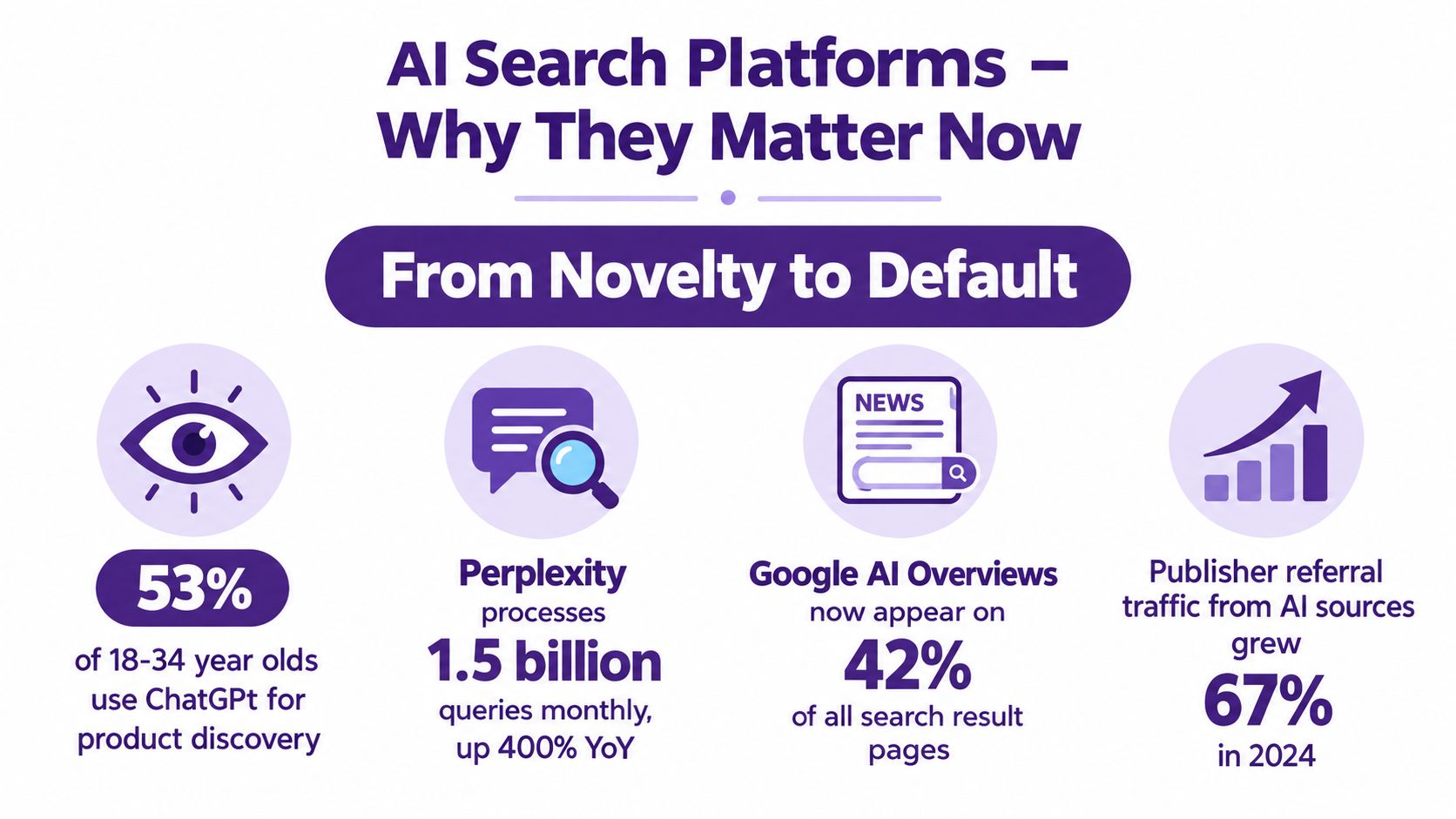
The important implication isn't that every reader has abandoned traditional search. It's that archival content now has more paths into a reader's consideration set. A decades-old interview, an overlooked transcript, or a technical explainer can surface because it answers a question semantically, even when the user never types the exact phrase used in the original headline.
That creates a visibility layer publishers can't evaluate with rankings alone. A platform might mention a publication without linking to it, cite a source but attract no click, or synthesize several archive items into an answer that changes how a reader understands the brand. For publishers, those outcomes matter, but they need separate tracking and editorial review.
The real publishing question
Don't begin with “Which platform wins?” Begin with:
- Discovery fit: Does the platform handle the questions your audience asks?
- Archive fit: Can it retrieve older, context-rich material rather than only recently crawled pages?
- Attribution fit: Does it expose citations clearly enough for editorial and analytics teams?
- Operational fit: Can your team inspect, update, and govern the content being surfaced?
This broader view is also relevant to publishers developing an AI strategy for publishers. Google remains important, but AI answer engines redistribute attention earlier in the research journey. A publisher that optimizes only for clicks may miss influence that happens inside the answer itself.
How AI Search Platforms Actually Work
An AI search platform usually combines several systems rather than relying on one magical model. The simplest analogy is a newsroom library. Retrieval is the librarian finding candidate documents. Embeddings are meaning-based fingerprints. Indexing organizes those fingerprints so the librarian can search quickly. Ranking decides which candidates deserve attention, and answer synthesis turns selected evidence into a response.
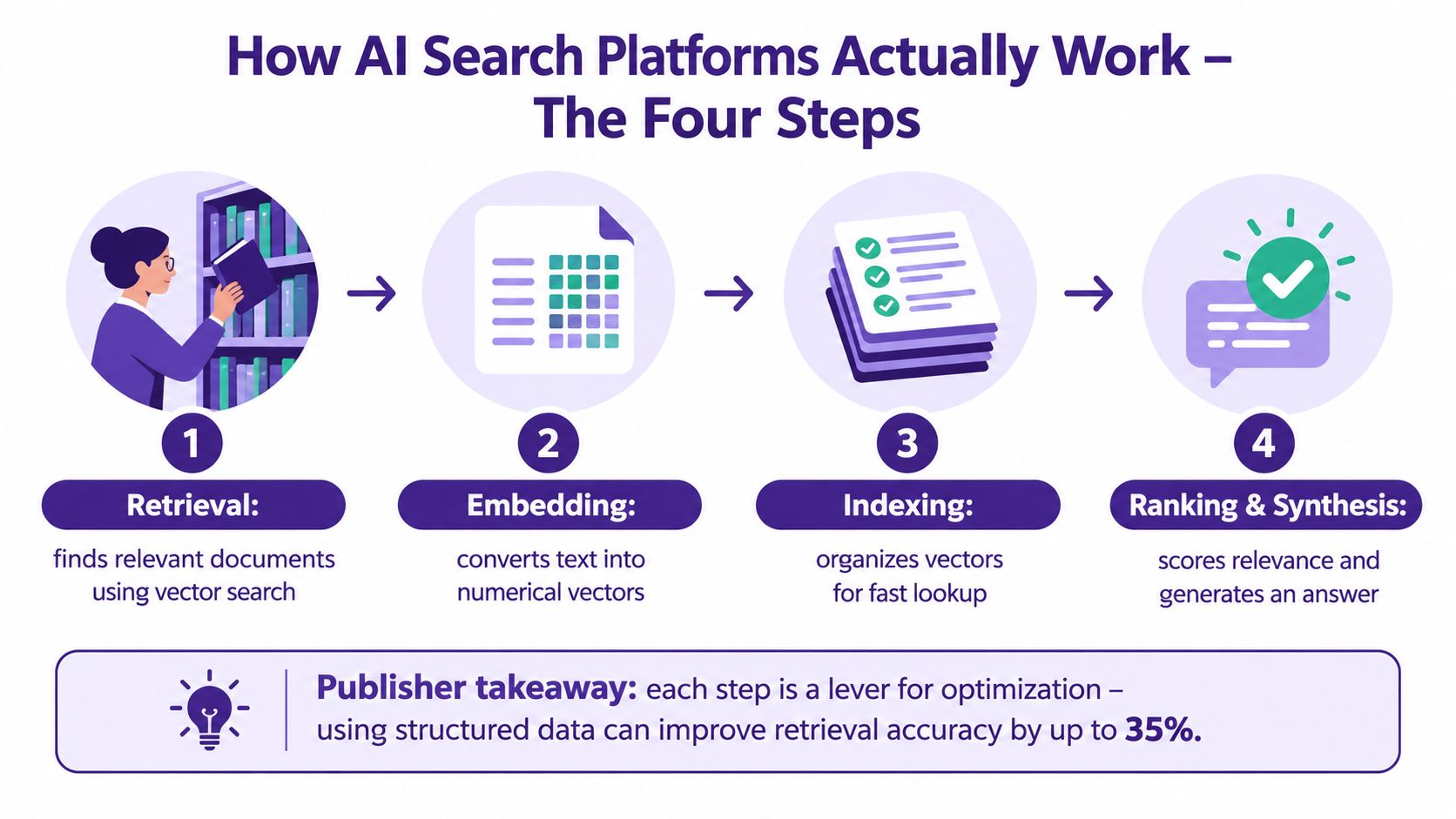
The retrieval chain
A user may ask, “What did this publication say about the long-term effects of remote work?” A keyword-only system might search for an exact phrase. A semantic system tries to identify related language across essays, interviews, transcripts, and reports.
Publishers should recognize these terms in vendor documentation:
- Dense vectors: Numerical representations that capture semantic meaning. They help match related concepts even when wording differs.
- Sparse vectors: Representations that preserve strong lexical signals, such as names, dates, product codes, and exact phrases.
- Hybrid retrieval: A combination of keyword and vector search. It matters because archives contain both conceptual language and precise entities.
- Reciprocal rank fusion: A method for combining results from different retrieval systems into a single ordering.
- Chunking strategy: The way a long document is divided into searchable passages. Poor chunking can separate a claim from its qualification or a speaker from the statement they made.
- Query understanding: The process of identifying intent, entities, constraints, and implied context before retrieval begins.
Modern AI search research increasingly treats intent as multidimensional. One framework describes 16 query intents, 7 phrasing styles, 6 criteria types, and 28 fields of study, demonstrating why generic keyword matching is insufficient for complex research questions. (Retrieval and taxonomy framework)
Where errors enter
Answer synthesis is the most visible stage, but retrieval mistakes often happen earlier. If the system retrieves an incomplete transcript, a stale page, or a passage stripped of its surrounding context, the language model can produce a polished answer from weak evidence.
That's why a publisher should ask vendors how they expose retrieved passages, document dates, source URLs, and confidence signals. A neat response isn't proof of a sound retrieval process.
The following video offers a visual explanation of how semantic and vector approaches differ in practice.
For teams evaluating search architecture, the distinction between semantic search and vector search is practical rather than academic. It affects whether an archive can answer exact entity questions, broad thematic questions, or both.
Comparing the Leading AI Search Platforms
No leading platform exposes every implementation detail publishers would want. Embedding models, crawl schedules, ranking systems, and source-selection rules are often proprietary or described with broad marketing language. The table below is therefore a workflow-oriented comparison, not a claim that each vendor publishes a complete technical specification.
Leading AI Search Platforms at a Glance
| Platform | Indexing approach | Embedding model | Freshness | Scalability | Relevance tuning |
|---|---|---|---|---|---|
| ChatGPT Search | Model-gated web retrieval and selected sources | Proprietary and not fully disclosed | Varies by query and retrieved source | Consumer and professional research workflows | Limited publisher control |
| Perplexity | Web retrieval with citation-first answer construction | Proprietary and not fully disclosed | Strong orientation toward current web sources | Broad web research | Limited direct publisher control |
| Google AI Overviews | Google search index with generated answer overlays | Proprietary Google systems | Connected to Google's web index and search systems | Web-scale | Governed through search, content, and structured-data signals |
| Bing Copilot | Bing index combined with conversational generation | Proprietary Microsoft systems | Connected to Bing's web search infrastructure | Web-scale | Search and webmaster ecosystem signals |
| You.com | Web search combined with generative interfaces | Proprietary and not fully disclosed | Fresh-web orientation | Broad web discovery | Platform-level controls vary |
| Brave Search | Independent search index with AI-assisted answer features | Proprietary and not fully disclosed | Independent crawl and index behavior | Web-scale with an independent index | Limited publisher control |
ChatGPT Search suits research journeys where the model's conversational context matters, but publishers get less visibility into the precise gates that determine whether an archive item appears. The experience can be useful for synthesis, yet editorial teams should test citation consistency rather than assume that a strong page will always be retrieved.
Perplexity makes citations central to the user experience. That can help source-driven publishers inspect whether their work is being surfaced, although citation presence doesn't automatically prove that the platform used the most authoritative passage.
Google AI Overviews adds an answer layer to an established search environment. This gives publishers continuity with traditional search optimization, but it can compress several sources into a short answer and reduce the prominence of individual pages.
Bing Copilot combines Bing's search infrastructure with conversational interaction. Its fit depends on how well a publisher's technical search foundation, metadata, and authority signals align with Bing's index.
You.com emphasizes a generative search experience connected to fresh web discovery. It may be relevant for publishers whose value depends on current pages, but the team should verify how consistently older material is retrieved.
Brave Search offers an independent index and a different retrieval posture from Google and Bing. Its importance isn't that it automatically produces better publisher visibility. It's that an independent index gives diversification value when teams don't want every discovery path to depend on one search ecosystem.
For readers tracking the broader AI company space, a curated AI company credits directory can provide context around Perplexity and adjacent companies without substituting for hands-on platform testing. Publishers evaluating enterprise options can also compare architectures through this enterprise search software comparison.
Indexing, Embeddings, and Relevance Tuning Compared
A publisher's archive succeeds or fails before an answer is written. The decisive questions are often mundane: how documents are divided, whether metadata survives ingestion, how often indexes refresh, and whether the system can distinguish a transcript speaker from a quoted subject.
| Platform | Indexing approach | Embedding model | Freshness | Tuning controls |
|---|---|---|---|---|
| You.com | Web-scale search and generative retrieval | Not fully disclosed | Oriented toward current web content | Platform-dependent |
| Perplexity | Retrieved web sources assembled into cited answers | Not fully disclosed | Citation freshness is central to the experience | Mostly abstracted from publishers |
| Glean | Permissioned enterprise corpus search | Proprietary and deployment-dependent | Depends on connected enterprise sources | Strong access and enterprise relevance controls |
| Elastic | Search infrastructure combining lexical and semantic methods | Configurable according to deployment | Controlled through ingestion and indexing operations | Broad technical control |
| ChatGPT Search | External retrieval selected through model and search systems | Not fully disclosed | Query and source dependent | Limited direct control |
The architecture matters because publisher archives contain different types of evidence. A podcast transcript needs speaker-aware chunks and timestamps. A magazine archive needs issue dates, authorship, sections, and canonical URLs. An academic collection needs identifiers, references, and publication relationships.
A taxonomy-focused retrieval paper reports an approach that combines semantic matching with corpus taxonomy, using taxonomy to complement retrieval rather than replace it. (Taxonomy-aware retrieval research) That distinction is important. Semantic similarity can find related passages, but a taxonomy can tell the system whether those passages belong to the same subject, format, publication, or editorial category.
Latency is a publisher concern
Independent benchmarking of 8 agentic search APIs across 100 real-world AI and LLM queries found the top four providers, Brave Search, Firecrawl, Exa, and Parallel Search Pro, statistically indistinguishable on the benchmark's Agent Score. The notable difference was operational: Brave outperformed Tavily by about 1 point, while end-to-end latency ranged from 669 milliseconds to 13.6 seconds, roughly a 20-fold spread. (Agentic search benchmark)
That result argues against choosing a retrieval layer based on a small score difference. For a publisher, integration quality, response time, citation handling, and observability may determine whether editors use the system.
Before signing, demand answers to these questions:
- Document structure: Can the system preserve authors, dates, speakers, sections, citations, and canonical links?
- Freshness controls: Can the team trigger re-indexing or confirm the latest indexed version?
- Ranking controls: Are authority, recency, source type, and editorial boosts available?
- Evidence exposure: Can users inspect the exact passages used to generate an answer?
- Analytics: Can the team distinguish retrieval, citation, answer, and downstream engagement?
Teams researching lightweight tools for building or testing these workflows can also explore resources for indie hackers, but the evaluation standard should remain the same: inspect the retrieval path, not just the interface.
Real Use Cases for Content Teams and Publishers
The right AI search platform depends less on brand recognition than on the shape of the library. A daily newsroom, a podcast network, and an academic publisher ask different retrieval questions.
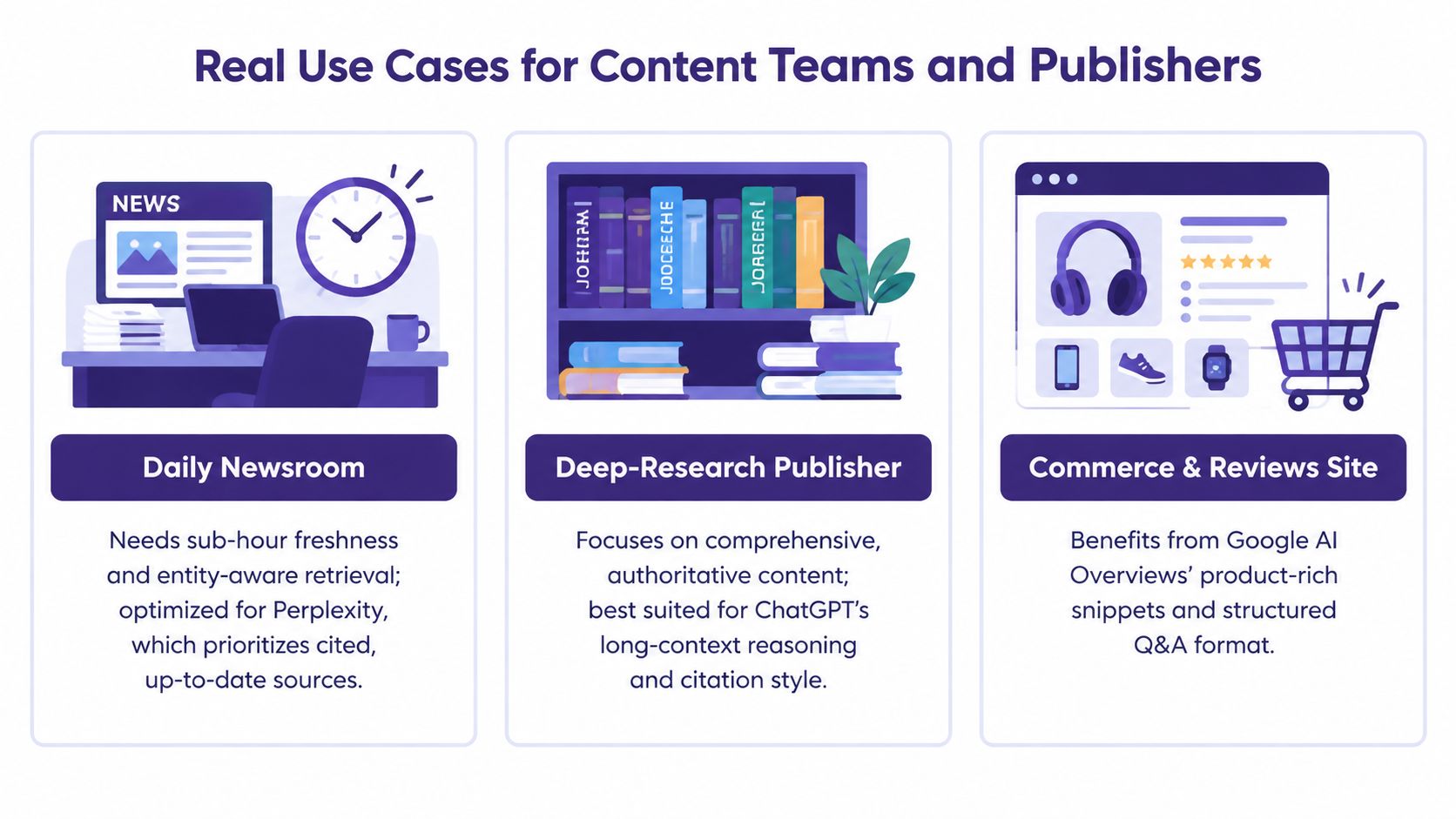
A daily newsroom
A newsroom needs current reporting, clear entities, and visible source dates. Perplexity's citation-oriented interface can support rapid source checking, while You.com's fresh-web positioning may suit teams exploring current coverage. General conversational platforms can help reporters form hypotheses, but editors still need to verify every quotation and date against the original article.
Fit score: Strong for Perplexity or a fresh-index search layer, provided citation review is built into the workflow.
Failure modes: stale citations, an answer that merges separate events, and ranking opacity that makes an editorial decision difficult to reproduce.
A podcast network
A podcast archive has a different problem. Search must understand speakers, episodes, recurring themes, and time positions. A chunk that contains an interesting sentence but omits the speaker or timestamp isn't sufficient for production research.
Glean and Elastic can be attractive where permissioning, hybrid retrieval, and schema control matter. General web search platforms may discover public episode pages, but they won't necessarily expose the internal transcript structure a producer needs.
Fit score: Strong for a controlled corpus with speaker-aware chunking and timestamp-level citations.
Failure modes: hallucinated quotes, speaker confusion, and retrieval that finds an episode but not the passage that supports the answer.
An academic publisher
An academic publisher managing a long journal archive needs authority signals, citation relationships, publication metadata, and precise identifiers. A fluent answer isn't enough if the system can't distinguish editions, revisions, or related papers.
ChatGPT-style long-context reasoning may help researchers explore a topic, while a domain-tuned retrieval system is more appropriate for final source discovery. The publisher should prioritize metadata-aware indexing over a visually impressive chat interface.
Fit score: Strong for a specialized corpus with citation graphs, structured metadata, and reviewable evidence.
Failure modes: flattening scholarly disagreement, confusing related studies, and omitting the precise document version used in the answer.
Across all three scenarios, the editorial requirement is the same: the answer must remain traceable to the archive. Publishers aren't merely trying to generate more text. They're trying to convert existing knowledge into reusable research, new episodes, articles, videos, and products without losing provenance.
How AI Search Platforms Compete With and Complement Google
The popular story says AI search platforms will replace Google. The audience evidence points somewhere more complicated. In both September 2025 and May 2026, 95% of ChatGPT users also appeared in Google's audience, while visits to generative AI platforms rose 70% year over year. That pattern indicates overlap rather than clean substitution. (Audience overlap analysis)
Users also combine behaviors by intent. ChatGPT and Perplexity can be useful for open-ended research, comparisons, and synthesis. Google remains embedded in navigational, local, and transactional discovery, where users often want a specific site, place, product, or action rather than a long explanation.
The click path is changing
Public survey data cited in the same coverage found that 42% of U.S. adults use chatbots to find information, 60% read AI summaries at the top of search results, and 54% of global respondents encountered AI-generated search answers in the previous week. Only one-third frequently clicked through to original sources. (Search behavior coverage)
Those figures don't prove that source traffic disappears. They show that attention can move earlier in the journey, before a user visits a publisher. A source may influence a decision through a citation, a mention, or a synthesized explanation even when analytics records no immediate referral.
Practical rule: Treat AI visibility as an influence signal and source traffic as a downstream signal. Neither one is a complete substitute for the other.
Use both systems deliberately
For Google, publishers should maintain crawlable pages, clear metadata, structured data, internal links, and topical authority. For AI answer engines, the same foundation helps, but the archive also needs clean dates, explicit authorship, extractable passages, descriptive headings, and citation-friendly formatting.
Teams that want to find AI-powered search engines can use alternatives for discovery testing, but experimentation shouldn't lead to channel abandonment. The risk is measurement blindness, especially when teams can't tell which questions trigger their content or whether a visibility strategy is producing meaningful audience and business outcomes.
Choosing the Right AI Search Platform for Your Content Library
A small newsroom shouldn't choose the same system as a research publisher. The decision should begin with corpus shape, editorial risk, and measurement maturity, not a headline benchmark.
Platform Selection by Publisher Profile
| Publisher profile | Primary recommendation | Secondary option | Top evaluation criterion | Avoid if |
|---|---|---|---|---|
| Small newsroom | Perplexity or a fresh web retrieval layer | You.com | Citation freshness and review speed | The system can't expose source passages |
| Multi-vertical media company | A hybrid or permissioned search stack | Google and Bing discovery testing | Cross-library taxonomy and analytics depth | Archives remain siloed across teams |
| Research-driven publisher | Domain-tuned retrieval with structured metadata | ChatGPT for exploratory synthesis | Citation precision and provenance | The model obscures document versions |
A practical evaluation protocol
Run a controlled test rather than accepting a product demonstration. Ingest 10,000 representative documents, run 10 real editorial queries, inspect answer grounding, and track click-through to source content. Those quantities form a useful evaluation protocol, not an industry benchmark, so teams should document their own results and keep the test set stable.
Measure more than answer quality:
- Retrieval accuracy: Did the system find the right document and passage?
- Attribution: Did the answer identify the source clearly?
- Freshness: Did current material outrank obsolete material when appropriate?
- Archive depth: Did older, relevant work appear alongside recent pages?
- Operational speed: Could editors get results quickly enough to use them?
- Governance: Can teams manage permissions, corrections, and re-indexing?
The benchmark evidence on agentic search supports putting latency and integration quality ahead of tiny score differences. Measurement should also outweigh a polished interface. If you can't connect a surfaced archive item to a citation, referral, downstream engagement, or a documented editorial decision, you don't yet know whether the platform creates value.
A multi-platform stack is often more sensible than vendor loyalty. Use Google and Bing to monitor conventional discovery, a citation-oriented engine to inspect external visibility, and a controlled internal retrieval layer for archive research. The decision rule is simple: optimize for indexing fit and answer attribution first, retrieval latency second, and raw benchmark numbers third.
Contesimal provides one option for teams that need AI-powered search across articles, podcasts, videos, and other library assets, combining keyword discovery, semantic retrieval, taxonomy, and collaborative research workflows. If your archive is already a source of ideas but remains difficult to classify and reuse, visit Contesimal to explore how its tooling can help turn historical content into new research and publishing opportunities.