
You already have more content than you can realistically reuse by hand.
There are old interviews worth clipping, evergreen blog posts buried under newer launches, webinar transcripts nobody has mined, newsletter issues that could become scripts, and research notes scattered across drives and docs. Meanwhile, the publishing treadmill keeps moving. Another post. Another episode. Another campaign. Another attempt to win traffic that's harder to earn than it used to be.
That's why AI for publishers matters right now. Not because it can help you flood the internet with more generic content, but because it can help you finally organize, understand, and act on the library you already own. If your archive is sitting there like a storage cost instead of a strategic asset, AI gives you a way to bring it back to life, move longform ideas across platforms faster, and turn old work into new audience growth and revenue.
Why AI Is Now Essential for Publishers
The old model rewarded volume. Publish often, rank well, collect clicks, repeat.
That model is under pressure. Publishers globally have experienced a severe 15% to 40% decline in referral traffic over the past year due to AI summaries in search, with many losing one-third or more of their site visits, according to Digiday's reporting on AI's impact on publisher traffic and media M&A. If you run a magazine, newsletter business, podcast network, book imprint, or creator media brand, you can't ignore that shift.
The content treadmill is no longer enough
Publishers still respond the same way when traffic softens. They produce more. More posts, more clips, more explainers, more SEO pages.
That reaction makes sense, but it often creates a second problem. You end up with a larger archive and less clarity. Valuable material gets trapped inside transcripts, longform articles, video libraries, interview footage, and back catalogs that nobody can search well enough to reuse.
Practical rule: If your team can't quickly answer “what do we already have on this topic?”, you don't have a content creation problem. You have a content retrieval problem.
AI changes that when you use it as infrastructure instead of a shortcut. The practical value starts with classification, search, synthesis, and pattern detection. If you want a plain-English grounding in that foundation, this guide to natural language processing is a useful place to start.
AI is more useful as a collaborator than a replacement
The strongest publishers aren't using AI to erase editorial judgment. They're using it to reduce drag.
That means helping editors find related material faster, helping marketers identify repurposing angles, helping producers turn one strong episode into a package of derivative assets, and helping leadership spot where the archive can support products beyond ad-supported pageviews. In practice, AI for publishers works best when it supports humans who already know the audience, the standards, and the business model.
Here's the opportunity. Search volatility has turned archives from nice-to-have libraries into assets you need to operationalize. The teams that win won't be the ones who generate the most raw output. They'll be the ones who reignite their content libraries and create infinite content value from what they've already made.
Core AI Use Cases for Your Content Library
The phrase “AI for publishers” gets tossed around so broadly that it stops being useful. What matters is what the system helps your team do on a Tuesday afternoon when an editor needs a brief, a producer needs clips, and a marketer needs campaign assets by end of day.
The most practical way to think about it is as a set of working capabilities tied directly to your archive.
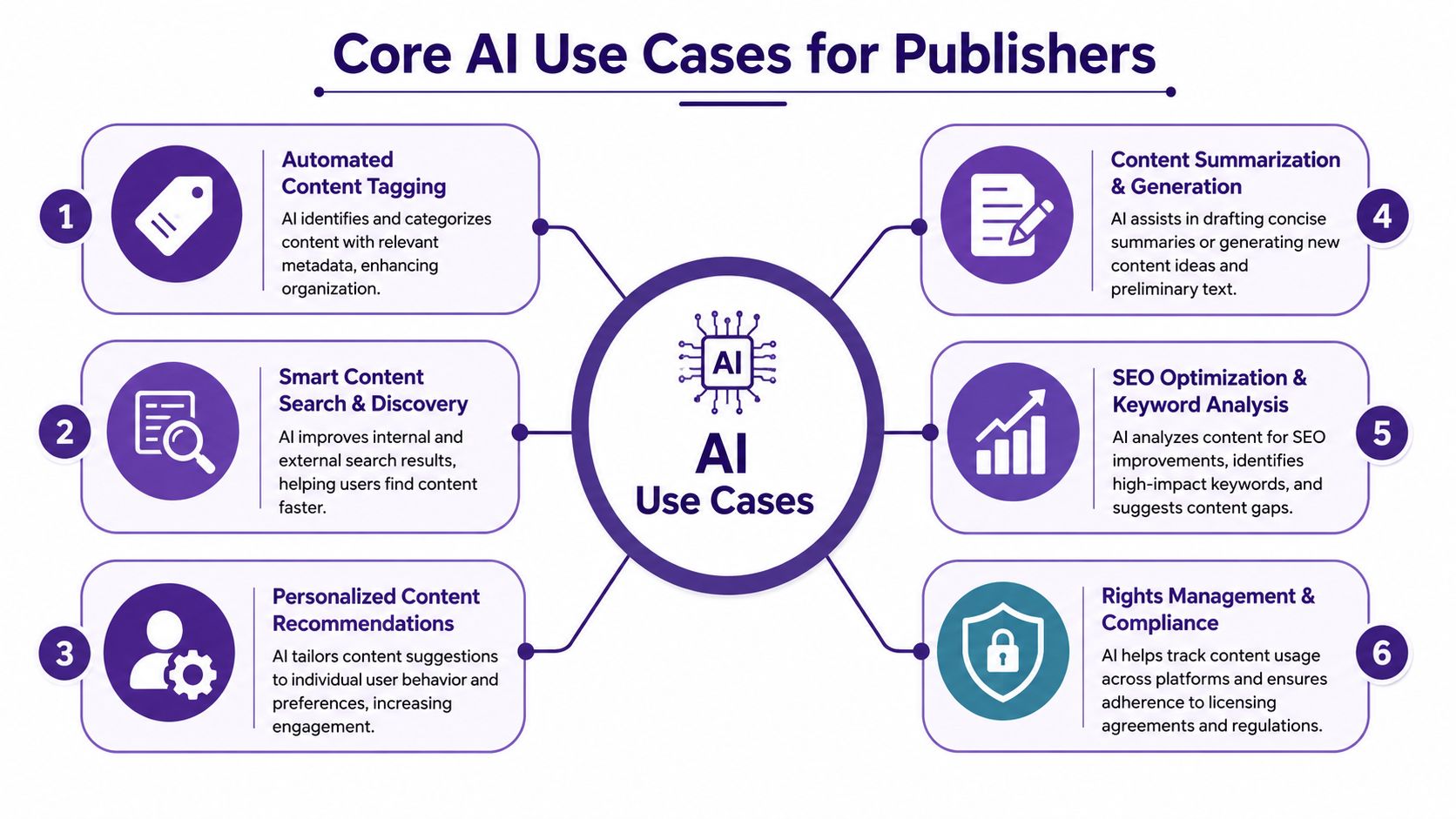
Automated tagging gives you a usable inventory
For many publishers, the most important AI task isn't generation. It's classification.
The most common AI-assisted task for publishers is content classification using metadata tagging, which combines NLP and machine learning to automatically generate layered taxonomies for large document sets, improving discoverability, according to the Publishers Association report on AI in publishing.
That matters because most archives aren't failing due to lack of quality. They're failing because nobody can see what's in them. Automated tagging fixes the first bottleneck. It labels topics, entities, themes, formats, people, source types, rights-sensitive material, and relationships between pieces.
For a podcast publisher, that could mean identifying every episode where a guest discussed pricing, burnout, or fundraising. For a magazine team, it could mean grouping years of reporting into reusable editorial clusters. For a book publisher, it could mean surfacing excerpts, themes, and derivative marketing hooks from a deep backlist.
Smart search changes editorial speed
Search inside many content libraries is still primitive. It depends on filenames, vague categories, or someone's memory.
AI-assisted search makes the archive queryable in a more human way. Instead of hunting for exact keywords, teams can search by concept, angle, tone, or use case. That's a major difference. It lets a strategist ask for “stories about first-time founders struggling with hiring” or “past interviews that support an audience retention series” and get relevant material without knowing the original headline.
Good search doesn't just retrieve files; it surfaces hidden value by helping teams discover what they forgot they made.
Recommendations increase depth, not just clicks
Personalization often gets framed as a homepage widget problem. It's bigger than that.
When AI analyzes behavior signals like reading history and click patterns, publishers can recommend related pieces more intelligently and keep audiences moving through a library in a way that feels useful rather than random. That helps with engagement, but it also helps with packaging. Once you know how topics connect, you can assemble guided reading paths, playlist-like bundles, newsletter sequences, and thematic collections.
A creator with a YouTube archive can turn scattered episodes into structured learning journeys. A trade publication can turn old reporting into a subscriber onboarding track. A media brand can build issue hubs that feel editorially intentional rather than algorithmically messy.
Good recommendation systems don't just say “read next.” They say “stay in this world a little longer.”
Summarization and repurposing make archives portable
This is the use case people notice first, and sometimes misuse first.
AI can summarize longform content, extract key arguments, draft social copy, propose outlines, create episode descriptions, generate briefing docs, and turn one long asset into multiple platform-native derivatives. Used well, this is how you take an old webinar and convert it into a blog post, a podcast teaser, a short video script, an email sequence, and a sales enablement brief.
Used poorly, it creates bland derivatives that sound detached from the original material.
The difference is source quality and editorial intent. Start with strong archive material. Then use AI to compress, adapt, and reshape it for the next format instead of asking it to invent value from nothing.
SEO analysis works best when tied to existing assets
AI can help with keyword analysis, search intent mapping, gap identification, and on-page improvements. But the most effective move isn't always “write something new.”
Often it's “which existing asset deserves a second life?” That could mean updating a durable explainer, combining several underperforming articles into a stronger pillar, or extracting a niche angle from a transcript that never became a standalone page.
Try this workflow:
- Find proven source material: Pull articles, episodes, or transcripts that already resonate with your audience.
- Identify derivative angles: Ask where the same idea could live as a short video, newsletter series, FAQ page, or downloadable resource.
- Refresh before expanding: Update framing, examples, and structure so the repurposed asset feels current.
- Publish across formats: Move the same core idea into channels where different audience segments consume it.
Rights management deserves more attention
This is the least flashy use case and one of the most important.
Publishers need to know what they own, what they can adapt, what they can license, and what needs review. AI can help flag reused material, identify possible copyright issues, and support internal compliance checks across large libraries. That's especially useful for organizations repurposing mixed media assets across sites, newsletters, feeds, social channels, and partner formats.
A rights-aware archive is more monetizable than a chaotic one. If your team can't confidently package content for reuse, syndication, internal research, or future AI-related licensing conversations, the library stays underused.
How to Implement AI in Your Publishing Workflow
Teams often don't need a grand AI transformation plan. They need a repeatable operating rhythm.
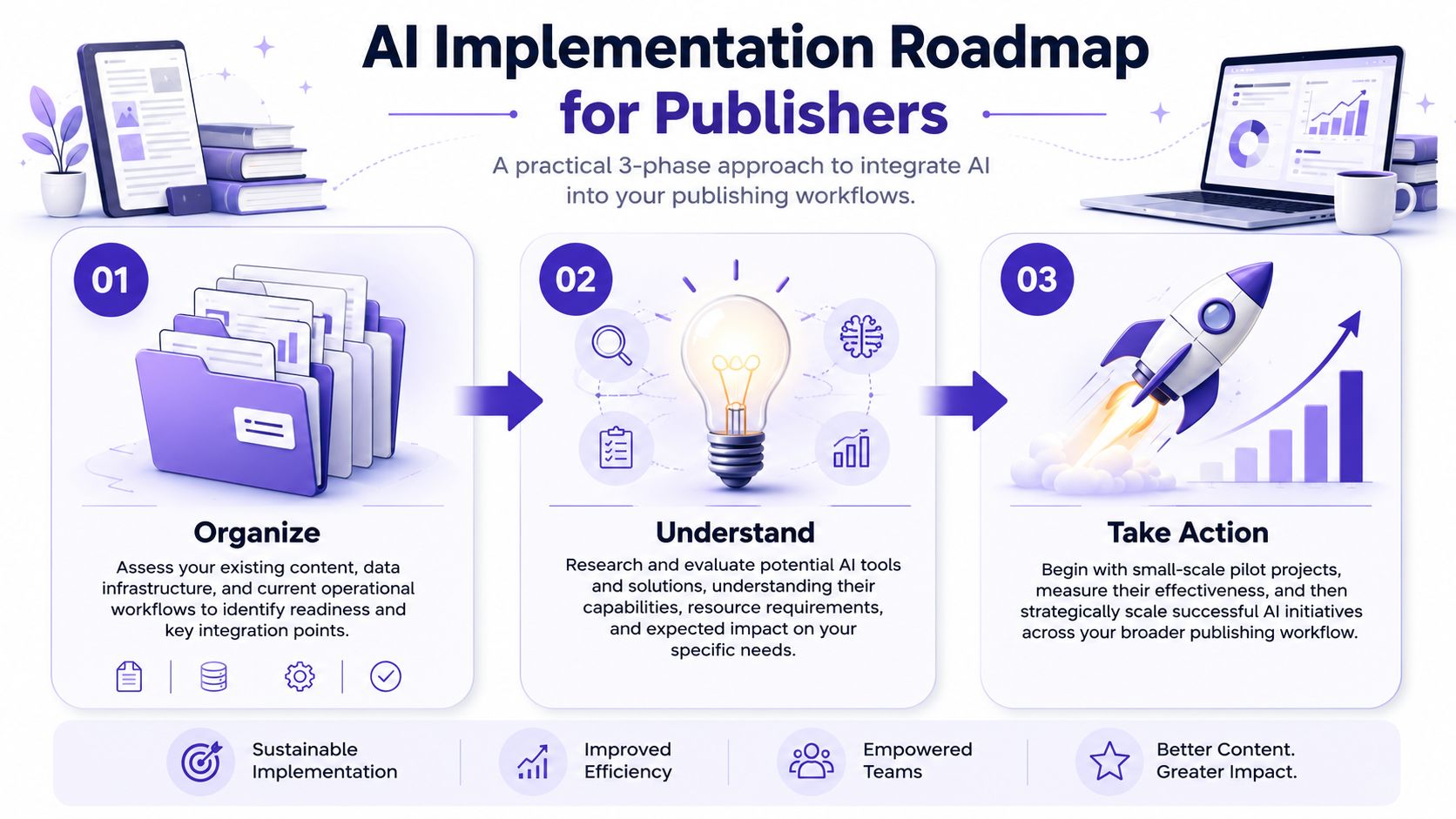
The simplest one is this: Organize. Understand. Take Action. That loop turns AI from an abstract initiative into a working publishing process.
Organize
Start with an audit, not a tool demo.
Inventory the assets you already have. Articles, transcripts, episodes, newsletters, videos, research files, books, campaign collateral, and internal knowledge bases all count. Then identify what metadata exists, what's missing, and where your team currently loses time.
Industry best practice calls for quarterly reviews of content libraries using metrics such as page views and conversion rates, with a focus on content from the past 12 months to keep repurposing relevant, as outlined in Cloud Present's guide to repurposing content. That review cycle keeps your archive active instead of static.
A practical audit usually reveals the same friction points:
- Scattered storage: Assets live across drives, CMS folders, transcript apps, and private docs.
- Weak labeling: Titles exist, but themes, audiences, formats, and reuse potential don't.
- No repurposing workflow: Teams create content once and move on.
- Limited collaboration: Research, editorial, video, and marketing work from different versions of the same source material.
Understand
Once the library is mapped, choose tools based on jobs to be done.
Some platforms are strong at drafting. Others are better at taxonomy, search, summarization, workflow support, or editorial analysis. If you want a broad survey before narrowing your stack, Maxijournal's guide to AI tools offers a useful overview of the current environment.
For archive-heavy teams, the priority should be content intelligence, not just generation. A platform like Contesimal's content intelligence approach is designed around classifying, searching, and drawing insight from large content libraries, which is a different need from using a standalone writing assistant.
Your first AI tool should solve a retrieval problem, a packaging problem, or a decision problem. If it only creates more text, it may add to the mess.
A quick way to evaluate fit is to run one real archive task through the system. Ask it to find reusable material for an upcoming campaign, cluster related content around a topic, and produce a short list of derivative opportunities. If the output helps your team move faster without losing context, you're on the right track.
Here's a practical walkthrough worth reviewing before you roll out anything wider:
Take Action
Don't start with newsroom-wide automation. Start with one repeatable pilot.
Good first pilots include turning a back catalog into searchable research, repurposing a set of top-performing longform pieces into multi-platform assets, or building a recommendation layer around a topic cluster. Keep the test narrow enough that editors and marketers can judge output quality directly.
Then create a standing workflow:
- Review the library quarterly
- Select high-potential assets
- Use AI to classify, summarize, and surface derivative paths
- Assign human review before publication
- Track business outcomes, not just output volume
That's how “organize, understand, take action” becomes a habit instead of a slide deck.
Measuring the ROI of Your AI Publishing Strategy
If you can't connect AI to business outcomes, it stays a novelty project.
The cleanest way to evaluate AI for publishers is to measure it against four business goals: efficiency, engagement, audience development, and revenue creation. Each one maps to a different part of your archive strategy.
Efficiency is the first win
The easiest return to spot is operational.
When AI helps teams classify assets, retrieve sources, create briefs, summarize longform material, and prepare cross-platform derivatives, editors and marketers spend less time hunting and more time deciding. That matters for lean organizations, especially when the same staff is expected to support site content, newsletters, social, audio, and video.
Look at the workflow before and after implementation. How quickly can someone go from idea to source material? How many manual steps were removed from packaging an old asset into a new one? How often does the team reuse existing work instead of recreating it?
Engagement shows whether the archive became usable
A reorganized library should help audiences find more of what matters to them.
The value of recommendation systems, better internal search, cleaner topic clustering, and stronger repackaging starts to pay off. If people consume more related content, move more naturally between formats, or respond better to updated archive-based assets, your content library is becoming a navigable product rather than a pile of posts.
For a practical measurement framework, this content performance analysis guide is a useful reference point when deciding what to track and how to separate activity from impact.
Audience growth comes from format expansion
One archived idea can now travel.
A long interview can become a short video, a carousel, a blog post, a podcast clip, a newsletter sequence, and a subscriber-only resource. That opens reach across platforms without requiring your team to start every asset from zero. It also helps creators who are shifting from hobbyist publishing to professional operations. They need systems that support playlists, buckets, recurring themes, and ongoing experimentation without burning out the team.
If one strong piece can support several audience entry points, your archive starts acting like distribution infrastructure.
Revenue requires a sharper archive thesis
This is the strategic layer. With generative AI projected to reduce traditional search traffic by 20% to 40%, leveraging archives through AI-native products is a key survival path for publishers that want to build insightful audience relationships and monetize legacy content, according to Bombora's analysis of future paths for publishers in the AI economy.
That means your ROI model shouldn't stop at traffic recovery. It should include products and offers your archive can support, such as premium research packages, member briefings, subscriber onboarding series, curated topical libraries, repurposed education content, sponsorship-ready issue hubs, and licensing-informed content bundles.
Here's a simple way to track the business side:
| Business Goal | AI Tactic | Key Metric (KPI) |
|---|---|---|
| Efficiency | Automated tagging, summarization, internal search | Editorial time saved, production cycle speed |
| Engagement | Personalized recommendations, archive clustering | Session depth, repeat consumption, content path completion |
| Audience | Multi-format repurposing from longform assets | New subscriber growth, cross-platform reach |
| Revenue | Archive packaging, AI-native products, reusable content bundles | Conversion rate, qualified leads, product uptake |
The smartest ROI question isn't “did AI write faster?” It's “did AI help us turn underused content into useful assets that grow audience and support revenue?”
Navigating AI Governance and Common Pitfalls
AI can save time and create new options. It can also introduce sloppiness fast if you skip governance.
That tension is already visible across publishing. More than 50% of publishers are adopting generative AI for tasks like text creation, yet they remain concerned about inaccuracy of information, content quality, and plagiarism, according to Statista's overview of AI in U.S. publishing. That's the right instinct. AI should support the workflow, not lower the standard.
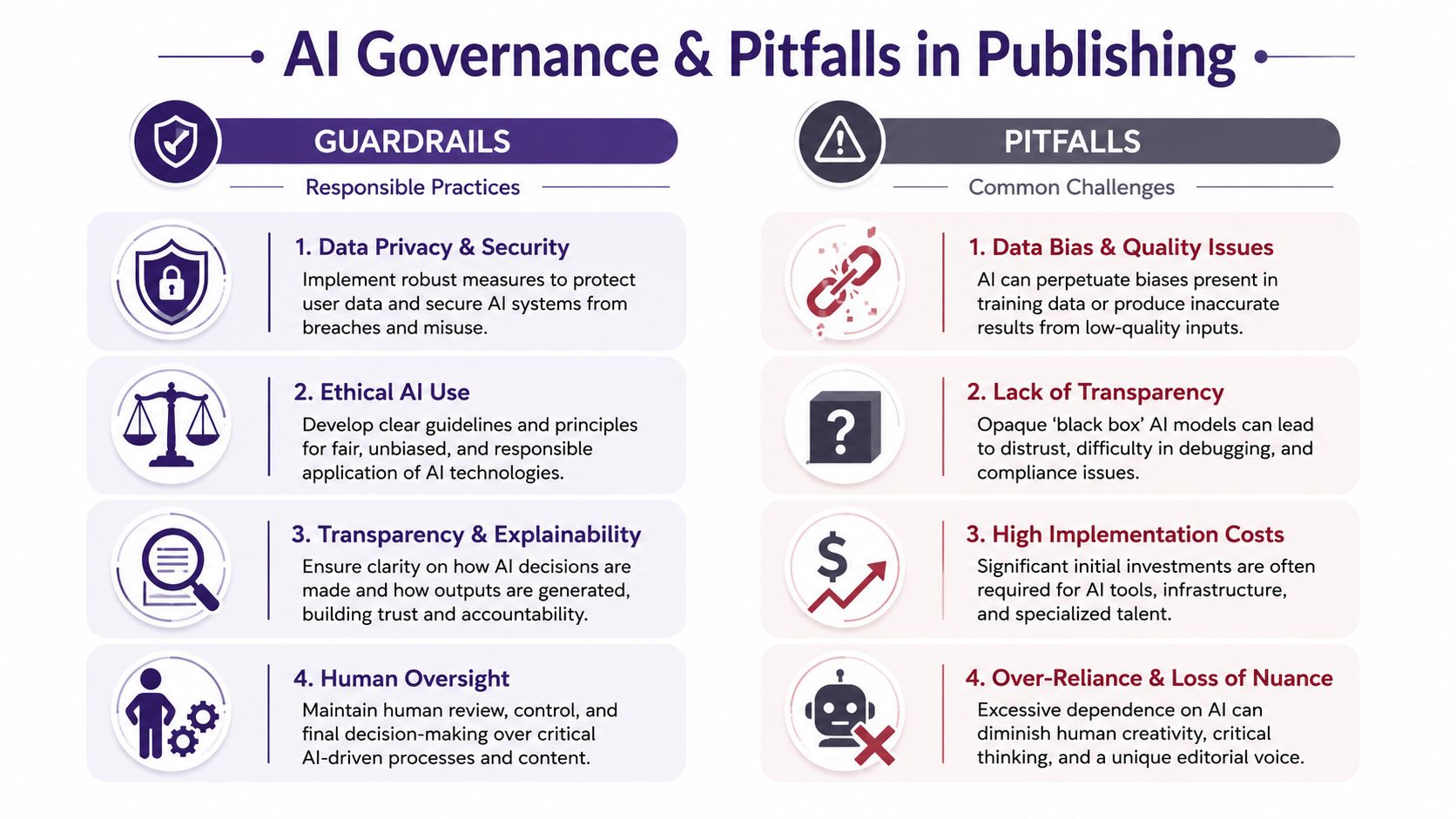
Guardrails that keep the work publishable
The best AI publishing workflows are disciplined, not loose.
- Keep humans in the approval loop: Editors, producers, or rights owners should make final calls on publishable output, attribution, and framing.
- Set source boundaries: Define which materials the model can use, what counts as approved reference material, and what requires separate review.
- Document acceptable use: Teams need clear rules for summarization, drafting, translation, adaptation, and archive reuse.
- Review for rights and originality: If you're reworking interviews, book material, licensed content, or mixed-media assets, confirm what can be republished where.
One practical policy helps a lot: AI can assist with discovery, distillation, and first-pass drafting, but it doesn't get final editorial authority.
Common mistakes that quietly weaken trust
The biggest problems usually don't look dramatic at first. They show up as subtle quality decay.
A generic summary strips away important nuance. A draft sounds polished but includes unsupported claims. A social package overstates what the original piece said. A content team starts publishing derivative work that no longer sounds like the brand.
That's how AI becomes a quality leak instead of a force multiplier.
Treat AI output like an eager junior collaborator. Useful, fast, and capable. Still in need of review.
Another mistake is treating governance as purely internal. It's also a market issue. Publishers are operating in a broader policy and platform environment that's still forming. For teams tracking that bigger picture, Global Governance Media's overview of G7 and AI governance gives useful context on how the regulatory conversation is evolving.
A simple standard that works
Ask three questions before anything AI-assisted goes live:
- Is it accurate to the source material?
- Does it preserve the brand's editorial voice and nuance?
- Do we have the right to publish or adapt it in this format?
If the answer to any of those is unclear, the draft isn't ready.
Strong governance doesn't slow down good AI use. It keeps your archive valuable enough to reuse again.
The Future Is Collaborative Your Content Library Reimagined
The future of AI for publishers isn't about replacing creators, editors, producers, or strategists. It's about making their existing work more usable, more discoverable, and more valuable.
That shift matters because the archive is no longer passive. It can become a working system for audience growth. Old interviews can feed new episodes. Longform articles can become shortform assets. Backlist material can support campaigns, subscriber experiences, research products, and fresh editorial packages. A library that once felt heavy starts acting like a profit engine.
The teams that get the most from AI will think less like factories and more like portfolio managers. They'll organize what they own, understand what's inside it, and act on the best opportunities across platforms. They won't ask AI to replace judgment. They'll ask it to reduce friction, reveal patterns, and help humans make smarter publishing decisions faster.
That's the fundamental insight. Your content library is not just a record of what you've made. It's raw material for what you can build next.
If you're a creator with a deep back catalog, a publisher trying to protect value as search shifts, or a marketing team trying to align content across channels, the move is the same. Stop treating old content as finished work. Start treating it as reusable inventory.
Contesimal helps publishers and creators turn existing libraries into usable knowledge systems by organizing, classifying, and searching articles, videos, podcasts, and documents in real time. If your team wants a more practical way to upcycle old content, collaborate around research, and create new value from the archive you already own, explore Contesimal.