
Natural language processing (or NLP for short) is the magic that lets computers actually understand what we say and write. It's the bridge between messy, complex human language and the clean, structured world of machine logic. For any creator, podcaster, or publisher sitting on a mountain of videos, podcasts, and articles, this is huge. It means you can finally make sense of your entire content library—automatically—and reignite it to create new value.
What Is Natural Language Processing
Think about your entire content library. Every podcast episode, every YouTube video, every blog post you’ve ever published. It’s like a massive, disorganized room full of books. You know there are gems in there, but finding a specific idea or connecting related themes is a soul-crushing manual task. This is a common challenge for content creators and marketers trying to grow the value of their content.
Now, what if you could hire a team of super-smart librarians who’ve already read every single word you’ve ever produced? They speak every language, never get tired, and can instantly find not just words, but the ideas behind them.
That’s basically what Natural Language Processing does. It’s a field of artificial intelligence (AI) that gives computers the ability to read, understand, and interpret human language, whether it’s written text or spoken words. This isn't just about spotting keywords; it's about grasping context, emotion, and the subtle relationships between concepts.
To put it simply, here’s a quick breakdown of how NLP works its magic.
Natural Language Processing at a Glance
| Concept | Simple Explanation | Why It Matters for Creators |
|---|---|---|
| Tokenization | Breaking down sentences into individual words or "tokens." | It's the first step in making your content machine-readable, like creating an index for a book. |
| Embeddings | Turning words into numbers (vectors) that capture their meaning and context. | This allows an AI to understand that "podcast" and "audio show" are related, even if the words are different. |
| Language Models | AI models trained on massive text datasets to understand and generate language. | These are the "brains" that power everything from search to summarization, giving the AI its "understanding." |
| Transformers | An advanced AI architecture that excels at tracking context in long sequences of text. | This is what allows tools to make sense of an entire hour-long podcast, not just a single sentence. |
With these building blocks, NLP moves far beyond what old-school tools could ever do.
Beyond Simple Keywords
We’ve all been there—typing a keyword into a search bar and getting a flood of irrelevant results. In the old days, you could find every document that mentioned the word "marketing," but you couldn't find that one specific segment where you discussed launching a new product with a guest who was a B2B marketing expert.
NLP is the leap beyond keywords. It’s about understanding intent.
This is what allows modern tools to perform tasks that feel almost like a superpower, such as:
- Understanding context: The AI knows that "Apple," the company, is completely different from "apple," the fruit.
- Recognizing sentiment: It can instantly tell you if a comment on your latest video is positive, negative, or just neutral.
- Identifying concepts: It automatically groups your content based on the core ideas discussed, not just the words you used.
For creators, podcasters, and publishers, NLP is the key that unlocks the hidden value in every single piece of content you've ever made. It’s the engine that organizes your archive, surfaces new opportunities, and helps you upcycle and repurpose your best work without breaking a sweat.
This is a complete game-changer for anyone with a growing library of work. Instead of your old content gathering digital dust, NLP turns it into a living, searchable, and valuable asset. It’s how platforms like Contesimal help you team up with AI to discover brand-new value in your existing work, making it your central hub for understanding and acting on your entire creative history.
How Machines Learn to Understand Language
So, how does a computer go from staring at a jumble of letters to actually getting the point? It’s not magic, but it is a clever process of breaking our language down into tiny, manageable bits and then piecing them back together to find the meaning. For podcasters and publishers, this is the engine that powers the tools that can finally make sense of your entire content archive.
Think of it like teaching a toddler to read. They don't start with Shakespeare. First, they learn letters, then they string them into words, and eventually, they grasp how those words build sentences and express big ideas. Natural Language Processing (NLP) follows a similar path, just with a whole lot more math.
This is where NLP acts as a bridge, translating the messy, beautiful chaos of human language into something a machine can actually work with.
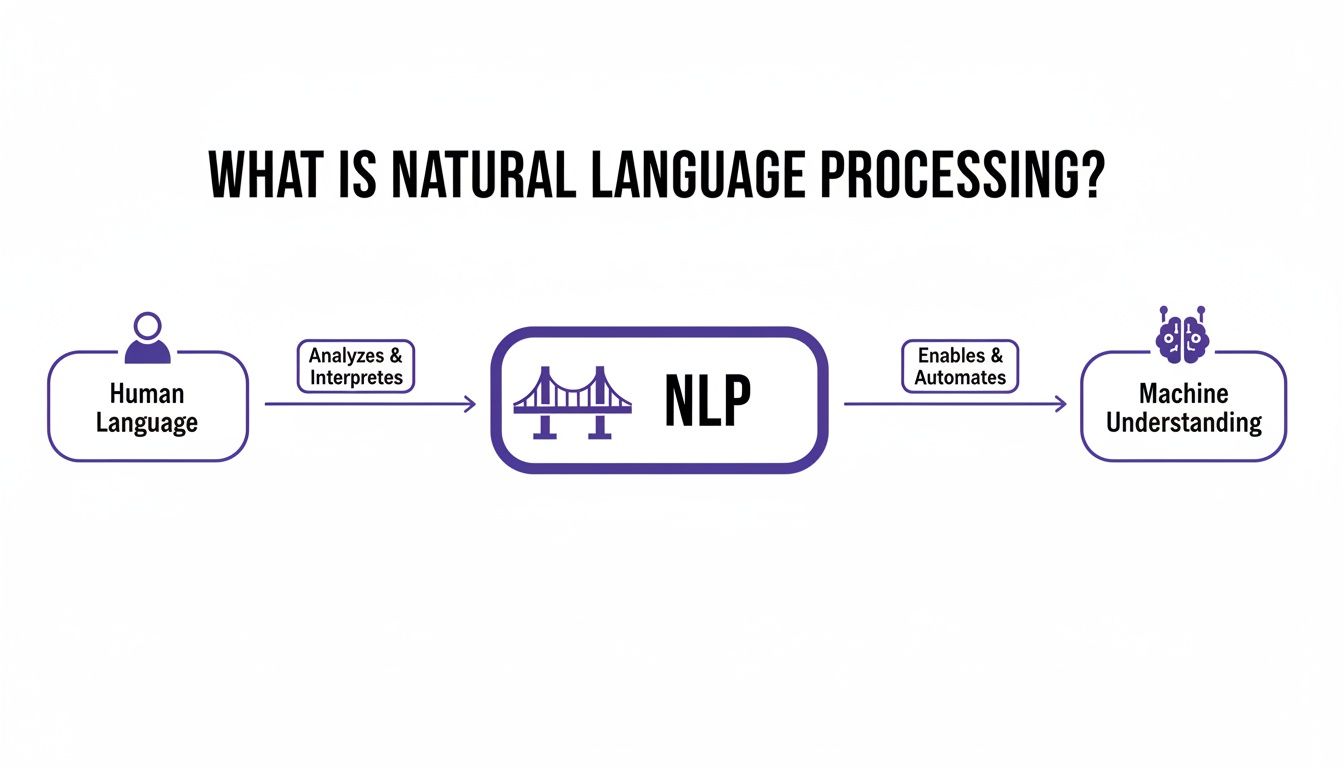
As you can see, the whole point is to create a structured path from our way of talking to real, actionable machine intelligence. It’s what turns your mountain of content into a searchable, analyzable asset.
Tokenization: The First Cut
The very first step on this journey is tokenization. It’s a simple but vital process where the AI chops up a sentence or paragraph into individual words or “tokens.” It’s like taking a sentence and dealing each word out onto its own index card.
For instance, the sentence "Check out our latest podcast episode!" gets broken down into:
Checkoutourlatestpodcastepisode!
This might seem almost too basic, but it’s the bedrock. It turns a massive, intimidating block of text into a neat, ordered list of items that a computer can finally start working with. Once every word is separated, the machine can begin to analyze them one by one and, more importantly, in relation to each other.
Word Embeddings: Giving Words Meaning
With the text chopped into tokens, the real fun begins. A computer doesn't get what "podcast" or "video" means; it only understands numbers. This is where word embeddings come into play.
Embeddings are the truly clever part of how NLP works. They are a method for representing words as lists of numbers, known as vectors. These vectors are specially designed to capture the "vibe"—the meaning, context, and relationships—of a word.
The real magic of embeddings is that words with similar meanings get similar numerical fingerprints. This is how an AI learns that "king" is to "queen" as "man" is to "woman," or that "creator," "vlogger," and "podcaster" are all part of the same family of concepts.
For a publisher, this means an NLP tool can understand that an article about "startup funding" is highly relevant to another one about "venture capital," even if they don't share the exact same keywords. It's this contextual understanding that unlocks the deep insights hiding in your content archive.
Language Models: The AI Brain
Once words are turned into meaningful numbers, the final piece of the puzzle is the language model. Think of a language model as the AI "brain" that has been trained on a staggering amount of text—we’re talking a huge chunk of the internet—to learn the patterns, grammar, and nuance of how we communicate.
These models, like the ones behind ChatGPT or Bard, use all that training to get incredibly good at predicting the next word in a sentence. By doing this millions and millions of times, they develop a sophisticated grasp of context. If you want a deeper dive, our guide on the best LLM models breaks down exactly how these systems operate.
This predictive skill is what allows language models to handle an incredible range of tasks:
- Generating text: Spinning up new blog post drafts or video scripts from a simple prompt.
- Answering questions: Digging through your podcast transcripts to find a specific answer for a listener.
- Summarizing content: Boiling down a long-form article into a short, punchy summary for social media.
For any creator looking to scale up, these language models are what make smart tools like Contesimal possible. They’re the engines that can analyze audience feedback, spark new ideas from your past work, and help you organize your library to find your next hit.
The Journey of Teaching Machines to Talk
To really understand what natural language processing is today, you have to look back at its rocky, decades-long history. The dream of getting computers to understand our language isn't new. It’s a wild ride full of incredible ambition, some crushing disappointments, and finally, the breakthroughs that now power the smart tools creators rely on.
This story explains why the tools you use today feel so much more intelligent than anything that came before them.
The first attempts were all about rules—piles and piles of rigid, handcrafted rules. Think of it like trying to teach someone English by just handing them a dictionary and a grammar book. Sure, it works for simple, perfect sentences, but it completely falls apart the second you run into slang, a typo, or a metaphor.
The First Steps and a Long Winter
This rule-based approach definitely had its moment. The famous Georgetown-IBM experiment in 1954, for example, managed to translate over 60 Russian sentences into English. This kicked off a huge wave of optimism, with people predicting that machine translation was just a few years away from being a solved problem.
Of course, reality turned out to be a lot messier. We got the infamous mistranslation of "the spirit is willing, but the flesh is weak" into the nonsensical "the vodka is agreeable, but the meat is spoiled." By 1966, a major report concluded that machine translation was still slower, more expensive, and less accurate than humans. That report kicked off a long "AI winter" where funding and interest all but vanished.
You can read more about this fascinating cycle of hype and reality in this deep dive into NLP's history. This history matters because it shows the core weakness of old systems: they just couldn't handle ambiguity. Human language is messy, and rules are brittle. For content creators, this meant early tools for analyzing content were clunky, literal, and mostly useless. They could find keywords, but never the actual ideas behind them.
The Shift to Learning from Data
The game completely changed with the rise of machine learning and, more recently, deep learning. Instead of programmers trying to write a rule for every single turn of phrase, the new approach was surprisingly simple: let the machine learn for itself.
By feeding AI models massive amounts of text—books, articles, websites, and transcripts—they began to learn the patterns, context, and relationships of language on their own.
This was the big shift from a rigid rulebook to a flexible, data-driven intuition. It’s the difference between memorizing grammar tables and actually becoming fluent. A huge part of how machines now process and understand language comes from breakthroughs in areas like Large Language Models (LLMs), which are central to how AI works in everything from search engines to content creation tools.
This evolution is exactly why modern NLP is so powerful for creators. We've moved past brittle tools that break on real-world content. Now, we have flexible AI partners that can:
- Understand nuance: Grasp the sentiment behind a flood of audience comments.
- Identify themes: Discover recurring topics across your entire video library.
- Connect concepts: Find the invisible threads linking a podcast episode from 2018 to a blog post from last week.
Today's platforms, like Contesimal, are built on this modern, data-driven foundation. They help humans and AI collaborate and discover value seamlessly, turning a static content archive into a dynamic source of new value. It's the long-awaited payoff from a decades-long journey, finally allowing you to organize, understand, and act on your life's work.
Alright, we've covered the nuts and bolts of what NLP is. Now for the fun part—seeing what this stuff can actually do. The truth is, you’re already using NLP every single day, probably without even noticing. It’s the invisible engine running inside the tools you rely on.
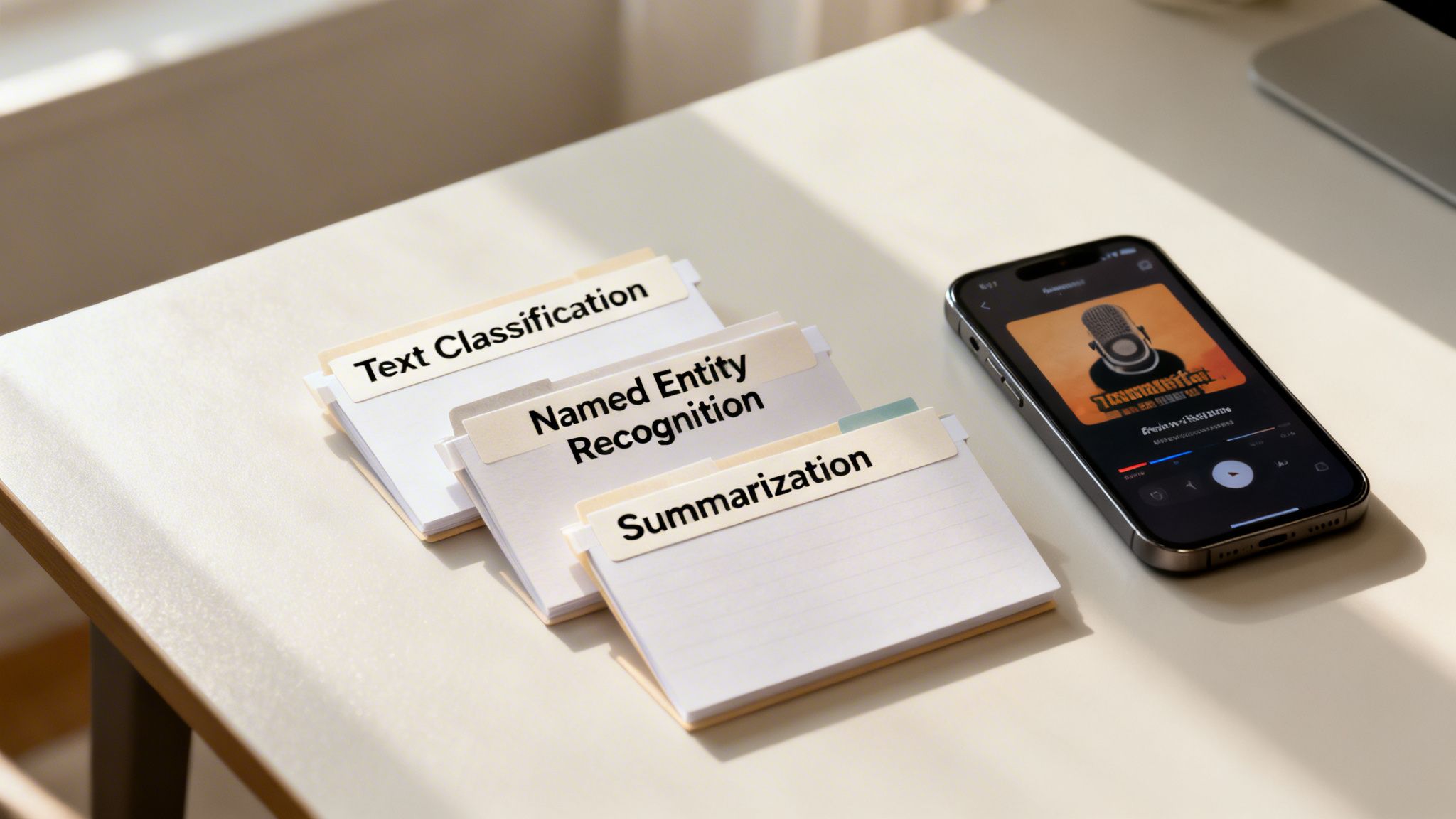
From your phone’s predictive text to the recommendations you get on Netflix, NLP is quietly making things work. For podcasters, publishers, and content teams, these functions are a direct line to getting your time back and making your archive work for you, not against you.
Let's look at the most common NLP tasks and how they translate into real-world tools that can change your workflow.
Text Classification: The Automatic Organizer
At its most basic, text classification is just about putting a label on a piece of text. Think of it as a hyper-fast sorting hat for your content. It’s how your email app knows to shuttle a marketing blast into the "Promotions" folder instead of cluttering your main inbox.
This one is a game-changer for anyone sitting on a big content archive.
Here’s where it gets really useful:
- Sentiment Analysis: Imagine automatically knowing if the thousands of comments on your latest video are overwhelmingly positive, negative, or just neutral. That’s a real-time pulse on what your community actually thinks, without you reading every single comment.
- Topic Modeling: This is like having an assistant who can scan your entire blog archive and automatically group posts into buckets like "Audience Growth," "Marketing Tips," or "Productivity Hacks." Suddenly, building those content hubs that keep people clicking is easy.
- Language Detection: For creators with a global audience, this is essential. It instantly identifies the language of a comment or a customer query so you can respond appropriately.
Instead of spending hours manually tagging hundreds of podcast episodes, text classification does the grunt work for you. It brings order to the chaos and makes your library something you can actually use.
For a creator, text classification acts like an always-on assistant, meticulously organizing your work by topic, theme, and audience sentiment, so you can see the big picture at a glance.
This kind of automated organization is the first step toward a genuinely smart content library. It’s what lets you move beyond simple keyword searches and start finding things based on concepts. We dig into this more in our guide on semantic search vs. keyword search.
Named Entity Recognition: Finding The "Who" And "What"
Ever wish you could instantly pull up every single time you mentioned a specific person, brand, or book across your entire podcast history? That’s exactly what Named Entity Recognition (NER) does. It combs through text to find and tag "named entities"—the proper nouns that give your content its context.
Think of NER as a team of researchers who listen to every second of your audio, noting down all the important names, places, and things.
This is incredibly powerful for making connections within your own work.
- A podcaster can use it to auto-generate show notes with links for every guest, book, or company they talked about. No more frantic scribbling post-recording.
- A publisher can create a rich, searchable database where they can find every article that references a key competitor or industry leader in seconds.
- A YouTuber can analyze their transcripts to see which brands pop up most often, spotting potential sponsorship opportunities they might have missed.
By finding these key details, NER turns your shapeless mountain of content into structured data. That makes it far more valuable and way easier to navigate—for you and your audience.
Automatic Summarization: Creating Snippets in Seconds
Long-form content is fantastic for building authority, but let's be real—it’s not built for the fast-paced world of social media. This is where automatic summarization steps in. This NLP task uses AI to read a long-form piece—an article, a blog post, a transcript—and spit out a short, punchy summary that hits all the main points.
It generally works in one of two ways:
- Extractive Summarization: This is the highlighter method. The AI picks out the most important sentences from the original text and strings them together to create a summary.
- Abstractive Summarization: This approach is more advanced. The AI actually "gets" the material and writes a brand-new summary in its own words, just like a person would. The results are often much more natural.
For any busy creator, this is a productivity cheat code. Think about it: you upload an hour-long podcast and instantly get a bulleted list of key takeaways for your show notes, a short paragraph for your newsletter, and a handful of tweet-sized highlights for social media. That’s what automatic summarization does—it turns one pillar piece of content into a dozen smaller assets with almost no effort.
How Creators and Publishers Can Use NLP to Grow
Knowing the theory behind Natural Language Processing is one thing, but the real fun starts when you see how it can actually grow your business. For creators and publishers, NLP isn't some abstract tech curiosity. It’s a set of tools that can help you find your next hit idea, repurpose your old work, and even create new income streams from the content you’ve already made.
This is the point where your content library stops being a dusty digital attic and starts acting like a living, breathing asset. By using NLP, you can finally understand and organize your entire catalog at a scale that was never possible before. Let’s get into the practical ways this tech can go to work for you.
Find Your Next Viral Idea in Your Own Data
Your audience is constantly telling you what they want to see, but that feedback is usually scattered across thousands of comments on a dozen different platforms. Once you start to grow, trying to read everything yourself is a losing battle. NLP can handle this for you with sentiment analysis and topic modeling.
An NLP-powered system can scan all your YouTube comments, podcast reviews, and blog feedback to instantly spot:
- Recurring questions: If you see dozens of people asking the same question, that’s your next Q&A video or how-to guide, served up on a silver platter.
- Positive sentiment spikes: Did a specific guest or topic in your last podcast get a wave of positive reactions? That’s a massive signal to double down and create a follow-up series.
- Emerging trends: NLP can pick up on new keywords and ideas your community is talking about before they hit the mainstream, giving you a huge head start.
This flips audience feedback from a noisy distraction into your most powerful source of market research. You’re no longer guessing what might work; you’re making decisions based on what your community is already begging you for.
Turn Your Content Library into a Goldmine
For most creators, old content just sits there, gathering digital dust. NLP completely changes that by making your entire back catalog searchable and ready for a second life. It helps you organize your work by the concepts inside it, not just by file names, which unlocks some serious potential.
Think of your content archive not as a pile of individual files, but as a single, connected knowledge base. NLP is the key that lets you ask questions of your entire body of work and get smart answers back.
Here are a few ways this plays out in the real world:
- Build Topical Content Hubs: You can automatically tag every video, podcast, and article you've ever made. A platform like Contesimal can instantly pull together all your content about "audience growth" or "video editing," letting you create curated playlists and resource pages that boost watch time and SEO.
- Repurpose Content Intelligently: NLP can watch a ten-part video series and pull out the main themes, key lessons, and most powerful quotes. You can then use that structured data to effortlessly outline a book, script a mini-course, or generate a month’s worth of social media clips.
- Monetize Niche Expertise: Imagine a publisher using NLP to scan their archives for every article that mentions a specific person or technology. That organized collection can then be packaged into a premium ebook or a special print edition, creating a brand-new product from assets they already own.
Streamline Your Creative Workflow
The constant pressure to ship fresh content is exhausting. It leads to burnout and a whole lot of staring at a blank screen. NLP can act as your creative partner, handling the tedious stuff so you can stay focused on the big, creative ideas.
For example, when you hit a wall, you can get a major head start by using AI-powered content drafting tools to brainstorm initial concepts or clean up your writing.
Here’s how this can fit into your day-to-day:
- Automated Research: Instead of endless Google searches, you can just ask your own content library, "What have I said about brand sponsorships before?" An NLP tool like Contesimal can pull every relevant clip from your videos and transcripts, giving you a perfect starting point for your next script.
- Generate First Drafts: By feeding an NLP model a simple outline and a few key points, you can get a rough draft for a blog post or video script in minutes. It won't be perfect, but it breaks the "blank page" problem and gives you something to react to and shape with your own voice.
When you start using these strategies, you stop being just a content maker and start operating like a savvy business owner. Your work is no longer a series of one-off projects, but a compounding library of value that can be remixed, repurposed, and remonetized for years to come.
Putting NLP to Work with Intelligent Content Tools

Understanding the concepts behind Natural Language Processing is one thing. Putting that power into practice is a whole different game. This is where modern tools come in, bridging the gap between tech-talk and tangible results.
These tools are designed to turn a chaotic, sprawling content archive into an organized, valuable asset. For creators, publishers, and marketers, this is huge. It means you can finally make sense of your entire library without needing a degree in data science.
Your Content as a Knowledge Base
For too long, your old videos, podcast episodes, and articles have been gathering digital dust in separate folders, impossible to search and connect. NLP-powered platforms like Contesimal change that by turning this scattered collection into a single, searchable knowledge base.
Think of it as a central brain for all your creative work.
This is all happening behind the scenes, powered by core NLP tasks:
- AI-Powered Classification: The system automatically watches, listens to, and reads every piece of content, tagging it with relevant topics. A video about "email marketing" and a podcast on "newsletter growth" are finally linked, even if they never use the same words.
- Entity Recognition: It also identifies and catalogs every person, brand, and product you’ve ever mentioned, creating a rich, interconnected map of your entire universe.
Instead of a messy desktop full of files, you get an organized library that actually understands the ideas inside it. This deep organization is the bedrock for turning your past work into future opportunities.
By applying NLP, a platform like Contesimal acts as your co-pilot. It helps you and your team collaborate with AI to turn disconnected files into structured value, reigniting your content library and bringing it to life.
This entire approach is central to modern content intelligence platforms, which are all about squeezing new meaning and value out of the content you already have.
Talking to Your Content Library
Now for the really cool part. Imagine being able to ask your archive questions and get instant, specific answers. This is one of the most powerful ways NLP is changing content workflows.
Using a simple chat interface, you can "talk" to your entire library in plain English. No complicated search filters or weird syntax required.
You can ask things like:
- "Show me every time I talked about SEO with a guest."
- "What were the top three points from my podcast series on audience building?"
- "Find all clips where I mentioned my sponsor's competitor."
The system uses NLP to understand your question, scan its organized index, and pull up the exact video clips, audio segments, or text passages that have your answer.
This ability to query your life's work is a massive time-saver. It helps you find forgotten gems, fact-check new scripts, and discover connections you never knew existed. It’s the ultimate way to organize, understand, and finally take action on your entire creative history.
Your Top NLP Questions, Answered
As creators and publishers start digging into what natural language processing is, a few questions always seem to surface. The tech itself can sound complicated, but its real-world uses are refreshingly straightforward. Here are some clear answers to help you see exactly how NLP can fit into your work.
Our goal here is to cut through the confusion and show you how to get started with these powerful tools.
Do I Need to Be a Tech Guru to Use NLP?
Not at all. While the underlying technology is incredibly complex, modern tools like Contesimal were built for creators, not data scientists. These platforms do all the heavy lifting for you, offering simple, intuitive interfaces—think a simple chat window—that let you get all the benefits of NLP without ever touching a line of code.
How Is an NLP Chatbot Different from Those Old, Clunky Ones?
You probably remember those old, rule-based chatbots. They could only respond to specific keywords you programmed in advance. If you didn't phrase your question exactly right, the whole thing would just break.
An NLP-powered bot is a different beast entirely. It understands intent. It gets the meaning behind your words, isn't thrown off by typos, and can even remember what you were talking about earlier in the conversation. It's the difference between a rigid, pre-written script and a genuinely flexible conversation. In fact, a recent report showed 70 percent of business leaders see modern bots as essential architects for creating personalized user journeys.
Is It Super Expensive to Get Started with NLP Tools?
It definitely used to be. Building an NLP system from the ground up meant a huge investment in data, servers, and specialized talent. Thankfully, that's no longer the case.
Subscription-based software brings the power of enterprise-level NLP down to individual creators and small teams. This lets you pay for a service instead of building an entire infrastructure from scratch, making it a cost-effective way to organize and monetize your content library.
Instead of a massive one-time expense, it becomes a manageable operational cost, just like your other creative software subscriptions.
Ready to turn your content library into a goldmine? With Contesimal, you can organize, understand, and monetize your creative assets with the power of AI. Stop letting your old content gather dust and start discovering its hidden value today. Explore how it works and see what's possible.