
You're probably in one of two places right now. Either you have a term paper due soon and a pile of notes that still doesn't look like an argument, or you create research-driven content and you've realized the same problem keeps showing up there too. You have material, but not shape. You have sources, but not a point.
That's why writing a term paper matters far beyond school. A strong term paper teaches disciplined thinking: how to narrow a subject, build an argument, choose evidence, and revise for clarity. Those are the same skills behind a serious video essay, a white paper, a longform newsletter, or a deep-dive blog post.
Most advice stops at generic steps like pick a topic, do research, make an outline, add citations. That isn't enough. The hard parts are deciding what your paper is trying to prove, and making sharp judgment calls about what belongs in the final argument. Those are the skills that separate a paper that feels assembled from one that feels authored.
Beyond the Topic Forging a Defensible Thesis
The weakest advice students get is “pick a topic.” A topic is not a paper. “Climate policy,” “Shakespeare,” “social media,” and “AI in content creation” are shelves, not arguments.
A better starting point is the angle. Pat Thomson's guidance is more useful than most term paper checklists because it pushes writers to think about the reader, what the reader already knows, what is new, and why the reader should care in the first place, rather than just formatting sections or gathering citations in a generic way (Pat Thomson on finding an angle).
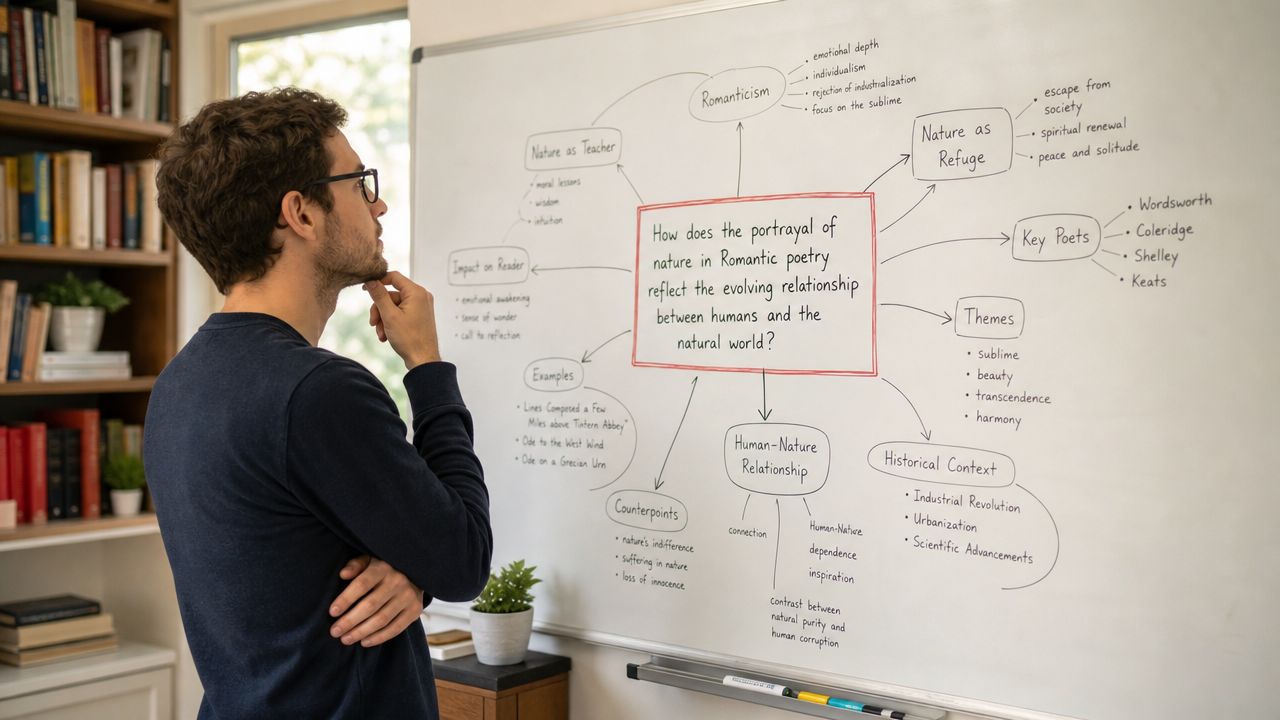
Topic versus thesis
Here's the practical distinction:
| Starting point | What it produces |
|---|---|
| Topic | A broad subject area |
| Question | A focused line of inquiry |
| Thesis | A claim that can be defended with evidence |
If your draft opens by summarizing everything related to the subject, you probably stopped at the topic stage.
A thesis needs pressure. It should force decisions. It should make some evidence relevant and other evidence unnecessary. If your statement allows every paragraph to wander anywhere, it isn't a thesis yet.
How to build a usable angle
Try this sequence before you draft a single paragraph:
Name the broad area
- “Independent podcasting and AI tools.”
Identify a tension
- “These tools can speed production, but they may also flatten originality or alter revenue models.”
Define the reader
- “An instructor evaluating argument quality” or “an audience of creators trying to make editorial decisions.”
Ask what's new
- Not “AI exists.” More like “How does this tool change editorial labor, credibility, or economic viability?”
Turn it into a claim
- “Generative AI changes independent podcasting less by replacing hosts than by shifting research, scripting, and production decisions upstream.”
That final sentence gives you something to defend. It also gives you something to reject if the evidence doesn't support it.
Practical rule: If two reasonable people couldn't disagree with your thesis, it's probably too descriptive.
What works and what doesn't
What works:
- A narrow claim: Specific enough that you can test it against evidence.
- A built-in standard of relevance: Every source must help support, complicate, or challenge the claim.
- A clear sense of audience: You know what needs explanation and what can be assumed.
What doesn't work:
- A report disguised as an argument: “This paper will discuss…”
- A fact collection: Multiple interesting points with no central tension.
- A giant umbrella thesis: So broad that every paragraph becomes a mini-essay.
If you need help tightening the core sentence, this guide on how long a thesis statement should be is useful because length often reveals whether the claim is focused or bloated.
Strategic Research That Builds Your Argument
Once the thesis exists, research becomes selective. That's the shift students often miss. You are not collecting information about a topic. You are building a case.
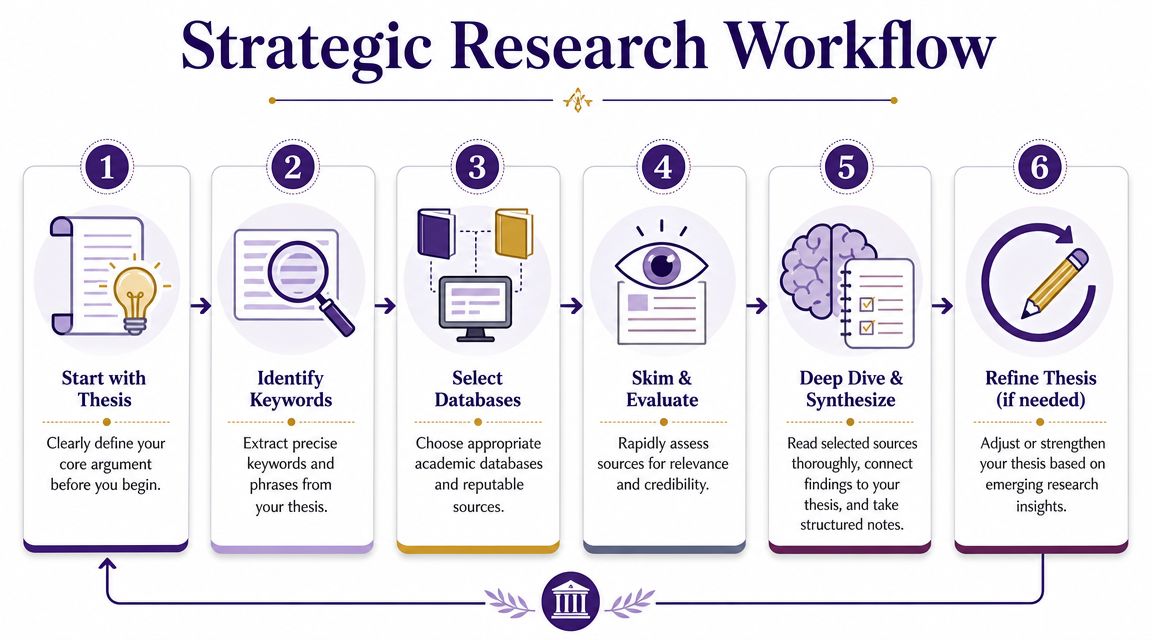
A simple workflow keeps research from turning into endless browsing.
A research workflow with a point
Start with the thesis
- Pull out the key terms, tensions, and possible counterarguments.
Translate the thesis into search language
- Use exact concepts, close synonyms, and narrower sub-questions.
Skim before you commit
- Abstract, introduction, headings, conclusion, then selected pages.
Sort each source by role
- Background, supporting evidence, challenge, method, or context.
Take notes against the thesis
- Don't just summarize. Record what the source lets you say.
Refine the thesis if the literature forces it
- Strong research sometimes sharpens the original claim.
This section of the process is where writers either gain authority or lose weeks.
For a quick visual explanation of how to move from a thesis to usable material, this video is worth watching:
Decide what kind of source you're holding
Not all sources do the same job. Students often mix them as if they're interchangeable, then wonder why the paper feels flimsy.
A practical filter:
- Primary sources give you direct material from the subject you're studying.
- Secondary sources interpret, explain, or argue about that material.
- Scholarly sources usually help with sustained argument and discipline-specific framing.
- Popular sources can help with context, current examples, or public framing, but they rarely carry the whole paper.
If you want a clean explanation of how to separate source types, Model Diplomat has useful advice on primary vs secondary sources.
A second filter matters just as much: credibility. Before you rely on any article, report, or archive item, check authorship, publication context, evidence quality, and whether the source is addressing your question. This guide on what makes a source credible is a strong checklist for that judgment call.
A source can be accurate and still be wrong for your paper. Relevance is part of credibility in practice.
Build a working research system
The best note-taking system is the one you'll use consistently. But it should capture three things every time:
| Note field | Why it matters |
|---|---|
| Claim | What the source argues or shows |
| Usable evidence | The passage, finding, or example you may cite |
| Your analysis | Why it matters for your thesis |
That third column changes everything. Without it, you end up with a stack of quotations and no paper.
This is also where term-paper discipline becomes transferable to content creation. A creator building a video essay or longform article needs a reusable research library, not a pile of random tabs. When you research by claim, source role, and argument value, you're building material you can later adapt into scripts, posts, explainers, or editorial briefs.
Architecting Your Paper with a Powerful Outline
A stack of good notes can still produce a messy paper. The missing step is structure. Strong papers feel inevitable because the outline did the heavy lifting before the prose ever appeared.
One reliable academic structure includes introduction, literature review, methodology, findings or analysis, discussion, and conclusion, and some style guides also require elements such as a title page, abstract, main body, and references. Ignoring format constraints can damage the submission even when the argument itself is strong, especially when a style guide expects specific sections and page layout (overview of term-paper structure and formatting pitfalls).

What each section has to do
An outline gets stronger when you assign a job to each part.
Introduction
- Establish the question, supply needed context, present the thesis.
Literature review
- Show what others have already said, where they agree, where they differ, and where your paper enters the conversation.
Methodology
- Explain how you are approaching the material. In some humanities papers this may be brief, but the logic still matters.
Analysis or findings
- This is the center of gravity. Evidence appears here because it advances your claim.
Discussion
- Interpret the meaning of the analysis. Address implications, tensions, and limits.
Conclusion
- State what the reader should now understand differently.
Use assignment-specific judgment
Many papers cease to be strategic at this point. Generic advice states, “include evidence” and “be thorough.” In practice, that's not how good papers are built.
Loyola's writing guidance on close reading is useful because it emphasizes patterns, contrasts, and the central passages rather than trying to cover everything. That assignment-specific judgment is what many term-paper guides skip (Loyola on close reading and evidence selection).
You usually do not need every relevant point you found. You need the points that do the most work.
The strongest paper is rarely the one with the most evidence. It's the one where every piece of evidence earns its place.
A useful test is to ask of each paragraph: does this move the argument, or does it merely prove I did research?
Reverse-outline your draft before it exists
A normal outline lists what you plan to say. A reverse outline lists what each paragraph must accomplish.
Try a stripped-down version like this:
| Paragraph | Job | Evidence | Why it belongs here |
|---|---|---|---|
| 1 | Introduce problem | Course context or central issue | Opens the question |
| 2 | State thesis | Your claim | Sets reader expectations |
| 3 | Position against literature | Key scholarly dispute | Establishes relevance |
| 4 | Analyze core example | Primary text or data | Begins proof |
| 5 | Address objection | Counter-source | Strengthens credibility |
That level of planning prevents repetition and helps you see where the logic jumps too fast.
If you want a broader guide to shape and coherence, this resource on structure in writing is helpful because it treats structure as argument, not decoration.
Format is part of the argument
Students often treat formatting as clerical cleanup. In grading, it isn't. If the assignment asks for APA, MLA, Chicago, or a department-specific pattern, follow it exactly. The reader shouldn't have to guess where your abstract is, whether your references are complete, or why the headings are inconsistent.
That same discipline carries into content work. A video essay has section logic. A newsletter has pacing. A longform article has hierarchy, transitions, and source transparency. The medium changes. The structural thinking does not.
The Art of Drafting Without Procrastination
Most procrastination in term papers isn't laziness. It's perfectionism wearing academic clothes. Students stall because they think drafting is the moment when every sentence has to become final. It doesn't.
Drafting works better when you treat it as translation, not performance. You already did the hard thinking in the thesis, research, and outline. Now you are converting planned argument into readable prose.
Why the fast draft works
A fast draft reduces the number of decisions you make at once. You are not trying to solve structure, style, citation perfection, and wording in a single pass. You are trying to get a usable version of the argument onto the page.
That matters because writing term paper assignments often collapses when students keep line-editing the introduction while the rest of the paper still doesn't exist. They spend an hour reshaping one sentence, then panic because no body paragraphs are drafted.
What works better is this:
Start with the easiest section
- If your evidence paragraph is clearer than your opening, begin there.
Use placeholders
- Write “[insert citation]” or “[transition]” and keep moving.
Draft one argument chunk at a time
- Aim for paragraph logic first, not elegant phrasing.
Save sentence polish for revision
- Clarity improves faster when the whole structure is visible.
Sentence patterns that keep momentum
Students freeze when they think every paragraph needs a brilliant opening. It doesn't. A few sturdy templates can move the paper forward.
For introducing a claim:
- “This evidence suggests that…”
- “A more convincing interpretation is…”
- “The central issue is not X but Y.”
For bringing in evidence:
- “This passage matters because…”
- “The source complicates that view by showing…”
- “Rather than confirming the common assumption, this example indicates…”
For analysis:
- “That distinction changes the argument in two ways.”
- “The stronger reading focuses on the contrast between…”
- “This matters for the thesis because…”
Draft badly on purpose, then improve it
Here's a trade-off I've seen over and over. Writers who try to sound polished too early often produce stiff, cautious paragraphs with no analytical force. Writers who allow themselves a rough first pass usually generate better material because they leave room for thinking on the page.
Drafting advice: Write a version that is honest before you write one that is elegant.
That applies outside the classroom too. The same method helps when scripting a documentary-style YouTube video or building a research-heavy blog post. If the argument is good, the prose can be sharpened later. If the argument is weak, no amount of polish saves it.
A practical drafting rhythm looks like this:
- Open the outline.
- Pick one paragraph.
- State the paragraph's claim in plain language.
- Add the evidence.
- Explain why the evidence matters.
- Move on before rereading too much.
That rhythm keeps the paper alive. It also prevents a common trap: writing long descriptive paragraphs that never return to the thesis. If a paragraph ends and you still haven't explained why the evidence matters, the paragraph is incomplete.
Refining and Polishing Your Final Paper
A familiar scene plays out the night before submission. The draft looks finished, the citations are in place, and the writer starts fixing commas. An hour later, a significant problem surfaces. One body section does not support the thesis, two quotations do work the writer should have done, and the conclusion repeats the introduction with cleaner wording.
That is why revision has to start with judgment, not proofreading. The hard part is deciding what strengthens the argument and what only looks impressive because it took time to find. Strong final papers come from writers who are willing to test the draft against the thesis they set out to defend, then cut anything that weakens the line of reasoning.

Pass one fixes the argument
Set the draft aside before revising it. Even one night helps. Distance makes it easier to notice when the paper drifted from a defensible claim into summary, topic coverage, or paragraphs that belonged to an earlier version of the thesis.
Read for structure first and ask sharper questions than “does this sound good?” Ask:
- Does the thesis still make a specific, arguable claim?
- Does each section earn its place by advancing that claim?
- Which evidence is carrying the argument, and which evidence is just sitting on the page?
- Did any paragraph turn into background when it should have produced analysis?
- Does the conclusion show what the paper proved, changed, or clarified?
This pass often requires real cuts. I usually advise students to save removed material in a separate document, not because it may return, but because it makes better decisions easier. Once you stop treating every note or quotation as sacred, the paper gets tighter fast.
Pass two fixes the prose
After the structure holds, revise sentence by sentence. The goal is not to sound fancier. The goal is to make the reasoning easier to follow.
Look for these common problems:
| Problem | Better move |
|---|---|
| Redundant phrasing | Cut repeated claims and keep the strongest wording |
| Vague verbs | Use direct analytical verbs such as argues, qualifies, rejects, or demonstrates |
| Overlong quotations | Quote less, explain more |
| Foggy transitions | State the logical connection between paragraphs plainly |
Read the paper aloud. Awkward syntax, inflated phrasing, and weak transitions become obvious when heard. So do claims that seemed persuasive on the screen but fall apart when spoken in full.
This habit transfers well beyond academic work. A video essay script, reported newsletter, or research-heavy blog post also benefits from the same test. If a sentence is hard to say, it is often hard to understand.
Pass three fixes the submission
The final pass checks credibility at the technical level. Readers notice argument first, but instructors also notice carelessness.
Review these details:
- Citations: Every in-text citation matches the bibliography or works cited page.
- Formatting: Headings, spacing, margins, title page, and required elements follow the assignment rules.
- Reference consistency: Names, capitalization, dates, punctuation, and ordering follow one style.
- Small errors: Typos, repeated words, missing words, and copy-paste leftovers are gone.
Tools can help here. Zotero can organize references. Styles in your word processor can keep headings consistent. Grammar tools can flag cluttered sentences. None of those tools can decide whether a paragraph belongs in the paper or whether a source earns its space. That judgment still belongs to the writer, and it is one of the most transferable skills term-paper work teaches.
Managing Your Time and Avoiding Common Pitfalls
The usual failure point is not the night before the deadline. It starts earlier, when a student treats the paper as one task instead of a chain of decisions. A strong schedule protects the two judgments that matter most: settling on a thesis you can defend, and choosing evidence that earns its place in the argument.
Time management for a term paper is really decision management. If the thesis is still vague, research expands without control. If source selection stays loose, the draft swells with quotations, summary, and side roads that never support the central claim. The result is familiar: too much material, not enough argument, and a rushed ending.
A practical timeline
With more than a few days, divide the work into blocks that match the cognitive load of the assignment:
Start with the claim
- Decode the prompt, test a narrow direction, and write a provisional thesis you could defend in one paragraph.
Research for relevance
- Collect sources with a purpose. Ask what each one helps you prove, qualify, or challenge.
Outline by argument
- Build the paper around paragraph jobs and logical sequence, not generic headings.
Draft in passes
- Write the body first if needed. Get the reasoning down before spending too much time polishing the opening.
Revise with distance
- Leave the paper alone for a few hours or overnight, then review structure, analysis, and citations as separate tasks.
This approach also mirrors how strong research-driven content gets made outside the classroom. A video essay, reported feature, or longform blog post improves when the creator decides early what claim the piece will defend and which material belongs on the cutting-room floor.
Common mistakes that weaken otherwise good papers
Treating the prompt as background information
- Keep it visible. Many decent drafts lose points because they answer a nearby question instead of the assigned one.
Researching before forming a workable thesis
- Early research should help sharpen the claim, but endless reading often becomes a delay tactic.
Including evidence because it is interesting
- Interesting is not enough. If a source does not advance the argument, frame a counterargument, or supply needed context, cut it.
Letting quotations do the thinking
- A paper earns its authority through explanation. Sources support the argument. They do not replace it.
Spending too much time on the introduction
- Instructors usually grade the analysis more heavily than the opening scene-setting.
Saving citation checks for the last five minutes
- Small reference errors can make careful reasoning look careless.
One habit solves more problems than students expect. Put dates on decisions, not just tasks. Set one deadline to approve the thesis, another to stop gathering sources, and another to finish the outline. Without those stopping points, research and drafting blur together, and the paper never becomes selective.
The larger lesson matters beyond school. Writing a term paper teaches disciplined judgment under constraints. That is the same skill serious writers and creators use when turning notes, archives, interviews, and sources into work an audience can trust.
If your work involves research-heavy articles, videos, podcasts, or a growing archive of source material, Contesimal can help you organize that knowledge so it's easier to search, reuse, and turn into new content. For creators and publishers trying to move from one-off production to a real content system, that kind of structure makes it much easier to build stronger arguments, faster briefs, and better longform work from what you already have.