
You're staring at a prompt, a blank document, and a text that feels persuasive for reasons you can't quite name. That's exactly the right moment to learn how to write a rhetorical analysis, because the assignment isn't really about retelling what a speaker said, it's about explaining how the speaker made an audience listen, trust, feel, and respond.
A strong rhetorical analysis works like a close reading with a purpose. You're not hunting for plot, you're investigating persuasion, and once you know what to look for, speeches, ads, essays, YouTube videos, and podcasts start to look like carefully built arguments instead of random content.
Why Rhetorical Analysis Is a Superpower
A persuasive message can feel effortless when it lands well. A campaign video, a podcast monologue, or a fund-raising speech may sound natural on the surface, but that calm surface usually hides deliberate choices about language, structure, pacing, and audience. Each choice shapes how the message is received, almost like a speaker adjusting the volume, timing, and tone of a conversation to guide the room.
This is why rhetorical analysis matters beyond the classroom. It helps you notice how persuasion works, which matters whether you are evaluating a political speech, a brand story, a YouTube video, a podcast episode, or your own content. Classical rhetoric still organizes this work through ethos, pathos, and logos, and writing centers teach it as a way to identify devices, judge whether they help the message, and explain why they matter. That framework stays useful because it gives you a repeatable method for looking at both essays and modern media.

If you have ever watched a video and thought, “Why did that feel convincing?”, you were already doing a version of rhetorical analysis. The goal is to turn that instinct into a clear, organized argument.
Practical rule: do not ask only, “What is the message?” Ask, “What choices make this message persuasive to this audience?”
The Foundations of Rhetorical Analysis
Rhetorical analysis starts like a case file, not a summary. You are not only asking what the speaker said, you are tracing the choices around the message, the speaker, the audience, the purpose, and the context that shape how it works. That mindset matters whether you are studying an essay, a YouTube video, or a podcast episode, because digital texts often persuade through voice, pacing, visuals, and editing as much as through wording.
The first lens is the rhetorical situation. Look at the author or speaker, the audience, the purpose, and the context. A speech written for voters during an election will make different moves than a podcast episode aimed at loyal subscribers, because the audience's expectations change the strategy. A creator speaking to first-time viewers has to build trust and clarity fast, while a writer addressing insiders can rely on shared knowledge.
The second lens is Aristotle's trio, ethos, pathos, and logos. Ethos is credibility, the way a writer or speaker builds trust. Pathos is emotion, the way a text pushes readers to feel concern, hope, anger, or pride. Logos is reasoning, the way a text uses evidence, structure, or cause-and-effect logic to support a claim. Writing centers describe this framework as a practical way to identify devices, judge whether they help the message, and explain why they matter.
A simple way to think about the three appeals
| Appeal | What it does | What to notice |
|---|---|---|
| Ethos | Builds trust | expertise, experience, fairness, tone |
| Pathos | Shapes feeling | loaded words, stories, imagery, urgency |
| Logos | Supports logic | evidence, examples, sequence, reasoning |
A useful next step is to keep your notes organized while you read or watch. A short note-taking system helps you track repeated patterns without losing your place, and a guide to annotating PDFs and digital texts can make that process easier when you are working with screens instead of printed pages. If you are balancing classes, work, or content creation, reading skills for busy professionals can also help you read with more focus and less drift.
University guidance also points writers toward a focused essay shape, usually built around a few main strategies, because a rhetorical analysis gets stronger when you choose a small set of defensible moves instead of trying to mention everything. That means you are not memorizing a script. You are learning how to choose what matters and explain why it matters.
A good analysis sounds like this, “The speaker uses credibility, emotion, and structure to persuade a skeptical audience,” not, “The speaker talks about a big issue.”
How to Actively Read and Annotate for Analysis
Passive reading asks, “What happened?” Active reading asks, “What did the writer do here, and why?” That shift matters because rhetorical analysis depends on noticing patterns, not just understanding content.
Start with a quick preview. Scan the title, first paragraph, headings, visuals, and ending. Then read once for general meaning, without stopping every few words, so you can hear the overall argument before you dissect it. If the text is a video or podcast, listen or watch once for the emotional shape of the piece, then a second time for specific choices like pauses, transitions, music, framing, or repetition.
Your annotations should be questions, not just highlights. Mark places where the writer sounds especially confident, careful, urgent, warm, skeptical, or ironic. Circle vivid diction, underline claims, and jot brief notes in the margin about audience response, because the point is to track the relationship between technique and effect.
What to look for beyond ethos, pathos, and logos
- Tone shifts: notice where the voice becomes more formal, more intimate, or more urgent.
- Diction choices: watch for words that feel plain, technical, emotional, or loaded.
- Imagery: mark language that creates a picture or sensory response.
- Structure: note where the argument slows down, speeds up, or repeats itself.
- Repetition: look for phrases or ideas that are brought back for emphasis.
- Audience cues: identify where the speaker seems to assume the listener already agrees, doubts, or needs reassurance.
If you want a practical system for marking PDFs, this note-taking guide for PDFs is useful because it shows how to keep observations organized instead of scattered. For readers who need a stronger refresher on comprehension before analysis, reading skills for busy professionals can help sharpen the first pass before you start annotating.
Note to self: if you can't explain why a line matters, you haven't analyzed it yet, you've only highlighted it.
Building Your Argument With a Strong Thesis and Outline
A rhetorical analysis thesis should not read like a report title. It needs to make a judgment about effectiveness, which means it has to answer a simple question, how well do the writer's choices work for this audience?
A weak thesis says something like, “The author uses ethos, pathos, and logos in the speech.” That only names tools. A stronger thesis says something like, “The speaker builds trust through a calm, expert tone, stirs urgency through emotional examples, and strengthens the argument with direct reasoning, making the message effective for a cautious audience.” The difference is clear, one reports, the other argues.
Once your thesis is set, choose 3 or 4 strategies you can defend. Too many categories can blur the essay, while a smaller set keeps your reasoning focused and easier to follow. If you are still sorting rough notes into a claim, planning thesis workflows can help you turn scattered observations into a sentence that makes a real argument.
A useful way to picture the outline is as a map with only the roads you plan to travel. You do not need every note you wrote down. You need the few points that support the route your thesis is taking, and that is where this guide to structure in writing becomes helpful when you are deciding what belongs in the draft.
A practical outline shape
Your introduction should identify the author, the text, the audience, and the context before you state your central claim CSU East Bay's rhetorical analysis formatting handout. Then each body paragraph should focus on one strategy, one example, and one effect, so the reader can see the argument develop one piece at a time.
A simple outline looks like this:
- Intro: author, title, context, audience, thesis.
- Body paragraph 1: first strategy and its effect.
- Body paragraph 2: second strategy and its effect.
- Body paragraph 3: third strategy and its effect.
- Conclusion: explain why the strategy matters overall.
If your notes feel messy, that is normal. The job here is not to include every observation, it is to choose the few that best support your argument and build a line of reasoning around them. A thesis and outline work like a scaffold, they hold the essay in place while you sort which evidence deserves the most attention.
Writing Compelling Paragraphs That Show Your Work
The best body paragraphs in a rhetorical analysis feel like small proof machines. Each one should start with a claim, bring in evidence, and then explain the effect on the audience, so the reader can follow your logic without guessing what the quotation is supposed to prove.
The technique, evidence, effect pattern
A useful paragraph shape is technique → evidence → effect. You name the rhetorical move, show the exact words or moment that demonstrate it, and then explain how that choice changes the audience's response. That structure keeps the essay analytical instead of descriptive Tutor.com's rhetorical analysis workflow.
Here's a model paragraph built from that structure:
The speaker builds ethos by speaking in a measured, respectful tone that makes the audience see him as steady rather than impulsive. When he describes the issue with plain, controlled language instead of dramatic exaggeration, he presents himself as someone the audience can trust to handle a difficult topic responsibly. That calm tone matters because it lowers resistance, especially for readers who might initially doubt the argument.
Now compare that to a weaker version:
The speaker uses ethos. He sounds calm and respectful. This makes the speech better.
The first paragraph explains how the choice works. The second only labels the device and gives a vague opinion. That's the gap between analysis and summary.
A short revision model
When you revise a paragraph, check whether each sentence does one of these jobs:
- State a strategy clearly so the reader knows what you're analyzing.
- Include a specific example from the text, not a general description.
- Explain the audience effect in plain language.
- Use present tense when describing what the author does, since university guides expect that convention in analysis writing Scranton Writing Center's rhetorical analysis advice.
Writing center habit: after every quote, add at least one sentence that answers, “So what does this do for the audience?”
If you're writing for AP Lang or another timed setting, remember that the grader wants evidence plus commentary, not just a pile of quotations. The commentary is where your thinking shows up, and that's usually where the strongest essays separate themselves from the average ones College Essay Guy's AP Lang rhetorical analysis guide.
Advanced Analysis and Polishing Your Final Draft
Rhetorical analysis gets more interesting when you move beyond essays and speeches. A YouTube video can build ethos through a creator's setting and on-screen presence, pathos through music and pacing, and logos through a step-by-step visual explanation. A podcast can persuade through vocal tone, pauses, editing rhythm, and the way a host frames the listener's role.
That matters because modern rhetorical texts often mix formats. If you analyze a TikTok, a documentary clip, or a podcast clip, treat the visuals and audio as evidence, not decoration. Ask what the camera angle suggests, what the sound design encourages the listener to feel, and how the editing controls attention, because those choices are part of the argument too.
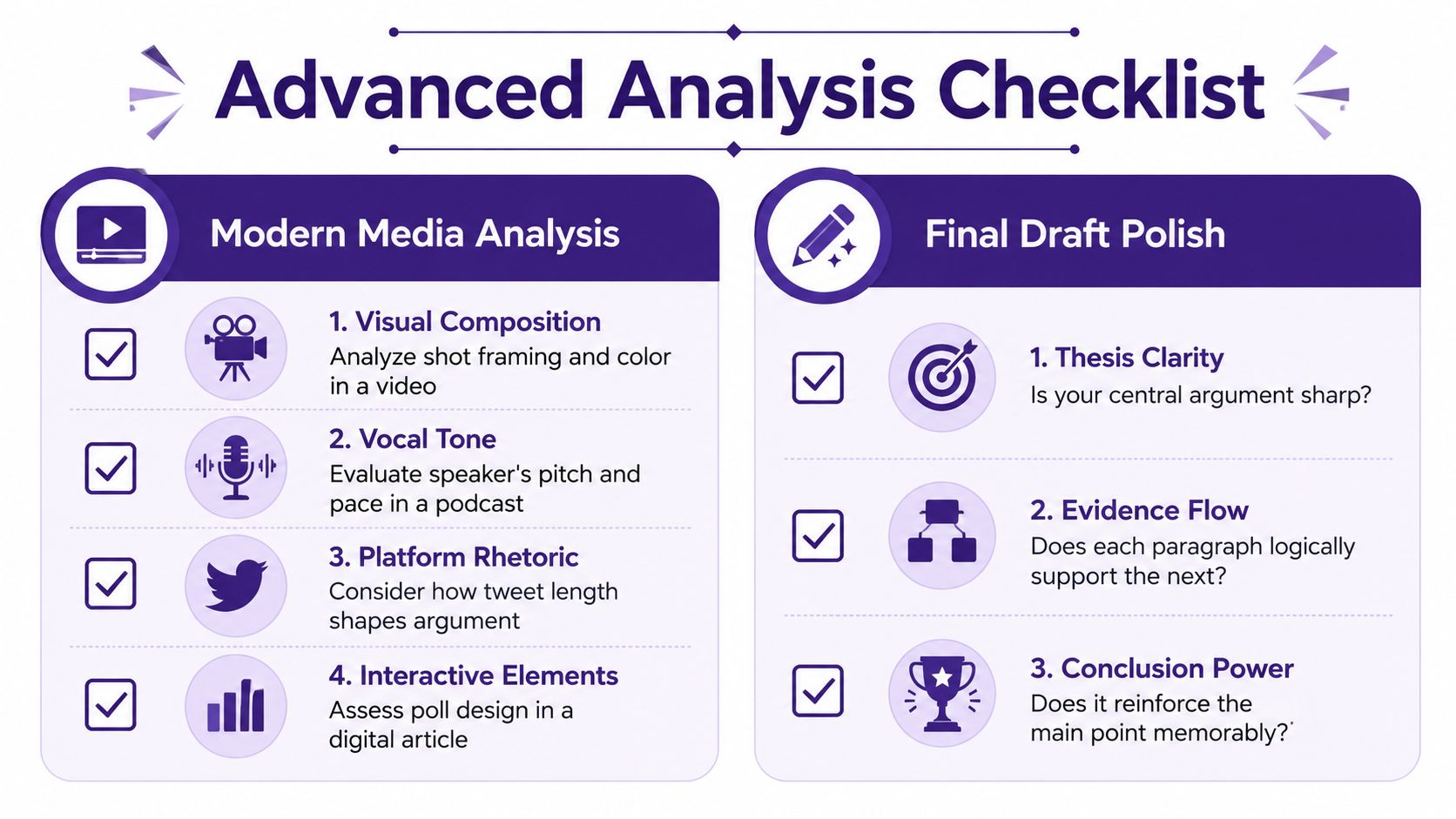
Final draft checklist
- Watch for summary creep: if a paragraph only tells what happened, rewrite it so it explains why the choice matters.
- Test each quotation: every quote should lead to commentary about audience impact.
- Check the thesis: it should argue effectiveness, not just identify the topic.
- Keep the focus narrow: if you have too many strategies, cut the weakest ones.
- Read for flow: each paragraph should support the next without repeating the same point.
- Fix the ending: your conclusion should reinforce the main claim and show why it matters.
If you need a reminder for citation handling while you revise, this guide to adding citations can keep your evidence clean and consistent. A polished rhetorical analysis doesn't just sound smart, it proves that you can connect form, audience, and purpose without drifting into plot recap.
If you're building a library of analyses, outlines, transcripts, or research notes, Contesimal helps you turn that material into something reusable instead of letting it sit in scattered files. Visit Contesimal to see how it can help you organize content, surface patterns, and create new value from the work you already have.