
You've got the audience, the downloads, the page views, and the content backlog. What's missing is the part most creator-led businesses avoid until it gets painful, a sales plan format that turns attention into repeatable revenue instead of hoping sponsorships, partnerships, or product sales happen on their own.
That gap shows up fast. A podcast can look healthy on the outside and still have no clear sponsorship pipeline. A publisher can ship consistently and still rely on a few unpredictable inbound deals. A creator can have strong traffic and still make every monetization decision from scratch. A structured sales plan format fixes that by turning your content library, your audience segments, and your outreach motion into one operating document, not a loose collection of ideas. In that sense, it behaves less like a memo and more like a blueprint for execution, which is exactly how modern planning tools frame it, as a roadmap that links goals, targets, tactics, timelines, and metrics to actual sales work. The basic structure also aligns well with a practical AI LinkedIn viral content generator when your team needs faster top-of-funnel content ideas, and the broader monetization mindset fits naturally with what content monetization looks like in practice.
Why Your Content Growth Needs a Sales Plan Format
A creator can build an audience for years and still not know what the next revenue step is. The downloads climb, the newsletter grows, the traffic looks good in analytics, and then a sponsor asks for a media kit, a partnership lead asks for pricing, or a brand wants territory, audience, and timeline details, and the whole process turns improvised.
That's where a sales plan format earns its keep. Salesforce describes the modern plan as connecting plan data to CRM, assessing team capacity from historical performance, and defining quotas, compensation, customer segments, and territories, while Zendesk and Pipedrive both frame it as a roadmap for hitting revenue targets with clear objectives, strategies, timelines, and performance metrics. In plain terms, it's the document that tells a creator business how content becomes commercial motion. For a media brand, that might mean assigning sponsorship outreach to one person, affiliate partnerships to another, and subscription upsell to a third.
Why creator businesses outgrow “we'll figure it out”
The more your business depends on collaboration, the more dangerous informal selling becomes. A solo creator can survive on instinct for a while, but once editors, producers, account managers, or marketers enter the mix, everyone needs the same plan, the same target customer, and the same way to measure progress. Highspot's guidance on plan specificity matters here, because vague plans usually break at the handoff from strategy to activity, especially when responsibilities and timing aren't written down.
A practical sales plan also makes your content library more useful. Instead of treating old episodes, articles, or videos as finished assets, you can organize them around audience segments, sponsorship themes, and upsell paths. If you're also building outreach workflows, a tool like sales strategies can support the thinking process, but the core value still comes from the plan itself, not the software.
The trade-off is simple. Without a sales plan format, monetization stays opportunistic. With one, you can decide what content supports what offer, who owns the outreach, and what counts as progress.
Core Sections Every Sales Plan Format Must Include
A sales plan for a content business only works if it translates audience growth into revenue activity. A publisher, podcast network, or creator brand cannot rely on the same loose planning style that might pass in an early-stage content calendar. The format has to show what gets sold, who owns the work, and how content supports the commercial push without turning the plan into a brand essay.
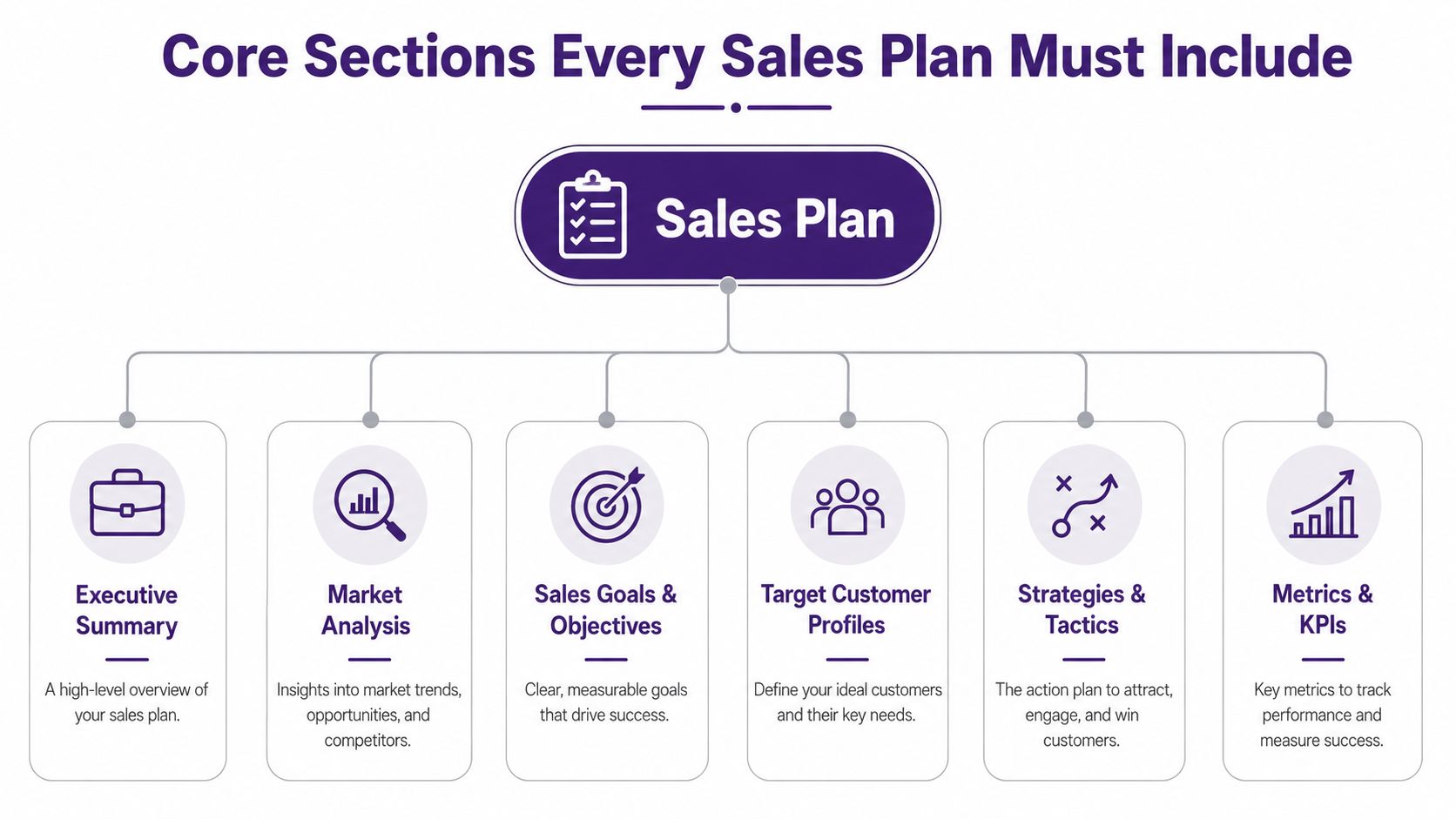
The sections that carry the plan
Start with the executive summary and mission. Fullcast says this section should stay short and specific, and it should focus on concrete outcomes like market leadership in a segment, expansion into a new region, or a defined growth milestone. That keeps the plan tied to a real commercial result instead of a broad statement about the brand.
Then define revenue goals and target customer segments. Zendesk and Pipedrive both stress that the plan needs clear objectives and a defined target market, because revenue targets only matter when they point to a buyer group the team can reach. For a creator business, that may mean separating sponsorship buyers, subscribers, and affiliate partners instead of treating all revenue as one bucket. The trade-off is simple, more segmentation creates more clarity, but it also forces you to make sharper choices about where the team spends time.
Add team structure and capacity next. Salesforce ties this to historical performance, quotas, compensation, customer segments, and territories, and that logic still applies when the “sales team” includes editors, account managers, producers, or a founder wearing all three hats. If you skip this section, work gets over-assigned, follow-up slips, and nobody knows who owns the next conversation. For teams that also need a wider planning reference, a sample strategic marketing plan can help show how the commercial plan fits alongside content and channel priorities.
Practical rule: if a section does not change a decision, it probably does not belong in the first draft.
Budget, timeline, and KPIs close the loop. Indeed's template adds milestones and deadlines as the way to break broad goals into smaller tasks, while Smartsheet highlights measurable revenue and sales goals, budget, and schedule as standard components. This part matters because content businesses often spend heavily on production before they see any signal from the market. If the plan does not show when outreach starts, how much room the team has to test, and what gets measured, it becomes hard to tell whether a stalled result comes from weak demand or weak execution.
A responsibility matrix belongs here as well. If nobody owns the outreach, the reporting, or the follow-up, the handoff from strategy to activity fails.
The result is an operating blueprint, not a narrative memo. That is the difference between a plan teams admire and a plan they use.
How B2B and B2C Sales Plan Formats Differ
A content business can sell like a B2B company, a B2C company, or both at once, and the sales plan format needs to reflect that. A podcast selling enterprise sponsorships doesn't need the same structure as a creator selling digital products to subscribers. If you write one mixed plan without deciding which motion matters where, the team ends up with conflicting targets and muddled priorities.
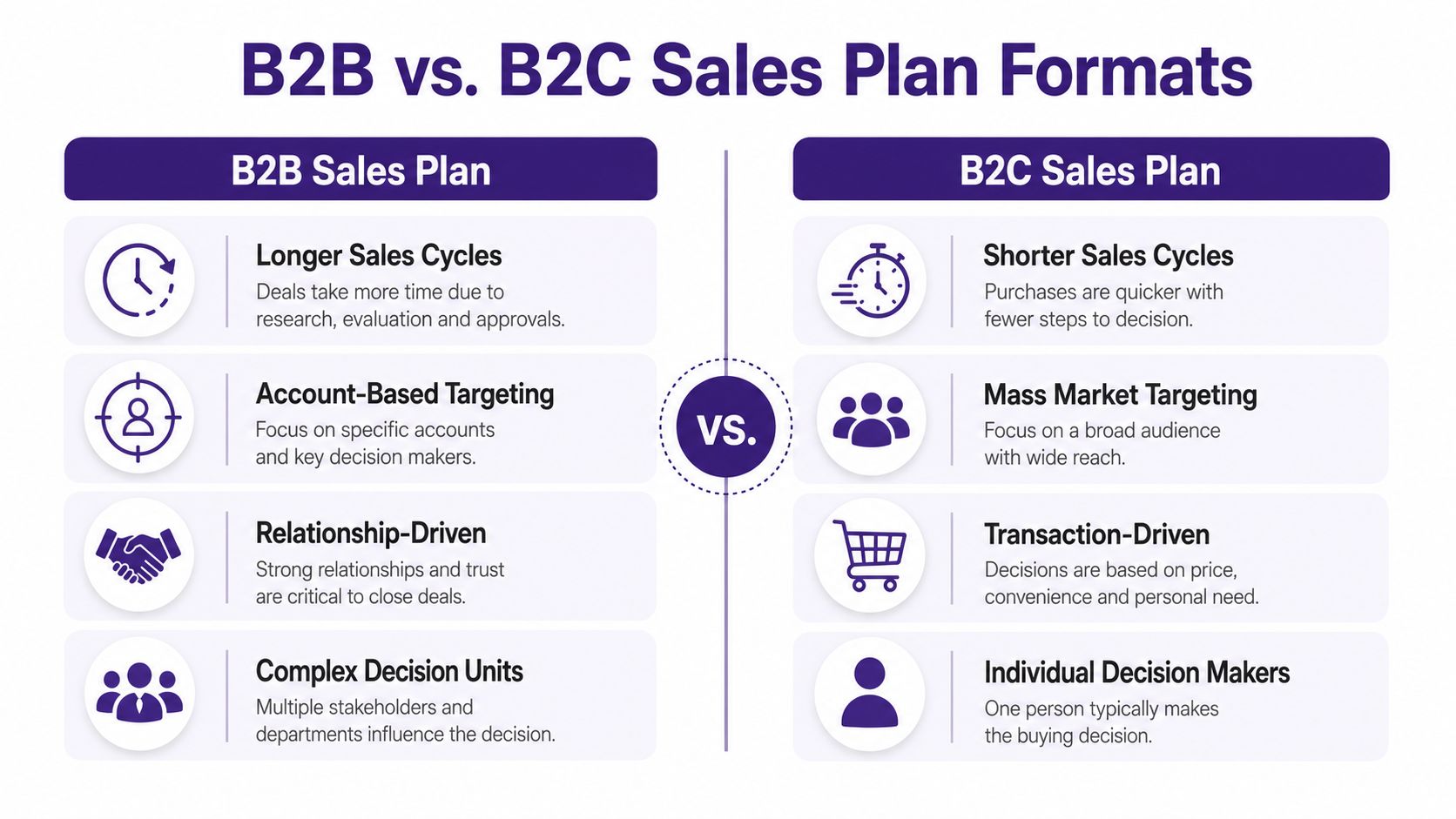
Where the formats split
B2B sales plans usually lean on account-based targeting, longer relationship cycles, and multi-stakeholder decision paths. That means the plan should map territories, buying committees, sponsorship categories, and pipeline ownership. A media company selling annual brand packages needs that structure because the buyer often wants internal approvals, consistent reporting, and a clear fit with audience segments.
B2C sales plans look different. They focus on transaction flow, conversion steps, and repeat purchase behavior. A creator selling a course, membership, or digital download needs to watch the funnel more closely than the account list. The plan needs stronger emphasis on campaign timing, offer sequencing, and conversion points than on territory mapping.
For teams managing both, the smartest move is usually to separate the motions inside one plan. Keep one section for brand partnerships and another for direct-to-audience offers. That prevents sponsorship targets from distorting subscription tactics, and it stops consumer product goals from weakening enterprise outreach.
A strong plan also helps with the choice of tactics. If you want a reference point for different sales strategies, use it as a library of approaches, not as a substitute for your own format. The plan still needs to tell the team who the buyer is, how the sale happens, and what the success metric is for each motion.
The trade-off is clarity versus convenience. One blended plan is easier to write. Two clearly separated motions are easier to run.
KPIs and Metrics That Actually Predict Revenue
Many sales plans look busy but tell you almost nothing about revenue. They track the final outcome, then act surprised when the pipeline dries up. The better approach is to use KPIs that reveal whether revenue is likely to happen before the month closes.
Leading indicators beat dashboard decoration
Lagging indicators matter, but they're not enough. Closed revenue tells you what already happened. Leading indicators tell you whether your team is building enough momentum to hit the target later. That's why Salesforce's format, and the broader planning guidance from Smartsheet and Pipedrive, all push measurable goals, historical performance, and structured reporting. Those pieces help you set targets from reality instead of wishful thinking.
For creator businesses, the same logic applies with different labels. A sponsorship-heavy business might watch pipeline quality and outbound response patterns. A subscription or product-led creator might watch audience-to-lead movement and offer conversion behavior. The metric is useful only if it helps a manager decide whether to keep going, adjust tactics, or change the offer.
| KPI Category | B2B Metrics | B2C Metrics |
|---|---|---|
| Pipeline health | Qualified pipeline coverage, deal stage progression, outreach-to-meeting conversion | Funnel conversion, landing page conversion, repeat purchase behavior |
| Sales velocity | Average deal cycle length, stage aging, follow-up cadence | Offer cycle timing, campaign response speed, checkout completion |
| Revenue quality | Sponsorship fill rate, account expansion, forecast reliability | Audience-to-lead conversion, subscription retention, content-attributed pipeline |
A good metrics dashboard stays lean enough to use every week. That's the trap to avoid. If the dashboard takes too long to update, people stop trusting it. If it's too broad, nobody knows what to fix. For forecasting methods and how AI tools can support projection work, DMpro's overview of AI revenue projection techniques is a useful companion reference.
The best sales metric is the one that changes a decision before the quarter is over.
If you're tying this to content operations, connect the numbers back to actual library performance. That keeps the sales plan from floating above the work, and it aligns nicely with a structured review of how to analyze content performance.
Building Your Fillable Sales Plan Template
A usable template has to be simple enough to fill out, but sharp enough to drive decisions. That means writing for the person who will run it, not for a theoretical executive reader. For a solo creator, that may be one page and a short appendix. For a publisher or 10-person team, it can be more detailed, but it still needs to stay practical.
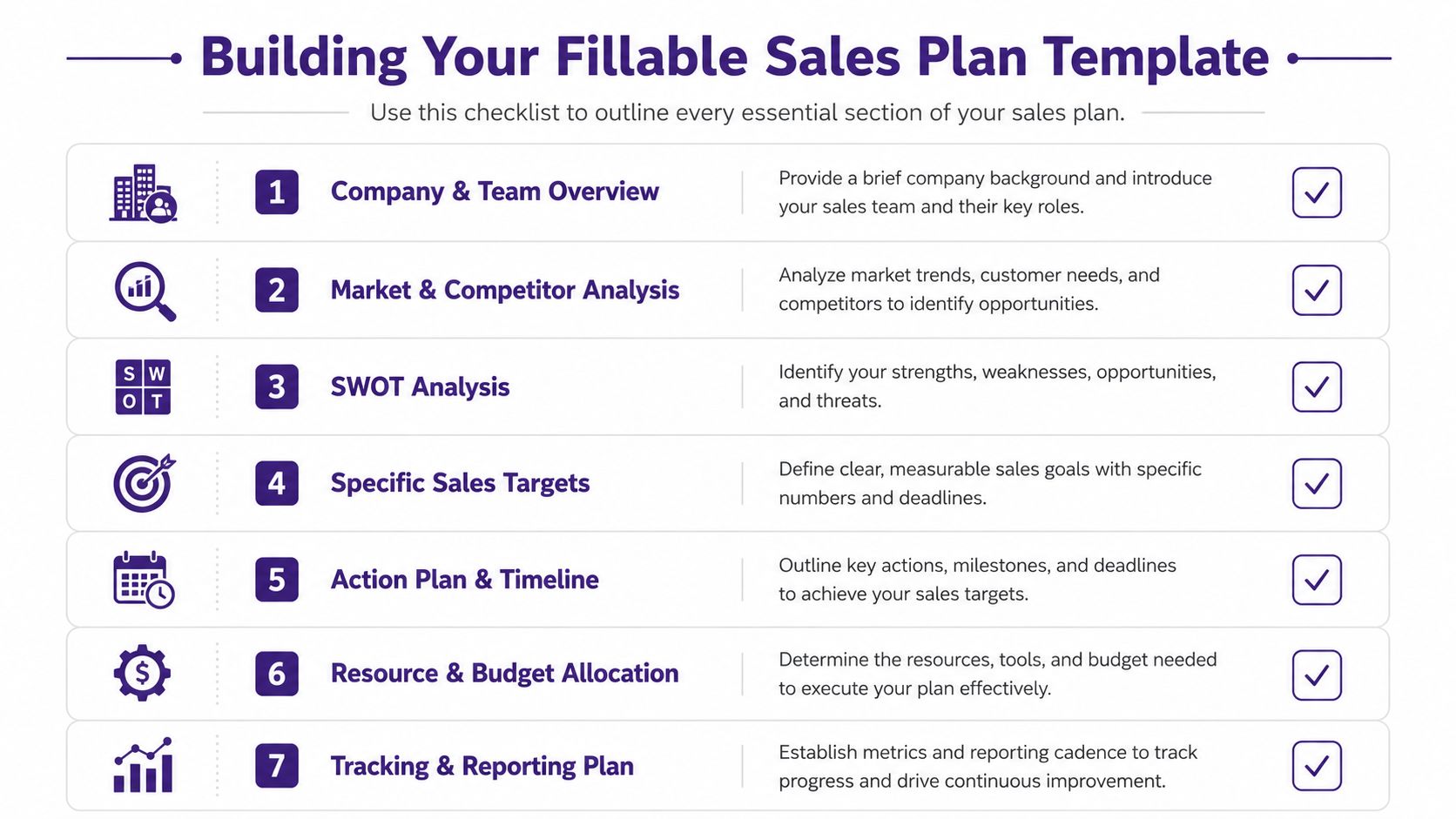
A fillable structure that people will use
Write the executive summary first, and keep it short. Fullcast's guidance is clear here, focus on the mission and a concrete commercial outcome. Then move into buyer personas with more than demographics. Include buying triggers, decision criteria, and the reasons someone says yes. A podcast sponsor, a media buyer, and a subscriber don't buy for the same reasons, even if they all like the content.
From there, define revenue targets using historical performance and team capacity. Salesforce and Smartsheet both stress historical data because quotas built on guesswork tend to break under pressure. Then write the action timeline as milestones, not vague intentions. Milestones make it obvious what has to happen first, what can run in parallel, and what depends on another person's work.
A fillable template can look like this:
- Company and team overview. Who owns the plan, who executes it, and what team capacity exists today.
- Market and competitor analysis. Which buyers, sponsors, or channels matter most.
- Sales goals and objectives. What revenue outcome the team is working toward.
- Target customer profiles. Who buys, why they buy, and what blocks the sale.
- Strategies and tactics. Which motions the team will run.
- Resource and budget allocation. What tools, people, and spend support the plan.
- Tracking and reporting plan. How often the team reviews progress and what gets measured.
Tailor the depth to the channel mix. A creator heavy on brand deals will need more detail on sponsor targeting and outreach cadence. A publisher with ads, subscriptions, and events needs separate notes for each motion so the plan doesn't blur into generic revenue talk.
Useful habit: if a section can't be filled out in under 20 minutes, it's probably asking for too much on draft one.
Keeping Your Sales Plan Alive Beyond Quarter One
The fastest way to kill a sales plan is to treat it like a launch artifact. It gets built with energy, approved with confidence, and then ignored until someone asks why revenue drifted. The plan only works if it stays in the weekly and monthly rhythm of the business.
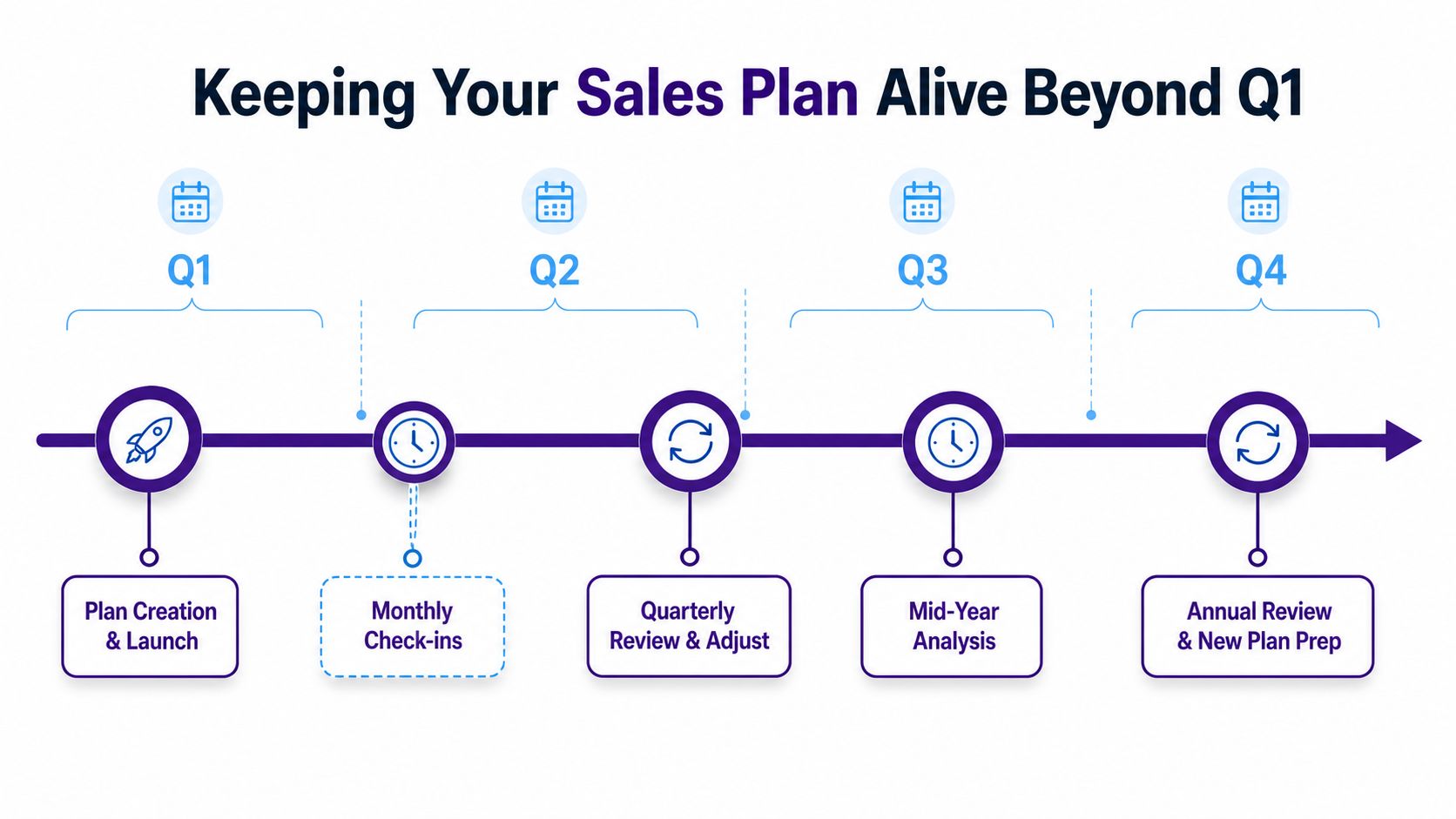
How to keep it working
Run monthly check-ins against the plan, not just against outcomes. That's where you catch weak outreach, slow follow-up, and buyer-persona drift before the quarter is gone. Then do a quarterly review and adjust pass to compare the plan with actual performance and decide whether the issue is execution or strategy.
The distinction matters. If the team missed a target because a campaign stalled, you may need to change the tactic. If the market shifted, the persona changed, or the offer no longer fits, the plan itself needs a revision. Don't overreact to one bad month, but don't defend a stale strategy just because it looked good in January.
A sales plan also works well as an onboarding tool. New team members can see who the buyer is, what the offer is, and how the process runs without sitting through five scattered explanations. For creator businesses, that's especially useful because content strategy and sales strategy often overlap. A new hire should understand which content pillars support outreach, which playlists or series map to specific offers, and where the library can be reused to create fresh commercial value.
By Q4, the goal isn't just to review results, it's to prep the next plan with what the team learned. That's how the sales plan format stops being shelf-ware and starts becoming part of the operating system.
If you're building your first real sales plan for a content business, start with the core sections, separate B2B and B2C motions where they diverge, and pick metrics you'll review. Then turn the plan into a working document your team can update, share, and use to turn content into revenue. A CTA for Contesimal is the next step if you want a platform that helps organize a content library, surface reusable assets, and support the collaboration that makes monetization easier to run.