
Struggling to turn your growing content library into a revenue-generating machine? You're not alone. Many talented creators, from YouTubers and podcasters to professional publishers, hit a plateau where passion needs a plan. The key to unlocking sustainable growth, a wider audience, and real income lies in a structured approach. This isn't just about creating more content; it's about upcycling your old content to create new value and bring your entire library to life.
In this guide, we break down 10 distinct strategic marketing plan examples tailored for the modern content creator. Each sample strategic marketing plan provides a replicable blueprint, complete with goals, channels, KPIs, and actionable takeaways. We'll show you how to move from being a hobbyist to a professional creator building a scalable content business. To begin, constructing a comprehensive social media marketing plan template is crucial for defining your content strategy and overall growth.
Here, you will learn how to reignite your content library, organize your assets for maximum value, and take deliberate actions that drive results. The goal is to provide you with the specific frameworks and tactical insights needed to analyze your own situation and build a strategy that works. Whether you're a YouTuber trying to figure out how to create the next new video or a content marketer needing to align content across many platforms, these plans offer a clear path forward. Get ready to transform your content archive from a passive collection into your most powerful asset.
1. Content Repurposing & Library Monetization Strategy
A Content Repurposing and Library Monetization strategy is a sample strategic marketing plan focused on generating new value from your existing content archive. Instead of constantly producing new material from scratch, this approach systemizes the process of finding, refreshing, and redistributing your best historical content. It's especially effective for creators and publishers with deep back catalogs, helping them maximize the return on their original investment.
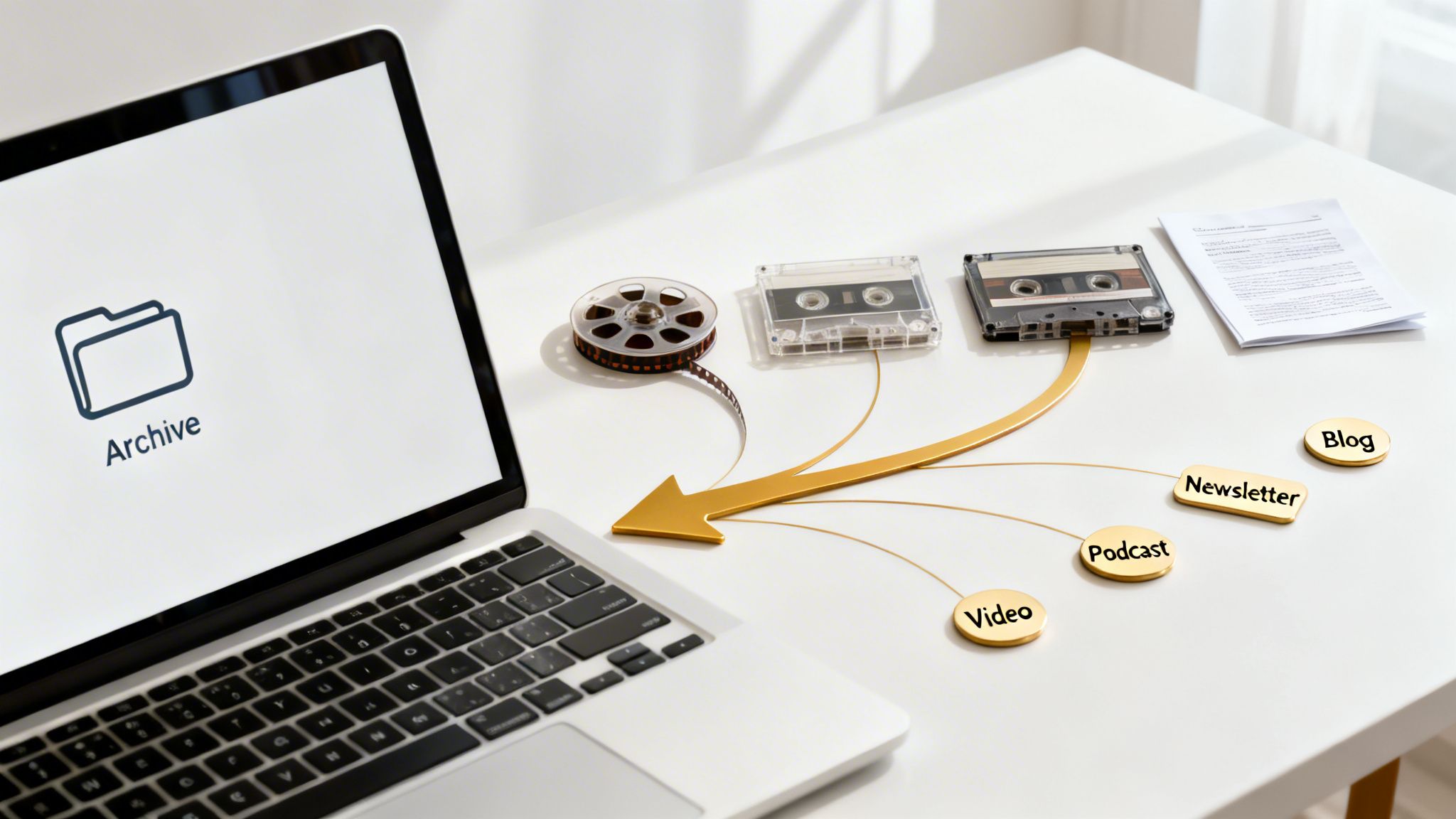
The core idea is to treat your content library as an active asset, not a dusty shelf. This involves "atomizing" long-form content—like podcasts, videos, or even books—into smaller, shareable formats. A single one-hour podcast episode can become a series of blog posts, dozens of social media clips, an infographic, and a quote-card carousel. This multiplies your output without a proportional increase in production time, allowing you to take your long-form content across platforms in one click.
Strategic Breakdown
- Audience: Creators with an established library (podcasters, YouTubers, bloggers) and publishers aiming to increase the value of their archives.
- Goal: Increase content output, audience reach, and engagement while minimizing production costs. Monetize existing assets more effectively.
- Channels: Original platform (e.g., YouTube), blog, social media (TikTok, Instagram, LinkedIn), email newsletters.
- KPIs: Traffic to older content, engagement rates on repurposed assets, lead generation from repurposed content, and new revenue streams.
Key Insight: The goal isn’t just to recycle old content. It's to re-contextualize it for new platforms and audiences, breathing new life into proven ideas. Your most popular piece of content from two years ago is brand new to the audience you gained yesterday.
To efficiently repurpose your audio content, leveraging effective tools is important. Explore how dedicated voice-to-text solutions for content creators offer seamless access to high-quality transcriptions and summaries, enabling creators to expand their reach and monetize their content library with ease. Organizing and understanding your library is the first step; a powerful content intelligence platform can help you discover connections and opportunities within your archive.
2. SEO-First Content Discovery & Optimization Strategy
An SEO-First Content Discovery and Optimization strategy is a sample strategic marketing plan designed to make your content library more visible in search engine results. This approach methodically uses data to find content gaps, keyword opportunities, and optimization needs within your existing assets. It merges historical content analysis with modern SEO practices to improve organic discovery and attract qualified traffic from search engines like Google.
This strategy is crucial for publishers, bloggers, and creators in competitive niches where search rankings directly impact audience growth and revenue. Instead of guessing what topics to cover, this plan relies on search data to guide content creation and updates. By analyzing what your audience is actively searching for, you can align your content to meet that demand, establishing your brand as a go-to authority. The process involves auditing existing content, identifying high-potential keywords, and structuring your library around pillar topics to build topical authority.
Strategic Breakdown
- Audience: Publishers, bloggers, and content marketers with an existing library who rely on organic search traffic for growth.
- Goal: Increase organic search traffic, improve keyword rankings for valuable terms, and build domain authority by becoming a definitive resource on specific topics.
- Channels: Website/blog, Google Search, and other search engines (e.g., Bing, DuckDuckGo).
- KPIs: Organic traffic growth, keyword ranking improvements, number of indexed pages, and conversion rate from organic visitors.
Key Insight: Success with this strategy comes from treating SEO not as a one-time checklist but as an ongoing process of discovery and refinement. Your audience's search behavior reveals their needs; your job is to systematically meet those needs better than anyone else.
To execute this effectively, you need a solid understanding of how search engines interpret content. Understanding the differences between older keyword-focused methods and modern intent-based approaches is fundamental. For a deeper dive, explore how semantic search differs from keyword search to better align your content with user intent and improve its discoverability.
3. Audience Segmentation & Personalized Distribution Strategy
An Audience Segmentation and Personalized Distribution strategy is a sample strategic marketing plan that moves beyond one-size-fits-all content delivery. Instead of sending the same message to everyone, this approach uses audience behavior data and content metadata to group your audience into distinct segments. It then delivers tailored content experiences designed to match each segment's specific interests and consumption habits.
This method is powerful for creators and publishers because it directly increases relevance. When content feels personally selected for a user, engagement, loyalty, and consumption time all tend to increase. It’s the principle behind Netflix’s recommendation engine, which is credited with driving a majority of user watch time, and Spotify's "Discover Weekly" playlists, which introduce listeners to new music based on their historical preferences.
Strategic Breakdown
- Audience: Publishers, podcasters, and video creators with a diverse content library and a growing, varied audience.
- Goal: Increase user engagement, session duration, and content consumption. Reduce churn by delivering highly relevant experiences.
- Channels: Email newsletters, on-site/in-app recommendations, social media retargeting, and push notifications.
- KPIs: Click-through rates on recommendations, time on site/page, content consumption per user, and audience retention rate.
Key Insight: Personalization doesn’t have to be complex from the start. It can begin with simple segmentation based on topics (e.g., sending tech updates only to readers who engage with tech content) and grow from there. The core idea is to make your audience feel understood.
A key first step in this strategy is making sense of your existing content. By using a content intelligence platform to analyze and tag your library, you create the necessary metadata to match assets with the right audience segments. This foundational organization makes effective personalization possible, turning your archive into a dynamic asset for targeted distribution.
4. Social Media Content Strategy with Viral Amplification
A Social Media Content Strategy with Viral Amplification is a sample strategic marketing plan built to extract high-impact moments from your long-form content. This approach focuses on creating optimized short-form videos for platforms like TikTok, Instagram Reels, and YouTube Shorts. The goal is to maximize reach and engagement by converting your existing content into formats native to each social channel, driving traffic back to your core assets.

This strategy turns a single podcast episode or video into a promotional engine that runs for weeks. Instead of just a single post announcing new content, you create a steady stream of compelling micro-content. By identifying the most controversial, funny, or insightful moments, you create "hooks" that capture attention and encourage viewers to seek out the full piece, as seen in the massive reach of Joe Rogan's podcast clips. This is how you experiment with new concepts to hit on the next viral thing.
Strategic Breakdown
- Audience: Podcasters, YouTubers, and video creators with a library of long-form content. Publishers and marketers looking to increase audience engagement and drive traffic from social media.
- Goal: Increase brand awareness, drive traffic to primary content, and grow social media following. Identify and capitalize on viral moments.
- Channels: TikTok, Instagram Reels, YouTube Shorts, Twitter/X, and LinkedIn video.
- KPIs: Social media engagement (likes, comments, shares), video view count, click-through rate to full content, and follower growth.
Key Insight: The most effective clips are not just random snippets. They are strategically chosen moments that tell a mini-story or present a powerful, standalone idea. This method acts as a trailer for your main content, giving new audiences a reason to engage further.
Extracting the right moments is key. Creators often find success by pulling 3-5 clips from each piece of long-form content and adding captions for accessibility. For a deeper dive into what works, you can explore various examples of effective social media posts to inspire your own strategy.
5. B2B Content Authority & Thought Leadership Strategy
A B2B Content Authority and Thought Leadership strategy is a sample strategic marketing plan built to establish an organization as a definitive expert in its field. This approach moves beyond simple content marketing to create deep, data-driven resources like original research, proprietary frameworks, and in-depth reports. It is designed to attract high-value B2B audiences by demonstrating undeniable expertise and building institutional credibility.
The central principle is to become the source of truth for an industry. Instead of just commenting on trends, organizations like Gartner, McKinsey, and HubSpot create them through primary research and analysis. This cornerstone content, such as Gartner's Magic Quadrant or HubSpot's free certification programs, becomes an industry standard, driving consulting revenue, software sales, and lead generation. This plan is resource-intensive but offers a powerful competitive moat.
Strategic Breakdown
- Audience: B2B enterprises, publishers, and educational institutions targeting senior decision-makers and industry professionals.
- Goal: Establish industry authority, generate high-quality inbound leads, justify premium pricing, and build a defensible brand.
- Channels: Company blog/resource center, industry publications, research reports, webinars, exclusive events, and academic journals.
- KPIs: Media mentions and backlinks, lead quality and conversion rate from gated content, speaking invitations, and revenue attributed to thought leadership assets.
Key Insight: True thought leadership isn't about having an opinion; it's about owning the data. Investing in original research allows you to shape the industry narrative, forcing competitors to react to your findings rather than setting the agenda themselves.
For creators and publishers, organizing existing knowledge is the first step toward building authority. A robust content intelligence platform can help map out your expertise and identify gaps where original research would have the most impact, turning your content library into a foundation for industry leadership.
6. Email Marketing & Newsletter Strategy with Content Leverage
An Email Marketing & Newsletter Strategy with Content Leverage is a sample strategic marketing plan designed to build a direct and resilient connection with your audience. This approach moves beyond simple email blasts by using your best historical content as the foundation for subscriber growth and engagement. It transforms your email list into a primary asset, creating a communication channel that is immune to algorithm shifts on social media or search platforms.

The central principle is to systematically analyze your content library, identify top-performing assets, and repackage them into valuable email formats. A highly successful blog post can become a welcome email series, a popular video can be the basis for an exclusive email course, and your most-shared podcast clips can be curated into a "best-of" weekly newsletter. This method, exemplified by media giants like Morning Brew and Axios, focuses on delivering consistent, high-quality information directly to an opted-in audience.
Strategic Breakdown
- Audience: Podcasters, bloggers, and video creators who want a direct line to their audience. Publishers aiming to build a loyal, monetizable readership.
- Goal: Increase subscriber count, improve email open and click-through rates, and create a sustainable, direct-to-audience channel for content distribution and monetization.
- Channels: Email marketing platforms (e.g., ConvertKit, Substack), website/blog for sign-up forms, and social media for list promotion.
- KPIs: Subscriber growth rate, open rate, click-through rate (CTR), conversion rate from emails, and list churn rate.
Key Insight: Your email list is the only audience you truly own. This strategy turns that list from a simple notification tool into a core part of your content ecosystem, driven by the proven value of your existing work.
To build an effective email program, start by understanding what resonates with your audience. A deep dive into your content library can reveal themes and topics that consistently drive engagement. Organizing your library with a content intelligence platform helps you identify these winning assets, making it easier to create email sequences and newsletters that your audience is eager to receive and read.
7. Video Content Strategy & YouTube Optimization
A Video Content Strategy and YouTube Optimization plan is a sample strategic marketing plan designed for creators to build a sustainable and discoverable video presence. Rather than treating each video as an isolated event, this approach builds a system for analyzing your audience, identifying content gaps, and optimizing for the YouTube algorithm. It focuses on long-term growth by prioritizing metrics like watch time and audience retention, which signal to YouTube that your content is valuable.
The strategy centers on creating content series, structured playlists, and compelling packaging (thumbnails and titles) to encourage binge-watching and repeat viewership. Success here isn't just about going viral; it's about building an engaged community that returns for every new upload. Creators like Marques Brownlee (MKBHD) and Kurzgesagt have demonstrated the power of consistency, high-quality production, and deep audience understanding to build massive followings. Running buckets and playlists helps you keep building on successful concepts.
Strategic Breakdown
- Audience: YouTubers, vloggers, and video creators transitioning from hobbyists to professionals; publishers aiming to establish a strong video channel.
- Goal: Increase key YouTube metrics like watch time, subscriber count, and click-through rates. Build a loyal community and establish topical authority.
- Channels: YouTube (primary), with content repurposed for TikTok, Instagram Reels, and other social media to drive traffic back to the main channel.
- KPIs: Average view duration, audience retention rate, click-through rate (CTR) on thumbnails, subscriber growth, and views per viewer.
Key Insight: The YouTube algorithm rewards channels that keep viewers on the platform longer. A successful strategy focuses less on single-video views and more on creating an ecosystem of content that guides viewers from one video to the next, maximizing their session watch time.
Optimizing a YouTube channel requires a solid understanding of both audience behavior and platform mechanics. Using tools like VidIQ or TubeBuddy can provide important data for making informed decisions on titles and tags. For creators with extensive back catalogs, a content intelligence platform is a great way to identify underperforming videos that could be updated or find patterns in successful content to replicate.
8. Programmatic Advertising & Audience Monetization Strategy
A Programmatic Advertising and Audience Monetization strategy is a sophisticated sample strategic marketing plan designed to generate revenue directly from your audience. It moves beyond simple ad placements by using detailed audience insights and content performance data to implement programmatic advertising, sponsorships, and tiered premium content. This approach helps creators maximize revenue by identifying valuable audience segments for advertisers and creating exclusive offerings for loyal supporters.
This plan focuses on creating a sustainable revenue model that complements your content creation efforts. Instead of relying solely on one income source, it diversifies by combining automated ad sales with direct-to-consumer offerings like paid memberships or subscriptions. The strategy works by understanding exactly who your audience is and what content they value most, allowing you to charge a premium for both advertiser access and exclusive content.
Strategic Breakdown
- Audience: Established creators and publishers with a significant, engaged audience (e.g., The New York Times, Spotify, successful Substack writers, and Patreon creators).
- Goal: Maximize revenue per user by layering programmatic ads, sponsorships, and premium subscription tiers. Increase overall profitability without alienating the core audience.
- Channels: Website/Blog (with ad placements and paywalls), Email Newsletters (for premium content), Podcast platforms (with dynamic ad insertion), and membership platforms like Patreon.
- KPIs: Average Revenue Per User (ARPU), ad CPM (Cost Per Mille), subscriber churn rate, conversion rate for premium tiers, and sponsorship revenue.
Key Insight: The foundation of this strategy is a deep understanding of your audience. By segmenting your audience and tracking their behavior, you can deliver targeted value to advertisers and premium subscribers simultaneously, justifying higher prices on both fronts.
Successfully monetizing requires a balance between free and paid offerings. For instance, using paywalls like those on Medium or membership tiers on Substack requires consistently delivering high-value, exclusive content to justify the cost. Similarly, commanding high sponsorship rates means providing partners with detailed analytics on audience engagement and demographics, proving the value of their investment in your platform.
9. Community Building & Engagement Strategy
A Community Building and Engagement Strategy is a sample strategic marketing plan that prioritizes the creation of a loyal, interactive audience around your content. Instead of treating your audience as passive consumers, this approach focuses on turning them into active participants through discussion forums, social groups, and live events. This transforms content consumption from a one-way broadcast into a two-way conversation.
The central idea is to foster a sense of belonging and shared identity. A group of people gather around a set of knowledge to create meaning; and then as they collaborate they are able to generate value from it. Platforms like Discord and Circle enable creators to build private, moderated spaces where members can connect, share ideas, and support one another. This deepens the creator-audience bond, boosts retention, and generates powerful network effects where the community itself becomes a primary reason for people to stick around.
Strategic Breakdown
- Audience: Creators with an established following (YouTubers, podcasters) looking to deepen engagement; publishers who want to create a premium membership experience.
- Goal: Increase audience loyalty and lifetime value, reduce churn, and generate user-driven content and insights.
- Channels: Dedicated community platforms (Discord, Circle, Mighty Networks), private social media groups (Facebook Groups), and live interaction tools (Zoom, live streams).
- KPIs: Member engagement rate (daily/monthly active users), user-generated content volume, member retention/churn rate, and conversion from free audience to paid community member.
Key Insight: A strong community acts as a moat for your brand. While competitors can copy your content format, they cannot replicate the genuine relationships and collective identity you build with your audience. This community becomes your most valuable asset.
Building an engaged community begins with clear values and well-defined guidelines to ensure a safe and productive environment. To sustain momentum, creators should establish recurring events like weekly Q&As or member-only behind-the-scenes content. By featuring member-generated content and soliciting feedback on future projects, you empower your audience and make them feel like true collaborators in your creative journey.
10. Affiliate Marketing & Performance-Based Growth Strategy
An Affiliate Marketing & Performance-Based Growth Strategy is a plan centered on earning revenue by promoting other companies' products or services. Creators earn a commission for each sale or lead generated through a unique affiliate link placed within their content. This approach monetizes an audience's trust by recommending relevant products without charging the audience directly.
The model works because it aligns the interests of the creator, the audience, and the product company. The creator gets paid for making valuable recommendations, the audience discovers useful products, and the company gains a new customer. This strategy is popular with YouTubers reviewing gear, podcasters recommending software, and bloggers creating detailed product comparisons. Success depends on authenticity and relevance; the recommendations must genuinely solve a problem for the audience.
Strategic Breakdown
- Audience: Creators with a niche, engaged following (YouTubers, podcasters, bloggers) who trust their recommendations.
- Goal: Generate a sustainable, often passive, revenue stream by monetizing content through commissions. Increase audience trust by recommending valuable solutions.
- Channels: Blog posts (reviews, tutorials), YouTube videos (unboxing, how-to), podcast episodes (ad reads, show notes), email newsletters, and "gear/tools" pages on a website.
- KPIs: Click-through rate (CTR) on affiliate links, conversion rate, earnings per click (EPC), and total affiliate revenue.
Key Insight: Your credibility is your most valuable asset. Only promote products you genuinely believe in and would recommend even without a commission. Always disclose your affiliate relationships clearly to maintain audience trust, which is the foundation of this entire sample strategic marketing plan.
For this strategy to be effective, you must first understand what problems your audience faces and what tools can solve them. Start by creating content that addresses these problems directly, then introduce the affiliate product as the solution. Track which links and content formats perform best using UTM parameters to refine your approach and focus your efforts on what drives the most value for both your audience and your business.
10 Strategic Marketing Plans Compared
| Strategy | Implementation complexity | Resource requirements | Expected outcomes | Ideal use cases | Key advantages |
|---|---|---|---|---|---|
| Content Repurposing & Library Monetization Strategy | Medium — audit and workflow setup required | Moderate — classification tools, conversion workflows, rights checks, staff time | Faster content production, higher ROI from archives, new revenue streams | Publishers with extensive back catalogs, podcast/video archives, research libraries | Maximizes existing assets, reduces new-creation cost, multi-format reach |
| SEO-First Content Discovery & Optimization Strategy | Medium–High — technical SEO and topic architecture needed | Moderate–High — SEO tools, analysts, content editors, ongoing maintenance | Increased organic traffic and search rankings over months | Bloggers, publishers in competitive niches, limited-ad-budget marketers | Sustainable organic growth, topical authority, reduced paid spend |
| Audience Segmentation & Personalized Distribution Strategy | High — modeling and recommendation systems | High — large historical data, personalization engine, privacy/compliance resources | Higher engagement, retention, conversion, improved LTV | Subscription platforms, publishers with diverse content, podcast networks | Increased relevance, targeted monetization, better retention |
| Social Media Content Strategy with Viral Amplification | Medium — clip extraction and platform tailoring | Moderate — editors, social team, trend monitoring tools | Rapid reach expansion, social-driven traffic, follower growth | Podcasters, video creators, bloggers seeking social amplification | Fast audience growth, low cost per social asset, platform-native optimization |
| B2B Content Authority & Thought Leadership Strategy | High — original research and expert coordination | High — subject-matter experts, research budget, PR and long-form production | Industry credibility, high-value leads, premium partnerships (6–12 months) | Enterprises, consultancies, academic and research organizations | Builds authority, attracts premium clients, long-term brand equity |
| Email Marketing & Newsletter Strategy with Content Leverage | Low–Medium — platform setup and sequencing | Moderate — email platform, list-building effort, content packaging | Owned audience, high ROI, predictable traffic and retention | Bloggers, publishers, educators, creators with engaged fans | Direct channel beyond algorithms, strong ROI, retention tool |
| Video Content Strategy & YouTube Optimization | High — production plus algorithm optimization | High — equipment, editors, analytics, consistent production cadence | Compounding views, subscriber growth, diverse monetization paths | Video creators, educators, podcasters moving to video | High discoverability, multiple revenue streams, strong community potential |
| Programmatic Advertising & Audience Monetization Strategy | High — ad ops and pricing systems | High — ad tech stack, sales team, analytics, compliance | Multiple revenue streams, recurring subscriptions, advertiser partnerships | Publishers with scale, media organizations, podcast networks | Scalable monetization, data-driven ad targeting, subscription options |
| Community Building & Engagement Strategy | Medium–High — platform and moderation systems | Moderate — community managers, moderation tools, events budget | Increased loyalty, retention, UGC, referrals and network effects | Creators with passionate audiences, niche publishers, educational platforms | Strong CLV increases, advocacy and organic growth, rich feedback loop |
| Affiliate Marketing & Performance-Based Growth Strategy | Low–Medium — program setup and disclosure management | Low–Moderate — affiliate programs, tracking tools, content integration | Passive revenue tied to conversions, scalable with audience growth | Review sites, tech/gadget bloggers, course creators, niche influencers | Low operational overhead, revenue without inventory, aligns with content audiences |
Activate Your Content Goldmine and Create Infinite Value
We've just walked through ten distinct, powerful blueprints designed to turn your content creation efforts into a structured, goal-oriented business. From an SEO-first discovery strategy to a community-focused engagement plan, each sample strategic marketing plan offers a unique path to growth. The common thread connecting them all is the profound, often untapped potential lying dormant within your existing content library. Your past podcasts, videos, articles, and research papers are not just artifacts of work completed; they are the raw materials for your future success.
The journey from a hobbyist creator to a professional, revenue-generating entity is marked by a shift in perspective. It's about moving from creating individual pieces of content to building a cohesive, valuable content ecosystem. The challenge isn’t a lack of ideas or a shortage of strategic options, as this article has shown. The real obstacle is often operational: a lack of organization, a failure to see the connections within your own work, and an inability to efficiently act on repurposing opportunities. Manually sifting through hundreds of files to find the perfect clip or quote for a new campaign is a time-consuming task that drains creative energy.
From Static Archive to Dynamic Asset
This is where you must evolve beyond simple creation and embrace strategic management. The plans we've detailed-like the B2B thought leadership strategy or the affiliate marketing growth plan-all depend on your ability to quickly find, adapt, and deploy existing content. Without a system to organize, understand, and take action on your library, even the most brilliant sample strategic marketing plan remains a document on a hard drive.
Consider these core takeaways from the examples provided:
- Your Content is Interconnected: A single long-form video can be the source for dozens of assets. It can become social media clips, a blog post, a newsletter series, and even quotes for a thought leadership article. A successful strategy depends on seeing and exploiting these connections.
- Strategy Requires Insight: To personalize distribution or optimize for SEO, you need data. You must understand which topics resonate, what formats perform best on which channels, and where gaps exist in your content map. This insight comes from analyzing your library as a whole, not just as individual pieces.
- Collaboration Amplifies Value: As your operation grows, you'll need to bring in more people. A disorganized content library becomes a bottleneck, slowing down collaboration and hindering growth. A centralized, intelligent system where humans and AI collaborate seamlessly is essential for your team to find what they need and execute the strategy effectively.
These principles highlight that the true power of a sample strategic marketing plan is only unlocked when you have the operational capacity to implement it. The goal is to make your content library an active, living asset that continuously generates value, informs new ideas, and fuels your marketing engine. By organizing your work, you can begin to see it as an interconnected web of knowledge, ready to be repurposed for any strategic goal. This systematic approach frees you to focus on what you do best: creating meaningful content and connecting with your audience.
Ready to stop guessing and start building a real content business? The strategies in this article are your map, but Contesimal is your vehicle. It’s the platform designed to help you organize your entire content library, collaborate with your team, and discover the hidden value in your work, making any sample strategic marketing plan instantly actionable. Explore how you can turn your content archive into a revenue engine at Contesimal today.