
Think of a video script template as your secret weapon. It’s the structured document that guides you from a raw idea to a polished final cut, making sure you hit every key message, hook, and call-to-action along the way. It’s the framework that separates a professional, engaging video from an improvised ramble.
Why a Solid Script Template is Your Secret Weapon

Let's get real for a second. The idea of just hitting 'record' and "winging it" sounds freeing, but it rarely leads to viral success. In a world overflowing with content, a reliable video scripts template is what separates the pros from the hobbyists. Top YouTubers, marketing executives, and podcasters all lean on templates to stay consistent and efficient, especially when they're transitioning from a creative passion to a revenue-generating business.
A structured script is your best defense against rambling off-topic. It keeps you laser-focused, ensuring your core message actually lands with your viewers. This isn't about boxing in your creativity—it's about building a strong container for it so you can focus on delivering your unique spark.
Build a Foundation for Consistent Quality
A good template is the blueprint for your video. You wouldn't build a house without a plan, right? The same logic applies here. A script helps you organize your thoughts, nail all your talking points, and strategically place those calls-to-action that actually get people to click, subscribe, or buy.
When you use a template, you guarantee a baseline of quality and brand consistency for every video you publish. Your audience, whether they're on YouTube, TikTok, or your company blog, starts to recognize and even anticipate your format. That familiarity builds trust and turns casual viewers into a dedicated community. It’s a critical step in turning your creative outlet into a real business and moving from hobbyist to professional.
A video scripts template shifts your process from chaotic to controlled. It saves you time, cuts down on waste, and makes sure your most important ideas are delivered with clarity and impact.
Unify Your Entire Production Workflow
The magic of a video script template doesn't stop once you’ve finished writing. It becomes the command center for your entire production, especially when you need to align content across many platforms.
- Slash your editing time. When everything is outlined in advance, you won't spend hours searching through rambling footage for a single usable clip.
- Get your team on the same page. A script acts as the single source of truth for everyone, from the talent on camera to the editor and the social media manager. This is essential as you collaborate more.
- Boost your on-camera confidence. Knowing your lines cold gives you the freedom to perform more naturally and speak with genuine authority.
- Design for viewer engagement. A great script strategically maps out the hooks, emotional beats, and CTAs that keep people watching and drive them to act, boosting those view counts you're focused on.
This organized workflow is quickly becoming the industry standard. As content operations grow, templated systems are the only way to maintain both speed and quality. This shift toward efficiency is reshaping how modern video gets made.
Modern Video Production Methods at a Glance
As you can see, template-driven methods are not just a trend; they're becoming central to how smart creators, publishers, and brands scale their content effectively.
| Production Method | Adoption Rate (2026) | Key Benefit |
|---|---|---|
| Template-Driven Workflow | 75% | Scalability & Consistency |
| Fully Improvised | 10% | Spontaneity (High Risk) |
| Traditional Scripting | 15% | Creative Control (Slow) |
Ultimately, a template gives you the structure to be more creative, not less. It handles the organizational heavy lifting so you can focus on what you do best: creating content that connects.
Choosing the Right Video Scripts Template for Your Goal
Not all videos are created equal, and your script template can't be a one-size-fits-all solution. Picking the right framework from the get-go is like choosing the right lens for a camera—it makes sure you capture exactly what you intend to. The structure that works for a 10-minute YouTube deep dive will feel clumsy and slow for a 30-second TikTok ad.
The real key is matching the template to your specific goal. Are you trying to educate, entertain, persuade, or just build a personal connection? Each of those goals has a script structure designed to maximize its impact on the viewer. A podcaster, for example, would use a completely different template when repurposing audio into a quick YouTube Short versus creating a long-form product demo.
Aligning Template Structure with Content Goals
Let's break down the most effective structures for the video types you're probably making. Think of these not as rigid rules, but as proven starting points. The idea is to build a versatile toolkit of templates you can pull from, so you always begin with the strongest possible foundation for your message.
The Explainer (Hook – Problem – Solution – CTA): This is your go-to for tutorials, product demos, or breaking down complex topics. You start with a strong hook to grab attention, clearly define a problem your audience faces, present your idea as the perfect solution, and end with a clear call-to-action.
The Storyteller (Beginning – Middle – End): This classic narrative arc is perfect for brand stories, case studies, or personal vlogs. It’s all about building an emotional connection by taking the viewer on a journey, showing challenges, triumphs, and transformations along the way.
The Advertiser (Problem – Agitate – Solve): This is a punchy and persuasive formula tailor-made for short-form ads on platforms like Instagram Reels or TikTok. You identify a pain point, amplify the frustration it causes (agitate), and then reveal your product as the quick, easy fix.
The most effective video script template is one that feels invisible to the audience. The structure should guide the story so naturally that the viewer is simply absorbed in the content, not thinking about the formula behind it.
Practical Scenarios for Template Selection
Let's get practical. Imagine you're a content marketer with a library of blog posts. You want to repurpose an article about "10 Time-Saving Tips for Entrepreneurs" into video content to generate more audience across platforms. How do you pick the right template?
If you're making a detailed YouTube video, the Explainer template is your best bet. You can dedicate a few minutes to each tip, giving in-depth explanations and showing visual aids. Your script would have a sharp hook, an intro to the problem of wasted time, a body section with 10 distinct parts, and a concluding CTA to download a resource.
But if you're spinning that same article into a series of Instagram Reels, the Advertiser (PAS) model is way more effective. Each Reel could focus on one time-wasting problem, agitate the frustration it causes, and present your tip as the instant solution. This approach is built for quick consumption and high engagement on social feeds. Understanding the various types of videos you can create is fundamental to making the right choice here.
Specialized Video Script Formats
Beyond these common structures, many niches have their own specialized formats. For instance, a creator launching a weekly news-style update for their industry needs a very specific, repeatable flow—much like a publisher would.
For that kind of specialized video content, exploring professional sample newscast script formats can give you an excellent starting point. These often include dedicated slots for intros, headlines, main segments, and outros, ensuring a polished and consistent delivery every time.
By adopting and adapting these proven structures, you save a ton of time and seriously elevate the perceived quality of your content. This is how you start building a system for generating real value—not just views—and transition from a hobbyist to a respected voice in your field.
The Anatomy of a High-Performing Video Script
A video script template is your skeleton, sure. But the real work—the stuff that gets views and builds a following—is adding the muscle and personality. It’s what separates a video people scroll past from one they just have to share.
We’re moving beyond just filling in the blanks. This is about getting into the psychology of what keeps someone watching.
It means picking apart every single piece, from the first three seconds to that final call-to-action, to make sure every word pulls its weight. You have to write for the ear, making it sound like you're talking to a friend, not reading off a teleprompter. When you know what works, you can spot the patterns in timing, tone, and language that turn a casual viewer into a loyal fan.
Before you even write a word, you need to know your goal. This little decision tree can help you see how what you want to achieve changes the whole shape of your script.
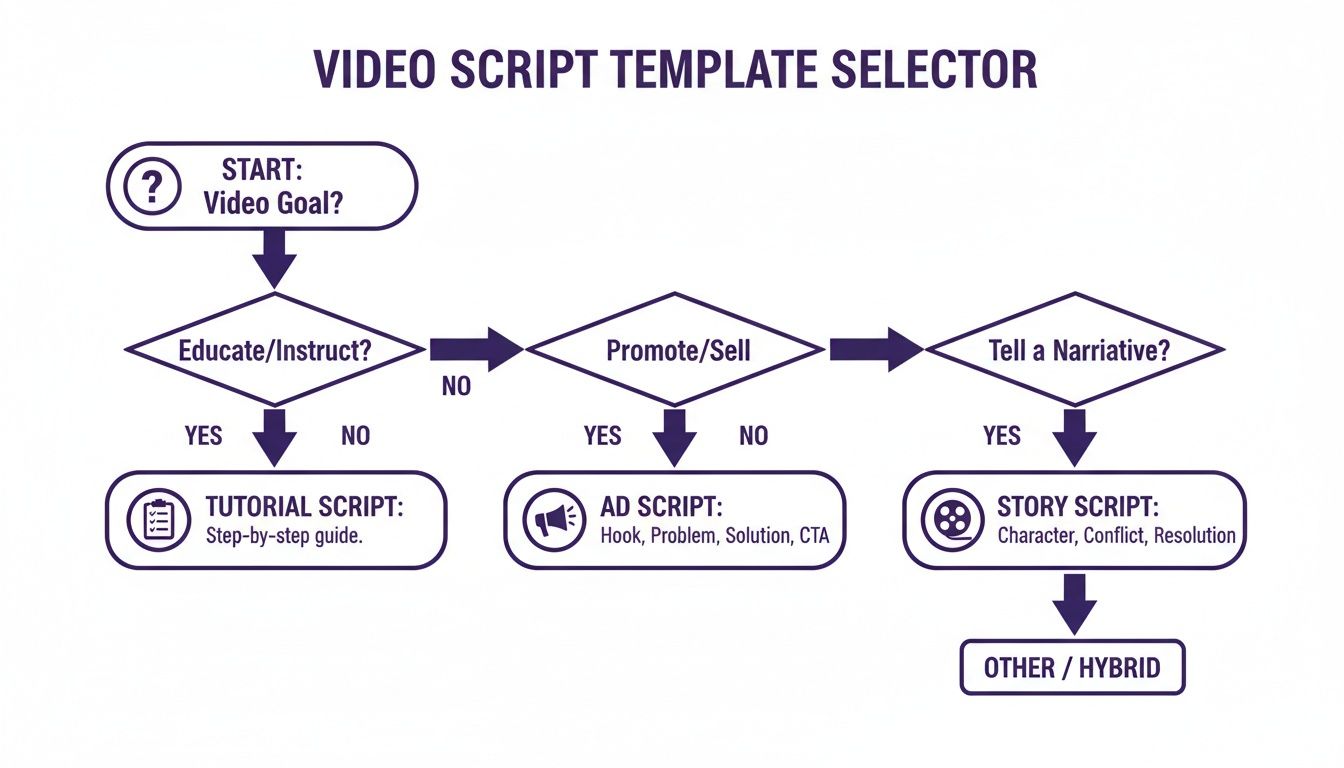
The takeaway here is simple: your goal comes first. Are you teaching, selling, or telling a story? That single decision sets the foundation for your entire script.
The All-Important Hook
You’ve got about 3-5 seconds to stop the scroll. That’s it. The hook isn’t just your first line; it’s the promise you make to your audience about the value they’re about to get.
A solid hook could be:
- A Provocative Question: "What if you could edit your videos twice as fast?"
- A Surprising Statistic: "Did you know that 80% of viewers will drop off in the first minute if your video is boring?"
- A Relatable Problem: "Are you tired of staring at a blank page, trying to come up with your next video idea?"
A good template must have a spot to workshop your hook. Seriously, it's the most important part of your video. If the hook flops, nobody will see the rest of your brilliant work.
The purpose of a great video script isn't just to be read; it's to be felt. It should feel like a natural conversation that builds trust and guides the viewer on a journey.
Maintaining Momentum with Pacing and Tone
Once you’ve snagged their attention, you have to keep it. A script that just drones on in the same monotone is a surefire way to get people to click away. This is where a good video scripts template can really help you map out the energy shifts.
Think of your script in "beats." You need to mix it up. Go from a high-energy reveal to a quieter, more personal story. This rhythm keeps the viewer guessing and locked in. If you want to go deeper on this, our guide on writing a script for a YouTube video is packed with more techniques.
The Art of the Call-to-Action
Alright, we’re at the finish line. The call-to-action (CTA) is where you turn someone who's just watching into someone who does something. A lazy CTA like "check out my website" is practically invisible. A great one is specific, creates urgency, and offers real value.
Don't just tell them what to do; tell them why it's good for them.
- Weak: "Subscribe for more."
- Strong: "Subscribe now so you don't miss next week's video where I'll reveal my top three editing secrets."
This is where data becomes your best friend. By analyzing what works, you can learn how to create high-performing Reels templates that are built for action. It stops being guesswork and starts becoming a predictable system for growing your channel.
Customizing a Template to Sound Uniquely You
Let's be honest. The biggest fear with using a video scripts template is that you'll end up sounding like a robot. You know that stiff, hollow delivery that just screams, "I'm reading off a piece of paper."
But here’s the thing: a template isn't a cage; it's a launchpad. It gives you the structure, but the magic happens when you inject your own personality and brand voice into it. This isn't about ditching the template. It's about making it sound like you.
Get Clear on Your Message and Voice
Before you touch a single word, stop and ask yourself two questions. First, what’s the one single thing I want my audience to walk away knowing? Nail that down into one sentence. That's your compass for every edit you make.
Next, who are you to your audience? Are you the witty expert who drops clever analogies? The empathetic guide who understands the struggle? Or maybe the no-nonsense coach who gets right to the point? If you’re not sure, go read the comments on your best-performing videos. Your audience will tell you.
- Witty Expert: You probably use industry jargon but with a fun, clever twist.
- Empathetic Guide: You’re all about relatable stories and gentle encouragement.
- No-Nonsense Coach: You use direct, actionable language and skip the fluff.
Once you know your core message and your voice, every change you make to the template should be to turn up the volume on those two things.
Weave in Your Own Stories
The fastest way to make a script your own is to get personal. A template might have a placeholder like, "[Insert personal story about struggling with this problem]." Don't just fill in the blank—dig for the real stuff.
Think about a specific moment. What did it feel like? What was the turning point? What ridiculous mistake did you make that you can laugh about now?
Details are what connect people. Instead of saying, "I used to be disorganized," try something like, "I still remember sitting on my office floor, totally surrounded by a mountain of sticky notes, convinced I was going to fail." That kind of specificity makes your story stick.
A video scripts template gives you the "what" to say. Your personal experiences provide the "why" anyone should care. It’s the difference between information and inspiration.
This is a game-changer, especially if you're trying to go from hobbyist to pro. Your unique perspective is your biggest advantage. Anyone can list generic tips, but nobody else has your story. That makes your content impossible to copy.
Speak Like a Human, Not a Textbook
Now, read your script out loud. Does it sound like you? Or does it sound like you're giving a book report? If it feels stiff, it's time to rewrite.
Swap out formal words for conversational ones. Use contractions—"you're," "it's," "don't." It’s a tiny change, but it makes your delivery feel way more natural and approachable.
Also, pay attention to the language your community uses. If you're a filmmaker talking to other filmmakers, you can geek out about "log footage" and "color grades." But if you're talking to a bunch of beginners, you’d probably say "raw video files" and "adjusting the colors." Speaking their language proves you're one of them.
Tweak the Template for Different Platforms
One great idea can fuel content for a week, but you can't just copy and paste the script. The structure has to change depending on where you're posting.
For YouTube (Long-form): This is where you can flesh out the body of your video scripts template. Go deeper, add more examples, and build out the story. You have the time.
For TikTok/Reels (Short-form): The hook is everything. You have about 3 seconds to grab someone. Your script needs to be super tight. Pull one powerful point from your main video and use a quick "Problem-Agitate-Solve" model.
For LinkedIn (Professional): The tone shifts to be more authoritative. Your hook could be a shocking statistic or a bold prediction for your industry. The call to action is usually something like reading a report or joining a webinar.
By tweaking a single base template, you're not just saving time. You're building a cohesive content machine that hammers home your core message on every channel, helping you build authority and grow way more effectively.
Unlocking Your Content Library to Build New Scripts
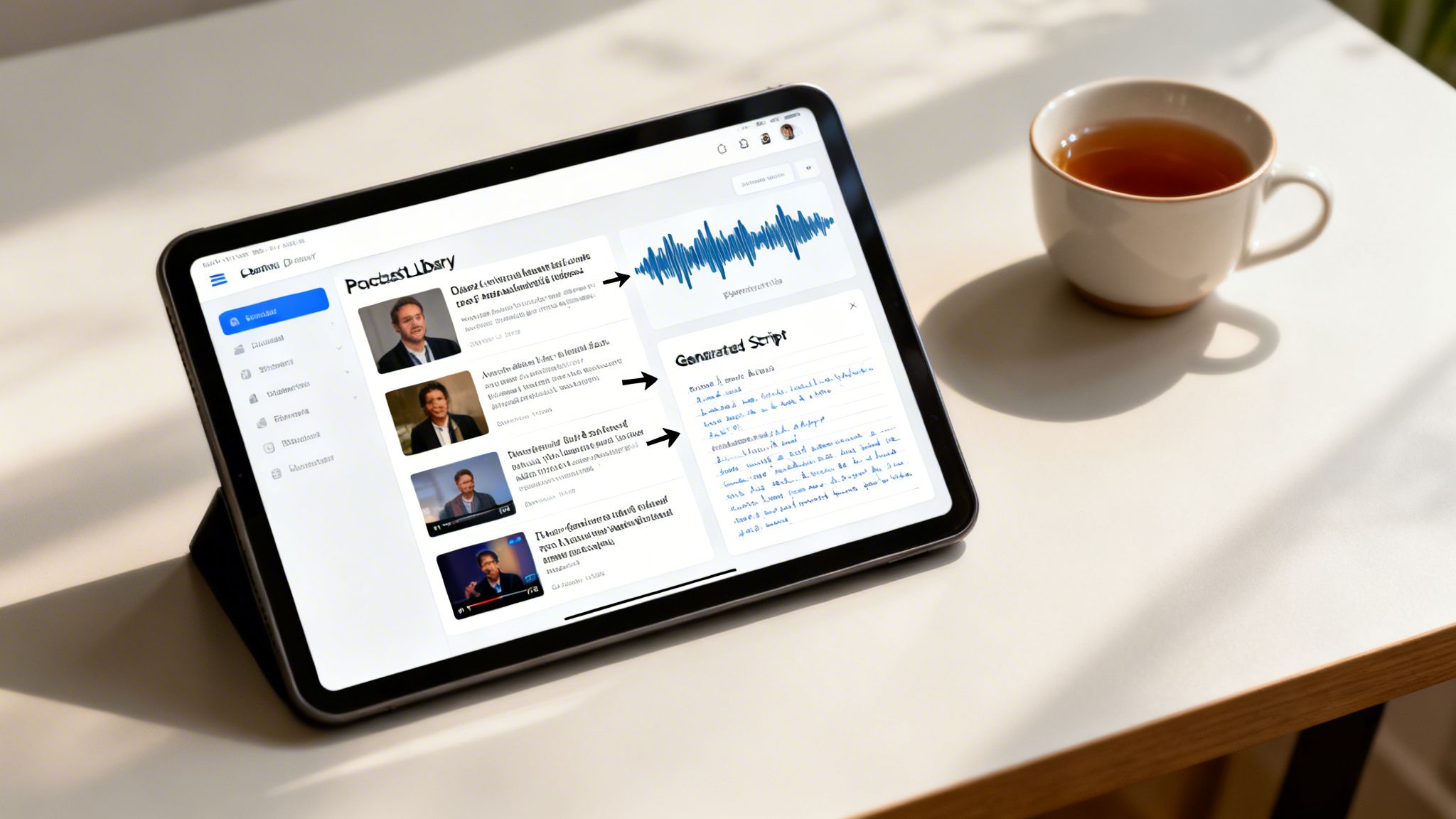
What if your next killer video is already written? Chances are, it’s just scattered across your old blog posts, podcast episodes, and video transcripts. For creators sitting on a mountain of content, the best ideas are often hiding right under your nose. This is how you upcycle old content and create new value.
Instead of staring at a blank page, you can dig into your past successes to build your next hit. Reignite your content library and bring it to life! All the raw material is right there. This is how you shift from being a creator who just makes stuff to a professional who systematically builds value.
Imagine turning your entire backlog into an intelligent, searchable database. This isn't just about finding old files; it's about spotting the patterns and hot topics that got your audience hooked in the first place. You can create almost infinite content value from the assets you already have. Organize. Understand. Take Action.
Turning Your Archives Into Actionable Scripts
Think about a publisher with hundreds of articles. Manually sifting through them to spot trends for a new video series would take an eternity. Now, picture feeding that whole library into a tool like Contesimal. By helping humans and AI collaborate, you can instantly organize and make sense of your content at a massive scale.
With Contesimal, you can use its AI chat to ask direct questions about your own library. You could ask things like:
- "What are the top three themes I discuss most in my podcast transcripts?"
- "Which audience questions show up most often in my video comments?"
- "Break down the core structure of my most-viewed 'how-to' videos."
The system will pinpoint recurring ideas, audience-favorite moments, and the structural DNA of what's already worked for you. From there, you can generate a new, structured video scripts template that’s already proven to resonate with your audience.
A Real-World Scenario in Action
Let’s get practical. A book publisher wants to launch a short-form video series promoting their back catalog of non-fiction books. The old way would involve a ton of research and custom scripting for every single video.
Instead, they use Contesimal to upload the manuscripts of their top 20 books. The AI quickly classifies the content, pulling out key concepts, great anecdotes, and powerful quotes from every chapter. The publisher's team then asks the AI to build a templated script for a 60-second video using the classic "Problem-Agitate-Solve" framework.
The result is a reusable video scripts template with placeholders for a book's central problem, the pain points it causes, and the solution the book offers. This simple setup absolutely slashes their research and writing time, letting them pump out a high-quality video for a book in a fraction of the time. It’s a perfect example of how to take your longform content across platforms in one click.
This approach completely changes the game for content production. The financial impact is huge. AI video tools have been shown to cut average production costs by a staggering 91% compared to traditional methods. With a projected $30 billion in corporate video spending by 2026, that kind of efficiency is non-negotiable.
By treating your content library as an active asset, you can build a predictable engine for creating high-performing scripts. You stop guessing what might work and start building on what you know already does.
Ultimately, your past work is a goldmine of insights. By using the right tools to dig into it, you’ll find the foundation for your next great video. If you're interested in this strategy, you can learn more about unlocking new value by mining your content library for fresh ideas in our detailed guide.
Common Questions About Using a Video Scripts Template
Even with the best templates in hand, jumping into a new workflow can feel a little weird. I hear the same questions pop up all the time from creators worried about timing, originality, and just getting it right.
Let's tackle those head-on. This isn't about just filling in blanks; it's about building a professional system that helps you produce consistently great content without all the guesswork.
How Long Should My Video Script Be for Different Platforms?
This is a big one. Script length is everything when it comes to keeping viewers locked in, and the right length changes dramatically depending on where you're posting. So many creators write a fantastic script that's simply too long or short for the platform, and all that hard work goes to waste.
A good rule of thumb is that most people speak at about 150 words per minute (WPM). You can use that as a baseline to estimate your video's final runtime.
- YouTube (10-minute video): You're looking at a script around 1,500-1,600 words. This gives you plenty of space to go deep on a topic without making your audience feel like they're watching a lecture.
- TikTok/Instagram Reels (60 seconds): Keep it incredibly tight. A script of roughly 150 words is your target. The real work here is packing a massive punch into the first three seconds.
- Facebook/LinkedIn (1-3 minutes): A script between 150 and 450 words usually hits the sweet spot. It’s got more meat than a Reel but is still concise enough to stop someone scrolling through their feed.
Pro Tip: Always, always read your script out loud with a timer before you even think about hitting record. The pacing in your head is never the same as what comes out of your mouth. This one step will save you hours of pain in the editing room.
Will Using a Video Scripts Template Make My Content Feel Unoriginal?
This is probably the number one fear I see, and honestly, it’s a fair question. No one wants to sound like a soulless robot reading a generic script. But that fear comes from a fundamental misunderstanding of what a template is actually for.
A template is a guide, not a cage. It gives you the bones of your video—the structure. Things like a hook, main points, and a call-to-action are just proven storytelling principles that work because they tap into basic human psychology.
Your originality is what you build on top of that skeleton:
- Your unique insights and expert angle.
- The personal stories and anecdotes only you can share.
- The niche examples that prove you really get your audience.
- Your distinct voice—whether you're funny, serious, or super motivational.
Think of it like a chef using a classic recipe. The recipe provides the steps—sauté the onions, then add the garlic—but the chef chooses the quality of the ingredients and adds their own secret spice blend to make the dish unforgettable. That's exactly how a video script template works; it’s the framework for your creative genius.
How Can I Create a Template From My Own Successful Content?
Now we're talking. This is one of the smartest things you can do to guarantee brand consistency and just double down on what you know already works. Reverse-engineering your own greatest hits is the key to building a real content engine.
First, go find your top-performing content. Pick a video, blog post, or podcast episode that absolutely crushed it with engagement. Got it? Okay, now break it down.
- The Hook: What was the exact first sentence or question you used to grab people?
- The Core Points: What were the 3-5 main ideas you covered? How did you move from one to the next?
- The Pacing: Where did you drop in a story, a joke, or a surprising stat to keep the energy high?
- The Conclusion: How did you wrap it all up and what was your final call-to-action?
Transcribe that flow into a blank document. Boom. That's your own master template, built from proven success.
If you want to get more advanced, tools like Contesimal can analyze your entire content library, find these winning patterns for you, and help generate optimized templates automatically. It’s like collaborating with an AI to figure out the secret sauce that makes your best content tick.
What Is the Most Important Part of Any Video Script?
While every section matters, the hook—your first 3-5 seconds—is hands-down the most critical part of any script. On today's platforms, you have a sliver of a moment to stop someone from scrolling away forever. If your hook is weak, the rest of your brilliant script might as well not exist.
A killer hook immediately answers the viewer's unspoken question: "What's in it for me?" It could be a bold question, a shocking statistic, or a painfully relatable problem. Your video script template should have a dedicated, unmissable section labeled "THE HOOK" to force you to pour real creative energy into making it absolutely irresistible.
A great hook doesn't just get you a view; it earns you the right to deliver the rest of your message.
Ready to turn your entire content library into an endless source of high-performing scripts? Contesimal helps you organize your content library to create new value and ultimately make money with it. Collaborate with AI to discover hidden gems and generate new value from the content you've already created. Visit https://contesimal.ai to see how it works.