
In the ever-evolving world of digital media, standing out requires more than just a consistent posting schedule. For professional creators, marketers, and publishers, the key to sustainable growth lies in understanding the full spectrum of content formats available and strategically repurposing your existing library to meet audiences where they are. Mastering the primary types of social media content is the first step toward building a resilient brand that can thrive across multiple platforms.
This guide moves beyond surface-level advice to give you actionable strategies for creating, repurposing, and monetizing each format. You'll learn not just what to post, but how to transform your content archive from a passive storage unit into an active, revenue-generating asset. Whether you're a YouTuber looking to expand your reach, a podcaster aiming to grow your audience, or a publisher wanting to unlock the value of historical content, this is your blueprint for infinite content value. To truly dominate the social media landscape, it's essential to master various different kinds of content; explore these 9 Essential Types of Social Media Content to get a foundational overview.
Here, we will dive deeper into a comprehensive list of formats. We'll detail how to optimize each one, provide creation tips, and show you how to mine your existing library for new opportunities. The goal is to build a cohesive, multi-platform content ecosystem that drives views, fosters community, and reignites your creative library for long-term success. Let's get started.
1. Short-Form Video Content
Among the different types of social media content, short-form video reigns supreme for audience reach and engagement. This format includes vertical videos, typically ranging from 15 seconds to three minutes, created for fast-paced mobile consumption. Platforms like TikTok, Instagram Reels, and YouTube Shorts have propelled this content into the mainstream, making it a critical tool for connecting with younger audiences and gaining algorithmic favor.
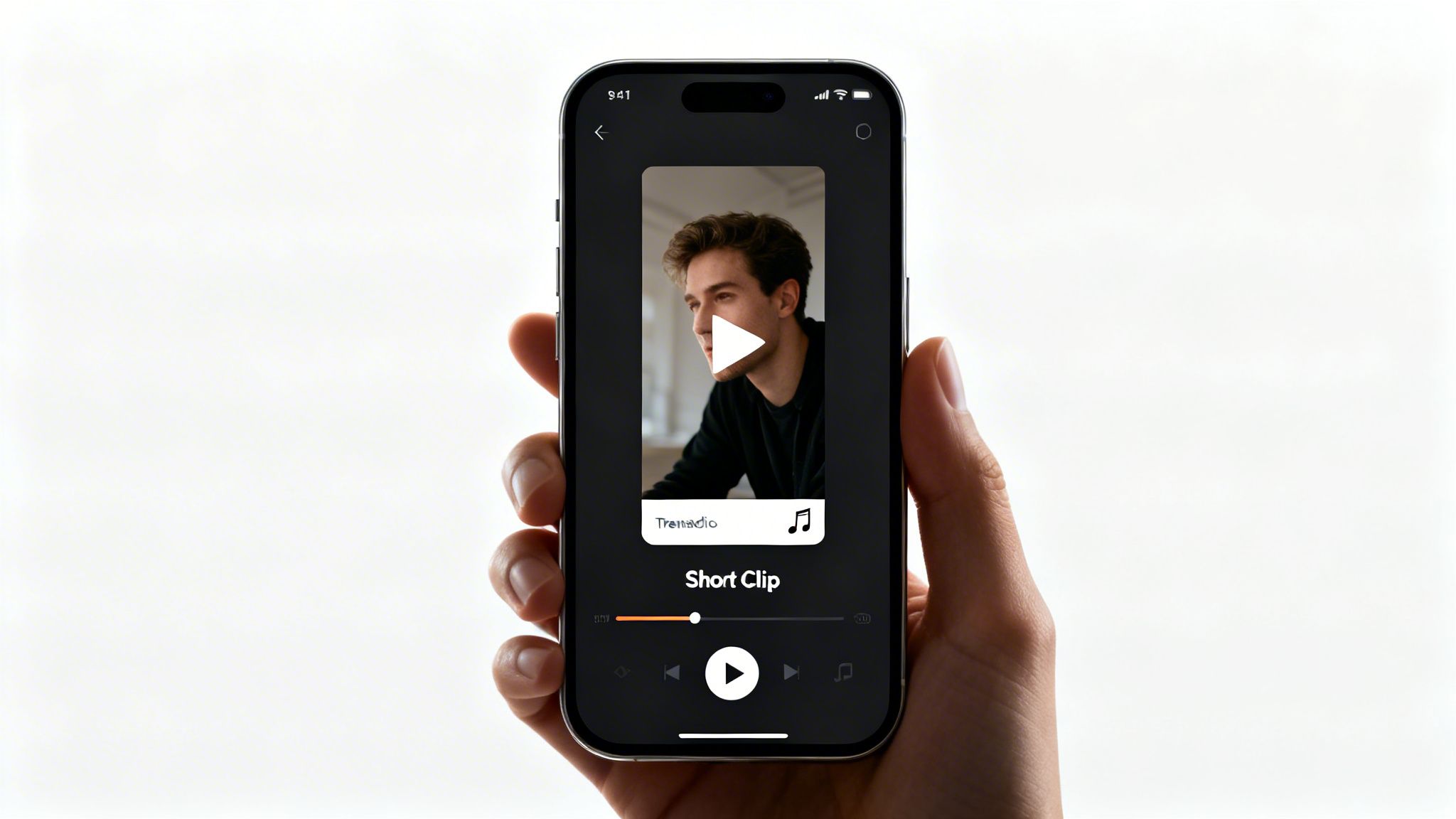
This video style is effective because it aligns perfectly with modern viewing habits. From major brands like Nike sharing dynamic product showcases on Reels to podcasters like Joe Rogan posting compelling clips on TikTok, the format’s versatility is clear. Its strength lies in its ability to deliver a quick, impactful message.
Actionable Tips & Strategy
- Hook Immediately: Capture viewer attention within the first three seconds to stop them from scrolling. A strong opening is non-negotiable.
- Repurpose Smartly: Don't let your long-form content sit idle. Use a tool like Contesimal to mine your archives and identify the most engaging 60-second moments from podcasts, interviews, or webinars. This turns one asset into many.
- Follow Trends: Use trending audio and relevant hashtags, but ensure they align with your brand's voice. Don’t force a trend if it doesn’t fit.
- Create a Series: Develop a recurring content theme or series. This gives audiences a reason to follow you for the next installment, building a loyal community. To get even more out of this strategy, learn more about how to get more views on YouTube Shorts and apply those tactics across platforms.
- Track Key Metrics: Monitor watch time, completion rate, and shares. These signals tell you exactly what resonates with your audience, guiding future content creation.
2. Podcast Episodes and Audio Content
Podcasting has cemented its place as a powerhouse among the different types of social media content, offering a medium for deep dives and authentic connection. This long-form audio format, with episodes typically running from 20 minutes to several hours, is ideal for in-depth interviews, expert discussions, and narrative storytelling. Distributed on platforms like Spotify, Apple Podcasts, and even YouTube, podcasts build authority and foster a strong, loyal audience.

The format's power comes from its ability to capture listeners' attention during commutes, workouts, or daily chores. Shows like The Joe Rogan Experience and NPR's How I Built This demonstrate how audio can create an intimate bond between host and listener. This direct-to-ear communication is perfect for establishing thought leadership and exploring topics in a way that other formats simply cannot accommodate.
Actionable Tips & Strategy
- Invest in Quality Audio: Clear sound is non-negotiable. Good microphones and basic sound treatment make your content sound professional and keep listeners engaged.
- Organize and Repurpose: Your audio archive is a content goldmine. Use a tool like Contesimal to organize transcripts and search your entire podcast library. This lets you quickly find guest insights, topic clusters, or key moments to repurpose into clips, articles, and social posts.
- Maintain a Consistent Schedule: Release episodes on a predictable schedule (e.g., every Tuesday morning). Consistency builds anticipation and turns casual listeners into dedicated subscribers.
- Create Detailed Show Notes: Provide timestamps, guest links, and resource mentions in your episode descriptions. This improves the listener experience and aids in SEO. For more ideas on how to grow your show, explore detailed guides on podcasting for small business.
- Build a Community: Engage with your audience through Q&A segments, social media discussions, or a dedicated community forum. This two-way communication strengthens listener loyalty.
3. Long-Form Blog Posts and Articles
While social media is often associated with brevity, long-form articles of 1,500+ words are foundational types of social media content for establishing authority and driving organic traffic. These comprehensive pieces are not just for your blog; they are cornerstone assets you can promote and deconstruct for social channels. Their depth signals expertise to search engines and provides immense value to your audience, positioning your brand as a go-to resource.
This content format excels at building trust and capturing leads. Marketing powerhouses like HubSpot and SEO experts like Neil Patel built their empires on in-depth guides that solve specific problems. The goal is to create the single best resource on a topic, making it a shareable and link-worthy asset that fuels your entire content ecosystem. These articles are the pillars that hold up your content strategy.
Actionable Tips & Strategy
- Target Long-Tail Keywords: Focus on specific, less competitive search phrases. This helps you attract a highly motivated audience actively looking for the detailed answers you provide.
- Create Scannable Formatting: Use short paragraphs, subheadings, bullet points, and bold text. This makes your detailed information digestible for online readers who often skim.
- Develop Content Clusters: Build your strategy around central "pillar" articles and surround them with related "cluster" posts. This organized approach improves your site's authority on a topic.
- Analyze Your Archive for Gaps: Use a tool like Contesimal to analyze your entire library of articles. It can help identify topic duplication, find content gaps, and spot opportunities to combine existing pieces into a more definitive pillar page.
- Optimize for Featured Snippets: Structure your content with clear questions and concise answers. Aiming for "position zero" in search results can dramatically increase your visibility and click-through rate.
4. Social Media Captions and Text Posts
Among the many types of social media content, well-crafted text remains a powerful, direct way to engage audiences. This category includes everything from standalone text posts on platforms like X (formerly Twitter) and LinkedIn to the descriptive captions that accompany images and videos on Instagram and Facebook. This format excels at starting conversations, sharing detailed thoughts, and building a distinct brand personality through the written word.
The power of text-based content is evident across platforms. Think of Reid Hoffman sharing professional insights on LinkedIn, Wendy's building a witty brand identity on X, or an influencer using a detailed Instagram caption to tell a compelling story. Its strength is in its simplicity and ability to convey nuanced ideas, opinions, and calls-to-action without the need for high production value.
Actionable Tips & Strategy
- Ask Engaging Questions: Prompt your audience to respond by asking direct questions related to your content. This simple action is one of the most effective ways to increase comments and algorithmic reach.
- Use Native Formatting: Adapt your writing to the platform. Use threads on X to tell a longer story, leverage bullet points and spacing on LinkedIn for readability, and craft compelling narrative captions for Instagram.
- Tap into Trending Topics: Connect your message to current cultural moments or trending news to increase relevance and discoverability. Ensure the connection feels authentic to your brand.
- Analyze Past Performance: Use a tool like Contesimal to analyze your content library and identify which written topics or themes have generated the most discussion in the past. Re-introduce these successful themes into your current text posts.
- Respond to Comments Quickly: Engaging with replies as they come in signals to the algorithm that your post is fostering community, which can boost its visibility. Learn more about writing effective posts by exploring different social media post examples to see these strategies in action.
5. YouTube Videos and Long-Form Video Content
While short-form video dominates quick-scroll feeds, long-form content on platforms like YouTube serves a different, equally important purpose. This category includes in-depth videos, typically over 10 minutes long, that are designed for dedicated viewing. As the world's second-largest search engine, YouTube is a powerhouse for education, entertainment, and building deep community connections, making it a cornerstone among the different types of social media content.
This format allows creators to explore topics with nuance and depth that shorter clips cannot accommodate. From MrBeast's elaborate entertainment spectacles and Veritasium's detailed science explainers to Wired's popular celebrity interview series, long-form video is a medium for establishing authority and providing immense value. Its strength is in capturing and holding audience attention for extended periods, fostering loyalty and trust.
Actionable Tips & Strategy
- Hook in 10 Seconds: Your introduction must convince viewers that the entire video is worth their time. Clearly state the value proposition or pose a compelling question right away.
- Optimize for Search: Write keyword-rich titles and descriptions that answer questions your audience is searching for. Treat every video as a solution to a problem.
- Create Custom Thumbnails: Design bright, high-contrast thumbnails with expressive faces or clear visuals that stand out. Your thumbnail is the first "ad" for your content.
- Use Video Chapters: Add timestamps to break your video into logical sections. This improves the viewing experience by allowing people to navigate directly to parts that interest them most.
- Analyze Retention Graphs: Study your YouTube Analytics to see where viewers drop off. These data points are critical for understanding what works and what to avoid in future videos.
- Find Your Next Big Idea: Use a tool like Contesimal to analyze your most-watched video segments and recurring themes. This helps identify proven concepts from your content library to guide your next production and build on success.
6. Infographics and Visual Data Storytelling
Another powerful category among the types of social media content is the infographic. These visual assets translate complex data, statistics, and processes into a format that is easy to digest and share. By blending smart design, typography, and data visualization, infographics make dense information accessible and compelling, perfect for social media feeds where users quickly scan for value.
This format is especially effective for establishing authority and providing concrete value. Organizations like Our World in Data use infographics to explain global trends, while financial communicators like Visual Capitalist simplify market data for their audiences. The strength of an infographic is its ability to make a data-backed point in a visually engaging and shareable way.
Actionable Tips & Strategy
- Focus on a Core Insight: Start with a clear dataset and a single, powerful takeaway. An effective infographic tells one story well, rather than trying to cover too much information at once.
- Find Data in Your Archives: Use a tool like Contesimal to scan your content library for key statistics, research findings, or step-by-step processes. It can quickly pinpoint data points from interviews or articles that are perfect source material for a new infographic.
- Design for Readability: Use color and layout strategically to guide the viewer’s eye through the information. Keep text minimal, use a clear font, and ensure the entire graphic is optimized for mobile viewing, as that’s where most users will see it.
- Cite Your Sources: Always include proper attribution for your data at the bottom of the graphic. This builds credibility and positions your brand as a trustworthy source of information.
- Create Multiple Versions: Design your infographic so it can be broken into smaller, shareable pieces. A tall graphic for Pinterest can become a multi-slide carousel for Instagram or individual data points for Twitter, extending its reach.
7. User-Generated Content (UGC) and Community Engagement
Among the most authentic types of social media content, user-generated content (UGC) builds powerful social proof and community trust. This format consists of any content-photos, videos, reviews, or discussions-created by your audience rather than your brand. It turns customers and community members into advocates, leveraging peer validation to promote your brand in a way that official marketing cannot.
This approach is effective because it hands the microphone to your biggest fans, creating a flywheel of authentic promotion. Campaigns like Starbucks' seasonal #RedCupContest generate massive engagement by encouraging customers to share their experiences. Similarly, GoPro built its brand by showcasing incredible adventure videos submitted by its users, demonstrating the product’s capabilities in real-world scenarios.
Actionable Tips & Strategy
- Create Branded Hashtags: Establish a unique and easy-to-remember hashtag for a specific campaign or for general use. This makes it simple to find, collect, and share contributions from your community.
- Feature User Content: Regularly showcase the best user submissions on your official channels. This recognition rewards participants and encourages others to contribute, creating a positive feedback loop.
- Offer Clear Incentives: Motivate participation by offering prizes, discounts, or exclusive features. Making the reward clear gives your audience a compelling reason to create content for you.
- Make Participation Easy: Lower the barrier to entry. Ensure the rules are simple and the type of content you're asking for is easy for anyone to create with a smartphone.
- Identify Community Trends: Use a tool like Contesimal to analyze keywords and themes within user comments, reviews, and discussions. This data reveals what your community truly cares about, guiding future product development and content strategy.
8. Email Newsletters and Direct Messaging
While not strictly a social media platform, email newsletters represent one of the most powerful types of social media content for building a direct, owned relationship with your audience. This format involves sending curated content directly to subscribers' inboxes, giving you a line of communication that is immune to algorithmic changes. Newsletters can range from daily news digests to weekly deep-dives, offering a space for more personalized and long-form engagement.

This direct channel has proven its value across industries. Creators on platforms like Substack have built entire media businesses from their subscriber lists, while brands like Morning Brew deliver business news to millions. The key is that you control the list and the delivery, making it an essential asset for any serious content creator or publisher looking to create a stable, engaged community.
Actionable Tips & Strategy
- Craft Compelling Subjects: Your subject line is the gatekeeper. Personalize it with the subscriber's name or reference their interests to significantly increase open rates.
- Segment Your Audience: Don’t send the same message to everyone. Group subscribers based on their interests, past engagement, or where they signed up to deliver more relevant content.
- Balance Value and Promotion: Follow the 80/20 rule. Ensure 80% of your content provides genuine value (education, entertainment, insights) and only 20% is promotional. This builds trust and keeps subscribers from unsubscribing.
- Mine Your Archives: Use a tool like Contesimal to scan your content library and identify top-performing themes or stories. Feature these proven topics in your next curated newsletter to guarantee a high-value send.
- Include Clear Calls-to-Action (CTAs): Every email should have a purpose. Guide your readers on what to do next, whether it’s reading a blog post, watching a video, or checking out a new product.
9. Case Studies and White Papers
Among the most authoritative types of social media content, case studies and white papers build significant credibility and trust. These formats offer an in-depth analysis of real-world results, detailed methodologies, and expert insights. While traditionally seen as B2B assets, they can be adapted for social media to establish expertise and provide genuine value, moving beyond simple engagement to demonstrate tangible impact.
This content is powerful because it provides proof. Think of Salesforce sharing customer success stories on LinkedIn to prove their platform's ROI, or HubSpot publishing marketing research reports that become industry benchmarks. These assets are shared as downloadable PDFs, detailed blog posts, or even broken down into carousel posts, making complex information accessible to a wider audience.
Actionable Tips & Strategy
- Focus on Outcomes: Center your study around measurable business outcomes. Use clear data points, percentages, and dollar figures to show the "before and after" transformation.
- Show, Don't Just Tell: Use a tool like Contesimal to analyze customer project archives and identify the most compelling success stories. This helps pinpoint projects with the strongest data and narratives to develop into formal case studies.
- Include Customer Voices: Incorporate direct quotes and testimonials from the client or partner. This adds a layer of authenticity and social proof that makes the results more believable.
- Visualize Key Data: Create charts, graphs, and infographics to highlight the most important metrics. Visuals make complex data easier to understand and are highly shareable on platforms like LinkedIn and X (formerly Twitter).
- Break It Down: Deconstruct your detailed white paper into a series of smaller content pieces. A single report can fuel dozens of social posts, short videos, and infographics, extending its reach far beyond the initial download.
10. Live Streaming and Real-Time Content
Live streaming offers an unscripted, real-time connection with your audience, making it one of the most authentic types of social media content. This format involves broadcasting video live on platforms like YouTube Live, Instagram Live, and Twitch. It creates a sense of urgency and shared experience, allowing creators to interact directly with viewers through synchronous chat, Q&As, and polls.
Live content is effective because it fosters a strong community connection and provides immediate feedback. From LinkedIn Live sessions with industry leaders to Twitch streams where gamers build loyal followings, the format’s power is its immediacy. It turns passive viewers into active participants, building trust through unfiltered conversation and a behind-the-scenes feel.
Actionable Tips & Strategy
- Promote in Advance: Build anticipation for your stream by promoting it across your channels several days beforehand. A simple countdown can significantly boost initial viewership.
- Have a Loose Agenda: Plan your key talking points but leave room for spontaneous conversation and audience questions. This keeps the stream engaging and natural.
- Engage with the Chat: Acknowledge viewers by name and respond to their comments and questions. This direct interaction is the core appeal of live content.
- Test Your Setup: Before going live, always check your audio, video, and internet connection to avoid technical issues that can disrupt the viewer experience.
- Repurpose Your Stream: After the broadcast, edit the recording into highlight clips, short-form videos, or even podcast episodes. You can use a tool like Contesimal to mine your archives for topics that would generate great live discussions, giving you a starting point for your next stream.
11. Webinars and Online Courses
Among the more structured types of social media content, webinars and online courses are powerful formats for establishing authority and delivering deep, educational value. This content can be synchronous, like a live webinar, or asynchronous, like a self-paced course. Both approaches position creators as experts in their field, building a strong connection with audiences looking for in-depth knowledge.
This educational style is ideal for turning passive followers into an active community or customer base. Platforms like Kajabi and Udemy allow creators to host entire learning experiences, from single-session marketing webinars to multi-module creative courses on Skillshare. The goal is to provide a clear, tangible outcome that leaves the audience with new skills or insights.
Actionable Tips & Strategy
- Define Clear Outcomes: Start by outlining what your audience will be able to do or know after completing your webinar or course. A clear curriculum structure is essential.
- Boost Engagement with Interaction: During live webinars, use polls, Q&A sessions, and breakout rooms to keep attendees involved. For courses, include quizzes and assignments.
- Map Your Curriculum: Use a tool like Contesimal to organize your existing content library. You can create curriculum maps that show how different videos, articles, and podcasts can be sequenced into a logical and compelling course structure.
- Promote Across Channels: Announce your webinar or course registration through email lists, social media posts, and short-form video teasers to maximize sign-ups.
- Develop Supporting Materials: When creating an effective program, consider including workbooks, checklists, and other resources to supplement the core lessons. For more practical advice, review these online course tips to improve learner outcomes.
- Follow Up Strategically: Segment your follow-up communication. Send recordings and thank-you notes to attendees, and a "sorry we missed you" sequence with a link to the recording for no-shows.
12. Interviews and Conversation-Based Content
Among the various types of social media content, interview-driven formats build authority and expand reach by tapping into a guest's expertise and audience. This content is centered on conversations between hosts and guests and can be published as long-form videos, podcasts, blog posts, or edited articles. Its power comes from introducing your brand to new communities through a trusted figure.
This format is a staple for knowledge-based creators. Shows like The Tim Ferriss Show and NPR's How I Built This demonstrate how in-depth conversations can attract a dedicated following. The value lies in providing unique insights and stories that audiences can't find elsewhere, directly from the source.
Actionable Tips & Strategy
- Prepare Deeply: Go beyond a surface-level search of your guest. Thorough research uncovers unique questions and shows respect, leading to a much better conversation.
- Guide, Don't Restrict: Have your core questions ready, but allow the conversation to explore interesting tangents. The most memorable moments are often unscripted.
- Find Future Guests in Your Archives: Use a tool like Contesimal to search your past interviews for mentioned names, topics, and areas of expertise. This data can pinpoint ideal future guests who align with your content and have a built-in connection to your existing library.
- Create Clip-Worthy Moments: During the interview, be mindful of creating concise, powerful soundbites. Extracting these quotes for short-form video clips on TikTok or Reels is a key promotional tactic.
- Track Audience Crossover: Monitor new followers and engagement spikes when you release a new interview. This helps you understand which guest audiences are most receptive to your content.
12-Item Social Media Content Comparison
| Content Type | Implementation Complexity | Resource Requirements | Expected Outcomes | Ideal Use Cases | Key Advantages |
|---|---|---|---|---|---|
| Short-Form Video Content | Low–Medium (fast turnaround, consistent schedule) | Minimal gear, quick editing, social-native formats | High engagement, viral reach, rapid audience growth | Awareness, trend participation, repurposing clips | Algorithmic distribution, low cost, strong retention |
| Podcast Episodes and Audio Content | Medium–High (recording, editing, planning) | Quality mics, hosting, time for long-form production | Deep listener loyalty, thought leadership, monetization potential | Long-form interviews, storytelling, niche authority | High engagement, repurposable transcripts, sponsorships |
| Long-Form Blog Posts and Articles | Medium–High (research + SEO expertise) | Skilled writers, editors, SEO tools, research time | Sustained organic traffic, authority, lead generation | Pillar content, SEO-driven education, evergreen guides | Strong SEO, long lifespan, credibility |
| Social Media Captions and Text Posts | Low (rapid creation, frequent posting) | Minimal — social manager or small team | Quick conversation, brand voice building, real-time engagement | Community engagement, timely commentary, thought leadership | Fast, low-cost, direct audience interaction |
| YouTube Videos and Long-Form Video Content | High (production and editing intensive) | Cameras, lighting, editing, channel management | High watch time, discoverability, multiple revenue streams | Educational series, entertainment, tutorials, interviews | Search visibility, monetization, subscriber growth |
| Infographics and Visual Data Storytelling | Medium (design + data synthesis) | Designer, data analyst, visualization tools | High shareability, improved comprehension, backlinks | Data summaries, reports, social distribution | Simplifies complex info, strong social traction |
| User-Generated Content (UGC) and Community Engagement | Low–Medium (curation and moderation) | Community managers, incentives, moderation tools | High trust, continuous authentic content stream | Campaigns, reviews, brand advocacy, social proof | Authenticity, low production cost, engagement |
| Email Newsletters and Direct Messaging | Medium (segmentation and personalization) | Email platform, list growth, content curation | High ROI, direct conversions, repeat traffic | Nurture sequences, promotions, curated digests | Owned channel, personalization, measurable ROI |
| Case Studies and White Papers | High (research-heavy, polished production) | Analysts, designers, access to customer data | B2B lead generation, credibility, sales enablement | Enterprise sales, gated lead capture, thought leadership | Demonstrates ROI, trusted proof points |
| Live Streaming and Real-Time Content | Medium (live tech and moderation) | Stream setup, reliable internet, moderators | Immediate engagement, community building, FOMO | Q&A, launches, interactive events | Real-time interaction, authentic connection, VOD repurposing |
| Webinars and Online Courses | High (curriculum design and delivery) | LMS/platform, instructors, production resources | Qualified leads, revenue, deep audience education | Training, certification, premium education products | High engagement, monetization, structured learning |
| Interviews and Conversation-Based Content | Medium (guest coordination and editing) | Recording tools, guest outreach, editing time | Audience crossover, fresh perspectives, evergreen episodes | Expert interviews, panel discussions, guest amplification | Builds networks, repurposable highlights and quotes |
Unify Your Content, Amplify Your Value
We've explored a dozen distinct types of social media content, from the rapid-fire engagement of short-form video to the deep authority of white papers and case studies. You now have a strategic map detailing what each format is, where it thrives, which metrics matter, and how to create it effectively. But simply knowing the types is only the first part of the equation. The real challenge for creators, publishers, and marketers is not just producing more content; it's about making that content work smarter and harder for you.
The path from a passionate hobbyist to a professional, revenue-generating content business is paved with strategic integration. Your content library, filled with past podcast episodes, long-form videos, and detailed articles, should not be a static archive. It is a dynamic asset, a goldmine of insights, narratives, and data waiting to be rediscovered and repurposed.
Beyond the One-Off: Building a Content Ecosystem
Thinking of each piece of content as a standalone effort is a recipe for burnout. A successful content strategy treats every asset as a node in a larger, interconnected network.
- A single long-form YouTube video can be the source material for dozens of other assets.
- A well-researched blog post can provide the foundational knowledge for an entire webinar.
- An insightful podcast interview contains the quotes, stories, and data points for a week's worth of social media text posts and carousels.
This approach stops you from constantly chasing the "next new idea" and instead empowers you to build on proven success. It's about creating a system where every piece of content informs and fuels the next, establishing a self-sustaining cycle of value creation. You reignite your past work, giving it new life and new audiences across different platforms.
Key Insight: The most successful creators don't just create content; they build an intelligent system. They organize their library not as a collection of finished products, but as a repository of raw materials for future innovation.
Take Action: Your Next Steps to Infinite Content Value
Mastering the many types of social media content is about more than just execution; it's about orchestration. To move forward, you need to shift your perspective from production to asset management.
- Organize Your Library: Stop thinking of your content as a chaotic folder of files. Begin cataloging what you have, tagging it by topic, format, performance, and core themes. Understand the knowledge contained within your creations.
- Identify High-Performers: Dive into your analytics. What blog posts still get traffic? Which videos have the highest watch time? These are your "pillar" assets, proven to resonate with your audience and ripe for repurposing.
- Collaborate and Discover: Content creation is rarely a solo endeavor, especially as you scale. You need a way for your team, whether it's a co-writer, an editor, or a video producer, to access and understand the wealth of information you've already produced. This is where you can find hidden connections and generate fresh angles from existing work.
By adopting this mindset, you stop creating in a vacuum. You start building a powerful, interconnected content engine that not only grows your audience but also creates new opportunities for monetization. You transform your content library from a cost center into your most valuable business asset.
Ready to stop guessing and start building a true content ecosystem? Contesimal is designed to help creators and publishers organize, understand, and act on their entire content library. It's the system that allows your team to collaborate with AI, discovering hidden value in your archives and seamlessly turning your best long-form assets into a diverse range of social media content. Reignite your content library with Contesimal today.