
Your archive is full, but your next piece still feels like a blank page. A podcast episode sits in one folder, its research in another, the best quote is buried in a transcript, and three promising clips are scattered across a social media playlist. When a sponsor asks for a themed series or your audience responds to an old idea, finding and rebuilding the material takes longer than creating something new.
That problem usually isn't a lack of creativity. It's a classification problem. Building classification types offer a useful blueprint because they connect labels to purpose, evidence, and relationships. Applied to a library of videos, podcasts, scripts, articles, and research, classification can turn passive storage into a working system for repurposing, collaboration, and revenue.
Why Your Content Library Feels Stuck
A creator may have years of useful material and still be unable to answer simple questions quickly. Which interviews discuss audience growth? Which episodes contain unfinished ideas? Which blog posts could become a video series? Which scripts have enough research to support a book chapter?
Without consistent classification, the answers depend on memory. One folder might be called “interviews,” another “guest talks,” and a third “episodes with experts.” A YouTuber may organize by playlist, while an editor organizes by production date and a marketing manager searches by campaign. Each person sees part of the archive, but nobody can reliably see the whole content system.
Practical rule: If people need to open an asset to understand what it is, the classification system isn't doing enough work.
A useful comparison comes from international building statistics. The United Nations Economic Commission for Europe building classification guidance defines a building as an independent, roofed structure enclosed by external or dividing walls. It classifies a building as residential when more than half of its gross floor area is used for dwelling purposes. That threshold gives mixed-use structures a measurable rule instead of relying on labels such as “apartment” or “shopping center.”
Content libraries need the same discipline, although their dimensions are different. A longform interview can be classified as an episode, an interview, research material, a source for short clips, and an asset aimed at an advanced audience. If you force it into a single folder called “Podcast,” you lose the evidence that makes it reusable.
From storage closet to asset system
Classification helps a team connect related material without destroying the original context. A publisher can find every asset about a topic, then filter by format, audience, production status, or distribution intent. A filmmaker can locate unused scenes and supporting research. A content marketer can identify a successful concept and trace the source material behind it.
The payoff isn't just tidier folders. A structured archive helps creators organize, understand, and take action. It supports new episodes, derivative posts, clips, newsletters, research briefs, and other formats without requiring the team to start from an empty document every time.

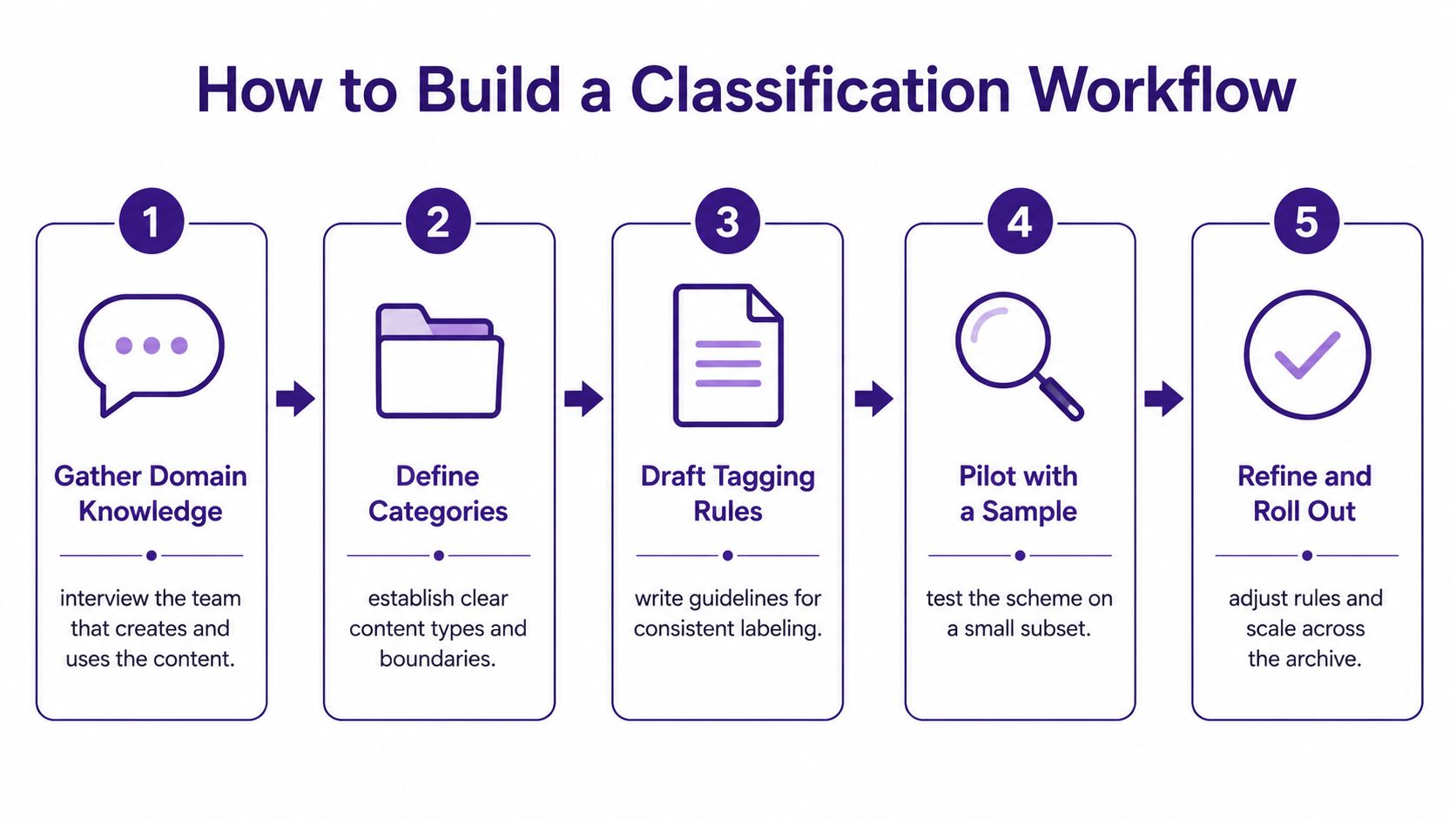
How to Build a Classification Workflow
A classification workflow should follow a deliberate pipeline. Ad hoc tagging feels fast during upload, but it creates inconsistent labels that become expensive to repair once an archive grows.
Start with knowledge, not software
First, gather the language your team already uses. Ask creators, editors, producers, marketers, and publishers how they describe assets when they search for them. Capture the differences. An editor may care about revision status, while a producer needs to know whether a recording is cleared for publication.
Then define the top-level dimensions. Keep them separate rather than building one enormous tree. Useful dimensions for a content library include:
- Format: podcast episode, video, article, script, transcript, image, or research document.
- Topic: the subject or knowledge area covered by the asset.
- Audience: beginners, professionals, subscribers, customers, or internal teams.
- Intent: educate, entertain, convert, document, announce, or explore.
- Production status: idea, planned, drafted, edited, published, archived, or needing review.
The hierarchy should show parent-child relationships. “Video” can contain “interview,” “tutorial,” and “roundtable,” while “interview” can contain topic-specific subtypes. Every child needs an inclusion rule and a reason for existing beside its siblings.
Formalize the model
The building-classification workflow described in airborne-laser-scanning research combines domain ontology engineering with observable features. It gathers expert knowledge, conceptualizes the hierarchy, formalizes the ontology, implements it computationally, and validates it against labeled data. The research used building footprint, extent, shape, height, and roof-slope features, which illustrates the important principle for content teams: a class should connect to evidence, not just a name. The research on ontology-based building classification also shows why class-level evaluation matters. Residential or small buildings reached a 97.7% F-measure, while apartment buildings reached 60% and industrial or factory buildings reached 51%.
For a content archive, evidence fields might include transcript phrases, speaker role, publication date, intended audience, rights status, or source project. Borderline assets should go to expert review instead of receiving a confident label that nobody can explain.
A publishing team that wants to connect classification with assignments, approvals, and handoffs may also benefit from Refact's workflow software guide. The tool is relevant because classification works best when it connects directly to the process that moves an asset from idea to publication.
Before scaling, test the model against a representative sample. Create stable identifiers, document the rules, and make searchable fields visible to the people who will use them. The practical details of metadata management best practices matter because weak metadata can undermine a carefully designed taxonomy.
Taxonomy versus Tag Vocabulary
A flat tag vocabulary is a list. A taxonomy is a structure. An ontology goes further by defining explicit meaning and relationships among entities.
Flat tags are attractive because they're easy to add. A team can attach “interview,” “marketing,” “launch,” and “YouTube” to an episode in seconds. The trouble begins when different people add “video interview,” “guest interview,” and “Q&A” for similar assets. Search results become noisy, and the team can't tell whether two labels are synonyms, parent and child, or unrelated concepts.
A taxonomy gives terms a place in relation to one another. An ontology can also describe how an episode relates to a guest, a campaign, a topic, a source document, or a derivative clip. Construction-information standards such as IFC and OmniClass demonstrate why interoperable domain models need more than an unordered vocabulary. The content tagging and taxonomy guide applies the same logic to editorial archives.
Choose controlled terms for stable retrieval
| Dimension | Flat Tag Vocabulary | Controlled Taxonomy or Ontology |
|---|---|---|
| Structure | Unordered terms | Parent-child hierarchy and explicit relationships |
| Search | Dependent on synonyms and spelling consistency | Supports consistent filtering and related discovery |
| Governance | Anyone can add labels | Terms have owners, definitions, and stable identifiers |
| Reporting | Difficult to group reliably | Easier to analyze by type, topic, audience, or status |
| Repurposing | Finds isolated matches | Connects source assets with related derivatives |
| Risk | Vocabulary grows without boundaries | Design work is required before scale |
The most common design mistake is mixing classification dimensions in one ladder. “Podcast,” “entrepreneurship,” “beginner,” and “published” shouldn't sit beside one another as if they were siblings. They describe format, topic, audience, and status. Put them in separate facets and attach all facets to the same asset.
Design test: Every child in a hierarchy should answer the same kind of question as its siblings.
Disagreement between reviewers deserves attention too. It isn't always simple annotation error. Two trained reviewers may classify the same document differently because the definition is vague or the asset falls between categories. One published document-classification setting reported average Pearson correlation of 0.72 and Cohen's kappa of 0.79 in its annotation research, demonstrating that reviewer variation can remain material even with trained participants. The NIST publication on classification and annotation supports treating disagreement as evidence for improving the model.
Measure agreement, adjudicate disputed items, revise the definitions, and preserve uncertainty where it communicates something real. A useful archive doesn't pretend every asset fits neatly into one box.
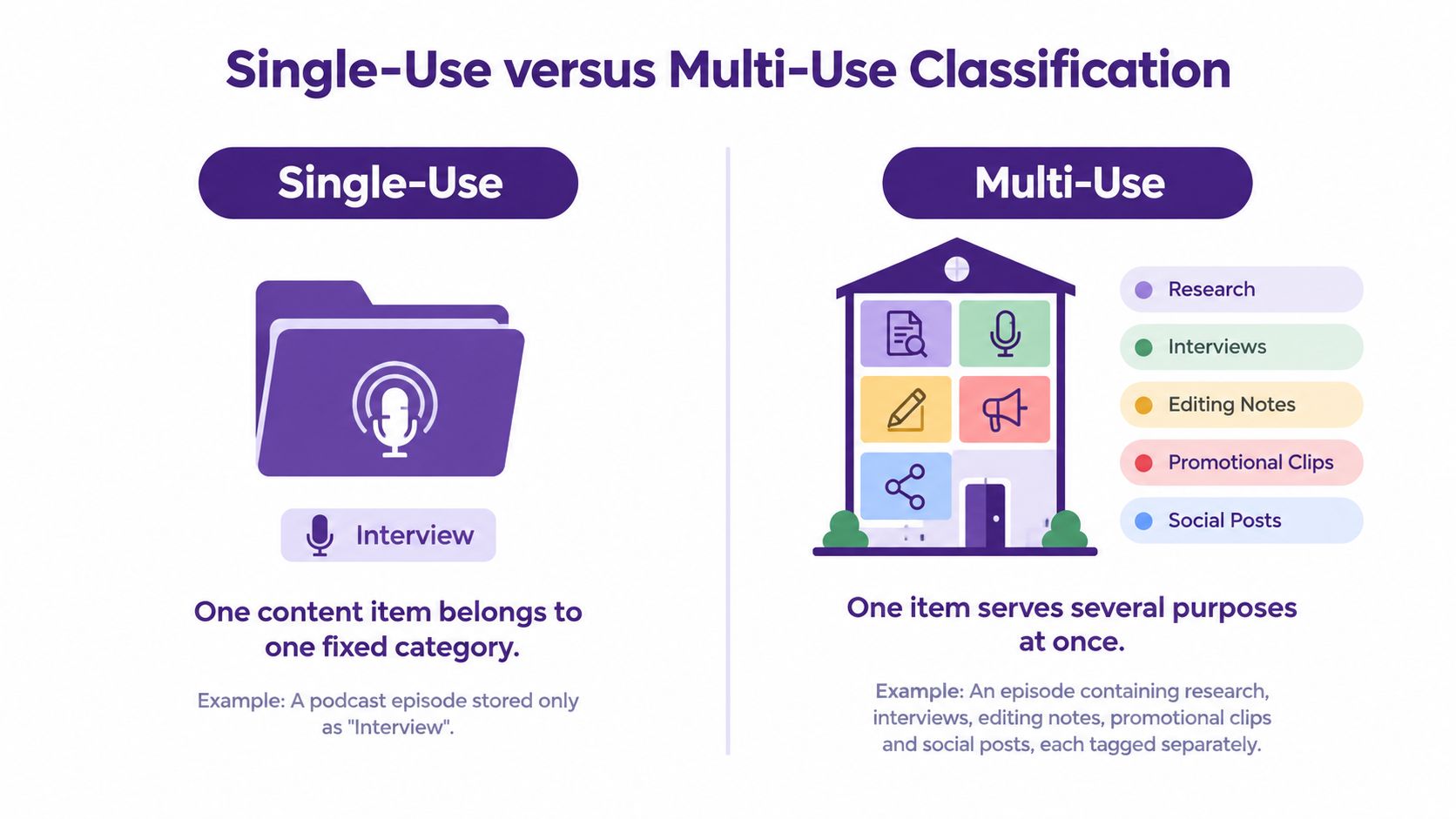
Single-Use versus Multi-Use Classification
Most content archives behave more like mixed-use buildings than single-purpose buildings. A podcast episode may contain original research, an interview, a personal story, production notes, promotional clips, and ideas for a future series. A script folder may include the main draft, revised scenes, audio references, legal notes, and distribution metadata.
Single-use classification asks one label to carry all that meaning. If the episode is stored only as “Interview,” the system may hide its research value, its audience intent, and its potential as a source for short-form content.
The International Building Code provides a useful analogy. Its 2018 framework contains 10 broad occupancy groups and 26 specific classifications, including Assembly, Business, Educational, Factory and Industrial, High Hazard, Institutional, Mercantile, Residential, Storage, and Utility. The framework allows a building to contain multiple occupancy classifications rather than forcing one designation across the entire structure. The International Code Council's building classification material explains how subdivisions address different risks, including H-1 through H-5, I-1 through I-4, and R-1 through R-4.
Apply the mixed-use lesson to content
A building's classification isn't determined only by its dominant use. Portions of a mixed-use structure can receive separate classifications, and occupant load, hazardous materials, egress, fire protection, and construction type can alter the requirements. The code's explanatory material commonly uses 50 or more people as a threshold for many assembly situations, which shows why descriptive labels alone aren't enough.
Content systems should make the same shift from dominant labels to layered evidence. Use separate facets for:
- Artifact type: the original episode, transcript, clip, article, draft, or image.
- Content role: source, evidence, narrative, quote, explanation, or derivative.
- Audience and intent: who should see it and what the asset should achieve.
- Production state: raw, edited, approved, published, or available for reuse.
Single-use classification is still useful in narrow situations. A final invoice, a legal release, or a published URL may need one primary artifact type for operational reasons. The mistake is treating that primary type as the complete description of the asset.
Practical rule: Give an asset one stable identity, then allow multiple independent facets to describe how the team can use it.
That structure supports cross-platform work. A publisher can locate research that supports a newsletter and a video. A podcaster can find every episode containing a recurring concept. A content executive can build playlists around successful themes without losing the original episode's production history.
Building Classification Types with Human-AI Collaboration
An AI system can label a large archive in minutes, yet a fast label is still wrong if it confuses a controlled class with a loose tag. Build classification types around the same structural logic used in well-organized buildings: define stable rooms for core meanings, then use flexible tags for temporary topics, campaigns, and relationships. AI can suggest the structure, but people must decide what each class means and when it applies.
A systematic review of 106 experiments found that human-AI performance varies by task. For creation tasks, the pooled human-AI synergy effect was positive, g = 0.19, but not statistically significant at the 5% level, with P = 0.180 and a 95% confidence interval from −0.09 to 0.48. Human augmentation showed a statistically significant positive effect, g = 0.65, with P < 0.001 and a 95% confidence interval from 0.52 to 0.78, while decision tasks were associated with performance losses. The systematic review of human-AI collaboration supports a practical split: let AI expand and organize material, while people retain control over selection and approval.
Give each stage a clear owner
AI can detect recurring topics in transcripts, propose candidate classes, extract entities, and suggest links between a source episode and its possible derivatives. People should decide whether a class reflects editorial meaning, whether a quote is safe to reuse, and whether the proposed audience fits. For a deeper treatment of how to split ownership between reviewers and models, see this guide to human and AI collaboration.
A creative-writing experiment found that collaboration models with meaningful human creative input produced higher content interestingness and overall quality, along with greater task-performer satisfaction, than models where people mainly confirmed AI output. The creative-writing collaboration research points to a clear operating rule: creators shape the brief, add perspective, and revise the draft. They should not function as passive approvers.
Map archive revival into explicit stages:
- Task definition: identify the audience, channel, and reason for reuse.
- Planning: choose source assets, constraints, and the intended output.
- Ideation: generate angles, hooks, episode structures, or derivative concepts.
- Content generation: create a draft, clip list, outline, or adapted version.
- Testing and finalizing: check accuracy, rights, tone, accessibility, and approval status.
A 2025 qualitative marketing study used these operational phases and found that GenAI broadened ideas, sped up routine work, and reduced cognitive load. Participants also identified limitations in emotional depth and authenticity. The University of Malta study of GenAI in marketing content creation presents AI as assistive technology that still requires oversight.
Preserve the workflow in each classification record. Store who framed the task, which sources informed the draft, what AI generated, who edited it, and who approved the final version. That history makes repurposing reproducible rather than mysterious.
Validating Classification Types Before Scale
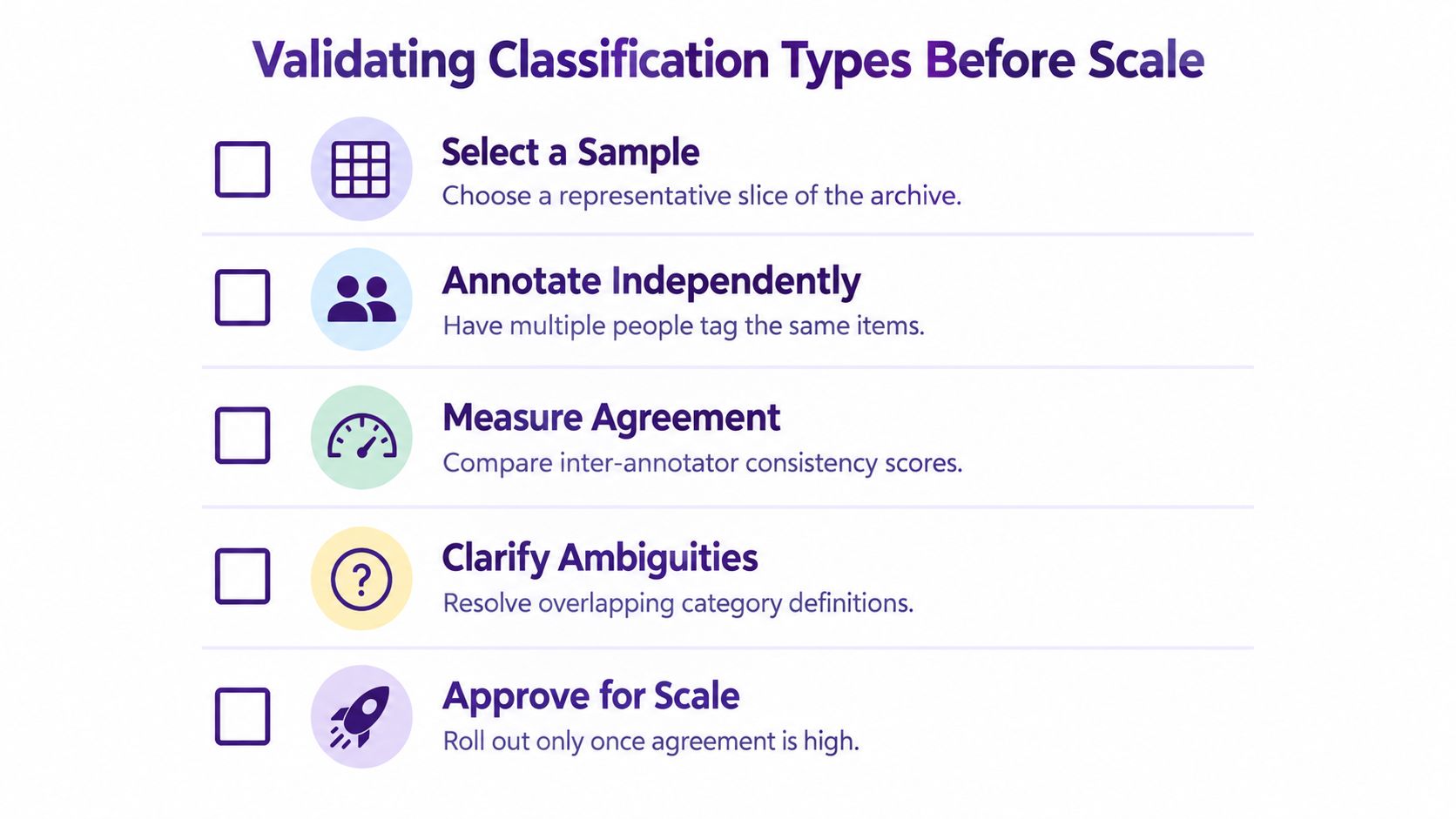
A taxonomy that looks elegant on paper can fail during real annotation. Test it on a representative sample before applying it to the full archive, and ask multiple reviewers to classify the same items independently.
Track precision, recall, and F-measure for every class, not just one overall accuracy figure. A weak class may have overlapping definitions, too few training examples, or features that don't distinguish it from a neighboring class. The building-classification research cited earlier illustrates why aggregate performance can hide these category-level problems.
Use a validation checklist
- Select a sample: Include common assets, unusual assets, old material, recent material, and items with incomplete metadata.
- Annotate independently: Ask multiple reviewers to apply the rules without seeing one another's decisions.
- Measure agreement: Compare inter-annotator consistency and inspect the disagreements rather than treating the score as the entire diagnosis.
- Clarify ambiguities: Rewrite inclusion and exclusion rules, add edge cases, and decide when uncertainty should remain visible.
- Approve for scale: Roll out the model only after the team can apply it consistently and explain its boundaries.
Borderline assets should route to expert review. A forced label may improve the appearance of completion while damaging search quality and future analytics. Preserve a provisional state or confidence note when the evidence doesn't support a final classification.
Human involvement also matters to audience trust. Research comparing authorship models found perceived human input ranked from traditional human authorship at a mean of 8.29, to AI-supported human authorship at 4.42, human-controlled AI authorship at 3.39, and AI authorship without meaningful human control at 2.11. The authorship and consumer-response research also found that human control helped prevent negative responses associated with fully automated authorship. Keep a visible human role in framing, editing, and approval, especially when old material becomes public-facing content.
Turning Classification into Content Value
A publisher with years of interviews, briefs, and videos gains value only when classification improves retrieval and reuse. Stable identifiers connect each asset to its subject, audience, format, and permitted use, so editors can find evidence and create derivatives without treating occupancy labels as fixed content categories.
The archive supports a repeatable cycle. Organize assets, understand their relationships, and take action by adapting proven material into a newsletter, episode, or article. Keep controlled vocabulary separate from flexible tags. The first protects consistency, while the second captures emerging themes. Teams extending this work into market and audience research can consult a LinkedIn content intelligence platform.
Contesimal helps creators, publishers, and content teams classify, organize, and search documents, podcasts, videos, and articles. Its human-AI collaboration supports taxonomy review and reuse, helping teams test whether their classification serves daily editorial decisions rather than merely storing files.